How Kids Benefit From Real Responsibilities

hands on responsibilities for toddlers, household chores benefit kids,

Years ago my two older kids, about seven and nine at the time, were getting ready to wash the floor. A neighbor girl knocked at the door asking to play. When my son told her he was going to wash the floor first she begged to be included. Although this girl had more monetary advantages than my children could have imagined, she was entranced. She’d never seen kids doing chores, let alone kids in charge of cleaning a floor.

She pitched right in as they scooted furniture out of the way, then swept. I gave them a bucket of slightly soapy water and they went to work with rags, scooting across the wet floor on their knees like crabs, giggling as the floor got wetter and their scooting became sloshy sliding. Their method didn’t matter to me. I was holding the baby and diverting the toddler while peeling potatoes and finishing up a work-related call. I was pretty sure the floor would be somewhat cleaner when they were done. They dried it with towels, moved the furniture back with appropriate grunting and groaning, then slumped on the couch. They looked entirely relaxed, as people do when satisfied with a job well done. When I got off the phone I came in to thank them. They were admiring how the floor caught the light and cautioning our toddler to keep his sippy cup on the table.

After that day the neighbor girl asked if she could do chores every time she came over. It seemed funny at the time, but I think now that she recognized she’d been missing the sense of accomplishment and camaraderie found in working together.

The floors aren’t spotless in my house. The bathrooms are also far from perfect. But I’m totally at peace with this. That’s because my kids handle much of the cleaning around here. I’m happy to do the cooking (or more truthfully I have control issues about what goes into the food my family eats). And I don’t mind being the family laundry wench, although I know kids are capable of handling their own laundering tasks. But in the spirit of “we’re all in this together” I’ve expected my kids to handle a sizeable share of household (and farm) work ever since they were small. I still do.

Timing

Actually, starting young is the key. When toddlers beg to help fold laundry or wash the car with us it’s easier to send them off to play so we can get the job done ourselves. But this is exactly the time to foster a child’s natural helpfulness.

It’s also a powerful way to promote positive development in all sorts of areas. Research shows that children who participate in household tasks are more likely to succeed in adulthood.

Twenty years of data analyzed by professor Marty Rossmann at the University of Minnesota found that the best predictor of success in young adulthood on measures related to education completion, meeting career goals, and maintaining good relationships with family and friends was whether they had begun doing chores in the preschool years. This association did not hold up when young people did not begin helping out around the house until the mid-teen years. Even I.Q. scores had a weaker correlation with success than giving children early responsibilities.

Forty-five years of data from the Glueck Study of inner-city males (part of the longer-running Harvard Grant Study) found that willingness and ability to work in childhood — shown by holding part-time jobs, participating in household chores, or taking part in school clubs or sports — was a stronger predictor of adult mental health than factors such as social class or family problems.

The 2019 study “Associations Between Household Chores and Childhood Self-Competency” of nearly 10,000 U.S. children entering kindergarten in 2010/2011 assessed how regularly they participated in household chores. These same children were assessed again when they reached third grade for prosocial behavior, prosocial behavior, academics, and life satisfaction. Researchers concluded, “The frequency of chores in kindergarten was positively associated with a child’s perception of social, academic, and life satisfaction competencies in the third grade, independent of sex, family income, and parent education… Compared with children who regularly performed chores, children who rarely performed chores had greater odds of scoring in the bottom quintile on self-reported prosocial, academic ability, peer relationship, and life satisfaction scores.”

A small, more recent 2022 study, “Executive functions and household chores: Does engagement in chores predict children’s cognition?” of five to thirteen-year-old children affirms that both self-care chores (such as making one’s own snack) and family-care chores (such as helping make a family meal) significantly predicted improved executive functioning including working memory, flexible thinking, problem solving, follow-through, and self-control.

We tend to spend a lot on activities and products for our children assuming this enriches their lives but if they don’t get the chance to take on real responsibilities, we’re depriving them of key components of adult competency.

Young children clamor to be included. When a preschooler begs to help prepare dinner, he doesn’t want to play with cooking toys, he wants to participate in the real work that’s taking place. It slows us down to let him cut fresh mushrooms with a butter knife (and restraint to avoid criticizing or re-cutting), but a child recognizes his contribution toward dinner. He’s also more likely to eat it.

Movement and Hands-on Experience
how movement builds bodies and brains, chores=success,

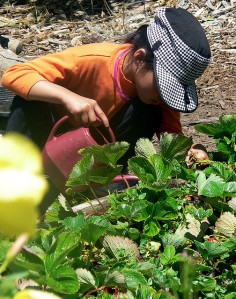
Helping out engages young children in activities that promote movement-cued development. This includes large motor activities like digging in the garden, carrying a watering can, putting away groceries, and sweeping with a broom. It also includes fine motor tasks like using a screwdriver and tearing lettuce for a salad.

Childhood is a period of major neuroplasticity, when learning actually changes the brain’s functional anatomy. Hands-on experiences are particularly vital at this time. In fact, the child who regularly engages with manipulatives (arranging veggies on a platter, setting the table, sorting socks) and applies real-world math (measuring and pouring coffee beans in the grinder, taking things apart and putting them together, following recipes) has a strong foundation of representational experience, which enables better understanding of abstract mathematical concepts when they are introduced later. These movement-based tasks are also closely linked to the brain development necessary for reading and writing. (Find out more about this in Sally Goddard Blythe’s wonderful book, The Well Balanced Child: Movement and Early Learning.)

Growing as a Person and a Family

chores build relationships,

Children accustomed to flashy toys and rapidly changing screen images may become so wired to this overstimulation that without it they’re bored. The slower pace of yard and household tasks can be an important antidote, especially when we’re willing to go at a child’s pace. Young children tend to balk when they’re hurried or left out. They show us, stubbornly and often loudly, that there’s nothing more important to them than the here and now. So whenever possible, slow down so you can make working together enjoyable. Letting a small child spread peanut butter, cut sandwiches, and pour milk into cups from a small pitcher affirms the value of the present moment. It also makes an ordinary lunch into a tea party.

The benefits don’t end for older children. Hands-on experience in all sorts of tasks and hobbies promotes learning, builds character, and helps to form the basis of our future selves. When neurologist Frank R. Wilson interviewed high achievers he found many credited their expertise to attributes learned through hands-on activities. In his book, The Hand: How Its Use Shapes the Brain, Language, and Human Culture, Wilson emphasizes that resourcefulness and self-definition arise from the use of our hands more than from the dictates of our educational system.

In a way, doing tasks together puts parent and child on more even ground. So often we parents are rushing to schlep our kids to practice or lessons or other kid-oriented events, making them the pivot around which a family’s activities revolve. Taking part in regular tasks together, even if we’re pulling weeds on opposite sides of the garden, affirms the sort of mutuality that advertisers tell us is only found in pricey vacations. Of course time afterwards for a nice game of hoops and some cold lemonade builds bonds too.

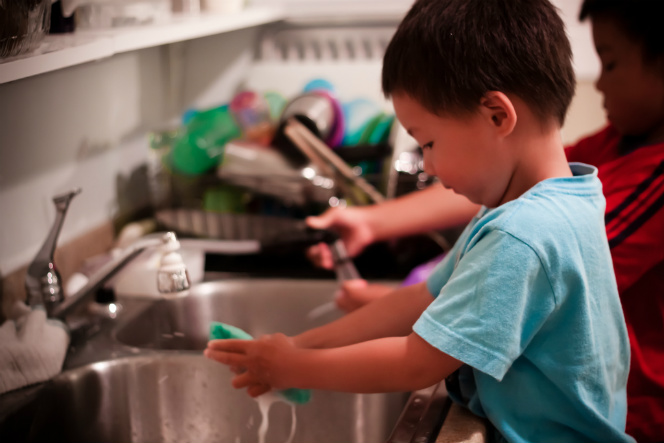
As our children grow, doing tasks together can continue to strengthen our relationships. Moments of meaningful interaction happen easily when washing dishes, folding laundry, fixing the car, or walking the dog together. Working on shared chores helps a child’s contemplative side emerge, prompting discussions that may never have happened otherwise. This is true between parent and child as well as between siblings. I remember my mother bemoaning the arrival of our dishwasher because we no longer took turns washing and drying, ending a relaxed half hour of post-dinner conversation each evening.

It’s easy to make these activities a tradition. Teenagers who have always helped out when a parent puts on snow tires, cleans out the basement for a yearly garage sale, or cans pickles may grumble when asked, but chances are they’d feel excluded if left out too. In part, who we are is defined by what we do. Growing up with hands-on lessons in taking initiative, practicing cooperation, and working towards a goal helps to shape character. And it transforms pickle-making from drudgery to an important family ritual.

Delayed Gratification
early responsibility for success in adulthood,

This is a biggie in the “you’ll thank me later” department because kids who are able to delay gratification are much more likely to do well as they grow up.

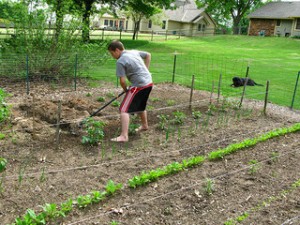
We model delayed gratification each time we choose to work for a later or larger goal. This includes saving, making do, and making it ourselves. We demonstrate it when the whole family pitches in to rake a neighbor’s leaves while she’s recovering from a broken hip. We teach it when we let a child see that if he doesn’t do the laundry when it’s his turn, there won’t be a clean team shirt to wear to the game. And we show that it’s expected every time our kids pitch in with the ordinary jobs necessary to run a household.

This may seem negative, particularly when popular culture constantly screams “have it now” and “get what you want.” But there are enormous positives. Our children become familiar with the pleasures of anticipation, which multiplies the eventual delight when a goal is reached. They also begin to internalize the ability to delay gratification.

This is pivotal for success. Multiple studies (cited in Daniel Goleman’s book Emotional Intelligence) found that children who were able to defer gratification grew into teens and young adults who were more socially competent, better able to deal with frustration, more dependable, reached higher educational attainments, and were effectively able to make and reach long-term goals. Delayed gratification is also related to impulse control. Research shows that a child’s ability to control his or her impulses at an early age is predictive of success even decades later as a healthy, financially stable, and positive member of the community.

Expecting children and teens to take an active part in running a household gives them plenty of opportunity to gain the positive coping skills that help them control their impulses and delay gratification. It may seem like returning to the old adage, work first, play later, but the benefits can be extraordinary.

Skill building

give kids real work, make chores meaningful,

Regular tasks allow our children to see for themselves how the world works. They grasp principles of science and math as a seed becomes a tree, as boards are transformed into bookshelves, as flour and yeast turn into bread. They develop traits such as patience. They are motivated to apply what they’re learning to more challenging endeavors of their own. Sure, it doesn’t hurt to know what it takes to grow the tomatoes, make the sauce, and prepare the beans for tonight’s enchiladas. But more importantly, as our children become proficient at the jobs necessary to sustain their families, they also see themselves as capable. That perception transfers across all endeavors.

There’s no denying that children who participate pick up useful skills. They see that maintenance is easier than waiting till the car or laptop breaks. They can set the table, toss a salad, make a sandwich, and boil pasta. Not right away, but eventually. While they are making real contributions to running the household they’re actively learning how to cook, launder, clean, make repairs, maintain a vehicle, budget expenses, and handle other tasks which are essential for an independent life once they’re adults. Wonderful lessons in cause and effect are reinforced when children complete work and benefit from the results. Seeing oneself as an agent of useful change, priceless.

They also learn from the examples we show them, such as how to handle pressure and ways to learn from mistakes. Whether we’re four or 40, gaining competency feels good. It doesn’t hurt to give credit where it’s due. So if your child has been busy chopping mangoes, strawberries, and pineapple into tasty chunks, try renaming the result “Sophie’s Special Fruit Salad” for extra reinforcement.

Purpose

meaningful chores for kids, finding purpose in chores, raising responsible kids, teaching delayed gratification, building impulse control,

When we stack firewood to prepare for the upcoming winter, make a gift to celebrate a friend’s good news, or change a favorite recipe to accommodate Grandpa’s diabetes, our efforts have purpose and value. As our children participate along with us, they feel the intrinsic satisfaction of doing something that has meaning.

So many educational tasks put before our children serve no purpose other than to instruct. But when learning is connected to something truly purposeful, it can’t help but kindle motivation.

From the earliest time our species lived on planet Earth, young children benefitted from the purposeful learning that comes when adults around them are engaged in practical activities — welcoming a child’s questions and eagerness to be included as entirely natural parts of growing up. It acknowledges that these essential skills are necessary for maintaining and belonging in a community.

Children feel honored to be included in real work that includes real challenges. If we pay attention, we see that’s just what they pretend to do when they play.

Beyond Chores
teaching impulse control, delaying gratification, families working together,

I’m not fond of the word “chores.” It implies that kids and adults have tasks that are set apart from the rest of our lives. Making work around the house and yard a regular part of our lives together seems more natural.

I think it’s valuable to get work done together as much as possible. For me, the simplest way to respond to grumbling has always been, “that’s just how we do it in our family,” without engaging in arguments on the topic. And of course balance is essential. Children and teens (well, all of us) need time for daydreaming, play, socializing, relaxation, projects, and all of life’s other joys.

My kids have their own chores, which they sometimes rotate. They haven’t always done them well or on time by any means. Accepting a floor as clean as a child will get it is part of having children participate. And I’m pretty laid back about things like clean bedrooms. (I remind them we try to adhere to the Firefighter Rule: Could emergency workers navigate a bedroom if necessary?) I understand that kids put less energy into tasks that don’t seem to have much importance. They recognize that a clean bedroom doesn’t affect our family’s functioning, while they know for sure that cutting and stacking firewood will keep our house warm. Hence, the firewood is done right while their rooms are often just short of scandalous.

We’ve never given them an allowance, mostly because we haven’t been able to afford it. Families have counted on children throughout history for work that was reliable and essential. Today we are fortunate that we don’t have to rely on our kids to survive, but we can expect them to contribute. The tasks may not be fun or interesting but they are necessary. They demonstrate to every child that he or she is a valuable contributor to the well-being of the family. And hearing, “Thanks, we couldn’t have done it without you,” feels good too.

I’m pretty sure growing up this way has contributed to how super responsible my kids are now in their teen and young adult years. They see a pile of boxes I need to load for our food co-op and carry them, never waiting for me to ask. They gladly stop whatever they’re doing to pitch in for an hour or all day when help is needed in the garage or barn or back yard. They are incredibly capable people who are far more astute and skilled than I’ll ever be. They can milk cows, fix tractors and cars, cut and bale hay, install plumbing, make meals, diagnose a sick chicken, hang drywall, identify spiders, back up their political opinions, weld, put on a roof, well, you get the idea. Sure, they have busy social lives and enjoy keeping their faces aimed at screens just like everyone else. But they recently spent an entire weekend helping a family member pack, move, and make repairs. They worked hard and displayed nothing but their usual good cheer. After exhausting 14 hour days I asked if they’d rather have skipped this particular task. Every one of them affirmed that it was no big deal. And I heard my words come back to me, “It’s just the way we do things in our family.”

Portions of this article were excerpted from Free Range Learning.

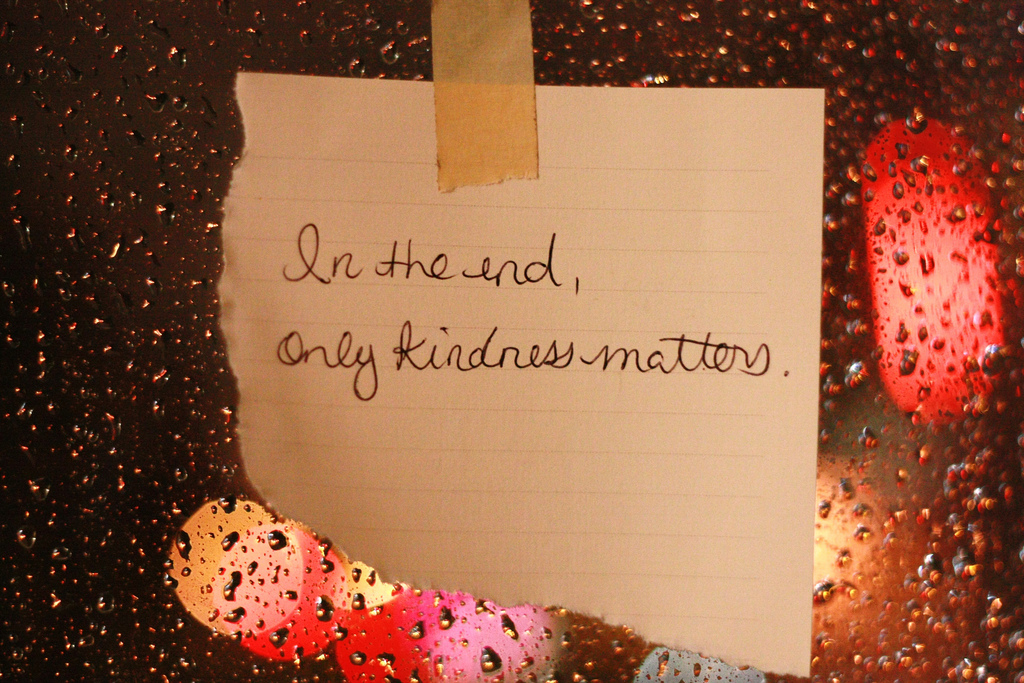
25 Ways To Spread Some Kindness

Image: SweetOnVeg’s flickr photostream

1. Take your compliments about an employee to management. Chances are you’ll never see the impact. Chances are, it’ll be greater than you imagine.

2. Give up a great parking space for the car behind you. Parking farther away simply gives you more exercise.

3. Call an elderly relative or neighbor once a week to chat. You may think you’re enriching that person’s life. They’re enriching yours too.

4. Hold the door open for the person behind you.

5. Write a thank you note. To see the powerful impact this practice can have, check out A Simple Act of Gratitude: How Learning to Say Thank You Changed My Life.

6. Write an anti-thank you. Sure, it seems counter-intuitive but it’s a way of using a  negative experience to help others.

7. Leave money in vending machines, especially in hospitals and detention centers.

8. Leave a positive review for a local business on Merchant Circle, ThinkLocal, or Yelp. And don’t forget writers. Leave stars on sites such as Goodreads and Amazon, recommend books you’ve enjoyed to friends, maybe give a shout-out on social media to authors whose work impacted you.

9. Listen. You know how it feels when someone really listens to you. They look into your eyes, they react to your words, and you feel understood. Check your listening skills against the Scale of Attuned Responses.

10. Meet your needs and those in your community, maybe with other new parents or people in your neighborhood, by collaborating. Check Shareable for all sorts of guides. These include How to Create a Walking School Bus in Your Neighborhood, How To Host a MamaBake Food Swap Session, How to Share an Education, How to Plant a Habitat Garden at the Local Playground, How to Build a Better Neighborhood, and How to Set Up a Neighborhood Exchange Box in 4 Easy Steps.

11. Give genuine compliments. You might want to challenge yourself to give compliments to five people a day. It keeps you on the lookout for truth and beauty. Tell a clerk she has a lovely voice, a child that his smile made your day, a loved one that their eyes are beautiful.

12. That kid who keeps hanging around, looking as you grill dinner or wanting to talk while you wash the car? He may be longing for encouragement. Even a few kind words may be the kind of mentoring he needs.

13. Help budding entrepreners through Kickstarter or Indiegogo. Make your money go farther by lending to a Kiva project.

14. Greet new people on your street with a small gift such as a houseplant or plate of cookies. The neighbors you’ve never met? Try online resources to connect such as NextDoor or front porch forum.

15. Give gifts that do some good.

16. See an act of aggression? Get involved even if it seems like none of your business. That’s a kindness too.

17. Set books free. Donate them to a good cause (a nearby school, your library’s book sale?) or leave them ala Book Crossing to find new readers.

18. Donate pet food to the nearest animal shelter. While you’re there, offer to walk a few dogs.

19. Patronize kids’ car washes and lemonade stands.

20. Be aware of newcomers to your workplace, school, house of worship, or other organization. Make a point of greeting them and introducing them to others.

21. Keep duplicates of your child’s toys and books in the diaper bag. When you encounter fussy children, offer an extra to their parents.

22. Smile. Find out 10 ways this face stretcher benefits you as well as those on the receiving end.

23. Donate blood. One pint of blood can save up to three lives.  

24. Designate a tiny container as your family’s Pass It Forward box. Tuck it somewhere one member of the family will find it (under the bed pillow works) with a little surprise inside (a loving note, a handmade coupon for an unexpected perk, some chocolates, a drawing, a map of a place you’re going that day, a compliment). That person is expected to put something else in the box and leave it for another family member, so kindness can circle around and around.

25. Set a good example, be kind to yourself.

Life Lists

life lists, journaling, paying attention,

What do you want to remember?

The most avid bird watchers keep Life Lists, tracking the first time they sight a bird. They write down information like order, genus, and species. Usually they note much more. Things like date and place the bird was spotted. The more detail, the more a birder’s Life List becomes something greater than a factual log of avian sightings. Years later the pages can return that person to an afternoon standing in the dappled sunlight of a New England forest when a blue, orange, and yellow flash heralded the arrival of a Painted Bunting. It can evoke a remarkable trip to Mexico where along a riverbank three distinctive wavery notes of a Great Tinamou were heard, and all the rest of that day bird after bird was sighted until darkness arrived. It can bring back time spent with dear friends in whispered conversation waiting hours for a glimpse of a single Black-Capped Vireo.

I’m no birder. I appreciate but know next to nothing about our feathery friends. But I am intrigued by the Life List concept. Life Lists keep birders motivated. The lists also alert them to a wavelength most of us ignore. A wavelength sensitive to birdsong, flight, and the faint hush of a wings on a nearby branch. Keeping track of any one thing is entirely unnecessary but such lists cue us to a chosen frequency.

What do you want to notice and cultivate in your life? Here are some possible Life Lists to consider.

Books That Made A Difference   I’ve often thought of books that changed my worldview or opened doors inside me with their insights. Do I remember the titles and authors? Only sometimes. I truly believe there are pivotal books that make us who we are. I started such a list years ago but let it lapse.

If you keep such a list, add more than title and author. Include a quote or two, some quibbles you have with the text, questions you’d like to ask the author, why this book came at the right time for you, where you were when you read it, what it means to you. Many people are keeping their book lists on GoodReads and Library Thing.

Wildlife Seen  Like a hugely expanded birder’s list, this could be open to all species or your own particular fascination, perhaps spiders (that would keep you busy with something like 38,000 species). And like a birder’s list, you could note species, location, description, your impressions, and much more.

Trips Taken  My mother made an effort to write about the long summer trips my family took, filling spiral notebooks with destinations and mileage and her impressions. I cherish them now, even if those trips left me with the wrong kind of lust.

If you keep such a list, fill it with photos and memorabilia. Make notes about your expectations and how they were fulfilled, about sights and sounds and tastes, about conversations and funny moments.

Favorite Movies (or Movies Seen)  This can be remarkably helpful if, like me, you find yourself starting to watch a movie that sounds good only to realize you’ve seen it. A list of movies seen, with details about favorites, is something I marginally keep up on Netflix just to keep myself from re-watching something I didn’t enjoy in the first place. I have friends who attend yearly film festivals, keeping extensive notes that they share with non-festival goers like me when those movies are released. Again, the more details the better. Write down who you were with when you saw the movie, where you saw it, snippets of meme-worthy dialogue, your favorite scene, actors you predict will go places, and your review.

People Who Have Influenced You  So many people flit in and out of our lives. Sometimes we don’t realize their impact until years later when we see they served as role models (like the woman I met during my brief espionage career) or anti-role models (a surprisingly important motivator). This is one of the few lists that can be made retroactively. Think of neighbors, friends, classmates as well as public figures. Note what they did and said along with behaviors that contributed to that influence. Once you start writing these observations down you may be more attuned to daily influences of people in your life, from the spirit-lifting cheer of a clerk to the resolutely calm example of a friend in trouble.

Dream List  Sure, you could write a bucket list and cross off each experience. But I’m talking about keeping a list of dreams you remember. I’ve written down only my most memorable and startling dreams for years, usually the ones that refuse to leave my mind. There are potent messages in dreams, coming to us from deep places where wisdom waits to inform us. If you want to more fully remember your dreams, try this. Before falling asleep, remind yourself to remember and understand your dreams. As you waken, pull the threads of your dreams into your conscious awareness. Whenever possible, write them down. It helps to take the images in the dream (ladder, teacher, highway, blue car) and note what each means to you. Look back at your dream list every now and then, you may find themes unspooling into new awareness.

Paths Hiked  There’s something about coming upon new vistas along the trail that prompt reflection. Those musings might be interesting to record along with hike data like location, distance traveled, terrain, weather, and date. Note who you hiked with and maybe what you talked about or laughed over. Include photos. Some folks contribute their photos and thoughts on Tumblr sites or blogs.

Words That Cut To The Center   This is a list I’ve kept on and off since I was a teenager. I find a quote or poem that distills meaning to the essence and write it in a journal (or now, on a Word doc). I’ve lost several of these lists, only to find them years later and catch a glimpse of what occupied my heart during those times. I’ve also found such lists remarkably useful, perfect when I want to share a poem or quote with a friend.

Gratitude List    This is a popular one, even recommended by mental health experts. I’ve learned it’s possible to look past what we label “good” and “bad” to appreciate mistakes, doubt, and crisis. I’m sure a gratitude list filled with sweetness and light can lift a mood. But I suspect a gratitude list more fully fleshed out might lift our spirits into a realm of blessed understanding.

Belly Laughs, Inside Jokes, Made-Up Words  Laughter is good for us, but we rarely remember what caused us to laugh ourselves into tears. I wish I’d started a list years ago with just a few notes about who, where, and particularly what we found so funny. I suspect I’d laugh all over again.

I’d also love a list of all the inside jokes and words unique to my family and friends. Some trigger us to laugh, some promote a feeling of solidarity because they remind us of shared experiences. How easily we forget.

Here’s one my family still uses, “You no see big thing like train?”  A friend drove a truck for a business started by an immigrant whose English wasn’t easy to understand. The business made money in part because of the owner’s extreme frugality, he barely even maintained the truck. One day the friend was making a delivery when the truck’s brakes failed. Unfortunately they failed as he was approaching railroad tracks where a train was stopped. It was a large truck and much as he tried, he only managed to slow down. He crashed into the train. He was fine, the truck was not. He called his boss to explain. The boss yelled, “What, you no see big thing like train?” This line has proven itself handy in many circumstances, thankfully none involving real trains or failed brakes.

Tastings  Savoring the good things is a tasty reason to start a list.  Consider wines, beer, cheeses, chocolate, or heck, start a list of Chomping Something From Every Street Cart I Can Find. Take notes on subtle flavors, good pairings, and circumstances such as where you were and who you were with. Highlight the very best. Hmmm, I like that street cart idea…

Perfect Moments   We live in a happiness-chasing culture, perhaps because advertisers tell us in every possible way that it’s easily purchased. But if we pay attention we find that perfect moments happen all by themselves. It’s a father rocking a baby to sleep, a calf taking first tottering steps in a pasture, a turn on the dance floor made of movement and beat and sheer exuberance.  These moments aren’t easily remembered. They enlarge our lives only briefly before drifting into fragments of memory. Taking time to sketch a perfect moment is an unexpectedly rich way to capture it (try these drawing hacks for non-artists). You might also draw a mind map or write a poem. Who said lists have to be list-like?

Juncture List  You know those junctures when a decision is made that shifts the course of your life. Sometimes we realize something big is about to happen: picking which college to attend or starting a job or ending a relationship.  Sometimes the choices seem minor at the time, like not answering the phone or telling a white lie or ignoring a symptom. This is another list that is more easily written while looking back. It may not seem valuable to parse out where things changed, but it helps us see larger patterns, feel synchronicity’s strange power, and appreciate the mysterious paths we’ve taken to arrive at this moment.

It's about paying attention.

Raising Aspiring Emigrants

Kids are their own people. Any of us can see this is an underlying theme in drama (in books, on the screen, and in real life dramas).  It’s obvious from a quick look at how much our friends differ from their own parents. Years ago I joked that my anti-establishment neighbor’s son might just grow up to be a conservative stockbroker and that my frantically risk-averse friend could end up with a thrill-seeking daughter. I learned pretty quickly such jokes are not appreciated.

But I thought I understood that kids go their own way reasonably well. I’ve managed to celebrate the unique passions my own kids pursue, even though their interests are nothing like mine. I’m glad to see that we’re largely in sync on bigger issues. My kids and I tend to agree on politics and religion, we share a disinterest in most sports, and we’re all somewhat introverted. What we don’t share? A desire to stay close to our roots, geographically speaking. I’ve tried to raise them to be global citizens. Is it possible to take that too far? I’ve always lived close to my hometown and extended family. One or two of my four kids may not have that gene.

One of my sons is entranced by Finland. I think it started while chatting with online Finnish friends. Hankering to drive, he told me that kids in Finland are encouraged to get driving experience starting at a very young age and given training to handle slippery and hazardous road conditions (ice + moose, for example). The licensing requirements are some of the strictest in the world, he explained, a pointed contrast to the jerk on the road in front of us at the time who was cutting off cars and weaving across lanes.

My son also has a thing for Finnish music, starting with the now iconic band Apocalyptica formed by classically trained cellists.

Finnish musicians offer plenty of diversity, including partially submerged folk singers

and dancing puffballs.

And he is inspired by the Finnish spirit. He sees it in their traditions and history (I never thought I’d hear so much about the Winter War). Finnish character is said to have a lot to do with the term sisu. This doesn’t translate easily. It’s related to inner will and the determination to persist despite the odds. This spirit, as my son sees it, also has to do with the Finnish way of doing things. That includes summer competitions that Finns call “world championships” in swamp soccer, mobile phone throwing, and wife carrying. Or a recent proposal in Parliament to extend the annual four-week paid holiday by another week, for a “love holiday.”

Browsing around the web, I can see the allure. The country has stunning beauty and cultural richness. Newsweek ranked Finland the world’s best country in 2010 based on high life expectancy, high literacy rates, minimal income gap, excellent access to health care, and a good work-leisure balance. In The Geography of Bliss: One Grump’s Search for the Happiest Places in the World it was noted that people in Finland are remarkably content. Of course we’ve all heard about Finland’s world-class school system. Their educational approach says quite a bit about the country. Schools there don’t rely on standardized tests or a heavy homework load but instead emphasize balance, giving kids plenty of time for outdoor play, art, and music. That seems to reflect a general emphasis on living at a slower pace and enjoying life’s simpler pleasures. I may have to adjust to having one of my beloved offspring emigrate some day. (sob)

But another of my kids is talking up New Zealand. Land of fascinating spider species, amazing diversity, and gorgeous vistas.

Also home to the compelling Haka, traditional ancestral war cry of the Maori people, now performed by the All Blacks, NZ’s rugby team, before their matches.

Serves me right for joking about other people’s children. Come to think of it, my attempts at humor weren’t all that far off. My anti-establishment neighbor’s son is now in college getting a degree in business, hoping to work in investment banking. The daughter of my risk-averse friend is into barefoot climbing.

Guess I’d better make sure my passport is in order.

Batik Party: Color To Last A Lifetime

how to batik, backyard batik, ironing memories,

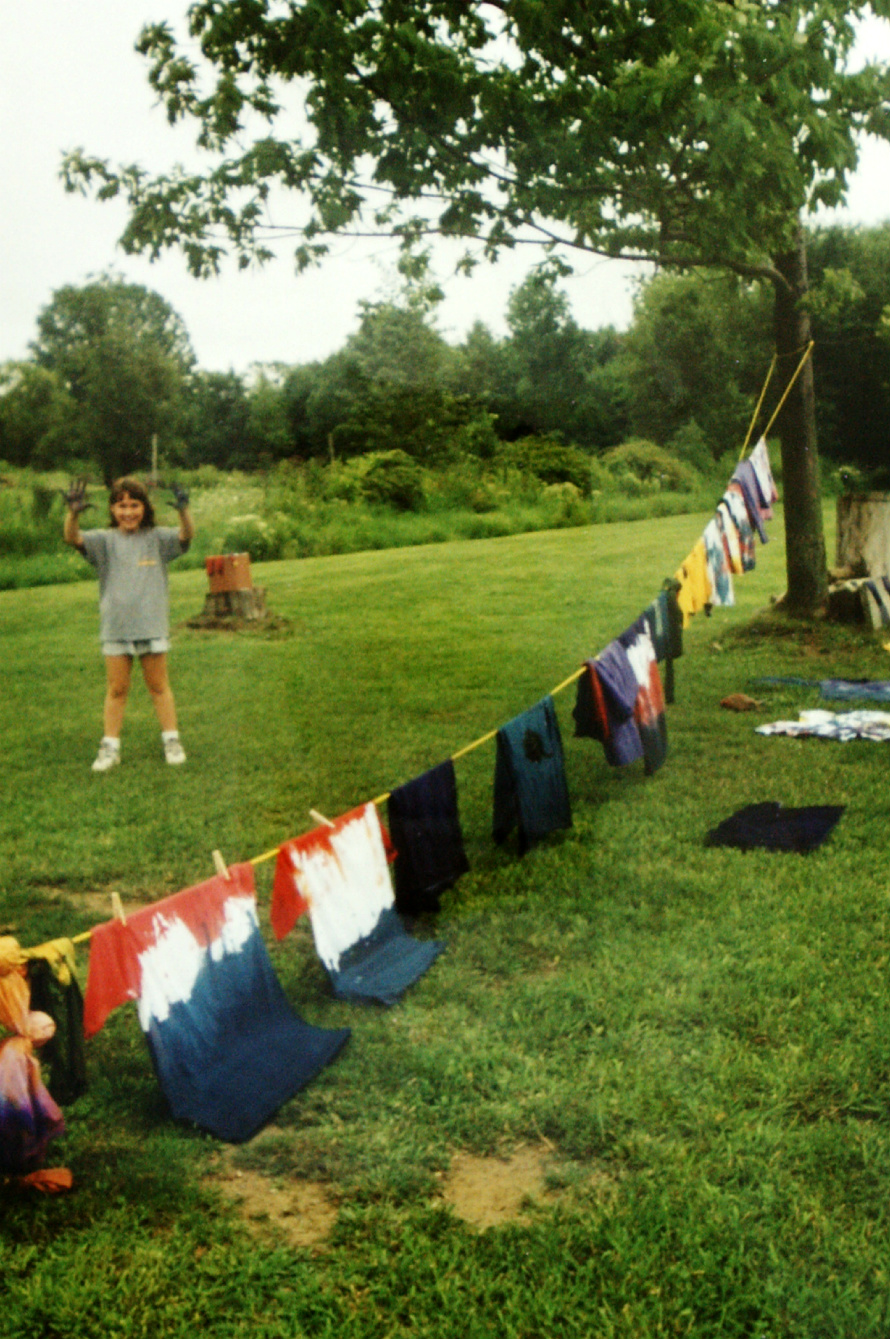
The grass is spread with dyed shirts drying in the sun. It seems fuchsia, cobalt blue, and orange are the favored colors of our backyard batik party.

We approach this ancient art using shortcuts that would make a purist shriek. First we peel faded paper from old crayons, revealing the richer hues underneath. The crayons are melted in tin cans bubbling in a big pot of water on our camp stove. Then grandmothers, mothers, and children together, we crowd around picnic tables and paint the gooey wax onto cotton shirts, pillowcases, and tote bags. Some of us splash abstract designs, others draw intricate pictures. Eager conversations quiet as artists concentrate on their work.

Next we dunk them into pails of dye—gumdrop yellow, indigo, rose, pale green or sky blue. Children set their projects out on the grass to dry in the sun, then run off to play. To complete the process the wax has to be melted out of the fabric, ironed over and over on newspaper until no more will seep out under the press of a hot iron. Nothing of the crayons will remain but color locked into the fibers, wax resisting dye.

I drag my wooden ironing board out of the dark closet and pull it into the bright yard. My sister gave it to me as a humorous wedding shower gift but my mother’s friends in attendance thought it refreshingly practical. I’ve only used for the odd art project. The rickety wooden legs have to be forced into warped slots which hold them in place. The children come from catching frogs in the creek, from roasting marshmallows over the fire, from all over our property just to watch their mamas stand over the ironing board.  “Can I try?” and “Wow” is the standard kid response. Cautioning them to hold their fingers only on the handle and to keep the iron moving we let them work the wax out of the batik designs. Recognizing the possibility of danger they are entranced, as if we’ve let them use power tools.

They wait impatiently for their turns while the seven of us women sit at the picnic table eating hummus, Greek salad, and chocolate cake. We talk of how far we’ve come from our own mothers’ ironing boards here in the slow-to-evolve Midwest. Christie describes her mother as a “laundry fascist” who did her wash on Monday and ironing on Tuesday, regarding stains with the same disgust as sins.  Holding to such an immutable schedule of laundering was what her mother believed “good women” did. The moral character of others could be determined in part by the cleanliness of their clothes, making the world a more easily understood place. Christie’s mother still gives advice on stain removal, valuable irony-tinged information for those of us trying to live simply.

Debra remembers looking for a summer job in back when classifieds in her hometown paper were displayed in separate columns: Men Wanted, Women Wanted.  As a high school sophomore she had difficulty deciphering descriptions like “Gal Friday” and “sturdy middle-aged woman.” She avoided waitress jobs, not only because of the potential pats on the rear but to spare herself the necessity of ironing a uniform each day.

I volunteer memories of downtown shopping trips each summer. My mother put me in a crisply ironed dress and tied matching ribbons at the bottom of my braids. My grandmother never left the house unless impeccably clad. She sewed her own lined suits, wore stockings and girdle every day, and carried dress gloves in her purse no matter the season. I recall waiting as they shopped at iconic Cleveland department stores Halles and Higbees, then they took me and my sister to the tea room. A trip to the ladies lounge followed.  I remember hopping up to the toilet, admiring my shiny shoes as my feet swung off the floor.  But I was afraid to unlatch the door because frightening noises often came from other stalls in that fancy pink restroom. Ladies who moments ago were delicately patting their lipsticked mouths with heavy cloth napkins were now making groaning noises.  I knew full well at the age of four that ladies did not make such noises, particularly in public.  Something bad had to be happening.  I pictured them transformed into monsters.  When I finally left the stall and made my way to the line of sinks I watched in the mirror as other doors opened.  Demure ladies stepped out as if they’d made no such sounds. Only years later did I realize that these women were struggling with heavy girdles which cut into their summer-weary flesh.

We laugh at domestic memories as our children finish the exotic task of ironing. When we look up from our reverie they have started a game of hide and seek. Their voices sound distant in the gathering darkness. Their small shirts are now bobbing from wire hangers along the porch. One by one we iron our own shirts as the sun goes down. The smell of crayons hangs in the evening, imprinting memories to last a lifetime.

I think our next art party will involve candy cigarettes and paint flinging, ala Jackson Pollack.

easy batik, iron in some memories,

How To Host A Batik Party

This process isn’t “real” batik. It’s an approximation that’s fun and basic. It’s also time consuming, messy, requires close attention when wax is near heat, and can stain anything from driveways to flesh. That’s why you should make it into a gathering of friends who will share the effort and joy. And why you should do it over grass as much as possible.

Supplies

  • lots of newspaper
  • old crayons with paper removed, sorted by color
  • chunks of paraffin
  • empty cans (16 oz or larger food cans), paper wrappers and tops removed
  • large disposable roasting pan
  • thick and thin paintbrushes you’re willing to throw out afterwards
  • old camp stove or electric skillet you’ve willing to have wax spilled on
  • fire extinguisher
  • metal sheeting for safety (we found a piece in the garbage)
  • tarp
  • ironing board
  • picnic table and/or sturdy tables to work on
  • clothesline
  • clothes iron (it too may get waxy)
  • clothing dye (can use Rit Dye or order more professional dyes from Dharma Trading)
  • large buckets for dye (you can often get them free from store bakeries and delis, food is delivered in them)

Method

Ask everyone to wear old clothes, hair tied up where applicable, and to bring food and drinks to share. They also must bring items to batik. That might be t-shirts, tote bags, curtains, pillowcases, skirts, ties, etc. The best are all-natural fabrics such as cotton, hemp, silk. If it’s a blend, a high natural content is preferable.

Preparation: Mix dyes in buckets. Most dyes need hot water to dissolve. Some need other ingredients so make sure you’ve checked in advance. You’ll want at three to five separate dye colors. If kids are involved, you may not want too many conflicting colors. Repeated dips will leave them with brown or grays. (Educational but possibly not what they intended.) Leave the buckets out in the yard as dye stations.

Spread the tarp over the picnic table and/or work area. Put the metal sheeting down where the camp stove/electric skillet will sit.

Step One: Put different colors of crayons in the empty cans. Add a few slivers of paraffin to each can. You also want a can with only paraffin for clear resist areas. Put the cans in the roasting pan. Fill the pan with several inches of water, about a third of the way up. Keep a pitcher of water nearby to keep filling as water evaporates. You do not want to spill water in the wax.  Heat gently to melt the crayons and paraffin. Once it’s liquified turn the heat off and it will remain liquid quite a while.

Caution. SUPERVISE CHILDREN, hot wax burns. NEVER leave wax over heat unattended. NEVER put out a wax fire with water, which spreads it. Instead it must be smothered (fire extinguisher or fireproof lid over it, we kept an old grill lid handy).

Step Two: It’s time to paint designs or pictures on fabric. Just dip brushes in melted wax. Make sure you return the right brushes to the right container. Use clear paraffin in areas where you want the fabric color to show within or around your design.

Step Three: Dip all or select portions of your fabric into dye of choice.

Step Four: Hang on clothesline. Do another fabric item or simply wait for your item to dry.

Step Five: Put several sheets of newspaper under and several over a single layer of your dry fabric. Iron to melt the wax out of the fabric. You’ll need to replace the newspaper sheets several times until wax no longer melts from the fabric.

Without (or Beyond) College: 24 Tools For Success

resources to skip college, careers with no college, collaborative success,

Free to explore options. Image: iateyourbubbles.deviantart.com

What doesn’t add up

It’s easier to teach an old dog new tricks than it is to change old mindsets. Like the one that insists that all the years up to 18 are preparation for college. After that a bachelor’s degree or higher must be obtained because college is THE ONLY route to success.

This dusty way of thinking relies on old figures showing that college leads to high-earning careers. That’s true for people who become doctors, engineers, and lawyers. Oh wait, that’s not so true for lawyers now either. New law school grads can’t find jobs  and their average student debt hovers close to $100, 000.

Equating college with success doesn’t take today’s realities into account. In thirty years the consumer price index has increased two-and-a-half times while the overall price to attend college has risen sixfold.  Today’s students can’t simply work their way through college. This was possible back in 1970.  A student could easily work 14 hours a week at a minimum wage job to pay for an education at a public institution. Today a student would have to work full time at minimum wage, leaving very little time to fit in those classes.

So students go into debt. The average graduate gets a diploma along with more than $25,000 in debt. Payments are expected to begin right after graduation or the student will begin accumulating additional interest as well as penalties and damaged credit. The pressure is on to find a job.

Except the job market sucks. While a greater share of 18- to 24-year-olds are in school than ever before, the employment rate is worse. Half of today’s young college graduates are either jobless or underemployed in positions that don’t require a degree. Since the 2008 recession, the largest job growth has been in the lowest paying jobs. Some of the biggest projected employment openings are in low paying, lower-skilled positions such as home health, waste hauling, and transportation.  The problem isn’t just in the U.S. Twenty-five percent of young people are unemployed in the Middle East and North Africa, more than 50 percent in Greece and Spain.

What does add up

In the real world, grades and tests actually don’t correlate with adult accomplishments.  We know there are fresher, more interesting ways to learn. Our experiences teach us to pursue success on our own terms. That has to do with crafting a life based on our passions, our integrity, and the unique vision each of us brings to the world. That’s true whether we’re lifting a hoe or a conductor’s baton.

The college highway is actually one of many roads to the future. People everywhere are finding ingenious and collaborative ways to flourish, with or without a degree. Here are some of those ways.

&&&&&&&&&&&&&&&&&&&&&&&&&&&&&&&&&&&&&&&&&&&&&&&&&&&&&&&&&&

Learning Empowerment Tools

1. ZeroTuitionCollege (ZTC)  is an online community of self-directed learners. If that’s not inspiration enough, it offers information for travel, building a portfolio, finding a peer community and much more. ZTC was founded by Blake Boles, author of Better Than College: How to Build a Successful Life Without a Four-Year Degree, a manual with thought-provoking and empowering information on each page.

2. It’s My Life: A Guide To Alternatives After High School is a free e-book put out by the American Friends Service Committee. It includes a rich array of information about apprenticeships, service work, travel learning, and careers both inside and out of the mainstream.

3. UnCollege is packed with information and advice, like “How To Learn Anything” (complete with downloadable sheets to write your own personal learning plan). UnCollege was started by Dale J. Stephens, whose book Hacking Your Education will be published next year.

4. Intern Match helps you locate paid and unpaid internships in your area of interest.

5. BackDoorJobs connects you with short-term job adventures around the world.

6. Volunteer Match helps you get experience doing what you care about.

7. Idealist lists all sorts of internships, volunteer opportunities, and jobs.

&&&&

Learning Exchanges

8. Trade School is a barter-based learning space, meaning you don’t have to pay to learn.

9. Citizen Circles are small groups of people who meet to learn together, with an emphasis on collective learning and action. No fee.

10. (un)classes are casual ways to meet and learn from people in your area.

11. Skillshare is like the eBay of local education. You can learn what you want from someone in your community as well as teach others what you know. Fee. 

12. P2PU is a grassroots global community working together to learn by completing tasks and providing feedback. Free.

13. FreeSkool is whatever participants create. Some are informal gatherings to share knowledge, others are networks brimming with activity happening in parks, living rooms, and community centers in IthacaSanta Cruz, and dozens of other cities in the U.S., Canada, and the U.K. Check out piece in Shareable about how to set up a FreeSkool

&&&&

Collaborative Solutions

14. Share or Die: Voices of the Get Lost Generation in the Age of Crisis is co-written by 20-somethings who are developing collaborative consumption networks and connecting via “lattice” rather than scrambling over each other to climb the corporate ladder. Get this book for free by “paying” with a tweet.

15. Generation Waking Up empowers young people to connect and create a thriving, sustainable world.

16. The Sharing Solution: How to Save Money, Simplify Your Life & Build Community This book helps people find practical and legal solutions for scaling down their work hours, possessions, and expenses by sharing everything from childcare to cars to living space.

&&&&

Free and Nearly Free College Online

17. Coursera pairs with top universities to offer full courses to a global network of students.

18. Khan Academy has a free and ever growing library of 3,200 videos in the sciences to humanities, along with exercises to help learners practice what they are seeing.

19. University of the People is oriented toward awarding degrees to students all over the world, using online courses and charging only an admission fee. It has accepted 1,500 students from 130 countries

20. Academic Earth offers free online classes using video lectures from leading university professors. It’s possible to sign up to earn an online degree, fee unknown.

&&&&

Guides

21.  Better Than College: How to Build a Successful Life Without a Four-Year Degree by Blake Boles

22. Hacking Your Education: Ditch the Lectures, Save Tens of Thousands, and Learn More Than Your Peers Ever Will by
Dale Stephens


23. 40 Alternatives to College by James Altucher

24. DIY U: Edupunks, Edupreneurs, and the Coming Transformation of Higher Education by Anya Kamenetz

The Future Belongs to the Curious from Skillshare on Vimeo.

Mother & Child Are Linked At The Cellular Level

fetal cells heal mother, life long benefits of pregnancy, baby's cells help mother,

Fetal cells remain to heal a mother throughout her life. shortgreenpigg.deviantart.com

Today is my youngest child’s birthday. As my mother used to tell me, we always carry our children in our hearts. I know this is true emotionally. Apparently it’s also true on the physical level.

Sometimes science is filled with transcendent meaning more beautiful than any poem. To me, this new research shows the poetry packed in the people all around us.

It’s now known that cells from a developing fetus cross the placenta, allowing the baby’s DNA to become part of the mother’s body.  These fetal cells persist in a woman’s body into her old age. (If she has been pregnant with a male child it’s likely she’ll have some Y-chromosomes drifting around for a few decades too). This is true even if the baby she carried didn’t live to be born. The cells of that child stay with her, resonating in ways that mothers have known intuitively throughout time.

Fetal cells you contributed to your own mother may be found in her blood, bone marrow, skin, kidney, and liver. These fetal cells appear to “treat” her when she is ill or injured.   Researchers have noticed the presence of these cells in women diagnosed with illnesses such as thyroid disease and hepatitis C. In one case, a woman stopped treatment against medical advice. A liver biopsy showed “thousands of male cells” determined to be from a pregnancy terminated nearly 20 years earlier. These cells helped her body recover just as fetal cells you gave your mother rush to help repair her from within when she’s unwell.

Fetal cells may influence a woman’s autoimmunity, although it’s not yet known if they are always beneficial. According to fascinating accounts in Do Chocolate Lovers Have Sweeter Babies?: The Surprising Science of Pregnancy, the more fetal cells there are in a woman’s body, the less likely she is to have conditions such as multiple sclerosis and rheumatoid arthritis. That’s not always the case. It’s thought that sometimes a mother’s body may instead battle those cells, thus provoking autoimmune disorders. (Apparently family dynamics are complicated even at the cellular level.)
There’s evidence that fetal cells provide some protection against certain cancers. For example, they’re much more prevalent in the breast tissue of healthy women than in those with breast cancer. Fetal cells are less common in women who developed Alzheimer’s disease, suggesting they provide late-life protection. Fetal cells can contribute stem cells, generate new neurons in the mother’s brain, even help to heal her heart. Her heart!

Look around at your family. Any woman who has ever been pregnant, even if she miscarried so early she never knew she was with child, is likely to be a microchimera (a person who carries the cells of another person).  Fetal cells have the imprint of her child’s father and his ancestry. Fetal cells can be shared from one pregnancy to another, meaning the cells of older siblings may float within younger siblings. These cells are another reminder of the ways we are connected in a holographic universe.

Overall, the presence of fetal cells in a woman’s body is associated with substantially improved longevity, with an overall mortality rate 60 percent lower than women whose bodies don’t contain such cells.

I’d like to think that my fetal cells helped my mother battle the congestive heart failure that eventually took her life. I like to consider that I carry within me my older sister’s fierce intelligence and that my talented younger brother benefits in some way from the cells of both his sisters. Knowing that I carry the cells of my four living children as well as babies I lost makes my heart ever more full on this special day.

We heal our mothers and our children heal us. Again poetry takes a back seat to nature’s awesome secrets.

The Antidote Is Awe

cure for stress, coffee ritual, easing worry, finding peace,

My husband and I seek refuge on the porch each afternoon in a ritual known simply as “time for coffee.” Somehow just out the door we’re a step away from the pull of obligations and worries. Here we feel centered by the light through the trees or the sounds of birds or the strange lumbering grace of a bumblebee in the flowers.

Our lives, and yours too, are twisted into knots so complicated we can’t see where they start or end. Those complications are made of bills to be paid, old arguments that didn’t heal, long hours and too little sleep, by endless political bluster and the fallout it causes. It’s good to let go of those tangles, even for a while.

Today on the porch we watched an insect we’d never seen before. It skittered without visible wings, its body open like the spokes on a wheel or the arms of a star. It looked improbable as an undersea creature swimming in the air. We gaped in quiet wonder until it was out of sight.

A few moments of awe are all it takes to remind us that our lives aren’t about those knots. We are pulsing, breathing wonders ourselves in a world bursting with miracles.  It takes looking closely at only one thing to see those miracles, whether watching a spider spin her web or looking at fungi that seemed to spring up overnight.  We exist for so short a time on this beautiful planet. We clamor over concerns when our lives may be better measured by how much awe we allow ourselves.

I have things to do, but it’s time for coffee. I’m heading for the porch. Hope you do the same.

We are, perhaps, uniquely among the earth’s creatures, the worrying animal. We worry away our lives, fearing the future, discontent with the present, unable to take in the idea of dying, unable to sit still.   Lewis Thomas 

Reprint from my farm site Bit of Earth Farm

Who We Are In A Crisis

how people act in disaster, survivor, true survivor behavior,

Versions of Survivor are watched all over the world. Forty-five countries have pitted contestants against the odds and shows are still filmed in Denmark, Croatia, Italy, Norway, Serbia, France, India, Israel, Spain, Sweden, Turkey, and the U.S. These series drop people in inhospitable places with minimal resources and ask them to cope successfully with unexpected challenges. It’s called “reality” television, although people in the real world face harder challenges every day.

Survivor shows have to be carefully structured with authoritarian rules and imposed competition. Otherwise contestants might resort to a very natural state. Not Lord of the Flies levels of cruelty and exclusion. No, something far worse for ratings. Cooperation.

In our non-reality TV lives we don’t live as separate entities battling for limited resources like wanna-be stars on an island bristling with cameras. We humans are wired to live in interdependent networks of people based on mutual support and compassion. Ninety-nine percent of humanity’s time on earth took place while we lived as nomadic hunter-gatherers, a time when we did not make war against each other. Anthropologists tell us that our species never would have survived without structuring our lives around sharing food and resources. This responsive caring is basic to who we are.

But somehow, after years of schooling where collaboration is redefined as cheating and recreation where play is turned into supervised competition, we adopt the idea that people are essentially selfish. Popular culture feeds this concept by elevating what’s superficial and materialistic, the better to shape us into perpetual consumers. Worse, we seem to think that selfishness can easily erupt into brutally dangerous behavior when disaster strikes. According to a remarkable book, A Paradise Built in Hell: The Extraordinary Communities That Arise in Disaster, the opposite is true.

Author Rebecca Solnit takes a close look at disasters including earthquakes, floods, and explosions. She finds tragedy and grief, but something else too, something rarely noticed. During and after these horrific crises there shines from the wreckage something extraordinary. People rise up as if liberated, regardless of their differences, to act out of deep regard for one another. They improvise, coordinate, create new social ties, and pour themselves into work that has no personal gain other than a sense of meaning. Such people express strangely transcendent feelings of joy, envisioning a greater and more altruistic community in the making. Even those suffering the most horrific misfortune often turn around to aid others and later remember it as the defining moment of their lives. This is a testament to the human spirit, as if disaster cracks us open to our better selves. As Solnit says, “The possibility of paradise is already within us as a default setting.”

Disaster is often compounded by those who believe that human nature is selfish and cruel. In many cases this is the drumbeat sounded by the media and acted on by authorities. An analysis of disasters shows that official efforts to deal with disaster tend to focus on this aspect, suppressing the efforts of ordinary people to help one another while increasing militaristic control. This deprives people of helping one another and compounds the crisis.

Solnit says that the enlivening purpose that truly comes to the fore as a result of disasters tells us something about ourselves. “Each of us enlarges the world by idealistic passion and engagement. Meaning must be sought out; it is not built into most people’s lives. The tasks that arise in disaster often restore this meaning.”

No one wants their blessedly ordinary lives wiped away by something unimaginably horrible. But it’s good to know, as Solnit says, who we are in a crisis gives us a “glimpse of who else we ourselves may be and what else our society could become.”

who we are in a crisis, humanity at its best in crisis,

This article first published in Wired

Successful Teen Homeschooling: Two Vital Factors

homeschooling teens, meaningful work for teens, responsibility for teens, teen interests,

The teenaged years are actually the most rewarding of the homeschooling years. That’s what we’ve found with our four homeschooled children. And that’s what I was told by many of the 110 families I interviewed for my book Free Range Learning:: How Homeschooling Changes Everything. People in Ireland, Australia, India, Germany, and the U.S. described coming to this realization in similar ways. Their concerns about helping a young child master the basics or their struggles to find the right homeschooling style gradually resolved. Parents grew to trust the process of learning much more completely and, perhaps as a result, they saw their children mature into capable and self-directed young people.

Homeschooling isn’t the cure-all, by any means, for a culture that barely recognizes a young person’s need for identity and meaning. But homeschooled teens are not limited to the strictures of a same-aged peer culture or weighed down by a test-heavy form of education. They also have more time. This provides ample opportunity to stretch and explore in ways that can benefit them for life.

There are a number of pivotal elements in the period we call adolescence. Two significant ones are the pursuit of interests and meaningful work. These factors are just as important for teens in school as those who are homeschooling. But homeschoolers are freer to fill their time with what’s significant to them. That can make all the difference.

INTERESTS

Pursuing interests builds character traits that benefit us for life.


In my family, we’ve noticed that interest-based learning builds competence across a whole range of seemingly unrelated fields. For example, as a preteen one of my sons put together a few rubber-band powered airplanes at a picnic. When they broke, he tried fashioning the pieces into other workable flying machines. This got him interested in flight. He eagerly found out more through library books, documentaries, museum visits, and You Tube. Soon he was explaining Bernoulli’s principle to us, expounding on changing features of planes through the last century, and talking about the effect of flight on society. He designed increasingly sophisticated custom models. He read biographies of test pilots, inventors, and industrialists. He won a state award for one of his planes through 4H and got a family friend to take him for a ride in a small plane. What he picked up, largely on his own, advanced his understanding in fields including math, history, engineering, and physics. All inspired by learning that felt like fun.

This particular passion didn’t last, but the pursuit of his interests continued. He built spud guns with friends, played bagpipes in a highland band, bred tarantulas, repaired recording equipment, and tried his hand at woodworking. He wasn’t always at full tilt (never missing a chance to sleep in). Now a college student, he’s surprised that his fellow students are so turned off by learning.

Interests engaged him, as they do each one of us, in the pleasure of exploring and building our capabilities. They teach us to take risks, make mistakes, and persist despite disappointment as we work toward mastery. Making sure that a young person pursues interests for his or her own reasons, not the parent’s, keeps motivation alive and passion genuine. Research backs this up. Pursuing our interests builds character traits that benefit us for life.

Self-directed young people really take off in their teen years

Long-term homeschooling families know that self-directed young people really take off in their teen years. Comfortable with their ability to find out what they need to know, they often challenge themselves in their own ways. Some add ambitious schedules to previously unstructured days, others seek out heavy doses of academic work to meet their own goals, still others don’t appear to be remotely interested in conventional educational attainment but instead create new pathways for themselves.

Children as well as teens tend to have lengthy pauses between interests. A boy may not want to act in any more plays despite the promise he’s shown, a girl may not choose to sign up again for the fencing team just when she was starting to win most of her matches. During these slack times they are incorporating gains made in maturity and understanding before charging ahead, oftentimes toward totally new interests. The hiatus may be lengthy. They need time to process, daydream, create, and grow from within. They need to be bored and resolve their own boredom.

Decades ago educational researcher Benjamin Bloom wondered how innate potential was best nurtured. He was convinced that test-based education wasn’t bringing out the best of each child’s ability. So he studied adults who were highly successful in areas such as mathematics, sports, neurology, and music. These adults, as well as people significant to them (teachers, family, and others), were interviewed to determine what factors led to such high levels of accomplishment. In nearly every case, it was found that as children, these successful people had been encouraged by their families to follow their own interests. Adults in their lives believed time invested in interests was time well spent. Due to their interests, these individuals developed a strong achievement ethic and a drive to learn for mastery.

This makes sense. We recognize that young people gain immeasurably as they pursue their interests. And not only in terms of success. When caring adults support a teen who loves to play baseball, study sea turtles, and draw comics, he’s likely to recognize, “I’m okay for who I am.” The interests well up from within him and are reinforced by those around him, so there’s coherence between his interior life and exterior persona. This reinforces a strong sense of self. All of us need sturdy selfhood to hold us in good stead while so many forces around us emphasize unhealthy and negative behaviors.

Interests have a great deal to do with promoting a young person’s feelings of worthiness. There’s an enhanced quality of life, a sense of being completely present that’s hard to name but recognized by those who “find” themselves within a compelling pursuit. A girl may love speed skating, or writing short stories, or designing websites. When she’s engaged in her interests, she knows herself to be profoundly alive. That feeling doesn’t go away, even when she has to deal with other tasks which are not as entrancing. Everyone needs to belong, contribute, and feel significant. The teen who knows his or her interests provide fulfillment is already aware that self-worth doesn’t come from popularity or possessions.

MEANINGFUL WORK

Teens want challenges and the accompanying responsibilities.


A group of homeschoolers touring a rural historical society noticed that storage areas were stuffed with uncataloged documents, some crumbling from age. They offered to digitally scan and reference these materials with the museum’s coordinator. Several other teens researched the requirements for a dog park in their suburb. Working with a group of interested citizens, they petitioned city council for a permit and eventually won a grant to construct the dog park. Another teen started a business fixing and modifying bicycles. He also earns revenue from videos of his mods. These examples from my book indicate how young people eagerly take on challenges and the accompanying responsibilities.

Throughout human history teens have fully participated in the work necessary to help their families and communities flourish. They were needed for their energy as well as their fresh perspective, and they built valuable skills in the process. Working alongside adults helped motivate them to become fully contributing adults themselves. Most of today’s young people are separated from this kind of meaningful work. They have fewer opportunities to encounter inspiring people of all ages who show them how to run a business or foster a strong community. Now that teens aren’t needed to run a farm or shop, they also don’t get as many real world lessons in taking initiative, practicing cooperation, deferring gratification, and working toward a goal.

Ideally young people have taken part in real work from an early age. Many studies bear out the wisdom of giving children responsibility starting in their earliest years. In fact, having consistent chores starting in early childhood is a predictive factor for adult stability.

Although work is largely valued for monetary reasons in our society, the kind of meaningful work I’m talking about has inherent worth. Chances are it is unpaid. (Here are dozens of service ideas for kids.)Through this work young people learn that it’s the attitude brought to any task, whether shoveling manure or performing a sonata, that elevates its meaning. Often an endeavor that’s inspiring doesn’t always feel like work. It may include establishing an informal apprenticeship, developing a small business, traveling independently, or volunteering with a non-profit.

It’s the attitude brought to any task that elevates its meaning.

What is meaningful work may be different for each person. A homeschooled teen may put up a shed for a neighbor, make a documentary with fellow parkour enthusiasts, perform puppet shows at a nearby daycare, help a zither club record their music, become a volunteer firefighter, assist an equine therapy program, coach a kids’ chess team, tend beehives, walk puppies at a dog shelter, or help a chemist in the lab. Through such work they tend to get more involved in their communities and connect with inspiring role models.

Meaningful work may not always be interesting, let alone fun. It has to do with putting in sustained effort to get results, even when the hours become long and the endeavor doesn’t feel rewarding. Through this work young people gain direct experience in making a valuable contribution. They know their efforts make a difference. That’s a powerfully rewarding experience at any age.

  Learning of the highest value extends well beyond measurable dimension. It can’t be fit into any curriculum or evaluated by any test. It is activated by experiences which develop our humanity such as finding meaning, expressing moral courage, building lasting relationships, channeling anger into purposeful action, recognizing one’s place in nature, acting out of love. This leads to comprehension that includes and transcends knowledge. It teaches us to be our best selves.

Originally published in Lilipoh Magazine, Winter 2012