Bundled Together

“The purpose of listening across lines of difference is not agreement or compromise. It is understanding.” ~Valarie Kaur

The Bundle of Sticks is a perpetually useful fable passed down to us by Aesop. If you don’t remember it, here’s a quick retelling.

A father was distressed that his many sons were forever quarreling among themselves. No words he could say did the least good, even when he was nearing his final days. He cast about in his mind for an example that could show them the folly of their discord, until finally he happened upon an idea.  

He presented his sons with a bundle of sticks. Handing the bundle to each in turn, he asked them to break it. Although each one tried his best, none was able to do so.

Then the father untied the bundle and gave individual sticks to his sons. They broke them easily.

“My sons,” said the father, “do you see if you agree with each other and help each other, it will be impossible for your enemies to injure you? But if you are divided among yourselves, you will be no stronger than a single stick in that bundle.”

I thought about that fable today when I read a Facebook post by Kris Bordessa. She was a colleague of mine back when we both were senior editors for a Wired blog called GeekMom. Kris is smart, funny, resourceful, and deeply committed to practical solutions. She wrote a fantastic handbook called Attainable Sustainable: The Lost Art of Self-Reliant Living. (I’ve given quite a few copies as gifts.) Kris also offers a popular website and social media presence under the same name, both packed with entirely useful information. Here’s what she posted:

Let’s talk. I presume if you’re following me here, you’re interested in the idea of stepping with a lighter footprint on this earth. Making a difference, somehow, some way in how you eat or acquire things or spend your time. 

Can we acknowledge that this will look different for each of us? We are all at different stages, each taking baby steps to improve our self-reliance. My goal is to introduce you all to different possibilities. 

The man who called me “pathetic” for sharing a recipe with all-purpose flour? He didn’t get that. (Oh, I get messages, friends! 

You might think some of the recipes I share have too much sugar. That I shouldn’t share recipes with meat. Or dairy. Or that they are not “healthy enough.”

But think for a minute. If a family is used to buying, say, store-bought cookies (in a plastic clamshell container and filled with preservatives), making cookies at home – even if there is more sugar than you think is reasonable – is an improvement.  Maybe their *next step will be to make cookies with less sugar and whole wheat flour. If a family regularly dines out, counting on fast food or restaurants to fill their bellies, learning to cook meals at home is an improvement, even if the ingredients included might not pass muster in *your household. Others aren’t there yet, you know? 

Once upon a time, I relied on some of those “instant” boxes of rice. They were cheap, I was busy. Over the years, I decided that wasn’t for me. Because I’ve learned how to make my own, I won’t ever need to rely on those boxes again. One successful, small change. 

The beauty of this page is that you can take what you need, learn from it, improve yourself. Good, better, best. 

What’s one small change YOU’VE made in how you do things at home?

I get a lot of criticism on social media sites I manage too, especially the FB page I started back in 2010 when my book Free Range Learning came out. Most of the time it’s a supportive group, but whew, sometimes people turn on each other over things like how babies are raised (breast or bottle, responsive parenting or cry-it-out, full-time parent or employed parent), over how kids learn (public school, charter, homeschool, unschool, Montessori, Waldorf), over how they’re raised (screens or no screens, supervised activities vs free play). Lately there’s been significant pushback on my (admittedly regular) posts about the danger of book bans. I get very angry DMs accusing me of advocating for books that damage children. Really?

I get angry denunciations in response to articles I write too. Of course I’ve got a poem about this….

“Raising Children Tenderly” Article’s Online Comments     

You’re a spare-the-rod moron
writes blessedamny82.
How to raise whiney assholes
christernanplumbingsupply
posts three times in a row.
This crap makes me sick
complains finsterseventeen.  

Knee deep in
affection’s sacrifices,
I simply hold up a creased map
of my own wrong turns.
Got lost here. Crashed there.

We’re all souls
packed by glory into cells
for this short sojourn.
I don’t mean to offend
but chances are
I’ll do it again tomorrow. 

Angry accusations and finger-pointing takes place on a much larger scale. Those with the most money and the most power must delight in fomenting divisions between people who need each other. How can we head in regenerative environmental directions when advocates are pitted against each other about the wisest solutions? How can we bring forth the next generation of political leaders when they may have said or done something that doesn’t fit in the narrow definition of a movement’s ideology? Such “purity tests” are not helpful.

It’s disheartening to look at each day’s news. Worse, many of us are experiencing its effects— in the weather, on our health, in the collapse of once-trusted systems, and through injustices perpetrated on us or on people we love. We need each other. We need to listen, to care, to consider our planet’s fellow inhabitants in our decisions.

I particularly appreciate the way Kris gently told folks that they don’t need to be cast apart by a culture of individualism grown toxic, but can support each other. I love that her last line drew people back in, asking them to share a small change they’ve made that might inspire others. This is how we bundle ourselves back together. This is the way forward.
“The scarcest resource is not oil, metals, clean air, capital, labour, or technology. It is our willingness to listen to each other and learn from each other and to seek the truth rather than seek to be right.”
~Donella H. Meadows, environmental scientist and systems thinking educator
Contemplative Errands

I make my way east on Smith Road from our rural Ohio township, heading toward the nearest small town for this week’s errands — library, local market, fabric store. These last few tumultuous years I crave peace, so I don’t click on a podcast or audiobook. I drive in the quiet of my own thoughts. (They are not all that quiet.)  

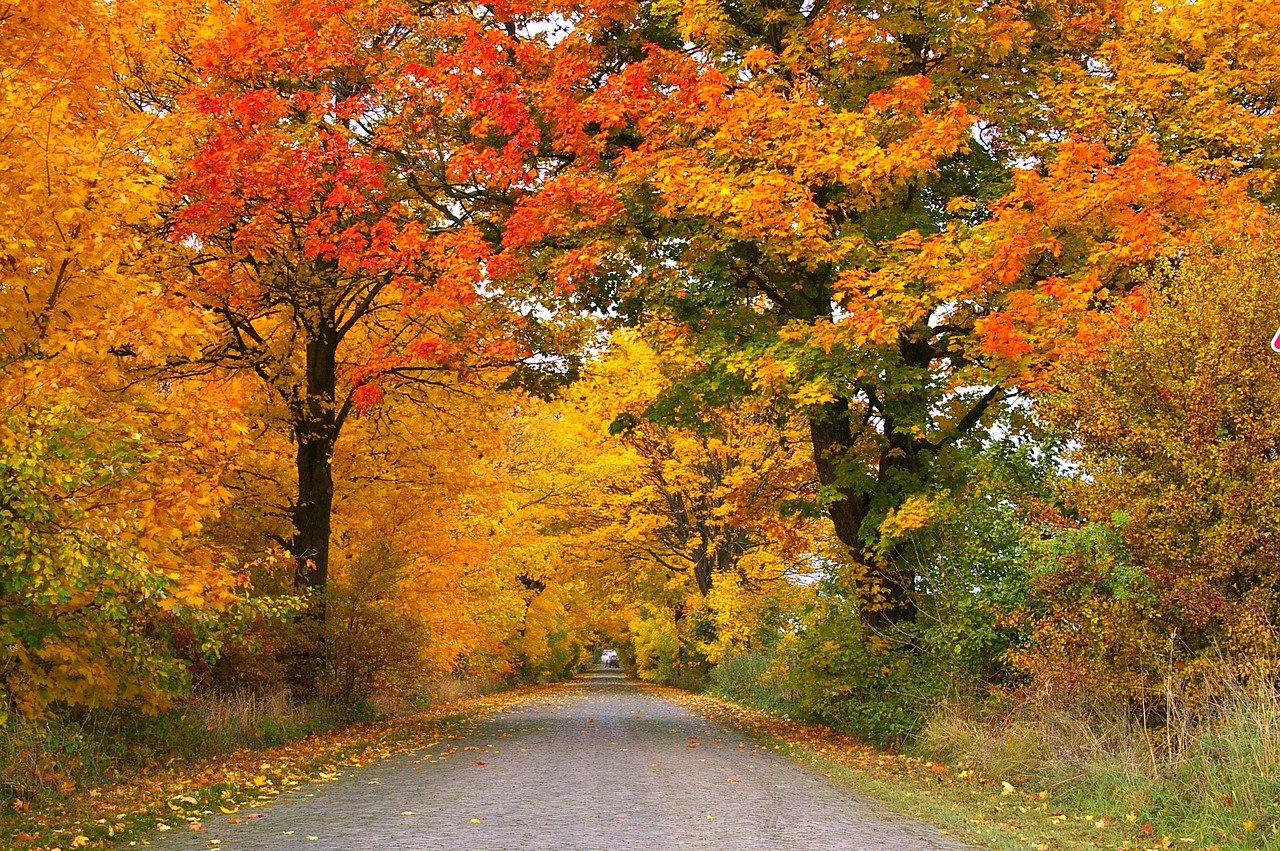
It’s a gorgeous autumn day. Leaves are at their peak and stand out against vivid blue skies. Temperatures are an unseasonable 67 degrees. Even my light sweater is too warm.

On my left I pass a place that still yanks at my feels. For years an old house with a rotting roof stood there, surrounded by weeds and junk cars. Despite its decay, this was a home. It lifted my spirits to see laundry on the line and light in the window. That house surely survives in the memories of those who lived there. It also hangs on in a poem I titled, unimaginatively, “House On Smith Road.” Here are a few of its lines:

There are people who keep going
past all predictions,
chewed up by cancer
or rattling with emphysema.
They hold things together
for the daughter struggling
with heroin, the spouse
wandering through dementia.
I think of them as this house
slides ever closer to the ground,
plastic flowers still blooming 
on that brave tilting porch.

The old house was knocked down a few years ago and another home stands there now. I wonder if the new residents sense the energy fingerprint left by everyone who ever lived there – the old farmhouse most recently but also all who came before, back to the Haudenosaunee Confederacy, and back before them to the earliest peoples.  

Hills I drive over were carved by glaciers thousands of feet thick. The ice sheet was so heavy that earth’s surface is still rebounding from that long-ago weight. Between these gentle slopes lie fields of dry soybeans and baled hay brilliant in the sunlight.

I wave “go ahead” to a woman turning left on Columbia Road. I let my eyes rest on a house that captured my attention each election year. The yard was always festooned with signs for both Republican and Democratic candidates. Many times I’d see one sign blocking another, then the next time I’d see a bigger sign replace the blocked sign, like a checkers game played with opinions. It always gave me hope to see people with such different politics sharing one home.

I find myself behind a school bus and wait as it drops children off every few driveways. Little children in the back make silly faces in response to my finger-waggling ears.

Finally I arrive at the store. A man sits in the pickup truck next to me, windows up, engine running. I get out, pull on my mask, walk past another vehicle parked and running, this one with a young woman on speaker phone who talks in loud angry tones.

I go in to collect bounty sown, harvested, and held by many hands before mine: bananas, dates, walnuts, coffee, lentils, soap, wine, oatmeal.

I get in line behind a frail elder who hangs on hard to the cart handle, his middle-aged daughter solicitous as she unloads. A man with the name Eduardo on his tag never stops ringing up groceries as he lifts a hand in salute to this elder he calls “sir.” They talk easily and I notice the older man straighten into his height.

When it’s my turn I tell Eduardo the respect he showed a stranger made my day. He tells me as a teen he worked at a nursing home. “Only in housekeeping,” he says, “but the people living there treated me like family.” I tell him worked at such a place too, starting at age 13. In the few minutes it takes to pack my rumpled cloth bags, Eduardo explains he is far from his grandmother in Puerto Rico but hopes she finds respect everywhere. “We have much to learn from our oldest people,” he says.

Back in the parking lot the woman still swears into her phone, the man still waits, both cars running, and I hope they too are finding beauty here in the hours we have.

House Concerts

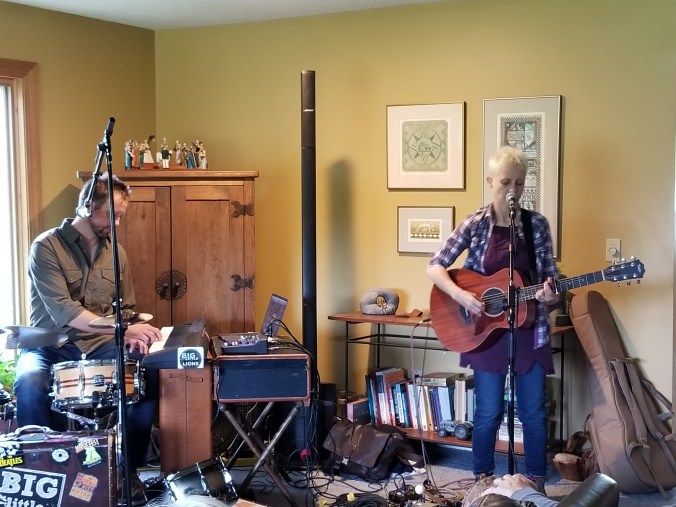
Big LIttle Lions here September 2018.

Our home seems made for house concerts. This place is open in an unassuming way. Plenty of space for people eat and talk, then find a spot to sit when musicians begin to play. I feels to me as if a glow hovers around everyone at these events, intensifying as the evening goes on.

It doesn’t matter that our carpet is three decades old, that portions of the kitchen floor are in ruins, that there are several different colors of siding on our house. What matters is making very real connections in an era when we’re ever more likely to be distracted and rushed.

Two years ago my husband wanted to cancel our scheduled house concert. He insisted it would be too much for me. I’d recently gotten several frightening diagnoses and he was worried. I told him every crisis reminds us how radiant our lives already are and we were absolutely going ahead with the concert.

Our performer that autumn was veteran singer-songwriter Doug MacLeod. Doug had long performed the blues as a story-teller and won many  national Blues Music Awards. When he showed up we were all in his thrall. Can you remember the hippest guy in school, exploring the best music and coolest haunts but too laid back to brag? Doug was that guy, all the more awesome for each of his years. Doug sat down to play, man and guitar, his sandpaper-y voice wearing off our sharp edges. His stories and songs held us . Late in the evening he told us about his son Jesse’s cancer diagnosis and how they had begun composing together.  Quite a few of us were madly in love with him by evening’s end. Maybe, from sheer proximity, a little more hip too.

Our most recent house concert happened this weekend. We are honored to host amazing musicians from around the country, around the world (many found through the Concerts in Your Home network). I send out invitations well in advance, ask for RSVPs, try to have a houseful of around 30 people all donating a decent amount (100% to the musicians) to make it worth the musicians’ while. Many musicians stay here overnight, our breakfast conversations a rich new element to this experience. I tend to stress over RSVPs, probably because so many musicians performing in our rural home travel long distances to get here.

Maybe it’s a symptom of our times, but increasingly the 70 or so people on our invite list do not respond. Or they say they can come but cancel a few days before the performance. Recently a friend who cancelled actually paid for the two seats she and a friend would have occupied. Otherwise people don’t seem to understand that this is opportunity to engage with live music on the most direct terms —- literally feet away — with established, talented, extraordinary artists. The audience for this weekend’s concert, including family members, came to only 14 people in attendance.

My spouse says that our house concert experiment has run its course after nearly four years. I disagree. I did my share of active worrying when I got cancellation after cancellation for this weekend’s show, many of them less than 24 hours before performance time, but those who came told me it would be perfect exactly as it was.

They were right.

Artist Noah Derksen and his accompanist Abby Wales made it an all acoustic show to accommodate our small audience and it was perfect. Nothing will stop me from continuing after the marvelous energy of this show.

The community we all need is  in front of us. Miss your village? Maybe it’s right here, waiting for you to show up.


House Undivided

political opposites get along

This isn’t an accurate representation of the house I’m describing! CC by 2.0, photo by Michal Osmenda

When I drive into town, I go past a house that never fails to interest me. The house itself is entirely ordinary. I’ve never met the inhabitants. What’s fascinating is the dichotomy on display out front.

Take the driveway. Most evenings a pickup truck with mud streaks from off-roading is neatly parked next to a fuel-efficient hybrid.

Or take the landscaping. For over a decade and a half, the garden bed under the front window has sported a perennial planting — two equally large logos for rival teams Ohio State Buckeyes and University of Michigan Wolverines. This is a brave statement here in Ohio.

But the lawn is my favorite. Each presidential election season a competition is waged right there on the grass. A regular-sized Gore/Lieberman sign appeared close to the street in early autumn of 2000. The next time I drove by, a Bush/Cheney sign was placed directly in front of that sign. As weeks went by the signs were moved like two parrying chess pieces until a much larger Bush/Cheney sign appeared. That was followed by a larger Gore/Lieberman sign. A similar dance of political signs took place for the Kerry vs Bush race, the Obama vs McCain race, and the Obama vs Romney race. (This year, two very small signs….)

The couple in this house surely eat at the same table, sit on the same couch, flush the same toilet, and sleep in the same bed. They’ve managed to live together all these years while holding widely differing opinions. I thought I lived in a household of contradictions but these two are an inspiring example of publicly embracing their differences.

We’re told we live in an ever more divisive country. We tend to choose news sources that amplify our own worldviews. We tend to delete social media friends who don’t share our opinions. We tend to live in areas and move in social circles with people very similar to us. Yet insulating ourselves from those who are different just strengthens the perception that we’re irreconcilably different.

Research shows us that diversity sparks more innovative and energizing approaches to building strong communities and successful businesses.  Diversity can lead to some invigorating soul-searching  and growth on a personal level too. One of the main principles of nonviolence is finding common ground with each other. Across all so-called divides, we truly want the same things. Things like safety, freedom, individual purpose, a sense of belonging, hope for the future, a say in decisions that affect us. We may believe there are different routes to achieve these goals, but the goals are darn similar. That’s common ground.

This house reminds me we can express our differences and still laugh.  We can challenge each other and in doing so, learn from each other. We can get beyond the urge to assert the superiority of our viewpoints by respecting each other, helping each other, and collaborating with each other. This house is who we really are as a nation. May it be so.

“Society evolves not by shouting each other down, but by the unique capacity of unique, individual human beings to comprehend each other.” ~Lewis Thomas

Gifting a Week of Meals

giving meals, cooking for others, meal sharing,

Yum. (CC by 2.0 thebittenword.com on flickr)

Soon after my second baby was born, I was informed that I’d be receiving a week of meals delivered by my friends. The next seven nights our doorbell rang and there stood someone dear to me holding warm dishes filled with delights.

A break from planning and making dinner was a blessed relief. It also exposed my family to a wider array of foods. More importantly, each night we sat down to eat a relaxed dinner lovingly made for us.

We were given so much food that we tucked lots of it in the freezer, spreading the bounty of kindness into the following weeks. One friend came laden with two different kinds of lasagna, one with garlicky white sauce and spinach, another layered with black beans and lots of veggies. Years later I still make both of her recipes.

A week of meals for families with new babies became a tradition in my circle of friends and my Le Leche League chapter. Here’s what worked for us.

1. Someone particularly close to the new mom and her family usually broached the idea to their mutual friends. We never designated a person in charge of planning. But your group of friends, or church, or neighborhood may decide that putting one person in charge of noting who will make a meal which night makes it easier.

2. We contacted the new mom with some basic questions such as best days and times to drop off food, food preferences, and if she wanted food brought ready to eat at dinner time or in advance to heat up later that day. Some moms preferred to have meal deliveries every other day.

3. Then we verified the plans with all potential participants. It worked best to accommodate a variety of needs among people contributing meals. Some preferred to drop off bags of Mid-Eastern salads or trays of sushi they picked up on the way home from work. Some didn’t have time to deliver a meal during the week but happily provided brunch on the weekend. It helped to jot down what people were planning to make so the family didn’t end up with three enchilada entrees on three consecutive nights.

4. We sent out a full schedule to everyone participating. It functioned as a reminder, listed who was bringing what, and offered suggestions such as labeling pans and including recipes. A shared Google doc can uncomplicate things. Or use one of these online meal scheduling sites to make this easier:

Meal Baby

Take Them a Meal

Meal Train

Care Calendar

Lotsa Helping Hands

Caring Meals

Of course, a new baby isn’t the only reason to provide a series of meals. It’s a great way to welcome someone home when they return from service project or military assignment. It’s a godsend when people are dealing with illness or injury. And it’s remarkably helpful during the time a family is undergoing a major home renovation. Mix it up. Rather than arranging a week of steady meals, you might offer a meal every Wednesday or set up a regular potluck date to eat together.

There may be no more basic gesture of kindness than feeding people. Food sharing is a tradition found in every culture, stretching back to our earliest history. It’s a stomach-filling, community-building kindness like no other. It can also swing back around remarkably. By the time my fourth child was born I was gifted with a full three weeks of meals, nearly all made by people I’d once cooked for. It was an embarrassment of riches but oh how those delicious foods warmed our hearts.

Other ways to build community:

Bring Kids Back to the Commons

Engage the Window Box Effect

It Really Does Take a Village

We Don’t Need No Age Segregation 

Welcome Kids Into the Workplace More Than Once a Year

Odd Second Saturday Suppers

Better Together: Restoring the American Community

The Abundant Community: Awakening the Power of Families and Neighborhoods

All That We Share

This is a repost from our farm site

Welcome Kids Into The Workplace More Than One Day A Year

role models, peer segregation, children in workplace, take your child to work day,

Finding out about real world work. (Clarkston SCAMP)

Twenty-some years ago, a radical idea was launched. One day out of the year take girls out of school and bring them to work for Take Our Daughters To Work Day. The practice was intended to give girls a glimpse into possible careers and break down barriers to success. From the start many parents brought both boys and girls. Then the project was officially expanded to include boys. Today it’s wildly popular. Last year 37 million people participated in the U.S. alone.

It’s hard to know how much impact one day a year has on a child’s career aspirations, let alone determine if it breaks down any barriers. According to the National Committee on Pay Equity,

The wage gap persists at all levels of education. In 2011, the typical woman in the United States with a high school diploma working full time, year round was paid only 74 cents for every dollar paid to her male counterpart. Among people with a bachelor’s degrees, the figure was also 74 cents…A typical woman who worked full time, year round would lose $443,360 in a 40-year period due to the wage gap. A woman would have to work almost 12 years longer to make up this gap.

Inequality remains firmly in place for women in business and the sciences. There are larger issues going on here, but spending more than one day a year observing the real world of work might help.

Throughout nearly all of their childhood and teen years our kids are segregated in day care, school, sports, and other activities. Even when they benefit from the very best programs, if they’re restricted to the company of same-aged peers they are deprived of the riches found through fully engaging in the larger community.

This subverts the way youth have matured throughout most of human history, when children learned right alongside people of all ages as they gathered food, built shelters, and performed every other skill necessary to sustain a community. Young people learned more than carving spears and tanning hides, they picked up character traits that would hold them in good stead through life.

Today’s kids still have the age-old desire to gain mastery in areas of interest and to model themselves after those they admire. There’s nothing like being exposed to people engaged in meaningful and useful activities to spark those desires. That’s why I’ve made a point of making sure my kids get the chance to see as much of the working world as possible. Along with members of our homeschool groups and 4-H club, my kids and their friends have gotten the chance to see, up close, the work of chemists, wood carvers, bankers, blacksmiths, forensic investigators, geologists, boomerang athletes, farmers, engineers, chefs, potters, horse trainers, entrepreneurs, and many other adults who are passionate about what they do.

Interestingly, when I’ve asked for our kids’ groups to observe or even take part in the work-a-day world people rarely turn us down. Perhaps the desire to pass along wisdom and experience to the next generation is encoded in our genes.

Age segregation goes both ways—adults are separated from most youth in our society too. After an afternoon together we’ve gotten the same feedback again and again. These adults say they had no idea the work they do would be so interesting to kids. They marvel at the questions asked, observations made, and ideas proffered by youth that the media often portrays as disaffected or worse. They shake hands with young people who a few hours ago were strangers and say, “Come back in a few years, I’d like to have you intern here,” or “We could use an engineer who thinks the way you do. Think about going into the field,” or “Thanks for coming. I’ve never had this much fun at work.”

If you want to help your kids benefit this way, here’s how to activate your knowledge networks and reconnect kids with the larger community.

Hijab Games & Pink Shirt Days

bystander effect, stand up for others, hijab soccer, pink shirt day, anti-bullying,

“Whenever one person stands up and says, “Wait a minute, this is wrong,” it helps other people do the same.”  Gloria Steinem

A high school soccer referee barred Samah Aidah from her March 12th game because she wore a hijab, even though the association that governs soccer internationally had already lifted rules preventing players from wearing head covers.

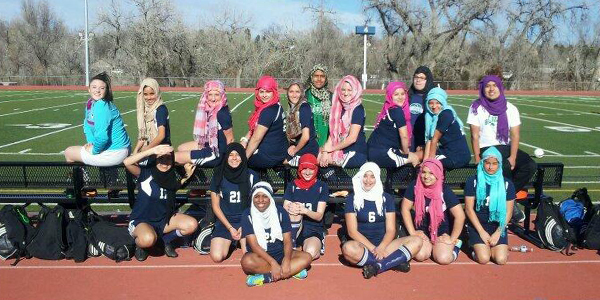
Samah’s teammates responded. At their next game, every single girl wore a hijab in playful solidarity with her.

bystander effect,

Samah Aidah and her teammates smiling together at Overland High School in Denver, Colorado
(aquila-style.com)

These girls took action rather than letting oppression go without comment. Whether they knew it or not, they followed a basic principle of nonviolence— that problems are most easily reversed at the early stages. If ignored, issues can become progressively more difficult to stop as they spiral to ever more intense levels. That’s the case whether we’re talking about so-called non-physical forms of violence such as humiliation, harassment, and prejudice. It’s also the case with physical forms of violence, from domestic abuse to war.

When people don’t intervene, assuming others will step in, they become bystanders who “permit” violence to happen. Studies show if an emergency unfolds before a group of people they’re less likely to take action, basing their decisions on the behavior of those around them. This is called “diffusion of responsibility.” If that same emergency presents itself in front of one person, that person is more likely to take action. We’ve all heard of these situations precisely because they’re so heinous.

Social scientists who study intervention in violent situations know that when others object or actively get involved their efforts tend to slow or stop the violence. Dr. Ervin Staub, who survived under Nazi rule, reports in The Roots of Evil that genocide perpetrated by the Khmer Rouge in Cambodia and the Nazis in Germany started with prejudicial statement and small acts of repression. Oppressors test the response, only escalating to greater atrocities once they determine that bystanders will allow to them continue. It requires the willingness of uninvolved people to step in, advocating for the victim or victims, in order to halt the escalation of violence and to uphold the common good. Such actions empower the victim and reduce the power of the aggressor.

We tend to believe that we’ll have the moral courage to speak up and help when someone is suffering. But when something happens we usually have only an instant to respond, either we listen to our doubts and turn away or step outside our comfort zone to intervene. What makes it more likely that we will help?

1. A sense of commonality with people who are unlike us is important, letting us see beyond “us versus them” and prompting us to act with empathy.

2. Past experience reacting positively in a crisis leads people to do so in the future. In that case, the girls wearing the hijab to support their teammate not only made the current situation better but also primed themselves to act compassionately next time it’s necessary.

3. People who feel freer to defy the norms and who are able to think for themselves are more likely to help. Pluralistic ignorance (going along with the crowd) dampens a person’s compassionate response.

That’s why learning about nonviolence is so important, because it gives us a background on which to base our actions.  For examples of individual bystanders who stepped up to make a difference, check out the heartening real-life examples in this piece:

How To Get Involved When It’s None of Your Business

And let’s enjoy another example of young people choosing to go beyond being bystanders.

A few years ago a new freshman arrived at a Nova Scotia high school on the first day back to class. He was wearing a pink shirt. Several students mocked him and threatened to beat him up.  No one intervened. But two senior boys heard about it and decided to respond. They bought dozens of pink shirts at a discount store, emailing their friends to let them know they’d be handing them out the next day. The news spread and hundreds of students showed up the next morning already wearing pink shirts.  The bullying stopped and now Pink Shirt Days are held yearly in many schools to spread awareness about bullying.


Resources

books

Above All, Be Kind: Raising a Humane Child in Challenging Times by Zoe Weil

Keeping the Peace: Practicing Cooperation and Conflict Resolution with Preschoolers by Susanne Wichert 

The Bully, the Bullied, and the Bystander: From Preschool to HighSchool–How Parents and Teachers Can Help Break the Cycle by Barbara Coloroso

Why Good Kids Act Cruel: The Hidden Truth about the Pre-Teen Years by Carl Pickhardt

Born to Be Good: The Science of a Meaningful Life by Dacher Keltner

Calm and Compassionate Children: A Handbook by Susan Dermond

books for kids

Bystander Power: Now with Anti-Bullying Action  by Phyllis Kaufman Goodstein

Just Kidding by Trudy Ludwig

My Secret Bully by Trudy Ludwig

Stand in My Shoes: Kids Learning About Empathy by Bob Sornson

Speak Up and Get Along!: Learn the Mighty Might, Thought Chop, and More Tools to Make Friends, Stop Teasing, and Feel Good About Yourself by Scott Cooper

other resources

Erase Bullying videos

Stop Bullying site


I Heckle, You Heckle, Let’s All Heckle

heckle, roots of word heckle, change the world,

I just got back from a workshop teaching us how to research injection wells for a citizen’s audit project. It’s boring and difficult. I’m appalled when I look closely at the data. I don’t want to do it, although I will because we’re currently mired in a struggle over fracking.

That may not be your issue but of course there are plenty of others that jab at our consciences. Drone strikes, refugees, melting polar regions and burning rainforests, poisons in our food, toxic tactics wielded by the powerful. The list goes on and on. We feel like screaming in the streets, but there are bills to pay and meals to make.

I haven’t thrown open my window to yell, “I’m mad as hell and I’m not going to take it any more.” But I want to affirm the heckling all of us do. These days the word “heckle” has entirely negative connotations. It conjures up images of rude people who interrupt performers and ruin the experience for everyone. Instead, lets hop on a wagon to the past where this word meant much more (as explained by Mark Forsyth in The Etymologicon).

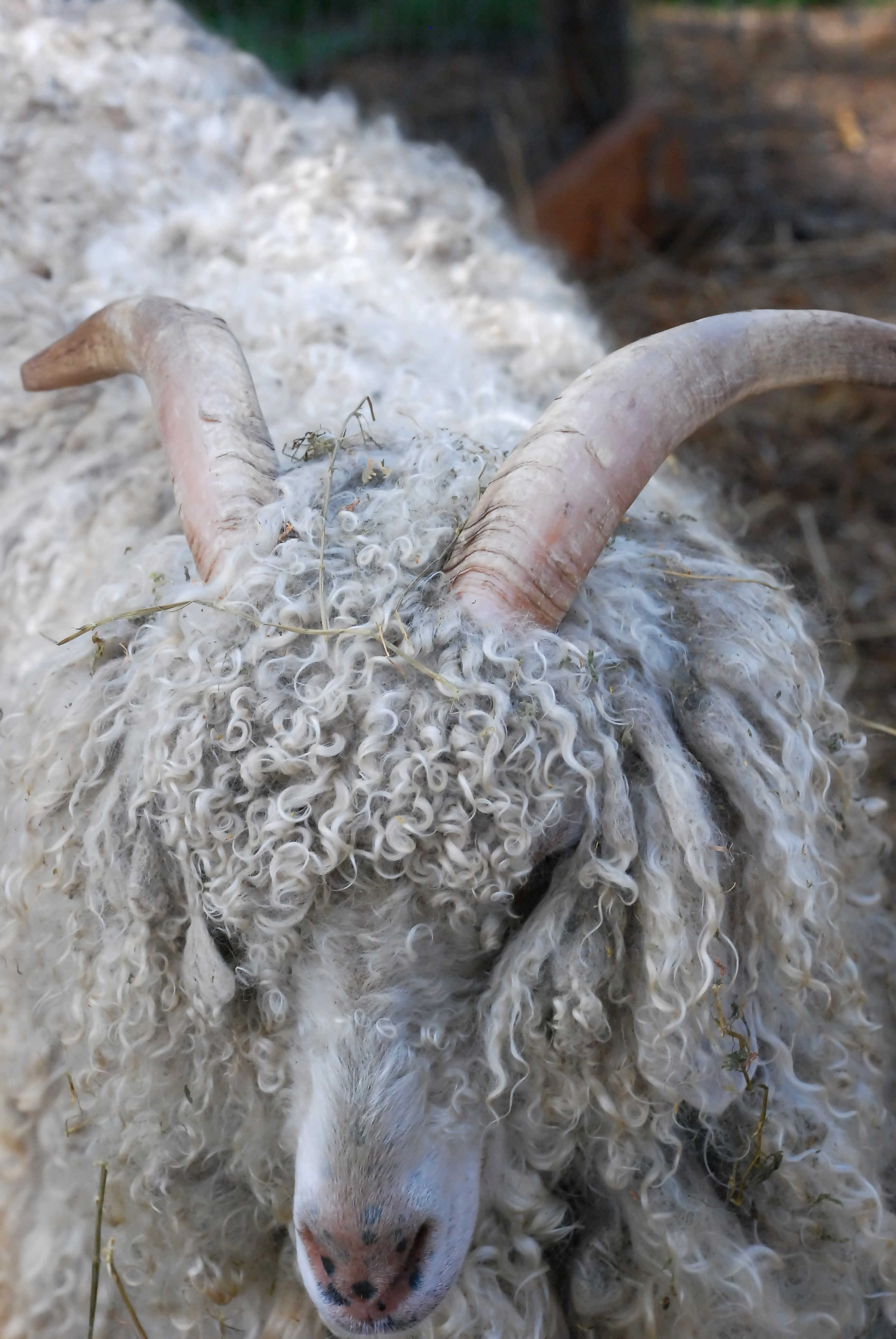
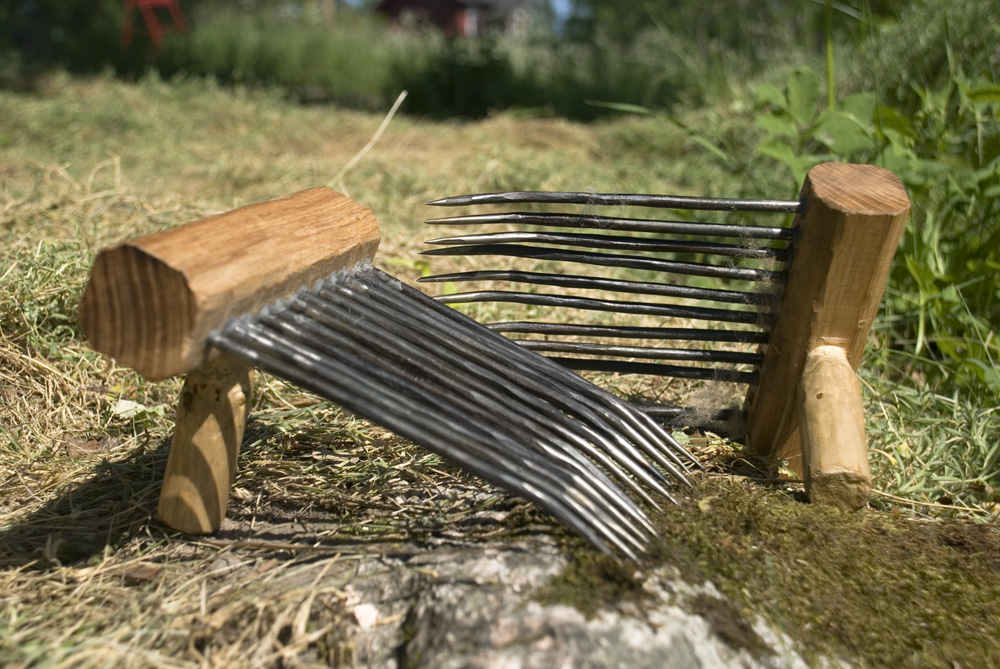
Heckling originally referred to the process of combing sticks, burrs, and knots from sheep’s wool so it could be spun into usable fibers. Sheep tend to ramble around without any concern for fleece-related loveliness, so this is quite a task.  People who did the combing were naturally called hecklers.

Back in the eighteenth century, the wool trade flourished in the town of Dundee, Scotland. Hecklers worked long hours together. In the morning as they set to work heckling, one of their fellow hecklers read aloud from the day’s news.  There was plenty to read, since this was an era when all sorts of publishers put out lots of newspapers, broadsheets, and handbills. The hecklers were thus well-informed in many subjects.

When politicians and power brokers of the day addressed the public, the hecklers combed over their speeches as thoroughly as they combed wool. They raised objections, pointed out contradictory facts, called people to account for their behavior. In other words, they heckled. These hecklers formed what would now be called trade unions, using their collective efforts to bargain for better pay and perks. They also stirred up awareness of worker’s rights while empowering ordinary people to speak up against injustice.

Hecklers were people who were knowledgeable and alert to hypocrisy. They were aware how easily something nasty can snag what’s useful into uselessness until it’s pulled free, no matter how arduous and smelly the process.

Heckling is a potent way to question the powerful. Over the centuries the term implied thoughtful questions from the audience which a speaker would answer before going on. In parliamentary proceedings it remains a method of engaging in open discourse with a speaker by someone who isn’t entitled to the floor.

Nearly everyone I know is actually a heckler. We’re well-informed. We care. We lean toward positive change, willing it into being by our words and thoughts as well as our actions.

The poet Lawrence Ferlinghetti joins other writers and thinkers who claim the masses are sheep, as he does in this evocative poem.

PITY THE NATION
(After Khalil Gibran)

Pity the nation whose people are sheep
and whose shepherds mislead them.
Pity the nation whose leaders are liars,
whose sages are silenced
and whose bigots haunt the airwaves.
Pity the nation that raises not its voice
except  to praise conquerors
and acclaim the bully as hero
and aims to rule the world
by force and by torture.
Pity the nation that knows
no other language but its own
and no other culture but its own.
Pity the nation whose breath is money
and sleeps the sleep of the too well fed.
Pity the nation—oh pity the people
who allow their rights to  erode
and their freedoms to be washed away.
My country, tears of thee
Sweet land of liberty!

With respect to Mr. Ferlinghetti, I disagree. His poem is packed with truth but it doesn’t acknowledge how these exact circumstances also propel people to deeper understanding and stronger commitment to change.

I see eyes opening. I see loving hearts broken by Earth’s sorrows, knitted back together with hope. I see the sort of consciousness rising that wakens more and more people.

We aren’t the sheep. We’re the hecklers.

social change, heckler,

Heckling combs. Image: nimpsu.deviantart.com

Odd Second Saturday Suppers

Odd Second Saturday Suppers, potluck inspiration, easiest party ever,

Image: 8o-clock.deviantart.com

The happiness glass fills when we spend time with people we love.  It’s startling and appalling to me how many friends I adore, but almost never see. When we do get together we can pick up right where we left off, laughing as well as diving into the deepest topics, yet we don’t make time to see each other very often. That’s just wrong. (I’ll keep myself from using the newest curse word although it applies here.)

Years ago we spontaneously invited friends over for dinner all the time. We hosted wildly silly kid events like BYOB parties (bring your own box) and pig pen parties. But lassitude set in after years of constant financial strain and the sadness of dealing with our parents’ last years. Lately I’ve been fighting back.

At the start of 2013 I decided to commit to a series of events at our house. I named them Odd Second Saturday Suppers. Last January I sent emails to a few friends who live nearby inviting them to potlucks here on the second Saturday of every odd month. That meant we committed in advance to hosting parties in January, March, May, July, September, and November. Because they were planned well in advance, I bypassed the vague “Oh we really should get together” intentions that are unlikely to happen. Here’s the invite:

Odd* Second Saturday Suppers

We’re starting a new tradition.

We are inviting friends to a regular gathering at our home for food, conversation, and simple relaxation. These will take place the second Saturday on odd months.

 I’ll send out reminders at the beginning of those odd months. We’ll provide an entree or two. Bring something to share if you can: beverage, appetizer, side, or dessert. Not sure about the time, I was thinking around five-ish but let’s stay flexible. Different months may offer different possibilities. You are invited to all but of course, come to the ones that best fit your schedule.**

 We also welcome new friends, so feel free to bring along a guest or two.

 Here are the dates:

January 12th

March 9th

May 11th

July 13th

September 14th

November 9th

*Odd as in quaint, funny, unusual. Also odd as in unevenly numbered months.

**If you abhor the idea or plan to be busy every one of those Saturdays let me know and I’ll spare you the reminders.

Sometimes as the date got closer we didn’t feel ready to have a houseful of guests. But when the day arrived we were eager to see everyone. Each event has been slightly different. We’ve sat out back to enjoy a bonfire, we’ve played Cards Against Humanity, I even cajoled people into playing absurd outdoor games, but mostly we’ve focused on eating and chatting. Because these are potlucks there’s minimal fuss. (Also, my husband and kids are great about hustling in advance of events to straighten the house, mow grass, and generally help prepare.)

By the last scheduled Odd Supper we weren’t sure if we’d continue. Difficulties cropped up as they do—a house needing repair, a job lost, a refrigerator that no one wanted to clean even if the Queen herself might be arriving.  But really, it’s not hard at all. It’s wonderful. (I was kidding about cleaning the refrigerator, we don’t invite people who care about my semi-awful refrigerator.)

So in 2014 year we’re throwing the invite list open a little wider and asking friends from a little farther away. And they won’t all be Odd Suppers. I’m plotting that several dates will be art parties or adventures far from our little farm.

How are you fighting back against the forces that keep you from enjoying friends near and far?