Save Moments In A Memory Jar

make a memory jar, how to save family memories,

Today is a wonderfully ordinary day. Lots of laughter and no squabbles. Will we remember any of it? Probably not.

It’s hard to understand why we hang on to some memories but not others. The process isn’t about how much effort or money we expend trying to make something memorable.

Long-term retrievable memories are built by what we notice, fully notice, with our minds as well as our bodies. (They aren’t made when we multitask.) Look back at any particular memory. What you recall is constructed from the sights, sounds, tastes, thoughts, and feelings unique to your experience. The way you pay attention to those elements forms your memories. The shocking part? Looking back and realizing how few rich and full memories we really form.

That’s because we only really latch on to memories when we pay attention. When we’re engaged in the moment. Recall the last really memorable meal you had. It probably wasn’t one you ate in the car or standing at the kitchen counter. It was one you savored with full awareness of flavor, texture, scent. Most likely there were other important elements as well. Perhaps it was a meal shared with a new friend or made from a challenging cookbook. Perhaps it was a last meal you had before a loved one passed away, a meal you now try reconstruct in detail.

Emotion plays a part in memory formation. And our five senses are integral when forming strong memories. Particularly smell, perhaps because the olfactory bulb is closely connected to the hippocampus (related to learning) and the amygdale (related to emotion).

For years I’ve encouraged my family to take “sensory snapshots.” We may be standing out back together, having just finished stacking firewood (because togetherness on our little farm often has to do with work) and I urge them to remember the moment in their bodies as well as their minds. We notice the scent of blackberry and milkweed blossoms, listen to frogs croaking in the pond, feel the evening’s coolness on our skin, look at the fireflies beginning to arc through the dusky sky. I don’t just want the moment to linger, I want to be able to retrieve it long after today. I want to hang on to our easy banter and feeling of shared accomplishment.

That’s where memory-storing traditions come into play. Yes, it’s easier than ever to take photos and videos. But there’s something about writing down our impressions that augments the process of locking them into place.
hang on to memories, write down family memories, unique memory traditions,

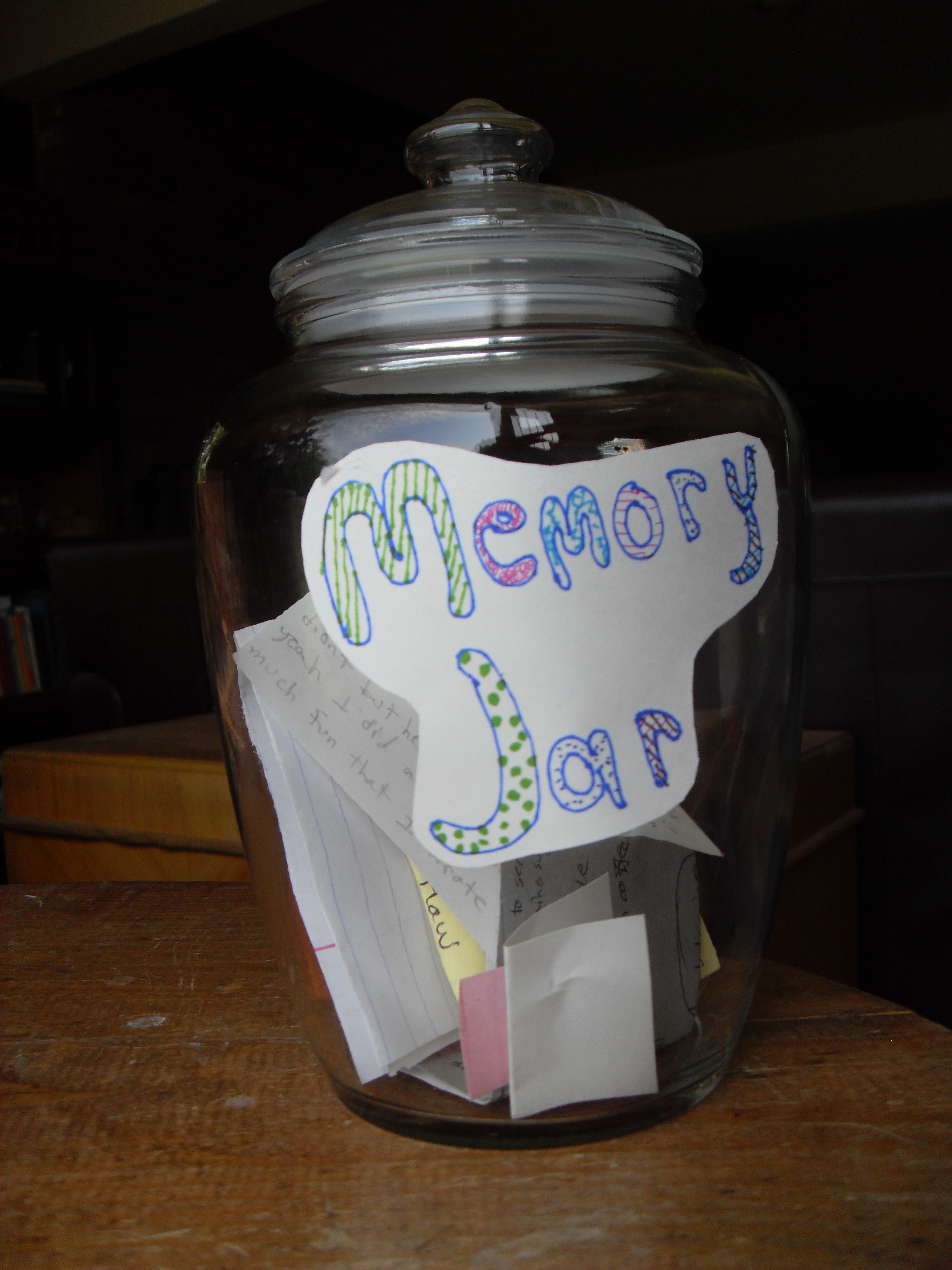
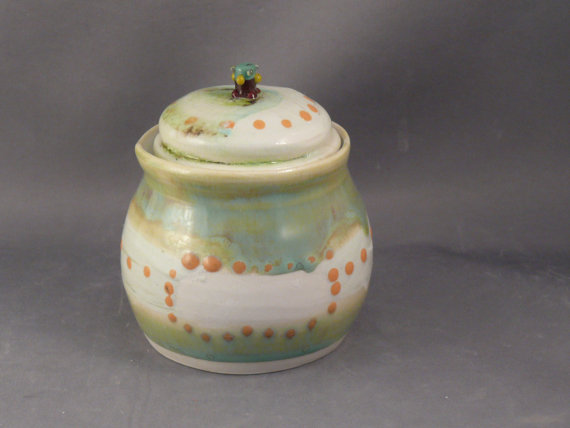
One tradition you might want to start in your family is a memory jar. Grab any jar, name it the Memory Jar, and keep it in an accessible place. Filling it is pretty easy. Encourage your family members to scrawl memories on any piece of paper, sign their names, add a date if they can, and stuff these memory scraps in the jar. Let the youngest ones dictate their memories to you and pop them in as well.

You’ll be interested to note what different family members regard as significant enough for the memory jar. Good grades on a test probably won’t get in. Watching the neighbor’s puppies born probably will. Your five year old may stuff in a new memory each day, your teenager may add one only at your prompting, you may tend to write down funny things the kids say. But if they’re not noted and saved, chances are they’re lost.

It’s helpful to have a “no grudge” rule. Memories don’t have to be happy, of course. The most powerful are probably those that aren’t. Your daughter may write,

“I was really scared when Max fell off the slide. We went right from the park to the hospital. We waited a long time and I fell asleep watching a TV high on the wall. Max got a green cast on his arm and I was first to sign it. I was mad my name didn’t come out too good because it’s not easy writing on a cast. The letters are kinda bumpy. We were so hungry Mom stopped for ice cream on the way home. I got peach, Max got chocolate chip, Mom got a smoothie. I think it would be fun to have a cast too but I don’t want to fall off a slide to get it.”

There are plenty of options that go along with opening and sharing the tidbits from your Memory Jar. You might choose to have a memory ceremony once a year. That’s a day when the jar is opened and the memories are read. You might want to do this on Thanksgiving, New Year’s Day, or every July 13th because that’s your family’s yearly Dad Finished His Tour of Duty party.

And you’ll want to store these memories safely. It’s easiest to start a new jar every year. Label last year’s jar and tuck it in the back of your closet. If you’re ambitious, carefully scrapbook each slip of paper next to photos or turn them into a photo collage to hang on the wall. Or, your family may prefer to keep adding to a collective jar of memories without going over the contents together, happy to make the jar a sort of time capsule to be opened well into their adult years.

While a memory jar is well-suited for family use, there are other great ways to use this random-memories-on-scraps-of-paper approach.
how to hang on to memories, memory-making for couples

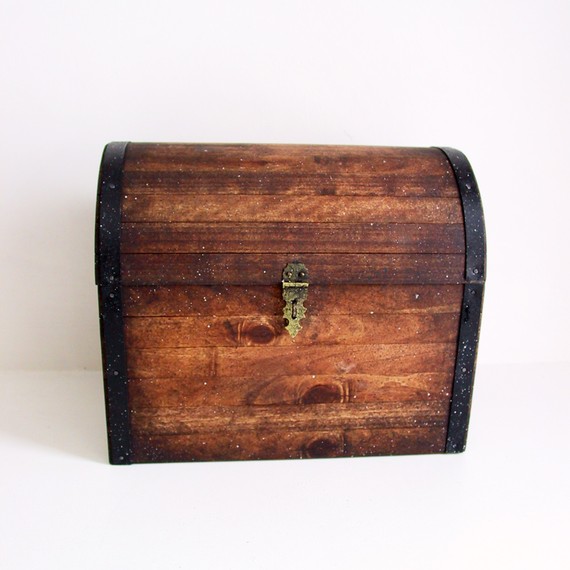
For couples, why not start a Memory Bank? This is best made with an opening no bigger than a piggybank. This way the memories each of you contribute can’t be fished out and read in private. It’s a way of noting little tidbits about your lives together without the pressure to contribute. Of course a “no grudge” rule is still important. And when a Memory Bank is shared by a couple, it’s best to make it a long-term project. Vow to keep it sealed until your 25th anniversary or some other far off date. By then neither of you will care if she contributed 95% of the memories, you’ll both simply have fun going over recollections you thought were long gone.

Perhaps the best impetus for storing and retrieve memories is in partnership with the oldest members of the family. On each Father’s Day card I used to share a reminiscence about my childhood to let my Dad know how much he factored into my happiness then and my resilience now. I thought I was doing it for him but I know now that sharing these memories was one way I strengthened a link with someone so dear to me.
preserve memories with your elders, keep a memory book, daily log book for seniors,

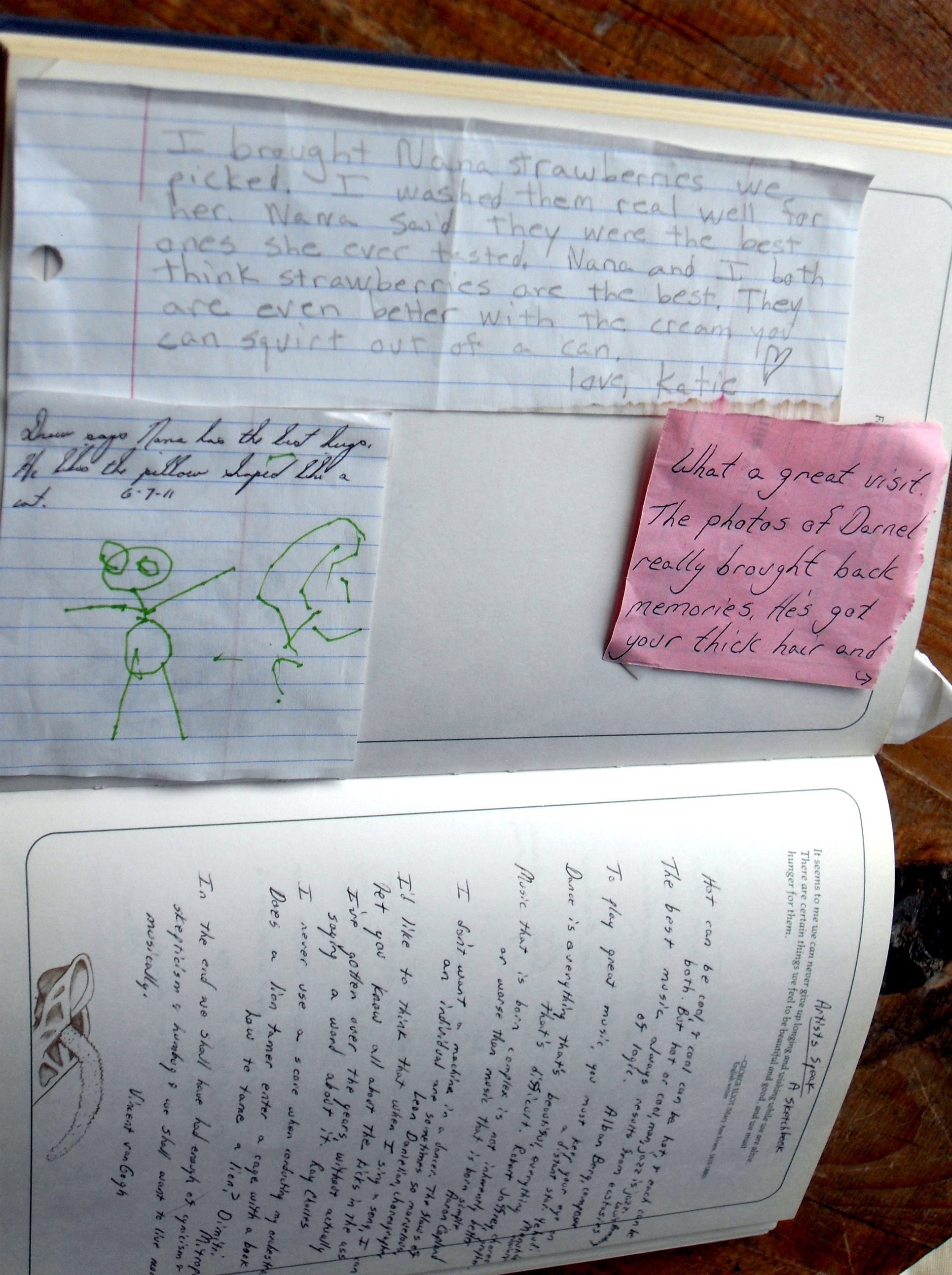
You can keep track of up-to-date memories with the elders in your family using a Memory Book, one that’s always open. A large format blank book is especially good for this purpose. With each visit write down a recollection (old or new) to paste in the log book. Add drawings and photos. If you’ve exchanged memorable phone calls, texts, and other communications remember to add notes about them when you visit. The Memory Book is a warm reminder of your affection. It’s also helpful if your loved one is in an assisted living facility or nursing home because other visitors can flip through the pages, starting conversations by talking about these and other memories while making new ones.

Thinking about the ways we form and hold on to memories is inspiring me to have more fun with my family than stacking firewood!

Non-Stylish Woman Wears Blog

no style sitting at the computer, blog hag,

Image: charizard110011.deviantart.com

Stylish? Nope. Nothing about me qualifies.

My presence makes people who are fashion backward and technologically inept feel much better about themselves. Clearly there are perks for hanging out with me.

But my friend Linda Dobson who authors the wonderfully useful site Parent at the Helm has bestowed the Stylish Blogger Award on me anyway. Maybe she’s decided that my endless quest for meaning counts as style. Thank you Linda, I’m surprised and grateful.

The “rules” that accompany this honor are to divulge seven things about myself, and then pay the Stylish Blogger Award forward to fifteen other blogs. Linda and I read some of the same blogs so to avoid overlap I’ll gladly bestow the award on other worthy winners.

Seven Random Things About Me List

1. I want to do everything. I tend to have trouble fitting my chosen everything into that container called my life.

2. I can find a positive angle just about anywhere. Sometimes I have to use my optimism-tuned crowbar.

3. My ideal breakfast involves lots of onions, homemade paneer, curry spices, and any vegetables that show themselves.

4. After a youth misspent being painfully polite I’m developing minimal impulse control. When my youngest offspring wondered what it would be like to frisbee a tortilla, I tossed it for him. We ended up flinging it up the stairs, at each other, and at his sister. (This is VERY fun.) The dog disciplined us by eating the tortilla.

5. Deep sighs activate the vagus nerve, making one feel calm and relaxed. I admit I should join Vagus Overusers Anonymous.

6. I’m still afraid of the dark. Actually, that there will be no more light.

7. Told too many times by too many formative people that I had so much potential, I began to see my Better Self taunting me from a far distance. I renounce that pressure. Hereby I rename that Better Self by the more apt initials, BS, and accept my own flawed and tender self.

Newest Stylish Blog Winners
From Skilled Hands

The Contrary Farmer

The Chatelaine’s Keys

Campaign for the American Reader

The Committed Parent

Food Renegade

Humane Connection

Math Mama Writes

The Unschooler Experiment

Living Peacefully With Children

The Parenting Passageway

Post In Space

Robinsunne

Balzer Designs

*

blog walk,

Image: hiilda.deviantart.com

Now it’s your turn. Take a stroll through these blogs. Enjoy the the wealth of content and uniqueness of vision you find there. Now that’s stylin’.

Naked With My Editor

I’m not well-behaved or well-dressed enough for most careers. That may be what led me to cobble together enough freelance gigs to call myself a writer. It doesn’t pay quickly or pay well. In fact, I earn less than in my former occupation, social work, and that’s saying something.  But freelancing suits me.

Well, except for that episode of nudity with my editor.

Perhaps I should explain.

Years ago I secured a job writing a column for a newspaper. I worked after the kids were in bed and I e-mailed the first piece just before the midnight deadline in a sleepy haze.

The next morning was typical. I unloaded the dishwasher, explained long division, feigned patience while listening to a child’s original knock knock jokes, discussed the ethics of phone screening with my eight-year-old (who considered it a politeness violation to let it ring), and took photographs of my daughter dissecting a sheep eyeball for a biology project.

It was mid-morning before I had time to shower.  Because I’m efficient (lazy) I wear whatever comes out of the dryer.  It spares me the effort of putting away my own laundry.  I don’t mind monotonous outfits in the service of convenience.

When I got out of the shower I grabbed a towel for my usual mad dash to the dryer and on the way was handed the phone by my eight-year-old.  It was the newspaper editor. He wanted me to add a few sentences to my column.  He expected me to do this off the top of my head, over the phone, immediately.

While he was telling me this I realized my 11-year-old son had opened the front door, inviting in his pubescent pals.  They were chatting eagerly as they headed toward me on their way to the kitchen.  There was no way I could get to our dryer, handily located on the first floor, unless I ran directly into these youths and knocked them over like baggy-pants’d bowling pins.  I didn’t want to expose these poor youngsters to my not-supermodel flesh at their impressionable ages so I took the kindest course of action possible. I retreated down the basement steps, towel clutched in one hand and phone in the other.

Although I had no chance of sounding professional on the phone, I went on talking to my editor, giving him the lines he needed. He asked if he could edit them to fit.  “Sure,” I told him. He’s a writer too, I thought, it’ll be fine. He chatted away as if we were old friends—-he surely sitting in a comfortable chair at his desk, me a semi-naked freelancer huddled in the basement.

I stayed trapped in that basement long enough to meditate on the beauty of cobwebs and the interconnection of all life.  Long enough to get really cold in my small wet towel.

When my column was published, I saw that my editor had rearranged my few sentences into a nonsensical word soup.  It took a lot of self control to keep myself from going into a  sheep eyeball tossing snit. But just then my check arrived in the mail. It was larger than I’d expected. I felt like dancing right out the door to celebrate, but I couldn’t. That’s because I’m a freelance writer and of course, I wasn’t dressed yet.

Poetry Diet

struggling poet, making money as a poet, appreciating poets, life of a poet,

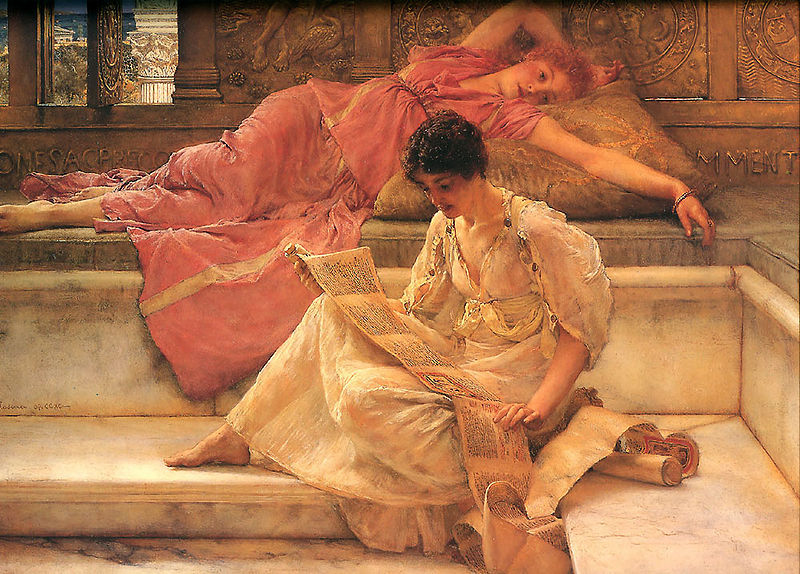
“Favourite Poete” by Lawrence Alma-Tadema

Poetry is thoughts that breathe, and words that burn.  ~Thomas Gray

The term Poetry Diet might imply a rare appetite. The sort of longing only appeased by words strung spare and stark, like a meal so desired that imagination keeps creating it anew.

Ink runs from the corners of my mouth
There is no happiness like mine.
I have been eating poetry.
~Mark Strand

Or Poetry Diet could imply hunger for that rare current some call inspiration, the elusive muse carrying phrases from ether to pen.

Everything in creation has its appointed painter or poet and remains in bondage like the princess in the fairy tale ’til its appropriate liberator comes to set it free.  ~Ralph Waldo Emerson

However in this case, what I’m calling the Poetry Diet is something much more mundane.  It simply means to eat nothing but what is purchased with money earned from one’s poetry. Reading, teaching, publishing, wearing them on your naked body, selling poems painted on scrap metal, whatever it takes. If I started a Poetry Diet now I’d be svelte in a week, thin rather soon. Before long, starving artist might be a literal (hah!) condition.

Surely a Poetry Diet would provide a vast incentive to write and, here’s the rub, send out one’s work. It could also leave the poet so imperiled that friends might stage a poetry reading to raise funds to feed the annoyingly hollow wordsmith.

Thus far I’m not dedicated or foolhardy enough to attempt a Poetry Diet. Mostly because I’m already trying to live by patching together the Essay Diet, Columnist Diet, and Editor Diet. But also because I know how long it takes from inspiration to paycheck. Right now I’m waiting for one of my poems to appear in Christian Science Monitor, two in Trillium Literary Journal, two more in J Journal. The total pay will amount to, well, let us not speak of actual numbers. I wouldn’t last long on the Poetry Diet. Surely that says something about the quality of my poetry but it also says something about our culture as well.

Poets aren’t very useful
Because they aren’t consumeful or very produceful.
~Ogden Nash

I hardly expect to live by poetry alone, although I have been sustained by the work of other poets in ways more vital than any meal. I long to see greater support for artists of all kinds. I have dear friends who devote their lives to perfecting a craft. They act, compose, weave, calligraph, paint, weld, invent, write, bake, work with wood, sing, and throw pots. They are driven to explore the intersection of art and cosmology, continually refining what it means to create. Yet most of them spend their days at jobs that are unrelated in order to survive. They wait tables or work in accounts receivable. Their real gifts emerge during precious hours plucked from mundane obligations.

It’s quite possible to attend a production at a local playhouse and see performances that shift the way you experience the world. You walk out a changed person for the extraordinary art you’ve enjoyed. Chances are that director, those actors, that playwright are unable to support themselves with their work, vital though it is.

I’m certainly not in league with those whose work is transformative. My poetry is about ordinary things like opening doors, moving stones, forgetting a name.

Perhaps I should head in a new direction—food poems. That way I’d feel nourished while contemplating the swirling curds and whey in the next batch of cheese I make. I’d also be answering Chesterton.

Poets have been mysteriously silent on the subject of cheese.  ~G.K. Chesterton

Anyone Hear A Horn Tooting?

book release, free range learning, hope, peace, natural learning, sustainability, I’ve been filling this space with hope, concern, peace and some attitude.

When I come across little-known books , music, documentaries and new research it’s a pleasure to share them.

I admit to feeling bashful when my publisher insisted I establish this site.  Sure, the net is teeming with people shining spotlights on themselves but I was raised to be polite and avoid attracting attention.  Not that I’m a credit to my upbringing. I’m too opinionated and sarcastic to qualify as polite. I’d be happy to avoid attracting attention but I can’t help it due to problems with gravity and a history of being attacked by vegetables.

But I know this site is a way of extending the work I do as a writer. Except…. I haven’t posted anything about my writing!

Well, I’m giving that a go right now.

That’s because today is the release date for my book. It’s titled Free Range Learning: How Homeschooling Changes Everything. What’s it about?

Free Range Learning celebrates the promise found in each person’s abilities and interests. It emphasizes community enrichment, connection to nature, purposeful work and much more.  This handbook on educating the whole child provides a wealth of ideas and resources that help to preserve curiosity, awe and intellectual vigor as lifelong attributes.

Free Range Learning doesn’t shy away from data. It cites research by neurologists, child development specialists, anthropologists, educators, historians and business innovators. And it offers insights and experiences shared by over 100 homeschoolers from around the world.

The book also takes a look at the impact of our educational choices. It asks the reader to consider alternative education as a cultural shift that is redefining success and reshaping the future of schooling. Free Range Learning asserts that innovative and ethical young people who are accustomed to critical thinking will be the best equipped to meet the challenges of our changing world.

Attention given the book hasn’t risen to a thunderous clamor by any means. I did enjoy two recent moments of attention, for the following reasons:

Participating in Writer’s Read gave me a glorious opportunity to promote the work of other authors (click “read on” to see all five books I’m reading).

And Campaign for the American Reader’s Coffee with a Canine let me talk about my hound friends ( click “read on” for photes and details).

If clamor erupts, I’ll share links to reviews (and rants too) on the main page. Right now you can find endorsements, an interview and a few articles based on the book.

Free Range Learning is published by Hohm Press, a wonderful independent press committed to books promoting harmony and integrity for the last 35 years. They don’t, however, do anything in the way of marketing.

So it’s up to me. I want this book to do a world of good. I’m trying to get the word out to people interested in educational alternatives, community enrichment and natural parenting. That may include parents, educators, administrators, policymakers, sustainability groups, homeschool groups, anyone who might be open to more holistic learning . If you are inclined, please help me spread the word.

And stay tuned, a book trailer is in the works!

*

*

*

Image courtesy of Fantasy Stock