My husband and I seek refuge on the porch each afternoon in a ritual known simply as “time for coffee.” Somehow just out the door we’re a step away from the pull of obligations and worries. Here we feel centered by the light through the trees or the sounds of birds or the strange lumbering grace of a bumblebee in the flowers.
Our lives, and yours too, are twisted into knots so complicated we can’t see where they start or end. Those complications are made of bills to be paid, old arguments that didn’t heal, long hours and too little sleep, by endless political bluster and the fallout it causes. It’s good to let go of those tangles, even for a while.
Today on the porch we watched an insect we’d never seen before. It skittered without visible wings, its body open like the spokes on a wheel or the arms of a star. It looked improbable as an undersea creature swimming in the air. We gaped in quiet wonder until it was out of sight.
A few moments of awe are all it takes to remind us that our lives aren’t about those knots. We are pulsing, breathing wonders ourselves in a world bursting with miracles. It takes looking closely at only one thing to see those miracles, whether watching a spider spin her web or looking at fungi that seemed to spring up overnight. We exist for so short a time on this beautiful planet. We clamor over concerns when our lives may be better measured by how much awe we allow ourselves.
I have things to do, but it’s time for coffee. I’m heading for the porch. Hope you do the same.
We are, perhaps, uniquely among the earth’s creatures, the worrying animal. We worry away our lives, fearing the future, discontent with the present, unable to take in the idea of dying, unable to sit still. Lewis Thomas
To press 5,000 bricks from the dirt beneath your feet in one day.
To build an affordable tractor in six days.
It’s possible thanks to the members of Open Source Ecology (OSE). They aren’t armchair visionaries. These engineers, farmers, and developers are dedicated to making communities sustainable and self-reliant. They’re taking on scarcity and inequality with open source enthusiasm
OSE got its start when Marcin Jakubowski’s tractor broke. Well, lets back up a little. After Jakubowski earned a PhD in the physics of fusion energy, he bought a farm in Missouri where he grew fruit trees and raised goats. One day his tractor broke. He didn’t have the hands-on experience to fix it himself. But he hauled out some can-do attitude along with his welder and torch. He realized a tractor is simply a box with wheels, each powered by hydraulic motors. So he bolted together square steel tubing to make one from scratch. It worked.
This inspired him to look beyond pricey, commercially made machines. He began to come up with versions that were hardy, low-cost, and constructed out of locally sourced or repurposed materials. His posted designs generated lots of enthusiasm and input. Participants began showing up to help build prototypes on project days, becoming OSE collaborators.
The idea evolved. They considered what it takes to build independent, sustainable communities that support farming, construction, small manufacturing, and power generation. They came up with a list of the 50 machines most important for modern life including a hay baler, bakery oven, laser cutter, drill press, solar concentrator, and truck. Low cost, industrial strength, DIY versions of these machines became known as the Global Village Construction Set. The motors, parts, and other fittings of these machines are designed to be interchangeable. All the 3D designs, schematics, and instructional videos are posted on the OSE Wiki.
On average, constructing these machines costs about eight times less than comparable machines made by industrial manufacturers. As Jakubowski explained in his recent TED talk, “Our goal is a repository of published design so clear, so complete, that a single burned DVD is effectively a civilization starter kit. ..The implications are significant: a greater distribution of the means of production, environmentally sound supply chains, and a newly relevant DIY Maker culture can hope to transcend artificial scarcity.”
So often hope seems abstract. This is tangible hope, made of steel. It puts independence and equality in reach for people in both the developed and developing world. Welding never seemed so inspiring.
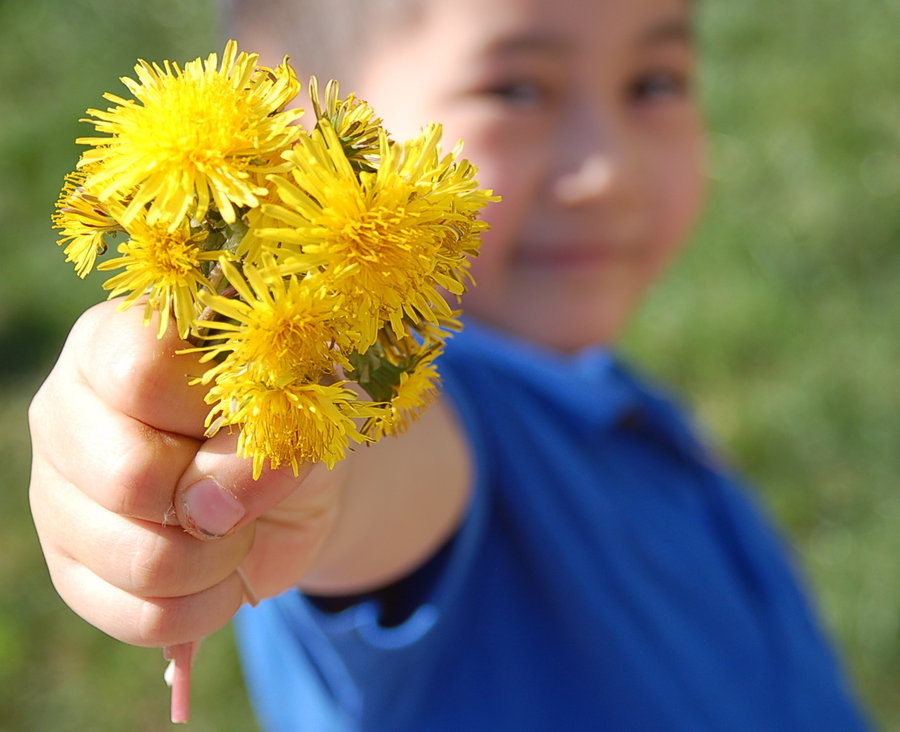
“You EAT them?” a little boy new to the neighborhood asks. He leans forward for the answer, his face ready to constrict in doubt.
Children already well acquainted with our family’s springtime ritual stop picking.
“Yeah!” they eagerly assure him, “They’re really good.”
They aren’t referring to a new vegetable in our garden. They’re talking about dandelions.
Herbalists tell us exactly what we need grows nearby. Those plants we call “weeds” may in fact remedy what ails us. They are so common that their properties are easily overlooked in a culture searching for packaged wellness. Plantain, mullein, comfrey,mint, mugwort,St. John’s wort, chicory and purslane spring up wild in my untreated lawn and garden. Weeds, but also powerful healers.
Today we’re picking dandelions in full flower. It isn’t about finding a remedy. For me the harvest is has to do with celebrating spring and affirming the beauty around us. For my children and our neighbors it’s about fun. I wait until the blooms are at their peak. Then I call friends and neighbors to announce, “Today is the day!”
Children spread out across the yard holding little baskets. A girl squats in front of each plant, pausing a long moment before she reaches out to pluck a flower from its stem. The oldest boy in the group walks by many dandelion plants to pick only those growing in clusters. And the newest little boy falls silent, as the rest of the children do, taking delight in the seriousness of the harvest.
European settlers brought the dandelion plant to this continent for food and medicinal purposes. The perennial spread easily across most states. It’s a testament to the power of herbicide marketers that such a useful plant became so thoroughly despised. Standing under today’s blue sky, I look at exuberant yellow rosettes growing in bright green grass and feel sheer aesthetic pleasure.
After the children tire of picking we sit together on the porch and snip off the dandelion stems right up to the flower. We mothers look over their busy heads—blonde, brown, black—and smile as we watch them stay at this task with the kind of close attention children give to real work. One girl remarks that the flowers look like the sun. Another child says her grandmother told her that in the Old Country they call the plant by the same name as milk because of its white sap. The newest boy chooses to line the stems neatly along the wide porch planking, arranging and rearranging them by length.
Every aspect of a ritual holds significance so I pay attention to the warm breeze, the comfortable pulse of friendship, and flowers so soft against my fingers they remind me of a newborn’s hair.
When we’re done the flowers are rinsed in a colander, then it’s time to cook them. I’m not a fan of frying. There are better ways to preserve the flavor and nutrients in food. Consequently I’m not very skilled. But this is easy. The children, their mothers and I drop the flowers in a thin batter, scoop them out with slotted spoons and fry them a dozen at a time in shallow pans.
After the blossoms cool slightly on paper towels they’re put on two platters. One is tossed with powdered sugar and cinnamon, the other sprinkled with salt and pepper. Handfuls are eaten in the kitchen while we cook. Then we carry the platters outside. Children run off to play in grass polka dotted with bright yellow flowers. We adults sit on the porch laughing and talking.
It’s suggested that we should be eating healthfully prepared dandelion greens and roots rather than indulging in delectable fried blossoms. That sentence fades into a quiet moment as a breeze stirs new leaves on the trees and lifts our children’s hair. I feel enlivened. Everywhere, around me and inside me, it is spring.
Flower Power Recipe
Gather dandelion flowers from areas free of chemical treatments or fertilizer. Pick in a sunny part of the day so the flowers are fully open, then prepare right away so flowers don’t close.
Cut away stem, as this is bitter, leaving only the green part holding the flower together.
Douse briefly in salt water (to flush out any lurking bugs). Dry flowers on dish towels while you prepare batter.
Ingredients
3 to 4 cups dandelion flowers, prepared as above
1 cup milk (dairy, soy, almond, coconut, any variety)
1 egg (or equivalent egg replacer product)
1 cup flour (slightly smaller amount of any whole grain alternative)
½ teaspoon salt
oil (frying is best with healthful oils which don’t break down at high temperatures, try safflower oil, coconut oil or olive oil)
Method
1. Combine milk, egg, flour and salt in wide bowl. Mix well. Heat an inch or two of oil in skillet (350-375 degrees).
2. Drop a dozen or so blossoms into the batter, stir gently to coat. Lift out with slotted spoon or fork. It’s best to hold the bowl over the skillet as you drop each blossom into the hot oil.
3. Turn flowers over to brown on both sides. Remove with slotted spatula to drain briefly on paper towels. Continue to fry remaining flowers using same steps. Toss cooked dandelions with sugar and cinnamon. Or salt and your choice of savory flavoring such as garlic, pepper or chili powder.
4. Making flower fritters is a speedier method than frying individual flowers. Simply drop flowers and batter into the oil by the spoonful, then turn like a pancake. Serve with jam, maple syrup or honey. Or try savory toppings like mustard, ketchup or barbeque sauce. These fritters are endlessly adaptable. Try adding sunflower or sesame seeds to the batter and serve with either the sweet or savory toppings.
What You May Not Know About Dandelions
The common dandelion, Taraxacum officinal, has been used in traditional medical systems around the world to boost nutrition as well as treat conditions of the liver, kidney and spleen; slow abnormal growths; improve digestion and more. Recently science has taken a closer look at this often scorned plant. No surprise, traditional wisdom holds up under scrutiny.
~Dandelions appear to fight cancer. Researchers testing for biologically active components to combat cancer proliferation and invasion note that dandelion extracts have value as “novel anti-cancer agent[s].” Their studies show dandelion leaf extract decreases growth of certain breast cancer cells and blocks invasion of prostate cancer. The root extract blocks invasion of other specific breast cancer cells and also shows promise inhibiting skin cancer.
~Dandelion extract lowers cholesterol. This, plus its anti-inflammatory and antioxidant qualities leads some researchers to believe that the plant may reduce the risk of atherosclerosis (hardening of the arteries).
~ Leaves, roots and flowers of the humble dandelion are fully edible. USDA National Nutrient Database analysis proves that a festive array of nutrition awaits any lawn harvester. One cup of chopped fresh dandelion greens are extremely rich in vitamins K, A and C as well as good source of vitamin E, thiamin, riboflavin, vitamin B6, calcium, iron, ,magnesium, manganese, fiber and omega-3 fatty acids.
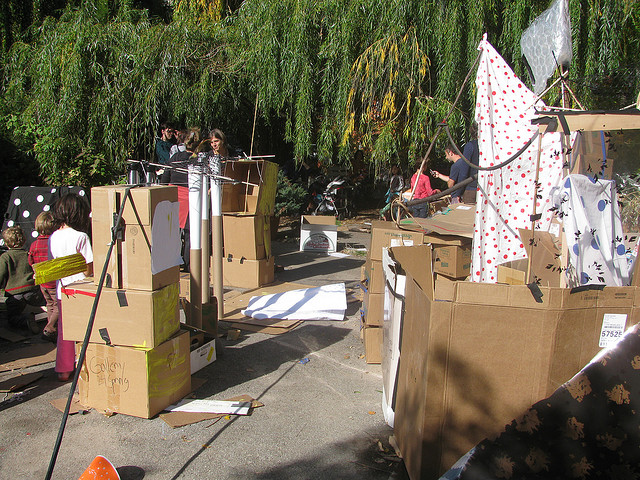
A large appliance box waiting at the curb has always been a call to action. We’ve done whatever is necessary to get it home, mostly dragging it behind our bikes or lashing it to the car roof. That because every refrigerator or washing machine box (as well as every smaller box) has another life waiting for it. One dreamed up by children.
When I was a little girl, we played for months with a tall furniture box. My mother fashioned a door and windows that opened like shutters. It stood in our basement ready to serve as a palace, fort, or playhouse. This box was large enough to fit my sister and me and a few of our friends. It lasted through the winter before sagging into uselessness. (Check out a wonderful gallery of cardboard creations on MyMakeDo.)
CC 2.0 edenpictures Flickr photostream
One of my favorite events to throw for the kids of friends and neighbors is a BYOB gathering. As in Bring Your Own Box. Guests are invited to show up with cardboard boxes of all sizes. We supply masking tape, duct tape, markers, paint, and plenty of room on our property. The adults wield mat knifes, cutting where the kids direct. Sometimes more than a dozen huge boxes are transformed into cardboard rooms featuring turrets and rope-opening drawbridges. Sometimes they are a connected series of tunnels leading to a fort under a tree. Once the kids made a child-sized passageway they invited to adults to enter, giggling as we stooped and crawled and squeezed our way through. The biggest thrill for kids seems to be in the planning, arguing for one vision or another, then working together to make the project a reality. Of course, playing in it afterwards is fun too. The benefit of hosting it here? Plenty of days to play in the box creation after the event is over.
A cardboard box-related program we ran at enrichment classes was a hit. We called it Junk Science. We saved cardboard boxes and cardboard tubes of all sizes, along with string, rubber bands, lids, paper clips, yogurt cups, and other creativity-inspiring loose parts. Each child or team was given equal amounts of this “junk” and on free days allowed to build whatever he or she choose. On other days they were given a specific challenge, similar to the old TV series Junkyard Wars. The kids built sorters that sent pennies down one chute and dimes down another, bridges that held weight, catapults that tossed ping pong balls, and much more. They preferred the specific challenges to free days, perhaps enjoying the way their ideas took off while solving a problem.
I know a boy who used to make vehicles and trains out of cardboard boxes. He hitched them together with ropes and dragged them around. This made cleaning up toys more fun, and conveying groceries from the front door to the cupboards became his favorite job. And I know a girl who used to make mazes out of boxes for her pet rats to scurry through, kissing them on their pink noses when they emerged to find a treat at the end.
I also know a child who made a world out of a refrigerator box, a world that continutes to absorb his interest for hours on end day after day.
You may have thought I’d list 955 other ways to play with cardboard boxes but any child can do that. Who wants to limit creativity to a list anyway? Start saving those free toys called boxes.
Before he was born, his mother decided her son would have no toys. Abandoned by the father, she was already a single parent. She made a living cleaning for other people. Most days she took the bus to affluent streets where children never seemed to play outside. As she vacuumed and scrubbed beautiful homes overfilled with possessions she paid close attention to what children did all day. Often they were gone at lessons, after school programs, or playdates. When they were home they usually sat staring at screens. Toys in their carefully decorated rooms appeared to be tossed around as if the small owners had no idea how to play, only how to root restlessly for entertainment.
She thought about it, talked to the oldest people she knew, and read everything she could. Then she informed anyone who cared to listen that her child would not have toys. Not a single purchased plaything.
Will (name changed) and his mother live in a small mobile home park. By most standards they are poor. Their income is well below the poverty line. They don’t have a TV or computer (although Will uses the computer at the library and watches the occasional TV program at babysitters’ homes). But their lives are rich in what matters. Together Will and his mom grow food on several shares of a community garden, bartering when they have extra produce. They make all their meals from scratch. These routines activate a whole array of learning opportunities for Will, quite naturally.
They are close to most of their neighbors in proximity as well as in friendliness. While his mother is working Will is cared for by several different seniors in their trailer park. He not only likes to help his mother garden, cook, and take care of their small home but he also likes to take part in helping his neighbors with small tasks. He carries groceries for certain ladies, helps an older gentleman with a birdhouse building hobby, and sometimes gets to assist another neighbor in automotive repairs. He gets a lot out of these meaningful tasks. Children long to take on real responsibility and make useful contributions. Giving them these opportunities promotes their development in important ways.
Sounds nice. But what about play?
When Will was a baby his mother made all sorts of toys. Most took no time at all. Food containers became stacking toys, a small water bottle with beans inside became a rattle, a sock stuffed with drier fuzz and tied in knots became a soft animal.
Will is now six years old. He plays as any child naturally does. He makes up games and turns all sorts of objects into toys. His mother saves money by not owning a car, so Will has commandeered a large portion of the shed that would normally be used as a garage. Mostly he uses it to stockpile his own resources. He has scrap wood, a few tools, and cans of nails. He likes to straighten bent nails for future projects, working carefully now that he recently discovered what smacking his fingers with a hammer feels like. Recently he found a discarded lawn mower tire, so he’s looking for three more tires to make a go-cart. In the evenings he likes to draw elaborate pictures of this upcoming project. He particularly enjoys playing in the soft dirt along the side of the shed where “robot men” he makes out of kitchen utensils use their potato peeler and wisk limbs to churn through the soil, leaving tracks as they clink. When he visits friends he happily plays with their toys, although he doesn’t always “get” that certain TV or movie-themed toys are limited to the plot-related storylines. So far he seems to have no urge to possess the same toys.
What about birthdays and holidays? Will’s mother does give him gifts. But she limits her gifts to useful items—crayons, clothes, tools, a compass. Each weekend her folk band practices at their mobile home. Will quickly mastered the harmonica and begged for time on the fiddle, so her big gift to him this year was a used child-sized fiddle. She urges the other adults in his life to gift him with experiences—a trip to the beach, a day of horseback riding, a visit to a museum. Out-of-town relatives now renew a children’s magazine subscription and send him regular snail mail letters, both of which are helping him learn to read with very little prompting.
Will’s childhood has a lot in common with the way children have learned and grown throughout history. As historian Howard Chudacoff notes in Children at Play: An American History, play is vital to development. It’s has everything to do with autonomy, exploration, imagination, and fun. It has very little to do with purchased playthings. In fact, structured programs and commercial toys actually tend to co-opt play.
Studies with rodents show those raised in enriched environments (toys and changing items in cage) have enhanced brain development compared to rats raised in a standard environment (plain cage, unchanging). We’ve misinterpreted these results. Rats don’t naturally live in boring, unchanging cages. They live in nature, which is by definition a challenging often constantly changing environment. In nature rats have far more complex lives than they ever might in a cage. Such an interesting life IS an enriched environment. It’s the same for children.
Sure there are devices that will “read” to a child. These are not more enriching than being read to by a responsive adult. And there are all sorts of adult-designed games. They’re not more fun or enticing than games kids make up on their own or with friends.
In fact, the overstimulation of blinking, beeping, passive entertainment isn’t beneficial for children. Joseph Chilton Pearce wrote in Evolution’s End: Claiming the Potential of Our Intelligence that the overload of television, electronics, and too many toys limits a child’s sensory awareness. Their brains and nervous systems accommodate intense bursts of sound, light, and color during their earliest years. Rather than developing the subtle awareness fostered by time spent in nature, in conversation, and in play they instead are wired to expect overstimulation. Without it, says Peace, they’re bored.
And yet, so many people are amused when tiny children are clearly pushed to the limits by a toy too overwhelming for them. (Every search for a video to illustrate this seems to think “baby scared by toy” is funny.)
The children Will’s mother cleans for, who are kept busy in adult-run programs and have access to electronic distractions, don’t have Will’s advantages. As he plays and innovates he’s actually promoting the kind of learning that translates to a lifetime of passionate interests. Studies show that children who are free to explore their interests without adult pressure and interference are more autonomous, eagerly pursuing excellence through healthy engagement rather than heavy-handed adult pressure.
Ask the oldest person you know to share some memories about play from his or her childhood. Chances are you’ll hear about pick-up games, handmade toys, and free time that spun long summer days into marvels of imagination. That’s what Will’s mother wants for her child.
Ask any child. When adults meet them for the first time, standard questions include, “What do you want to be when you grow up?” right after classics like, “What grade are you in?” and “What’s your favorite subject?”
Such questions, unintentionally, gauge a child’s progress toward adulthood. That’s because adults tend to be future oriented. We’re distracted from the present moment by the need to plan and work toward any number of goals—what to do about dinner, how to juggle next week’s schedule, when bills can be paid. These distractions take our attention away from what is in the here and now. When we think ahead so often we have less time to notice, let alone appreciate, what makes up our lives minute by minute.
What is impatience except denying the value of the present moment? The watercolor effect of rain on the window, the meandering quality of a child’s conversation, the long wait for a pot to boil—these can be occasions to experience impatience or opportunities to breathe deeply and be present, gratefully.
Leaning so often toward the future unconsciously demonstrates to our children that later is more important than now. Yet as we know, later never comes. As long as we’re alive there’s always “later” to strive toward. Worse, we are surrounded by advertiser-driven messages telling us that we aren’t there yet, that we need to do more or become something more in order to have friends, be successful, find love.
The nature of early childhood is the perfect antidote to this hurry-up attitude. That is, if adults truly pay attention to the lessons the youngest model for us. Young children who are not yet pulled by the adult world’s messages are oriented to the present moment. When forced to disregard what is vital to their bodies and spirits—pretending, daydreaming, playing, snuggling—they rebel. They are who they are, where they are. They’re not caught up in the future tense which dimishes the here and now. They demonstrate the oldest way of knowing.
Pay close attention to the youngest children in your life. Let them help you learn solutions to our cultural overdrive.
As we slow down we have time to truly know each other and to truly know ourselves. We’re more aware of the messages our bodies send us and can act on those signals before they become symptoms. We have time to reflect. Time to remember our dreams when we awaken. After all, time is the only true wealth we have to spend.
Sophie is a single mother raising a five-year-old boy. She’s working to establish her own house cleaning business after losing her job nearly two years ago. Sophie and her son live in a small trailer home.
Marissa and Jack run a thriving dental practice while raising five-year-old twin daughters. They live in a suburban home on several acres.
The five-year-olds from these families are at opposite ends of the economic spectrum. But their parents are raising them in remarkably similar ways. Frugally.
Although Sophie would prefer a more reliable income, she wouldn’t spend a cent more than she already does on herself or her son. She adheres closely to simple living tenets. Sophie grows as much food as possible in a community garden plot and makes meals from scratch. She and her son fully enjoy the free benefits of the local library and park system. On weekends, Sophie’s folk band crowds into her trailer for practice sessions. Her son is already learning how to play the harmonica and fiddle. Sophie believes he should rely on his imagination for fun rather than on toys. When she does buy him gifts, they tend to be modest items such as crayons or socks, or ones that have long- term use such as simple tools or sheet music.
Marissa and Jack choose to live simply in their own way. They buy clothing and their children’s playthings from thrift stores, exchange only homemade gifts, and emphasize having fun outdoors. They carefully consider expenditures based on their ethics. Health is a priority, so they buy only organic foods and belong to a CSA. Supporting the arts is another priority so they invest in original works to hang on their walls and regularly attend plays, concerts, and gallery events. They strongly believe in the importance of international travel. When they go to far-off places, they get around by bike or local mass transit, a method they find brings them closer to the cultures they’re visiting.
Many of us are living more frugally. It certainly eases financial strain. It also makes a difference in wider ways, from reducing our ecological footprint to promoting social justice.
Today’s relentlessly materialistic culture tells young people in every way possible that their identity is built on wearing, playing with, and using the very latest consumer products. That’s a heavy tide to fight against on the home front. But that tide is worth turning.
Living simply puts the emphasis on exactly the conditions that are best for our kids, now and as they grow into adulthood.
Shelter From Commercialism
Humanity has always raised her children with the stories, foods, rituals, and values of particular meaning to the people close to them. While there are undeniable benefits to today’s connections and conveniences, a major drawback is the way advertisers have insinuated themselves into the lives of even the youngest children. Nowadays, a child’s stories, foods, rituals, and values are more likely than ever provided by the marketplace. And we know what’s preached there – that meaning comes from what can be bought.
Every year, a 15 to 17 billion dollar marketing industry is aimed at our kids. That money is spent because it’s effective. It’s estimated that 565 billion dollars in purchases are influenced by four- to twelve-year-olds.
Susan Linn, who teaches psychiatry at Harvard Medical School, notes in Consuming Kids: The Hostile Takeover of Childhood, that psychological and neurological research is used to exploit the vulnerabilities of children. She writes, “The explosion of marketing aimed at kids today is precisely targeted, refined by scientific method, and honed by child psychologists – in short, it is more pervasive and intrusive than ever before.”
These strategies are not only employed in advertising itself but are embedded in Internet sites, video games, television, and movies. They’re designed into packaging, implicit in many playthings, and nearly ubiquitous in schools.
Those of us who live simply shelter our kids in different ways and to differing degrees. No matter what approach we take, it’s neither possible nor desirable to shelter teens the same way we shelter toddlers. That’s why it’s vital to raise our kids to be critical thinkers with a strong sense of self. Then they’re empowered to make their own fully informed choices.
Delayed Gratification
This is a biggie in the “you’ll thank me later” department because kids who are able to delay gratification are much more likely to do well as they grow up.
We model delayed gratification each time we choose to save, make do, or make it ourselves. We demonstrate it when the whole family adds coins to a jar until there’s enough to finance an anticipated event. We teach it when we help children find ways to earn and save for their own aims. And we show that it’s expected whether our kids have to wait to see a movie until it’s available at the library or wait until the next birthday for a new pair of jeans.
This may seem negative, particularly when popular culture constantly screams “have it now” and “get what you want.” But there are enormous positives. Our children become familiar with the pleasures of anticipation, which multiplies the eventual delight when a goal is reached. They also begin to internalize the ability to delay gratification. In multiple studies (cited in Daniel Goleman’s book Emotional Intelligence) children who were able to defer gratification grew into teens and young adults who were more socially competent, better able to deal with frustration, more dependable, reached higher educational attainments, and were effectively able to make and reach long-term goals.
Delayed gratification is related to impulse control. Research shows that a child’s ability to control his or her impulses at an early age is predictive of success even decades later as a healthy, financially stable, and positive member of the community. There are many ways to help kids gain the positive coping skills that help them control their impulses and delay gratification. It may be about waiting, but the outcome is extraordinary.
Happiness
Despite advertisers’ images of happy children playing with new toys and giddy teens dancing in designer hoodies, the facts are glaringly obvious. Things don’t make us happier. Children seem to understand the “time is money” conundrum. When their parents spend more time away from home earning an income, they have less time to spend with the family. In a nationwide poll of American kids ages nine to fourteen, ninety percent said they’d prefer increased time with friends and family over material possessions. And when asked if they could have one wish to change their parents’ jobs, sixty-three percent said they would like their mom or dad to have a job that gave them more time to do things together. Only thirteen percent wished their parents made more money.
The more materialistic young people are, the unhappier they tend to be. According to research cited in The High Price of Materialism by Tim Kasser, people who hold materialistic values are more likely to suffer from a whole dumpster load of problems. This includes aggressive behavior, insecurity, depression, low self-esteem, narcissism, even physical maladies. And when people place high value on material aims, they’re prone to have trouble with interpersonal relationships and intimacy. Materialism is also related to less independent thinking and lower value placed on being “true to oneself.” Of course, we want to spare our kids this festering personal mess.
How? We recognize that a sense of well-being depends on intangible qualities like warm interpersonal relationships and reasonable autonomy in one’s choices, exactly those things that money can’t buy. But what’s interesting is that materialism and unhappiness seem to “cause” each other. We all know people who exemplify this. Unhappy people tend to seek status and satisfaction in more transitory ways such as acquisition and appearance. When they do, they feel a temporary boost in happiness, which reinforces even greater materialism.
Studies show that happiness has much more to do with experiences than with possessions. A family camping trip will provide more lasting pleasure than a large purchase. That may be due to the way we access memories. Long after the experience is over, we have fuller sensory-based recall that’s invariably richer than any a purchase can provide.
It’s important to model a cheerful approach to simple living for our kids, but that’s not enough. To ward off materialistic attitudes, our children need the personal strength found in the self- worth that comes from supportive relationships and a sense of accomplishment. In a marvelous example of synchronicity, these are precisely what simple living reinforces in our daily lives. We consciously choose to do for our- selves, to spend more family time together, and to focus on active rather than passive entertainment.
Creativity and Enthusiasm
Many adults seem determined to keep kids busy by enrolling them in supervised activities. And they provide kids with plenty of distractions like toys, video games, and television. Unintentionally, these efforts teach children that fallow time is undesirable. But brain studies show that daydreaming, contemplation, even that uncomfortable condition we identify as “boredom” is vitally important. These natural periods of down time are necessary to incorporate higher level learning and to generate new ideas.
If we expect children to resolve their own boredom without resorting to electronic or other distractions, we help them access a wellspring of ideas that seem to come from nowhere, a wellspring they discover within. Frugal living is one way to preserve a slow pace and minimal distraction load, letting our children become familiar with generating their own ideas.
When we live frugally, we also tend to avoid popular methods of “enriching” our children’s lives such as academic preschool, specialty classes, coached sports, and other paid programs. That saves on fees. It also fosters the kind of expansive learning that’s natural for our species. Research continues to show that when adults are highly directive and exert influence even in the form of rewards or evaluation, their efforts actually diminish a child’s motivation, enthusiasm, creativity, and ability to innovate. Well-intended efforts to hone a child’s abilities through early instruction tend to be counterproductive.
That’s also true of play. Our kids don’t need expensive toys or games. Children’s creativity and resourcefulness flourish when they play without the structure imposed by most playthings. Imagination flows freely when they use what they find in the backyard to play act, build hideouts, or create their own games. In contrast, a toy linked to a movie release or a game with structured rules has predetermined uses and children are much less likely to innovate.
Stuart Brown and Christopher Vaughn write in Play: How it Shapes the Brain, Opens the Imagination, and Invigorates the Soul that, “play lies at the core of creativity and innovation.” It enhances development in areas such as emotional health, social skills, motivation, confidence, a sense of justice, and much more. Young people who maintain a playful nature into adulthood are, according to Brown and Vaughn, remarkably well suited for success. A playful adult is more flexible, humorous, optimistic, and efficient. They note that throughout life, “the ability to play is critical not only to being happy, but also to sustaining social relationships and being a creative, innovative person.”
When our frugal homes provide plenty of raw materials necessary for play without up-to-the-minute popular toys, we’re putting into place the best conditions for sustaining creativity and playfulness.
Self-Reliance And Responsibility
There’s a resoundingly positive impact on our children when we include them in the real work of maintaining our family home, yard, vehicles, and more. Children growing up in frugal households often have regular chores. While some complaining is natural, chores help children understand how things work. They see the benefits of saving as they do calculations for the family budget. They recognize what happens if they forget to take the dog out or don’t bring the laundry in from the line before it rains. They take extra pleasure in the warm fire from firewood they helped to stack. Chores also enable children to master useful skills that will help them become more self-reliant adults.
Taking on early responsibility brings long-term consequences. A study, starting in the 1930s, followed men from young adulthood to death. These men had very different lives; some were affluent Harvard graduates and others were impoverished inner city residents. The men who helped out with regular tasks starting at a young age were most likely to enjoy stability and good mental health.
And there’s more evidence. A long-term study followed children from early childhood to their mid-twenties. What led to success? Balancing all other variables, it was found that the best predictor of a young adult’s success was participation in household tasks at a young age. And we’re talking resounding success – including educational attainment, high intellectual capabilities, a career, and good relationships with family and friends.
The optimum age to get started is three or four years old. According to researchers, starting in the preteen or teen years doesn’t have a strong association with success, although children who take an active role early continue to help out as teens. It’s important to gear the task to the child. Parents should take care to present tasks that aren’t too difficult and that fit the child’s learning style, and not to “pay” for tasks directly or through an allowance tied to the work. Researchers also suggest that children be involved in choosing tasks, perhaps through family meetings or rotating chore charts.
They key to success may also lie in the sensory riches gained by hands-on tasks. Those of us who live simply tend to do more for ourselves. We may grind our own grain and make our own bread, we may raise chickens and barter the extra eggs for a local beekeeper’s honey, we may fix rather than replace what’s broken. And when our kids take part they also gain learning experiences that apply to many other areas of life.
Neurologist Frank Wilson explains in The Hand: How Its Use Shapes the Brain, Language, and Human Culture that brain development and hand use is inextricably connected. And Wilson found a transfer effect. As he studied people who were masters in all sorts of fields (surgeon, puppeteer, and guitarist to name a few), he found each of them had engaged in regular hands-on efforts during their formative years. Whether they grew up doing farm work, playing a musical instrument, or helping grandpa build birdhouses,Wilson says the hand-brain link activated “hidden physical roots . . . of passionate and creative work.”
Starting our kids on tasks at an early age blesses them with self-reliance and a greater likelihood of success. It also demonstrates to them day after day that their efforts are needed. A child can see the outcome of his or her efforts in a meal the whole family worked to get on the table. It feels good. It feels even better is when a parent says, “Thanks, I couldn’t have done it without you.” There’s not a commercial product out there that can create the same genuine satisfaction.
Sophie’s little boy and Marissa and Jack’s twin daughters know that satisfaction. Their young lives have ample time for play, working alongside adults, and warm family conversation. The children soak up their parents’ values while learning and growing largely free of commercial influences, at least for now. Their parents have never met each other but they have the same focus. They see simple living as an integral way to bring forth a more conscious and life sustaining future for their children.
It’s a family joke that I am unable to follow a recipe. Not a funny joke but completely true.
I can’t help myself. I tweak the kind of flours and fats, ramp up the spices, toss in a few extra ingredients, adjust the methods used. Yes this approach alters a recipe beyond recognition. But my family will admit the end result usually tastes good even if they like to ask, “Okay, now tell us what’s really in here.” That’s because I’ve been known to put chard in popsicles, beets in dip, and beans in brownies.
Sometimes I try, really try, to follow a recipe to the letter. There’s the real joke. Because when I do the results are awful. The casserole is tasteless, the biscuits are scratchy, and the cookies slump into pools of goo. Clearly improvising is the best route for me.
What I really like about improvisation is facing the challenge our great grandparents faced as they ran frugal households. The same challenge accepted by cooks every day all over the world. Very simply, to use everything well while wasting nothing. This is more about necessity than anything else. It means the cook knows what is in the garden, pantry, and refrigerator at all times. She knows a hard frost is coming, so the rutabagas can stay in the ground but the green tomatoes must be picked. She remembers that the potatoes in the pantry are starting to soften and must be used right away. She knows the lentils made two days ago have to be served or frozen. She finds ways to use carrots going limp and cheese getting dry. She purees leftover soup to make sauce for an entrée and turns yesterday’s roast chicken into today’s enchiladas. In our current economy it’s not a game for many of us. This real life pursuit is more interesting and more rewarding than any competition faced on Top Chef.
I find the creative aspect downright addictive. So tonight, when our dinner guests called to say they were running late I realized I had time to make another dip to serve alongside our homemade salsa. I turned up the music and started pulling out potential leftovers. A few ounces of cream cheese abandoned when the asymmetrical but tasty homemade bagels ran out, a few spoonfuls of leftover canned chile in adobo sauce, a large cooked sweet potato. Probably doesn’t sound like a dip. Except to this recipe heretic.
I warm the cream cheese a little, then mash half the sweet potato with a fork and mix in a bit of the chile in adobo sauce. The texture is awful and the taste is nothing like dip. So I toss it in the blender. Nope, it’s too thick to blend. I add a dollop of sour cream. Blend. Oh, nice orange-y color. Taste? Needs something. I toss in a pinch of dry chipotle powder and a dash of salt. Blend. Taste. Needs more heat so I add a bit more chile in adobo sauce. Blend. Taste. It needs some freshness. I have green tomatoes, tomatillos, and peppers but I don’t think I’m aiming for a raw element. Instead I pour off a tiny bit of the liquid from the salsa we canned. Blend. Oooh, it’s good. Still needs something to round off the strong edge. Hmmm. Maybe this sort of spicy will benefit from a little sweetness. I think about putting in applesauce but first try drop of our honey. I give the blender another whirl. Perfect!
The doorbell rings, the dogs bark, and our friends come in bringing lively conversation. My improvised dip is there on the table next to the salsa, waiting to be scooped up with blue chips. The colors are an aesthetic delight and the use of leftover ingredients satisfies my frugal heart. But what’s really a pleasure is watching the whole bowl emptied by friends who rave over the taste even after I confess that it’s made out of sweet potato. In a heavenly kitchen somewhere I hope those great grandmothers nod their approval.
*
Subversive Cook is now the title of my next book. I’m slow at work on it. See how you can contribute at subversivecook.com or get in touch with me using this site’s contact form.
My husband is the bee inspector for two counties. He meets interesting people every time he goes out to another apiary. If he lingers after the heavy work of opening hives, the conversation invariably heads in the direction of self-reliance. People tend to talk about making home and equipment repairs, canning and freezing a garden’s bounty, earth-respecting ways of farming, living on less. It seems everywhere around us people are doing what they can to save. They’re also working harder to connect with others who have experience and talents to offer.
After two years of searching for full-time work my husband is well acquainted with these topics, but also because we’ve spent decades trying (sometimes with slapstick results) to live well on less. We make do, repurpose, and enjoy frugality without making a fuss about it. It’s a work in progress, as we’re still trying to gain reasonable proficiency in skills our great grandparents took for granted.
The times we live in are tossing millions of people in this direction whether they go willingly or scream all the way. It isn’t easy. It probably isn’t fair either. Our current economic downturn came after a long slide of wealth slipping from middle class hands into the tight grip of the wealthy. Nearly 8 million jobs are gone, many possibly for good. Yet the richest among us have actually increased their holdings.
Some of us have lost the illusion of security. Some of us have lost much more—jobs, health care, pension funds, and homes. All of us have been forced to grow a little. That’s part of a larger shift. Insecurity pushes us to pay closer attention to our core values. We’re recognizing that purchases don’t really buy happiness and as a result, saving more than we have in decades. We’re doing more for ourselves and still reaching out to help others. We’re as ingenious, adaptable and happy as we choose to be.
The shift is even more noticeable when we see certain long-established structures around us breaking apart, with more cracks appearing every day. Just look at what’s happening to prescribe-and-placate medical models, inflexible financial institutions, condemning religious frameworks, and rigid corporations.
But these current conditions of breakup, economic chaos, and environmental decline are exactly those which are (slowly) leading to beneficial change. Collectively we’re waking up to the weakness of limited thinking and short-term fixes. Hopefully we’re also waking up to the reality that we’re in this together—rich and poor, developed and developing nations, young and old, left and right.
We see in our own lives that what’s important can’t be measured by dollars alone. Things like good health, supportive relationships, a vital ecosystem as well as economic security. Even the word “wealth” is derived from the Old English term “weal” which means “well-being.”
Less than two months before he was assassinated, RFK said in a speech,
“…America is deep in a malaise of spirit: discouraging initiative, paralyzing will and action, and dividing Americans from one another, by their age, their views and by the color of their skin and I don’t think we have to accept that here in the United States of America.”
He went on to say,
“For too long, we seemed to have surrendered personal excellence and community values in the mere accumulation of material things… The Gross National Product counts air pollution and cigarette advertising, and ambulances to clear our highways of carnage. It counts special locks for our doors and the jails for the people who break them. It counts the destruction of the redwood and the loss of our natural wonder in chaotic sprawl. It counts napalm and counts nuclear warheads and armored cars for the police to fight the riots in our cities. It counts Whitman’s rifle and Speck’s knife, and the television programs which glorify violence in order to sell toys to our children.”
“Yet the gross national product does not allow for the health of our children, the quality of their education or the joy of their play. It does not include the beauty of our poetry or the strength of our marriages, the intelligence of our public debate or the integrity of our public officials. It measures neither our wit nor our courage, neither our wisdom nor our learning, neither our compassion nor our devotion to our country, it measures everything in short, except that which makes life worthwhile.”
Time to clarify what we mean by well-being—for ourselves, our economy and our future.
Imagine someone with Jane Goodall’s observational powers coming from outer space to observe us for a few days.
Let’s narrow this alien’s study down to something relatively simple. Our imaginary alien doesn’t have time to report on Earth’s progress toward peace, justice, and environmental balance. Our imaginary alien doesn’t even have time to cast her gaze across the whole planet.
Instead, the alien watches a few children in a typical American suburb before filing this report. (Alien disclaimer: this report isn’t representational of all humans or all time spans on Earth.)
*
How to Impede Humanity
Each human is born with vast potential which unfolds in ways unique to that person’s talents and experiences. Human culture starts immediately to prevent that newborn’s potential from being fully realized.
The smallest humans are kept for much of their waking day in devices called car seats, booster seats, high chairs, playpens, cribs and strollers. Without sufficient and varied movement, learning can be impeded.
They are kept indoors most of the time. This limits their vision, their sense of connectedness, and their happiness.
Instead of foods harvested directly from nearby sources, the taste preferences of these small humans are developed on diets of lower nutrient but more expensive packaged substances. The health effects of these foods is beyond the scope of this report. It is, however, noted that transporting and purchasing these foods has an economic impact on the families of these small humans.
Humans are a people of story and image. As small humans get older they more readily absorb the lessons surrounding them from such objects as billboards, magazines, television, video games, and toys. These stories and images teach humans that success and happiness come through power, the right possessions, perfect appearance, rare skill, and of course, wealth. Small humans learn this quickly.
For example, appearance. They are repeatedly exposed to images of impossible bodies. Note evidence—-a process called retouching applied to human Jennifer Anniston and to humans Twiggy and Keira Knightley. As a result, five year old females judge their bodies harshly. By what humans call adolescence, 92 percent of females are unhappy with their bodily appearance.
Males also experience self-loathing due to impossible body images and behavior of heroes in movies, video games, and comics.
Movies, television, politics, and pundits teach small humans that the world is more violent than it is and games teach them that aggression is the best response.
The whole market-driven culture pushes materialistic values on young humans, which can leave them depressed, anxious and unhappy when they most need the powerful boost of optimism.
Even though young humans are perfectly suited to learn in ways matched to their abilities and interests without coercion, even though humanity has evolved throughout time by learning directly from wisdom-bearers in their own fields, these youth are put in institutions called schools. There each young human is judged by pre-determined standards. A large percentage don’t measure up.
It has been determined that the primary need of young humans is for self-expression, reasonably consistent guidance, and what on Earth is called love.
It is beyond the scope of this field report to discuss all the factors impeding humans but this observer notes that humanity flourishes due in large part to the overwhelming ability of human families to raise children using tools of kindness, laughter, and true affection. These behaviors are observed every moment, shared freely. This seems to be the essence of this species, so the report overall views humanity’s progress as positive.
(We prefer, however, that humans stick to their own planet. See the following video update.)





 , play is vital to development. It’s has everything to do with autonomy, exploration, imagination, and fun. It has very little to do with purchased playthings. In fact, structured programs and commercial toys actually tend to co-opt play.
 that the overload of television, electronics, and too many toys limits a child’s sensory awareness. Their brains and nervous systems accommodate intense bursts of sound, light, and color during their earliest years. Rather than developing the subtle awareness fostered by time spent in nature, in conversation, and in play they instead are wired to expect overstimulation. Without it, says Peace, they’re bored.


 , that psychological and neurological research is used to exploit the vulnerabilities of children. She writes, “The explosion of marketing aimed at kids today is precisely targeted, refined by scientific method, and honed by child psychologists – in short, it is more pervasive and intrusive than ever before.”
 by Tim Kasser, people who hold materialistic values are more likely to suffer from a whole dumpster load of problems. This includes aggressive behavior, insecurity, depression, low self-esteem, narcissism, even physical maladies. And when people place high value on material aims, they’re prone to have trouble with interpersonal relationships and intimacy. Materialism is also related to less independent thinking and lower value placed on being “true to oneself.” Of course, we want to spare our kids this festering personal mess.
 that, “play lies at the core of creativity and innovation.” It enhances development in areas such as emotional health, social skills, motivation, confidence, a sense of justice, and much more. Young people who maintain a playful nature into adulthood are, according to Brown and Vaughn, remarkably well suited for success. A playful adult is more flexible, humorous, optimistic, and efficient. They note that throughout life, “the ability to play is critical not only to being happy, but also to sustaining social relationships and being a creative, innovative person.”
 that brain development and hand use is inextricably connected. And Wilson found a transfer effect. As he studied people who were masters in all sorts of fields (surgeon, puppeteer, and guitarist to name a few), he found each of them had engaged in regular hands-on efforts during their formative years. Whether they grew up doing farm work, playing a musical instrument, or helping grandpa build birdhouses,Wilson says the hand-brain link activated “hidden physical roots . . . of passionate and creative work.”


 Laura Grace Weldon