Holding Together

Hubble telescope poem

Too Little


Nose pressed in tiny squares

against the screen, I watch

casual laughing gods

walk home from school.

I envy their long legs

and glossy notebooks,

their unseen power

to unlock

words from shapes,


My sister drops A+ papers

and library books

on the speckled Formica table.

Asks me how many times

a butterfly flaps its wings.

Tells me I’m wrong.

Eats two cookies.

Announces we’re made up

of tiny things called cells,

made up of tinier things

called atoms,

also made of what’s smaller.


The kitchen walls stretch

to galaxy proportions,

the table a raft among stars.

I hold tight to my chair

and concentrate,

keeping my short legs,

my clumsy fingers,

the balloon of my body,

from dissolving into bits.


Laura Grace Weldon


Originally published by Litbreak. 

Poetry Writing Hacks: 7 Playful Ways To Create Poetry

Spine poetry

Spine poetry

I’m eager to liberate poetry from that stuffy good-for-you closet where it’s so often kept. That is, as long as I can do so playfully.

Each time I lead poetry-writing workshops I learn from students as young as eight years old. I see them write in a direct line from experience to meaning, use metaphor intuitively, and fiercely adore their own work. Our time together often looks like crafts or games, but it’s much more. We draw faces on peanut shells, glue them to cardboard, and write poems around them. We use bright permanent markers to adorn an old footstool or rocking chair with poems to make a classroom Inspiration Seat. We ask stones to tell us what they’ve seen over their long geologic history, then write down our impressions. We compose from the perspective of carrots as we bite, chew, and swallow them. We write on prayer flags to let poetry fly with the wind. We write and release poems in public places for others to find. It’s never, ever boring.

The following poetry writing hacks are fun to do with kids. But don’t forgot they’re great to do with anyone—your book group, at a family reunion, as a party game, even to liven up a meeting.


Stack up spine poetry

Ever noticed a stack of books with titles that, together, form unintentional wordplay? That’s spine poetry. Over 20 years ago, artist Nina Katchadourian started the Sorted Books Project,  creating clusters of books that display clever idiosyncrasies and themes. (Some images were published under the title Sorted Books.)

To create your own spine poetry start by looking through books you have on hand and pull out titles that appeal to you. Then arrange them spine out to form poems. Take a photo to preserve your literary remix. If you’d like, share your images on Twitter as #spinepoem or #spinepoetry.


Play Exquisite Corpse

This absurdly pleasing game was dreamed up during the Parisian Surrealist Movement. There are a variety of approaches. Basically you start with a good-sized piece of paper. Each person writes a phrase or sentence, folds the paper to conceal lines from previous contributors, and passes it on to the next player with only the newest passage revealed. Keep going around until the paper is used up, then read the whole construction aloud.


Encounter unexpected poetry

Collect a variety of everyday objects. You might come up with an apple, peanut butter jar, mitten, shoe, flashlight, toy dinosaur, and nightlight. Then label each object by taping a word where it can’t be readily seen, perhaps folding the word to the inside or hiding it underneath. You don’t want the labels to read “apple” or “peanut butter jar.” Instead use unrelated yet evocative words like “beast,” “messenger,” “neck,” “song,” “intention,” and so on.

Each person picks one of the objects and writes a poem fragment leaving a blank for the object. If someone gets stuck, encourage them to simply write two or three adjectives and a verb. You might study the apple, then write, “Red, round _____ crisp on my tongue.” When the apple is turned over, a label reading “silence” transforms the poem fragment into: “Red round silence, crisp on my tongue.”  Or you might pick up the flashlight, write, “High intensity _______ let’s me see where I’m going” only to find that it’s labeled “wrath.” Change word tense to fit the poem fragment as necessary. If inspired, turn the fragment into a longer poem.


Keep a perpetual poem going

There’s something freeing about adding to an evolving verse. There are no rules, only possibilities. Start it with a line stuck with magnets on a file cabinet or fridge door. Or paint a cupboard,  wall, even your car with chalkboard paint  — keeping chalk handy for anyone to use. Or cut strips of paper to leave out in a container next to a jar of markers and a box of poster tack, letting contributors stick the next line right on the wall. In my house we use dry erase markers on a laminated world map mounted in the kitchen.


Make collage poems

Collect words and phrases from all sorts of sources such as food containers, magazines, and junk mail. Provide heavy paper or mat board so each person can glue their word choices into a collage poem.


Write an erasure poem

Choose a page from a magazine, newspaper, or unwanted book, then blot out some of the words to reveal a new meaning. You can also make erasure poems digitally using the Erasures site via Wave Books. They provide classic texts and the e-tool for erasures. Check out Austin Kleon’s erasure poems in his book Newspaper Blackout.


Pull a poem from a bag

Romanian poet Tristan Tzara was denounced by his fellow Surrealists when he proposed making a poem by pulling words from a hat.   In 1920 he wrote “Dada Manifesto on Feeble & Bitter Love” which contains these instructions:

To Make a Dadaist Poem

Take a newspaper (or magazine or other printed resource)
Take some scissors.
Choose from this paper an article of the length you want to make your poem.
Cut out the article.
Next carefully cut out each of the words that makes up this article and put them all in a bag.
Shake gently.
Next take out each cutting one after the other.
Copy conscientiously in the order in which they left the bag.
The poem will resemble you.
And there you are – an infinitely original author of charming sensibility, even though unappreciated by the vulgar herd.


This article was originally published in Poet’s Quarterly.

Calling the Dog


a

 Calling the Dog


Following messages left in leaves, soil, air

he wanders too far.

When I call    he pauses

quickening

to hurl fullness and glory

ahead of the self

like whales breach, tigers lunge, hawks soar.

There’s nothing but an arc

between hearing his name and springing

toward the one who named him.


I want this completeness.

I want to feel 100 trillion cells spark

from my body in answer

to what we call spirit.

I want to taste

the shimmering voltage course

from every rock, tree, star.


A moment before reaching me

he unsprings,

back to golden fur and brown eyes

arriving tongue first.


Laura Grace Weldon

from Tending  (for my friends Cocoa Bean and Winston)

Everyone Is A Poet

everyone is a poet

When people tell me their largest stories I am helpless as a page under pen.

A woman told me how, as a child of 11, she struck out when her grandparents were ignored rather than served at a restaurant in the deep South. Her anger was so heated that she used the restaurant’s complementary matches to start the place on fire.

It wasn’t entirely the content of the memory or the force in her voice. It was the way she strung words together; spare yet detailed. She talked about her grandmother’s arthritic hands picking up and putting down a salt shaker. She described her grandmother’s dark green dress and sensible heels, the patient smile she wore even though no one came to take their order. Before this raised-up-North granddaughter could utter a word of complaint she was shushed by her grandmother’s stern look. As her grandparents stood to go the girl ducked into the cloakroom and in seconds set to smoldering the hair oil soaked fedoras left there by white gentlemen. Of the fire she said little, except that the restaurant was forced to turn everyone away that day.

A teen described how, when he was a small child, his mother got so strung out that she’d leave him alone for days at a time.

He ended most sentences with “you hear me” and “wasn’t nothing” as he talked about licking his fingers before running them along the insides of drawers and cupboards to find crumbs. He said his mother got angry if she caught him sleeping curled next to the apartment door. She’d yell “I didn’t raise no dog.” When his story ended a refrain continued. He said “wasn’t nothing” four times, each repetition softer until his moving lips made no sound at all.

An elderly woman recounted the story of union busters coming by their cabin at supper time to beat up her father, who’d been organizing his fellow coal miners.

She didn’t recognize her own family any longer but vividly remembered this tale from her earliest years. Her words were impressions. I saw her mother standing fearfully at the door insisting her husband wasn’t home, children clustered behind her wide-mouthed with alarm. I envisioned this little girl with the presence of mind to hide her father’s dinner dishes. “Just laid em in the stove with a cloth over,” she said. When the men barged in they found only enough place settings for mother and children on the table. They left, never looking under the porch where her father hid. She had no other stories left to tell. This one was large enough for a lifetime.

Not only do I feel what they’re saying, I’m awestruck by how they say it.

When people talk about extremes they’ve experienced they speak as poets do. They rely on verbal shorthand made up of sensory description and metaphor. They drift from past to present, change viewpoints, dip into myth and scripture. Often they end abruptly, as if what they’re trying to say can’t truly be said. Their stories, powerful already, gain a sort of beauty that sends ordinary language aloft. It’s truth that trembles. To me, it’s poetry.


This essay first published in Poet’s Quarterly.


17 Ways to Show Authors Your Love

image: vjcx.com

We know how to love celebrities and athletes in our culture. We hashtag them, go to their performances/games, read about them, imitate them, talk about them, and in many other ways make these people an ongoing presence in our lives. (Note: there may be a strange reason we’re so obsessed with celebrities.)

It’s less common to love writers, far less common to show it.

Today’s publishing houses expect authors (other than the most commercially promising ones) to do their own book marketing. We’re expected to blog, tweet, arrange book signings and readings, do interviews, and otherwise connect with potential readers as if there’s nothing awkward about begging people to buy our words.

But we know that books, articles, essays, poems, posts, (actually, all forms of writing) live on only when they’re read. It’s even better if they’re discussed, shared, and remembered. My writer friends and I do our best to promote one another’s work to a wider audience. Most writers do this for each other. If you’re inspired, take a tip or two from us and show some authors your love.

Share a great author interview or book review. Share a passage from a book, article, blog post, or poem. Toss it out there on Twitter, Instagram, Facebook, whatever platform you use.

Quote. If you’re writing a report or giving a presentation, sprinkle in a relevant quote or line of poetry. It’ll add another dimension to your work.

Review books you love on Goodreads.com, LibraryThing.com, Amazon.com, BarnesandNoble.com, wherever you go to check reader reviews. You can make it easy on yourself by simply leaving a bunch of stars. Take it up a notch with a glowing one-line opinion. On Amazon, you only need to click “like” to boost a book or other people’s reviews of the book. Your viewpoint really does help potential readers find what to read next.

Advocate for writing that has changed your outlook, expanded your interests, led you in entirely new directions. A few months ago Facebook bristled with personal lists of 10 Life Changing Books. I love hearing what books impact other people and I’m often inspired to read those titles too. (Here are 10 that occur to me at the moment: The Secret GardenOriginal Wisdom, The Continuum Concept,  Nature and the Human Soul,  A Paradise Built in Hell Pronoia Is the Antidote for ParanoiaMan’s Search for MeaningBeyond WarSpontaneous EvolutionListening for the Heartbeat of God.

Give books as gifts. They make wonderful presents for birthday, holidays, and milestone celebrations. They make wonderful business gifts for clients and great promotions for related products. They’re great to give simply when it occurs to you that a specific book and a specific person might go well together. Give books to children for special occasions but also for fun. Don’t forget to leave an inscription even for the youngest. If you like, pair a book with a small related present. Tea, coffee, or something more spirited is a perfect accompaniment to any book gift.

Try something different. Indulge in your favorite genres and let yourself branch out from there. A fan of historical novels set in a certain era? Try poetry from that time period, non-fiction books about the art or science of the era, biographies of people from that time, as well as history magazines and related sites. I’ve come across writing I normally wouldn’t read only to discover a passion for science-y novels, tomes on evolutionary biology, sites offering vintage maps, work by outsider artists, and other fascinations.

Request. I couldn’t possibly afford to buy a fraction of the books I read. Instead, I’m a unrepentant library addict. If there’s a book you’d like, order it from your local library. They’ll call or email you when it’s available. If they don’t own a copy, ask them to purchase it. Some library systems put request forms online, other systems prefer you go directly to a librarian to request a book acquisition.

Hang out with other book lovers. I’m a long-time member of a book club. It prompts me to read books I wouldn’t normally read and our wide-ranging discussions are a delight. And our boys’ book club lasted till our kids all went off to college, over nine years of lively bookish gatherings.  You can start up a book club with friends or join an existing group. Check out nearby clubs through Reader’s Circle, your local library, or Meetup.

Offer books for sale through your business. If you have a bike repair shop, offer guides to bike trails along with some bike-riding memoirs. If you run a stand at a farmer’s market, offer a few cookbooks and urban farming volumes. If you own an art gallery, sprinkle a few poetry and art books among your offerings.

Give magazine subscriptions as gifts. There’s a wealth of not-so-mainstream options, from boat-building magazines to literary journals to kids’ science publications.

Recommend. Create your own list of favorites on a topic via Amazon’s Listmania. Perhaps “Little-Known Poetry Books You Should Read…” or “Alternative Education Books We Use….” While you’re at it, search all the Listmania lists of interest to you.

Link. An insight or idea sticking with you? Link to (or at least attribute) books or author sites when you write about ideas they’ve prompted in you.

Talk about writing you love. I tend to go on and on with vast enthusiasm about what I’m reading. I adore memoirs from the sublime to the hilarious: A Private History of Awe by Scott Russell Sanders, A Girl Named Zippy by Haven Kimmel, and Kick Me by Paul Feig. Beautifully written, unforgettable novels such as All the Light We Cannot See by Anthony Doerr,  The History of Love by Nicole Kraus, State of Wonder by Ann Patchett, and Peace Like a River by Leif Enger. Animal books, a worthy indulgence, including The Good Good Pig by Sy Montgomery and A Small Furry Prayer: Dog Rescue and the Meaning of Life by Steven Kotler. Sci-fi like The Kin of Ata Are Waiting for You by Dorothy Bryant and Agent to the Stars by John Scalzi. And  books that don’t fit in any category like Sum: Forty Tales from the Afterlives by David Eagleman. Really, read these books!

Expose local authors. Ask an author to serve as an expert, answering a question or two for an interview to be published online or in print. Invite an author to do a reading or give a talk to your organization, club, or business either in-person or via Skype. Talk up local authors with people you know.

Promote. The Southern Independent Booksellers Association started a YouTube channel called Parapalooza! Submit a video of yourself reading a passage from a favorite book to parapalooza@sibaweb.com. If you live in the UK, contact Steve Wasserman of Read Me Something You Love. He’ll come out to record your reading of a passage you choose, along with some conversation. If it’s poetry you adore, read one you love aloud for Record-a-Poem. You can also reach out to others in your community who’d like to share a favorite poem through the Favorite Poem Project or start up a poetry-sharing group on Meetup.

Read already. Titles piling up on your Kindle, overdue library books, a teetering stack of magazines next to the couch are all evidence that you want to read. But you’ve got more to do than you’ve got time. Admit it to yourself, you’ll never defeat your in-box. Might as well go lie on the grass or in the tub or on your couch and read!

Connect. Follow authors on Facebook or follow their tweets. Write to them care of their publishers. You might send a brief note about how much you enjoyed a book or how it or improved your life. You might send suggestions, questions, a cheerful aside. Writing is a solitary occupation. When an author hears that his or her work made a difference, I guarantee it’ll have an impact. On a few rare occasions readers of my first book let me know it changed the way they parent or educate and how that’s impacted their lives. These communications are the sort of wealth I’d never believed possible. Utterly priceless.

Some days I like to imagine a world where we love our writers and artists and scientists and volunteers with the same passion we show celebrities. A girl can dream.
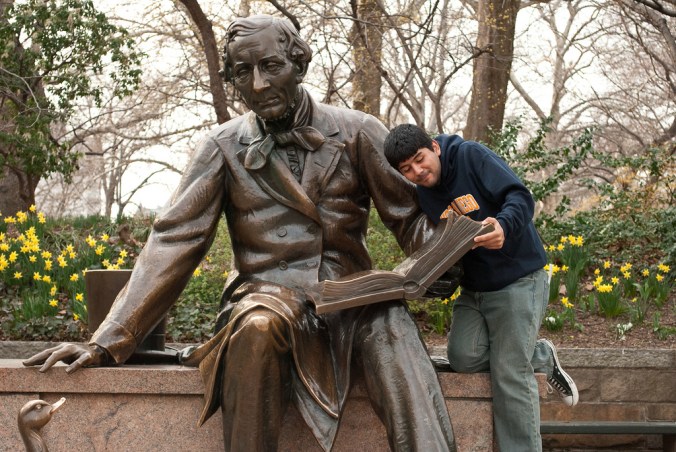
Alejandro Mallea's flickr photostream

Alejandro Mallea’s flickr photostream

“The writer’s way is rough and lonely, and who would choose it while there are vacancies in more gracious professions, such as, say, cleaning out ferryboats.”

Dorothy Parker

Survivors of Child Abuse Support Group


a

Survivors of Child Abuse Support Group


Tuesday evenings I can’t think of my baby

or the current between us

more elemental than love,

switches my milk on,

wetting the shirt

under my buttoned blazer.

My job is to listen

as people unknot the past.


The guy who constantly flirts,

his smile sugar white,

admits to road rage. Others

laugh in recognition,

their cars monsters too.


A young mother,

chandelier of dreads shaking,

mocks overheard endearments

like “Precious” and “Sweetie Pie,”

the same names I call my baby.


An older woman, beautiful

and resolutely friendless, agrees.

Affection shown children in public

sickens her. At home

kids are tied in the attic

or locked in a dog cage.

She knows this for sure.


Then Wilson speaks up,

says he feels good.

He’s taken his stove apart,

cleaned filth under and behind.

Wilson’s father dragged him from bed

to scrub for hours, sometimes his tongue

the rag. Or dragged him to the basement

to menace more than his tongue.


Empathy rises from Wilson

freely as other people sweat.

He and his wife cared for foster children

from the time their own sons were small.

Wilson kept the house clean,

took them to church, taught them the secret

of balancing a two-wheeler

(keep pedaling, that’s right),

but his sons became angry strangers.

Since the divorce they don’t speak to him at all.


He now knows

through all those years of dinner together

and homework done neatly,

older boys carrying hurt too large to contain

tormented his children in their own beds.

Wilson, his hands raw from scrubbing,

smiles as he says softly,

The stove is spotless.

Everyone in the circle of folding chairs

nods, understanding.


Laura Grace Weldon

Recently published by Literary Mama.  Find more poems in my collection, Tending.

Use It Till It’s Tattered

Porch peace flags still hanging in there.

Porch peace flags still hanging in there.

Erma Bombeck, comedian of all things domestic, once wrote,

My mother won’t admit it, but I’ve always been a disappointment to her. Deep down inside, she’ll never forgive herself for giving birth to a daughter who refuses to launder aluminum foil and use it over again.

My parents used what they had until it couldn’t be used again. Clothes that couldn’t be repaired became rags (although I refused to use my father’s old underwear for a dust cloth). Bread bags were washed and turned inside out to dry. And yes Erma, sometimes foil was reused too.

My kids would surely say I uphold that tradition. It might be frugality, but I think there’s more to it. I have sort of a Velveteen Rabbit feeling about objects worn from use. I like using the same cloth bag to carry library books home. Sure it’s frayed, with straps ever shorter from being sewn back on, but the bag has life left in it. I wear shoes until sunlight shows through, then relegate them to gardening shoes. I save old jeans too, using them for everything from a jeans quilt to trying out my weird idea for jeans-based weed control.

I once wrote a post about the psychological effects of materialism, illustrating it with an image of my toe peeking through a hole in one of our very old blankets. My toe really didn’t appreciate the publicity. Yet here’s that photo again because it really illustrates my point.

Use it till it's tattered.

Who takes pictures of their own toes in a past-its-prime blanket?

We have dear ones over for dinner on a regular basis. Each time, I use trivets that were probably given to my parents as wedding gifts over 50 years ago. The cork covering has degraded pretty badly, but they deflect heat as well as they ever did.

Useful, just unattractive.

Useful, just unattractive.

I also use the best hot pads ever. These were crocheted in tight little stitches by my grandmother sometime in the 1960’s. They still work perfectly even if marred by scorch marks. I’ve tried all sorts of replacements, from thermal fabric to silicone. Nothing is as flexible and washable as these handmade spirals.

In use for decades. Stained but still perfectly functional.

In use for decades. Stained but still perfectly functional.

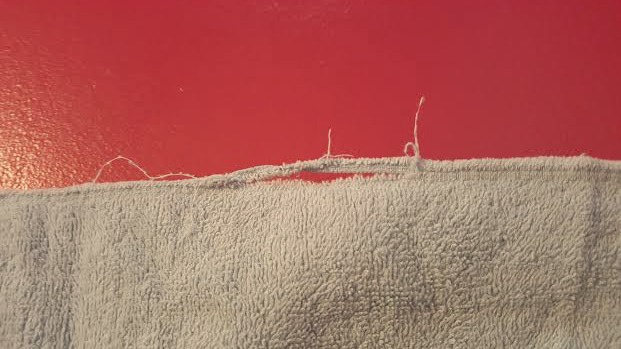
Our towels are, as you might imagine, pretty tattered. Of course they absorb moisture as well as they did when their side seams were perfect.

Old towels need love too.

Old towels need love too.

Even the kitchen floor is giving up.

No, that's not a giant spider. Not dirt. Just a floor after years of service.

No, that’s not a giant spider. Not dirt. Just a floor after years of service.

We actually do buy new things. I can prove it.

The comforter on our bed had been worn through for years. I repaired it over and over until the fabric got so thin that it simply split. It had also been indelibly stained. I remember the origins of some of those stains. Like the time one of my son’s friends came in our bedroom late at night to seek our counsel on some apparently vital adolescent matter, sitting on the edge of our bed (with bib overalls greasy from working on his car in our garage) while chatting with my husband and me. Those stains wouldn’t launder out.

Bedspread of 20 years.

Bedspread of 20 years.

We used it with peek-a-boo batting for years until we broke down and bought a (severely marked down) bedspread. “A new bedspread? Who are you?” my daughter asked, “It’s like I don’t know you any more.”

Something new. It happens, even here.

Something new. It happens, even here.

There’s a heightened beauty in things we use everyday. I see it in our daily tablecloth, our heirloom dishes, our antique furniture. I like the sense of completion that comes when using something fully.  We’re supposed to use ourselves up too.

While we’re not defined by our things, they do say quite a bit about us. I guess I’ve said this already in a poem.  Nuff said.


Object Lesson  


18 and in love

I heard

Too young.

Won’t last.


Yet each solid thing unwrapped

from fussy wedding paper

made it real.


The cutting board

too thin to last

split into kindling.

Paint chipped off leaky flowerpots,

used until they cracked.


Bath towels, coarse and cheap,

wore down to barn rags.

Bed sheets, gone to tatters, torn

to tie tomato plants and peonies.


One last gift, a satin-edged coverlet

saved for good till every other blanket

fell to pieces. Pretty but polyester,

it too frayed to shreds.

Nothing temporal

remains inviolate.


All that’s left are

clear glass canisters

holding exactly what we put in them

right here on the counter

for us to see

each day of our long marriage.


Laura Grace Weldon, from Tending


This post is shared from our farm site.

Earthbound

Earthbound


Are we supposed to settle for a planet

lagging behind our expectations?

We want reversible time,

admission into past or future

easy as changing our minds.

We want teleportation, so we can

zip anywhere for the afternoon,

maybe Iceland or Argentina,

where we’ll make new friends,

agree to meet up for lunch

next week in Greece

on only an hour’s break.


We want to get past

greed and suffering and war,

enough already.

And death? That’s awfully primitive

for souls with so much left to learn.


That said, this planet does a lot right.

Birds, for one.

Water in all its perfect manifestations.

Those alive poems called trees.

The way a moment’s glance

can reveal a kindred spirit.


Which we all are, really.

The oneness between self and everything

is this planet’s secret, kept imperfectly.

That’s more than we might expect.

Although time travel would be nice.


Laura Grace Weldon

First published in Dove Tails, An International Journal of the Arts. Find more poems in my collection, Tending.

How Do You Introduce A Friend?

Years ago, a family new to our area came to an enrichment program my kids and I were attending. Someone said, “Oh you’ve got to meet Beth, she dragged roadkill to the back of her yard so her kids could observe the process of decomposition.”

I knew immediately that Beth and her kids were our kind of strange. Every member of her family is clever in charmingly different ways and they quickly became integral to our lives. I don’t need to introduce her with that roadkill story because I have so many other Beth stories by now.

I don’t know about you, but I’m uncomfortable with the usual what-this-person-does-for-a-living introduction. Your friend may be amazing at her job, but she’s more than that. I’d rather introduce people by what they mean to me.  “I’d like you to meet Margaret, who is truly the most unique person I know,” or “This is Leslie, who has helped me out of more more scrapes than you can imagine,” or “I’d like you to meet Mark, an amazingly open-hearted man who also tends to make scatological jokes.”

Or introduce them by something they do that brings them joy. “I’d like you to meet David, who is a reading buddy with kids in an inner city school,” or “This is Amy, who has challenged herself to write an acrostic poem every single day,” or “This is Cynthia, who has such attuned vision in nature that she can see what most people never notice.”

Or, as in the case of Beth, to introduce someone with a story.

I suspect most of us feel awkward in a group of strangers at a party, reception, or stalled elevator. Oftentimes a conversation starts more naturally by simply sharing an observation (“I hope elevator cables only snap in the movies,” might not be the right one. Which means I’d probably say it…)

Or asking a more essential question that might lead to real connection. Maybe, “What’s capturing your attention lately?” or “What do you like to do that you don’t have to do?” (Yeah, lame. I told you I’m awkward.)

And whatever we do, by really listening to the answers.

I ran across this wonderful poem by a fellow Ohioan, Susan Glassmeyer. She says it all, perfectly.

INTRODUCTIONS

Let’s not say our names
or what we do for a living.
If we are married
and how many times.
Single, gay, or vegan.

Let’s not mention
how far we got in school.
Who we know,
what we’re good at
or no good at, at all.

Let’s not hint at
how much money we have
or how little.
Where we go to church
or that we don’t.
What our Sun Sign is
our Enneagram number
our personality type according to Jung
or whether we’ve ever been
Rolfed, arrested, psychoanalyzed,
or artificially suntanned.

Let’s refrain, too, from stating any ills.
What meds we’re on
including probiotics.
How many surgeries we’ve survived
or our children’s children’s problems.
And, please—
let’s not mention
who we voted for
in the last election.

Let’s do this instead:
Let’s start by telling
just one small thing
that costs us nothing
but our attention.

Something simple
that nourishes
the soul of our bones.
How it was this morning
stooping to pet the sleeping dog’s muzzle
before going off to work.

Or
yesterday,
walking in the woods
spotting that fungus on the stump
of a maple
so astonishingly orange
it glowed like a lamp.

Or just now,
the sound
of your
own breath
rising
or sinking
at the end
of this
sentence.

— Susan Glassmeyer

Poet Seeks Words

Unraveling Y, acrostic poet, Amy Heath,

Amy Heath. Sojourner, tinker, acrostic poet.

Amy Heath is a writer, poet, and artist. The past few years she’s lived a somewhat nomadic life, exploring ways to sustain herself while being true to her spirit.

I met Amy when she was a children’s librarian and children’s book author, back when I spent a lot of time in the picture book section with my four kids.  I was drawn to her friendly blue eyes and gentle manner. I cherished our brief, always lively conversations. I’d walk away thinking how much I’d like us to be friends but I was too shy to ask if we could get together because she was vastly cooler and far more fascinating than I’d ever be. Fast forward to the last few years, when Amy befriended me. I’m giddy about it in a can’t-believe-my-luck sort of way.

One of the many things Amy is up to lately is a poetic challenge. About a year ago she decided she’d write an acrostic poem a day. Being Amy, she amped up the challenge by making a rule for herself that the acrostics must be composed around words chosen at random from a book or words others chose for her.

a·cros·tic   (ə-krô′stĭk, ə-krŏs′tĭk) n.
1. A poem or series of lines in which certain letters, usually the first in each line, form a name, motto, or message when read in sequence.

“The main point of this project was to play with words every day until I reach 60,” she says. “Until that idea struck me, I had been writing acrostics in a more serious vein, on words like mindfulness, anxiety, patience, empathy. I have seen many people approach the Big 6-0 with trepidation. Well, I would play my way there!”

And no matter what, she vowed to post each piece on her blog, Unraveling Y. She says, “After reading the book Show Your Work by Austin Kleon, I decided that if I blogged these short daily creations I would feel somehow more accountable to my intention. My wordplays would be out there. And being fairly sure that very few people would read them, I felt liberated to do my best without worrying about what anyone thought of them. That’s good practice anyway. Worrying about what other people think is trespassing in their heads. Not cool.”

Amy’s poems find an inner presence in words, making each one into something so alive we can feel it breathe, as she does with equanimity.

Amy Heath, acrostic poem, pixabay.com/en/space-sky-hand-fingers-paint-636894/

Even in the space of a few syllables.

acrostic poem, Amy Heath, pixabay.com/en/background-branch-dusk-evening-20862/

She turns a word into a tale that leaves us wondering.

acrostic poem, Amy Heath, morguefile.com/archive/display/890638

She helps us understand why the Latin word for hearth has come to mean “center of activity.”

Amy Heath, Unraveling Y, acrostic poem, pixabay.com/en/fire-heiss-fireplace-cozy-heat-266093/

Amy Heath, Unraveling Y, acrostic poem, pixabay.com/en/fire-heiss-fireplace-cozy-heat-266093/

She shares little known history, explaining in her blog entry: “The lighthouse built by Ptolemy I Soter and completed by his son Ptolemy II Philadelphus was a prototype for subsequent structures. Pharos, a small island, ultimately the tip of a peninsula near Alexandria, became the root word in many languages for lighthouse.”

Andreas Achenbach, Pharos, Amy Heath, pixabay.com/en/andreas-achenbach-sea-ocean-water-85762

She’s undaunted when faced with a word like quitch.

acrostic poem, Amy Heath, morguefile.com/archive/display/951061

Among my favorites is a poem she composed around the word orenda, which is defined as “a supernatural force believed by the Iroquois to be present, in varying degrees, in all things and all beings, and to be the spiritual force underlying human accomplishment.”

Amy Heath, acrostic poem, birthday poem, orenda, pixabay.com/en/background-gold-golden-texture-630417/

Amy is brimming with acrostic-related ideas. She may write a book on a single theme or compose a children’s story using words for various literary devices. She may illustrate her poems using paint or yarn or glass. The future is open for my playfully creative friend.

What is she seeking right now?

Words.

She’s continuing her daily acrostic challenge and invites you to send her a word which she’ll gladly transform into a poem. Her email is unravelingy@gmail.com

While you’re at it, I suggest you:

visit her blog Unraveling Y 

read her memoir I Pity The Man Who Marries You

share her poems on social media

contact her to let her know how much you enjoy her work

consider embarking on a challenge of your own!