What’s The Perfect Age?

what is the perfect age,growing older is perfect, child is not an ungrown adult, baby is not an unformed child,

(Image:littlefantasy.deviantart.com)

There must be an ideal age floating around in our collective unconscious. This is such a fixed part of our media-driven culture that it’s hard to focus on it. But let’s give it a try. Allow a number come to you as you consider the following questions.

 What age do parents have in mind as they groom their kids for success?

 What age do kids have in mind as they imagine growing up?

 What age do older adults have in mind as they try to look and act younger?

I’m guessing it’s somewhere between 21 and 35, a time when we’re supposed to be brimming with youthful good looks and potential. Or maybe it’s not a number but just a fundamental belief that young adulthood is some sort of peak. Everything before that is preparation, everything after a slide toward old age.

Consciously or unconsciously, believing in this ideal age uses up a large part of all our other ages.

Consider how relentlessly the adult world prods children to get (or at least act) older. I know I’m somewhat guilty. I did my very best to savor the baby and toddler years but honestly, it’s hard. I found myself thinking that it would just get better after they finished teething, or could talk, or finally mastered toilet training. Even the most sainted in-the-moment parent will find him or herself bombarded with well-intended, future-oriented inquiries from others like, “Is she sleeping through the night?” and “Does he talk in sentences yet?” Such questions don’t stop as the child gets older, instead they have to do with bigger topics like academic abilities, athletic achievement, even popularity. Admiration is heaped on little ones who act much older than their developmental age, especially those children who exhibit social poise beyond their years, as if six-year-olds who act like six-year-olds are already somehow behind.

The pressure becomes more intense with each passing year. Parents often find themselves buying all sorts of educational toys and electronics, filling what could be free time with an ambitious schedule of practices and enrichment programs, and of course, pushing educational achievement. We’re told that these efforts “count” as if there’s a permanent record for eight-year-olds or 13-year-olds. There isn’t.

We’re assured that getting kids ahead in sports or hobbies will create passionate engagement, but research affirms that children build rewardingly intense interests when they are free to explore activities without adult pressure and interference

We’re led to believe that early academic accomplishment is the path to later success. Too often, that’s not true either. Success is closely linked to much more nuanced personal factors which develop quite nicely, research tells us, during free play, early participation in household tasks, conversation, and other experiences that foster self- control as well as an internal locus of control

Pushing our children toward adulthood takes us (and them) away from seeing that each of us are whole people exactly as we are. A baby is not an unformed child, a child is not an ungrown adult, an elder is not an age-ruined version of a once younger self.

Each of us is wonderfully unique. Of course we’re flawed and often foundering. But at the same time we are also brimming with emerging possibilities. We don’t have to paddle away from the moment we live in toward some ideal age. Doing so doesn’t just wish away right now, it also condemns every other age we live in to be something less.

Truly seeing our children and our elders as complete and whole, right now, means seeing ourselves that way too.

Monday Hearts For Madalene

art from found objects, love made visible,

Page Hodel

A heart-shaped anything used to seem overly sentimental, even mawkish, to me until I encountered those created by Page Hodel. Her hearts are ephemeral and made from the unexpected. Things like chile peppers, paper clips, postage stamps, kumquats, metal bolts, cast-off sneakers, green onions, all sorts of colorful objects.

The story behind her art is equally unexpected and poignant. Page is a disc jockey whose presence unifies and enlivens a crowd. Billboard magazine named her one of the country’s best. She also works for the non-profit Rhythmic Concepts to foster jazz education. Before she started making hearts her hands-on creative efforts took place on a larger scale, including the renovation of large vehicles and homes. Her life seemed full. Then she met her neighbor, Madalene Louise Rodriguez, a librarian and glass artist. The moment they met, they both fell in love. As Page writes on her site,

There is something extraordinary about falling so deeply in love later in your life. The profound awareness of the miracle of finding the love you have looked for all your life, and the realization of how much you each have to share having lived so long and experienced so much.

Page began making hearts out of buttons, leaves, anything she could find to leave on Madalene’s doorstep late each Sunday night. That way when Madalene stepped out to go to work the next morning, she’d be greeting by a beautiful reminder of their love.

Page Hodel

Page Hodel

Only seven months after they met, Madalene was diagnosed with late stage ovarian cancer. Page promised to continue making hearts for her each week, no matter what. After a courageous battle, four months later Madalene died.

Page never intended the hearts she created to be anything more than a private way of expressing her feelings. Thanks to a request by Madalene’s brother, she gradually began sending online photos of each week’s heart to loved ones, inviting them to forward the images as a way of putting more love out in the world.

Page initially refused offers to collect the photos into a book. The feeling associated with them was too painful. But she kept hearing from strangers whose lives were affected by the hearts. She realized that her love for Madalene could touch others.

Now you can find 100 hearts collected in a beautiful volume titled Monday Hearts for Madalene as well as Hearts for Madalene Notecards. Page donates a portion of the proceeds from each sale to the Women’s Cancer Resource Center.  Anyone who would like to receive a weekly email with the newest Monday Hearts For Madalene, simply email  page.hodel@gmail.com with “subscribe” in the subject line.

Seeing these images, hearts can’t help but take on a larger meaning.

Page Hodel

Page Hodel

Conduct Human Experiments of the Word Kind

bring back obscure words, get people to say strange words,

Human experimentation is banned unless the subjects are volunteers who have provided their informed consent. I believe the more casual research my son recently tried is exempt from those rules.

Let me explain.

Over the summer he worked with the grounds crew for a local park system. Being the sort who enjoys occupying his mind with more lively endeavors than weed whacking, he found other ways to keep himself amused. It may be helpful to point out that he and his siblings know many more words than they can pronounce. Their vocabularies are considered odd by others. Their dinner table discussions are, at best, eccentric. These tendencies can be almost entirely blamed one habit: avid reading.

He used this social liability as the basis for the human experimentation trials he conducted on his unwitting co-workers. The research took all summer. His subjects were not aware that they were part of the study until it was too late. The damage had been done. The results are now in. His experiment was a resounding success. I’m going to tell you how to conduct the same experiment.

Purpose. 

You, the experimenter, can bring  nearly extinct words and phrases back into regular usage. (See, you’re providing a service to an endangered vocabulary.)

Hypothesis. 

Employing an outmoded word or phrase on a daily basis will subtly promote its usefulness and stimulate others to add it to their ordinary lexicon. Yes, you get people to say funny words.

Materials.

1. You will need subjects. Rely on people you see everyday. Your children, co-workers, neighbors, and friends are excellent victims candidates for your experiment. The more the merrier. If you want to get all science-y, choose a group of people you interact with separately from all other groups. They will form your experimental group, while everyone else in your life will be your control group.

2. You will need a word or phrase you think shouldn’t have fallen out of popular usage. My son chose “dagnabbit,” one of the many oddly amusing words his grandfather used without a hint of irony. (That was a rich well indeed. Other possibilities from my paternal line included “holy mackerel,” “jehoshaphat,”  and “tarnation.”)

Method.

This is a casual experiment, best done over a long period of time. Begin using your chosen word or phrase regularly but naturally in your conversation. Pay no obvious heed to the word as it is adopted by others.

If people make a fuss over your use of the word, you might choose to insist it is back in style. Or you might use the opportunity to expand the experiment by promoting those subjects to fellow experimenters. Explain what you are doing in the most noble terms possible, then implore the person use his or her own outdated word or phrase in daily conversation. You’re simply enlarging this Human Experiments of the Word Kind study, surely to enhance the world as we know it.

Observation.

See how long it takes to firmly embed your word or phrase in other people’s regular discourse.

Conclusion. 

Have you gotten subjects to saying funny words? Then you’ve proven the hypothesis and done your part to save endangered terms. Another successful Human Experiment of the Word Kind!

Thanksgiving: A Holiday To Prevent War

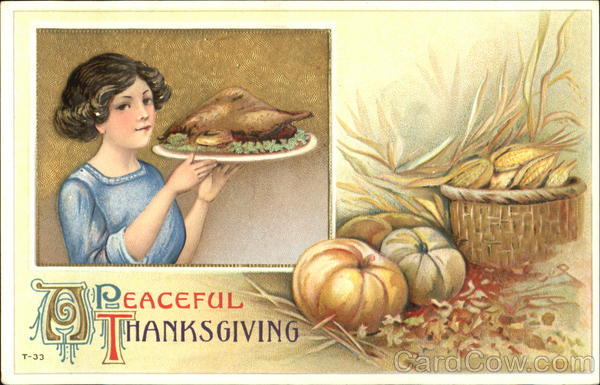
A Peaceful Thanksgiving cardcow.com

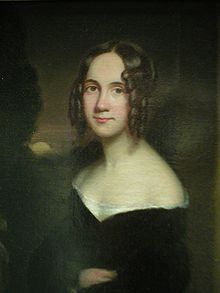
Kids draw bright crayoned versions pictures of the “first” Thanksgiving, although chances are they don’t depict the original celebrants eating venison and eel, or engaging in shooting demonstrations. It’s certainly not an event the Wampanoag would have recognized. The Thanksgiving holidays we celebrate today center around family and togetherness. That’s due to one woman, Sarah Josepha Hale (who incidentally was the author of the poem “Mary Had A Little Lamb,” later put to music).

Before Hale’s campaign to create a national holiday, Thanksgiving was held at different times in different jurisdictions on any date between October and January. Or not at all. And in the South the holiday was largely unknown.

Thanksgiving origins, Thanksgiving peace,

Sarah Josepha Hale, 1831, by James Reid Lambdin

But Hale was editor of the most widely circulated magazine of the time, Godey’s Lady’s Book. This publication, largely aimed at women, published influential poetry, art, and fiction, and under Hale, advocated for women’s educational attainment. Beginning in 1846, Hale used this platform to push for a national day of gratitude. She hoped such a holiday would help to unify the North and South, even prevent a Civil War. Violating the magazine’s policy against politics, she wrote editorials year after year asking the nation’s leaders to declare the last Thursday in November a national holiday–Thanksgiving Day.

In an editorial published November 1857 she wrote:

Consecrate the day to benevolence of action, by sending good gifts to the poor, and doing those deeds of charity that will, for one day, make every American home the place of plenty and rejoicing. These seasons of refreshing are of inestimable advantage to the popular heart; and, if rightly managed, will greatly aid and strengthen public harmony of feeling. Let the people of all the States and Territories set down together to the “feast of fat things” and drink, in the sweet draught of joy and gratitude to the Divine giver of all our blessings, the pledge of renewed love to the Union, and to each other; and of peace and good-will to all the world. Then the last Thursday in November will soon become the day of AMERICAN THANKSGIVING throughout the world.

She also steered public sentiment by promoting Thanksgiving recipes (including roast turkey and pumpkin pie), poems, stories, and drawings of families gathered at the Thanksgiving table. She wrote hundreds of letters to governors, presidents, and secretaries of state as part of her campaign.

Seventeen years later, in the midst of the Civil War, Abraham Lincoln issued a presidential proclamation that Thanksgiving Day be celebrated as a national holiday. This day, which many of this country’s original inhabitants consider a national day of mourning, is also a day established to promote peace and goodwill. Never underestimate the power of an idea, pushed by a pen and persuasive pumpkin pie recipes.

Don’t Deprive Kids Of Risk

let kids take risks, don't overprotect,

jessicareeder’s flickr photostream

I publicly admitted to letting my teen take risks that would make most parents shudder. I’m not talking about the month long backpacking trip my 16-year-old took with his older brother and a friend. Nope, I’m talking about letting him meet up with middle-aged guys he talks to online.

The circumstances were perfectly suited to advancing his maturity as well as his skills. But to most parents, that decision marks me as a very bad mother. I’ll take that risk. Parenting has a lot to do with drawing the line between safe and unsafe. And then there’s that pesky line between good and bad.

It found it easier to see absolutes when my kids were babies. Bottle or breast, free play or playpen, guiding or scolding. The choices seemed easy. As they got older I didn’t lose my cherished parenting philosophies and obnoxiously healthy dietary scruples, but I did relax into the gray area. Some would say I’ve gotten too relaxed.

Every day I watch as parents pile their cars with their darling backpack-laden children, then transport them all the way to the end of the driveway where they sit, engines idling, until the school bus arrives. The reverse process takes place in the afternoon. These kids are spared more than the exercise required to get from house to curb. Presumably they’re also kept safe from potential child abduction. I don’t know if this is the case in your neighborhood but it’s a standard practice around here, even though I live in a rural township so small that it doesn’t have a single traffic light. (It’s rumored we may get lines painted on the streets.)

Despite the pastoral beauty of our area, kids rarely play outside. Clearly their parents are quite a bit more cautious than I am. Apparently this is a major trend. With the very best intentions kids are kept indoorswatched closely, even monitored. But why?

According to How to Live Dangerously by Warwick Cairns, “stranger danger” is so vastly overblown that you’d have to leave your child outside (statistically speaking) for about 500,000 years before he or she would be abducted by a stranger.

Violence against kids has markedly decreased and the overall crime rate continues to plummet. A teen is three times safer today than a teen in 1979. Sure, there was no Internet in the 70’s but online, the real danger to kids tends to be peer harassment. A larger danger? Kids who have no experience with real challenges.

Kids require escalating responsibility as well as escalating risk in order to grow toward a healthy adulthood. The common practice of delaying risk (and often responsibility as well) stems from the best motivations: love, concern for their safety, interest in staying closely involved. But today’s highly cautious approach to parenting actually inhibits a young person’s healthy development, according to Too Safe for Their Own Good: How Risk and Responsibility Help Teens Thrive by resilience expert Michael Ungar. It can result in young people who are overly anxious or who take unnecessarily dangerous risks. It can also leave them unprepared for adulthood.
The decisions I make for my family probably aren’t the ones you make for yours. I give my kids the go-ahead to build spud cannons in the name of science but I wouldn’t dream of giving them non-organic celery. I encourage them to join online special interest forums but abhor movies with gratuitous violence. It’s not easy to keep looking at where we draw the line, but just like you, I’ll risk anything for my kids.

We Don’t Need No Age Segregation

open-source teen learning, active learning, teen unschooling,

My teenaged son just spent the day with middle-aged guys he met online.

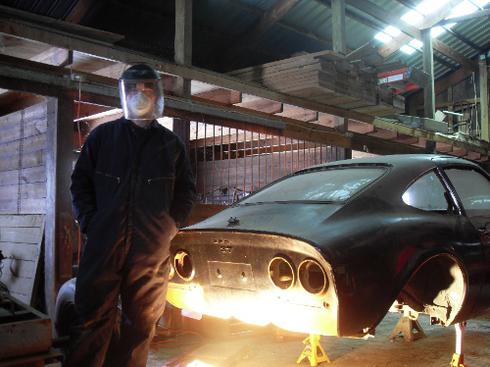
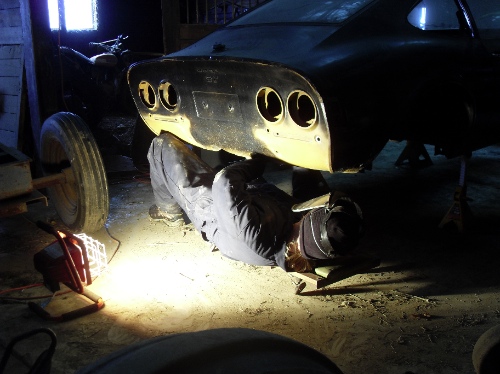
Let me explain. Before he could drive, my son earned enough money shoveling out horse stalls to buy a 1973 Opel GT. Or what was left of one.

The car sits out back in a dark barn, its classic little outline like a rough sketch waiting for functional automotive details to be filled in again. He is restoring it himself, but not alone. He’s in touch with an online community of automotive enthusiasts from around the world. They eagerly share experiences and resources on forums. They also boast, complain, and talk about their interests just as any friends do.

My son and his father have met some of these folks at auto meets and car shows. When my son discovered an Opel club not far from our family farm he was invited to join. Today he and his older brother drove out for a day-long gathering. Although my boys were the youngest by decades they enjoyed an open-hearted welcome.

Yes, I realize there are significant concerns about teens talking online with adults, let alone meeting them. I try to keep those concerns in perspective. Studies of online behavior by youth indicate the biggest risk they face is peer harassment, not sexual predation. Today’s young people are much more overprotected than previous generations even though violence against kids has markedly decreased and the overall crime rate continues to plummet. Overly cautious, restrictive parenting practices actually inhibit a teen’s growth toward maturity and responsibility. So I watch, ask questions, and recognize that my son benefits from online friends and mentors.

It’s a pivotal coming of age experience to be accepted by elders one admires. Until that time it’s hard to feel like an adult. These experiences are frequently depicted in movies, but children and teens in our culture are almost entirely segregated from meaningful and regular involvement with adults.

These days kids spend their formative years with age mates in day care, school, sports, and other activities. So their adult role models are largely those whose main function is to manage children. This subverts the way youth have learned and matured throughout human history. Children are drawn to watch, imitate, and gain useful skills. They want to see how people they admire handle a crisis, build a business, compose music, repair a car, and fall in love. Separate kids from purposeful, interesting interaction with adults and they have little to guide them other than their peers and the entertainment industry. That’s because our species learns by example. Ask any child development expert, neuroscientist, or great grandparent.

There are plenty of educational initiatives to bridge this gap, particularly for teens. These programs connect students with mentors or bring community members into schools to talk about their careers. While these efforts are admirable, such stopgap measures aren’t the way young people learn best. They need to spend appreciable time with people of all ages—observing, conversing, and taking on responsibility. Real responsibilities, real relationships.

Because my kids are homeschooled they’ve have more opportunities (and a lot more time) to hang out with interesting adults. My daughter volunteers for hours each week alongside a woman who rehabilitates birds of prey. Another of my sons has played bagpipes for years with an 80-something gent who once served as a Pipe Major for Scotland’s Black Watch. The age range of my kids’ friends spans decades. Natural mentors such as these are a rich source of authentic experience. And they’re in every community. It’s not hard to find them.

Along with other homeschooling families, my kids have also taken a close look at the workaday adult world. The owner of a steel drum company explained the history and science of drum-making, talked about the rewards and risks of entrepreneurship, then encouraged us to play the drums displayed there. An engineer took us through his testing facility and showed us how materials are developed for the space program. We’ve spent days with potters, woodworkers, architects, chemists, archeologists, stagehands, chefs, paramedics and others.

People rarely turn us down when we request the chance to learn from them. Perhaps the desire to pass along wisdom and experience to the next generation is encoded in our genes. Age segregation goes both ways–adults are also separated from most youth in our society. After an afternoon together we’ve gotten the same feedback again and again. These adults say they had no idea the work they do would be so interesting to kids. They marvel at the questions asked, observations made, and ideas proffered by youth that the media portrays as disaffected or worse. They shake hands with young people who a few hours ago were strangers and say, “Come back in a few years, I’d like to have you intern here,” or “We could use an engineer who thinks the way you do. Think about going into the field,” or “Thanks for coming. I’ve never had this much fun at work.”

So today my teenaged son hung out with fellow Opel aficionados. They trust he will drive his car out of the dark barn and into the sunlight soon. It will be a shared accomplishment, the kind of thing that happens all the time when young people aren’t separated from the wider community.

unschooling teens, homeschooling teens, teens free to learn,

I wrote this piece nearly two years ago for Shareable.com. Since then this son of mine has become a mechanical engineering student at a private college. His fellow classmates brought with them years of advanced placement math and science classes. The advantage he brought? Lots of hands-on experience, an active approach to learning, and insatiable curiosity. He’s at the top of his class.   

Do Childhood Books Shape Us?

story and character formation, selfhood and book, self-image and books, girls and books,

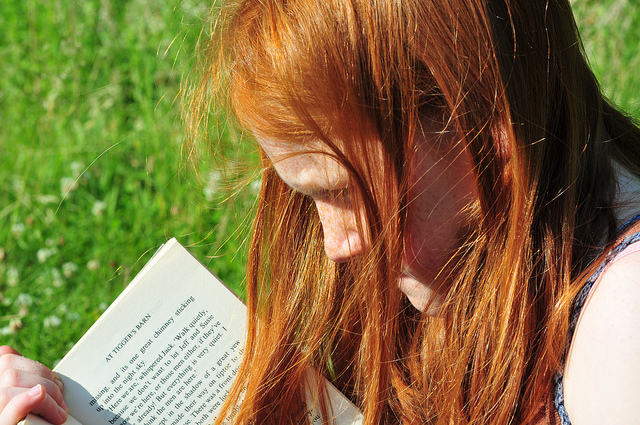
Building a self. (andycarter’s flickr photostream)

Children’s inner lives may not seem all that complicated. But they are, even if kids aren’t fully aware of the complexities they’re dealing with until they’re much older. That’s one reason it’s hard for them to talk with their parents about ways they are gaining strength, inspiration, and a sense of self.

Their favorite books offer a clue.

Children are drawn to stories that resonate with the same challenges they’re facing. Authors know kids seek out tales that present certain compelling themes. Speaking one’s truth, overcoming adversity, enduring tragedy, relying on wit or cleverness, making a sacrifice, establishing one’s own values, finding a kindred spirit, gaining new powers or knowledge—this is the stuff that translates into purposeful meaning for the young reader.

To understand what kids are going through as they grow up, it helps to look back at the pivotal books that made a difference during our own formative years.

As I look back I realize two books I read over and over still echo in my life today. One of my favorites was Johanna Spyri’s Heidi. It’s the story of a little girl who is taken to live in the mountains with her grumpy but kind grandfather. She loves to spend her days outdoors on the hillsides, playing with the goats, talking to Peter the goatherd and his blind grandmother, and eating simple wholesome foods like cheese made from goat’s milk. When Heidi is taken away to live in the city, a companion to her sickly cousin Clara, she’s deeply homesick. Although she happily learns to read, hoping she can go home to read to the blind grandmother, each day away from her beloved mountains haunts her. She convinces her uncle to let Clara come back with her for a summer visit. There they spend days outdoors, playing with the goats, eating her grandfather’s hearty food, and laughing. Her cousin recovers her health and Heidi is free to stay in the place she loves.

My other favorite book was so pivotal I’ve called it the book that saved me.  The Secret Garden by Frances Hodgson Burnett is about a lonely girl named Mary who lives on the moors of England. She befriends a boy, Dickon, who can speak to animals. She also insists on becoming acquainted with an invalid named Colin. Mary doesn’t want dolls or toys. She wants the joy of helping a hidden garden come alive. She wants to remain free of lessons so she can learn Dickon’s wisdom. She wants to understand the mystery that makes flowers grow, helping Colin find that strength in himself.
Both books are about a certain kind of justice, one that permits self-determination and self-definition. Both are about the value of staying rooted and feeling nourished by a sense of place. Both are about the restorative power of nature. I feel those elements in my life strongly. Yet I see even more of these books in my choices. My children have grown up without schooling, as Heidi and Mary did. I make cheese from our cow’s milk, insist on wholesome food, and speak to all the animals on our little farm (though I’m still waiting for birds to alight on my arm as they did on Dickon’s). I have Heidi’s passion for reading and Mary’s passion for watching things grow. And I hope I have what both characters had in abundance, the determination to speak up for what they believed was right.

What books made you who you are today?

Did you share any of that book-related inner growth with the adults in your life?

And does looking back at these influences give you a glimpse of your own child’s complex emerging selfhood?

Carly’s Voice

reaching autistic child, non-verbal autism, technology for autism, voice assist for autism, aphasia in children,

Carly Fleischmann was unable to communicate. Diagnosed with autism and related disorders by the age of two, she screamed, threw herself to the floor, smeared feces, moved constantly, and barely slept at night. An attentive family plus hours of daily therapy helped teach her rudiments like walking and feeding herself. Experts advised her parents to consider residential care.

But one day during a therapy session, Carly reached for the computer. Slowly, using one finger, she typed

help

teeth

hurt.

Her therapists were astonished. It took months and much coaxing to get her to use the computer again (at that time, an augmentative communication device). But she began to recognize that communication was essential. Technology made it possible.

What emerged from her arduous single strokes on the keypad showed a girl who wasn’t mentally retarded, as her doctors suspected, but someone spirited, insightful, and intelligent. She wrote about wanting to have fun with normal kids. She asked to do things she’d always wanted to try. And she tried to convey what it was like to live in an autistic body. She explained that behaviors (like banging her head on the floor and bleating loudly) erupted from her like liquid would burst from a can of Coke when it had been shaken and opened. She said those behaviors helped block the sensory input of sight and sound that constantly overwhelmed her.

A few years ago, a segment about Carly’s new-found communication aired on 20/20.

Now Carly uses technology to communicate with a world that’s ever more open to her. She keeps up with a busy Twitter  feed and Facebook fans. She answers questions, promotes autism awareness, and says that she feels part of a larger community by connecting with people through social media.

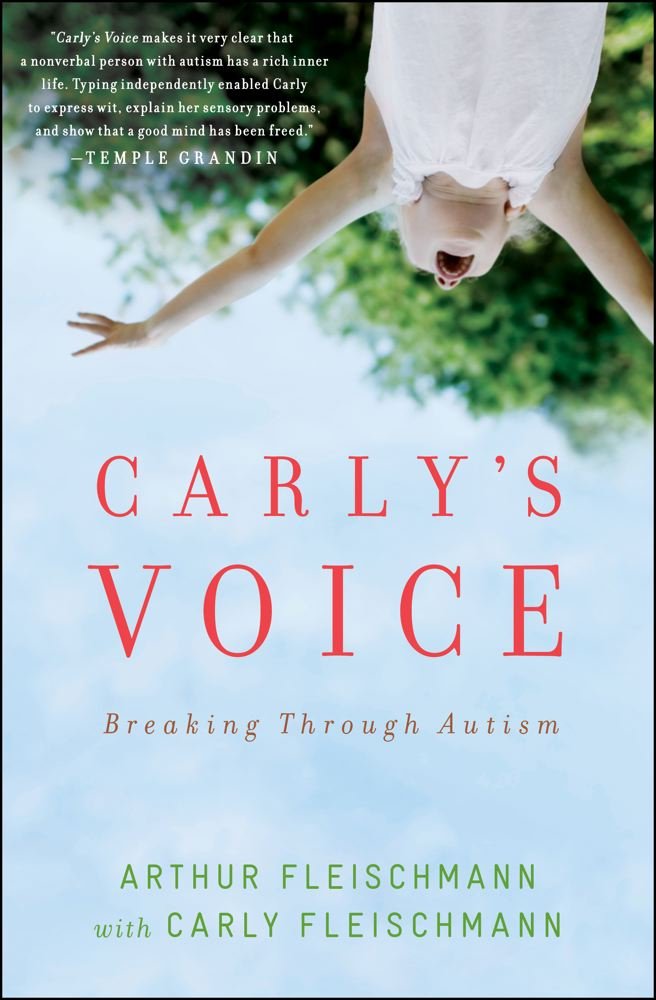
Technology allows Carly to share what she calls her “inner voice.” Check out Carly’s Cafe, an interactive web video, to experience a coffee shop as she experiences it. And take a look at the memoir she wrote with her father, Carly’s Voice: Breaking Through Autism
to better understand this bright engaging girl whose world unlocked thanks to a keyboard.

Oh, and don’t think Carly’s drive to move forward has slowed. Now 17 years old, she was recently asked to appear on a panel at The Nantucket Project, a prestigious request for any expert, even more impressive that she would be their youngest ever. Senator John Kerry was also scheduled to give a presentation. She tweeted him in advance, challenging him to take a seat on the panel so she could ask him questions. Her challenge was retweeted thousands of times by her followers and Sen. Kerry did indeed do as she asked. Her first question to him was, “What have you done in the Senate to help autism and do you think it’s enough?” Watch the video here.
We may not know what sparks autism, from inflammatory responses in a pregnant mother’s body to systemic changes in the body to another step in emerging neurodiversity. We do know that Carly and many more like her are with us, speaking in voices we’re meant to hear.

Throw Strangely Amusing Parties

throw an art party,

We used to throw strangely amusing parties on a more regular basis. Box parties where kids made forts and mazes and castles out of huge boxes. Tie dye and batik parties that were a messy extravaganza of color. Science-y gatherings where everyone worked on the same ridiculous experiment with vastly different results. Even an election commiseration event where everyone had to bring a few jokes about a certain president whose name rhymed with “tush.”

The longest lasting tradition? Our summer pig pen parties. These were grand messy BYOB affairs, as in bring your own bucket—of dirt. It was dumped in a backyard kiddie pool and mixed by all children in attendance into perfectly creamy mud, which they used to coat themselves until they were recognizable only by bathing suit outlines. We put a garden hose at the top of our slide and the kids careened down in glorious streaks of mud. We handed out cans of shaving cream for use as body décor (with firm instructions to avoid faces because it’s not fun in the eyes). We brought out ample water balloon supplies. And we insisted the kids eat without utensils or hands, just direct face to plate. Like pigs. Of course these parties got out of hand once the grown-ups refused to sit in lawn chairs watching their kids have all the fun. Some neighbors showed up in pig masks, others showed up with water balloons sneakily hidden in baby strollers and red wagons, others brought massive auxiliary supplies of shaving cream. Normally well-behaved men used hoses to fill garbage cans with water, which they dumped over the heads of the few civilized mommies who thought they’d keep their hair looking nice. One year the entire assemblage of pig pen partiers were incensed that a regular pig pen attendee decided to stay home to repair a fence. All of us walked down to the street in wet, muddy, shaving cream streaked glory to drag him to the party. His police chief father who was there helping him make the repairs looked seriously alarmed. We dragged him anyway.

I’ve been fantasizing about a backyard Jackson Pollack party where everyone brings leftover paint to fling at canvases, maybe even using the giant trebuchet our kids built for some super-charged paint tossing. I can just see us all in splattered clothes, posing for a group picture with candy cigarettes hanging out of our mouths. What’s stopping me? I live with practical people who wonder if paint will get tracked in the house because partygoers are human and will eventually need to use the bathroom.

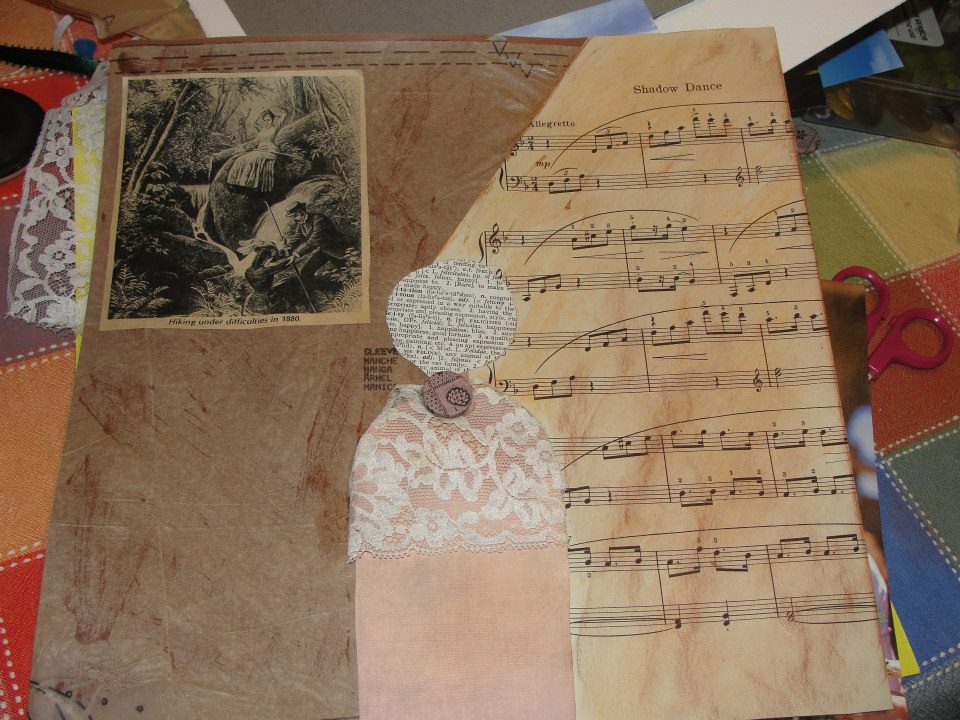
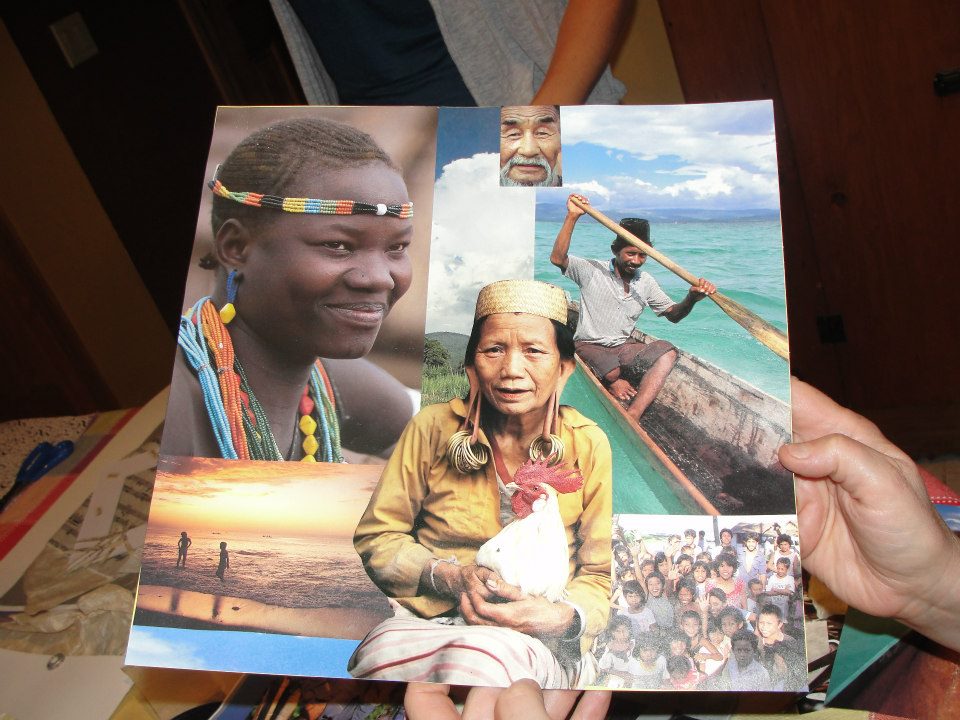
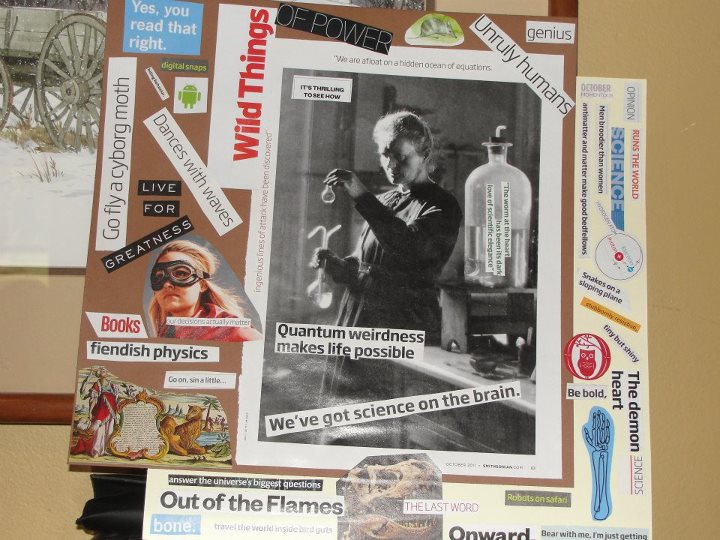
My recent event was a quietly civilized affair: a collage party for some artful cutting and pasting. I have all sorts of glue-able stuff here. Old sheet music, sewing patterns, stockbooks, wallpaper, tiny do-dads, lace, game pieces. All I asked people to bring were their own scissors, marked with their names (because scissors are migratory beasts) and a potluck offering. They brought a lot more glue-able stuff to share. I thought we’d stick down some background, let it dry while we ate and drank, then finish and move on to a second or third one each. But my friends ate and drank and talked while collaging. They didn’t want to stop cutting and arranging. It’s as if we all have too little time for something as simply satisfying as placing a scrap of paper on a page exactly as it pleases us. The event was less lively than the average pig pen party, that’s for sure. But it was restorative. No phones. No screens. Nothing else to do but indulge in the kind of play we call creating. I guess that doesn’t happen unless we make time for it.

Here’s a sample of collage party creations. (Some are backgrounds awaiting finishing touches.)

And let me know your ideas for strangely amusing events. I plan to steal them.

turn junk into collage,

art party,

make a collage, throw a collage party,

science collage,

You’re Having A Perfect Day

today is perfect, unique day, gratitude reasons,

ilovemcl.deviantart.com

A hundred million babies are being soothed in loving arms, lulled to sleep by songs in every language. Those gently nurtured babies will grow up to change our lives in ways too marvelous to imagine.

children change the world, imagine future,

siobhan68.deviantart.com

Today Muslims pray, “Praise be to the Lord of the Universe who has created us and made us into tribes and nations. That we may know each other, not that we may despise each other.” Cloistered nuns petition God that our world be blessed with the wine of Christ’s love and peace. Tibetan Buddhists practice tonglen, breathing in the suffering of others and breathing out happiness for all beings.  Individuals meditate, chant, pray, or contemplate nature while sending light to each soul on earth. People of all faiths dance and sing in Dances of Universal Peace.

Right now, artists are creating something that never before existed. Their medium may be cake batter, dance steps, paint, tiny gems, huge beams, words, reclaimed trash, wool, glass, musical notes, or curved light. They bring vision into reality. The way they see transforms the way we see.

art, vision into reality, art shapes world,

onebadcat.net

Right now people in crisis are rising up, acting out of deep regard for one another in an ongoing testament to the compassion that defines us. Every second millions of people are selflessly working around the world to advance ecological sustainability, economic justice, human rights, political accountability, and peace. Unnoticed ordinary acts of kindness allow life to flourish as we nurture the youngest and tend to the oldest, share with those in need, and weave the web of mutuality that holds us together.

reasons for gratitude, inspiration, appreciate today,

samlim.deviantart.com

Right now people assumed to be dead are reviving, changed forever after by a near-death experience.  They reawaken to a life less focused on material success or narrow beliefs, and instead emphasize love, curiosity, and awe.

living in awe, it's all love,

flickr.com/photos/qthomasbower

Right now you are fueled by a perfect circle: sunlight, soil, and the seed’s mysterious will. At this moment your extraordinary body is replacing millions of cells, pumping quarts of blood, actively defending your immunity, releasing precisely timed hormones and enzymes, operating on rhythms well beyond your perceptions.

perfect body, how body works,

gajitz.com

Today in an unimaginably vast universe, clouds of interstellar dust reflect the light of nearby stars. We are made of elements forged inside of stars that died out long before our own solar system emerged.

we are made of stars, perfect day,

nasa.gov

Each of us is unique, yet we are one being.

What an amazing day.