36 Poetry-Infused Movies

36 poetry-infused films

You don’t have to stretch your movie-watching habits far to include movies infused with poetry. Here’s a short, by no means comprehensive list.


Biopics (often loosely) based on poets’ lives

Neruda  dramatizes the search for the Nobel Prize-winning Chilean poet during the 1940’s, when he became a fugitive in his own country due to his Communist leanings.

A Quiet Passion explores Emily Dickinson’s life from her school days to her later years.

Kill Your Darlings looks at a 1944 murder that draws together beat generation poets Allen Ginsberg, Jack Kerouac and William Burroughs.

Howl looks at the 1957 obscenity trial against Allen Ginsberg.

Set Fire to the Stars portrays a week in 1950, when aspiring poet John Brinnin takes his idol, Dylan Thomas, on a retreat in hopes of readying the legendary poet for a series of poetry readings in the U.S.

Reaching for the Moon  Elizabeth Bishop took a trip to Rio in 1951, intending to stay only long enough to battle her drinking problem, but met and fell in love with famed architect Lota de Macedo Soares, staying 20 years.

Total Eclipse is a dramatized account of Arthur Rimbaud’s affair with Paul Verlaine.

Sylvia tells of the relationship between poets Ted Hughes and Sylvia Plath.

The Basketball Diaries is a harrowing story of athleticism, addiction, and redemption based on poet Jim Carroll’s autobiography.

Barfly is based on Charles Bukowski tumultuous life.

Before Night Falls is adapted from the memoir of Cuban poet Reinaldo Arenas, who was jailed for ‘ideological deviation’ and forced to denounce his own work.

Piñero tells the story of Puerto Rican poet-playwright Miguel Piñero, whose urban poetry is recognized as a forerunner to rap and hip-hop.

An Angel at my Table tells the story of Nene Janet Paterson Clutha, a New Zealand woman who published under the name Janet Frame.  After years of psychiatric institutionalization, Frame was scheduled for a lobotomy that was cancelled when, just days before the procedure, her début publication of short stories was unexpectedly awarded a national literary prize.

Mrs. Parker and the Vicious Circle brings the Algonquin Round Table to life in this portrayal of Dorothy Parker.

Tom & Viv depicts  T. S. Eliot‘s brief marriage to muse Vivienne Haigh-Wood.

Endless Poetry portrays Alejandro Jodorowsky’s young adulthood of the 1940s and 50s, in the electric capital city of Santiago. There, he decides to become a poet and is introduced into the bohemian and artistic circle of the time.


Movies inspired by poems

O Brother, Where Art Thou? is the Coen brothers’ version of Homer’s “Odyssey.”

Mulans story comes from the ancient Chinese poem “The Ballad of Mulan.”

The Raven by Edgar Allen Poe  has been made into several movies, the most recent starring John Cusack.

Jabberwocky is a poem found in Lewis Carroll’s novel Through the Looking-Glass, and What Alice Found There. The nonsense poem added words such as “chortle” and “galumphing” to the English language.  This nonsense movie is directed by Monty Python alumnus Terry Gilliam.

Much Ado About Nothing, OthelloHamlet, well, there are dozens of movies versions of Shakespeare’s poetic plays. Dozens more are based on his work, including The Lion KingShe’s the Man, and Akira Kurosawa’s Ran

Beowulf comes from the oldest surviving epic poem of Old English.

Bright Star is inspired by a poem of the same name by John Keats, about his love for Fanny Brawne.

Braveheart is based on the the epic written by makar Blind Harry, “The Actes and Deidis of the Illustre and Vallyeant Campioun Schir William Wallace.”

Troy is based on Homer’s epic Iliad.

Horton Hears a Who! or any of the Dr. Seuss movies, are all based on the imaginatively rhyming books by Theodor Seuss Geisel.


Movies about poetry

Paterson takes place during one week of a poetry-writing bus driver’s life, and includes a meeting with a stranger who loves poetry.

Poetry, detailing an elderly woman’s first poem, gets a rare 100 percent rating on Rotten Tomatoes.

Elling is a deadpan comedic Norwegian film about two men, Elling and Kjell,  who are released from a state institution. Elling discovers he is a poet and bring his work to the public in an unusual way.

Henry Fool is about an ex-convict who encourages a friend to become a poet.

Poetic Justice includes several poems by Maya Angelou.

Big Bad Love highlights the struggles of a poet and writer dealing with his own war memories and alcoholism. Based on the short stories of Mississippi writer Larry Brown, Brown’s own poems and those of William Carlos Williams, are in the film.

Slam is about a young man’s dedication to spoken word poetry after his release from prison.

Dead Poets SocietyRobin Williams plays an English teacher in an East Coast boys’ prep school who inspires his students to love poetry, among other life lessons. The film, which popularized the tradition of carpe diem poems, features verse by Frost, Tennyson, and Shakespeare.

Shakespeare in LoveThe endeavors of a young William Shakespeare, with allusions to Shakespeare’s later work.

The Kindergarten Teacher is the story of an Israeli kindergarten teacher who is convinced that one of her students is a poetry prodigy, and becomes obsessed with what she perceives as his ability.
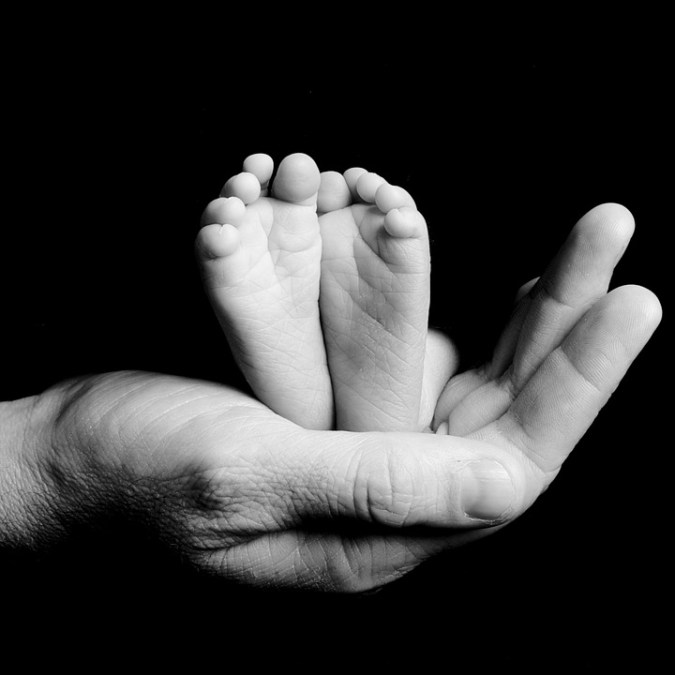
 

Mathematical Improbabilities


Welcome


Eyes, fingertips, tongues

form one from two.

Yield three.


You.


Snowflake fingerprints,

tiny palms creased with foreknowledge,

DNA whirling proteins

into the plot of a new story.


Despite vast mathematical improbabilities

here you are.

Your mother’s hundred thousand eggs

your father’s five trillion sperm,

a one-in-five-hundred-million-million-million

chance of your existence.


Our gladness is incalculable.


Laura Grace Weldon


Find more poetry in my collection, Tending. 

Summer Day at Huntington Beach

poem, Lake Erie shore

Summer Day at Huntington Beach


I tick with alarm clock worry.

My sister is afraid of nothing.

Not the dark or death or

Jay Preslan down the street

who pushes kids in front of cars.


Look at her run into the water

while I stand squinting.

She doesn’t pinch her nose

to dive under. Doesn’t pause

before splashing back

strange splashing kids. Doesn’t heed

the lifeguard’s megaphoned warning

to stay away from the ropes.


Lake Erie grabs at the shore,

slurps it greedily in foaming waves.

I picture monstrous goggly-eyed fish

lurking under the pier,

ships skudded in the depths,

lost sailors forever unburied.

I inhale the curved scent

of suntan lotion, clench my toes

in the sand, stand still. Far out,

bobbing in foil-bright waves,

my sister is another being entirely,

straining at the boundary ropes

trying to see all the way to Canada.


Originally published by Silver Birch Press.  Find more poems in my collection, Tending. 

Failure Too


Failure Too, a poem

Failure Too


Failure is more than shame’s

hot tar and feathers.


It’s cancer cells

destroyed daily

in the body’s

relentless furnace.


The unseen mugger

turning away

as a friend’s greeting

crosses the street, bright

streamers through the dark.


The beads of a broken necklace

rolling in his mother’s

dresser drawer, evidence

of that long gone afternoon

he scooped blue stones and dust

from the floorboards,

weeping till she soothed

with words softer

than her disappointment.


Finding them the week she died

he’s glad the necklace broke,

carries those stones

in his pocket to this day,

as ruins remind

us of splendor

in civilizations that spawned us.


Laura Grace Weldon

Originally published in Mom Egg Review.  Find more poems in my collection, Tending. 

Perfectly Good

"Perfectly Good" by Laura Grace Weldon


Perfectly Good

The chair broke years ago

leaving jagged oak

at its topmost edge.

Repairs never held and

here my youngest son sits

his face lit from within

like all God’s children.

If I could I’d fashion everything broken

into a greater whole, forming

a bridge to his highest possibilities.

Instead he eats supper

with sharp wood bristling at his ear

and when I suffer it aloud

the boy says, “It’s perfectly good.”


This was the mantra of my childhood.

Spoken over fat and gristle

left on my plate till I forked those last bites

in my reluctant mouth. Invoked with each

hand-me-down, though Jennifer Kling’s

mother always made me wear suspenders

at her house to spare her

my sagging trousers. Implied

in a fistful of stubby No. 2 pencils

my schoolteacher father saved

from the classroom trash can,

the same ones my mother darkened

her eyebrows with each morning.


Today my son helped with yard work

at my childhood home, then stopped

CSI-faced, to hold up a dark loamy figure.

My mother dismissed it casually,

“Oh, the overcoat in the azaleas.”

Her father’s moth-eaten wool coat,

good tailoring still apparent in the shoulders,

was too good to discard, but perfectly suited

to smother weeds forty long years.


Standing next to her in the doorway

I knew identity as something

broader than a name.

This is who we are.

Resilient enough

to chew the fat, hitch up our pants,

and raise our brows— smoothing the way

for our children the best we can.

I grew up missing my grandfather,

yet all the while his coat

lay right outside the window

arms spread wide,

keeping a place for flowers to grow.


Laura Grace Weldon

Find more poems in my collection, Tending. 

Fog is composed of…

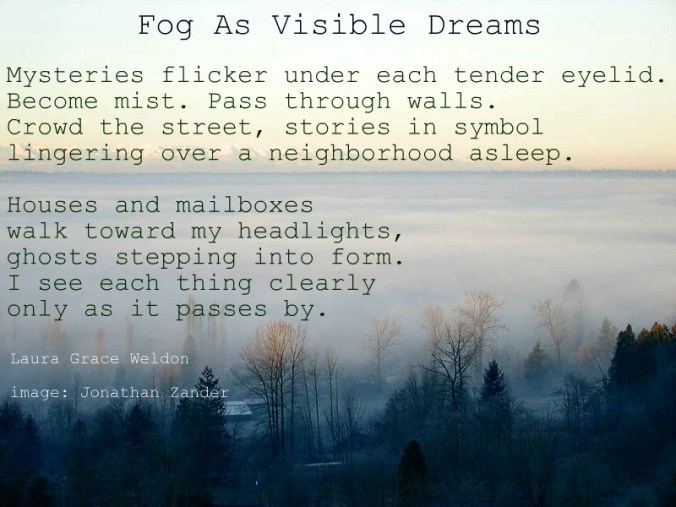
Fog As Visible Dreams

Fog As Visible Dreams


Mysteries flicker under each tender eyelid.

Become mist. Pass through walls.

Crowd the street, stories in symbol

lingering over a neighborhood asleep.


Houses and mailboxes

walk toward my headlights,

ghosts stepping into form.

I see each thing clearly

only as it passes by.


Laura Grace Weldon

Originally published in Shot Glass Journal.   Find more poems in my collection, Tending. 


fog as visible dreams

Holding Together

Hubble telescope poem

Too Little


Nose pressed in tiny squares

against the screen, I watch

casual laughing gods

walk home from school.

I envy their long legs

and glossy notebooks,

their unseen power

to unlock

words from shapes,


My sister drops A+ papers

and library books

on the speckled Formica table.

Asks me how many times

a butterfly flaps its wings.

Tells me I’m wrong.

Eats two cookies.

Announces we’re made up

of tiny things called cells,

made up of tinier things

called atoms,

also made of what’s smaller.


The kitchen walls stretch

to galaxy proportions,

the table a raft among stars.

I hold tight to my chair

and concentrate,

keeping my short legs,

my clumsy fingers,

the balloon of my body,

from dissolving into bits.


Laura Grace Weldon


Originally published by Litbreak. 

Calling the Dog


a

 Calling the Dog


Following messages left in leaves, soil, air

he wanders too far.

When I call    he pauses

quickening

to hurl fullness and glory

ahead of the self

like whales breach, tigers lunge, hawks soar.

There’s nothing but an arc

between hearing his name and springing

toward the one who named him.


I want this completeness.

I want to feel 100 trillion cells spark

from my body in answer

to what we call spirit.

I want to taste

the shimmering voltage course

from every rock, tree, star.


A moment before reaching me

he unsprings,

back to golden fur and brown eyes

arriving tongue first.


Laura Grace Weldon

from Tending  (for my friends Cocoa Bean and Winston)
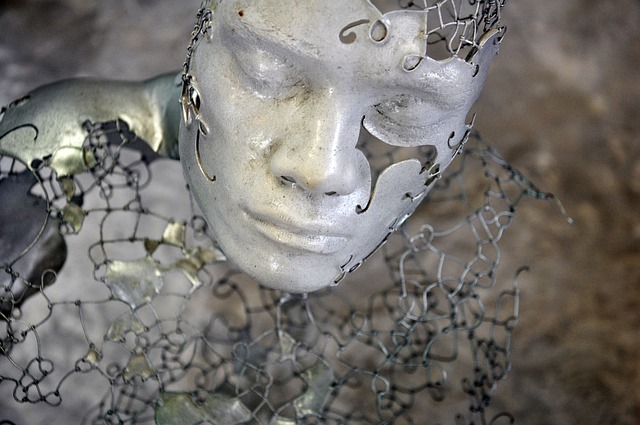
Everyone Is A Poet

everyone is a poet

When people tell me their largest stories I am helpless as a page under pen.

A woman told me how, as a child of 11, she struck out when her grandparents were ignored rather than served at a restaurant in the deep South. Her anger was so heated that she used the restaurant’s complementary matches to start the place on fire.

It wasn’t entirely the content of the memory or the force in her voice. It was the way she strung words together; spare yet detailed. She talked about her grandmother’s arthritic hands picking up and putting down a salt shaker. She described her grandmother’s dark green dress and sensible heels, the patient smile she wore even though no one came to take their order. Before this raised-up-North granddaughter could utter a word of complaint she was shushed by her grandmother’s stern look. As her grandparents stood to go the girl ducked into the cloakroom and in seconds set to smoldering the hair oil soaked fedoras left there by white gentlemen. Of the fire she said little, except that the restaurant was forced to turn everyone away that day.

A teen described how, when he was a small child, his mother got so strung out that she’d leave him alone for days at a time.

He ended most sentences with “you hear me” and “wasn’t nothing” as he talked about licking his fingers before running them along the insides of drawers and cupboards to find crumbs. He said his mother got angry if she caught him sleeping curled next to the apartment door. She’d yell “I didn’t raise no dog.” When his story ended a refrain continued. He said “wasn’t nothing” four times, each repetition softer until his moving lips made no sound at all.

An elderly woman recounted the story of union busters coming by their cabin at supper time to beat up her father, who’d been organizing his fellow coal miners.

She didn’t recognize her own family any longer but vividly remembered this tale from her earliest years. Her words were impressions. I saw her mother standing fearfully at the door insisting her husband wasn’t home, children clustered behind her wide-mouthed with alarm. I envisioned this little girl with the presence of mind to hide her father’s dinner dishes. “Just laid em in the stove with a cloth over,” she said. When the men barged in they found only enough place settings for mother and children on the table. They left, never looking under the porch where her father hid. She had no other stories left to tell. This one was large enough for a lifetime.

Not only do I feel what they’re saying, I’m awestruck by how they say it.

When people talk about extremes they’ve experienced they speak as poets do. They rely on verbal shorthand made up of sensory description and metaphor. They drift from past to present, change viewpoints, dip into myth and scripture. Often they end abruptly, as if what they’re trying to say can’t truly be said. Their stories, powerful already, gain a sort of beauty that sends ordinary language aloft. It’s truth that trembles. To me, it’s poetry.


This essay first published in Poet’s Quarterly.


17 Ways to Show Authors Your Love

image: vjcx.com

We know how to love celebrities and athletes in our culture. We hashtag them, go to their performances/games, read about them, imitate them, talk about them, and in many other ways make these people an ongoing presence in our lives. (Note: there may be a strange reason we’re so obsessed with celebrities.)

It’s less common to love writers, far less common to show it.

Today’s publishing houses expect authors (other than the most commercially promising ones) to do their own book marketing. We’re expected to blog, tweet, arrange book signings and readings, do interviews, and otherwise connect with potential readers as if there’s nothing awkward about begging people to buy our words.

But we know that books, articles, essays, poems, posts, (actually, all forms of writing) live on only when they’re read. It’s even better if they’re discussed, shared, and remembered. My writer friends and I do our best to promote one another’s work to a wider audience. Most writers do this for each other. If you’re inspired, take a tip or two from us and show some authors your love.

Share a great author interview or book review. Share a passage from a book, article, blog post, or poem. Toss it out there on Twitter, Instagram, Facebook, whatever platform you use.

Quote. If you’re writing a report or giving a presentation, sprinkle in a relevant quote or line of poetry. It’ll add another dimension to your work.

Review books you love on Goodreads.com, LibraryThing.com, Amazon.com, BarnesandNoble.com, wherever you go to check reader reviews. You can make it easy on yourself by simply leaving a bunch of stars. Take it up a notch with a glowing one-line opinion. On Amazon, you only need to click “like” to boost a book or other people’s reviews of the book. Your viewpoint really does help potential readers find what to read next.

Advocate for writing that has changed your outlook, expanded your interests, led you in entirely new directions. A few months ago Facebook bristled with personal lists of 10 Life Changing Books. I love hearing what books impact other people and I’m often inspired to read those titles too. (Here are 10 that occur to me at the moment: The Secret GardenOriginal Wisdom, The Continuum Concept,  Nature and the Human Soul,  A Paradise Built in Hell Pronoia Is the Antidote for ParanoiaMan’s Search for MeaningBeyond WarSpontaneous EvolutionListening for the Heartbeat of God.

Give books as gifts. They make wonderful presents for birthday, holidays, and milestone celebrations. They make wonderful business gifts for clients and great promotions for related products. They’re great to give simply when it occurs to you that a specific book and a specific person might go well together. Give books to children for special occasions but also for fun. Don’t forget to leave an inscription even for the youngest. If you like, pair a book with a small related present. Tea, coffee, or something more spirited is a perfect accompaniment to any book gift.

Try something different. Indulge in your favorite genres and let yourself branch out from there. A fan of historical novels set in a certain era? Try poetry from that time period, non-fiction books about the art or science of the era, biographies of people from that time, as well as history magazines and related sites. I’ve come across writing I normally wouldn’t read only to discover a passion for science-y novels, tomes on evolutionary biology, sites offering vintage maps, work by outsider artists, and other fascinations.

Request. I couldn’t possibly afford to buy a fraction of the books I read. Instead, I’m a unrepentant library addict. If there’s a book you’d like, order it from your local library. They’ll call or email you when it’s available. If they don’t own a copy, ask them to purchase it. Some library systems put request forms online, other systems prefer you go directly to a librarian to request a book acquisition.

Hang out with other book lovers. I’m a long-time member of a book club. It prompts me to read books I wouldn’t normally read and our wide-ranging discussions are a delight. And our boys’ book club lasted till our kids all went off to college, over nine years of lively bookish gatherings.  You can start up a book club with friends or join an existing group. Check out nearby clubs through Reader’s Circle, your local library, or Meetup.

Offer books for sale through your business. If you have a bike repair shop, offer guides to bike trails along with some bike-riding memoirs. If you run a stand at a farmer’s market, offer a few cookbooks and urban farming volumes. If you own an art gallery, sprinkle a few poetry and art books among your offerings.

Give magazine subscriptions as gifts. There’s a wealth of not-so-mainstream options, from boat-building magazines to literary journals to kids’ science publications.

Recommend. Create your own list of favorites on a topic via Amazon’s Listmania. Perhaps “Little-Known Poetry Books You Should Read…” or “Alternative Education Books We Use….” While you’re at it, search all the Listmania lists of interest to you.

Link. An insight or idea sticking with you? Link to (or at least attribute) books or author sites when you write about ideas they’ve prompted in you.

Talk about writing you love. I tend to go on and on with vast enthusiasm about what I’m reading. I adore memoirs from the sublime to the hilarious: A Private History of Awe by Scott Russell Sanders, A Girl Named Zippy by Haven Kimmel, and Kick Me by Paul Feig. Beautifully written, unforgettable novels such as All the Light We Cannot See by Anthony Doerr,  The History of Love by Nicole Kraus, State of Wonder by Ann Patchett, and Peace Like a River by Leif Enger. Animal books, a worthy indulgence, including The Good Good Pig by Sy Montgomery and A Small Furry Prayer: Dog Rescue and the Meaning of Life by Steven Kotler. Sci-fi like The Kin of Ata Are Waiting for You by Dorothy Bryant and Agent to the Stars by John Scalzi. And  books that don’t fit in any category like Sum: Forty Tales from the Afterlives by David Eagleman. Really, read these books!
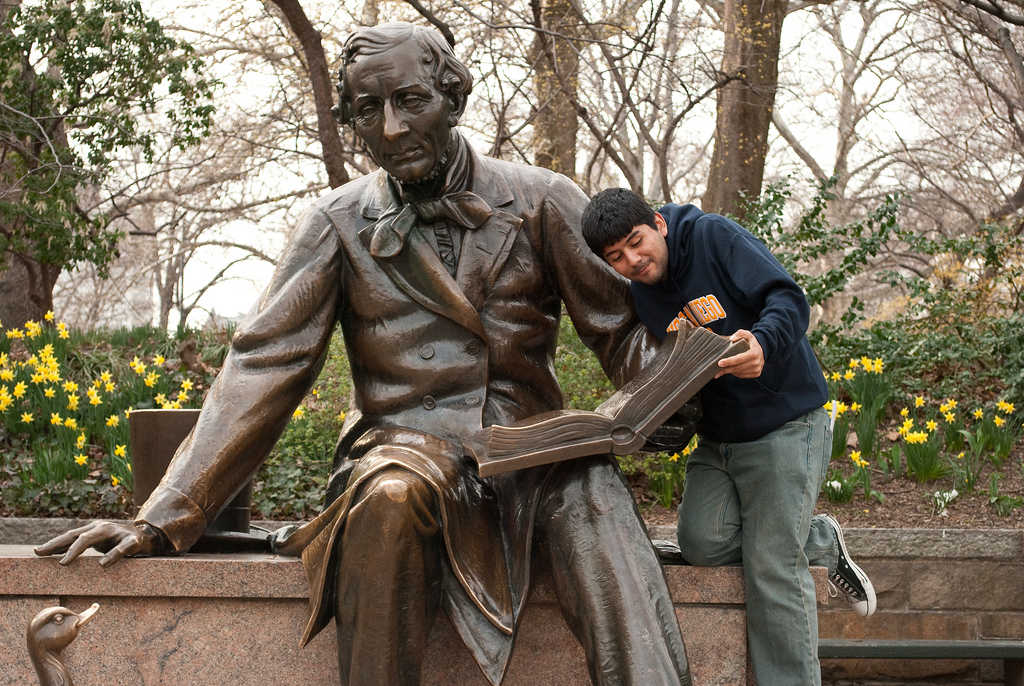
Expose local authors. Ask an author to serve as an expert, answering a question or two for an interview to be published online or in print. Invite an author to do a reading or give a talk to your organization, club, or business either in-person or via Skype. Talk up local authors with people you know.

Promote. The Southern Independent Booksellers Association started a YouTube channel called Parapalooza! Submit a video of yourself reading a passage from a favorite book to parapalooza@sibaweb.com. If you live in the UK, contact Steve Wasserman of Read Me Something You Love. He’ll come out to record your reading of a passage you choose, along with some conversation. If it’s poetry you adore, read one you love aloud for Record-a-Poem. You can also reach out to others in your community who’d like to share a favorite poem through the Favorite Poem Project or start up a poetry-sharing group on Meetup.

Read already. Titles piling up on your Kindle, overdue library books, a teetering stack of magazines next to the couch are all evidence that you want to read. But you’ve got more to do than you’ve got time. Admit it to yourself, you’ll never defeat your in-box. Might as well go lie on the grass or in the tub or on your couch and read!

Connect. Follow authors on Facebook or follow their tweets. Write to them care of their publishers. You might send a brief note about how much you enjoyed a book or how it or improved your life. You might send suggestions, questions, a cheerful aside. Writing is a solitary occupation. When an author hears that his or her work made a difference, I guarantee it’ll have an impact. On a few rare occasions readers of my first book let me know it changed the way they parent or educate and how that’s impacted their lives. These communications are the sort of wealth I’d never believed possible. Utterly priceless.

Some days I like to imagine a world where we love our writers and artists and scientists and volunteers with the same passion we show celebrities. A girl can dream.

Alejandro Mallea's flickr photostream

Alejandro Mallea’s flickr photostream

“The writer’s way is rough and lonely, and who would choose it while there are vacancies in more gracious professions, such as, say, cleaning out ferryboats.”

Dorothy Parker