No Parrots Here

free range parenting, kids different than parents, children's interests, selfhood,

Image CC by 2.0 Ajari

Parenting would be easier if my children wanted to learn about the same things that I happen to love.

I once had the naive assumption that they would naturally develop my passion for environmentalism, muckraking journalism, anthropology, applied ethics, messy art, alternative medicine, and satire.  I knew these passions weren’t genetic, my parents were into playing bridge and visiting historical sites.  But I figured my children would absorb my fascination by osmosis.

Nope. More like reverse osmosis. They seem to feel that just living
with me is exposure enough to those topics.  More than enough.

I play tapes of peace songs and world music despite their feigned death throes.  I take them, all right, drag them, to tiny art galleries, odd ethnic restaurants, wildlife sanctuaries and community service projects. They point out that they’ve never owned hand held video games and on that basis alone could be considered culturally deprived.

I occasionally read periodicals aloud hoping to discuss important issues with them, which has caused them to say, “She’s ranting again.”  My grandiose art schemes, such as building a catapult to fling paint onto huge canvases, ala Jackson Pollack, are met with rolled eyeballs.  I only need to look serious a brief moment before my daughter alerts her siblings, with warnings like, “Oh no, mom’s launching into another sermon.  I think she’s on number 127, the Deeper Meaning of Things.”  I concoct homemade tinctures of herbal remedies which admittedly aren’t taste treats, but aren’t cause enough for them to call the kitchen Mom’s Evil Laboratory.  You get the idea.

They are certainly their own people.  They seem instinctively drawn to what I’m not. I can almost hear the screech as my brain cells are continually forced to expand to include their interests.

Several of them actually like organized activities like scouts and 4-H.  This requires meetings where I have to sit in a folding chair and behave myself.  I prefer spontaneous, free form events, like “Hey, lets paint a mural on that wall.”

I hide it well, but secretly I’m squeamish.  Naturally they bring me snakes, toads, beetles, spiders, and slugs.  They expect me to fawn over them.  I can only do a passable faux fawn.

I like safety precautions like helmets, seat belts, and peace accords.  My 10-year-old son adores skateboards, stunt biking, and tree climbing.  He plans to be a pilot. He talks to me about airfoils and ailerons.  I’d only fly if I were being awarded the Nobel Prize. Even then I’d probably ask if it could be delivered.

I’m a vegetarian.  Naturally, my daughter is smitten with dissecting.  She wants to be a forensic pathologist.  Supportively, I’ve purchased poor innocent creatures floating in formaldehyde, procured eyeballs and hearts from the butcher shop, even taken pictures of the gore she calls anatomy.  She proudly showed her grandmother the virtual autopsy web site.  My mother was intrigued.  I restrained myself from asking, “What happened to playing bridge?”

I have trouble with technical details.  I even require assistance getting film in and out of our vintage 35 mm camera.  I finally recognized this as an immutable fact after indulging myself in a few temper tantrums over broken film. Of course my oldest is a ham radio operator, builds authentic model railroad layouts, fixes our 1949 tractor, and stuns his boss into silence with his ability to fix highly exacting equipment. When he was six he patiently explained to me how to program the clock in our car.  I forgot what he said AS he was saying it.

I’ve been known to slip into situational ethics from my pillar of universal truths at times, but I’m always caught by my youngest.  “Why do you talk about cherishing all life if you want to get rid of the wasp nest in the attic?” he’ll say sweetly with seven-year-old logic.  “Why do you let the phone go to voice mail?  Isn’t that like lying?” Okay, maybe they are learning what I have to say, but I wish they wouldn’t use it against me.

Occasionally I’ll get their grudging admiration for silly feats, like my useless mental compendium of decades-old song lyrics or my willingness to sass authority figures. But more and more often we find that our interests intersect.  I can’t help but be awed by the uniqueness of what they find fascinating, and they can’t help but understand what I thrive on.  Best of all, we laugh together.

Parenting would be easier if they parroted my interests, but that would be indoctrination instead of exploration.  I’m glad they are their own people.  We all lean toward what helps us grow, like eager plants inclining towards sunlight even if it shines from different windows.

reprint from Home Education Magazine

Getting Science On Everything

raising scientists, toddler science, teen science, unschooling science, supporting kids' curiosity, science at home, science happens naturally,

crystals of vitamin B6 ( CC by 3.0 Josef Reischig)

 We spread thick layers of science on everything at our house. Yes, occasionally it smells.

Sometimes our science-y obsessions are entirely nonsense, such as a typical dinner table conversation about how many citrus batteries it might take to start a car. Ideas were proposed for this never-to-occur project, including the use of lemon juice instead of whole fruit.

Sometimes that science is pseudo-educational, such as the time we swabbed between our toes and let the bacteria grow in petri dishes. The “winner’s” dish had such virulent growth that she felt sure it deserved to live. She gave it a name and tried feeding it extra glucose and agar. It quite effectively kept her siblings out of her room. I insisted she throw it away when it began creeping past the lid. I am still blamed for the demise of this biological fright.

encouraging young scientists, love of science starts early,

Sometimes it goes on and on. My offspring seem driven to find out. They can’t spot a spider without observing it, wanting to identify it, and then going on about the hydraulic features that are basic arachnid operating equipment. Then there was a certain months-long project that involved observing and sketching the decomposition of a muskrat. They have to discuss all possible angles of a problem, often in such depth that my far more superficial mind drifts off. They tend to walk into a room announcing odd factoids which invariably leads to strange conversations about recently de-classified Russian research, turbo charged engines, or riparian ecology. Or all three. They insist I look at video clips that go on much longer than my attention span. Woe to me if I question a postulate put forth by one of my kids. They will entertain my doubts playfully, as a cat toys with a mouse, then bombard me with facts proving their points. Lots of facts. I’ve tried to uphold my side in science disputes but it’s like using a spork to battle a light saber.

making math relevant, raising young scientists,

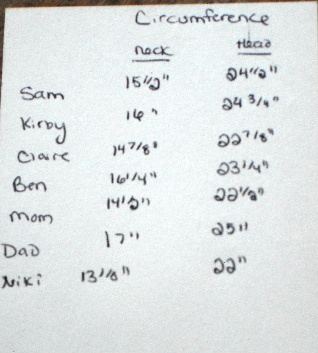
Other family homes probably have video game controllers. Our house has stacks of books and periodicals (who took the neutrino issue of New Scientist, someone yells); tubs overflowing with one son’s beakers, tubing, and flasks; culturing products in the kitchen (like the jar with a note that says “Leave me alone, I am becoming sauerkraut”); and random sounds of saws, welders, and air compressors as something entirely uncommon is being constructed or deconstructed. I know other families have nice normal pictures on their refrigerators. Ours tends to post odd information. The longest-running fridge feature here is a card listing the head circumference of every person in the family. By the time the youngest was 11, my head was the smallest.

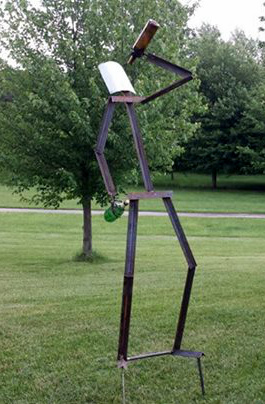
And then there’s the front yard. By the garage door a headstone leans. It has nothing to do with Halloween. Our youngest is teaching himself stone carving using hand tools. This stemmed from his interest in ancient Norse language and myth and lifestyles. That led to a study of runes, leading to old runic carvings, well, you get the idea. He’s already carved runes in a few stones. So of course his brother got him a headstone as a birthday gift. Entirely natural. Also in the yard, a giant sculpture another son welded out of scrap metal. He’s never taken a welding course, or an art course for that matter. No problem. He measured his own limbs to translate into the correct human form. He thought it was funny to make it a two-fisted drinker. I’m plotting to put a trumpet in one of the metal man’s hands so it looks like a rowdy jazz player. And recently my daughter spent the afternoon in front of the house cleaning an entire deer skeleton she found in our woods. She was entirely happy identifying bones, scrubbing, and assembling it into the likeness of a very hungry  deer. Maybe our front yard is why our mail carrier seems a little wary.

raising scientists, natural curiosity makes scientists,

Science shouldn’t be confined to a formal study. My husband and I have never worked in science fields. But we’ve found that keeping scientific curiosity alive isn’t hard.  It’s about an attitude of “yes.” Projects that are messy, time-consuming, and have uncertain outcomes are a form of experimentation. They are real science in action. When a kid wants to know, they want to find out. Not later, not next week, right away. Finding out is engaging. It leads to ever widening curiosity. In our family this process of discovery-to-mastery started early.

When my oldest was just a baby he was horrified by vacuums. Even the sight of one made him scream with This Will Kill Me volume. So we let him learn he could control the “off” and “on” switch. His horror turned to fascination, leading him toward ever greater curiosity, heading in all sorts of directions.

When my daughter was barely able to walk, around 11 months old, she was fascinated by the stones at the end of our driveway. Day after day she wanted to toddle close to the street just to pick up those stones. It occurred to me that it would be a lot easier to satisfy her curiosity than to keep saying no and turning her back toward the house. So she and I went there together and sat in those stones. She was enthralled. I marveled at all the different ways she chose to experience them. Holding, dropping, picking up one at a time then picking up handfuls, handing them to me and taking them back, rubbing the smooth ones and, once I showed her, holding them up to the light. Sometimes she’d raise a stone to her mouth, then shake her head, reminding herself that stones weren’t for eating. Once or twice a stone did touch her lips. The result? I told her we were all done, picked her up, and went back to the safety of the lawn near the house. She remembered. I let her investigate stones day after day until she was done, her desire to know satisfied.

When one of my boys was three he was entranced by the lighters and matches his grandmother used to light her cigarettes. Since she lived with us and on occasion unintentionally left those fire generating devices out, his intense curiosity concerned me. He knew that children shouldn’t touch anything that makes fire, but he was so intensely curious and active (I’ve already described his chimpanzee-like abilities as a toddler) that I knew it was a matter of time before her forgetfulness might collide with his need for some hands-on experience. So, explaining this was only okay to do with an adult, I stood him on a stool at a sink full of water, letting him light match after match to drop in the water. He was a little afraid. His fingers were almost singed a few times. He also conquered the fascination with flame that compelled him to disobey. He asked a few times over a period of months to do this again. Then he was done. Warming about danger doesn’t have the same effect as a child getting close enough to know that matches do burn but can be conquered in the presence of a parent.

Some experiments shouldn’t have happened.  One of my little boys quietly carved a small hole in the drywall of his closet, then attempted to spackle it with the unlikely combination of toothpaste covered by an ostrich feather he’d saved from a field trip. We didn’t discover it until we were emptying that closet as he packed for college. We still laugh about that one.

My kids are much more science-savvy than I’ll ever be, but more importantly, they’re capable of discovering anything they want to know.

Pride Goes Before Tiny Bite Marks

prideful parents, mom's downfall, don't take credit for your kids, my child bites,

I don’t take credit for my children’s many accomplishments. They are their own remarkable people.

As a new mother I didn’t have this quite figured out. Yes, I knew that babies arrive on this planet with all sorts of traits wired in. I knew it’s up to us to gently nurture them, shelter them from harm (including the damage cynicism can do), allow them to take on challenges, help them learn to trust themselves, and let learning unfold in delight.

But I had a few early years when I thought, probably with obnoxious smugness, that my wonderful parenting had something to do with how well my kids were turning out. They were very young and so was I.

My oldest, a boy, was thoughtful and clever. He liked to take my face between his little hands and call me every superlative he could think of like“dear, sweet, wonderful Mama. (Isn’t this positively swoonable?) He rescued insects from the sidewalk, telling them “go in peace little brother,” a line he picked up from one of his favorite picture books. When his father and I tried to talk over our little one’s head about issues we thought he shouldn’t hear, we used Shakespearean language to obscure our meaning. We had to stop, because our toddler began regularly using words like “doth” and “whence.”  What made things work fascinated this little boy, from the bones in our bodies to the engine in our cars, and he insisted on learning about them.

My next child, a daughter, was assertive and talented. She drew, danced, and sang made-up songs of such pure wonder that, I kid you not, birds clustered in trees near her. The force of personality in that tiny girl led us all to laugh at her improbable jokes and enter into her complicated realms of make-believe. Born into a home without pets, her drive to be close to animals was so intense that she kept trying to make worms her friends. Entirely due to her persistence we ended up with several pets by the time she was three.

Although our beautiful little children had medical problems, we had money problems, and other crises kept popping up I felt as if I lived in paradise each day. There’s something remarkable about seeing the world anew through the eyes of the planet’s most recent inhabitants. It’s like using an awe-shaped lens.

But I still had a lot to learn about parenting.

I recall being quietly horrified at a Le Leche League meeting when one toddler bit another. I thought about it for days, wondering what parenting might create such an impulsive child. All the parenting books I read, all the non-violence courses I taught, assured me there was a right way. Of course my comeuppance would arrive.

My third child was born soon after. This endearing, curious, and constantly cheerful little boy possessed relentless energy. Evidence? I’ve got evidence.

  • By the time he was 14 months old we had to twine rope around all the chairs, lashing them to the table between meals, otherwise this diapered chap would drag a chair across the room to climb on top of furniture in the few seconds it took me to fill a teakettle.
  • Before he could say more than a few words he’d learned to slide open our windows, unclip the safety latches on the screens, and toss the screens to the ground. 
  • He liked to grab the hand vacuum for experiments on his sister’s hair, houseplants, and other normally non-suckable items.
  • He watched with fascination as drips from his sippy cup fell into heat vents, the hamster cage, the pile of laundry I was folding.
  • He liked to take off all his clothes and climb on the windowsill facing the street, hooting like a giddy chimpanzee as he danced in naked glee.
  • We had no idea he could climb out of his crib till the evening he opened all the wrapped Christmas presents I had hidden in my room (keeping them safe from him) while we thought he was in bed. The look of complete joy on his face nearly made up for the hours of work it took me to rewrap.

I found myself making up new rules I never thought I’d utter, like:

“I know throwing is faster but we carry things down the stairs.”

We never run with straws up our noses.”

“Don’t poop in Daddy’s hat!”

He became a little more civilized by the time he was three, but not, as you might imagine, before he bit a few children.

Utterly besotted by the bright-eyed charm and endless curiosity of this dear little boy, I never suspected the labels doctors and schools so easily affix on non-conformist kids might be slapped on my child.  I never realized how much he would teach me about what real motivation and learning look like. And I never imagined how much he’d show me about what it means to pursue success on one’s own terms.

Today he is one accomplished young man, in part because he continues to see the world through an awe-shaped lens. And I am still learning from the four remarkable people who came to this world as my children.

Where Fascination Leads

child's interests, toddler's fears show inclinations, fear is fascination,

Born with uniqueness.

“I didn’t say I liked it. I said it fascinated me. There is a great difference.” Oscar Wilde

My oldest was calm and attentive as a baby, except around vacuum cleaners. The machine’s sound made him scream with the sort of primal terror normally associated with death by predator. He had no previous experiences with loud sounds in his short life, good or bad. Except for surgery, performed when he was five weeks old, he’d had no bad experiences at all.

As a first time parent I turned his reaction into a giant philosophical issue. (Okay, maybe I turn everything into a giant philosophical issue.) Should we only vacuum when one of us took him out of the house until he somehow grew out of it? Or should we hold and reassure him when the vacuum had to be turned on? I was convinced whatever we decided would somehow have lifelong ramifications.

For a few months we relied on the first solution. The only vacuum sounds he heard were through open windows. Even outside, he listened on Baby High Alert status until it was turned off, with wide eyes and a stiff body. Fortunately the vacuum didn’t run long since our house was tiny. Then winter hit. It wasn’t easy to go outdoors simply to turn on the vacuum. Much as I appreciated any excuse to be slothful, I was still in the first child clean house stage (that ended resoundingly long before child number 4). So we tried desensitizing him to the Terror Machine sound. Although he initially screamed when I got it out and named it, he began to calm down as I did this day after day, naming it, then saying OFF and ON while performing those functions quickly. I was relieved when he no longer cried in nervous anticipation. Next I’d hold him as I pushed it around, doing one room before letting him turn it off. His tension dissipated and it became a favorite activity. Have you guessed? Mastery of fear led to fascination.

One of his first words was “vacuum.” He wanted to know all about them. He loved sale fliers with pictures of vacuums. I ended up cutting out all sorts of vacuum pictures to put in a photo album so he could flip through it, pointing and making “vroom” noises. Anything associated with vacuums, like hoses and plugs, also made his fascination list. An early talker, he memorized manufacturer names of vacuums and, like a household appliance geek, would quiz other people about vacuums. I recall one such incident when he was not quite two. We were at the park when my child tried to instigate a conversation with a fellow toddler. It didn’t seem the other little boy was a talker yet. Meanwhile my son, telegraphing his strange upbringing, was asking, “Do you have a Eureka vacuum at home? Do you have a Hoover? A Kirby?” When he saw the respondent didn’t understand, my son tried what he thought was an easier question. “Is your vacuum upright or canister?” Both little boys looked up at me with incredulous expressions, as if asking what was wrong with the other.

He often called his play “work” and was never happier than when he could contribute to real work. For his third birthday my son’s dearest wish was for a hand vac. And to go to Sears so he could hang out in the vacuum section. That’s what we did. Even his best buddy Sara, who had come along for the birthday excursion, patiently indulged him. She understood him well and when they played house she often had him fix pretend things or turn on pretend things, which always made him happy. That year he got a gift wrapped hand vac.

The vacuum obsession wasn’t his only early childhood weirdness. Once he figured out that bones have Latin names (I think a physician friend leaked this info) he insisted on memorizing those names. He liked to rescue bugs from situations he deemed dangerous, telling them “go in peace little brother,” a line he got from one of his favorite books. He preferred actual tools to toys, and before he was four he started building things out of scrap wood and nails, carefully hammering them into shapes almost as incomprehensible as his crayon drawings.

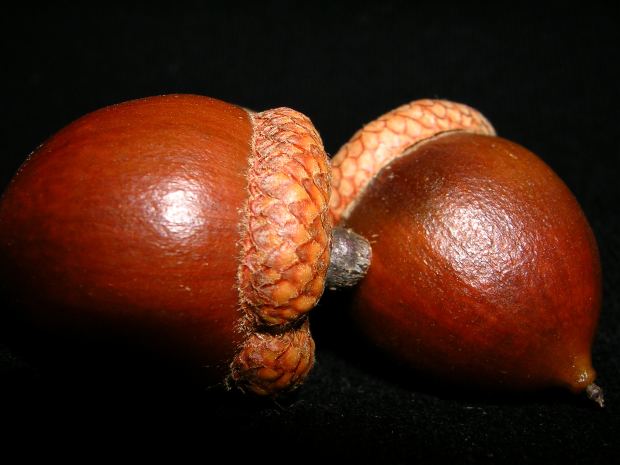
Around that time I read a fascinating book by James Hillman, The Soul’s Code. Hillman is a deep, insightful thinker. It has been a long time since I read the book, but I recall that it described each of us as coming into the world with a uniqueness that asks to be lived out, a sort of individual destiny, which he termed an “acorn.” It’s a remarkable lens to view who we are. A child’s destiny may show itself in all sorts of ways: in behaviors we call disobedience, in obsession with certain topics or activities, in a constant pull toward or away from something. Rather than steering a child to a particular outcome, Hillman asks parents to pay closer attention to who the child is and how the child shows his or her calling.

The examples Hillman gives are memorable. If I recall correctly, Yehudi Menuhin, one of the preeminent violinists of the 20th century, became fascinated when he heard classical music on the radio as a three year old. He wanted to feel the same rich notes coming out of a violin in his hands. His parents lovingly presented him with a toy fiddle. He drew the bow across the strings and was horrified at the cheap squawk the toy made. Enraged, he threw the instrument across the room, breaking it. His imagination had already taken him to the place in himself where beautiful music was made and he was unable to bear that awful sound. We normally call that behavior a “tantrum.”

Another example is award-winning director Martin Scorcese. As a child he suffered from terrible asthma and wasn’t allowed to go out to play on the New York streets. So he watched the world framed by a window. He drew what was going on, making frame after frame of cartoons. He was teaching himself to create scenes and action, essentially tutoring himself in the basics of moviemaking. We’d normally consider his circumstances a form of deprivation. Reading Hillman’s book gave me insight into the acorn of my own fears, longings, and daydreams. It also helped me see my child’s interests with new eyes.

My firstborn is an adult now. He can weld and fabricate, repair tractors and cars, build additions on a home and turn a shell of a room into a working kitchen, drive heavy equipment, do complicated calculations in his head, make do on little, and work until everyone around him has long given up. He’s also witty, intelligent, and endlessly generous. I don’t know if those early vacuum terrors had anything to do with how he’s turned out, but I’m sure the child he was would be amazed at the man he has become.

What was your earliest fear, fascination, and other ways you may have shown the “acorn” of yourself?” What about the children in your life? 

Child 1

This article first appeared in Life Learning Magazine.

Respecting A Child’s Urge To Discover

theory of loose parts, kid innovators, creativity, learning is discovery, self-motivation,

misspenthopesxx.deviantart.com

The kids had a bunch of boards, some old nails, a hand saw, and a few hammers. They also had the two most important ingredients, the desire to make something and the freedom to do so.

They spent an afternoon planning their tree fort, enthusiastically arguing over whose plan was best. Their first few attempts failed spectacularly. They were undaunted, even bragged a little bit about the noise the boards made falling down. Several of them asked family members for advice. A few others paged through books and watched YouTube videos as they tried to figure out basic construction techniques. They started again, measuring more carefully as they built a frame. The process took much longer than they’d expected but they stuck with it. When they ran out of materials they scavenged tree lawns on garbage pickup day, dragging back pieces of wood. They got a few cuts and bruises. They were proud of those too. As they worked they talked about how they’d use their clubhouse. It didn’t occur to them how much they were learning.

Conventional thinking tells us that children benefit from the newest educational toys and electronics, lessons, coached sports, and other adult-designed, adult-led endeavors. Well-intentioned parents work hard to provide their children with these advantages. They do this because they believe that learning flows from instruction. By that logic the more avenues of adult-directed learning, the more their children will benefit.

But learning has much more to do with curiosity, exploration, problem solving, and innovation. For example, if baby encounters a toy she’s never seen before, she will investigate to figure out the best way or a number of different ways to use it. That is, unless an adult demonstrates how to use it. Then all those other potential avenues tend to close. Studies show that “helpful” adults providing direct instruction actually impede a child’s innate drive to creatively solve problems. This experience is repeated thousands of times a year in a child’s life, teaching her to look to authorities for solutions, and is known to shape more linear, less creative thinking That’s true of a baby as well as older children and teens.

Young people are also cued to ignore information that is too simple or too complex. Research indicates that people are drawn to learn from situations that are “just right” for them.  They may make plenty of mistakes along the way, just as babies fall when learning to walk, but facing those challenges and making those mistakes are pivotal steps in maturity.

It’s also well-known that a child’s natural motivation tends to diminish in adult-led activities. Unless they’ve been raised on a steady diet of ready-made entertainment, children are naturally drawn to free play. They pretend, make up games, daydream, wonder, and launch their own projects. They are discovering not only the world around them but a rich inner life as well.

Of course adults are vital to young people’s lives. They provide safety, guidance, love, and much more. Kids know they can ask trusted adults for help or advice. They do so more eagerly when they recognize these adults won’t overwhelm them with information, quiz them on what they are learning, or take over. Adult responses simply need to stay in proportion to a young person’s request.

For an example of how powerful the drive to discover can be, let’s take a brief detour to two Ethiopian villages. These places may be rich in intangibles like family and tradition, but they are poor in every other way. The illiteracy rate is practically 100 percent. There aren’t even written words around for children to see: no books, no labels on packaged foods, no street signs. That’s where the One Laptop Per Child (OLPC) project dropped off 1,000 tablet PCs with solar chargers. They weren’t handed out in a school, but to kids. The devices were pre-loaded with English-language operating systems and software that tracked how the tablets were used. The boxes were taped shut, with no instruction given at all.

In less than five minutes, one child (who’d never seen an on/off switch) powered up a system. The kids collaborated as they learned. Within a few days they were using 47 apps per child, within five months they were taking pictures. That took a while since the kids had to teach themselves to hack Android because the tablet cameras were mistakenly deactivated. The OLPC project is finding, all over the world, that kids are learning to read and speak in multiple languages. They easily search, program, and connect using inexpensive tablets. These kids are also teaching adults in their villages to read and use computers. They’re doing it without adult instruction.

So how did our fort-builders do? They had three sides framed and were working on the fourth when one boy’s father stepped in to help. His help may have been welcomed if they’d asked or if he simply contributed to the team effort, but this very well-meaning man decided the kids weren’t doing a good job. He took over, telling the kids to re-do some of their work and to build the rest of it according to his instructions. They did, but without much gusto. The resulting fort was more sturdily built yet they only used it a few times.

A year or so later they scavenged some boards from it to make a go-cart, and then another go-cart. This time they welcomed the help of another child’s grandfather who worked alongside them, learning together as the project unfolded. Their enthusiasm had returned.

It Really Does Take A Village

takes a village to raise a child, don't raise children alone, parenting in isolation, isolated mother, community supported parenting,

onurrus.deviantart.com


You’ve heard the African proverb, “It takes a village to raise a child.” You’ve probably also noticed slap backs like, “I’ve seen the village and it’s not raising my kids.”

If we actually consider the proverb we see the wisdom it contains. Throughout nearly all eras of human history, parents weren’t isolated from a supportive network of other people. Grandparents, siblings, cousins, and friends not only nurtured children, they made good parenting much easier. When a baby cried there were other arms to carry it or carry on the mother’s tasks as she nursed. When a toddler played there were other eyes keeping watch. When a child was ready to learn there were people available to show him how to fashion reeds into a basket, to fish in the river, to tan hides, to choose the right plants to make medicines. When a teen sought role models there were many to emulate, people who had been guiding forces her whole life. Children grew up with an invaluable sense of connection to kinfolk and community.

Today we don’t benefit from the educational richness of traditional village life where children can see and take part in the real work necessary to sustain life. Few of us live near extended family members. But we can foster the development of our own “villages” in at least three ways. Here’s how it worked for me.

1. Establish a supportive network.

When my first child arrived I didn’t know another soul mothering a newborn. Although my parenting and life choices were far different than my mother’s, I found myself calling her nearly every day. It was comforting to talk to someone who cared that I’d been up all night, even if I had to filter out suggestions like feeding rice cereal to a newborn. I also started attending a nearby Le Leche League group to be around other mothers with small babies. There I found women who shared ideas, laughter, and lightly used baby clothes.

When we began homeschooling, once again I felt isolated. All my friends’ children were school bound. So I linked up with several homeschooling groups. Online is great but in-person is better in dozens of ways. My new homeschooling buddies and I had approaches to learning that spanned the spectrum from unschooling to school-at-home, but our lively conversations veered away from judgment. We cared about each other, looking forward to field trips and park days as much as our kids. We particularly enjoyed the way our kids’ unique curiosities blended, creating the kind of quirky fun so typical of homeschooled kids.

2. Create a “chosen” extended family.

Sure, I felt closer to my parents once I became a mother, but I also needed to expand my tribe. The first woman I met with a newborn became like a sister to me. We didn’t always agree on politics or religion but it didn’t matter. As more children came into both our families we watched each other’s kids, exchanged household items, went on day trips, and supported each other through crises.

My group of parent-friends expanded. This made it easy to take turns carpooling and babysitting. It also made for wonderfully boisterous get-togethers. My extended family also included a group of women who called themselves “crones,” new farming friends, and an elderly Scottish bagpipe instructor. These people cast all sorts of light in our lives.

3. Develop rich connections in the community.

When I moved it took a year to meet the people across the street. It was not an overtly friendly place. I was determined to make it into a real neighborhood. I invited people over for potlucks, Halloween parties, and all sorts of kid-centric fun. When new families moved in, I greeted them with homemade goods and an invite to my next event. It became a place where my kids felt known and accepted. One son learned small engine repair from a retired man who liked to tinker, another son liked to visit the guy a few doors down who sculpted in stone, my daughter sang impromptu operas in the front yard without a moment’s self-consciousness.

We stretched to make community connections as well. We struck up conversations that turned into remarkable learning experiences, giving us access to experts in all sorts of fields. My kids have spent years volunteering in Red Cross, recreation programs, wildlife rescue, and more. We make our home part of a larger village, for example hosting people from overseas, running a food co-op, and holding social action meetings. Like our home, the community became a place where my children’s interests were nourished. We have a village now. Whatever direction we extend a hand, we find a friendly hand waiting

Village building resources.

*Get in touch with family members, near or far. Reach out for support even if it doesn’t come in the exact flavor you’d prefer.

*Connect with other parents at the park, playgroups, and nature preserve. Build mutually supportive networks by exchanging your time and talents.

*Join groups that sustain your interests in a positive way. Ask for information about homeschooling groups and programs at your public library. If you are nursing a child, try your local Le Leche League chapter.  Consider joining the Holistic Moms Network. Find or start any sort of group on Meetup.com, from a stroller-pushing-dog-walking get-together to a kids’ chess club. 

*Enjoy the sense of belonging found in active membership in a church, charity, outdoor group, or any organization where families are welcome.

*Establish connections by becoming “regulars.” You may choose to go out for breakfast each Saturday at the same locally owned place where the staff knows your kids. You may help out at a CSA farm as a family. You’ll also feel more at home in your community through regular visits to your library, recreation center, and park.

*Be the neighbor you’d like to have. Extend kindness and warmth as you get to know people. Perform acts of service along with your kids, whether shoveling the driveway of an elderly neighbor or volunteering with Meals on Wheels. Even the smallest children can perform acts of kindness.

*Develop a tradition of community service. There are plenty of ways for kids, toddler to teen, can volunteer.  And help them get involved in civic affairs, clubs, and community organizations. They’re creating their own place in the village too.

it takes a village, community building for families,  isolated parents, parent friendships,

cozplayinsmed.deviantart.com

What’s The Perfect Age?

what is the perfect age,growing older is perfect, child is not an ungrown adult, baby is not an unformed child,

(Image:littlefantasy.deviantart.com)

There must be an ideal age floating around in our collective unconscious. This is such a fixed part of our media-driven culture that it’s hard to focus on it. But let’s give it a try. Allow a number come to you as you consider the following questions.

 What age do parents have in mind as they groom their kids for success?

 What age do kids have in mind as they imagine growing up?

 What age do older adults have in mind as they try to look and act younger?

I’m guessing it’s somewhere between 21 and 35, a time when we’re supposed to be brimming with youthful good looks and potential. Or maybe it’s not a number but just a fundamental belief that young adulthood is some sort of peak. Everything before that is preparation, everything after a slide toward old age.

Consciously or unconsciously, believing in this ideal age uses up a large part of all our other ages.

Consider how relentlessly the adult world prods children to get (or at least act) older. I know I’m somewhat guilty. I did my very best to savor the baby and toddler years but honestly, it’s hard. I found myself thinking that it would just get better after they finished teething, or could talk, or finally mastered toilet training. Even the most sainted in-the-moment parent will find him or herself bombarded with well-intended, future-oriented inquiries from others like, “Is she sleeping through the night?” and “Does he talk in sentences yet?” Such questions don’t stop as the child gets older, instead they have to do with bigger topics like academic abilities, athletic achievement, even popularity. Admiration is heaped on little ones who act much older than their developmental age, especially those children who exhibit social poise beyond their years, as if six-year-olds who act like six-year-olds are already somehow behind.

The pressure becomes more intense with each passing year. Parents often find themselves buying all sorts of educational toys and electronics, filling what could be free time with an ambitious schedule of practices and enrichment programs, and of course, pushing educational achievement. We’re told that these efforts “count” as if there’s a permanent record for eight-year-olds or 13-year-olds. There isn’t.

We’re assured that getting kids ahead in sports or hobbies will create passionate engagement, but research affirms that children build rewardingly intense interests when they are free to explore activities without adult pressure and interference

We’re led to believe that early academic accomplishment is the path to later success. Too often, that’s not true either. Success is closely linked to much more nuanced personal factors which develop quite nicely, research tells us, during free play, early participation in household tasks, conversation, and other experiences that foster self- control as well as an internal locus of control

Pushing our children toward adulthood takes us (and them) away from seeing that each of us are whole people exactly as we are. A baby is not an unformed child, a child is not an ungrown adult, an elder is not an age-ruined version of a once younger self.

Each of us is wonderfully unique. Of course we’re flawed and often foundering. But at the same time we are also brimming with emerging possibilities. We don’t have to paddle away from the moment we live in toward some ideal age. Doing so doesn’t just wish away right now, it also condemns every other age we live in to be something less.

Truly seeing our children and our elders as complete and whole, right now, means seeing ourselves that way too.

Educating Too Early

A1

My daughter started preschool a month before she turned three. She was too young. The facility was wonderful, the teachers kind, the activities entirely age-appropriate but she resisted the structure. It didn’t make sense to her that she was asked to learn color words she already knew. Or that she had to perform with her classmates at the annual holiday show after she’d already practiced the song and movement pieces well beyond her boredom tolerance. She did what she was told but she wasn’t happy.

I know why I was eager for her to start. Pregnant with her brother, I felt nauseated all the time and hoped preschool would feed her active mind. Or perhaps because she had been chronically ill nearly all of her first three years. Now she was finally better and I suspect, unconsciously, I signed her up to assure myself she was as healthy as any other little girl.

When I talked with her teachers about my child’s frustrations they emphasized how important it was to follow rules, even if she didn’t see the logic herself, because it prepared her to conform to many more rules in “real” school. That didn’t make sense to me either and we finally pulled her out of preschool.

Once she was a preschool dropout we went back to our ordinary, richly educational lives of chores and play. We played outside, hiked in the woods, made up songs, went to the library, visited friends and family, took trips to museums, snuggled, and read. She filled her free time with make-believe play as well as hours of drawing while listening to story tapes. If I had to do it over again, I’d have skipped preschool entirely. I’m not against the concept, just troubled by how much emphasis is placed on adult-led educational structure.

Take a look at promotional material for preschools in your area. Chances are they tout early math, pre-reading, and other academics. This approach sells.  Most people I know sign their children up at the age of two or three to attend specialized enrichment programs that claim to boost abilities in science, art, sports, music, or language. In addition, nearly everyone I know is sure their children benefit from a few hours each day using electronics that “teach.”

a1 (6)

Well-intentioned parents operate on a mindset that’s hard to dismiss in today’s society. They are convinced that learning flows from instruction. Logically then, early instruction will help maximize their child’s potential. But learning in young children (and perhaps at all ages) has much more to do with curiosity, exploration, and body-based activities. It has very little to do with structured activities, which may actually impair a child’s ability to set and reach goals independently.

Studies with four-year-olds show that, “Direct instruction really can limit young children’s learning.” Direct instruction also limits a child’s creativity, problem solving, and openness to ideas beyond the situation at hand. This is true when the instruction comes from parents as well as teachers.

As Wendy S. Grolnick explains in The Psychology of Parental Control: How Well-meant Parenting Backfires, research shows that rewards, praise, and evaluative comments actually undermine motivation and stifle learning in preschoolers as well as school-aged children. This is true when those actions come from parents or teachers.

Highly instructional preschool programs have been studied for years. Although they’re more popular than ever, the outcomes don’t hold up under scrutiny. 

a (1) (2)

Researcher Rebecca Marcon evaluated children in preschool and kindergarten programs falling within three categories: play based, academically oriented, and those that combined both approaches. Her study checked up on these students as they progressed through primary school. Students who had been in early academically oriented programs gradually declined, falling behind their peers. Children who’d been in a combined approach program also showed achievement gaps. Who benefited the most? Children who’d been in play-based programs. Their academic success was greater than those in the other two types of programs and continued to gain. Marcon concluded,

Children’s later school success appears to be enhanced by more active, child-initiated learning experiences. Their long-term progress may be slowed by overly academic preschool experiences that introduce formalized learning experiences too early for most children’s developmental status. Pushing children too soon may actually backfire when children move into the later elementary school grades and are required to think more independently and take on greater responsibility for their own learning process.

Another study confirmed that future success has to do with the kinds of abilities gained  through child-initiated, exploratory play. Compared to children in non-play-based preschool programs, the play-based group of children exhibited greater self-control, working memory, flexible thinking, and relational ability. These traits have more to do with academic success than testable abilities in math and reading, even more than IQ.

And when researchers  in the High/Scope study followed high-risk children who attended different preschool environments they found even more resounding results.  Some children were enrolled in an academic setting, others in a child-initiated play setting, and a third group in a preschool that balanced both approaches. By the middle grades, children from the play-oriented preschool were receiving the highest grades. They also showed the most social and emotional maturity.  Those who had attended the academic preschool lagged behind in a significant way— poorer social skills. The differences became more apparent as these children got older. By age fifteen, students from the academic preschool program showed twice as much delinquent activity as the other two groups. And in adulthood, former students of the play preschool and balanced preschool showed higher levels of success across a whole spectrum of variables. The academic group did not attain the same level of education as the play group and required more years of treatment for emotional impairment. They also faced more felony arrests than the other two groups.

And now a resounding new study (2022) is out. It followed children across Tennessee who had attended high quality pre-K programs staffed by teachers with bachelor’s degrees as well as early childhood certification, using the best available curriculum. These children were matched with those who did not attend such a program. The academic group initially performed better than the control group at kindergarten age, but by third grade they fell behind the control group in school. They were also more likely to be disciplined and to have a diagnosed learning disorder. By sixth grade the academic group was even more likely to have a diagnosed learning disorder and were also much more likely to have exhibited violent behavior at school.

a2

Today’s test heavy schools are burdening five-year-olds with a heavy load of academics. In 1998, 31 percent of kindergarten teachers studied believed students should learn to read in kindergarten. By 2010 that number had jumped to 80 percent. Play time, the arts, and recess had decreased in favor of worksheet and computer instruction. The study‘s co-author Daphna Bassok said, “We were surprised to see just how drastic the changes have been over a short period of time/ We expected to see changes on some of these dimensions but not nearly so systematically and not nearly of this magnitude.“

We know that free play, now so limited in the lives of most children, is actually essential for learning and character development. We also know that children learn more effectively when they’re the ones in charge of self-regulating. And we know loose parts play is far more valuable for a child’s development than adult structured activities.

My daughter mostly remembers the toy dinosaurs from preschool. I hope that pushing academics on toddlers itself becomes extinct.

a3

Additional resources

Free To Learn by Peter Gray

Reading Instruction in Kindergarten: Little to Gain, Much to Lose” summary of research by Alliance for Childhood

Balanced and Barefoot: How Unrestricted Outdoor Play Makes For Strong, Confident, and Capable Children  by Angela Hanscom

Play: How it Shapes the Brain, Opens the Imagination, and Invigorates the Soul by  Stuart Brown and Christopher Vaughan

Einstein Never Used Flashcards: How Our Children Really Learn–and Why They Need to Play More and Memorize Less by Roberta Golinkoff, Kathy Hirsh-Pasek, and Diane Eyer

The Power of Play: Learning What Comes Naturally by David Elkind

How Kids Benefit From Real Responsibilities

hands on responsibilities for toddlers, household chores benefit kids,

Years ago my two older kids, about seven and nine at the time, were getting ready to wash the floor. A neighbor girl knocked at the door asking to play. When my son told her he was going to wash the floor first she begged to be included. Although this girl had more monetary advantages than my children could have imagined, she was entranced. She’d never seen kids doing chores, let alone kids in charge of cleaning a floor.

She pitched right in as they scooted furniture out of the way, then swept. I gave them a bucket of slightly soapy water and they went to work with rags, scooting across the wet floor on their knees like crabs, giggling as the floor got wetter and their scooting became sloshy sliding. Their method didn’t matter to me. I was holding the baby and diverting the toddler while peeling potatoes and finishing up a work-related call. I was pretty sure the floor would be somewhat cleaner when they were done. They dried it with towels, moved the furniture back with appropriate grunting and groaning, then slumped on the couch. They looked entirely relaxed, as people do when satisfied with a job well done. When I got off the phone I came in to thank them. They were admiring how the floor caught the light and cautioning our toddler to keep his sippy cup on the table.

After that day the neighbor girl asked if she could do chores every time she came over. It seemed funny at the time, but I think now that she recognized she’d been missing the sense of accomplishment and camaraderie found in working together.

The floors aren’t spotless in my house. The bathrooms are also far from perfect. But I’m totally at peace with this. That’s because my kids handle much of the cleaning around here. I’m happy to do the cooking (or more truthfully I have control issues about what goes into the food my family eats). And I don’t mind being the family laundry wench, although I know kids are capable of handling their own laundering tasks. But in the spirit of “we’re all in this together” I’ve expected my kids to handle a sizeable share of household (and farm) work ever since they were small. I still do.

Timing

Actually, starting young is the key. When toddlers beg to help fold laundry or wash the car with us it’s easier to send them off to play so we can get the job done ourselves. But this is exactly the time to foster a child’s natural helpfulness.

It’s also a powerful way to promote positive development in all sorts of areas. Research shows that children who participate in household tasks are more likely to succeed in adulthood.

Twenty years of data analyzed by professor Marty Rossmann at the University of Minnesota found that the best predictor of success in young adulthood on measures related to education completion, meeting career goals, and maintaining good relationships with family and friends was whether they had begun doing chores in the preschool years. This association did not hold up when young people did not begin helping out around the house until the mid-teen years. Even I.Q. scores had a weaker correlation with success than giving children early responsibilities.

Forty-five years of data from the Glueck Study of inner-city males (part of the longer-running Harvard Grant Study) found that willingness and ability to work in childhood — shown by holding part-time jobs, participating in household chores, or taking part in school clubs or sports — was a stronger predictor of adult mental health than factors such as social class or family problems.

The 2019 study “Associations Between Household Chores and Childhood Self-Competency” of nearly 10,000 U.S. children entering kindergarten in 2010/2011 assessed how regularly they participated in household chores. These same children were assessed again when they reached third grade for prosocial behavior, prosocial behavior, academics, and life satisfaction. Researchers concluded, “The frequency of chores in kindergarten was positively associated with a child’s perception of social, academic, and life satisfaction competencies in the third grade, independent of sex, family income, and parent education… Compared with children who regularly performed chores, children who rarely performed chores had greater odds of scoring in the bottom quintile on self-reported prosocial, academic ability, peer relationship, and life satisfaction scores.”

A small, more recent 2022 study, “Executive functions and household chores: Does engagement in chores predict children’s cognition?” of five to thirteen-year-old children affirms that both self-care chores (such as making one’s own snack) and family-care chores (such as helping make a family meal) significantly predicted improved executive functioning including working memory, flexible thinking, problem solving, follow-through, and self-control.

We tend to spend a lot on activities and products for our children assuming this enriches their lives but if they don’t get the chance to take on real responsibilities, we’re depriving them of key components of adult competency.

Young children clamor to be included. When a preschooler begs to help prepare dinner, he doesn’t want to play with cooking toys, he wants to participate in the real work that’s taking place. It slows us down to let him cut fresh mushrooms with a butter knife (and restraint to avoid criticizing or re-cutting), but a child recognizes his contribution toward dinner. He’s also more likely to eat it.

Movement and Hands-on Experience
how movement builds bodies and brains, chores=success,

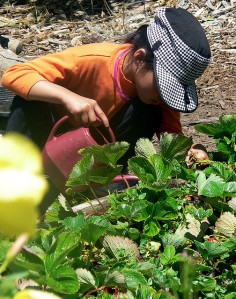
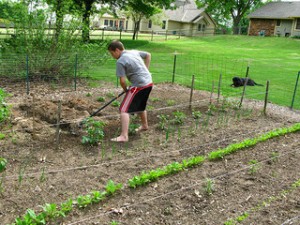
Helping out engages young children in activities that promote movement-cued development. This includes large motor activities like digging in the garden, carrying a watering can, putting away groceries, and sweeping with a broom. It also includes fine motor tasks like using a screwdriver and tearing lettuce for a salad.

Childhood is a period of major neuroplasticity, when learning actually changes the brain’s functional anatomy. Hands-on experiences are particularly vital at this time. In fact, the child who regularly engages with manipulatives (arranging veggies on a platter, setting the table, sorting socks) and applies real-world math (measuring and pouring coffee beans in the grinder, taking things apart and putting them together, following recipes) has a strong foundation of representational experience, which enables better understanding of abstract mathematical concepts when they are introduced later. These movement-based tasks are also closely linked to the brain development necessary for reading and writing. (Find out more about this in Sally Goddard Blythe’s wonderful book, The Well Balanced Child: Movement and Early Learning.)

Growing as a Person and a Family

chores build relationships,

Children accustomed to flashy toys and rapidly changing screen images may become so wired to this overstimulation that without it they’re bored. The slower pace of yard and household tasks can be an important antidote, especially when we’re willing to go at a child’s pace. Young children tend to balk when they’re hurried or left out. They show us, stubbornly and often loudly, that there’s nothing more important to them than the here and now. So whenever possible, slow down so you can make working together enjoyable. Letting a small child spread peanut butter, cut sandwiches, and pour milk into cups from a small pitcher affirms the value of the present moment. It also makes an ordinary lunch into a tea party.

The benefits don’t end for older children. Hands-on experience in all sorts of tasks and hobbies promotes learning, builds character, and helps to form the basis of our future selves. When neurologist Frank R. Wilson interviewed high achievers he found many credited their expertise to attributes learned through hands-on activities. In his book, The Hand: How Its Use Shapes the Brain, Language, and Human Culture, Wilson emphasizes that resourcefulness and self-definition arise from the use of our hands more than from the dictates of our educational system.

In a way, doing tasks together puts parent and child on more even ground. So often we parents are rushing to schlep our kids to practice or lessons or other kid-oriented events, making them the pivot around which a family’s activities revolve. Taking part in regular tasks together, even if we’re pulling weeds on opposite sides of the garden, affirms the sort of mutuality that advertisers tell us is only found in pricey vacations. Of course time afterwards for a nice game of hoops and some cold lemonade builds bonds too.

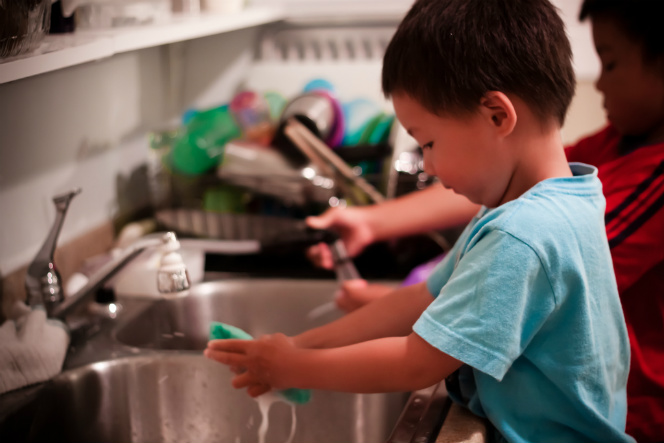
As our children grow, doing tasks together can continue to strengthen our relationships. Moments of meaningful interaction happen easily when washing dishes, folding laundry, fixing the car, or walking the dog together. Working on shared chores helps a child’s contemplative side emerge, prompting discussions that may never have happened otherwise. This is true between parent and child as well as between siblings. I remember my mother bemoaning the arrival of our dishwasher because we no longer took turns washing and drying, ending a relaxed half hour of post-dinner conversation each evening.

It’s easy to make these activities a tradition. Teenagers who have always helped out when a parent puts on snow tires, cleans out the basement for a yearly garage sale, or cans pickles may grumble when asked, but chances are they’d feel excluded if left out too. In part, who we are is defined by what we do. Growing up with hands-on lessons in taking initiative, practicing cooperation, and working towards a goal helps to shape character. And it transforms pickle-making from drudgery to an important family ritual.

Delayed Gratification
early responsibility for success in adulthood,

This is a biggie in the “you’ll thank me later” department because kids who are able to delay gratification are much more likely to do well as they grow up.

We model delayed gratification each time we choose to work for a later or larger goal. This includes saving, making do, and making it ourselves. We demonstrate it when the whole family pitches in to rake a neighbor’s leaves while she’s recovering from a broken hip. We teach it when we let a child see that if he doesn’t do the laundry when it’s his turn, there won’t be a clean team shirt to wear to the game. And we show that it’s expected every time our kids pitch in with the ordinary jobs necessary to run a household.

This may seem negative, particularly when popular culture constantly screams “have it now” and “get what you want.” But there are enormous positives. Our children become familiar with the pleasures of anticipation, which multiplies the eventual delight when a goal is reached. They also begin to internalize the ability to delay gratification.

This is pivotal for success. Multiple studies (cited in Daniel Goleman’s book Emotional Intelligence) found that children who were able to defer gratification grew into teens and young adults who were more socially competent, better able to deal with frustration, more dependable, reached higher educational attainments, and were effectively able to make and reach long-term goals. Delayed gratification is also related to impulse control. Research shows that a child’s ability to control his or her impulses at an early age is predictive of success even decades later as a healthy, financially stable, and positive member of the community.

Expecting children and teens to take an active part in running a household gives them plenty of opportunity to gain the positive coping skills that help them control their impulses and delay gratification. It may seem like returning to the old adage, work first, play later, but the benefits can be extraordinary.

Skill building

give kids real work, make chores meaningful,

Regular tasks allow our children to see for themselves how the world works. They grasp principles of science and math as a seed becomes a tree, as boards are transformed into bookshelves, as flour and yeast turn into bread. They develop traits such as patience. They are motivated to apply what they’re learning to more challenging endeavors of their own. Sure, it doesn’t hurt to know what it takes to grow the tomatoes, make the sauce, and prepare the beans for tonight’s enchiladas. But more importantly, as our children become proficient at the jobs necessary to sustain their families, they also see themselves as capable. That perception transfers across all endeavors.

There’s no denying that children who participate pick up useful skills. They see that maintenance is easier than waiting till the car or laptop breaks. They can set the table, toss a salad, make a sandwich, and boil pasta. Not right away, but eventually. While they are making real contributions to running the household they’re actively learning how to cook, launder, clean, make repairs, maintain a vehicle, budget expenses, and handle other tasks which are essential for an independent life once they’re adults. Wonderful lessons in cause and effect are reinforced when children complete work and benefit from the results. Seeing oneself as an agent of useful change, priceless.

They also learn from the examples we show them, such as how to handle pressure and ways to learn from mistakes. Whether we’re four or 40, gaining competency feels good. It doesn’t hurt to give credit where it’s due. So if your child has been busy chopping mangoes, strawberries, and pineapple into tasty chunks, try renaming the result “Sophie’s Special Fruit Salad” for extra reinforcement.

Purpose

meaningful chores for kids, finding purpose in chores, raising responsible kids, teaching delayed gratification, building impulse control,

When we stack firewood to prepare for the upcoming winter, make a gift to celebrate a friend’s good news, or change a favorite recipe to accommodate Grandpa’s diabetes, our efforts have purpose and value. As our children participate along with us, they feel the intrinsic satisfaction of doing something that has meaning.

So many educational tasks put before our children serve no purpose other than to instruct. But when learning is connected to something truly purposeful, it can’t help but kindle motivation.

From the earliest time our species lived on planet Earth, young children benefitted from the purposeful learning that comes when adults around them are engaged in practical activities — welcoming a child’s questions and eagerness to be included as entirely natural parts of growing up. It acknowledges that these essential skills are necessary for maintaining and belonging in a community.

Children feel honored to be included in real work that includes real challenges. If we pay attention, we see that’s just what they pretend to do when they play.

Beyond Chores
teaching impulse control, delaying gratification, families working together,

I’m not fond of the word “chores.” It implies that kids and adults have tasks that are set apart from the rest of our lives. Making work around the house and yard a regular part of our lives together seems more natural.

I think it’s valuable to get work done together as much as possible. For me, the simplest way to respond to grumbling has always been, “that’s just how we do it in our family,” without engaging in arguments on the topic. And of course balance is essential. Children and teens (well, all of us) need time for daydreaming, play, socializing, relaxation, projects, and all of life’s other joys.

My kids have their own chores, which they sometimes rotate. They haven’t always done them well or on time by any means. Accepting a floor as clean as a child will get it is part of having children participate. And I’m pretty laid back about things like clean bedrooms. (I remind them we try to adhere to the Firefighter Rule: Could emergency workers navigate a bedroom if necessary?) I understand that kids put less energy into tasks that don’t seem to have much importance. They recognize that a clean bedroom doesn’t affect our family’s functioning, while they know for sure that cutting and stacking firewood will keep our house warm. Hence, the firewood is done right while their rooms are often just short of scandalous.

We’ve never given them an allowance, mostly because we haven’t been able to afford it. Families have counted on children throughout history for work that was reliable and essential. Today we are fortunate that we don’t have to rely on our kids to survive, but we can expect them to contribute. The tasks may not be fun or interesting but they are necessary. They demonstrate to every child that he or she is a valuable contributor to the well-being of the family. And hearing, “Thanks, we couldn’t have done it without you,” feels good too.

I’m pretty sure growing up this way has contributed to how super responsible my kids are now in their teen and young adult years. They see a pile of boxes I need to load for our food co-op and carry them, never waiting for me to ask. They gladly stop whatever they’re doing to pitch in for an hour or all day when help is needed in the garage or barn or back yard. They are incredibly capable people who are far more astute and skilled than I’ll ever be. They can milk cows, fix tractors and cars, cut and bale hay, install plumbing, make meals, diagnose a sick chicken, hang drywall, identify spiders, back up their political opinions, weld, put on a roof, well, you get the idea. Sure, they have busy social lives and enjoy keeping their faces aimed at screens just like everyone else. But they recently spent an entire weekend helping a family member pack, move, and make repairs. They worked hard and displayed nothing but their usual good cheer. After exhausting 14 hour days I asked if they’d rather have skipped this particular task. Every one of them affirmed that it was no big deal. And I heard my words come back to me, “It’s just the way we do things in our family.”

Portions of this article were excerpted from Free Range Learning.

Raising Aspiring Emigrants

Kids are their own people. Any of us can see this is an underlying theme in drama (in books, on the screen, and in real life dramas).  It’s obvious from a quick look at how much our friends differ from their own parents. Years ago I joked that my anti-establishment neighbor’s son might just grow up to be a conservative stockbroker and that my frantically risk-averse friend could end up with a thrill-seeking daughter. I learned pretty quickly such jokes are not appreciated.

But I thought I understood that kids go their own way reasonably well. I’ve managed to celebrate the unique passions my own kids pursue, even though their interests are nothing like mine. I’m glad to see that we’re largely in sync on bigger issues. My kids and I tend to agree on politics and religion, we share a disinterest in most sports, and we’re all somewhat introverted. What we don’t share? A desire to stay close to our roots, geographically speaking. I’ve tried to raise them to be global citizens. Is it possible to take that too far? I’ve always lived close to my hometown and extended family. One or two of my four kids may not have that gene.

One of my sons is entranced by Finland. I think it started while chatting with online Finnish friends. Hankering to drive, he told me that kids in Finland are encouraged to get driving experience starting at a very young age and given training to handle slippery and hazardous road conditions (ice + moose, for example). The licensing requirements are some of the strictest in the world, he explained, a pointed contrast to the jerk on the road in front of us at the time who was cutting off cars and weaving across lanes.

My son also has a thing for Finnish music, starting with the now iconic band Apocalyptica formed by classically trained cellists.

Finnish musicians offer plenty of diversity, including partially submerged folk singers

and dancing puffballs.

And he is inspired by the Finnish spirit. He sees it in their traditions and history (I never thought I’d hear so much about the Winter War). Finnish character is said to have a lot to do with the term sisu. This doesn’t translate easily. It’s related to inner will and the determination to persist despite the odds. This spirit, as my son sees it, also has to do with the Finnish way of doing things. That includes summer competitions that Finns call “world championships” in swamp soccer, mobile phone throwing, and wife carrying. Or a recent proposal in Parliament to extend the annual four-week paid holiday by another week, for a “love holiday.”

Browsing around the web, I can see the allure. The country has stunning beauty and cultural richness. Newsweek ranked Finland the world’s best country in 2010 based on high life expectancy, high literacy rates, minimal income gap, excellent access to health care, and a good work-leisure balance. In The Geography of Bliss: One Grump’s Search for the Happiest Places in the World it was noted that people in Finland are remarkably content. Of course we’ve all heard about Finland’s world-class school system. Their educational approach says quite a bit about the country. Schools there don’t rely on standardized tests or a heavy homework load but instead emphasize balance, giving kids plenty of time for outdoor play, art, and music. That seems to reflect a general emphasis on living at a slower pace and enjoying life’s simpler pleasures. I may have to adjust to having one of my beloved offspring emigrate some day. (sob)

But another of my kids is talking up New Zealand. Land of fascinating spider species, amazing diversity, and gorgeous vistas.

Also home to the compelling Haka, traditional ancestral war cry of the Maori people, now performed by the All Blacks, NZ’s rugby team, before their matches.

Serves me right for joking about other people’s children. Come to think of it, my attempts at humor weren’t all that far off. My anti-establishment neighbor’s son is now in college getting a degree in business, hoping to work in investment banking. The daughter of my risk-averse friend is into barefoot climbing.

Guess I’d better make sure my passport is in order.