To press 5,000 bricks from the dirt beneath your feet in one day.
To build an affordable tractor in six days.
It’s possible thanks to the members of Open Source Ecology (OSE). They aren’t armchair visionaries. These engineers, farmers, and developers are dedicated to making communities sustainable and self-reliant. They’re taking on scarcity and inequality with open source enthusiasm
OSE got its start when Marcin Jakubowski’s tractor broke. Well, lets back up a little. After Jakubowski earned a PhD in the physics of fusion energy, he bought a farm in Missouri where he grew fruit trees and raised goats. One day his tractor broke. He didn’t have the hands-on experience to fix it himself. But he hauled out some can-do attitude along with his welder and torch. He realized a tractor is simply a box with wheels, each powered by hydraulic motors. So he bolted together square steel tubing to make one from scratch. It worked.
This inspired him to look beyond pricey, commercially made machines. He began to come up with versions that were hardy, low-cost, and constructed out of locally sourced or repurposed materials. His posted designs generated lots of enthusiasm and input. Participants began showing up to help build prototypes on project days, becoming OSE collaborators.
The idea evolved. They considered what it takes to build independent, sustainable communities that support farming, construction, small manufacturing, and power generation. They came up with a list of the 50 machines most important for modern life including a hay baler, bakery oven, laser cutter, drill press, solar concentrator, and truck. Low cost, industrial strength, DIY versions of these machines became known as the Global Village Construction Set. The motors, parts, and other fittings of these machines are designed to be interchangeable. All the 3D designs, schematics, and instructional videos are posted on the OSE Wiki.
On average, constructing these machines costs about eight times less than comparable machines made by industrial manufacturers. As Jakubowski explained in his recent TED talk, “Our goal is a repository of published design so clear, so complete, that a single burned DVD is effectively a civilization starter kit. ..The implications are significant: a greater distribution of the means of production, environmentally sound supply chains, and a newly relevant DIY Maker culture can hope to transcend artificial scarcity.”
So often hope seems abstract. This is tangible hope, made of steel. It puts independence and equality in reach for people in both the developed and developing world. Welding never seemed so inspiring.
I’d read that nursing home residents benefited enormously from contact with therapy dogs. During and after dog visits these elders were more alert and in better moods. So I figured, why not bring my baby to a nursing home?
I contacted a nursing home around the corner. The administrator was enthusiastic. Then I talked friends into forming a nursing home-based playgroup for our infants and toddlers. They were somewhat wary, but agreed to give it a try. Finally I got a local store to donate a carpet remnant for our little ones to crawl and play on. Between visits, the nursing home could roll it up for storage. We were ready.
We met regularly at that nursing home for several years. Our babies grew into toddlers, the elders became our friends. Residents’ families and staff members often told us that our visits stimulated memories, generated activity, even inspired people who were mostly mute to say a few words. We were awed. Something as simple as our presence, sitting on the carpet playing with our children, made a difference to people whose once full lives were now constricted. We benefited too. We learned the value of advice given by people older than our grandparents. And we noticed how completely our toddlers accepted the physical and mental differences around them with natural grace. (Here’s how to set up your own playgroup in a nursing home.)
I’m still not sure why the very old and young are kept apart from life on the commons. Vital and engaged communities are made up of all ages. And children have fewer opportunities to take an active part than almost any adult. This shortchanges everyone.
Throughout history, the young of our species have learned by getting involved. Children long to take on real responsibilities and make useful contributions. This is how they advance in skill and maturity. That is, unless we restrict them to child-centered activities.
Young people are also drawn to seek mentors. They want to see how all sorts of people handle crises, start new enterprises, settle disputes, and stay in love. But today’s young people are largely kept from meaningful engagement with the wider community. They’re segregated by age not only in day care and school but also in most spheres of recreation, religion, and enrichment. When we keep kids from purposeful and interesting involvement with people of all ages they are pushed to find satisfaction in other (often less beneficial) ways. Meanwhile, our communities are deprived of their youthful energy and innovative outlook.
It doesn’t have to be that way. There are ways to reconnect children with our communities.
Involve children by giving them real input and responsibility in civic groups, churches, co-ops, CSA’s, arts organizations, clubs, and neighborhood organizations. What about a child who is a dedicated rock enthusiast but the local lapidary club only accepts adult members? Propose a joint adult/child membership, giving that child the same (age factored) opportunities to build social capital in the club. A similar approach can be taken with organizations that refuse to take youthful volunteers. Offer to give your time in partnership with the child, a two-for-one volunteer bargain. Adult advocates are often necessary to pave the way for genuine youth involvement in many groups.
Give children contact with the workaday world. They need to know people with a range of hobbies and careers. Seek out those who are passionate about chemistry, bird watching, farming, the Civil War, engineering, astronomy, geology, blacksmithing, wood carving, well, you get the idea. Something vital is transmitted when one person’s enthusiasm sets off a spark of interest in a child. We’re rarely turned down when we ask to learn from others. People who love what they do can’t help but inspire kids and, they often tell me, the kids reignite their hope for the future of their work.
Help local businesses tune in to children’s interests. For example, a bakery might hang children’s art on the walls, make meeting space available for a kids’ chess club, host Invent A Cookie contests, open the kitchen for tours, offer apprenticeships to aspiring young pastry chefs, teach parent-child baking classes, invite speakers to explain the science of yeast and flour, give cupcakes as prizes for youth community volunteer hours, etc. Businesses that are truly engaged in this way inspire loyal customers, they also enliven the community.
Create age-bridging partnerships, as we did with babies and nursing home residents. Non-profit organizations are great places to start. One successful program called Girlfriend Circle started due to complaints. A group of women at a senior center often told a volunteer that they had no hope for the future because children “nowadays” are rude. The volunteer offered to set up a tea party for the ladies that included her daughters and their friends. At that first event the girls were seated between their older hostesses. Everyone enjoyed a lesson in napkin origami. Then they took part in a Q&A to learn about one another. After sharing refreshments both age groups were eager to meet again. The Girlfriend Circle met bi-monthly for several years, finding their friendships instructive and rewarding.
Include young people in civic affairs, giving them genuine input into programs and policies. This works in Hampton, Virginia. Young people take leadership roles by holding conferences and open forums, advising municipal divisions, and helping to run the Hampton Youth Teen Center. City administration also includes a Youth Commission, with 24 youth commissioners, 3 youth planners, and one youth secretary–all high school age.
Develop a tradition of service, starting at an early age. Need ideas? Here are 40 ways kids can volunteer, toddler to teen.
This comes full circle for me, right back to dogs and volunteering. A boy who’d once been a pint-sized member of the play group we held at the nursing home talked his family into raising puppies to be trained as service dogs. By the time he was 12 years old, this boy gave promotional talks about this program to clubs and schools. I attended one of his speeches. He started off with some anecdotes about exasperating puppies. Then he went on to describe the generosity and hope his family felt each time they attended graduation ceremonies for fully trained dogs, ready to serve. I know community involvement is a path to wholeness. I’m convinced it has a lot to do with this boy’s smile too.
“We become what we think about all day long.” Ralph Waldo Emerson
Anastasiya Markovich
Long before I became an adult I launched a quest. This was inspired by a something that weighed on my childish mind, an urgent calling to alleviate the suffering of others. Even when I was a misbehaving little girl who ignored her chores and fought with her sister (often), I still felt the weight of this obligation. My parents cancelled their subscriptions to news magazines to avoid my questions as well as my despair over every sorrowful photograph. And my entire family dreaded driving past a chained puppy or crying baby, knowing that I would agonize the rest of the day over this momentary glimpse out the car window.
For some reason my quest took the form of trying to understand why people acted cruelly. So in my spare time I read everything I could find on the history of suffering, evil, and misery. I learned about the Inquisition, U.S.betrayals of Native Americans, the Holocaust, the genocide ordered by the Khmer Rouge in Cambodia—if it was awful I studied it. I worked my way through every book and resource possible.
Fritz Fuhrken
This project of mine stretched well into my teen and early adult years. It was grim. It haunted my dreams and colored what should have been youthful optimism. I began to realize that every single human has the capacity for cruelty. We just pretend we don’t. A bad mood may be contagious but the shadow we hide can wreak havoc on a personal and even a global level.
One day as I sat in the sunshine while my firstborn played nearby in the grass, my dear friend Leslie came over for a visit. She found me reading yet another horrific book, a stack of similarly dire non-fiction at my side. And she’d had it. She told me I was ignoring the beauty all around me to immerse myself in misery. She told me to look at the light shining on my child’s face, the bright green grass, and all the love in my life.
She was right, of course.
Still I defended my quest. I told her it was an obligation to know what was wrong with the world in order to right it. I waved around books that described the evils of pesticides, the horrors of factory farms, and the title I was currently reading, something about political prisoners.
She disagreed. She said it was time to focus on what was good.
I told her I was I finding good. What I read exposed me to heart-expanding accounts of people who demonstrated the best of humanity no matter their circumstances. Those who were dying of hunger, yet gave their last bit of food to others. Those who had no reason for hope but who kept art and music alive. Those who faced the worst despair, but did not give in to it. The best lesson I learned from years of study? Every single person has a choice, even if it seems there are no choices. That choice is the attitude they take.
Fluxx
It was time to work on my own attitude.
Gradually I stopped trying to understand and fight against all the reasons for suffering. I also became a little less frantic about doing everything possible to counterbalance the wrong I saw everywhere. I noticed that people in activist groups I belonged to faced the world with the same despair I felt, battling evil so fiercely that they had no way to expand on all the good that also flourishes.
So I began volunteering less time to lost causes, marched in fewer protest rallies, and gave up stomping around with petitions. I did more that seemed to boost the positive—gardening, singing to my babies, and guerilla acts of encouragement.
I became certified to teach non-violence workshops which I taught to school systems, incarcerated teens, and senior citizens. As I taught, the lessons sunk in ever more deeply. The long and life-affirming history of non-violence can’t help but heal a heart heavy with the world’s troubles. The process of non-violence—reacting with love rather than hate—is more empowering than any other force we humans have ever used. It transforms greed, intolerance, and cruelty. It’s humanity’s way forward.
It may seem difficult to sustain a positive outlook these days. My own family has been through grief, injustice, unemployment, and other sorrows. And our world struggles while formerly stable structures crumble. Just look at what’s happening to prescribe-and-placate medical models, inflexible financial institutions, condemning religious frameworks, and rigid corporations. But I believe these current conditions of breakup, economic chaos, and environmental decline are exactly those which are (slowly) leading to beneficial change. Collectively we’re waking up to the weakness of limited thinking and short-term fixes. Hopefully we’re also waking up to the reality that we’re in this together—rich and poor, developed and developing nations, young and old, left and right.
Jules Henri Lengrand
I’ve come to believe a better world is made by building on what works rather than focusing on what’s broken, as long as the truth is told about that brokenness and healing is sought.
The world has seen a 70 percent decline in the number of high-intensity conflicts since the end of the Cold War era. Genocide is down 80 percent. Weapons sales between countries have diminished by 33 percent and the number of refugees has fallen by 45 percent. Even measuring from as little as 15 years ago, the number of armed conflicts has dropped from 44 to 28.
Why? Project Ploughshares credits peace building efforts.
Chances are, the reasons for peace are complex. Yet a stronger international resolve to focus on peace building and basic human rights is taking place. Imagine the far larger potential for enduring peace if we intentionally educate our children and ourselves in the proven methods of non-violence—-negotiation, mediation, reconciliation, even basic listening skills.
2. Freedom is stretching across the planet.
By evaluating variables including civil liberties, democratic institutions, and independent media it’s possible to assess how free each nation in the world really is. Back in 1973, 29 percent of nations were deemed free, 25 percent partially free, and 46 percent not free.
In a little over 35 years, the number of nations ruled by authoritarian regimes dropped from 90 to 30. Countries around the world considered to be free increased by 50 percent while those not free had dropped by more than half.
Independence has a long way to go. But positive signs—protests, dissent, political upheaval show us that ordinary people are speaking up for freedom.
3. Longevity is improving yet total population faces a downturn
Fulfilling the cherished hopes of their parents, more children around the world are born healthy. Mortality rates for those under five years of age have fallen by 60 percent since 1960.
Meanwhile, life expectancy has risen 21 years since the mid 1950’s. Try to suppress your optimism while looking at this analysis of longer lived well-being around the world.
This doesn’t mean the planet will be too crowded. Overall population will continue to rise for several more decades but we’re facing a major downturn. Already birth rates are near or below replacement rate in countries all over the world. Increased education and affluence tend to inspire women, no matter what country they live in, to invest their time and resources in fewer children. As Fred Pearce clearly explains in The Coming Population Crash: and Our Planet’s Surprising Future, our little Earth will likely reach a (painful) peak of 8 billion people around the year 2040, then the total number of human will begin to decline so rapidly that nations will struggle to keep their populations levels from slipping too low. They may create perks for becoming parents and incentives to attract immigrants.
4. Literacy rates continue to improve.
Global adult literacy rates have shot up from 56 percent in 1950 to nearly 84 percent today, the highest ever.
Women’s rates haven’t risen as quickly due to inequality and poverty, but in some areas, particularlyEast Asia, 90 percent more girls are able to read than 10 years ago. As female literacy goes up, other overall positive indicators tend to follow including decreased domestic violence, improved public health and greater financial stability.
5. Intelligence is on an upswing.
From generation to generation, we’re getting smarter. In fact, to accommodate continuously increasing intelligence the IQ test must be renormalized (standardized to keep the average test results at the 100). This is called the Flynn Effect.
Between 1932 and 1978, mean IQ scores in theU.S.rose 13.8 points. If your grandparent received IQ score results of 98 back in 1932 they’d have been deemed of average intelligence. That same grandparent, if administered today’s tests, would be considered to have a borderline mental disability by current scoring standards. IQ scores have risen even higher in some other countries. Of late, developing countries seem to be experiencing the biggest surge.
Plenty of explanations have been proposed, but the increase can’t be definitively pinned on genetic improvements, improved nutrition, greater familiarity with testing or better schooling.
According to Cornell professor Stephen J. Ceci, the most direct gains are not in subjects that aretaught (math, vocabulary) but are shown in parts of the test that seem unrelated to schooling (matrices, detecting similarities). In fact, test gains have been enormous in areas requiring the child to apply his or her own reasoning, such as arranging pictures to tell a story or putting shapes in a series. Although teaching children does return positive results, what a child learns through the natural stimulation of everyday life has a more profound effect. For example, a study to determine the effect of schooling on rural children inIndia found that the increase in overall intelligence from a year of age is twice the increase from that of attending a year of school.
IQ test scores don’t relate to what truly provides satisfaction in life. But the Flynn Effect is intriguing. Factors we can’t completely explain are giving us the intellectual capacities to deal with an ever more challenging world.
6. Compassion is huge.
Never before in history have so many people worked tirelessly and selflessly to benefit others. Paul Hawken writes in Blessed Unrest: How the Largest Movement in the World Came into Being and Why No One Saw It Coming that the abolitionist movement was the first major movement by human beings to advocate on behalf of others without seeking advantage for themselves or their particular social or political group. Since that time, such efforts have grown with astonishing vigor.
There are now over a million organizations on the planet working for environmental stewardship, social justice, the preservation of indigenous cultures, and much more. These groups don’t seek wider acclaim, they seek to make a difference for the greater good.
Humanity, which is clever and kind enough to bring about so much improvement, is also awakening to the vital importance of living more sustainably on Earth.
I know we can live more peacefully and wisely.
Thank you Leslie.
Salvatore Di Giovanna
“When I despair, I remember that all through history the ways of truth and love have always won. There have been tyrants, and murderers, and for a time they can seem invincible, but in the end they always fall. Think of it … always.” Mahatma Gandhi
My presence makes people who are fashion backward and technologically inept feel much better about themselves. Clearly there are perks for hanging out with me.
But my friend Linda Dobson who authors the wonderfully useful site Parent at the Helm has bestowed the Stylish Blogger Award on me anyway. Maybe she’s decided that my endless quest for meaning counts as style. Thank you Linda, I’m surprised and grateful.
The “rules” that accompany this honor are to divulge seven things about myself, and then pay the Stylish Blogger Award forward to fifteen other blogs. Linda and I read some of the same blogs so to avoid overlap I’ll gladly bestow the award on other worthy winners.
Seven Random Things About Me List
1. I want to do everything. I tend to have trouble fitting my chosen everything into that container called my life.
2. I can find a positive angle just about anywhere. Sometimes I have to use my optimism-tuned crowbar.
3. My ideal breakfast involves lots of onions, homemade paneer, curry spices, and any vegetables that show themselves.
4. After a youth misspent being painfully polite I’m developing minimal impulse control. When my youngest offspring wondered what it would be like to frisbee a tortilla, I tossed it for him. We ended up flinging it up the stairs, at each other, and at his sister. (This is VERY fun.) The dog disciplined us by eating the tortilla.
5. Deep sighs activate the vagus nerve, making one feel calm and relaxed. I admit I should join Vagus Overusers Anonymous.
6. I’m still afraid of the dark. Actually, that there will be no more light.
7. Told too many times by too many formative people that I had so much potential, I began to see my Better Self taunting me from a far distance. I renounce that pressure. Hereby I rename that Better Self by the more apt initials, BS, and accept my own flawed and tender self.
What makes a neighborhood? Sometimes that’s hard to figure out.
I’ve lived in a number of places. Not all of them seemed like neighborhoods. When I was first on my own I used to bemoan that my fellow renters could hardly be bothered to return a wave but someone kept stealing my newspaper. One day, walking home from the grocery store, I realized to my chagrin that I recognized names on mailboxes but couldn’t put faces to those names. I never did much to make that a neighborhood.
Then we moved to a little house. It was silly how hard it was to meet the neighbors. They’d wave but that’s about it. It took nearly a year to meet the older couple across the street. (They seemed old to me then because their kids were teenagers. Not so funny in retrospect.) Our mailbox was on their side of the street. I tried get my mail when one of them went out to collect theirs so I could introduce myself but they tended to scurry back in the house as if my nearly 5’3 stature blocked their share of sunlight. Finally I baked a loaf of bread, knocked on their door and said I was sorry we hadn’t gotten a chance to meet. They turned out to be lovely people. They still write long chatty updates to me years after we moved away.
I began to understand that it takes effort to make a real neighborhood. Change is carved out by a few people doing things differently (well, actually reawakening old ways).
I dug and planted a garden right by the sidewalk. Every time I tended it I was in close proximity to my neighbors, letting me say “hi” to people who walked by and wave at neighbors who drove by. I shared produce from my garden (sometimes leaving surprise zucchini and tomatoes on doorsteps with silly notes).
My kids were outside nearly every day. In their baby years they’d crawl in the grass or, if the ground was wet, play under a tree in a portable playpen. (I’m a believer in outdoor time even for babies.). As they got older they played outside for hours, sometime cavorting happily in the rain and sometimes shrieking with joy in the snow. I think the sheer presence of kids playing outside makes it enticing to other kids and makes it seem normal again to other parents.
When I could, I greeted people who moved onto our street with homemade goodies.
I also started inviting people over. In the fall we had bike parades where the kids spent a happy hour or so decorating their tricycles, scooters, and bikes to ride around the neighborhood in a grand procession before coming back to our house for a picnic. We had cookouts, Halloween parties, and Christmas caroling parties. We met up for working get-togethers such as picking apples with our kids, then devoting a moms-only evening to making applesauce. (Okay, that one time we drank wine and talked so long we had to get together another time to actually make the applesauce.)
The major neighborhood bonding events were our summer pig pen parties. These were grand messy BYOB affairs, as in bring your own bucket—of dirt. The dirt was dumped in a backyard kiddie pool and mixed by all the kids in attendance into perfectly creamy mud, which they used to coat themselves until they were recognizable only by bathing suit outlines. We put a garden hose at the top of our slide and the kids careened down in glorious streaks of mud. We handed out cans of shaving cream for use as body décor (with firm instructions to avoid faces because it’s not fun in the eyes). And we insisted the kids eat without utensils or hands, just direct face to plate. Like pigs. Of course these parties got out of hand once the grown-ups refused to sit in lawn chairs watching the kids have all the fun. Some neighbors showed up in pig masks, others showed up with water balloons sneakily hidden in baby strollers and little red wagons, others smuggled in massive auxiliary supplies of shaving cream. Normally well-behaved men used hoses to fill garbage cans with water, which they dumped over the heads of the few civilized mommies who thought they’d keep their hair looking nice. One year the entire assemblage of pig pen partiers were incensed that a regular pig pen attendee decided to stay home to repair a fence. All of us walked down to the street in wet, muddy, shaving cream-streaked glory to drag him to the party. His police chief father who was there helping him make the repairs looked seriously alarmed. We dragged him anyway.
One year a house caught fire down at the far end of the street that resulted in serious smoke damage. I had no problem getting donations from nearly every neighbor to help cover the family’s losses. It didn’t matter that few of us had met them. I dropped off the largess when their kids were in school so they wouldn’t feel beholden to anyone. It was anonymous except for the signature, “from your neighbors.”
That was years ago. Now we live on a small farm. Maybe because the houses are farther apart, maybe because it’s a small township, maybe it’s due to other complications but it has taken years to feel connected in a neighborly way. Yet it’s still a neighborhood. When a child is lost everyone turns out of their homes to tramp through the woods, fields, and streams until she’s found. When a car is stuck in a ditch, someone will get out a tractor to pull it free day or night, simply saying “no problem.” People offer the bounty from their fruit trees and willingly share equipment. I still harbor the ideal of a vibrant neighborhood but I’m grateful for the goodwill we’ve slowly managed to find here. I’m learning that neighborhoods are different, and who we are is only part of that difference.
There is something vitally important transmitted when one person’s enthusiasm sets off a spark in others. This sort of spirit can’t be reproduced in any curriculum. That’s why, whenever possible, we learn from people who are passionate. Potters, chemists, bird watchers, dairy farmers, blacksmiths, historians, wildlife rehabilitators, wood carvers, entrepreneurs, air traffic controllers, geologists, musicians, engineers, chefs, astronomers, you name it.
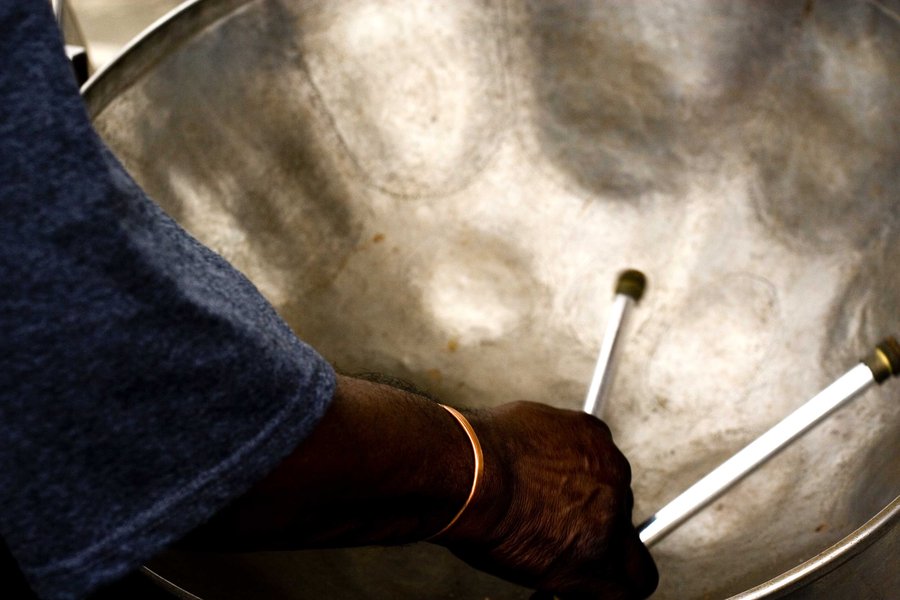
One time we drove to a part of town where we’d never gone. The address didn’t seem right, but around us friends were parking for a tour and discussion we’d scheduled at a local business. So we piled out and knocked at what looked like an abandoned warehouse. The door was pulled open by a man who welcomed us to his steel drum company. He seemed powered by perpetual gusto as he talked about the history of steel drums and his desire to preserve the music, factors which became the motivating force behind his company. He told about the shoestring nature of his own start-up and multiple problems with initial designs—- illustrating his tales with diagrams, tools and testimony from guys in the shop.
Our time there stretched out wonderfully as we played many different drums, including some extremely valuable models, and listened to recordings made in a studio he built on site. There’s no telling what particular element of that afternoon made an impression on the children and teens there. What he transmitted encompassed history, music, engineering, entrepreneurship, character-building, collaboration—all with an infectious energy.
Through any deep exploration we can uncover ever widening avenues of discovery, whether we search in archeology, cake decorating or steel drums. There are lessons to be learned that awaken us to greater wonders.
When we get a glimpse of those wonders through the eyes of others we’re not only learning. We’re sharing a source of pleasure. Asking people to impart some of what they’ve discovered and how they do it, well, that’s a gift because it lets them give us a taste of what, to them, has real sustenance.
That spark, carried from generation to generation, is how we humans have always built the future. As Antoine de Saint-Exupery wrote. “If you want to build a ship, don’t herd people together to collect wood and don’t assign them tasks and work but rather, teach them to long for the endless immensity of the sea.”
Few talk about it. Fewer know much about its principles or how to apply them. Yet it has a profound impact, a long history and a reach nearly as wide as heaven. I’m talking about non-violence.
Sure, we know a bit about the civil rights movement and a bit about Mahatma Gandhi, but not much. Mainstream media focuses on the changes wrought by violence.
Pacifism is confused with those who are passive. Nothing could be further from the truth.
Consider Liberia. This nation was birthed by colonization and racism. It existed in oppression for over 150 years. A few years ago Liberia was a land torn apart. Dictator Charles Taylor’s reign imposed hunger and brutal killings on Liberia’s people. The rise of rebel groups made the situation worse. Children were forced to become soldiers. They roamed the countryside stealing, raping and killing. Villages were burned. Brutalized refugees crowded the cities. No one was safe. No one knew where to turn. The only answer lay in the powerful force of love in action, non-violence.
By 2003 women began gathering at their own risk to demand peace. They wore white and sang in the marketplace. They called themselves Women of Liberia Mass Action for Peace. Their numbers grew. Against tradition, Christian and Muslim women worked together—singing, praying, planning and insisting on love. They held signs as truckloads of soldiers drove past, the same men and boys who terrorized them. Their signs said, “We love you. Put down your guns.”
Ignored at first, their numbers grew. As peace marchers walked past, other women joined in from the streets. Children sang along. Women of Liberia Mass Action for Peace tactics included passive resistance, withholding sex (in part to avoid birthing children who would later be raped, killed or forced to become soldiers) and insisting on reconciliation. Finally they forced a meeting with President Taylor, where they made him promise to attend peace talks in Ghana. Then they bravely met with representatives of the rebel faction, who also agreed to attend the peace talks.
A delegation of Liberian women went to the talks in Ghana at their own expense. They waited outside the hotel where negotiations were held, wearing white as reminding presence. The men stayed in luxury, stalling as they attempted to get more and more power for themselves without agreeing to more rights for the citizenry. After weeks of these fruitless talks the women learned that an embassy in Liberia had been bombed and war there had intensified. Afraid for the families they’d left behind, they took another risk. Entering the hotel, one hundred women linked arms outside the doors of the negotiating hall. They intended to force the men to stay without food and water, privations Liberian refugees knew well, until they had reached an agreement. Guards threatened them. One of the rebels kicked at them.
Leymah Gbowee, a leader of Women of Liberia Mass Action stood. She began to take off her clothing. This was a last resort. It is taboo to see one’s sister, mother or grandmother unclothed. The guards backed down. Two weeks later an agreement was signed.
When Liberia held landmark elections, Ellen Johnson-Sirleaf became the African continent’s first elected female head of state. Yet look around. The extraordinarily brave, powerfully liberating work by Liberian women went largely unnoticed by major news organizations. Heck, even the Liberia page on Wikipedia doesn’t cite their involvement. Stephen Colbert’s interview with Leymah Gbowee promos the sex strike angle.
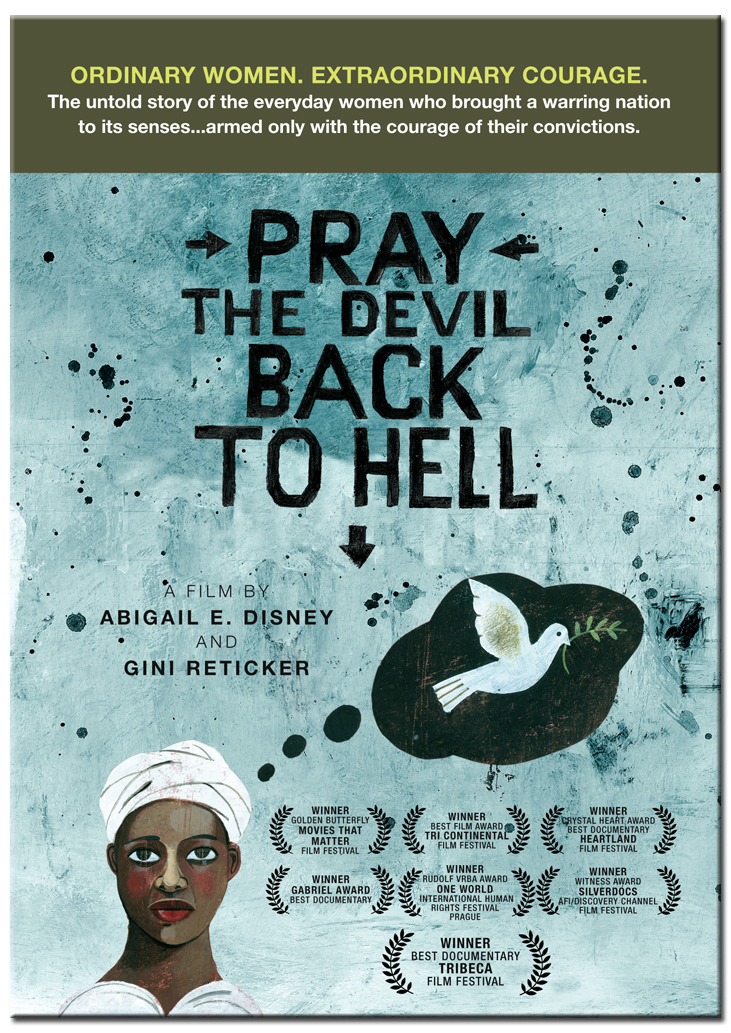
An extraordinary documentary about Women of Liberia Mass Action, called Pray the Devil Back to Hell came out in 2008. Producer Abigail E. Disney couldn’t rely on footage shot by news organizations. They barely cover non-violence. Instead she managed to find three years of material on the peace movement that shifted the course of history from “private individuals who just happened to be there with cameras.”
We can do more than thank goodness.
We can use non-violence so that goodness is a force for change.
We haven’t gotten this far through brutal force or greed.
Nope. It has taken cooperation, curiosity and cleverness.
Ninety-nine percent of our time on earth as a species has been spent as hunter-gatherers. Our ancestors wouldn’t have survived without collaborating to find food, raise children and stay safe from large predators.
This is still true now no matter what 24 hour news channels tell us. Each moment of the day we’re more likely to react with compassion, calm interest or cleverness than with any form of overt negativity.
Cooperative efforts abound all around us. Perhaps we simply need to look at life-enhancing innovations we take for granted in a new way. Consider these examples.
Want to travel the world finding friendly strangers offering you a place to sleep for free? You can through CouchSurfing. Their motto encourages everyone to “Participate in Creating a Better World, One Couch at a Time.” Started in 2004, this non-profit network has connected travelers with locals in 232 countries. This has resulted in nearly 3 million positive experiences, almost 2 million reported as friendships. People who never would have met are connecting, sharing experiences and developing greater cultural understanding.
How about Freecycle? Nearly 7 million members across the world make up this grassroots, non-profit movement of people who give and get goods for free in their own communities. The Freecycle Network, which started humbly in 2003, says, “Our mission is to build a worldwide gifting movement that reduces waste, saves precious resources & eases the burden on our landfills while enabling our members to benefit from the strength of a larger community.”
Or consider books set free to find new readers. Since 2001, BookCrossing members in more than 130 countries have shared millions of books with strangers. They’ve also enjoyed the treasure-hunt pleasure of finding books they want to read. It’s all part of an innovative network linking books and readers. More local book-sharing concepts are springing up everywhere. Recently a small town in the UK transformed an unused phone booth into a book exchange. They outfitted the booth with shelves and waited to see if anyone would participate. Residents continue to share books and movies anonymously at the booth, which is always open.
Maybe you need a bigger example. There’s always the Internet. Harvard Law professor Jonathan Zittrain notes in a TED talk that the net itself is built by millions of “disinterested acts of kindness” and based on trust, curiosity and reciprocity.
Giving and collaborating seem to be an intrinsic part of human nature. That may be why people freely share their expertise by editing Wikipedia entries, providing support online or otherwise helping people they’ll never meet via the net. That may be why giving inspires people to greater heights of generosity or creative expression, even when the act remains anonymous. The blogosphere abounds with art, craft and music exchanges. Increasingly this is taking place IRL more often too. In October an art collective calling themselves the Future Machine transformed an unused newspaper box into a “Stranger Exchange.” Located in Boston, the box features simple instructions on the side.
1. Leave an item; 2. Take an Item and 3. Don’t be a Stranger.
Their website offers a simple way to link people who give and take items in the box. Items in the box have included a map of Luxembourg, AA batteries and an invitation to a long ago New Year’s Eve party. They’ve also included projects created specifically for Stranger Exchange such as artwork and a mix tape made in response to another mix tape found in the box.
A post about this phenomenon by Rachael Botsman noted, “Interestingly, the early ‘members’ of the Stranger Exchange seem be participating for similar intrinsic motivations that are fueling the open peer-to-peer movements such as Flickr, Wikipedia, BitTorrent, BePress and so on. For these systems to keep flourishing, people need to “give before they get,” a dynamic that is built on a new kind of trust, trust in people you don’t know or are not even friends with.
This in turn reinforces certain behaviors—collaboration, kindness, openness and honor—that are critical for sharing to happen between strangers. What’s interesting is that once people participate in these exchanges, they experience the proverbial “warm inner glow” and they crave that experience again. In other words, the altruistic action and indirect reciprocity becomes self-reinforcing.”
Botsman is co-author of a book coming out next fall titled What’s Mine is Yours: The Rise of Collaborative Consumption. I’m looking forward to what the book will tell us about the rise in sharing, trading, gifting and swapping in communities around the world. I suspect it will have to do with the cooperation, curiosity and cleverness—-the foundations of our early survival and the building blocks of our shared future.
Creative Commons photo courtesy of Erica Reid’s Flickr photostream
 .
.




 .
.



 Laura Grace Weldon