Unfit for Polite Society

behaving rudely, what not to say at a potluck, how we're like chimps, avoid the rich,

Volunteer with a non-profit long enough and you’ll eventually find yourself agreeing to attend a member potluck. That’s why Spouse Man and I found ourselves pulling up the drive of what was clearly no ordinary house. To us the place looked like a mansion. It was populated with casually well-dressed people who talked about jazz clubs, eco tourism and where to get the best cheese. Things I would probably talk about if my annual income weren’t equivalent to what these folks spent on really good moisturizers.

Our smiles and greetings were completely ignored, as if we were low ranking primates walking slack-shouldered around the perimeter of alpha animals. Fine with me. That way I could do as I wished without the pressure of making conversation with strangers.

I boldly filled my plate with the most unfamiliar foods and poured a glass of organic wine. Anticipating an exiting gustatory event for my first mouthful I forked up the ugliest stuff, sure that taste would make up for appearance.

Wrong. Very wrong.

I deeply wanted to spit it out, but showed remarkable restraint. Only a grimace gave me away.

Now I know the first rule of potlucks is to utter nothing but praise for the food, but I had already determined that we were invisible in the press of people all glibly chatting about topics beyond our scope of wealth. And truly, I spoke so quietly that lip reading would have been helpful. All I did was lean toward Spouse Man, point to the smeary pile of brown on my plate and advise him lovingly, “Don’t get any of this tasteless goo.”

Immediately a woman materialized behind me. A tall woman with large aggressive earrings. She said (I think into a megaphone), “I made that. It’s polenta.”

Now I’ve met polenta before and this was no polenta. It was more like Cream of Spam, extra grainy.

I apologized, stammering something unintelligible about a cook’s poetic license. I even shoveled more of the glop into my mouth without shuddering. She watched until the heat radiating from my fuchsia-toned face drove her away, surely toward people more polite and gracious than a potluck food slandering boor.

I slunk off to drink more organic wine near a large potted plant. From this unobtrusive vantage point I pretended to be a party version of Jane Goodall, carefully watching the behavior of my own species. Still stinging with shame after hurting the feelings of Aggressive Earring Polenta Woman, I’m sure I wasn’t objective. But I did find that my fellow potluckers shared common traits. I observed that we humans indulge in the same expressive pouting, posturing and nit-picking found in any group of chimpanzees.

Except chimps would have thrown the food.

*

*


This piece first appeared on Poor Mojo’s Rant

Chimp image courtesy of Sihonorio

What Do Your Gifts Say?

gifts of love, meaning in gift giving, making gifts magical,

It’s upon us in full force, the biggest buying season of the year. A giant transfer is taking place. The life energy we call money (representing hours of work) or credit (hours of future work) is exchanged for stuff. Lots of stuff—toys, clothes, perfume, electronics, fancy foods, plus those novelty items that no one ever uses. (Okay, I actually wear the silly socks given to me and wear them with glee. I may be the only one.)

We transfer more than time and money. That’s because there’s meaning embedded in our gifts. We have certain intentions as we shop, wrap, anticipate giving, and finally offer the gift. Our efforts try to say something.

What? It’s complicated. Our gifts say different things to different people. A well-made carving knife for a friend who has recently taken up woodcarving shows you pay attention to what brings him delight and what you hope will enhance that delight. A box filled with birthday, get-well, sympathy, and thank you cards plus a roll of stamps for a great grandparent shows that you appreciate the way she keeps in touch with the extended family. It also helps her keep up that tradition now that she’s no longer driving.

Of course what we try to say with our gifts differs depending on whether we’re giving them to our children, our lovers, or our bosses. Still, most of us hope for that rare happenstance, when our gift brings our recipient more joy than we could have imagined. It’s almost like magic.

Maybe I take this too seriously. The first time I bought gifts on my own I was five years old. That year our church set up a Santa Shop in the basement where kids with a handful of change could buy gifts. Volunteers dressed as elves led each child to  tables where merchandise was arrayed. After making selections and paying, these elves helped the child wrap and tag each gift. The elf outfits didn’t fool me. These were the same nice older ladies whose wrinkled hands pretty much ran the whole church.

The elf who walked me from table to table was patient as I tried to choose. I knew that money wasn’t to be spent carelessly. My frugal parents always impressed upon me the importance of saving money. They made do with what they had, using it up until it was worn out and then fixing it to last a little longer. That was true of our car, the floorboards recently patched so I could no longer see the road rippling past in a dizzying gray stripe as we drove. That was true of my hand-me-down clothes, sagging at the knees and stitched at the elbows. So I shopped carefully.

I spent fifty cents on a super-sized paperclip for my schoolteacher father. I spent a quarter on a plastic optical illusion toy for my older sister. I couldn’t find anything for my mother. The elf told me a large strangely shaped bottle of perfume would be perfect. She nodded so much as she talked that the bell on her hat tinkled and the flesh under her chin wobbled. The liquid inside the bottle was dark. She unscrewed the cap and let me smell it. It smelled awful. She told me it was the best deal there. I knew “deal” meant a good thing. I’d heard my parents use that word. So I bought it, even though it cost a dollar and twenty-five cents.

The days before Christmas weren’t filled with delicious anticipation. I woke each morning with a heavy feeling. My Santa Shop gifts under our Christmas tree were terrible. I’d wanted to get my father a gift that would make him feel like whistling little tunes all day, the way he did when he was lighthearted. I’d wanted to get my sister something she liked so much that she’d never let me play with it. And I’d wanted to get my mother something special. When I thought of that bottle of perfume I knew it was what she called “vulgar.” It hit me then, the days leading up to my kindergarten year Christmas, that no gift could show people how much I loved them. It was a sad realization, particularly when every holiday commercial on TV told me the opposite.

I’m a lot more cheerful than my five-year-old self but I keep trying to give gifts that say the impossible. Every birthday and holiday I try. I realize holiday gift-giving is overhyped. Are we really supposed to show someone we care by presenting them with a mass-produced item? “I got you one of the 3 million identical objects made by underpaid workers in an overseas factory. Merry Christmas!”

I love to give all sorts of gifts. Books, music, tools. Handmade gifts (or gifts others make by hand).  Gifts of service, do-gooder gifts , gifts that support non-profit organizations, Fair Trade gifts, gifts to local restaurants/theaters/galleries, and of course, specific gifts the recipient requested. What I want to give is so much more. I want each person to know how much they are cherished. That can’t be wrapped.

If the cliché “it’s the thought that counts” really counted, my gifts would shimmer with magic. Instead my loved ones may be getting this year’s equivalent of a paper clip, plastic toy, and vulgar bottle of perfume despite my best attempts.

Do you suffer from gift-related dilemmas? What are you really trying to say with your gifts? What gifts have you given that were downright wondrous? Rest assured, one of my favorite gift-giving memories is finding a bagpipe action figure (that made farting sounds rather than pipe music) for a certain teenager. Sometimes silliness is magic too.

*

*


“Presents” illustration courtesy of BulletsInGunn

Fostering the Flip Side of Gratitude

dark side of gratitude, responding to nay-sayers, when those in authority predict doom, when doctors are wrong, when teachers are wrong, when therapists are wrong,

Cajoled into seeing a friend’s obstetrician, the one she praised so highly, I came prepared with a list of questions folded in my jeans pocket. But I didn’t get a chance to ask about a doula, the Leboyer method, or anything else. The doctor walked in, greeted me and looked me over without performing an exam. Then he announced with certainty that I had “insufficient pelvic capacity.” He assured me that my petite size meant I would never be able to deliver a full-term baby.

“What do you mean?” I gasped.

“It’s nothing to worry about,” he said. “It just means you’ll require a Cesarean.”

I was six weeks pregnant.

I may have been young and expecting my first child, but I dared to question his judgment. He became indignant. A lecture followed about the number of babies he’d delivered. He went on about anoxia and brain damage, then intoned the words that surely convinced legions of women before me, “Do you want to endanger the life of your baby?”

That was all it took.

I never returned.

But how was this self-satisfied man to know if his assertion turned out to be valid?  I didn’t get back to him. Nor did I refute the next obstetrician whose office I also left after he told me my vegetarian diet would result in a sickly, underweight baby.

Although these physicians never knew if their dire predictions came true, I went on to deliver a 9 lb, 10 oz baby quite naturally. In subsequent years I had three more sizeable vegetarian-grown babies.

On behalf of each of my children I learned to speak up–forcefully and often. This pushed me right past the shyness I thought was an indelible part of my personality. Once I became comfortable speaking up I felt empowered to assert my feelings of gratitude as well.

According to Thanks!: How Practicing Gratitude Can Make You Happier and Living Life as a Thank You: The Transformative Power of Daily Gratitude, regularly practicing gratitude boosts our health and well-being. Small acts of kindness also create a ripple effect, generating more compassion in others. Sometimes it’s easier to thank those who are close to us but it’s powerful to acknowledge people who are consequential strangers or people we’ve never met but whose efforts make a difference.

My gratitude practice often takes the form of appreciative letter to strangers. I leave a note for a waitress whose cheery demeanor has healed me of some common sadness. I send a letter to a nursing home administrator describing the tender affection I witnessed an aide show a patient. I send written kudos to the cast of a locally produced play. They don’t take long to write although occasionally I have to make an effort to find out where to send one.

Not long ago I was delighted to finally locate the address of a local school bus driver. I regularly wait in my car as he stops on a 55 mph road and in only a few moments backs into a narrow entry way with the grace and dexterity of a ballroom dancer. So I wrote a letter to explain that seeing him drive with such skill gave me the sense one day I too might develop true mastery in my line of work.

I never sign my name. I think it’s better to write “your customer” or “fellow traveler” or whatever fits the situation. That way it isn’t about me, it’s about a wider sense of appreciation. Although I have to admit, I benefit too. Looking for the good in a situation changes my energy in a positive way.

But really, paying attention only to sweetness and light ignores the shadow. People in positions of authority need to know when their judgments or actions are harmful. All of us can learn from mistakes, unless somehow we’re deprived of the consequences of our words or actions. Today, many professionals are well insulated from those consequences unless they reach litigation.

I don’t advocate griping or threatening. I’m talking about communication that fosters understanding. A simple letter can spare future clients, students or patients the same struggles your family may have endured. Of course this isn’t necessary when the situation can be handled right away. But how many of us have faced long term predictions of doom? A family bed is nothing but bad parenting.  Without this surgery you’ll end up crippled. Homeschool and you’ll have a maladjusted child on your hands. Ritalin is the only solution for that behavior. After years of hearing such pronouncements I have come to realize that updating a professional on his or her assessment is another form of kindness. It’s the flip side of gratitude.

If you choose to get in touch with someone for these same reasons, here are guidelines that have worked for me.

1. Be clear about your own goals before writing that letter or email. Wait until you can proceed without anger. The person you are contacting will be unlikely to learn anything unless you maintain a positive and respectful tone throughout.

2. Refresh the recipient about your situation as it was when you were last in contact.

3. State clearly and kindly that (as a physician, teacher, therapist) he or she is in a position to help many people. You assume that as a matter of professional interest it would be helpful to know about the outcome of a situation he/she assessed.

4. Sticking only to the facts, explain how in your situation their judgment or actions were misguided. Then update with pertinent details.

5. If relevant, include research or other data which the professional can use to gain insight.

6. Wish this person well. Don’t expect or ask for follow up contact.

The highest response to nay-sayers is to flourish joyfully in our choices. So I respond  to those who predicted doom for my children who were held long and nursed often, to those who judged our learning and lifestyle choices harshly—we are well. For that I’m endlessly appreciative.

Lets try, whenever possible, to find the freedom right beyond the boundaries of old ideas. To do that we need to share the insight that comes from experience. There, even the flip side of gratitude turns toward wisdom.

when professional advice is wrong, shadow side of gratitude, finding peace rather than revenge, gratitude's underbelly,

A version of this piece first appeared in the Sept/Oct 2010 issue of Natural Life magazine

Writing Hands image courtesy of Jggy

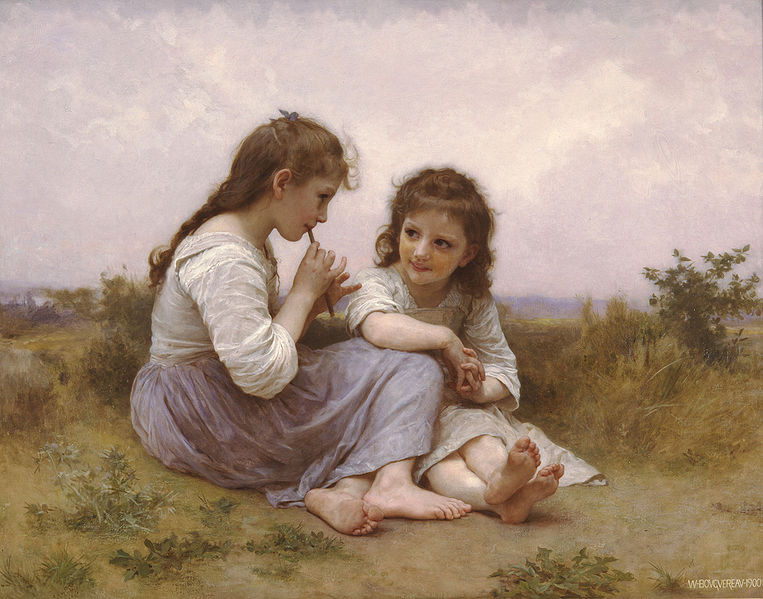
A Childhood Idyll by William-Adolphe Bouguereau

Thanks To Mom, We Tried Turkey Farming

I offered to host Thanksgiving year after year. My mother turned me down each time. She liked hosting the family get-together even though her kids and grandkids lived close enough to visit weekly. She preferred her wedding china and linens to my mismatched dishes and homespun tablecloth. Mostly she wanted to ensure that the meal featured homemade white crescent rolls and a large Butterball turkey filled with her own stuffing recipe. She was afraid that her annoyingly whole foods vegetarian daughter might prepare something horribly non-traditional, like nutloaf with chestnut wild rice dressing instead of turkey. Valid point.

But her health kept declining. I took to coming over early on Thanksgiving Day to stuff the turkey with her and hoist it in the oven. We all came back a few hours later with side dishes. I always brought homemade crescent rolls that looked suspiciously brown and healthy. Our meals continued to be lively events and we worked hard to make sure my mother didn’t notice how much we all helped out.

I knew she’d reached a new low in her energy level when she offered to let me host Thanksgiving a few years ago. She said I had to agree to one condition. I had to make a real turkey (not a Tofurky, she hastened to add) and stuff it with her stuffing recipe. I had to promise. I wanted to cry, knowing that she was much sicker than she let on. I promised.

But there was no way I was going to cook a typical grocery store turkey. I know these birds spend their short lives in tightly confined spaces, eating foods that aren’t natural to them. We raise pastured livestock on our little farm, so we drove nearly an hour to buy a similarly pastured turkey directly from the farmer. I felt particularly solemn as I prepared that first Thanksgiving meal at our house, knowing it was difficult enough for my mother to get from the car to the house so she could spend the day with us. At least the turkey was a hit. According to the meat-eaters in the bunch, it was the best they’d ever had. It was also so juicy that it overflowed the pan. That’s something grocery store birds don’t do, even though they’re injected with a “7% solution containing water, salt, modified food starch, sodium phosphate and natural flavors.”

But that pastured turkey was astonishingly expensive. We thought we might be able to raise a flock of our own more cheaply. We were wrong. But I’m getting ahead of myself.

Nearby farmers gently told us that we were foolhardy. They warned us to keep turkeys “on wire,” indoors, and away from what they said were the disease-carrying dangers of grass. They said our plan to avoid feed pumped up with medications and synthetic vitamins would leave us with a dying flock. Online articles repeated these woeful predictions.

Still, the next spring we bought turkey chicks. They were raised in the warmth of an Amish kitchen until they were old enough to live outdoors.

On our place they lived in what’s called a “tractor.” This is a moveable coop, allowing the birds access to fresh areas to forage. My husband and oldest son built it with roosts and feeders. We soon learned turkeys toss food from feeders and don’t like to roost. Out came both of those modifications. Then to forestall problems with predators we added a moveable electric fence.

How much our rapidly growing chicks ate surprised us. In addition to the roots, grasses, leaves, and bugs they scratched up on their own we provided them with a locally grown and ground mix of seeds and grain. And we gave them fresh organic produce from the garden each day. They had strong preferences. One day they might eagerly eat cucumbers and squash, the next day they refused to eat those veggies but enjoyed tomatoes. They turned up their beaks at plenty of other treats, like broccoli and rutabagas.

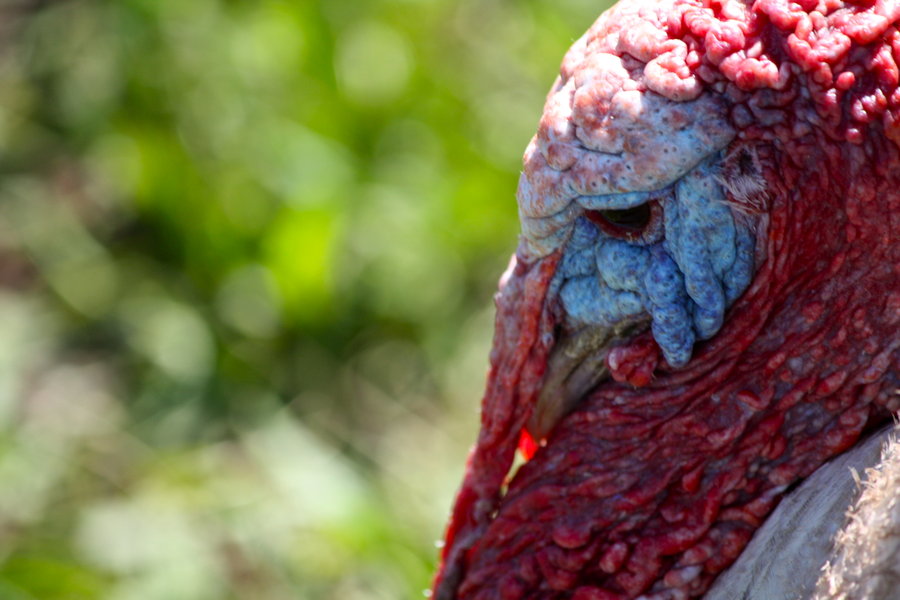
We found turkeys quite interesting. When they’re young they peep and squawk. Then the gobble develops, something we found relentlessly amusing. Hens don’t gobble. They chirp and cluck in their own quiet manner while the toms are prone to showy displays of exaggerated feather fluffing. The toms gobbled at any noisy airborne attraction including Canada geese, crows, and helicopters. When annoyed, their heads turned iridescent blue and sometimes they engaged in snood-grabbing jousts. Our dogs were fascinated by the turkeys, but the turkeys showed little interest in creatures beyond their own genus.

All day, every day the flock had a visitor. A little brown hen moseyed up from the back of our property to visit her fowl friends. She stayed close. She pecked at grass and bugs, sometimes a few feet away and sometimes a few inches away. When we gave the turkeys a treat from the garden like a monster zucchini she’d cluck at me, waiting for her own piece. Quite often the turkeys, in their zucchini-enhanced exuberance, tossed flecks of what they were eating almost as if to share. Their friend the hen was right there waiting for those offerings. I never saw the turkeys peck at her.

What we learned about turkeys wasn’t entirely charming. Full grown turkeys are huge. Some of ours were over 80 pounds. Their poo, I’m sorry to say, was also huge. I never realized just how foul it was until I slipped and fell in it. And despite the overall health and vitality of our flock, once we factored in all the expenses there wasn’t any profit at all. Plus, after feeding and chatting with them for six months, it felt like a horrible betrayal to take them to the butcher.

This year we let the turkey farming venture go. We’re gratefully buying a pastured turkey, knowing that it’s worth the cost. It’ll be cooked with my mother’s stuffing recipe. I’ll also be using my mother’s china and linens. We’ll sit here at a table filled with friends and family, fully aware that our blessings include those made of memory.

I’ll smile this Thanksgiving at all who are here with me. I’ll leave the sob in my throat, choosing instead to share fond and funny stories of my parents who I miss every day. I realize now why every generation goes on celebrating even after the elders who made the traditions meaningful have gone. Holidays are a sort of bridge between past and future, a way of steadying ourselves with the idea that some things stay the same. When the time comes for me to pass along the honor of hosting Thanksgiving dinner, I’ll try passing along my mother’s stuffing recipe too.

honoring memories at Thanksgiving, how to raise pastured turkeys, small farm turkey story, missing mom at Thanksgiving,

Image: Karuntribs


Poetry Diet

struggling poet, making money as a poet, appreciating poets, life of a poet,

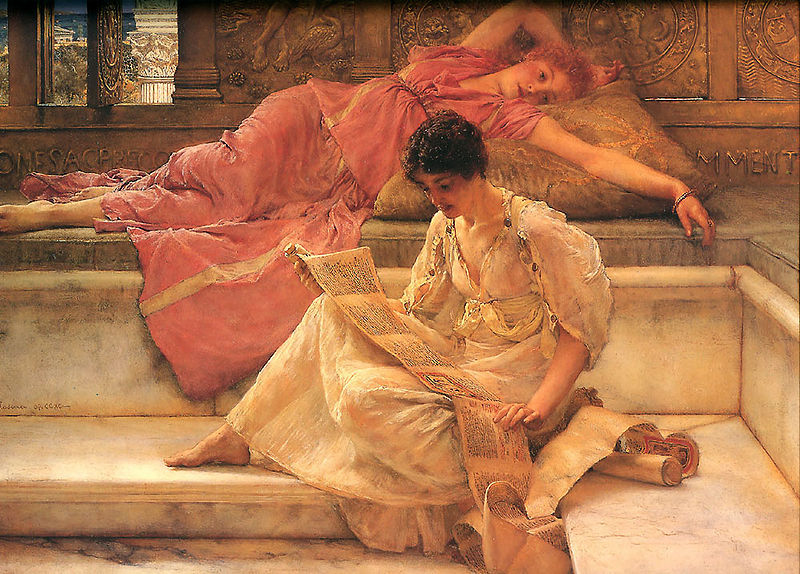
“Favourite Poete” by Lawrence Alma-Tadema

Poetry is thoughts that breathe, and words that burn.  ~Thomas Gray

The term Poetry Diet might imply a rare appetite. The sort of longing only appeased by words strung spare and stark, like a meal so desired that imagination keeps creating it anew.

Ink runs from the corners of my mouth
There is no happiness like mine.
I have been eating poetry.
~Mark Strand

Or Poetry Diet could imply hunger for that rare current some call inspiration, the elusive muse carrying phrases from ether to pen.

Everything in creation has its appointed painter or poet and remains in bondage like the princess in the fairy tale ’til its appropriate liberator comes to set it free.  ~Ralph Waldo Emerson

However in this case, what I’m calling the Poetry Diet is something much more mundane.  It simply means to eat nothing but what is purchased with money earned from one’s poetry. Reading, teaching, publishing, wearing them on your naked body, selling poems painted on scrap metal, whatever it takes. If I started a Poetry Diet now I’d be svelte in a week, thin rather soon. Before long, starving artist might be a literal (hah!) condition.

Surely a Poetry Diet would provide a vast incentive to write and, here’s the rub, send out one’s work. It could also leave the poet so imperiled that friends might stage a poetry reading to raise funds to feed the annoyingly hollow wordsmith.

Thus far I’m not dedicated or foolhardy enough to attempt a Poetry Diet. Mostly because I’m already trying to live by patching together the Essay Diet, Columnist Diet, and Editor Diet. But also because I know how long it takes from inspiration to paycheck. Right now I’m waiting for one of my poems to appear in Christian Science Monitor, two in Trillium Literary Journal, two more in J Journal. The total pay will amount to, well, let us not speak of actual numbers. I wouldn’t last long on the Poetry Diet. Surely that says something about the quality of my poetry but it also says something about our culture as well.

Poets aren’t very useful
Because they aren’t consumeful or very produceful.
~Ogden Nash

I hardly expect to live by poetry alone, although I have been sustained by the work of other poets in ways more vital than any meal. I long to see greater support for artists of all kinds. I have dear friends who devote their lives to perfecting a craft. They act, compose, weave, calligraph, paint, weld, invent, write, bake, work with wood, sing, and throw pots. They are driven to explore the intersection of art and cosmology, continually refining what it means to create. Yet most of them spend their days at jobs that are unrelated in order to survive. They wait tables or work in accounts receivable. Their real gifts emerge during precious hours plucked from mundane obligations.

It’s quite possible to attend a production at a local playhouse and see performances that shift the way you experience the world. You walk out a changed person for the extraordinary art you’ve enjoyed. Chances are that director, those actors, that playwright are unable to support themselves with their work, vital though it is.

I’m certainly not in league with those whose work is transformative. My poetry is about ordinary things like opening doors, moving stones, forgetting a name.

Perhaps I should head in a new direction—food poems. That way I’d feel nourished while contemplating the swirling curds and whey in the next batch of cheese I make. I’d also be answering Chesterton.

Poets have been mysteriously silent on the subject of cheese.  ~G.K. Chesterton

9 Amazing Reasons To Be Optimistic

world betterment, global optimism, oneness, hope, peace, all will be well,

If you could scroll through history searching for an era where you’d like to spend a lifetime, what would attract you?

Probably peace and prosperity. Probably a time when the arts flourish and science is open to new wonders. Probably too, a time period when people behave morally, care for one another, and uphold higher ideals than selfishness.

Does it make a difference to your answer if you don’t get to choose where on Earth you’ll be born?  Into what class, gender, creed, and ability?

You’ll probably want to stay right here, right now.

Our 24 hour media attention on what’s terrifying and what’s superficial steers us away from the big picture.  That picture, looking at the wider view, is actually pretty heartening.

*

1. War and global violence continue to decline.

Armed conflicts aren’t going up, they’re going down.

The world has seen a 70 percent decline in the number of high-intensity conflicts since the end of the Cold War era. Genocide is down 80 percent. Weapons sales between countries have diminished by 33 percent and the number of refugees has fallen by 45 percent. Even measuring from as little as 15 years ago, the number of armed conflicts has dropped from 44 to 28.

Why? Project Ploughshares credits peace building efforts.

Chances are, the reasons for peace are complex. Yet a stronger international resolve to focus on peace building and basic human rights is taking place. Imagine the far larger potential for enduring peace if we intentionally educate our children and ourselves in the proven methods of non-violence—-negotiation, mediation, reconciliation, even basic listening skills.

*

2. Freedom is stretching across the planet.

By evaluating variables including civil liberties, democratic institutions, and independent media it’s possible to assess how free each nation in the world really is. Back in 1973, 29 percent of nations were deemed free, 25 percent partially free, and 46 percent not free.

In a little over 35 years, the number of nations ruled by authoritarian regimes dropped from 90 to 30. Countries around the world considered to be free increased by 50 percent while those not free had dropped by more than half.

Independence has a long way to go. And what we may not recognize as positive signs—protests, dissent, political upheaval—may very well be ordinary people speaking up for freedom.

*

3. Affluence is on the increase.

A shifting focus away from war, conflict, and chaos means that countries are better able to meet the needs of their citizens. Those 151 countries deemed free or partly free account for 95 % of the world’s gross domestic production (GDP).

The number of people living in poverty has dropped by 500 million people, although most of those successes are in a few key countries.  Since 1975 the world’s poor have seen their incomes grow faster than the world’s wealthy, meaning economic equality is increasing.

Of course, we make a mistake when we confuse affluence with well-being. After certain (surprisingly minimal) levels of health and safety are reached, money doesn’t buy happiness.

Current global conditions of institutional breakup, financial chaos, and environmental decline are exactly those which seem to be (slowly) leading to long-term beneficial change. Collectively we’re waking up to the limitations of short-term fixes and relentless economic expansion. Hopefully we’re also waking up to the reality that we’re in this together—rich and poor, developed and developing nations, young and old, left and right. We see in our own lives that what’s important can’t be measured by dollars alone. Things like good health, supportive relationships and a vital ecosystem.

There are plenty of other ways to define affluence. A fascinating measure of wealth lies in a quick look at how many hours of labor it once took the average worker to pay for light.  In ancient Babylonia it took over 50 hours to pay for an hour of poor light from a sesame-oil lamp. At the start of the last century, it would have taken the average worker a thousand hours to earn the money to buy candles equaling the light of a single 100 watt bulb. Today’s high efficiency lighting costs us less than a second of work.

*

4. Fewer people are hungry.

Hunger continues to drop although we have a long way to go. It’s staggering to realize that 925 million people are chronically hungry. But according to The Improving State of the World: Why We’re Living Longer, Healthier, More Comfortable Lives on a Cleaner Planet by Indur Goklany, global food supplies increased 24 percent per capita in the last 40 years. In developing countries the food supply increased at an even greater rate, 38 percent more food per person. Since 1950, the real global price of food commodities has declined 75 percent.

No one should go hungry. The future of global food justice relies on efforts to restore and protect biodiversity, stop the spread of genetically modified crops, and assure water rights.

*

5. Longevity is improving yet total population faces a downturn

Fulfilling the cherished hopes of their parents, more children around the world are born healthy. Mortality rates for those under five years of age have fallen by 60 percent since 1960.

Meanwhile, life expectancy has risen 21 years since the mid 1950’s.

This doesn’t mean the planet will be too crowded. Overall population will continue to rise for several more decades but we’re facing a major downturn. Already birth rates are near or below replacement rate in countries all over the world. Increased education and affluence tend to inspire women, no matter what country they live in, to invest their time and resources in fewer children. As Fred Pearce clearly explains in The Coming Population Crash: and Our Planet’s Surprising Future, our little Earth will likely reach a (painful) peak of 8 billion people around the year 2040, then the total number of human will begin to decline so rapidly that nations will struggle to keep their populations levels from slipping too low. They may create perks for becoming parents and incentives to attract immigrants.

*

6. Health continues to improve.

Studies conducted by Robert W. Fogel, a Nobel laureate and economic historian at the University of Chicago, show that in a few hundred years human biology has changed in startling ways. We are more resistant to ill health, more likely to recover when faced with disease and less likely to live with chronic disability. We are also smarter and live longer. Fogel calls this radical improvement “technophysio evolution.”

An interview quotes Fogel as saying, “The phenomenon is not only unique to humankind, but unique among the 7,000 or so generations of human beings who have inhabited the earth.”

Fogel doesn’t necessary attribute the changes to genetic shifts.  Improvements in medical care, nutrition, sanitation and working conditions may cause epigenetic changes. These are shifts in gene expression that can last through many generations without altering underlying DNA.

Information amassed by Fogel indicates that chronic diseases such as arthritis, heart disease and lung ailments are occurring 10 to 25 years later in life than they did 100 or 200 years ago. Interestingly, well-being may be more strongly affected by conditions each individual faces in utero and during the first few years of life than previously suspected.

These remarkable health gains don’t diminish our current struggles with cancer, diabetes, Alzheimer’s disease, autism and other serious health conditions on the increase. Despite the blessing of bodies more resilient and healthy than those of our ancestors of just 150 years ago we suffer the effects of environmental toxins and nutritionally inferior diets. To fully accept the gift of health and energy from our ancestors, we need to make the right choices to pass those benefits to our descendants.

*

7. Literacy rates continue to improve.

Global adult literacy rates have shot up from 56 percent in 1950 to nearly 84 percent today, the highest ever.

Women’s rates haven’t risen as quickly due to inequality and poverty, but in some areas, particularly East Asia, 90 percent more girls are able to read than 10 years ago. As female literacy goes up, other overall positive indicators tend to follow including decreased domestic violence, improved public health and greater financial stability.

*

8. Intelligence is on an upswing.

From generation to generation, we’re getting smarter. In fact, to accommodate continuously increasing intelligence the IQ test must be renormalized (standardized to keep the average test results at the 100). This is called the Flynn Effect.

Between 1932 and 1978, mean IQ scores in the U.S. rose 13.8 points. If your grandparent received IQ score results of 98 back in 1932 they’d have been deemed of average intelligence. That same grandparent, if administered today’s tests, would be considered to have a borderline mental disability by current scoring standards. IQ scores have risen even higher in some other countries. Of late, developing countries seem to be experiencing the biggest surge.

Plenty of explanations have been proposed, but the increase can’t be definitively pinned on genetic improvements, improved nutrition, greater familiarity with testing or better schooling.

According to Cornell professor Stephen J. Ceci, the most direct gains are not in subjects that are taught (math, vocabulary) but are shown in parts of the test that seem unrelated to schooling (matrices, detecting similarities). In fact, test gains have been enormous in areas requiring the child to apply his or her own reasoning, such as arranging pictures to tell a story or putting shapes in a series. Although teaching children does return positive results, what a child learns through the natural stimulation of everyday life has a more profound effect. For example, a study to determine the effect of schooling on rural children in India found that the increase in overall intelligence from a year of age is twice the increase from that of attending a year of school.

IQ test scores don’t relate to what truly provides satisfaction in life. But the Flynn Effect is intriguing. Factors we can’t completely explain are giving us the intellectual capacities to deal with an ever more challenging world.

*

9. Compassion is huge.

Never before in history have so many people worked tirelessly and selflessly to benefit others. Paul Hawken writes in Blessed Unrest: How the Largest Movement in the World Came into Being and Why No One Saw It Coming that the abolitionist movement was the first major movement by human beings to advocate on behalf of others without seeking advantage for themselves or their particular social or political group.  Since that time, such efforts have grown with astonishing vigor.

There are now over a million organizations on the planet working for environmental stewardship, social justice, the preservation of indigenous cultures, and much more.  These groups don’t seek wider acclaim, they seek to make a difference for the greater good.

Humanity, which is clever and kind enough to bring about so much improvement for one another, is awakening to the vital importance of living more sustainably on Earth. Unless we pull another planet out of the galaxy’s pocket in the next decade or two, we have to stop using up our precious blue green Earth. It’s time to turn our ingenuity to living well within our means. Peacefully, wisely, and with optimism.

world peace, ending world hunger, ending war, ending illiteracy, global optimism, heartening optimism,

Hand Globe image courtesy of HapciuMadam

Hummingbird image courtesy of PhapPuppy
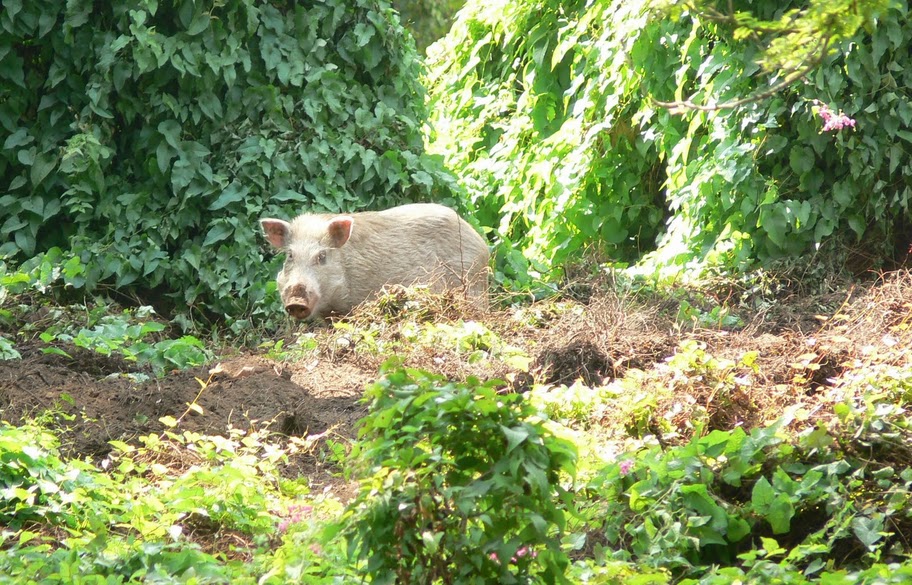
Letting Beauty Go

Beauty rarely shows herself nowadays.

It’s been years since I thought I owned her, but I remember our time together well. At first she was small, shy, and had more in common with cuteness than Beauty. Yes, I coddled her. I lavished hours on Beauty and the attention showed.

“Best not get attached to Beauty,” I was warned by people older and wiser. They told me the day would come when ordinary measures wouldn’t be enough to control her. They also told me that there was nothing I could do to change fate. Eventually Beauty and I would be parted forever.

I tried to deny it when the first chin bristles showed up. I pretended the increasing girth didn’t put me farther from Beauty. I ignored other tendencies like messy habits and gleeful snorting.

Time passed. Beauty was well on the other side of cute and would soon be taken from me for good. So I did what no one I know has ever done. I opened the gate to her pasture and made a path to the woods with apples, corn, and banana bread. Beauty was wary but followed her appetite. When she was well into the forest she heeded her instincts and kept walking toward freedom.

I don’t often get a glimpse of her these days. When Beauty shows herself I see that she is huge, bristled, her snout trembling as she smells the air. She seems gloriously happy. Let Beauty go. You’ll both be free.

*

*


Recommended post When Girls Think Their Looks Mean Everything

Woman and Pig by Wade Schuman

Free Pig

Do You Suffer From Mean World Syndrome?

tv overload, mean world syndrome, george gerbner, pessimism, fearful of strangers,

Do you turn on TV news most days? You’re probably not doing yourself or your family any favors.

What you bring into your home is tragedy, violence and the worst of human behavior. Study after study has shown that news programming tends to breed cynicism and helplessness.

Yes it’s important to be informed, but the kind of coverage found in network and cable news is usually superficial. And worse, it’s skewed to visuals and headlines chosen for shock value. That’s what boosts rating. In-depth information that advances real comprehension isn’t what TV news delivers. As a result, viewers are more likely to become pessimistic, fearful and unable to gauge reality.

Yes, really.

The phenomenon is called Mean World Syndrome.

It’s based on the research of George Gerbner. His analysis showed that the violent content of news and entertainment convinces viewers that the world is more dangerous than it actually is. Back when Gerbner did the bulk of his work, media was a smaller and quieter place. Now we have 24 hour access to news channels, movies, and shows as well as all kinds of net content.

Gerbner wrote,

Our studies have shown that growing up from infancy with this unprecedented diet of violence has three consequences, which, in combination, I call the “mean world syndrome.” What this means is that if you are growing up in a home where there is more than say three hours of television per day, for all practical purposes you live in a meaner world – and act accordingly – than your next-door neighbor who lives in the same world but watches less television. The programming reinforces the worst fears and apprehensions and paranoia of people.

And those who are convinced the world around them is a highly dangerous, unpredictable and unforgiving place have more than a heightened sense of insecurity. They are more likely to see violence as a solution to problems rather than to reason in more nuanced ways. Fear also drives them to take hard-line political and social attitudes.

When Gerbner testified before a congressional subcommittee in 1981, he said

Fearful people are more dependent, more easily manipulated and controlled, more susceptible to deceptively simple, strong, tough measures and hard-line measures…

mean world syndrome, news overload, cynicism and mass media, happy family without tv news,Hmmm.

Fact is, the world is NOT more violent.

Center for Media and Public Affairs did a study on network coverage of murder. Between 1990 and 1995, the murder rate in the U.S. went down thirteen percent. (It continues to go down.) But during that same period, network coverage of murders increased three hundred percent.

Try this antidote, an excerpt of a Steven Pinker article titled “We’re Getting Nicer Every Day: A History of Violence,”

The criminologist Manuel Eisner has assembled hundreds of homicide estimates from Western European localities that kept records at some point between 1200 and the mid-1990s. In every country he analyzed, murder rates declined steeply–for example, from 24 homicides per 100,000 Englishmen in the fourteenth century to 0.6 per 100,000 by the early 1960s.

On the scale of decades, comprehensive data again paint a shockingly happy picture:

Global violence has fallen steadily since the middle of the twentieth century.

According to the Human Security Brief 2006, the number of battle deaths in interstate wars has declined from more than 65,000 per year in the 1950s to less than 2,000 per year in this decade. In Western Europe and the Americas, the second half of the century saw a steep decline in the number of wars, military coups, and deadly ethnic riots.

Zooming in by a further power of ten exposes yet another reduction. After the cold war, every part of the world saw a steep drop-off in state-based conflicts, and those that do occur are more likely to end in negotiated settlements rather than being fought to the bitter end. Meanwhile, according to political scientist Barbara Harff, between 1989 and 2005 the number of campaigns of mass killing of civilians decreased by 90 percent.

The decline of killing and cruelty poses several challenges to our ability to make sense of the world. To begin with, how could so many people be so wrong about something so important? Partly, it’s because of a cognitive illusion: We estimate the probability of an event from how easy it is to recall examples. Scenes of carnage are more likely to be relayed to our living rooms and burned into our memories than footage of people dying of old age.”

Yes, we face harsh realities. I hardly need to recount them to you. But when crime, disaster, ecological devastation, famine, and other tragedies are presented as random occurrences nothing constructive is gained. Emotions like anger, fear, and sorrow can rouse us to positive action but only if action is an option. Sometimes that’s direct action, sometimes it’s seeking deeper understanding of how to prevent these occurrences from happening again.

Problems portrayed on movies and shows, problems relentlessly hyped in the news and by pundits—-well, they just seem so pervasive, so disconnected from causes, so impossible to change that we feel helpless to do anything about it. That’s another effect of Mean World Syndrome.

We end up pessimistic, which is bad for our own health and bad for the planet.

True, we humans may be more likely to pay attention to negatives than positives, a trait that probably helped us to survive in saber-tooth tiger days. But long progress of humanity has much more to do with our tendency to cooperate, form close relationships, and to care. We are hard-wired for compassion, not for the imaginary mean world.

*

*


Fight Mean World Syndrome

Get your news from sources that adhere closely to the highest journalistic standards.

Consider widening your perspective with international news.

Check out Center for Media Literacy. They offer resources to help young people develop critical thinking skills related to our world of mass media.

Read magazines about people and groups working for positive changes such as Ode and YES.

Enjoy some heartening news with Good News Network and Great News Network.

*

*

*


Fear image courtesy of Jimee, Jackie, Tom & Asha’s Flickr photostream.

When Girls Think Their Looks Mean Everything

lookism, girls who hate their looks, moms helping girls love themselves, mean girls, geek girls,

As little girls, Elissa’s friends were rambunctious and wholly themselves. They pursued their own interests with no concern for other people’s opinions. They drew comics featuring hilarious dialogue, danced and laughed simultaneously until they fell down in breathless mirth, conducted basement science experiments, and pretended they had super powers. Their mothers talked about how freely their girls expressed themselves, grateful to have strong daughters.

Then it started.

Like a relentless viral infection, one by one these girls succumbed to our appearance-obsessed culture. Elissa watched angrily as her friends were laden with heavy new concerns. They worried about what they looked like and what others thought of them. By 11, 12, or 13 years old they hid their unique interests and suppressed their considerable talents. Instead they maintained a near constant awareness of hair, make-up, clothes, body shape, who said what, and how everyone else reacted.

Threats, screaming outbursts, bleak despair became common. And that was just their mothers’ reaction to their daughters’ behavior. Helplessly witnessing what has become a female ritual of relentless self-scrutiny causes many of us to lose it.  We know all too well that the effort to constrict oneself into a mold is exhausting.

But who can blame our girls, let alone the adult women who continue to suffer painful confidence wounds, when impossible standards are the norm?  It’s almost as if we females are set up to fail at this appearance game. Oh wait, we are. Even the Beautiful People aren’t beautiful enough.

photoshopping, mena suvari, celebrity photoshop, teen beauty,

Celebrities “fail” too. Take a look at the already lovely Mena Suvari, model and actress whose acne is removed, pores eliminated, eyes brightened and skin smoothed.

Check out the before-photoshop pics of women like Kirsten Dunst, Alicia Silverstone, Christina Ricci, and others. Until they’re rendered plastic smooth and Barbie thin, they look somewhat like ordinary people.

And let’s not forget, reality shows have made transformation from ordinary to perfect an entertainment phenomenon in a society where make-overs for little girls and high heels for babies aren’t out of the question.

Image after image through their young lives, girls absorb an ever present lesson that females aren’t good enough as they are. Such lessons aren’t confined to images. Girls and women portrayed in movies are typically clad in sexualized clothes and lead one-dimensional lives.

What’s the effect?

Devastating, according to the American Psychological Association. Shame, anxiety, eating disorders, and depression. Girls judge their bodies harshly as young as the age of five.  No wonder a girl might choose keep the vitality of her true self hidden.

But there’s another side, often overlooked. Because Elissa and a few of her friends didn’t suffer (at least fully) the perils of lookism. They barreled through their pre-teen and teen years fueled by interests strong enough to hold them steady. Elissa poured her energy into a number of pursuits. She was a docent at the zoo, raised white rats, studied an ever increasing range of scientific interests, and moderated an online forum. One of her friends took up photography, becoming proficient in pinhole camera techniques and making albumen prints, while also advancing in a hockey league. Elissa noticed that girls who didn’t engage in the looks-first game were often ostracized by their more mainstream peers, but they also had strong friendships beyond school. Elissa, homeschooled through highschool, was one of those friends. She says she felt freer to follow her own interests without the pressures of school culture and advocated individuality to others.

As a teen, Elissa was angry at the influences that swayed so many of her other girlhood friends. She scorned their preoccupation with boys, clothes, body image, and interpersonal drama. But now Elissa is in her early 20’s. She’s reconnected with many of these same friends and learned a little about the adversity they suffered as they made their way through adolescence different than hers. One of her childhood friends became a mother at 15, another made multiple suicide attempts, still another struggles with bulimia. Elissa is sure the strengths from girlhood are still with all of them. She just doesn’t know how to let them know that their looks don’t define them.

Here are a few resources to light the way.

About Face

Adios Barbie

All Made Up: A Girl’s Guide to Seeing Through Celebrity Hype to Celebrate Real Beauty

Body Drama: Real Girls, Real Bodies, Real Issues, Real Answers

Body Outlaws: Rewriting the Rules of Beauty and Body Image

Can’t Buy My Love: How Advertising Changes the Way We Think and Feel

Mothers for a Human Future

New Moon Girls

Packaging Girlhood

Pink Stinks

Resolving the Confidence Crisis

Teen Voices

The Body Project: An Intimate History of American Girls

101 Ways to Help Your Daughter Love Her Body

*

*

Trying to Be Happy courtesy of Orm Huz

Mom Knows Nothing

open to questions, don't know answers, kid's questions, being a mom,

“Why don’t you know any answers?” my then three-year-old asked me.

He was exaggerating. I always gave him a straight answer when he asked what we could have for dinner or when we were going to the library. But it was true, sometimes I had to look things up. That’s because I really didn’t know answers to questions he posed like, “Do bees have intestines?”

Still, I knew what he meant. I tended to respond to his questions with inquiries of my own. “What do you think?” or “Let’s find out.” Of course I was intentionally vague in order to spark the process of discovery. I didn’t know such a tactic might annoy a toddler who sometimes just wanted to know. Yes, I modified my approach, although he’ll tell you today that I’m just as annoying in other ways.

However the habit of putting questions where answers might be continues, at least in my head. The more I experience the sorrows and delights of life the more I recognize that answers aren’t the aim. So much is better understood as a question.

Today I walk out back with a pail of vegetable peelings and leftover oatmeal for the chickens on our little farm. Chickens look perpetually quizzical, perhaps that’s one reason I like them so much.

Our cows graze in the sunny part of the pasture. I can’t get past marveling at the mystery of plants eating sunlight, cows converting grass to milk, and milk transforming into cheese on my stove. I simply stand watching the cows in wonderment.

While I stand here I know that what we call gravity bonds me and everything I see to the planet. Without this force all of us would drop into the darkness of space. Earth holds us. Yet here on this perfect sphere we humans find reasons to hurt one another and harm the Earth. I hear humanity’s questions asked over and over in songs, poetry and the scriptures of many faiths, and I am comforted by our common quest for understanding.

There’s peace to be found right beyond the need for answers. This sense of calm I find puts the emphasis on love, not on what’s right. (It doesn’t hurt to recognize that those who have all the answers actually don’t.) I walk back to the house, taking in the way the water flows along the creek and the mud squelches around my boots. I’m glad to live with people who are astonished daily by this world’s wonders. Even if they continue to ask me what’s for dinner and expect an answer.

inchworm, questioning everything, appreciating the moment,

*

*

*

Question tree photo courtesy of Type Zero