Clichés

“Story is an affirmation of our ties to one another.” 
~Terry Tempest Williams

My spouse and I are listening to a not-so-great audiobook as our long drive’s entertainment. After an hour or so I turn it off for a much-needed break. Mark is surprised I don’t like it. (Apparently he hasn’t heard my sighs.) I suggest the problem is not the plot but the clichéd writing. That’s when my marriage comes into question.

This man, with whom I have made children and to whom I have pledged lifelong fidelity, claims clichés are expected. He sees my expression but unwisely goes on to say he believe clichés are actually necessary.

It’s lazy writing, I tell him. As an editor I excise clichés with a fierce pen. (Although we editors no longer edit with pens.) 

Because we’re stuck in the car, I give him a bit of the cliché talk I share with writing classes. I say thanks to imaging studies, we know what writers have long understood. Sensory-rich language, particularly when embedded in stories, makes writing come alive for the reader.

When we take in straight-up information like a lecture or textbook, our brains show activity largely in the language-processing area. This indicates we are doing the basic work of decoding sounds or symbols into recognizable meaning. In contrast, a well-told story activates not only our language processing areas but also other areas of the brain – putting us inside the story. Say we read about walking into a much loved rib joint where smokers are finishing up bbq pork, greens and onions are frying, a milkshake is being poured from one of those chilled stainless steel malt cups. Our sensory cortex is activated as if we smell the smoker, hear the greens frying, see the thick milkshake slump into the glass. We may even salivate in anticipation.

Consider the way news comes to us. During a quick televised report we might hear brief facts about a suspected break-in on the west side of town, no one hurt, police investigating. We process the information along with the day’s avalanche of facts, unlikely to pay much attention unless we live on the west side or have our own troubling break-in memory. But if we’re told the story differently, we experience the story’s events. Say the homeowner is interviewed. She describes sitting on the couch late at night, snuggled up in her pajamas watching a movie. She thinks she hears something on the back porch. She mutes the volume, listens, gulping back her fear. When the doorknob rattles she grabs her phone. Suddenly broken glass is scattering across the kitchen floor. She leaps from the couch and runs to the front door, her fear-moistened hand scrabbling to turn the knob, and then she’s running barefoot across the snow to her neighbor’s house. She pounds on the door, almost collapsing in relief when she’s welcomed inside. As she tells the story, you react.. Emotional areas of your brain for fear and relief light up. Your motor cortex lights up in the area controlling your hand as if you too are scrabbling at the doorknob, then lights up in your legs and feet as if you too are running down the steps and across the snow.

That’s why I expound on this with my writing students, I tell Mark. So they know to let the reader’s arms feel their strain as they try to lift Grandma out of bed, preserving her dignity though they feel like weeping. So they help readers feel enraged at their high school math teacher’s expression when he suggested they drop out of calculus. So the reader’s skin prickles when they write about an unfair workplace. Mark is nonplussed. This man, who tears up at animal reunion videos, says maybe people don’t feel things as intensely as I do.

These are fighting words, but I’m still in explain-mode.

I’m talking brain imaging, I say. Our brains mirror other brains; that’s how we understand one another. He’s still got his patient listener face on, so I continue. This explains how clichés impair writing. Because when we hear a cliché like put the cart before the horse our brains don’t evidence any interest. That saying was originally a clever use of language the first 1,000 or 100,000 times it was said but our brains react minimally to clichés. Brain imaging shows we take them in only at the most basic level. Phrases like “scared out of my wits” or “made of money” were original once, but now they deaden our responses.  Besides, many clichés in common usage come to us from generations ago, when everyone knew how foolhardy it was to put the actual cart before the actual horse. Take the cliché “caught red-handed.” This likely came from centuries back, when serfs worked the land of some lord or another. There were strict rules against poaching. Even if one’s family was starving on what little they could grow, it was illegal to hunt on the lord’s land. Caught red-handed meant you had blood on your hands and would be severely punished.         

Mark alleges he still likes clichés and gleefully adds the cliché, “You can’t teach an old dog new tricks.”* It’s a game now. We continue to toss out ever more ridiculous clichés until we weary of them and put the audiobook back on.

Listening to it, we finally we reach a cliché-related accord. I agree with him that a book’s character can and perhaps should use clichés if it’s in keeping with that character. In this pop mystery, I can see why a character or two would talk this way. Mark agrees with me that the book we’re listening to also uses clichés in description and plot development outside of character narration, and it’s off-putting. We listen a few more miles and he says. “Now I can’t help but hear all the clichés. Thanks.” We give up on the book.

Yes, we’re still married. And yes, I still give that cliché talk but have learned to keep it in the classroom.

*The expression, “you can’t teach an old dog new tricks” first appeared in a book of husbandry back in 1523.  It’s also not true. Studies show you can teach old dogs new tricks, in fact senior dogs do better than young dogs when learning tasks that require inference or reasoning.

First published in The Blue Nib Literary Magazine.
A Child’s Place Is In The Kitchen

kids learn in the kitchen, kids learn by helping, kids help in the kitchen, what kids can cook,

flickr.com/photos/eyeliam

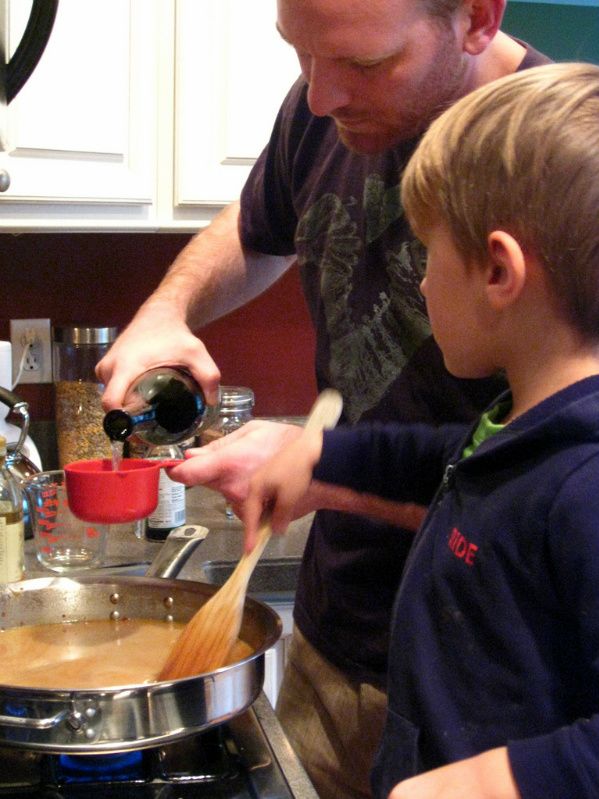
It’s easier to cook when kids aren’t in the way. Bubbling pots and sharp knives, after all, are hardly child-friendly. But the kitchen shouldn’t be off-limits to kids.

Yes, dinner takes longer to make when Mason snips the cilantro to shreds and Sophie reads the recipe out loud. And you’ve got places to go — probably places to take your darling children, like T-ball practice or that great science program at the museum.

But how much, really, do our beloved kids benefit from a steady schedule of, well, scheduled activities? Those educational, adult-led activities may very well be counterproductive. We tend to forget that ordinary things like cooking together are flexible, hands-on, purposeful learning experiences.

As they snip, read, and converse with us, our kids are learning physical, mental, and social skills. Here’s how cooking can be educational for them.

Mirror neurons. Even a baby in an infant seat benefits from time in the kitchen. She pays attention to your actions. She’s delighted when you talk to her and show her what you’re doing. Due to mirror neurons in our brains, all of us mentally duplicate actions and emotions we see. This inborn way of learning means that we’re continually participating in what we observe. Your baby’s mirror neurons allow her to vicariously experience what you’re doing. As she sees you wash, peel, and cut carrots, she’ll form a mental template for that task, essentially allowing her to practice in advance.

If you change an element of that familiar activity — perhaps by using garden-fresh carrots with long waving fronds instead of milled carrots from a plastic bag — your little one will pay heightened attention. If your knife slips and you cut yourself, she’ll react to your surprise and pain, making her understanding of sharp implements more real than any warning might accomplish.

Meaning. Young children clamor to be included. When a preschooler begs to help prepare dinner, he doesn’t want to play with a toy cooking set; he wants to participate in the real work that’s taking place. It slows us down to let him cut fresh mushrooms with a butter knife (and restraint to avoid criticizing or re-cutting), but your child recognizes his contribution toward dinner. He’s also more likely to eat it.

Responsibility. Research has shown that children who participated in household tasks starting at age three or four were more likely to succeed in adulthood. I’m talking really succeed: educational completion, career success, and good relationships with family and friends. Even I.Q. scores had a weaker correlation with success than giving children early responsibilities. And waiting until children were older tends to backfire. We spend much time and money on enriching activities and products for our children, but if they don’t get the chance to take on real responsibilities, we’re depriving them of key components of adult competency.

Higher-level learning. Kitchen-related tasks allow kids to learn more than how dry pinto beans can transform into enticingly tasty refried beans. Kids begin to see scientific principles at work. They develop personal qualities such as patience. They are motivated to apply what they’re learning to more challenging endeavors. Sure, it doesn’t hurt to know what it takes to grow the tomatoes, make the sauce, and prepare the beans for tonight’s enchiladas. But more importantly, as children become proficient in the kitchen, they also see themselves as capable learners. That perception transfers across all endeavors. 

Sensory learning. Full sensory learning has staying power. Apart from nature, it’s hard to find a more sensory-rich environment than the kitchen. As your child’s little fingers crumble blue cheese into dressing, add raisins to a measuring cup, or tear mint leaves for chutney, the tactile and olfactory pleasure help encode specific memories. Perhaps the happiness your daughter feels making mint chutney with you today will be evoked each time she smells mint in the future. We humans must see, hear, smell, touch, and, yes, taste to form the complex associations that make up true comprehension.

Active learning. Childhood is a period of major neuroplasticity, when learning actually changes the brain’s functional anatomy. Hands-on experiences are particularly vital at this time. In fact, the child who spends plenty of time with manipulatives (arranging veggie on a platter, sifting flour, washing silverware) and using real-world math (measuring ingredients, counting celery stalks, following recipes) has a strong foundation of representational experience, which in turn enables better understanding of abstract mathematical concepts. These movement-oriented activities also contribute to reading readiness. Another benefit of kitchen learning? Cooking and tasting the results a short time later provides wonderful lessons in cause and effect.

Simplicity. Children accustomed to blinking, beeping toys and rapidly changing screen images may become so wired to this overstimulation that without it, they’re bored. The slower pace of kitchen conversation and cooking tasks can be an important antidote, especially when we’re willing to go at a child’s pace. Young children tend to balk when they’re hurried. They show us, stubbornly and often loudly, that there’s nothing more important to them than the here and now. So whenever possible, simplify so you can make your time together in the kitchen enjoyable. Slowing down is better for digestion, concentration, and overall happiness. Letting a small child spread his own peanut butter, cut his own sandwich, and pour milk from a tiny pitcher into his cup is a way of affirming the value of the present moment. It also makes for an effortless tea party.

Skill building. There’s no denying that children who help out in the kitchen pick up useful skills. They learn that a cake takes lots of mixing, but muffins very little. They can set the table, toss a salad, make a sandwich, and boil pasta. Not right away, but eventually. They also learn from the examples we show them, such as how to handle pressure and ways to learn from mistakes. Whether we’re four years old or 40 years old, gaining competency feels good. It doesn’t hurt to give credit where it’s due. So if your child has been busy peeling potatoes and crumbling bacon, try renaming the entrée “Max’s special potato soup” for extra reinforcement.

Purpose. When we prepare a family meal, bake a cake to celebrate a friend’s good news, or change a favorite recipe to accommodate Grandpa’s diabetes, our efforts have noticeable value. As our children participate along with us, they feel that same satisfaction. So many educational tasks put before our children serve no purpose other than to instruct. But when learning is connected to something truly purposeful, it can’t help but spark enthusiasm. Children feel honored to be included in real work that includes real challenges. If we pay attention, we’ll see that’s just what they pretend to do when they play.

kids help in the kitchen, how kids can cook, preschoolers help in kitchen,

flickr.com/photos/limevelyn

Getting Started

Even toddlers can help. Let small children cut mushrooms, pears, bananas, and other soft items with a blunt knife. Encourage them to stir (as long as you or they hold the bowl). They’ll be happy to add ingredients, tear lettuces, and grate cheese. When putting together forgiving dishes like soups or casseroles, have them help you choose herbs and spices by smell before you toss in a pinch or two.

Encourage your small fry to wash unbreakable items in a sink of warm soapy water. Let them clean up crumbs on the floor with a small whisk broom or handheld vacuum. Put them in charge of setting out napkins on the table and calling family members to dinner.

Give them the job of stacking unbreakable containers in a low cabinet. Solicit their opinions on aroma, taste, and appearance as you cook together. And remember to thank them for their assistance.

As they get older, children can read recipes, plan meals, and do nearly every task required to make the dishes they enjoy. The time will come when they won’t want you in the room explaining how to fix a lumpy cream sauce or talking about how Nana always mixed pastry dough with her fingers. They’re on their way to making the kitchen a proving ground for their own culinary adventures. Hopefully you’ll be invited to taste-test while you relax for a change.

Parking the kids in front of the TV while we dash to get dinner ready may be efficient, but it’s not the way young people have matured throughout human history. Children need to watch, imitate, and gain useful skills. They’re drawn to see how their elders handle a crisis, fix a car, create a soufflé, build a bookshelf, heal what’s broken, and fall in love.

So welcome your little ones into the kitchen. Let the cooking begin.


First published in Culinate.com