7 Ways To Make Your Day More Magical

try on new identity, pretend to be someone else,

Creative Commons image Flickr photostream of Estadão.com.br

1. Head off to an interesting destination with your family or friends for an Alternative Identity Day. On the way, everyone makes up his or her own identity. Throughout the day make an effort to play along with that identity: call each other by the chosen faux names, enjoy elaborating on your character’s backstory, and interact with strangers through that identity. At the end of the experiment talk about how it felt to try on an alternative self. And if you’ve taken photos, check to see if anyone held their faces or bodies differently. The sense of observing yourself from the lens of another persona can be illuminating.

toast, ritual of the toast, make today significant, make today magical,

Wikimedia Commons

2. Start your meal with a toast. It may be as simple as raising your glass of orange juice in the morning, saying “Here’s to a wonderful day ahead.” Or as heartfelt as an unexpected toast to a friend in thanks for all you’ve shared. A toast is a ritual for adding significance to the moment. Why not make more moments significant?

Creative Commons image from Flickr photostream of Gj IMAGEWORKS

3. Don’t let a day go by without generating some music. You might sing along with the radio or whistle to make a chore go faster. If you play an instrument, even if you haven’t practiced in a long time, get it out (suspending all judgment) and get reacquainted. If you’ve always hankered to play an instrument but never tried, sign up for some introductory lessons.

An easy way to incorporate music into your life is to make up lyrics to familiar tunes. This is particularly satisfying when you’re annoyed. (Whoever passed down the traditional “Rock A Bye Baby” lullaby knew that grumpy lyrics go quite nicely with a sweet tune.) To the tune of “Row, Row, Row, Your Boat” try singing,

Wait, wait, wait on hold
Till I want to scream
Knowing from experience
Service is a dream.
 

See what other experiences you can transform using music.



encouraging banner,

Image: L. Weldon

4. Make an encouraging banner. This project was inspired by the collaborative art project Learning To Love You More. Assignment number 63 was to make an encouraging banner and hang it.  Participants hung banners in their bedrooms, across overpasses, in junkyards, alongside roadways, in parking lots—all over the place. In all sorts of colors and shapes their banners announced:

Don’t forget you are beautiful
It’s okay to ask for help
Life is art
Let’s hear it for love
Lose track of “I”
This is the land of milk & honey
You are incomparable
Less do, more be
You can trust what you can’t explain
Farm magic
 

What phrase gives you hope? Make a banner, either one you plan to hang in your home or to share with the public. You might want to photograph it in various places. The phrase you love comes alive in different settings.

treehouse, what you wanted as a child,

Creative Commons image from Flickr photostream of Karen Roe

5. Sketch something you wanted as a child. The perfect treehouse, a fairy godmother, that toy Santa never brought, a first place trophy, a real best friend. Maybe make a few sketches to get the details just the way you want them. Add some labels if that helps. Now close your eyes, imagine yourself as a child, and give this earlier version of yourself that gift. You may scoff but the disappointed child in you just might appreciate the attention.
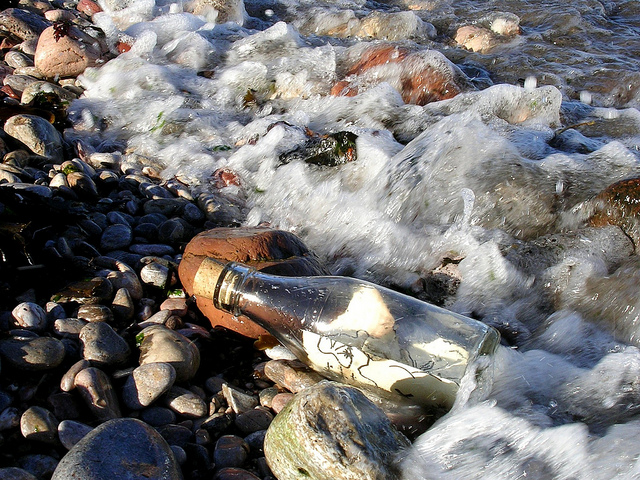
Creative Commons image from Flickr photostream of Tomorrow Never Knows

6. Look for metaphors in the ordinary. Challenge yourself to discern a “message” in the first news item you hear in the day or the first visual that appears when you flick on the TV. Ask yourself why a certain song is playing in your head—does it remind you of something, perhaps a feeling or memory the music evokes? Ask yourself why you might have a certain ache, is your body is speaking to you the only way it can? Look for coincidences, synchronicity, and little delights—these can be signposts indicating you are exactly where you need to be.

In particular, pay attention to the messages found in your dreams. Before going to sleep tell yourself that you will remember your dreams. You may want to ask a question before drifting off. When you wake, don’t jump right out of bed. Instead lie quietly and let dreams rise to your awareness. Although their images and stories often make no logical sense dreams speak in symbols with meaning specific to you. Let those symbols linger with you through the day. Even last night’s giant parking meters demanding soup may start to make sense, metaphorically speaking.

eyebombing, fun with googly eyes,

Creative Commons image from Flickr photostream of katerha

7. Heard of eyebombing? Very simply, it’s the act of putting sticky googly eyes on inanimate objects. As described on eyebombing.com, “Ultimately the goal is to humanize the streets, and bring sunshine to people passing by.”

This is an inexpensive and intentionally silly exercise.  Buy a package or two of googly eyes and start looking for where they belong. For inspiration, check out the eyebombing flickr group.  Then enjoy your quest.  Anthropomorphizing a mustard bottle never seemed so right.

 

Fun Theory

I’m not aware of any official Fun Theory in the field of learning. But fun shimmers under the surface of motivation and focus like a very big fish. And the fish named Fun shouldn’t be ignored.

I lifted the term Fun Theory from an old Volkswagen campaign. One of their videos shows busy commuters choosing an escalator instead of a staircase. People are rarely motivated to do otherwise. But when the same stairs were transformed into a giant electronic piano sixty-six percent more people chose to hop, dance and run up those musical steps. Fun works. (It also sends the Volkswagen logo around the world in a great example of viral marketing.)

It’s no surprise that pleasure is motivating, although what one person finds enjoyable may not be remotely engaging for the next person.

That’s the key. Fun is highly individual. It can’t be easily pre-packaged, even though promoters of textbooks, curricula, and enrichment programs assert their products do just that.

You can tell when educational materials and experiences don’t engage the young people in your life. They exhibit, shall we say, obvious symptoms. I won’t list them here. These symptoms tend to cause us all kinds of angst.

A child’s stubborn insistence that learning be meaningful and interesting is actually a sign of positive selfhood. We need to pay close attention to each child to really see what sparks enthusiasm, evokes awe, sharpens focus, builds on interests, and challenges abilities. That’s what advances learning.

The elements that make an activity or interest compelling for any one person can’t be neatly summed up, nor should they. A person is too complex to reduce to a List of Handy Motivators. But you might want to consider such factors if you’d like to understand why your child prefers to do things his or her way, or why some enriching activities “work” and others don’t. Below you’ll find brief notes about some of the factors that make learning intrinsically pleasurable and interesting. Think of your child as you read over the list. Think of yourself too. You’ll recognize many unique ways that lively, engaged learning happens quite naturally.

                Trial and Error 

Learning is fun when errors don’t feel like failures. Watch a group of friends figure out what tools and design elements they’ll use to make bracelets from a cast-off metal objects. Their initial results will likely be both positive and negative. Their mistakes will help to guide and refine their progress. Thomas Edison said of trial and error, “Results! Why man, I have gotten a lot of results. I know several thousand things that won’t work.”

When your child is building a fort out of branches she may experiment with several approaches. This open-ended process allows her to repeat successes and learn from errors, getting ever closer to the desired result. Trial and error often pulls the learner forward to greater mastery. It’s also tremendously enjoyable.

                 Meaning  

Full engagement in any pursuit that is meaningful to the individual may not sound like a prescription for fun. But it is, because it tends to lead to what is called flow:  a sense of focusing so fully that we lose sense of time, discomfort, even self.

Artists and athletes aren’t the only ones who experience flow, children easily merge into this state. A child may experience flow while engaging in make-believe, drawing, swinging on a backyard swing, playing the guitar, fixing a bicycle, even organizing a shelf.

You may not be able to predict what has meaning for your child, but chances are it fuels learning. Your daughter’s fascination with horses may lead her to equine-related mathematics, history and science. Her learning is enlivened with wonder and purpose. That absorption is also fun.

                Discovery/Exploration    

Discovery is highly motivating and feels quite a bit like fun. It lures babies to put everything into their mouths. It propels us to try new music, peer around forbidden corners, travel to distant places.

When a friend brings up an obscure bit of information, your preteen may check it out later only to find an unexpectedly engaging exploration through subjects that never interested her before. Or perhaps your son’s curiosity is piqued by a new venture he wants to try like making homemade cheese. The project opens up to ever wider explorations such as homesteading skills, the claims of raw milk advocates, and recipes using artisan cheeses. For most of us independent discovery has the greatest allure.

                Novelty

What is new and unexpected heightens attention and activates all kinds of interest. That’s why marketers are constantly coming out with newer versions of the same thing. Novelty leads readily to exploration or play. By itself, novelty wears off quickly. (Those commuters will tire of the musical stairs and probably go back to using the escalator.)

You can rely on something new to stimulate interest. Just remember that too much reliance on novelty doesn’t help children build their own deeper resources of attention and interest.

                Play

Play isn’t “just” for fun. It’s an essential component of learning. Stuart Brown, author of Play: How It Shapes the Brain, Opens the Imagination, and Invigorates the Soul said in an interview, “…evidence continues to accumulate that the learning of emotional control, social competency, personal resiliency and continuing curiosity plus other life benefits accrue largely through rich developmentally appropriate play experiences.”  Unstructured free play is particularly important. We already know it’s fun.

                Direct Experience

Hands-on efforts make learning come alive with pleasure and satisfaction. Frank R. Wilson notes in  The Hand: How Its Use Shapes the Brain, Language, and Human Culture that brain and hand use have always been connected. When a young child is put in charge of preparing vegetables for a stir fry dinner his efforts may not be entirely helpful, but the sensory experience of washing, chopping, and tasting offer him much more than growing competence in meal preparation. The sensory experiences enhance comprehension and lock in learning. When a child expresses interest in puppetry she may want the opportunity to make puppets, stage puppet shows, and go to puppet guild meetings. The more fully involved a child can be the more direct (and lasting) his or her learning will be.
                Challenge 

Challenges are fun as well as educational because they keep us right at the edge of our competence, pushing us on to the next level (exactly why video games are so compelling). A ten-year-old may enjoy the logical challenge of debating his older brother, the practical difficulties of planning and filming his own scary movie, the physical and social risks of showing off at the skating rink. These self-selected activities push him to advance a whole range of abilities. Challenges keep us too absorbed to grin but for our own good reasons.

There are plenty of other “fun in learning” factors such as relationship development, collaboration, sensory pleasure—surely you can think of more. All these elements are intertwined so completely that they only make sense when we see them as connected.

I think that’s why we need to pay attention to what’s fun about learning. Yes it’s different for each person. But what’s universal is that each of us is capable of fascination, excitement, and wonder. Why fish around for methods to motivate and sustain a child’s attention when joy is right there, showing us the way?

Portions of this post excerpted from Free Range Learning.

Don’t Say It, Draw It: Non-Threatening Sketching Inspirations

Quick, draw something important to you. Try to do it in five minutes or less.

Is it an object, a person, an idea, a goal, a value, or something else entirely?

drawing to explore feelings, drawing as meditation,

Image courtesy of jhannah42590.deviantart.com

Those of us who don’t draw often (or ever) may be uncomfortable taking pencil in hand to create an image. But if we draw something without criticizing, erasing, and apologizing for the result we find that the process itself pulls us out of our habitual patterns of thinking. Like a form of meditation, sketching can take us to a still point in ourselves.

We may rely heavy on the written word throughout the day but our species used images long, long before formalized symbols such as words. Images are much more primary. When we generate those images we’re going deeper, beyond the chatter and clamor of daily life.

drawing for non-artists, why we draw,

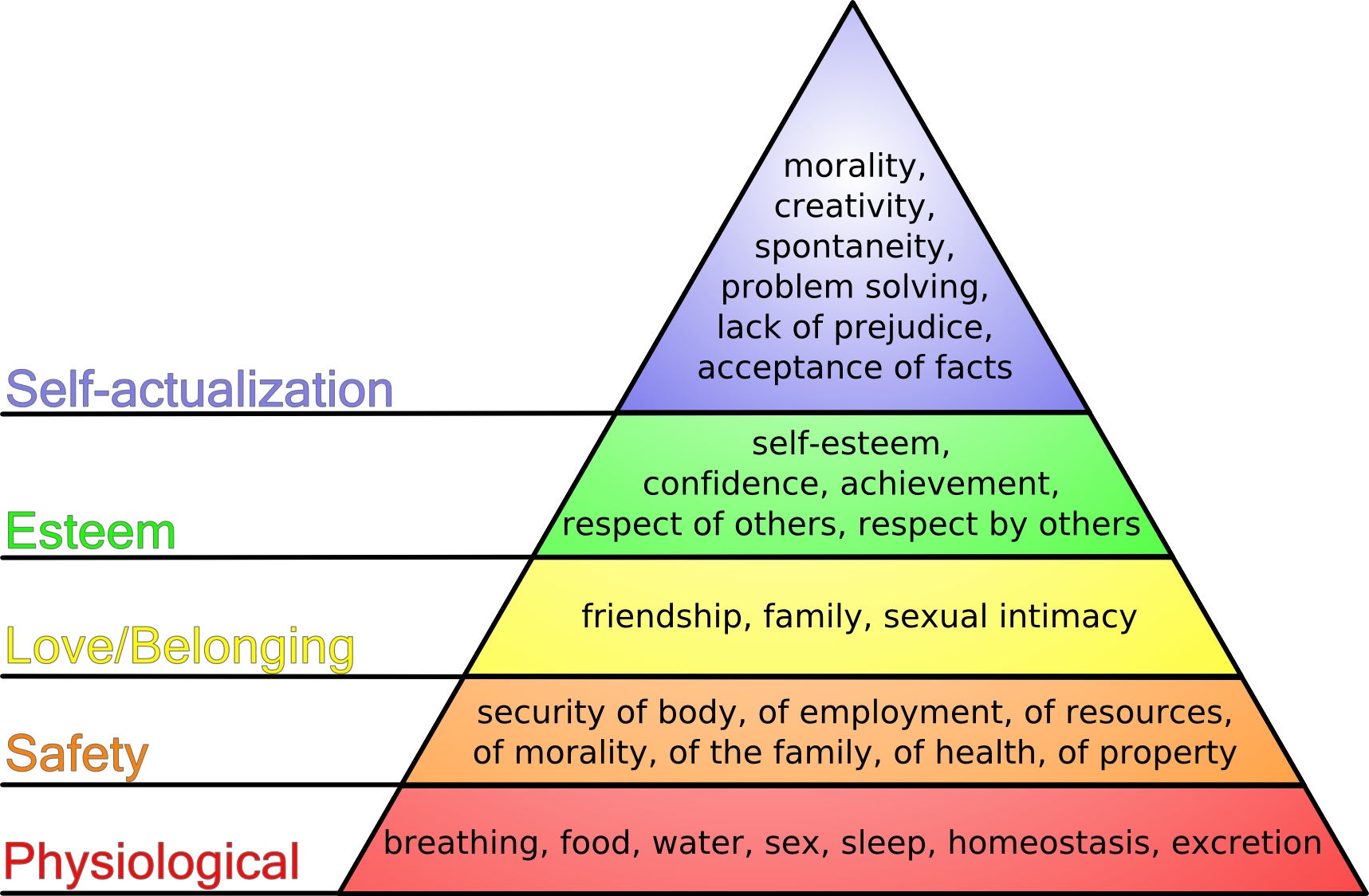
Back in college I was assigned a psychology class project. It was supposed to demonstrate Maslow’s hierarchy of needs. Maslow insisted that most people are focused on basic needs, fewer are able to move up to higher level needs, and the rarest make it to what he called self-actualization.

I designed my project to be simple and get me a good grade. I also hoped that it would disprove Maslow just a bit. I had nothing against the guy, I’m just not fond of stuffing people in categories. And besides, I already I knew people whose most basic needs were barely met, but were damn close to the top of the scale. They not only cared deeply but consistently reached out to help others. Or they worked tirelessly for a greater good without ever seeking acclaim. Or they lived creatively and according to their own unique vision, inspiring others by example.

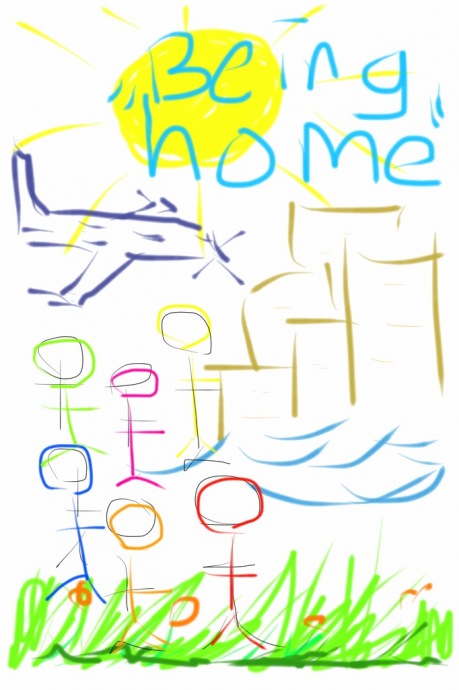
My project was easy. I asked people to make a quick sketch of something important to them. I asked college students, people on the bus, neighbors, strangers in coffee shops, college professors. Invariably they insisted they couldn’t draw. (Neither can I.) At least a third of the people I asked turned me down. Drawing is apparently pretty threatening. Or short blonde college students are, not sure which. But those who did participate created pretty interesting results. I got the expected number of humorous liquor and sex-related drawings from guys, shopping and chocolate drawings from girls. (These were hardly character-defining, after all, it was a spur-of-the-moment request.)

Many more drawings focused on subjects like family, educational goals (probably related to the preponderance of college students in my project), and activities of all kinds.

A surprising number of people drew something less tangible. Love, compassion, happiness, making a difference, God, higher consciousness. These were represented by abstract drawings or symbols.

The majority of people weren’t content to let the images speak for themselves. They also used words. They added labels, explanations, entire sentences—seeking to make their meaning clear.

Back then, I presented my project as evidence that Maslow’s hierarchy wasn’t proof positive that we’re all pedaling along on different tracks. I postulated that we operate across many levels depending on all sorts of variables. That assertion annoyed my professor, who was not amused by a student who dared question an icon in the field and who did so in a paper filled with drawings. He wrote nasty remarks all over my paper (right over the drawings I collected) even though I closed with a lovely quote by Maslow.

“The concept of creativeness and the concept of the healthy, self-actualizing, fully human person seem to be coming closer and closer together, and may perhaps turn out to be the same thing.” Abraham Maslow

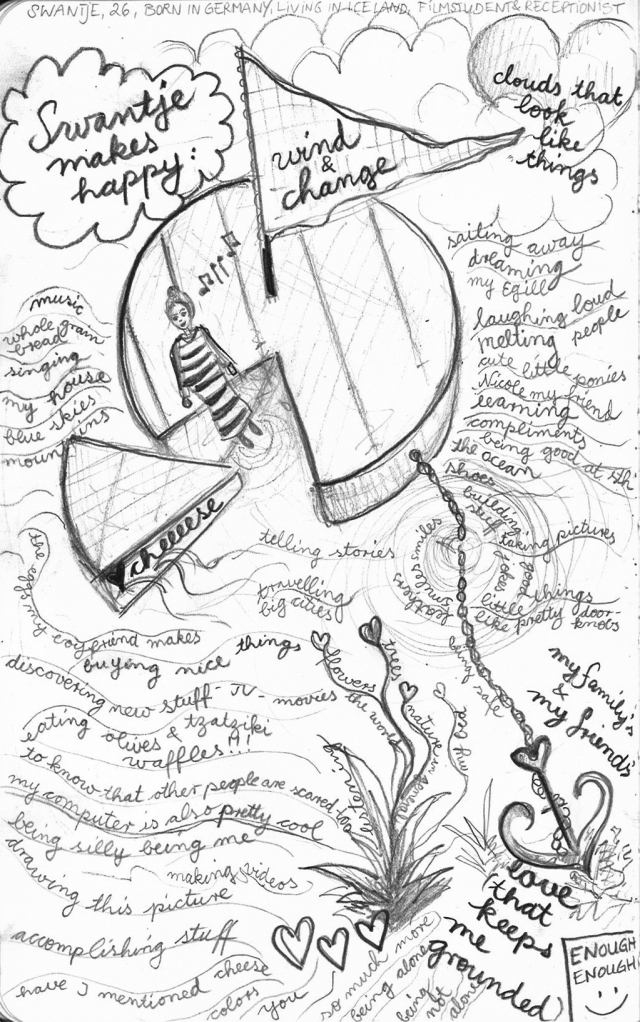
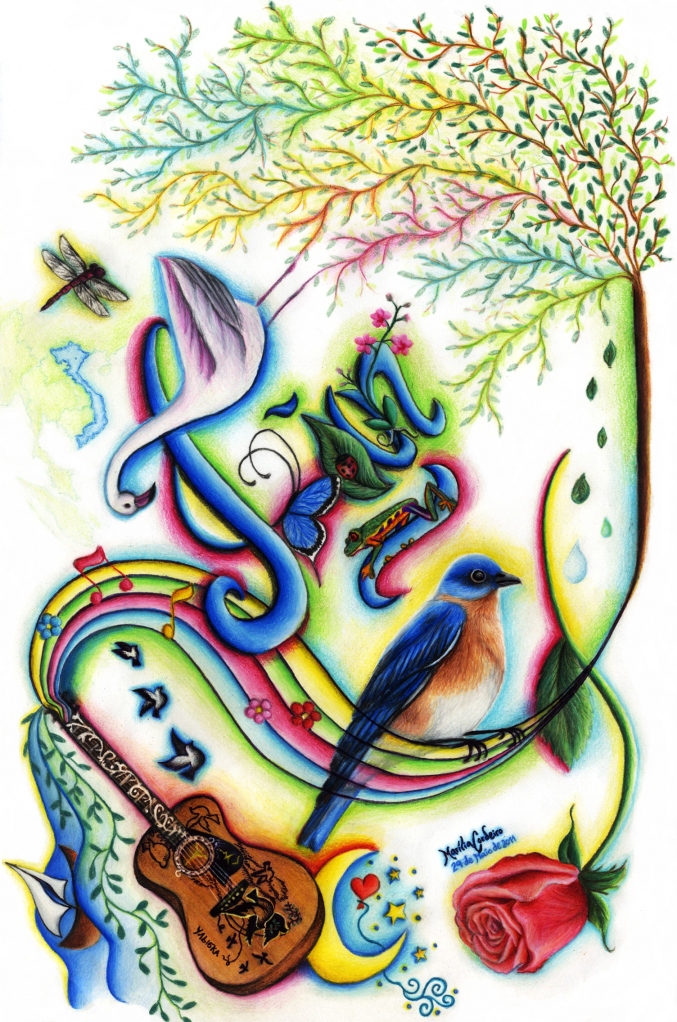
The range of images drawn for my college paper were very similar to those collected in a project by Catherine Young for the Schoolof Visual Arts MFA Interaction Design Program. Catherine explored how people around the world represent what makes them happy.  The response to Draw Happy  was so great that the project remains ongoing, with hundreds of participant’s drawings.

Canada drawhappy.wordpress.com

Germany drawhappy.wordpress.com

Portugal drawhappy.wordpress.com

I have no beef with Maslow. But I’m still interested in what drawing does for us as whole beings. Those of us who aren’t artists might consider drawing as an unexplored avenue. Down this particular road are new ways to express ourselves, expand our creativity, and take a break from our relentless multitasking.

I harbor fantasies of indulging in illustrated journals and like to pore over an enticing selection of books on the topic but the fact is, I don’t even write in a journal. And my vows of sitting down to sketch at least once a week have never taken hold.

But there are much easier ways to spur ourselves to draw.

How can you add some non-threatening sketch time to your life?

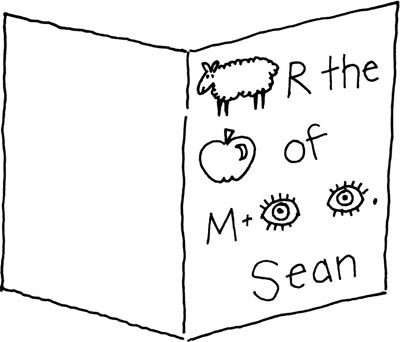
Draw rebus pictures     Chances are you don’t write to-do lists out by hand. And most people text rather than write notes (let alone postcards). Try this. Occasionally write these things longhand using rebus pictures. You’ll inject some personality in a fun, cartoonish way. Rebus, if you don’t remember from preschool, are simple pictures used to replace words. Even a quickly rendered image is pretty easy to recognize.

tlc.howstuffworks.com


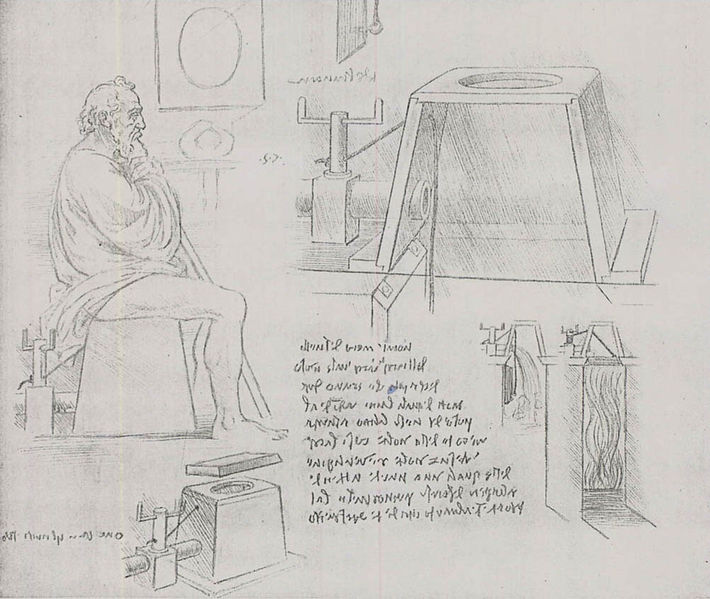
Draw studies     Keep a supply of blank note cards or a tiny sketchbook for this project. You might choose to draw only saltshakers, or lamps, or shoes. DaVinci did all sorts of studies of this sort. He drew page after page of noses, bird’s wings, running water. This is a daydreamy exercise that invites you to find all sorts of nuances in your subject. You may not only become proficient in drawing saltshakers, but may notice saltshakers wherever you go.

drawing as self-discovery,

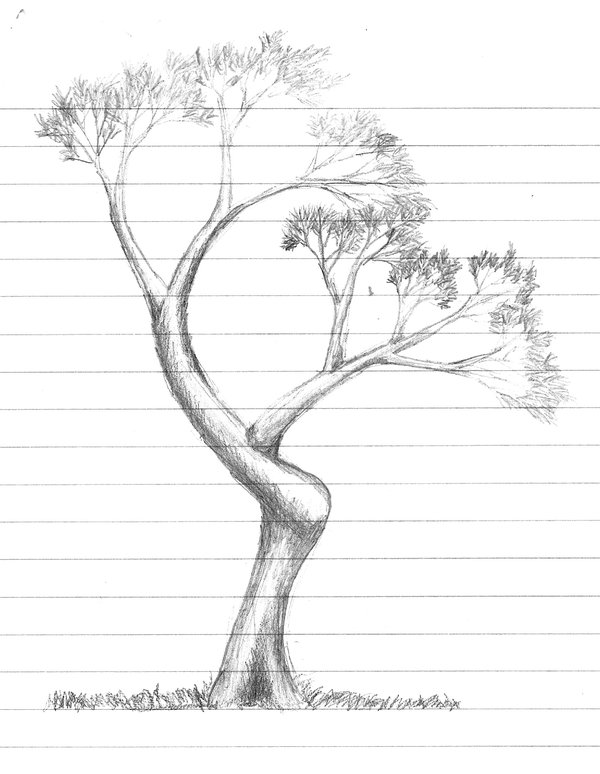
Draw the same thing repeatedly     Draw something you regularly encounter. Draw the tree in your back yard as it appears in different seasons and times of day. Draw that souvenir bottle on your windowsill–in light and shadow, surrounded by clutter, filled with flowers. Draw the same scene over and over from different angles, as it might have appeared a hundred years ago, as it might look to a creature that sees only in temperature, or from a worm’s eye view.

drawing to release stress,

autumnwhisper.deviantart.com

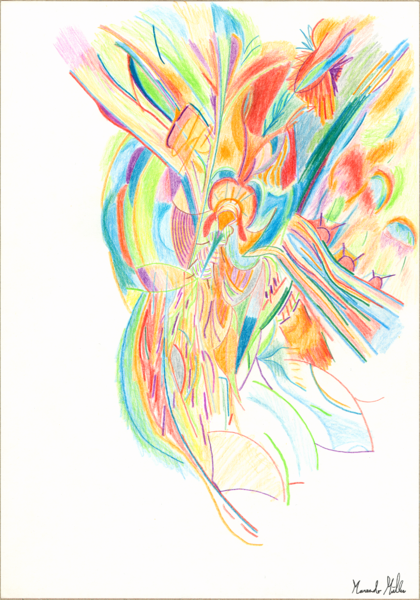
Draw your feelings     We don’t have a lot of creative outlets to express reactions to bad news, personal disappointments, big changes, grief, haunting regrets. Our feelings don’t go away while surfing the net. Whip out some colored pencils to illustrate your fervent opinion in satisfyingly jagged lines. Render your angst in exactly the right shade of gray, magenta, and orange. Or pull together your fractured ideals in a twisting vine that reaches across a wall you’ve drawn brick by brick. Chances are your mood will lift. Drawing might just empower you to take bolder action.

sketch your way to peace,

Marendo Müller

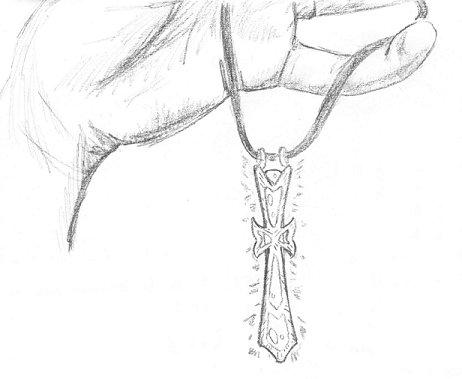
Draw on memories     The past continually inhabits the present. Try bringing it forth non-verbally by sketching it. Draw a favorite toy from childhood, the necklace your mother used to wear every day, your view of the chalkboard back in fifth grade, the door of your first apartment. You’ll be surprised what these drawings evoke.

drawing memories, drawing feelings,

molicalynden.deviantart.com

Draw abstractly     Take away the burden of recreating representational images. Draw a favorite smell, a new idea, a mood, a strong impression left when waking from a dream already forgotten, a taste, a laugh.

sketch your way to relaxation

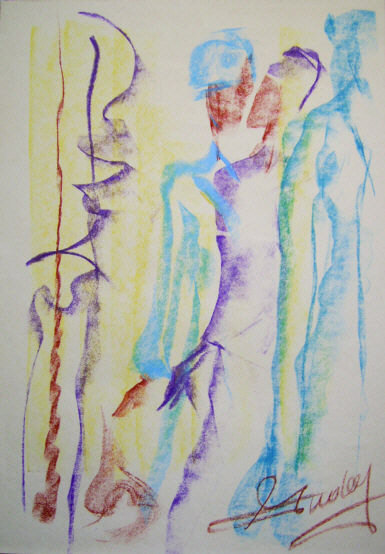
Alfons Anders “Begegnung”

Doodle  Doodling is great practice for those of us who don’t want to call what we’re doing “drawing.”  And this non-directed activity is a great way to allow your brain to idle while creative impulses emerge.

“A drawing is simply a line going for a walk.”  Paul Klee

Resources

Drawing Lab for Mixed-Media Artists: 52 Creative Exercises to Make Drawing Fun

Keeping a Nature Journal: Discover a Whole New Way of Seeing the World Around You

The Creative License: Giving Yourself Permission to Be The Artist You Truly Are

16 Ways To Spark Creativity

how to be creative,

1. Get out of your head and back to your senses. Touch, smell, and taste. Reach out and feel the texture of bricks as you walk by a building. Forgo utensils to eat with your hands. Notice the sensation of cool water sliding down your throat as you drink. Be in your body.

2. Avoid your playlist. Listen to music from a genre or part of the world completely unfamiliar to you. Music is a language more evocative than speech.

spark your creativity,

3. Better yet, try silence. The constant presence of media playing in our homes, cars, and public places dulls the essential connection we have to our inner selves.

eliminate blocks to productivity,

4. List your aggravations. Highlight the ones you have control over. Cross out the ones you don’t have control over. It’s a smaller list now isn’t it? Once you stop fretting so much you have energy for more generative pursuits.

why you should doodle,

5. Doodle. What seems like an aimless activity is a great way to allow your brain to idle while creative impulses emerge. And the doodles themselves may tell you something.

fun is good for your brain,

6. Play. We function best mentally and physically when we indulge in the free form fun sort of play that calls on us to improvise, move, and laugh. If you’ve forgotten how, consult a three-year-old.

Mateo Inurria: Daydream

7. Welcome daydreams, they fuel our creative lives.

Familia

8. Seek metaphors. Challenge yourself to discern a “message” in the first billboard you see, first sentence you hear when you turn on music, or first visual that appears when you flick on the TV.

Margret Hofheinz-Döring/ Galerie Brigitte Mauch Göppingen

9. Listen to your dreams. Before falling asleep, ask for a dream message. Remind yourself to remember the dream. As you waken, pull the threads of your dream into your conscious awareness and let it inform your day.

“Sprich! Ich höre Dir zu”

10. Imagine your own burning questions are being asked of you by someone you love dearly. Then answer as if you’re talking to that person. Your responses tend to be more wide open, innovative, and kind when responding to someone you love, much narrower within your own “self-talk.”

spark your creativity,

11. Keep creative thinking notebooks, as da Vinci did. Use them to make quick sketches and doodles, note ideas, write observations, free associate, draw mindmaps, and keep track of your inspirations.

creativity exercises,

Bjørn Christian Tørrissen

12. View issues from all angles. Don’t accept what you’re told or think what you’re expected to think.

Danny Gregory

13. Don’t wait till you have more time or life gets easier. Cultivate a passion that has been dormant too long. Pick up that paintbrush, practice your guitar, try out for that play, take those glassblowing classes, learn to sail. For inspiration, take a look at Everyday Matters. Author Danny Gregory’s wife became paralyzed in an accident. While caring for her and their infant son, Gregory decided to start drawing. His study of color, value, and ordinary beauty helped to heal their family too. And you don’t want to miss his extraordinary new book, Art Before Breakfast: A Zillion Ways to be More Creative No Matter How Busy You Are.

teach yourself to be more creative,

14. Make an effort to connect regularly with something in nature. Watch the same tree as it changes throughout the seasons, pay attention to a body of water in different weather conditions, take an evening walk (no matter the temperature) each time there’s full moon.

Mary Barnes

15. Cultivate flow, what’s also called being “in the zone.” That’s the feeling of being fully absorbed in your activity. Time is irrelevant, in fact you may feel at one with the project whether it’s sailing, gardening, sculpting, composing, or welding.

16. Do something unusual (for you) every day. Try an unfamiliar food, drive a different route, make up your own lyrics to a song, compliment a stranger, make a unique board game out of an old one, laugh off an irritation, use a new word three different times, lie in the grass, write affirmations on your underwear, leave encouraging notes in books, compose an anti-thank you letter, go on a media fast, use binoculars, chew every bite ten times, do somersaults.

There is a vitality, a life force, an energy, a quickening that is translated through you into action, and because there is only one of you in all of time, this expression is unique. And if you block it, it will never exist through any other medium and it will be lost. The world will not have it. It is not your business to determine how good it is nor how valuable nor how it compares with other expressions. It is your business to keep it yours clearly and directly, to keep the channel open. You do not even have to believe in yourself or your work. You have to keep yourself open and aware to the urges that motivate you. Keep the channel open.       -Martha Graham

The Youngest Have The Oldest Way Of Knowing

children as deep ecologists, seeing people as animals, older ways of wisdom, living the Gaia theory,

itallant.deviantart.com

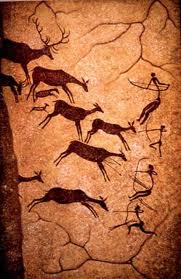
I had a translation problem when I was very small. Like any other reasonable preschooler, I knew full well that people had names just as I had a name. But I saw people’s faces as having their own animal faces too. I wasn’t sure why everyone else couldn’t see this. Many of the animals I saw flickering right under the surface of outward human appearances were creatures I didn’t recognize. Some kind of deer or antelope on one face, an unusual hound on another. This was fascinating and distracting. It also meant I had to translate in my head from what I saw as a person’s animal identity into their given name. I never slipped, never called my kindergarten teacher a hawk or referred to the boy down the street as a dolphin. I was polite enough to realize this would have been rude, although I couldn’t understand why animals were so much lower on the scale of importance.  I grew out of it by the time I was five or six.

I’m probably making my childhood self sound like a complete ninny. (And I’m still a ninny in other ways.) But I still remember “seeing” animal identities in people.

Young children have a very creative sense of reality. That’s exactly the way they’re supposed to be. Adults may teach children that the night’s dreams have nothing to do with the next day, that the wind doesn’t have a voice, that a beloved toy can’t feel their adoration. Still, children know what they experience. They sense potent meaning in everything.

We forget that human-centered reasoning is a cultural thing. A recent study compared children who live in direct contact with nature to urban children who have somewhat limited contact with the natural world. Researchers found striking differences in outlook. Children who are raised close to nature, and who are sensitive to certain beliefs, are more likely to call animal communication talking and to see water as alive. They seem to grasp what ecophilosopher Arne Naess termed deep ecology. The deep ecology worldview recognizes the intrinsic value of all beings and the complex interdependence of all natural systems.

This affirms what our species long understood and only recently forgot. We are inextricably connected to the natural world for sustenance, meaning, learning, and perhaps most intimately, for our sense of self. Looking at the whole swath of human existence, we are barely out of the hunter-gatherer era. Each of us is tuned to nature’s wavelength. Yet we conduct our lives as if we are separate. The youngest children among us may sense how wrong this is.

In one of the last books by ecologist Paul Shepard, Nature and Madness, he speculates that what ails civilization is a kind of arrested development. From birth each of us is cued toward greater wholeness through deep interconnection with one another and the natural world.  We require elders who understand this and guide us. But these days, Shepard writes, we’re not likely to grow to maturity in this way.
“Adults, weaned to the wrong music, cut short from their own potential, are not the best of mentors. The problem may be more difficult to understand than to solve. Beneath the veneer of civilization, in the trite phrase of humanism, lies not the barbarian and the animal, but the human in us who knows what is right and necessary for becoming fully human: birth in gentle surroundings, a rich nonhuman environment, juvenile tasks with simple tools, the discipline of natural history, play at being animals, the expressive arts of receiving food as a spiritual gift rather than as a product, the cultivation of metaphorical significance of natural phenomena of all kinds, clan membership and small-group life, and the profound claims and liberation of ritual initiation and subsequent stages of adult mentorship. There is a secret person undamaged in each of us, aware of the validity of these conditions, sensitive to their right moments in our lives.”

I think we can still raise children this way, pushing back against our rushed and fragmented world. More and more people seek natural birth, attachment parenting, child rearing balanced between freedom and responsibility, and free range learning. Nature-based living isn’t out of the equation, no matter where we live. It is restorative to spend time in wild places, but it takes only a shift in awareness to to immerse ourselves in nature wherever we are. As adults, we model for children how to treat all life with respect. In turn, children model for us many ways to find awe, metaphor, magic, and oneness in what we long ago learned to disregard. That is, if we pay attention.

Some might dispute that paying attention to such wonderment remains relevant in today’s world. Some may want to know what’s to be gained by dreams, imagination, watchfulness, and nature-centered thinking. Acknowledging the primacy of these wonders doesn’t point away from the path of achieving one’s potential. If we need an individual example, look to Lilian “Na’ia Alessa, a cell biologist who advances science by incorporating Western and traditional ways of knowing in her work.

Or wider examples. When psychologist Abraham Maslow developed his well-known hierarchy of needs he placed self-actualizers at the pinnacle. He defined such people as reaching “the full use and exploitation of talents, capacities, potentialities, etc.” Among those Maslow considered to be self-actualizers:  Spinoza, Goethe, Eleanor Roosevelt, Albert Schweitzer, Ralph Waldo Emerson and Joseph Haydn. These people didn’t “unlearn” older ways of knowing. In fact, the characteristics of self-actualizers sound quite a bit like children who aren’t limited to human-centered reasoning. Self-actualizers are spontaneous, they see things in fresh and often unconventional ways, they are interested in the unknown, they aren’t limited by other’s perceptions, they transcend cultural rigidity, and they feel compassion for all life. Some self-actualizers have what Maslow called “peak experiences.” A defining characteristic of a peak experience is a sense of unity with everything and everyone, a complete oneness. This too sounds like the children we’ve been discussing, those who haven’t yet been taught to stop seeing vibrant meaning around them.

So much is to be gained by a wider way of knowing. Let’s not unlearn all that we knew as children. Let’s see everything for what it can teach us. As poet Joy Harjo tells us, “Remember the plants, trees, animal life who all have their tribes, their families, their histories, too. Talk to them, listen to them. They are alive poems.”


Poetry Diet

struggling poet, making money as a poet, appreciating poets, life of a poet,

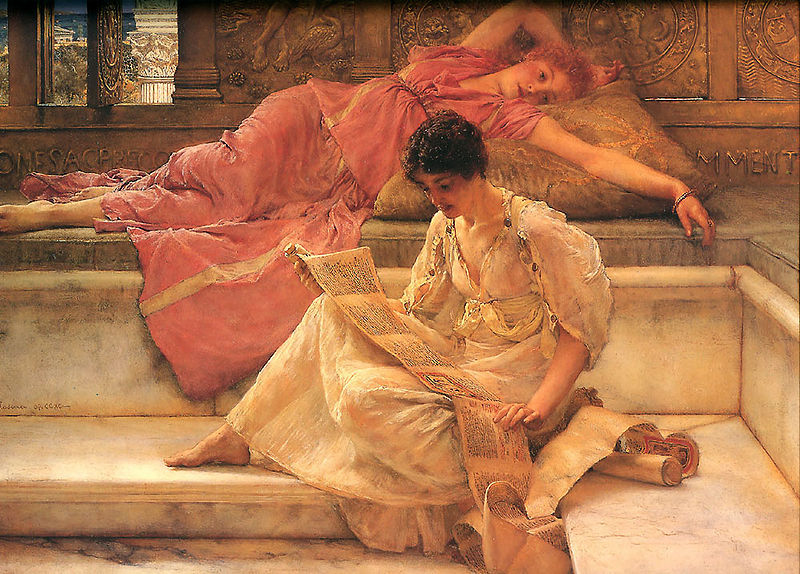
“Favourite Poete” by Lawrence Alma-Tadema

Poetry is thoughts that breathe, and words that burn.  ~Thomas Gray

The term Poetry Diet might imply a rare appetite. The sort of longing only appeased by words strung spare and stark, like a meal so desired that imagination keeps creating it anew.

Ink runs from the corners of my mouth
There is no happiness like mine.
I have been eating poetry.
~Mark Strand

Or Poetry Diet could imply hunger for that rare current some call inspiration, the elusive muse carrying phrases from ether to pen.

Everything in creation has its appointed painter or poet and remains in bondage like the princess in the fairy tale ’til its appropriate liberator comes to set it free.  ~Ralph Waldo Emerson

However in this case, what I’m calling the Poetry Diet is something much more mundane.  It simply means to eat nothing but what is purchased with money earned from one’s poetry. Reading, teaching, publishing, wearing them on your naked body, selling poems painted on scrap metal, whatever it takes. If I started a Poetry Diet now I’d be svelte in a week, thin rather soon. Before long, starving artist might be a literal (hah!) condition.

Surely a Poetry Diet would provide a vast incentive to write and, here’s the rub, send out one’s work. It could also leave the poet so imperiled that friends might stage a poetry reading to raise funds to feed the annoyingly hollow wordsmith.

Thus far I’m not dedicated or foolhardy enough to attempt a Poetry Diet. Mostly because I’m already trying to live by patching together the Essay Diet, Columnist Diet, and Editor Diet. But also because I know how long it takes from inspiration to paycheck. Right now I’m waiting for one of my poems to appear in Christian Science Monitor, two in Trillium Literary Journal, two more in J Journal. The total pay will amount to, well, let us not speak of actual numbers. I wouldn’t last long on the Poetry Diet. Surely that says something about the quality of my poetry but it also says something about our culture as well.

Poets aren’t very useful
Because they aren’t consumeful or very produceful.
~Ogden Nash

I hardly expect to live by poetry alone, although I have been sustained by the work of other poets in ways more vital than any meal. I long to see greater support for artists of all kinds. I have dear friends who devote their lives to perfecting a craft. They act, compose, weave, calligraph, paint, weld, invent, write, bake, work with wood, sing, and throw pots. They are driven to explore the intersection of art and cosmology, continually refining what it means to create. Yet most of them spend their days at jobs that are unrelated in order to survive. They wait tables or work in accounts receivable. Their real gifts emerge during precious hours plucked from mundane obligations.

It’s quite possible to attend a production at a local playhouse and see performances that shift the way you experience the world. You walk out a changed person for the extraordinary art you’ve enjoyed. Chances are that director, those actors, that playwright are unable to support themselves with their work, vital though it is.

I’m certainly not in league with those whose work is transformative. My poetry is about ordinary things like opening doors, moving stones, forgetting a name.

Perhaps I should head in a new direction—food poems. That way I’d feel nourished while contemplating the swirling curds and whey in the next batch of cheese I make. I’d also be answering Chesterton.

Poets have been mysteriously silent on the subject of cheese.  ~G.K. Chesterton