Observe The “Goldilocks Effect” In Action

 learning happens when it's "just right"

“Young children seem to recognize that knowledge is an essential shared resource, like air or water. They demand a fair share. They actively espouse the right to gain skill and comprehension in a way that’s necessary for them at the time. Often children seem to reject what they aren’t ready to learn, only to return to the same skill or concept later with ease. This is not only an expression of autonomy, it’s a clear indicator that each child is equipped with an learning guidance system of his or her own.”

I wrote these words two years ago in my book Free Range Learning. This concept is now being called the “Goldilocks effect.” According to a study published in the journal PLoS ONE, humans are cued to ignore information that is too simple or too complex. Instead we’re drawn to and best able learn from situations that are “just right.” It’s the educational equivalent of Goldilocks on a porridge-testing quest.

The study focused on how babies make sense of our complex world. For years researchers have noticed a contradiction. Sometimes babies prefer to look at familiar items, like a toy from home. Other times they prefer to look at unfamiliar items. Turns out this isn’t a contradiction at all. Babies self-regulate by choosing the amount of novelty and complexity that’s right for them at the time.

They also, according to the study, actively seek out the most reliable information and can predict what will happen next based on what they’ve seen. Babies are a great way to study human behavior. That’s because infants aren’t burdened with cultural and patterned responses. Babies indicate what all of us are like in our most basic form.

The Goldilocks effect has to do with learning at all ages. You are attracted to what holds just the right amount of challenge for you right now. Usually that means something that sparks your interest and holds it close to the edge of your abilities, encouraging you to push yourself to greater mastery. That’s the principle used to hold the player’s attention in video games. That’s what inspires artists, musicians, and athletes to ever greater accomplishments. That’s how kids who follow a fascination of their own tend to learn more than any prepared lesson could teach them.

How do we see this in action? By looking at children through the eyes of trust.

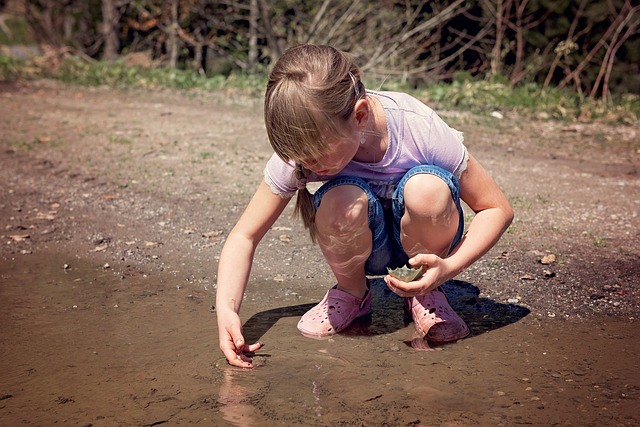
The little boy who’d rather stomp in muddy puddles after a rainstorm than attend story hour at the library may need that full sensory experience outdoors more than he needs, right now, to sit still in a group and listen quietly. He’d probably prefer hearing stories while sitting in a parent’s lap where he benefits from closeness and can ask questions as they occur to him.

The girl who prefers to draw pictures of animals and fairies rather than run outside to play with the neighborhood kids may need more time for quiet self-expression than other children. Her imaginative art fuels growth in all sorts of areas, one of which may be a sturdier sense of self that will help her interact more freely with others when she’s ready.

The teenager who drops out when she’s reached a high level of accomplishment in an area, say soccer or fencing or designing apps. What she’s learned in that field isn’t wasted. It’s taught her a whole range of skills and empowered her to move on. She may pursue other interests in what look like fits and starts of motivation. Or the learning situation that’s just right for her may look like boredom to others. She may need time to process, daydream, create, and grow from within before pushing ahead.

Children naturally focus on what they’re ready to take in and do their best to set aside the rest. Often what they set aside is exactly what adults push them to master. We call this stubbornness but really they show us, over and over, that human nature flourishes best without coercion. Efforts to structure learning too heavily are likely to fail (or more often, the student will fail) if it’s not understood that we’re all cued to learn in the ways best for us.


Benefits of Special Interest Groups

teenage bagpipers, esoteric interests, kids' interests, excellence through interests,

We like spending time with people who delight in the same things that fascinate us. That might be playing bagpipes, reenacting history, making homemade cheese, or white water rafting. Who doesn’t love sharing a favorite topic? It’s certainly easy to build friendships that way. Shared interests also foster greater enthusiasm and motivate us to expand our knowledge. That’s why interest-based groups make so much sense for our kids.

In my family, interest-based groups have been an important part of homeschooling life. We formed a number of these groups over the years. Some, like a history club made up of eager parents and not-so-eager young children, barely lasted long enough for a few meetings. Others have lasted ten years.

kids science club,

Our Science Club

The most successful has been our boy’s science club. It was started by five families with nine boys between the ages of seven and eleven. When we began it was highly structured. We met regularly at each other’s homes. Parents took turns planning a project or experiment, got the materials, explained the educational principles underlying the activity, and if things didn’t turn out as planned (actually quite frequently) it was usually a parent who searched for answers.

As time went by, more and more control over the science club was naturally taken over by the boys. They planned what they wanted to do and figured out what they’d need in order to do it. They decided whose house was best for that activity and when the day came, together they carried out the project or experiment, often improvising with different approaches.  If things didn’t turn out they searched for their own answers. Although nearby, parents didn’t hover to assure safety nor insist that they officially learn the principles behind each activity.

Our boys remained safe, happy, and increasingly savvy about many branches of science while running their own science club. Their projects included various propulsion systems designed to shoot tennis balls, a 12 foot high trebuchet, and a hovercraft which managed to get off the ground but not (as they’d planned) with a passenger. Over the years one family moved away and another was welcomed to the club. The older boys have gone on to college, several into the sciences, one to Harvard graduate school on a full scholarship. Since they shared the honorary title of Science Club President over the years, it probably didn’t hurt to put that on the college application.

Making Interest-Based Groups Successful

There are some lessons we’ve learned that can help make any interest-based group successful.

1. Build on what your children love to do. If they adore taking hikes it’s easy to expand on that. Depending on what your children and others who join decide, the group may expand to bird watching, letterboxing, geocaching, nature sketching, Volksmarching, any number of related activities. Or they may choose to stick to the simple pleasure of hiking. Your children may not be hikers, but prefer fashioning swords from household objects to joust with their siblings. There are plenty of ways to expand on those interests as well. Consider forming a special-interest group to enjoy fencing, foam fighting, Society for Creative Anachronism, writing and enacting scenes from the times of knights or high seas pirates, or live action role-playing games. Just about any interest can spark friendship and learning in a group of children.

2. Consider factors such as age range, group size, and location before starting a group.  What factors are likely to contribute to interesting, enriching and fun experiences?  How far are you willing to travel? Flexibility is important. For example if your daughter is eager to start up a journaling group for girls ages 11 to 13, you might consider forming a group for younger siblings who can meet at the same time for their own interest-based group.

3.  Invite potential members. Some interest-based groups develop out of casual get-togethers between friends. Some are formed as sub-groups within larger organizations such as block clubs, churches, or homeschool support groups. And others are the result of invitations spread on forums, lists, library bulletin boards and across homeschool networks.  How do you want to form the group?

4. Get started. For older kids, you may want to hold an informal organizing get-together at the local park, library meeting room, or your backyard. Gather ideas from the kids in attendance by encouraging them to brainstorm what they’d like to do and how often they’d like to do it.  Toss out questions to keep the ideas flowing and write down their suggestions. If they’re teens, let them run this meeting on their own as much as possible. This first get-together is also the easiest time to get some guidelines established. Consider questions such as: Do you want to be open to new members once you’re established? Do you prefer to agree to some basic rules or accommodate as the need arises?  How will responsibility for group activities be shared?

Or simply launch into the first session instead of holding an organizing meeting. After making apple butter and dipping candles with your new heritage club, or enjoying an afternoon making puppets and putting on an impromptu puppet show with other new members, they’ll understand what group sessions entail. Their suggestions for activities, group name, and potential rules will more easily flow from that initial encounter.

5.  Once your get-togethers begin, make sure that unstructured time is included. Build in ample time for kids to spend together after the activities are over. Friendships are a strong factor in motivating kids to stick with special interest groups. Whenever possible, be open to the inevitable plans your children concoct with friends in these groups. It’s a powerful acknowledgement of one’s worth to spend time with friends who are equally crazy about model trains, skateboarding, manga, horses, or cake decorating.

6. Recognize that the group will grow and evolve.  It’s important to be open to changes. Get-togethers between friends often naturally drift toward other activities as interests change. More formal groups tend to continue on long after the originators have moved on. An interest-based group your children start may last only a short time, but it still provides learning as well as enjoyable experiences. Some families launch quite a few such groups as their children grow up. You may be doing the same thing without recognizing that toddler playgroups and older children’s regular enrichment activities function just as interest-based groups do.

Image: Wikimedia Commons

Image: Wikimedia Commons

Examples of successful interest-based groups

~A cooking club for preteen girls meets at members’ homes to make (and eat) themed foods and plan recipes for next club event. They’ve made various ethnic meals, fancy desserts and food to donate.

~A multi-age group of stop motion movie-makers (youngest member five years old). They chat online about individual projects and also make collaborative movies. They have hosting screenings of their short films for an appreciative audience of relatives.

~A nature sketching and journaling group made up of families who schedule hikes in different wilderness areas to write, draw, and share their work.

~A boys’ book group based on sci-fi and adventure books. They vote on which book to read, read it the month before the meeting, then after the book discussion take part in activities such as scavenger hunts, making costumes and re-enacting scenes, testing tactics used in the book, or using repurposed materials to build something mentioned in the book.

~A multi-age rock climbing group which practices at indoor climbing walls as well as outdoor locations.

~A young children’s hands-on science club.

~A youth and adult fiber works group with projects, farm trips and visits to other spinning/weaving guilds.

~A group of families who get together to make costumes, chain mail and armor for re-enactments.

~A beachcombers group. Young children play along the waterside while adults and older children monitor ecological conditions for a non-profit organization.

~A debate and elocution society which prepares for regular memory-based recitations as well as occasional debating society competitions. The members’ aspirations include acting, politics, and law.

~A cartoonists’ meeting. Young members work on graphic novels, cartoon strips, and cards.

~A multi-age sculptor’s group. They meet to hear guest speakers which have included welders and mineralogists. They go on field trips and occasionally meet at one another’s homes to work on projects together.

You may find, as my family has, that interest-based groups are a favorite activity with extraordinary benefits. You may even notice that your child’s eagerness rekindles interests of your own. Maybe it’s time to enjoy the fellowship of other enthusiasts as you master the bagpipes or learn to make cheese.


Originally published in Wired. Portions of this article excerpted from Free Range Learning

Give Em The Finger

working with instead of against resistance, leading children, foster learning, non-compliant children, resistant children, non-coercion,

geograph.org.uk

“Self-trust is the first secret of success.”  Ralph Waldo Emerson

No one wants to be cajoled, forced, or coerced. Some of us resist mightily. Such resisters are called all sorts of names: underachieving, non-compliant, difficult, withdrawn, eccentric, or worse.

Human beings naturally resist when our autonomy is threatened. And autonomy is most threatened in childhood because many adults (particularly in the western world) believe children require moment-to-moment instruction, advice, and entertainment. Unlike most of previous human history, children’s lives today are heavily monitored and controlled. Adults keep kids in pre-planned activities,  insist that education proceed in a linear fashion, intervene to minimize difficulties, and provide distractions to prevent even momentary boredom. They do so assuming these efforts will advance learning and boost success.

Yet this puts character development at risk, because children are attracted to dilemmas that help them learn. Learning from mistakes, taking on challenges,  and developing a growth mindset are pivotal for success. So is preservation of a trait found in people at the top of their fields in science, the arts, and entrepreneurship—curiosity. And curiosity arises in unique and unpredictable ways, often appearing after a child has traveled from boredom to inspiration on his or her own.

Coercion also puts the child in an uncomfortable position, because all this control comes from adults with the best intentions. Usually adults who love them. So children, who don’t like overt control any more than you do, typically react somewhere on the spectrum between compliance and resistance. Extreme compliance and they’re less likely to think for themselves, developing an external rather than internal locus of control.  Extreme resistance and they’re likely to face ever more punitive efforts to get them to comply. Neither reaction is what adults want or expect.

Which leads me to a story about Transcendentalist writer, Ralph Waldo Emerson. He and his son Edward were trying to get a calf through a barn door. Emerson pushed from behind while his son pulled on the calf’s ear. The heifer wouldn’t move an inch despite a great deal of effort exerted by the two men. Emerson thought back over his scientific and literary readings in hopes of figuring out some way of getting the reluctant animal to move but didn’t come up with any solutions. They continued trying, to the amusement of a servant woman who was passing by. She offered a finger to the calf. Easily led by its desire to suckle, the calf followed her at once.

The wisdom of capitalizing on natural tendencies is the key to good animal husbandry. It’s probably a key to decent human relationships as well. I’m not for a moment suggesting that children are calves. (In fact, I’d rather see calves left with their mothers to suckle than led into a barn by capitalizing on that unmet need.) Children need rules, responsibilities, and the expectation that they’ll treat others with compassion. They need to be nurtured by adults who understand that pushing and pulling aren’t useful ways to help children mature. And they need the freedom to learn in ways that are best for them. At any age, those of us who aren’t oppressed by coercive relationships or controlling institutions gladly seek out advice as we need it, find role models who inspire us, and advance in the direction of our greatest gifts.

“No human right, except the right to life itself, is more fundamental than this. A person’s freedom of learning is part of his freedom of thought, even more basic than his freedom of speech. If we take from someone his right to decide what he will be curious about, we destroy his freedom of thought. We say, in effect, you must think not about what interests and concerns you, but about what interests and concerns us.” John Holt

The Boy With No Toys

why toys are bad for kids, overstimulated kids,

Before he was born, his mother decided her son would have no toys. Abandoned by the father, she was already a single parent. She made a living cleaning for other people. Most days she took the bus to affluent streets where children never seemed to play outside. As she vacuumed and scrubbed beautiful homes overfilled with possessions she paid close attention to what children did all day. Often they were gone at lessons, after school programs, or playdates. When they were home they usually sat staring at screens. Toys in their carefully decorated rooms appeared to be tossed around as if the small owners had no idea how to play, only how to root restlessly for entertainment.

She thought about it, talked to the oldest people she knew, and read everything she could. Then she informed anyone who cared to listen that her child would not have toys. Not a single purchased plaything.

Will (name changed) and his mother live in a small mobile home park. By most standards they are poor. Their income is well below the poverty line. They don’t have a TV or computer (although Will uses the computer at the library and watches the occasional TV program at babysitters’ homes). But their lives are rich in what matters. Together Will and his mom grow food on several shares of a community garden, bartering when they have extra produce. They make all their meals from scratch. These routines activate a whole array of learning opportunities for Will, quite naturally.

They are close to most of their neighbors in proximity as well as in friendliness. While his mother is working Will is cared for by several different seniors in their trailer park. He not only likes to help his mother garden, cook, and take care of their small home but he also likes to take part in helping his neighbors with small tasks. He carries groceries for certain ladies, helps an older gentleman with a birdhouse building hobby, and sometimes gets to assist another neighbor in automotive repairs.  He gets a lot out of these meaningful tasks.  Children long to take on real responsibility and make useful contributions. Giving them these opportunities promotes their development in important ways.

Sounds nice. But what about play?

natural play best for kids, free play, no toys,

When Will was a baby his mother made all sorts of toys. Most took no time at all. Food containers became stacking toys, a small water bottle with beans inside became a rattle, a sock stuffed with drier fuzz and tied in knots became a soft animal.

Will is now six years old. He plays as any child naturally does. He makes up games and turns all sorts of objects into toys. His mother saves money by not owning a car, so Will has commandeered a large portion of the shed that would normally be used as a garage. Mostly he uses it to stockpile his own resources. He has scrap wood, a few tools, and cans of nails. He likes to straighten bent nails for future projects, working carefully now that he recently discovered what smacking his fingers with a hammer feels like. Recently he found a discarded lawn mower tire, so he’s looking for three more tires to make a go-cart. In the evenings he likes to draw elaborate pictures of this upcoming project. He particularly enjoys playing in the soft dirt along the side of the shed where “robot men” he makes out of kitchen utensils use their potato peeler and wisk limbs to churn through the soil, leaving tracks as they clink. When he visits friends he happily plays with their toys, although he doesn’t always “get” that certain TV or movie-themed toys are limited to the plot-related storylines. So far he seems to have no urge to possess the same toys.

What about birthdays and holidays? Will’s mother does give him gifts. But she limits her gifts to useful items—crayons, clothes, tools, a compass. Each weekend her folk band practices at their mobile home. Will quickly mastered the harmonica and begged for time on the fiddle, so her big gift to him this year was a used child-sized fiddle. She urges the other adults in his life to gift him with experiences—a trip to the beach, a day of horseback riding, a visit to a museum. Out-of-town relatives now renew a children’s magazine subscription and send him regular snail mail letters, both of which are helping him learn to read with very little prompting.

natural child development,

Will’s childhood has a lot in common with the way children have learned and grown throughout history. As historian Howard Chudacoff notes in Children at Play: An American History, play is vital to development. It’s has everything to do with autonomy, exploration, imagination, and fun. It has very little to do with purchased playthings. In fact, structured programs and commercial toys actually tend to co-opt play.

Studies with rodents show those raised in enriched environments (toys and changing items in cage) have enhanced brain development compared to rats raised in a standard environment (plain cage, unchanging). We’ve misinterpreted these results. Rats don’t naturally live in boring, unchanging cages. They live in nature, which is by definition a challenging often constantly changing environment. In nature rats have far more complex lives than they ever might in a cage. Such an interesting life IS an enriched environment. It’s the same for children.

Sure there are devices that will “read” to a child. These are not more enriching than being read to by a responsive adult. And there are all sorts of adult-designed games. They’re not more fun or enticing than games kids make up on their own or with friends.

In fact, the overstimulation of blinking, beeping, passive entertainment isn’t beneficial for children. Joseph Chilton Pearce wrote in Evolution’s End: Claiming the Potential of Our Intelligence that the overload of television, electronics, and too many toys limits a child’s sensory awareness. Their brains and nervous systems accommodate intense bursts of sound, light, and color during their earliest years. Rather than developing the subtle awareness fostered by time spent in nature, in conversation, and in play they instead are wired to expect overstimulation. Without it, says Peace, they’re bored.

And yet, so many people are amused when tiny children are clearly pushed to the limits by a toy too overwhelming for them. (Every search for a video to illustrate this seems to think “baby scared by toy” is funny.)

The children Will’s mother cleans for, who are kept busy in adult-run programs and have access to electronic distractions, don’t have Will’s advantages. As he plays and innovates he’s actually promoting the kind of learning that translates to a lifetime of passionate interests. Studies show that children who are free to explore their interests without adult pressure and interference  are more autonomous, eagerly pursuing excellence through healthy engagement rather than heavy-handed adult pressure.

Ask the oldest person you know to share some memories about play from his or her childhood. Chances are you’ll hear about pick-up games, handmade toys, and free time that spun long summer days into marvels of imagination. That’s what Will’s mother wants for her child.

play develops intelligence, benefits of free play, deprive your kids of toys, handmade toys,

First published in Natural Life Magazine

How The “10,000 Hour” Rule Can Benefit Any Child

homeschooling for success, interest-led learning, learning for success,

Image: uktara.deviantart.com/gallery

If you haven’t heard about the 10,000 Hour Rule, you’re probably busy doing what people do, living life on your own terms. But what you may not realize is how this rule affects young people, whether they have one all-consuming interest or not.

Malcolm Gladwell identified the 10,000 hour maxim in his book, Outliers: The Story of Success. The rule describes how to attain Big Time Success. Based on an analysis of people who reached the top of their fields, Gladwell claims that any of us can reach greatness by practicing tasks relevant to our chosen field for a total of 10,000 hours. He provides pretty compelling examples including the Beatles, Bill Gates, and Tiger Woods. These guys put in the hours, then rapidly pulled ahead of the competition.

Plenty of other circumstances factor into success but it’s worth taking a closer look at what the 10,000 hour rule means for today’s kids. Good news. Those who are homeschooling or attending Democratic schools benefit enormously from the 10,000 hour rule, although not in ways you might expect.

First and most obviously, they have more time to explore their interests. They don’t spend hours every day on the school bus, standing in line to change classes, listening to instructions/attendance/announcements, doing rote schoolwork, and then completing homework in the evening. Even highly academic homeschooling families find that a full load of “schoolwork” can be completed in substantially fewer hours than the average school day.

That leaves plenty of time to pursue real interests. Long hours every day can be lavished, if a child wishes, on building expertise through direct experience in video game design, creative writing, chemistry, speed skating, cello playing, sculpting, astronomy, cake decorating, computer animation, or any other area.

It’s not difficult for a young person, free from the time constraints of conventional schooling, to spend 10,000 hours in an area of passionate interest. Let’s look at the numbers. The average school year in the U.S. is 180 days (pretty similar in most of the world) with an average school day of 6.7 hours.  Thus children are unable to pursue their own interests and learn in wider ways for a minimum of 1,206 hours a year. Even if we don’t count kindergarten, that’s 14,472 hours by the time they’re 18. And we’re not even adding time necessarily spent on travel to and from school, prepping for the school day in the morning, and doing homework after school (although we know these obligations probably add another hour or two each school day).

Sure, school kids engage in all sorts of worthy pursuits in their spare time. But homeschoolers and students in Democratic schools have a lot morespare time. These young people can accumulate the requisite 10,000 hours quite easily by their mid-teens, putting them on the fast lane to Big Time Success in exactly the field that makes them feel most vibrant and alive. If they choose.

But what about the homeschooled kids and students in Democratic schools who don’t have a single all-consuming interest? A girl might like to read sci-fi, go horseback riding, play soccer, and teach the dog tricks. A boy might drift from one pursuit to another, avidly creating his own graphic novel, then becoming passionate about parkour. Should these kids choose one thing in order to accumulate the all-precious 10,000 hours?

Absolutely not. They’re already putting 10,000 hours into the exact skills that more widely define success.

That’s because their daily lives are filled with self-directed and meaningful learning. Of course, depending on the style of homeschooling, it’s obvious that many kids will spend time doing some rote educational tasks. But nothing approaching15,000 hours. Instead they’re accumulating more useful and accessible wisdom honed by experience. How?

~Thousands of hours spent feeding their own curiosity, becoming well acquainted with the pleasure of finding out more. This develops eager lifetime learners.

~Thousands of hours exploring, creating, building friendships, making mistakes, taking risks and accepting the consequences (what’s ordinarily called play).This develops innovative thinkers.

~Thousands of hours spent shouldering real responsibility and connecting with role models through chores, volunteer work, and spending time with people of all ages. This develops self-worth based on competence and meaning.

~Thousands of hours pursuing interests, in whatever direction they take, building proficiency through direct engagement. This develops mastery.

~Thousands of hours reading, contemplating, conversing, asking questions and searching for answers, looking at the bigger picture from different angles, and discovering how people they admire handle challenges. This develops maturity and strength of character.

Gladwell reminds us that 20 hours a week for 10 years adds up to 10,000 hours. Filling those hours meaningfully? That’s no problem for self-directed, endlessly curious learners. Chances are, they’ll grow up to redefine success. Who knows what today’s young people, raised to think deeply and freely, can bring to the future?

homeschool success, success for today's kids, kids succeed on own terms,

Image: just1bite.deviantart.com

This article was first published in Life Learning Magazine, Sept/Oct 2011.

School ADHD Isn’t Homeschool ADHD

ADHD school issues, learning outside of school, why we homeschool, ADD school problem,

I hesitated at the heavy glass doors of my son’s school. I’d cheerfully walked in these doors many times. I volunteered here, served on the PTA board, joked with the principal and teachers, even helped start an annual all-school tradition called Art Day. But now I fought the urge to grab him from his first grade classroom, never to return.

I’d come in that morning hoping to discuss the angry outbursts my son’s teacher directed at several students, including my little boy. But I entered no ordinary meeting. It was an ambush.  Sides had clearly been chosen. The principal, guidance counselor, and my son’s teacher sat in a clump together along one side of the table. Feeling oddly hollow, I pulled out a chair and sat down. Since I led conflict resolution workshops in my working life, I was confident that we could talk over any issues and come to an understanding.

I was wrong.

The counselor read aloud from a list of ADHD behavioral symptoms my son’s teacher had been tracking over the past few weeks. My little boy’s major transgressions were messy work, lack of organization, and distractibility. The teacher nodded with satisfaction and crossed her arms.

No one who spent time with him had ever mentioned ADHD before. I breathed deeply to calm myself. I knew it was best to repeat what I was hearing in order to clarify, but the counselor barreled ahead, saying they had a significant “ADHD population” in the school system who showed excellent results with medication.

After giving the teacher kudos for dealing with a classroom full of children and acknowledging the difficulty of meeting all their needs, I tried to stand up for my child (although I felt like a mother bear defending her cub from nicely dressed predators). I said the behaviors she noted actually seemed normal for a six-year-old boy, after all, children are in the process of maturing and are not naturally inclined to do paperwork. The teacher shook her head and whispered to the principal. The counselor said first grade children have had ample time to adapt to classroom standards.

I asked if any of my son’s behaviors had ever disrupted the class. The teacher didn’t answer the question. Instead she sighed and said, looking at the principal, “I’ve been teaching for 15 years. This doesn’t get better on its own. I’m telling you this child can be helped by medication.”

When I asked about alternatives such as modifying his diet the teacher actually rolled her eyes, saying, “Plenty of parents believe there are all sorts of things they can do on their own. But students on restricted diets don’t fit in too well in the lunchroom.”

There was no real discussion. No chance to bring up her teaching style. No opportunity  for better collaboration between home and school. A conclusion had been reached without consulting me, my husband, or a mental health professional. My son required one vital ingredient in order to flourish in school: pharmaceuticals.

As I stood at the door, my heart pounding in distress, I vowed to solve this problem rationally. I told myself such an approach would help my child and other misunderstood students. I made it all the way to the car without crying.

Over the next few weeks I took my child to all sorts of appointments. A psychologist diagnosed him with ADHD (inattentive/distractible type) and said, after talking to me, that I probably had it as well. (It manifests somewhat differently in me.) Her report was tucked in a stack of handouts from a national non-profit organization known for its ties to the pharmaceutical industry. An allergist diagnosed our little boy with multiple food allergies including almost every fruit and grain he liked to eat (my research showed that diet can indeed affect behavior even for kids without allergies). A pediatric pulmonologist determined that his asthma was much worse than we’d known. In fact his oxygen intake was so poor the doctor said it was likely our son would change position frequently, lift his arms to expand his lungs, and have trouble concentrating. Right away I started the process of eliminating allergens in his life and following other advice given me by these professionals.

I also read about learning. I began to see childhood learning in a wider way as I studied authors such as Joseph Chilton PearceDavid Elkind , James Hillman, and Bill Plotkin. I read about the gifts inherent in ADHD. I talked to other parents who described managing ADHD using star charts, privilege restriction, close communication with teachers, and immediate consequences for behavior. Many told me their child’s problems got worse during the teen years. Some described sons and daughters they’d “lost” to drug abuse, delinquency, chronic depression and dangerous rage. One woman told me her 14-year-old son was caught dealing. The boy sold amphetamines so strong they were regulated by the Controlled Substance Act—his own prescription for ADHD.

And I spent a lot of time observing my son’s behavior. Yes, he was disorganized with his schoolwork. His room was often a mess too, but only because he had so many interests. I saw no lack of focus as he drew designs for imaginary vehicles, pored over diagrams in adult reference books, or created elaborate make-believe scenarios. I knew that he was easily frustrated by flash cards and timed math tests, methods that did little to advance his understanding. But I also knew that he used math easily for projects such as designing his own models out of scrap wood. And of course he was distractible. He resisted rote tasks as most small children do. Their minds and bodies are naturally inclined toward more engaging ways to advance their natural gifts. Mostly I noticed how cooperative and cheerful he was. He didn’t whine, easily waited for his own turn, and loved to help with chores. As a biased observer I found him to be a marvelous six-year-old.

Resolutely I tried to make school workable. I let the teacher know how my son’s allergies and asthma might impact his classroom abilities. I shared the psychologist’s report. And I tried to explain my son’s stressful home situation. In the past year our family had been victimized by crime, his father had been injured in a car accident and left unable to work, and several other loved ones had been hospitalized. His schoolwork may have reflected a life that suddenly seemed messy and disorganized.

The teacher, however, only told me what my son did wrong. She was particularly incensed that he rushed through his work or left it incomplete, only to spend time cleaning up scraps from the floor. She did not find his efforts helpful. In clipped tones she said, “Each student is supposed to pick up only his or her scraps. Nothing more.”

My son’s backpack sagged each day with 10 or more preprinted and vaguely educational papers, all with fussy instructions.  Cut out the flower on the dotted lines, cut two slits here, color the flower, cut and paste this face on the flower, insert the flower in the two slots, write three sentences about the flower using at least five words from the “st” list.  I’d have been looking for scraps on the floor to clean up too, anything to get away from a day filled with such assignments.

It took almost two years of watching my child try to please his teachers and be himself in two different school systems that were, by necessity, not designed to handle individual differences. His schoolwork habits deteriorated except when the project at hand intrigued him. He appreciated the cheerful demeanor of his third grade teacher even though she told me she didn’t expect much from him until his Iowa Test results came back with overall scores at the 99th percentile.  Then she deemed him an underachiever and pulled his desk next to hers, right in front of the whole class, to make sure he paid attention to his paperwork rather than look out the window or fiddle with odd and ends he’d found. That’s where he stayed, in the “not working up to your potential” morass common to many gifted kids.

When he was eight years old I took my children out of school forever.

Homeschooling didn’t “fix” everything for my son, at least right away. I made many of the same mistakes teachers made with him. I enthusiastically offered projects that meant nothing to him, expecting him to sit still and complete them. And I saw the same behaviors his teachers described. My son sat at the kitchen table, a few pages to finish before we headed off to the park or some other adventure. But every day he dropped his pencil so he could climb under the table after it, erased holes in his paper, found a focal spot out the window for his daydreams, complained as if math problems were mental thumbscrews. I used to lie awake at night afraid that he’d never be able to do long division.

Yet every time I stepped back, allowing him to pursue his own interests he picked up complicated concepts beautifully. I watched him design his own rockets. He figured out materials he needed, built them carefully and cheerfully started over with his own carefully considered improvements when he made mistakes. I realized his “problem” was my insistence he learn as I had done—from a static page. Homeschooling showed me that children don’t fare well as passive recipients of education. They want to take part in meaningful activities relevant to their own lives. They develop greater skills by building on their gifts, not focusing on abilities they lack.

The more I stepped back, the more I saw how much my son accomplished when fueled by his own curiosity. This little boy played chess, took apart broken appliances, carefully observed nature, helped on our farm, checked out piles of books at the library each week, memorized the names of historic aircraft and the scientific principles explaining flight, filled notebooks with cartoons and designs—-learning every moment.

Gradually I recognized that he learned in a complex, deeply focused and yes, apparently disorganized manner. It wasn’t the way I’d learned in school but it was the way he learned best. His whole life taught him in ways magnificently and perfectly structured to suit him and him alone. As I relaxed in our homeschooling life he flourished. Sometimes his intense interests fueled busy days. Sometimes it seemed he did very little— those were times that richer wells of understanding developed.

I sank back into worrying about academic topics during his last year at home before college. Although his homeschool years had been filled with a wealth of learning experiences I suddenly worried that he’d done too little writing, not enough math, minimal formal science. My anxiety about his success in college wasn’t helpful, but by then his confidence in himself wasn’t swayed.

His greatest surprise in college has been how disinterested his fellow students are in learning. Now in his sophomore year, my Renaissance man has knowledge and abilities spanning many fields. Of his own volition, he’s writing a scholarly article for a science publication (staying up late tonight to interview a researcher by phone in Chile). Self taught in acoustic design, he created an electronic component for amplifiers that he sells online. He also raises tarantulas, is restoring a vintage car, and plays the bagpipes. He’s still the wonderfully cooperative and cheerful boy I once knew, now with delightfully dry wit.

My son taught me that distractible, messy, disorganized children are perfectly suited to learn in their own way. It was my mistake keeping him in school as long as we did. I’m glad we finally walked away from those doors to enjoy free range learning.

learn freely, benefit of homeschooling, ADHD homeschooling, eclectic homeschooling, unschooling,

Wikimedia Commons

 Find out more about Free Range Learning here

Fun Theory

I’m not aware of any official Fun Theory in the field of learning. But fun shimmers under the surface of motivation and focus like a very big fish. And the fish named Fun shouldn’t be ignored.

I lifted the term Fun Theory from an old Volkswagen campaign. One of their videos shows busy commuters choosing an escalator instead of a staircase. People are rarely motivated to do otherwise. But when the same stairs were transformed into a giant electronic piano sixty-six percent more people chose to hop, dance and run up those musical steps. Fun works. (It also sends the Volkswagen logo around the world in a great example of viral marketing.)

It’s no surprise that pleasure is motivating, although what one person finds enjoyable may not be remotely engaging for the next person.

That’s the key. Fun is highly individual. It can’t be easily pre-packaged, even though promoters of textbooks, curricula, and enrichment programs assert their products do just that.

You can tell when educational materials and experiences don’t engage the young people in your life. They exhibit, shall we say, obvious symptoms. I won’t list them here. These symptoms tend to cause us all kinds of angst.

A child’s stubborn insistence that learning be meaningful and interesting is actually a sign of positive selfhood. We need to pay close attention to each child to really see what sparks enthusiasm, evokes awe, sharpens focus, builds on interests, and challenges abilities. That’s what advances learning.

The elements that make an activity or interest compelling for any one person can’t be neatly summed up, nor should they. A person is too complex to reduce to a List of Handy Motivators. But you might want to consider such factors if you’d like to understand why your child prefers to do things his or her way, or why some enriching activities “work” and others don’t. Below you’ll find brief notes about some of the factors that make learning intrinsically pleasurable and interesting. Think of your child as you read over the list. Think of yourself too. You’ll recognize many unique ways that lively, engaged learning happens quite naturally.

                Trial and Error 

Learning is fun when errors don’t feel like failures. Watch a group of friends figure out what tools and design elements they’ll use to make bracelets from a cast-off metal objects. Their initial results will likely be both positive and negative. Their mistakes will help to guide and refine their progress. Thomas Edison said of trial and error, “Results! Why man, I have gotten a lot of results. I know several thousand things that won’t work.”

When your child is building a fort out of branches she may experiment with several approaches. This open-ended process allows her to repeat successes and learn from errors, getting ever closer to the desired result. Trial and error often pulls the learner forward to greater mastery. It’s also tremendously enjoyable.

                 Meaning  

Full engagement in any pursuit that is meaningful to the individual may not sound like a prescription for fun. But it is, because it tends to lead to what is called flow:  a sense of focusing so fully that we lose sense of time, discomfort, even self.

Artists and athletes aren’t the only ones who experience flow, children easily merge into this state. A child may experience flow while engaging in make-believe, drawing, swinging on a backyard swing, playing the guitar, fixing a bicycle, even organizing a shelf.

You may not be able to predict what has meaning for your child, but chances are it fuels learning. Your daughter’s fascination with horses may lead her to equine-related mathematics, history and science. Her learning is enlivened with wonder and purpose. That absorption is also fun.

                Discovery/Exploration    

Discovery is highly motivating and feels quite a bit like fun. It lures babies to put everything into their mouths. It propels us to try new music, peer around forbidden corners, travel to distant places.

When a friend brings up an obscure bit of information, your preteen may check it out later only to find an unexpectedly engaging exploration through subjects that never interested her before. Or perhaps your son’s curiosity is piqued by a new venture he wants to try like making homemade cheese. The project opens up to ever wider explorations such as homesteading skills, the claims of raw milk advocates, and recipes using artisan cheeses. For most of us independent discovery has the greatest allure.

                Novelty

What is new and unexpected heightens attention and activates all kinds of interest. That’s why marketers are constantly coming out with newer versions of the same thing. Novelty leads readily to exploration or play. By itself, novelty wears off quickly. (Those commuters will tire of the musical stairs and probably go back to using the escalator.)

You can rely on something new to stimulate interest. Just remember that too much reliance on novelty doesn’t help children build their own deeper resources of attention and interest.

                Play

Play isn’t “just” for fun. It’s an essential component of learning. Stuart Brown, author of Play: How It Shapes the Brain, Opens the Imagination, and Invigorates the Soul said in an interview, “…evidence continues to accumulate that the learning of emotional control, social competency, personal resiliency and continuing curiosity plus other life benefits accrue largely through rich developmentally appropriate play experiences.”  Unstructured free play is particularly important. We already know it’s fun.

                Direct Experience

Hands-on efforts make learning come alive with pleasure and satisfaction. Frank R. Wilson notes in  The Hand: How Its Use Shapes the Brain, Language, and Human Culture that brain and hand use have always been connected. When a young child is put in charge of preparing vegetables for a stir fry dinner his efforts may not be entirely helpful, but the sensory experience of washing, chopping, and tasting offer him much more than growing competence in meal preparation. The sensory experiences enhance comprehension and lock in learning. When a child expresses interest in puppetry she may want the opportunity to make puppets, stage puppet shows, and go to puppet guild meetings. The more fully involved a child can be the more direct (and lasting) his or her learning will be.

                Challenge 

Challenges are fun as well as educational because they keep us right at the edge of our competence, pushing us on to the next level (exactly why video games are so compelling). A ten-year-old may enjoy the logical challenge of debating his older brother, the practical difficulties of planning and filming his own scary movie, the physical and social risks of showing off at the skating rink. These self-selected activities push him to advance a whole range of abilities. Challenges keep us too absorbed to grin but for our own good reasons.

There are plenty of other “fun in learning” factors such as relationship development, collaboration, sensory pleasure—surely you can think of more. All these elements are intertwined so completely that they only make sense when we see them as connected.

I think that’s why we need to pay attention to what’s fun about learning. Yes it’s different for each person. But what’s universal is that each of us is capable of fascination, excitement, and wonder. Why fish around for methods to motivate and sustain a child’s attention when joy is right there, showing us the way?

Portions of this post excerpted from Free Range Learning.

26 Ways To Make History Relevant


put your child in history, family history activities, make history fun,

History is always relevant.

It’s the quiet reminder found in old buildings, tall trees and important decisions. It is present in the way we do things, although we rarely stop to realize that we do things a certain way because it was done that way in the past. When children ask “why” we often realize we don’t know. Figuring out the answer invariably leads us back to history.

Each of us is the product of history. Our lives today are evidence that our ancestors survived unbelievable odds stretching back to prehistory. The ground we stand on and the flesh we are composed of is not new, each atom has history.

Taking a fresh look at the past is a great way to provide meaning for our lives today. Here are some ways to make history come alive for you and your family.
history of natural places, seeing hidden history, making history come alive,  

Imagine history. Take a walk in a natural area while thinking about how earlier peoples used resources they encountered. What could be utilized to hold water, provide shelter and heat, to cut or pound foods, to heal, to defend? How would natural conditions affect the stories, celebrations and religion of the region? What evidence might be left behind by the earliest inhabitants?

Take a walk in the city and ask children to imagine it as it was long ago. Notice buildings that were standing more than 100 years ago, talk about what sounds may have been heard then, ask what sort of businesses and transportation they would have seen.

Investigate the past in your backyard. See what you find in the ground before putting in a new garden or extending the patio. Learn about the people who lived in the area long before you by researching the settlement of the town, early explorers, and original inhabitants. Discover what you can about the history of your home and previous owners. Check out Discovering the History of Your House: And Your Neighborhood by Betsy J. Green.

Develop a book of family lore. Compile family recipes and any anecdotes that go with these foods. Add family sayings, funny stories, traditions, timelines, anything you’d like to record for coming generations.

Enjoy history brought to life. Check out Living History offerings to witness life as it was in the past. Enter terms such as “open air museum,” “folk museum,” “living history” and “living farm museum” into a search engine to find listings for your area. Such places provide immersion experiences, hands-on workshops, and history theater.

Don’t forget historical reenactments. Reenactment organizations use meticulous care to replay pivotal events. And there are the ever popular Renaissance fairs filled with entertainment, jousting tournaments, art and foods.

Emphasize the importance of primary documents. Rather than relying on the interpretations of others, discover what history has to say through letters, photos, deeds and more. Consider Eyewitness to History and American Memory Project. For information on using primary documents go to The National Archives.

Use the past today. When facing an ordinary quandary, think back to how the same sort of problem was handled in the past. This is particularly effective on a personal level.  History helps us learn from the actions of others. We can see the long term effects of mistakes and faulty reasoning. We can also see the results of highly ethical choices. A consideration of history helps develop good judgment.

explore your ethnic roots,

Explore your heritage. It’s likely your family tree branches out into several regions or countries. Find out about the stories, customs, foods, inventions, struggles, and successes that make up your cultural background.

Dig into archeology. This field connects history, anthropology, art, geography and more. History is underground awaiting discovery, just as our era will someday be a mystery to future archeologists. Children may be inspired to set up a backyard dig. They may want to wire bleached chicken bones back into a skeleton or excavate a garbage can for lifestyle “clues.”

Dig offers links, art and a state guide to educational events. For younger children, try  Archaeologists Dig for Clues by Kate Duke. For preteens, look into Archaeology for Kids: Uncovering the Mysteries of Our Past by Richard Panchyk.

Maintain a special trunk, box or storage container as a personal history cache for each child. Keep copies of photos, artwork, letters, special ticket stubs and programs, mementos such as a forgotten toddler toy, notes about the child’s humorous sayings, a lock of hair, even a few baby teeth saved from the Tooth Fairy.

See history as a mystery. The clues in letters, photographs and everyday items tell the story of people who can no longer speak for themselves. Books that children will enjoy are   The Mary Celeste: An Unsolved Mystery from History and Roanoke: Roanoke: The Lost Colony–An Unsolved Mystery from History both by authors Jane Yolen and Heidi Elisabet Y Stemple. For older youth, enjoy Unsolved Mysteries of American History
by Robert Stewart.

Indulge in biographies and autobiographies. This is a great way to learn how the conditions of the time impacted individual lives. It also gives insight into character formation. It’s helpful to let your child choose who he or she would like to read about. Even if your child tends to prefer specific biographies, say only sports bios, he’ll be learning how different eras shape a person’s life.

Gain perspective by playing historical games. Playing long-forgotten games helps us recognize that people in earlier eras were also youngsters who longed to have fun. For example, nineteenth century immigrant children in crowded U.S. cities played games that fit on stoops, sidewalks or a section of the street. Classic pastimes like stickball, scully (bottle caps), marbles, and hopscotch were inexpensive amusements for children even in the poorest families. Enjoy games from other cultures. Check out or the book Kids Around the World Play!: The Best Fun and Games from Many Lands by Arlette N. Braman

Value stories from your own family history. Tell your children stories of your childhood and what current events were going on at the time. Solicit stories from older members of the family. Encourage your children to ask their elders questions such as, “What made your family come to this country?” and “What was your first job?” and “What was it like when you were my age?” Display photos of ancestors and mention what you knew of their history. This provides children with a sense of continuity. It also helps them recognize that those who came before them contributed to who they are now.

Record oral history. Family members are a good way to start, but consider those in the community as well. Everyone has stories to tell, it’s a matter of finding out what topics are the catalyst. Be prepared with questions but remember to avoid interrupting. Start out with comfortable topics and work toward any that may be more intense. Let the interviewee talk and the conversation go in unexpected directions.

You may want to collect oral histories of a specific era, relevant to your ancestry or on a topic of interest. Augment this oral history with photographs, music and artwork.
history activities for families, history for kids,

Springboard into history using interests.  If your daughter is an adventurer at heart, she can learn how explorers, inventors, navigators, and wanderers changed the course of history with the same intrepid desire to “find out” that she has. If your son likes cartoons, he can discover similar drawings made for political commentary, social satire, and storytelling that show such artists as unafraid to advance ideas through deceptively simple sketches. Those earlier cartoonists made the medium what it is today.

There’s a historical angle to any interest. Whether your child has a passion for airplanes, stand-up comedy, glassblowing, or skiing there’s a back story to be discovered that makes history relevant to who your child is right now.

Act it out. Learning about Napoléon? As a child the future emperor was bullied by older students, that is until he led younger boys to rout their elders in a successful snowball battle (hinting at his nascent leadership skills).  It might look something like this.  Dramatic moments in history are perfect to reenact in the back yard or park.

Learn about time capsules. Documents and artifacts are vital historical evidence. Sometimes such evidence is discovered hidden away in an attic, trunk or archeological dig, creating a kind of unintentional time capsule. Many people leave time capsules, either to be opened themselves a few decades later or to leave for future generations. Make a time capsule together, filling it with personally and historically relevant items.

Learn about Golden Record included in both Voyager spacecraft launched in the late 1970s. Find out what it included and why. This message was sent along: “This is a present from a small, distant world, a token of our sounds, our science, our images, our music, our thoughts and our feelings. We are attempting to survive our time so we may live into yours.”

Put yourself in history with fiction. Good books help young people imagine themselves in another place or era. Try an activity mentioned in the book such as darning a sock, shooting a slingshot, or foretelling the future through dreams. A Book in Time offers a chronological list of children’s books, plus crafts and other project ideas.


history enrichment ideas, making history fun, history for kids,

Time travel. Ask yourself “what if” questions to stimulate thinking about different outcomes. “What if the Black Plague never occurred?” or “What if the Allies had lost World War I?” Ask what event or decision in history you would most like to see altered, and why. Ask what person from the past you would most like to meet, and what you would ask him or her.

Let periodicals bring history to your door. A freshly delivered magazine is enticing. There are wonderful historical and cultural magazines for children including Calliope: World History for Kids, Cobblestone: American History for Kids and Faces: People, Places and Cultures.

Make a gift of family history. Give the tiny leather case with great grandma’s reading glasses to your daughter, along with your memory of this lady who loved to write. This might mean a great deal to a teenager who harbors ambitions of becoming a novelist. The pocketknife from a great uncle who left to seek his fortune as a merchant marine, and who sent letters from ports all over the world may be a meaningful gift for your son who talks of setting off on his own travels.

cook historically, history activities, family history fun,

Cook historically. Try some of the characteristic foods and preparation techniques from the past. Cook stew over a fire, taste plantain, make hasty pudding, grind buckwheat. Ever wonder when people began eating certain foods or developing distinct recipes? The Food Timeline offers a look back, with each foodstuff clickable to an historical article.

Hold a fair. Some homeschool and enrichment groups have a yearly fair oriented toward history or social studies. Consider a biography fair, genealogy fair, history fair, or international fair. For example, at an international fair each young person sets up a display for the country or region they’ve chosen. They might have posters, projects, foods to sample, crafts and interactive activities. Each participant comes prepared to lead a game from the country they studied, making the fair a lively event. Some groups might also require each participant to provide a hand-out so that everyone leaves with information about all countries featured at the fair.

explore graveyards with kids,

Visit graveyards. Cemeteries have stories to tell. Children can learn about family size, immigration and wartime. They can look for the most unusual names, notice the frequency of childhood death in different eras, write down interesting epitaphs. Discuss in advance the necessity for showing respect for gravesites and acting with decorum.

Oakland Chinatown StreetFest

Explore the impact of culture. Immerse yourself in a culture’s art, music and stories. Learn about legends and beliefs. How do these aspects affect the way those people organized their societies and lived their lives? Who would you be in that society? How would your worldview change if that were your culture? Notice similarities and differences in current times.

Look at your life as an historian or anthropologist might. What’s called “folklife” is simply the everyday creativity surrounding us right now. Jump rope chants, ghost stories, jokes, the way your parents or grandparents warn you to behave, celebrations and daily rituals—these are folklife. The memories you are building right now are history in the making.

These ideas are excerpted from Free Range Learning: How Homeschooling Changes Everything.  

Additional Resources

Online

Odyssey provides interactive learning about the Near East, Egypt, Greece, Rome, Africa, and ancient Americas.

BBC History offers a wealth of information from ancient to recent history through in-depth articles, animations, games and videos.

History Matters emphasizes the use of primary sources in text, image and audio.

HyperHistory Online presents world history through interactive timelines, maps, images and text files.

World Digital Library offers multilingual primary materials to promote current and historical understanding.


Books

Around The World Crafts: Great Activities For Kids Who Like History, Math, Art, Science And More! by Kathy Ceceri

A Street Through Time by Anne Millard

A City Through Time by Philip Steele

Constitution Translated for Kids  by Cathy Travis

Turn of the Century by Ellen Jackson

We Were There, Too!: Young People in U.S. History by Phillip Hoose

Gathering Fifty Wise Homeschoolers in One Place

Award-winning Home Education Magazine has been published since 1984 by Mark and Helen Hegener and their third-generation homeschooling family. Each issue inspires, informs and invigorates readers.  Of all the magazines our family receives, this is one we keep. The copies are timeless. I share them, refer to them and treasure them.

A “best of” volume titled The Homeschool Reader: Series 1995-1999: Collected Articles from Home Education Magazine has just been released. It gathers nearly 50 homeschooling experts in one place.  I was honored to serve as editor for this project.

For a glimpse of what this very full little book offers, take a look at the bounty promised by the table of contents.

Starting Out

“Revelations of a Homeschooling Mom” by Carol Wanagel

“Keep It in the Family” by Catherine Daughton

“The Early Years Child’s Learning Assets” by Linda Dobson

“Leaving Public Education” by Ellen C. Bicheler

“Decompression – Frequently Asked Questions” by Cafi Cohen

“User Friendly Homeschooling Records” by Larry and Susan Kaseman

“Make Learning Fun” by Katie Fawcett

“A Word of Encouragement If Needed” by Rebekah Freedman

Family Life

“When Everything is a Mess…” by Katje Sabin-Newmiller

“And Baby Makes Trouble?” by Cindy Gaddis

“The Fabric of Home Education” by Kathy E. Waldorf

“My Kids Won’t Let Me Teach” by Ann Leadbetter

“On His Own Time” by Robin Ohlgren-Evans

“Anecdotes” by Helen Hegener

“All Play and No Work?” by Linda Kidwell

“Handmade, Homespun and Homeschooled” by Robin Ohlgren-Evans

Fathers’ Viewpoints

“The Forest Floor Theory of Love” by Odds Bodkin

“Notes From a Homeschooling Dad” by Jeff Kelety

“Homeschooling Fathers” by Gary Wyatt

“When Dad Homeschools: from Breadwinning to Baking” by Jim Dunn

Socialization

“Socialization” by Helen Hegener

Different Needs

“You’re Going To What?” by Melissa Wagner

“Personal Notes on ADD” by Janie Bowman

Math

“Learning to Love Math” by Alison Moore Smith

“Ten Counter-Intuitive Math Teaching Tips” by Cafi Cohen

Reading

“Learning to Read” by Sue Smith Heavenrich

“Learning to Read” by Christine Lozano

Reading Recovery Program” by Martine Palmiter

“A Family Book Club for Readers and Non-Readers” by Melinda Roth

Writing

“Getting It Down: Ways to Encourage a Reluctant Writer” by Sue Smith-

Heavenrich

“The Writing Club” by Jill Boone

“Haiku in my Pocket” by Sue Smith-Heavenrich

Art

“Art for the Younger Child” by Jan Brewington

“Art for the Older Child” by Jan Brewington

Physical Education

“Time For Family Baseball” by Earl Gary Stevens

Science

“Learning and Doing Science” by Cafi Cohen

“Learning High School Science Outside a Lab” by Sue Smith-Heavenrich

“Learning Nature’s Way: With Open Arms and Ample Interruptions” by

Gail McClelland Fenton

“Natural Nature Learning” by Deborah Taylor-Hough

History & Social Studies

“History At The Old Huff House” by Diane Huff

“Meet Travis The Traveling Bear” by Julie Hart

Philosophy & Ethics

“Philosophy and Learning at Home” by Jana Mohr Lone

“From Empathy to Altruism: Community Service” by Shalynn Ford

Discussing Unschooling and More Structured Homeschooling

“Unschooling” by Cheri Howard

“Keys to Successful Unschooling” by Susan Jordan

“What Do I Do?by Eileen Yoder

“Unschooling or School-At-Home?” by Chris Sims

“In Defense of Workbooks” by Joanne M. Billmers

First Day” by April Montgomery

Learning, Working and Heading Out on Their Own: Teen and Young Adults

“Ten Reasons to Homeschool Through High School” by Cafi Cohen

How to Help your Child Choose a Career” by Dr. Ferne Cherne

“Preparing for College: An Insider’s View” by Maggie Bryson

Travel Homeschooling

“A World of Learning” by Barbara Theisen

“A Year Abroad: A Family Learning Together” by Lantien Chu

Perspective

“Redefining Basics” by Earl Gary Stevens

“Reflections of a Homeschooled Homeschooler” by Rebecca Bangs Amos

“On Self-Doubt” by Lenita Harsch

“When Being a Mom Isn’t Enough” by Amy Hollingsworth

“I Told You Not to Do That” by Kathleen Creech

“Bad Homeschooling Days” by Selena Montoya

“My Kids Aren’t Geniuses!” by Sally Hunt

“Letting Go of the Reins” by Helen Hegener

“The Door’s Wide Open, Come Out and Play” by Kathleen Creech

If Jane Goodall Were An Alien

view of U.S. childhood, impeding humanity, how to better raise our children,

Imagine someone with Jane Goodall’s observational powers coming from outer space to observe us for a few days.

Let’s narrow this alien’s study down to something relatively simple. Our imaginary alien doesn’t have time to report on Earth’s progress toward peace, justice, and environmental balance. Our imaginary alien doesn’t even have time to cast her gaze across the whole planet.

Instead, the alien watches a few children in a typical American suburb before filing this report. (Alien disclaimer:  this report isn’t representational of all humans or all time spans on Earth.)

*

How to Impede Humanity

Each human is born with vast potential which unfolds in ways unique to that person’s talents and experiences. Human culture starts immediately to prevent that newborn’s potential from being fully realized.

The smallest humans are kept for much of their waking day in devices called car seats, booster seats, high chairs, playpens, cribs and strollers. Without sufficient and varied movement, learning can be impeded.

They are kept indoors most of the time. This limits their vision, their sense of connectedness, and their happiness.

Instead of foods harvested directly from nearby sources, the taste preferences of these small humans are developed on diets of lower nutrient but more expensive packaged substances. The health effects of these foods is beyond the scope of this report. It is, however, noted that transporting and purchasing these foods has an economic impact on the families of these small humans.

Humans are a people of story and image. As small humans get older they more readily absorb the lessons surrounding them from such objects as billboards, magazines, television, video games, and toys. These stories and images teach humans that success and happiness come through power, the right possessions, perfect appearance, rare skill, and of course, wealth. Small humans learn this quickly.

For example, appearance. They are repeatedly exposed to images of impossible bodies.  Note evidence—-a process called retouching applied to human Jennifer Anniston and to humans Twiggy and Keira Knightley.  As a result, five year old females judge their bodies harshly. By what humans call adolescence, 92 percent of females are unhappy with their bodily appearance.

Males also experience self-loathing due to impossible body images and behavior of heroes in movies, video games, and comics.

Movies, television, politics, and pundits teach small humans that the world is more violent than it is and games teach them that aggression is the best response.

The whole market-driven culture pushes materialistic values on young humans, which can leave them depressed, anxious and unhappy when they most need the powerful boost of optimism.

Even though young humans are perfectly suited to learn in ways matched to their abilities and interests without coercion, even though humanity has evolved throughout time by learning directly from wisdom-bearers in their own fields, these youth are put in institutions called schools. There each young human is judged by pre-determined standards. A large percentage don’t measure up.

It has been determined that the primary need of young humans is for self-expression, reasonably consistent guidance, and what on Earth is called love.

It is beyond the scope of this field report to discuss all the factors impeding humans but this observer notes that humanity flourishes due in large part to the overwhelming ability of human families to raise children using tools of kindness, laughter, and true affection. These behaviors are observed every moment, shared freely. This seems to be the essence of this species, so the report overall views humanity’s progress as positive.

(We prefer, however, that humans stick to their own planet. See the following video update.)

Image courtesy of Jean Kern’s flickr photostream