This has been a year of roller coaster ups and downs. Many tender moments and tiny delights in my life. Many heart-wrenching miseries in the larger world, some of them well-funded by our own tax dollars. I’m tempted to elaborate on this, but cannot summon the energy because I am enduring day four of my first-ever bout with covid. This bout did its best to ruin our holidays and we’re still desperately hoping it didn’t infect any of our loved ones. (Sad and guilt-sodden update, it did infect our loved ones.)
Thank goodness for the restorative, mind-stretching, soul-rejuvenating power of books. Here’s a short list of my standout reads from the last 12 months. (Many more on my Goodreads running tally, necessary because I’m not great at remembering titles.) And no, once again I haven’t included poetry books. I’d have to take a week off from actual work to list all my favorites this year, or any year.
~
NONFICTION
Wordslut: A Feminist Guide to Taking Back the English Language by Amanda Montell. Late one night I was in bed reading Amanda Montell’s wonderful book. I often read well into the quiet hours while my sleeps-through-anything spouse snoozes next to me. Until I got to an intriguing and (at 1 am, hilarious) passage quoting UPenn linguist Mark Liberman. I giggled so much that I woke the nonmobile, older, rural male who’d been faintly snoring. The next morning he diplomatically claimed he didn’t recall me calling him Norm. Here’s that passage:
“For decades, linguists have agreed that young, urban females tend to be our linguistic innovators. As South Korea is to beauty products and Silicon Valley is to apps, women in their teens, twenties, and thirties create–and/or incubate–future language trends… ‘It’s generally pretty well known that if you identify a sound change in progress, then young people will be leading old people, and women tend to be maybe half a generation ahead of males,’ Liberman says. (Fun fact: linguists have also determined that the least innovative language users are nonmobile, older, rural male, which they’ve majestically given the acronym ‘NORMs.’)”
Wilding: Returning Nature to a British Farm by Isabella Tree. This is a deeply lived and well-researched marvel of a book. It overlaps with quite a few other books I’ve read in the last decade, yet it is singular in its approach and offers all sorts of insights. Here are a few: “They estimate that if organic matter in the world’s farmed soils was increased by as little as 1.6 per cent, the problem of climate change would be solved.” Plus quite logical evidence that grazing animals are healthier themselves and for the planet, including lower methane emissions, when animals graze on common plants and herbs naturally growing in biodiverse pastures. And this,
“Children who spent time in green spaces between the ages of seven and twelve tend to think of nature as magical. As adults they are the people most likely to be indignant about lack of nature protection, while those who have had no such experience tend to regard nature as hostile or irrelevant and are indifferent to its loss. By expurgating nature from children’s lives we are depriving the environment of its champions for the future.”
In My Time of Dying: How I Came Face To Face With The Idea of an Afterlife by Sebastian Junger. The author regularly put his life on the line as a war reporter. But he was at home with his family when he nearly died. That’s when Junger, an atheist, was visited by his dead father. The experience moved the author to go on a scientific, philosophical, and personal examination of what happens after we die. He writes, “Every object is a miracle compared to nothingness and every moment an infinity when correctly understood to be all we’ll ever get.”
The Universe in 100 Colors: Weird and Wondrous Colors from Science and Nature by Tyler Thrasher The images, book design, and succinct passages for each color are all beautifully done. This is one of those books that inspired me to say to whoever was in the room, “You’ve got to hear this” before reading aloud a paragraph or two about Pompeian Red, Earth Aurora Green, Yinmn Blue, or Cystoseira Tamariscifolia. Any book that amplifies how amazing our world is, is a book worth savoring.
The Fearless Benjamin Lay: The Quaker Dwarf Who Became the First Revolutionary Abolitionist by Marcus Rediker. This book intersects with all sorts of my fascinations including pacificism, living up to one’s values, and most particularly how to to tilt history toward greater compassion. I was so taken with Benjamin Lay that I took copious notes while reading in hopes of including it in an essay that I have not (yet) written. Benjamin Lay lived as moral a life as he could, for example refusing to eat animals, ride animals, or tolerate their abuse. Well before other more well-known abolitionists, he did his best to shame those who enslaved people. He convinced his friend Benjamin Franklin to publish his book, one of the first books demanding abolition. He may well have also been the first to make public protest a form of performance art.
“Benjamin was thrice an outsider to mainstream society, as a religious radical, an abolitionist, and a dwarf. His experience as a little person, coupled with commitment of universal love to all peoples, turned compassion into active solidarity. Benjamin’s life as a dwarf was thus another key to his radicalism—a deep source of his empathy with enslaved and other poor people, with animals, and with all of the natural world.”
World of Wonders: In Praise of Fireflies, Whale Sharks, and Other Astonishments by Aimee Nexhukumatathil. This book is made up of beautifully written essays on the many ways nature has shaped the author’s life and outlook. I was so entranced by one passage that I brought it up for weeks any time I encountered someone I hadn’t already told. Here it is:
“There’s a spot over Lake Superior where migrating butterflies veer sharply. No one understood why they made such a quick turn at that specific place until a geologist finally made the connection: a mountain rose out of the water in that exact location thousands of years ago. These butterflies and their offspring can still remember a mass they’ve never seen.”
The whole book is a marvel. Here’s one more quick excerpt:
“I know I will search for fireflies all the rest of my days, even though they dwindle a little bit more each year. I can’t help it. They blink on and off, a lime glow to the summer night air, as if to say: I am still here, you are still here, I am still here, you are still here, I am, you are, over and over again. Perhaps I can will it to be true. Perhaps I can keep those summer nights with my family inside an empty jam jar, with holes poked in the lid, a twig and a few strands of grass tucked inside. And for those unimaginable nights in the future, when I know I’ll miss my mother the most, I will let that jar’s sweet glow serve as a night-light to cool and cut the air for me.”
Crafting A Better World: Inspiration and DIY Projects for Craftivists by Diana Weymar. I’ve been following the author’s Tiny Pricks Project, which uses the delicate art of embroidery to stitch the most outrageous political quotes. Even when we vote, march, volunteer, and donate it’s easy to feel hopeless. This (like Craftivist books I’ve previously recommended) inspires us to action through creativity. The author has collected projects and ideas from activists including Guerilla Girls, Roz Chast, and Gisele Fetterman. When the outrages become more audacious, our art and our play need to be more audacious too!
The Comfort of Crows by Margaret Renkl. This was a surprise gift from a friend (thank you Martha!) which made each page sweeter. Renkl mixes science and her own life in seamlessly written essays that can’t help but lure readers outside to pay closer attention to all the life that’s going on around them. She writes, “I stand at the window looking out, trying to remember the truths that nature always brings home. That what lies before me is not all there is. That time is ever passing, and not only when I notice. That strife and pain are no more unexpected than pleasure and joy. That merely by breathing I belong to the eternal.” She doesn’t shy away from the very damning changes imposed on the world by industrialized countries. She lives quietly and does what she can and urges us to do the same, eyes open. Here’s another glimpse:
“Even now, with the natural world in so much trouble—even now, with the patterns of my daily life changing in ways I don’t always welcome or understand—radiant things are bursting forth in the darkest places, in the smallest nooks and deepest cracks of the hidden world. I mean to keep looking every single day until I find them.”
Extreme Birds: The World’s Most Extraordinary and Bizarre Birds by Dominic Couzens. We’ve gotten ever more bird-obsessed since the beginning of lockdown. Some blame goes to the marvelous Merlin Bird ID app from the Cornell Lab, a must for anyone curious about the birds they’re hearing. My husband maintains five different feeders plus, ahem, grain and raw peanuts on the ground for visitors that include many ducks and one pheasant we’ve named Edwin. Back to the book at hand. This volume is arranged in categories like Longest Legs and Widest Wingspan, but those are just a excuse to entice anyone from age 8 to 108. The photos are incredible and each two-page spread includes just enough text to leave you eager to learn more.
~
NONFICTION-MEMOIR
Another Word for Love by Carvell Wallace. Wallace is a man whose soul is both stirred and stirring. He gives us the forward motion of memoir through the decades while also pausing to let us muse with him over life-sized unanswerable questions. In one gorgeously written passage he begins with a picture of his grandparents and takes us with him as he considers facial characteristics passed down through the family, imagines his fourth great-grandmother as a young woman gazing at the stars, offers her a vision of his children with their “bubbling anarchy of tender ages, their faces unbroken by grief and exhaustion…” and ends with his own struggle to be “far enough away to understand and close enough to grieve.”
Here’s another passage that sings with wisdom:
“To be a man as I learned it was to be contained, held within, under control. Unripped and unbroken. Everything I learned about the body early on was about control and containment. Men were not to leak or make too much noise or express too much or lose a grip on anything. Not on your body. Not on anyone else’s. This makes the world a fundamentally terrifying and destabilizing place for men because what the earth is, at its spiritual core, is a thing uncontained. It is liquid and explosive, the chaos of leaves and rivers, mountains of lava, fecund and overflowing.
To be a man as manhood was taught to me is to be fiercely at odds with the earth, which is to say it is fiercely at odds with the divine. It is to be in battle with the divine because to be a man is to be in control and the divine is the complete opposite of control. This is why men are so violent and angry and destructive to ourselves and to you and to the world. We teach each other to hate what we cannot control, and nothing, literally nothing, can be truly controlled.
Look at the earth, how it insists itself upon our buildings and shopping malls and golf courses and hiking trails. Look at how we have tried for centuries to overwhelm the earth and instead the earth has overwhelmed us, calmly, innocently, and with all the tender savagery of a stream running down a gentle slope. What is a body for in the midst of that kind of simple and inevitable passing?”
We Will Be Jaguars : A Memoir of My Peopleby Nemonte Nenquimo. This is powerful, essential reading. The author tells of her family, her entire people, who are threatened by the ongoing encroachment of Big Oil. What can tribal people do when facing extinction of their way of life and the ecosystems they have long upheld? Seems unimaginable when up against global economic interests and the will of governments, abetted by missionaries and the corrosive effects of commerce. Yet Nenquimo dreamed the way forward. This is not only an account of deep suffering. It is also one of stories, dreams, love, and tremendous victory.
Here’s a quote from one of the final chapters, when the author is in a courtroom standoff.
“I turned my gaze to the judges and realized that if they were to see us, to truly see us, then we must also see them. Not as enemies, not as heartless judges, not as caricatures of conquest but rather as people, like us, capable of love and hate, of joy and grief. As souls that were here on this earth in these bodies for just a momentary flash. Maybe if we showed them that we were capable of seeing them, then they would see us, hear us, learn from us? … Maybe violence is born in the chasms between us, within us? Maybe the conquest, at its root, has always been about that chasm, a pain so lonely, so unbearable, so spiritually numbing that violence becomes the only path, the narrow trail to being human, to feeling something, anything.”
Something In The Woods Loves You by Jarod K. Anderson. One night I went to bed early with this book, meaning to read a chapter or two. I ended up reading the whole book. My lord, do I ever feel understood, even if what I’ve been through is nothing approaching Jarod’s experience. His meaning-making from time in nature is, as I expected, truly inspiring. So too his unexpected meaning-making out of the suicidal impulse itself. There I was sitting up in a tiny circle of lamplight in my dark room at midnight circling wise words about how a culture without whimsy is dangerous and how the air is charged with a kind of aliveness in the presence of a wild animal, wrapped up completely in his words.
A few weeks earlier I’d sent a copy of Something In The Woods Loves You to a dear friend who is enduring another bout of severe depression. I meant to read a library copy first, to assure myself she might find it helpful, as I didn’t want to impose yet another well-meaning “do this and you’ll feel better” sort of gift. My library copy didn’t come in week after week, so I finally had this sent to her home sight unseen out of sheer trust in Jarod after loving his poetry for so long. Thankfully she enjoy reading it. The copy I sat up half the night reading? It was her gift to me. It’s that good.
Lights on a Ground of Darkness: An Evocation of a Place and Time by Ted Kooser. Beautiful writing, as one might expect in a poet’s memoir. This short (72 pages!) memoir evokes a specific Midwestern time and place, all the more poignant for its distance from today. Here’s a passage about his elderly father visiting a relative dying in a nursing home.
“Now, as he rushes through people calling and calling to him, his heart tapping in his ears, he feels how frail and light he may soon become. He wants more gravity, he wants to hold himself down, to keep himself together for a little longer, to cherish the softening muscles wrapped like weights around his bones. How little this skull of thin, translucent bone must weigh. How fragile and infirm (and yet how precious to him) are its tiny sutures, the pearly, polished sockets for the eyes.
He stares past the girl painting her nails at the information desk, past the big windows in the visiting room that open upon beds of white petunias drooping in the heat, past the empty iron benches in the neatly mown grass. The cornfield looks as if it were made of electricity. It has suddenly come upon him that he is seventy years old and incapable of walking in any other direction that straight into the future. Flowered sport shirt; thin, spotted arms.”
They Called Me a Lioness: A Palestinian Girl’s Fight for Freedom by Ahed Tamimi. The long struggle of the Palestinian people is made vivid through the author’s experiences as her close-knit family and village stand up (with all they have — songs, chants, and rocks) to the brutality of occupying Israelis. It’s even more heartbreaking to recognize this book was published before the current ongoing genocide began. I read this memoir earlier this week during long afternoon while coughing and shivering with covid. That night her stories came alive in my dreams. Maybe because Ahed is so determined and brave, those dreams were not nightmares.
Slow Noodles: A Cambodian Memoir of Love, Loss, and Family Recipesby Chantha Nguon. The author shares her experiences as a Cambodian refugee who lost her home, her family, her country in the horrors of the Pol Pot regime. She writes, “When you must flee and can carry only one thing, what will it be? What single seed from your old life will be the most useful in helping you sow a new one?” Nguon relies on her mother’s “slow noodles” approach to healing and to cooking, one that prioritizes time and care over expediency. This a testament to the power of culinary heritage to spark the author’s hope for an authentic life (and includes 20 Khmer recipes). Here’s a taste of her words. “But if there’s one thing I learned from my mother, it’s that losing everything is not the end of the story. She taught me that lost civilizations can be rebuilt from zero, even if the task will require many generations of work.”
The Body Is A Doorway: A Journey Beyond Healing, Hope, and the Human by Sophie Strand. I was grateful to get an arc of this book, due out in early March. Sophie Strand senses and understands in ways more whole, more alive, than most writers I have encountered in my decades as an avid reader. She brings this full beingness to all her work and this book is a standout. The Body Is A Doorway has widened and deepened the way I see my own health challenges. Here’s a passage from one of the closing chapters:
“How can we be well inside of an Earth we are actively harming?.. I want to suggest that we are all haunted. Not by flashbacks and memories. But by an imaginary idea of wholeness. By the idea that there is a normal body that renders our body deviant. That there is another version of us — a healthy version… That we must spend our every waking hour, our hard-earned money, our dedicated spiritual and physical focus, striving toward this other us…
For so long I’d viewed comfort and relaxation and ease as the goals that medical and psychological treatment were supposed to provide… I learned that we were supposed to create safe spaces and healthy boundaries…
Trauma does not belong to an individual. It is a web. It is not an object that can be removed. Your body’s innate ability to dance with harm and with discomfort is not always a problem. It is a relational tactic. A nonconsensual opening to both the good and the bad, the human and the nonhuman. .. I finally stopped defending the doorway of my own body. .Let it in. The love. The wonder. The pain. The uncertainty.”
Here’s another bit to give you a sense of her work:
“Every story, like every human body, is an ecosystem of other stories: the virus author that ‘taught’ us mammals how to develop wombs, the ancient ecological pressures that molded us into multicellularity, our pulsing microbiome, our fungi-dusted skin, our metabolic reciprocity with every substance we breathe and drink and eat. Every recombinatory miracle of genetics gave birth not to an individual on a hero’s journey, but to a biodiversity of competing and converging aliveness.”
Breaking Through: My Life in Science by Katalin Karikó. Breaking Through begins as a vivid coming-of-age story in postwar Hungary, showing us how Dr. Karikó developed the resilience and unquenchable curiosity that led to her remarkable breakthroughs. She takes us along through significant career drawbacks that would have daunted most other scientists. Her explanations of the work leading to mRNA is fascinating. She let her own experience demonstrate how innovation is easily stifled in our money and power-focused institutions. I also appreciate what this brave woman is doing for healthcare both now and for our collective futures.
~
FICTION
There Are Rivers in the Sky by Elif Shafak In this beautifully written and brilliant novel, the author does with water what Richard Power did with trees – science, history, art, and meaning flow through the underlying theme of water. She writes, “In this land where the stones are ancient and the stories are spoken but rarely written down, it is the rivers that govern the days of our lives. Many kings have come and many kings have gone, and God knows most were ruthless, but here in Mesopotamia, my love, never forget the only true ruler is water.” I can’t wait to read her other books.
Sandwich by Catherine Newman. I would gladly read about everything this family does through the eyes of the main character. Rocky is my kind of wry bittersweet. She and I share the same neuroses, our grown kids are similarly brilliant and funny (even if she has a too-perfect-to-be-true spouse). And I appreciate how well she inserts candid humor into scenes.
Here’s how she describes being examined by a doctor on a the paper-covered exam table: “I sit up so I could feel more like a human woman than like a pile of old ham slices wrapped in deli paper.”
After Rocky’s mother is taken to the hospital, daughter Willa remonstrates her grandmother: “I told you to drink something!” Willa says, because her genetic inheritance includes scolding the people you’re worried about.”
The God Of The Woods by Liz Moore. This immersive, character-rich mystery centers on class divides with all its embedded cruelties. I don’t read many mysteries, so my perspective may be limited, but I definitely did not see it ending the way it did — all the more satisfying.
By Any Other Name by Jodi Picoult. Why, when I read 100+ books a year, haven’t I read Jody Picoult’s tremendously popular books? I don’t have any idea. Maybe, subconsciously, I heard her books described (or dismissed) too many times as beach reads, as a typical airport fiction, as chick lit. To me, those dismissals are the fire burning under this wow of a novel.
By Any Other Name is a deeply researched and compelling work that manages to encompass centuries-long misogyny and chronic literary snobbishness in parallel stories—current day Melina Green and sixteenth century Emilia Bassano. Bassano’s story is the stronger of the two and could have been the standalone tale, but I see the need for the current story as a mirror. Probably as a mirror to readers like me who weren’t aware they dismiss too easily. I will never see Shakespeare’s name again without thinking of this book
Night Wherever We Go by Tracey Rose Peyton This is an incredible debut novel packed with humanity and its ugly failings. The author effortlessly lets her readers into the lives of these the enslaved women. And lets us feel the pull of relationship with the beyond-human in passages that stood out for me, like these:
“Some feet ahead, she spotted a chaste tree, its bright purple flowers just beginning to open. She wandered over to it, sensing some vibration calling to her. An unbelievable phenomenon she realized whenever she tried to describe it, but she had known it all her life–this ability to hear plants and trees whispering to her, offering her help.”
“We wanted to be inside the prayer and song, the deep vibration and sweaty fist of it, but couldn’t muster any of the necessary stuff to get up inside it. Some of us understood that these were relationships one remade over and over again. All the time, one was seeking alignment with God, with her Dead, with the trees and animals alike. All these relationships required sun and tending to, but the youngest among us didn’t understand the back-and-forth.”
“She picked up a stick and carried it low, scraping a trail in the dirt. A circle, a pointed arrow, a series of linked curlicues. She was pointing souls now. A whole army of them to nest inside the four walls. And she hoped by the time she got there, a war would be happening between her saints and his. She crossed herself and spun, left then right, as if she was trying to reach some hinge in the air, unlatching some hidden thing where all the otherworldly help could pour out of.”
Shy Creatures by Clare Chambers. It is a reader’s joy to start a book by an author new to her and realize, within a few pages, she’s found another author to love. This is an absorbing and deftly written novel that maintains its excellence all the way through to an unexpectedly redemptive ending. I will be hustling to read Clare Chambers’ other works.
Night Watch by Jayne Anne Phillips. This is a complex, brutal, and powerfully written work set in the Civil War era. The history itself is fascinating. I was particularly drawn to the character Dearbhla. Night Watch has much to say about trauma and its aftereffects both on individuals and a time period. (For those who appreciate advance warnings, there is a great deal of suffering in these pages.)
Our Missing Hearts by Celeste Ng. This is an essential book for our times. Today’s angry voices denouncing books and the study of history and diversity itself have gotten their way in Celeste Ng’s novel. In some unnamed near-future, economic strife and simmering anti-Asian racism is used to justify the shock doctrine-like creation of a sweeping new law called PACT: Preserving American Culture and Traditions. Free access to books and music is gone. History is censored. People are rewarded for informing on “troublemakers.” The law also prevents the spread of “un-American views” by permanently removing children from families thought to be sympathetic to Asian countries or from parents thought to harbor un-patriotic opinions, even thought to doubt the benefit of PACT itself. In the potentially not-far-off world of Our Missing Hearts we come to know a linguist and poet who have a child named Bird. We come to see the unflagging heroism of librarians. We feel the power of etymology, and folktales, and of symbols that lift from poetry into larger purpose.
Everyone In My Family Has Killed Someone by Benjamin Stevenson. This is a fresh and clever take on the mystery genre (at least in my admittedly limited experience). The narrator’s career centers around teaching others about the craft of writing mysteries, although he has not published one himself. Lots of asides to the reader about rules of mystery writing, very meta, even if a bit murder-y for my taste. I was happy to discover this is the first book in a series of three.
The Golden Spoon by Jessa Maxwell. This is a charming, character focused mystery with a resoundingly positive ending. (Well, not positive for some of them.) I found it a delightful retreat from a chaotic world and I recommend it to anyone needing their own 288 pages of sweet as well as savory escapism.
~
You know my yearly book lists are a poorly veiled attempt to hear about your favorite reads. Please comment with some titles you love.
“If we think of a library as a city and a book as an individual house in that city, each sentence becomes one tiny component of that house. Some are mostly functional – the load-bearing wall, the grout between the bathroom tiles – while others are the details we remember and take away, perhaps recalling their texture and colour when we assemble our own verbal dwelling-place.” –Jenny Davidson
Who I am is constructed, in part, out of books I’ve read. When I read, especially if I love what I’m reading, I feel as if the book has entered my very bone marrow. But I read, on average, four or five books a week. Often more. Where has my mind put decades of books?
Julie Beck’s article in The Atlantic offers an answer. It’s titled, “Why We Forget Most of the Books We Read.” She writes, “people often shove more into their brains than they can possibly hold.” She cites a study from 2009 showing the average American encounters 100,000 words a day. Our memories simply cannot keep all this information readily available. I say pish posh, the memories we take in from what we read has to do with its relevance. We hang on to the information that most impacts us, intrigues us, or that we put to use.
Beck also points out we’re better able to recall the context in which we read a book, so we remember reading a green-jacketed novel based in Sierra Leone while on vacation, but are likely to recall the book’s contents. To me that’s one of memory’s gifts. I’ll never forget reading The Color Purple while nursing my firstborn or reading The World According To Garp while on the couch recovering from knee surgery or becoming so immersed in by Kathleen Grissom’s The Kitchen House while at an airport departure gate that I missed my flight.
Okay, maybe I feel threatened by the idea that I’ve wasted literal years of my life reading books that simply float beyond memory into a void. But there’s plenty of evidence that books change us, whether we remember them well or not at all.
A study at Emory University found reading can have long-term effects on our biology. Study participants read only part of a novel, yet still showed significant increases in connectivity between the left and right brain regions. This effect lasted for several days. Imagine the effect of reading regularly!
Stanford’s Natalie Phillips found an overall increase in blood flow during close reading. She writes in Stanford News, “paying attention to literary texts requires the coordination of multiple complex cognitive functions.” Blood flow also increases during pleasure reading, but in different brain areas. Phillips suggested that each style of reading can create distinct patterns in the brain that are “far more complex than just work and play.”
Regular readers, according to various studies, are much more likely to volunteer, donate to charity, and vote than non-readers.
Research demonstrates that people who find themselves most transported by fiction and who express the most empathy for the book’s characters are more likely to express empathy in real life.
Fiction readers score higher on theory of mind, which is the ability to understand other people’s thoughts, emotions, and perspectives. It’s likely to stem from the way we engage with stories. As researcher Keith Oatley writes, ”These effects are due partly to the process of engagement in stories, which includes making inferences and becoming emotionally involved, and partly to the contents of fiction, which include complex characters and circumstances that we might not encounter in daily life. Fiction can be thought of as a form of consciousness of selves and others that can be passed from an author to a reader or spectator.”
Yes, we “forget” books we’ve read in the sense that we can’t easily recall them, or maybe recall but can’t remember much of the plot. In school-like terms, we can’t pass the test. I can’t help thinking, however, that this goes much deeper than surface recall.
Tiny babies take in language all around them. They learn, on their own timetables, more and more words. (Which adults around them can’t help but “test” with “What does an owl say?” and react in delight when the child hoots.) They also learn what reactions words elicit (Making the sounds for “Want milk” turns, magically, into actual milk.) And they learn much more – how words convey and transform emotion, how words affect people differently, how words on a flat page can hold a world-stretching story, how words can soothe and harm and instigate and become vehicles for imagination. Thankfully babies acquire language without testing them on where they first learned a word or what picture book taught them about the sounds made by owls.
I believe we take books in much the same way. They sink in deep and stay there whether we can dredge them back up to the surface of recall or not. I can remember some books reasonably well without Google’s help, but those are a fraction of the books that expanded my perspective, deepened my spiritual outlook, and gave me glimpses of lives well beyond my own. I may not remember the titles I’ve loved but at the same time I know they changed me. Still, I’ll let Billy Collins have the last word.
FORGETFULNESS by Billy Collins
The name of the author is the first to go followed obediently by the title, the plot, the heartbreaking conclusion, the entire novel which suddenly becomes one you have never read, never even heard of,
as if, one by one, the memories you used to harbor decided to retire to the southern hemisphere of the brain, to a little fishing village where there are no phones.
Long ago you kissed the names of the nine muses goodbye and watched the quadratic equation pack its bag, and even now as you memorize the order of the planets,
something else is slipping away, a state flower perhaps, the address of an uncle, the capital of Paraguay.
Whatever it is you are struggling to remember, it is not poised on the tip of your tongue or even lurking in some obscure corner of your spleen.
It has floated away down a dark mythological river whose name begins with an L as far as you can recall
well on your own way to oblivion where you will join those who have even forgotten how to swim and how to ride a bicycle.
No wonder you rise in the middle of the night to look up the date of a famous battle in a book on war. No wonder the moon in the window seems to have drifted out of a love poem that you used to know by heart.
During a hard time in my life, when I was really struggling with despair over the state of the world, I found myself dragging through the nearly 800 pages of historian Barbara Tuchman’s A Distant Mirror: The Calamitous 14th Century. Her book began by describing weather changes that limited the growing season across Europe for four hundred years and went on to explore the effect on average people when elites took every opportunity to expand their wealth and power. Willful ignorance and greed gave rise to invasions, revolts, and pograms. Atrocities in daily life abounded. It was common, for example, to leave unwanted babies outside to die of exposure, to abuse animals, to attend public executions for their entertainment value. Somehow this grim book helped me lift my head from what had me so downcast and see, no matter how dire things seemed, we humans have improved. A look back at history shows, despite current evidence, we are indeed evolving into more compassionate beings.
A few years later I ran across a far more directly life-enhancing book, Pronoia Is the Antidote for Paranoia: How the Whole World Is Conspiring to Shower You With Blessings by the imitable Rob Brezsny, whose bio describes him as an “aspiring master of curiosity, perpetrator of sacred uproar, and founder of the Beauty and Truth Lab.” I bought as many copies as I could afford, giving one to anyone whose spirit seemed weighted or who suffered from a chronic Eeyore-itis. I hoped the book’s magically reverent yet irreverent tone might heal them too.
Unexpectedly necessary books of all kinds have often shown up exactly when I needed them, a phenomenon sometimes called the work of library angels. More often, books have been suggested to me by people who were sure I’d love the same book they just finished reading. They are usually right. It’s no exaggeration to say that a day hasn’t passed since I learned to read that I haven’t spent at least some time with a volume of fiction or nonfiction. To me, books are more than escape. They are a journey beyond myself. They lift me into wonder. When I close the pages I return to my life gratefully expanded for the view.
What have you been reading that elevates you? That makes you laugh? That helps you see things in a new way? That completely takes you into a new world? I’d love to hear what you’ve enjoyed lately. Here are a few of my literary prescriptions.
Virgil Wander by Leif Enger. I have adored this author’s work ever since Peace Like a River. Enger loves words and the way they can be layered. This is evident everywhere including in many of his character’s delicious names — Rune, Adam Leer, Shad Pea, Fergus Flint. And oh my, the main character’s name — an epic poet paired with threads from his poem. I was right there in this town, traveling through Virgil’s days with him. I could smell the old movie theater and see the films playing, could sense the raven’s claws on my shoulder and feel the kite string play out through my fingers. Enger deftly tells a story with nuanced emotion and quiet wit. Here’s a small dose:
“The old man had tears in his eyes. He touched my shoulder as the men rode in on their Harleys and Indians and Hondas. They were led by a graybeard on an olive-drab Triumph. In they rolled, gloves on, black helmets squeezing faces red from the wind, a pack of paunchy old centaurs come to bury their own.”
This book gives us a small town with wide open skies where people’s lives are touched by what is unknowable. Best of all, it ends on a note of redemption.
~~~
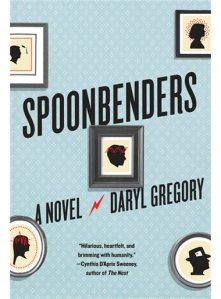
Spoonbenders by Daryl Gregory tells of a family in which each member possesses a psychic gift that may also seem like a curse. One of the characters in this entertaining book is truly an original in today’s literature. Buddy Telemachus has, since early childhood, seen the future. An observer might assume he suffers from a severe obsessive disorder or worse, but his behavior is that of a man desperate to avoid altering the future he sees and at the same time to save his family, even though he’s convinced his own timeline is running down to an early oblivion. I love (and weirdly understand) this character. Gregory’s story is addictive. Here’s a brief rumination by one of the main characters, (the obviously fuddy-duddy) Teddy Telemachus:
“The problem with getting old was that each day had to compete with the thousands of others gone by. How wonderful would a day have to be to win such a beauty contest? To even make it into the finals? Never mind that memory rigged the game, airbrushed the flaws from its contestants, while the present had to shuffle into the spotlight unaided, all pockmarked with mundanities and baggy with annoyances: traffic fumes and blaring radios and fast-food containers tumbling along the sidewalk. Even an afternoon such as this, spent cooling his heels in a well-appointed park, under a sky as clear as a nun’s conscience, was chock-full of imperfections that disqualified it from top ten status.”
~~~
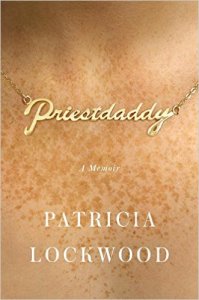
Priestdaddy by Patricia Lockwood is simultaneously hilarious and clever. It’s also strangely familiar, as if odd families wherever they may be still run on the same current. The author is a poet and precise writer. On nearly every page are passages so perfect they linger like chewy literary caramel.
“I sometimes wish my childhood had been less obsessed with the question of why we are here. But that must be the question of any childhood. To write about your mother and father is to tell the story of your own close call, to count all the ways you never should have existed. To write about home is to write about how you dropped from space, dragging ellipses behind you like a comet, and how you entered your country and state and city, and finally your four-cornered house, and finally your mother’s body and finally your own. From the galaxy to the grain and back again. From the fingerprint to the grand design. Despite all the conspiracies of the universe, we are here; every moment we are here we arrive.”
~~~
Jewelweed by David Rhodes is a multifaceted and marvelously written book. It’s told from many viewpoints—a chronically ill child, a wary young mother, a minister, an ex-con, a long-distance trucker, and many more. Each character reveals him or herself in quietly brilliant observations. For example, here’s a thought shared by Winnie, the minister.
“Winnie cherished Jacob’s need for passion from her, and sometimes imagined that his consciousness consisted primarily of an awareness of his own sexual instinct–his own gateway to rapture. Thankfully God had created this vital opportunity for bliss, yet Winnie remained convinced there were many more avenues that could be followed to divine pleasure. People could become hyperconscious in countless ways. It was possible. The sight of a hummingbird–along with the sound of its thrumming wings–once revealed to her how she had long ago lived with tiny black feet and a nectar-searching tongue. Her shoulders remembered the thrilled rhythms. On another occasion, the taste of a strawberry related its entire history of self-propelled spirit into matter. All human sensations could, she believed, provide paths to the same state of ecstatic worship. The principalities of civilization had hidden most of these gateways to heightened awareness, however, and for most people now, the only way back to the blessed original state involved a spectacular sexual event. And while Winnie rejoiced as much as anyone else in extraordinary sexual events, she sometimes feared that keeping the species alive had nearly replaced being alive, as if the entire galaxy of spontaneous felt-unity threatened to become perversely focused on one narrow impulse.”
~~~
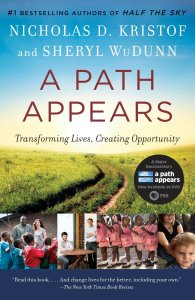
A Path Appears: Transforming Lives, Creating Opportunityby Nicholas Kristof and Sheryl WuDunn is, like their equally compelling book Half The Sky: Turning Oppression Into Opportunity For Women Worldwide, simply remarkable. The authors write about social ills and social progress, but in both books they do so through the stories of people who are making positive changes. These books carefully analyze the evidence to help us understand how any of us can make a difference. Truly heartening and important reads, both.
“Let’s recognize that success in life is a reflection not only of enterprise and willpower but also of chance and early upbringing, and that compassion isn’t a sign of weakness but a mark of civilization.”
~~~
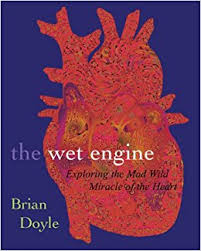
The Wet Engine: Exploring the Mad Wild Miracle of Heart by Brian Doyle, who passed away last year at age 60, leaving 20-some books. Too few from such a gifted, gentle soul. The impetus for this book began when Doyle’s infant son needed several heart surgeries. The boy grew up healthy, yet the author writes,
“Not a day goes by, not one, that I do not think of my son, tiny and round and naked and torn open and heart-chilled and swimming somewhere between death and life; and every day I think of the young grinning intense mysterious heart doctor who saved his life; and for years now I have wanted to try to write that most unwriteable man, to tell a handful of the thousands of stories that whirl around him like brilliant birds, to report a tiny percentage of the people he has saved and salved, and so thank him in some way I don’t fully understand, and also thank the Music that made him and me and my son and all of us; and somehow it seems to me that the writing down of a handful of those stories will matter in the world, be a sort of crucial chant or connective tissue between writer and readers, all of us huddled singing under the falling bombs and stars; and more and more over the years I have become absorbed and amazed at the heart itself, the wet engine of us all…”
This book meanders, as the passage above meanders, into faith and science and healing. I found myself reading parts of it aloud to my husband because they were just so beautiful. It’s a perfect read for anyone, at any age, who has had heart trouble. Also perfect for the rest of us because we have hearts too.
~~~
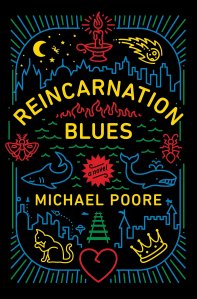
Reincarnation Blues by Michael Poore centers on Milo, who hasn’t yet reached perfection and is nearing the cosmic limit of 10,000 incarnations. An added complication —Milo is in love with Death (who prefers to be known as Suzie). It’s a clever plot, allowing author Michael Poore to change voice and tone as he shows us dozens of these lifetimes. Some, including Milo’s life as a meatpacker, offer an insightful view of human motivation. The book is packed with tiny delights, like the occasional homage to Where The Wild Things Are. It’s also illuminated by passages like this one when Milo is trying, but failing to meditate:
“But it can’t be helped, because it’s not just your head, is it? It’s the head and soul of all the voices of all your ten thousand lives and eight thousand years and all their pasts and futures, all the cavemen and race-car drivers and milkmaids with pale cheeks, all the spacemen, crickets, economists, and witches. The voices are full of the things people are full of, the things they will carry with them into whatever future takes shape, things like waffles and hard work and things you hope no one finds out.”
At times I found the whole pretense of perfection a bit of an overreach. The between-life portions of the book felt frustrating, especially when Milo had just done something damn useful or deeply compassionate in his past life, but it still wasn’t perfect enough. If, as Reincarnation Blues insists, each soul is charged with achieving something amazingly transformative before ending the cycle of rebirth, Earth itself would be Nirvana. Or maybe that’s the point.
~~~
There are so many more books I want to talk about, but let’s hear what books are captivating you lately. It may be just the thing someone else needs to read.
Take a photo of a book title that perfectly epitomizes your day and share on social media.
Read in a cozy retreat like a hammock, tent, yurt, tree fort, whatever sounds cozy to you.
Pay attention to Library Angels. This is the name given to reading materials you aren’t looking for that somehow appear in your life and turn out to be exactly what you need. Here’s a peek at the strange history of book synchronicity.
Leave a Post It note to the next reader of a library book. Maybe a simple, “Dear Next Reader, I hope you enjoy this book as much as I did. warmly, Previous Reader.”
Name a child after a literary character or author. There are plenty of lists online like Flavorwire, MomJunction, and Babble but chances are, your name and the names of your family members have probably already shown up in literature. Just do a search for “name fictional character.” (My kids’ names are found in the classics, in Star Wars, and in video games although we actually chose names that seemed wise and gentle.)
Bestow literary names elsewhere in your life. When I was a kid, my pink bike was named after a fictional horse. Over the years we’ve given cows, chickens, and dogs some lofty monikers. I tend to name things around the house too, like our vacuum and our kefir starter…
Try the read and release method with BookCrossings. Once you’ve read and enjoyed a book, simply go online to print out a label, then leave your book in a public place like a coffee shop, playground, or waiting room. The label assures others the book is free to anyone interested. The label also contains a code so readers can track and follow books as they are read, discussed, and released again elsewhere in the world. Currently, nearly 12 million books are traveling through 132 countries.
Read under a tree or in a tree or anywhere in nature that inspires you.
Stay up all night to finish a book.
Buy a copy of a book you appreciated and send it to a friend, just because. Do this often.
Whenever possible, buy your books from local brick and mortar bookstores. And get to know the people who work there, they’ll have excellent book suggestions. (But beware. I was thrilled to see a bookstore open not far from me. Although it quacks like a bookstore, it doesn’t act like one. It has lots of local authors and locally made bookish crafts with a token array of bestsellers, but it turns out the owner charges “partners” a non-refundable application fee of $75 to have their book or products sold there for a limited period of time. I cannot imagine what will happen to authors if such a model becomes commonplace.)
When you buy books online, consider steering your dollars to an ethical business or non-profit like Better World Books or Biblio.
Eat what characters are eating in the book. Thick inviting sourdough bread while readingSourdoughby Robin Sloan, hot fish and corn muffins while reading Their Eyes Were Watching God by Zora Neale Hurston, authentic bird’s nest soup while reading The Wangs vs. the World by Jade Chang, peanut butter bar cookies topped with chocolate while reading Kitchens of the Great Midwest by J. Ryan Stradal, nachos with cheese sauce while reading The Nixby Nathan Hill, a hearty sandwich of the sort served at The Bistro, in nearly any of Louise Penny’s Chief Inspector Gamache Series (sign up here to get a free download of Three Pines recipes).
Connect with your favorite authors on social media. Link to them with a meaningful quote or the way their work changed your outlook. Want more suggestions for showing authors your love? Here are 17 ways.
Let what you read inspire your own work. As Austin Kleon, author of Steal Like an Artistsays, “Read deeply. Stay open. Continue to wonder.”
“Music is the universal language of mankind.” ~Henry Wadsworth Longfellow
Andrew Schulman was born so ugly that his grandmother refused to believe he belonged to their family. She insisted the hospital investigate to make sure there wasn’t a baby mix-up. Many years later, his cousin Miriam told him the nurses felt sorry for that disputed lone baby in the nursery, so they held him and sang to him all day. “Show tunes,” she said. “I heard them when I was there. It was so lovely.”
He writes in his new book, Waking the Spirit, “I like to think that my brain was wired in the nursery by the healing power of music.”
Andrew grew up to become a successful musician. He plays Carnegie Hall, the White House, and throughout Europe. He has three CD’s, an active performance schedule, and an enjoyable life with his wife in NYC. His life, however, changed when he went in for surgery.
The operation was a success but on the way to recovery he suffered a rare reaction and was clinically dead by the time they rushed his gurney out of the elevator. Although they managed to resuscitate him in surgical intensive care, they couldn’t stabilize him. Doctors put him in a medically induced coma for several days, but his organs began to fail. He was not expected to live. His wife, desperate, asked permission to play music for him. His favorite piece, Bach’s “St. Matthew’s Passion” popped up on his iPod. After a half hour, still apparently unresponsive, his vital signs began to stabilize. Confounding doctors, he recovered quickly over the next few days.
As Oliver Sacks once said, “Nothing activates the brain so extensively as music.” Andrew explains in his book, “Music reaches neural networks, including some of the most primary…. such as the brain stem, the cerebellum, and the amygdala. Music then initiates brain stem responses that, in turn, regulate heart rate, pulse, blood pressure, body temperature, and muscle tension…. ”
We know that music chosen by parents and performed for premature babies for a few minutes at a time helps to calm them, resulting in longer quiet-alert states and easing pain. Music sung by parents has a beneficial effect throughout infancy. Babies respond to music, even regular drumbeats, with increased smiling. In fact research shows that babies correlate their movements with the tempo and rhythm. They dance! And music gets a much greater response than spoken words. No wonder adults all over the world naturally engage babies in a sort of singsong-like call and response. We’re translating our language into one that is more evocative to mind and body.
Music makes a difference at the other end of life too. Studies of music in hospice care show it can reduce anxiety, pain, and fatigue while enhancing mood, energy, and sense of spiritual comfort.
After Andrew fully recovered he made his way back to the same surgical intensive care ward at the same hospital. This time as a musician. Three times a week, every week, he enters the SICU, walks through the ward guided by intuition as much as beeping monitors, then sits at a bedside and begins to play.
People on this ward are very ill. They’re likely in pain and afraid. They may be in and out of consciousness, even comatose as he was. He plays all sorts of music for them, happy to honor requests by patients, family members, and staff. But he’s found music by certain composers has the greatest healing effect — Bach, Gershwin, the Beatles, along with Franz Schubert’s “Ständchen” and, strangely enough, “Bohemian Rhapsody” by Freddy Mercury.
In his experience, Bach’s music is the gold standard. It almost magically seems to increase alertness, reduce pain, and stabilize vital signs. Neuromusicologist Arthur W. Harvey agrees. Andrew quotes Dr. Harvey, “Of all the music we tested in medical school with patients, colleagues, and others, Bach’s music consistently made the brain work in a balanced way better than any other genre.”
Dr. Harvey and students studied the effect of music on the body using brain scans, focusing on seven genres: chant, Baroque, classical, gospel, new age, jazz, and folk. After two years they concluded Baroque era music most effectively “…stabilized the different rhythms of the body and mind — mental, physical, and emotional — which allowed for greater concentration and focus. Bach’s music consistently showed the best results in this regard.”
Andrew tries to unlock what it is about Bach. “…Bach’s music utilizes both chordal music (music characterized by harmony) and contrapuntal textures (the interweaving melodies) somewhat equally, which provides for music processing in both left and right hemispheres of the human brain. A descriptive characteristic of his music and music of his time is the significance of balance… You hear sounds that are soft and loud, high and low, short and long. Rhythms that are slow and fast, simple and complex. Melodies and harmonies that have enormous stylistic variety.” Such music stimulates brain functions without overload.
Andrew goes on to note that healing music often comes from composers who themselves suffered from depression and other forms of mental illness. Perhaps despair transmuted into beauty more profoundly eases other people’s suffering.
I can’t help but consider all that troubles our beautiful world. When music helps to lift the individual mind from unconsciousness to consciousness, surely music helps to lift our collective awareness as well.
After all, music is used to lull small ones to sleep, rouse teams to victory, woo lovers, deepen worship, commemorate solemn occasions, and celebrate joy. Throughout history, music has been a traditional way to bring peace and justice. Through music we more fully grasp that all of us feel grief, love, fear, injustice, delight, and moments of transcendence. Let’s play one another into a more loving world.
“This will be our reply to violence: to make music more intensely, more beautifully, more devotedly than ever before.” ~Leonard Bernstein
We know how to love celebrities and athletes in our culture. We hashtag them, go to their performances/games, read about them, imitate them, talk about them, and in many other ways make these people an ongoing presence in our lives. (Note: there may be a strange reason we’re so obsessed with celebrities.)
It’s less common to love writers, far less common to show it.
Today’s publishing houses expect authors (other than the most commercially promising ones) to do their own book marketing. We’re expected to blog, tweet, arrange book signings and readings, do interviews, and otherwise connect with potential readers as if there’s nothing awkward about begging people to buy our words.
But we know that books, articles, essays, poems, posts, (actually, all forms of writing) live on only when they’re read. It’s even better if they’re discussed, shared, and remembered. My writer friends and I do our best to promote one another’s work to a wider audience. Most writers do this for each other. If you’re inspired, take a tip or two from us and show some authors yourlove.
Share a great author interview or book review. Share a passage from a book, article, blog post, or poem. Toss it out there on Twitter, Instagram, Facebook, whatever platform you use.
Quote. If you’re writing a report or giving a presentation, sprinkle in a relevant quote or line of poetry. It’ll add another dimension to your work.
Review books you love on Goodreads.com, LibraryThing.com, Amazon.com, BarnesandNoble.com, wherever you go to check reader reviews. You can make it easy on yourself by simply leaving a bunch of stars. Take it up a notch with a glowing one-line opinion. On Amazon, you only need to click “like” to boost a book or other people’s reviews of the book. Your viewpoint really does help potential readers find what to read next.
Give books as gifts. They make wonderful presents for birthday, holidays, and milestone celebrations. They make wonderful business gifts for clients and great promotions for related products. They’re great to give simply when it occurs to you that a specific book and a specific person might go well together. Give books to children for special occasions but also for fun. Don’t forget to leave an inscription even for the youngest. If you like, pair a book with a small related present. Tea, coffee, or something more spirited is a perfect accompaniment to any book gift.
Try something different. Indulge in your favorite genres and let yourself branch out from there. A fan of historical novels set in a certain era? Try poetry from that time period, non-fiction books about the art or science of the era, biographies of people from that time, as well as history magazines and related sites. I’ve come across writing I normally wouldn’t read only to discover a passion for science-y novels, tomes on evolutionary biology, sites offering vintage maps, work by outsider artists, and other fascinations.
Request. I couldn’t possibly afford to buy a fraction of the books I read. Instead, I’m a unrepentant library addict. If there’s a book you’d like, order it from your local library. They’ll call or email you when it’s available. If they don’t own a copy, ask them to purchase it. Some library systems put request forms online, other systems prefer you go directly to a librarian to request a book acquisition.
Hang out with other book lovers. I’m a long-time member of a book club. It prompts me to read books I wouldn’t normally read and our wide-ranging discussions are a delight. And our boys’ book club lasted till our kids all went off to college, over nine years of lively bookish gatherings. You can start up a book club with friends or join an existing group. Check out nearby clubs through Reader’s Circle, your local library, or Meetup.
Offer books for sale through your business. If you have a bike repair shop, offer guides to bike trails along with some bike-riding memoirs. If you run a stand at a farmer’s market, offer a few cookbooks and urban farming volumes. If you own an art gallery, sprinkle a few poetry and art books among your offerings.
Give magazine subscriptions as gifts. There’s a wealth of not-so-mainstream options, from boat-building magazines to literary journals to kids’ science publications.
Recommend. Create your own list of favorites on a topic via Amazon’s Listmania. Perhaps “Little-Known Poetry Books You Should Read…” or “Alternative Education Books We Use….” While you’re at it, search all the Listmania lists of interest to you.
Link. An insight or idea sticking with you? Link to (or at least attribute) books or author sites when you write about ideas they’ve prompted in you.
Expose local authors. Ask an author to serve as an expert, answering a question or two for an interview to be published online or in print. Invite an author to do a reading or give a talk to your organization, club, or business either in-person or via Skype. Talk up local authors with people you know.
Promote. The Southern Independent Booksellers Association started a YouTube channel called Parapalooza! Submit a video of yourself reading a passage from a favorite book to parapalooza@sibaweb.com. If you live in the UK, contact Steve Wasserman of Read Me Something You Love. He’ll come out to record your reading of a passage you choose, along with some conversation. If it’s poetry you adore, read one you love aloud for Record-a-Poem. You can also reach out to others in your community who’d like to share a favorite poem through the Favorite Poem Project or start up a poetry-sharing group on Meetup.
Read already. Titles piling up on your Kindle, overdue library books, a teetering stack of magazines next to the couch are all evidence that you want to read. But you’ve got more to do than you’ve got time. Admit it to yourself, you’ll never defeat your in-box. Might as well go lie on the grass or in the tub or on your couch and read!
Connect. Follow authors on Facebook or follow their tweets. Write to them care of their publishers. You might send a brief note about how much you enjoyed a book or how it or improved your life. You might send suggestions, questions, a cheerful aside. Writing is a solitary occupation. When an author hears that his or her work made a difference, I guarantee it’ll have an impact. On a few rare occasions readers of my first book let me know it changed the way they parent or educate and how that’s impacted their lives. These communications are the sort of wealth I’d never believed possible. Utterly priceless.
Some days I like to imagine a world where we love our writers and artists and scientists and volunteers with the same passion we show celebrities. A girl can dream.
Alejandro Mallea’s flickr photostream
“The writer’s way is rough and lonely, and who would choose itwhile there are vacancies in more gracious professions, such as, say, cleaning out ferryboats.”
This volume should really be titled A Guide to Being Human. I recommend you read only a page or two at a time. Let it sink in. Apply it. Revel in it.
It’s authored by game designer and deep fun theorist Bernie DeKoven. I got the chance to interview Bernie last year and immediately found myself wishing he were my next door neighbor. (I still do.) For 40-something years Bernie has been promoting playfulness. He was instrumental in the New Games movement and a pioneer in computer game design. He’s developed games for the likes of Lego, Ideal Toy Company, Mattel Toys, and Children’s Television Workshop. He’s collected little-known games, created new ones, researched the value of fun, and organized all sorts of play events.
The book is actually titledA Playful Pathand it’s jam-packed with awesomeness. It’s made up of tools and ideas to inspire the possibility-building, wide-open glory of playfulness. DeKoven writes,
Fun is at the heart of things—of things like family, marriage, happiness, peace, community, health; things like science and art, math and literature; like thinking and imagining, inventing and pretending.
Sure, the playful path can enhance relationships, advance careers, and promote health. It can also help us deepen into who we truly are, beyond the limits of rules and score-keeping. As DeKoven calls it, becoming “embiggened.”
For adults, following a playful path is a practice, something you put into practice, and then practice some more. When you were a kid, it wasn’t a practice. It was what you did, always. You had to be reminded not to be playful. And you were. O, yes, you were. But now that you have become what you, as a kid, called “an adult,” you find that play is something you have to remind yourself to do, playful is something you have to allow yourself to be.
And once you again take up that playful path you knew so well, you discover that it’s different, you’re different. You can play much more deeply than you could before. You are stronger, you understand more, you have more power, better toys. You discover that you, as a playful being, can choose a different way of being. A way of being as large as life. A way of being you, infinitely.
Written in short one to two page segments, A Playful Path is perfect to read on an as-needed basis, sort of an antidote to all the not-fun that drags us down. A Playful Path is an entertaining book. It’s also wise, true, and entirely useful. Just like play. Get your copy in paperback or as a free e-book.
One week during the summer I was twelve, I had a crisis.
I ran out of library books.
Sure I rode my bike, went swimming with friends, and listened to music trying to figure out what the lyrics meant but I also indulged in hours of reading every day. Books transported me. My mother would call me to dinner and I’d look up, astonished to find I wasn’t a wolf on the tundra but a girl in shorts lying on the carpet. Or someone would knock on the bathroom door and I’d remember that I was soaking in the tub, not eluding soldiers in a medieval battle.
My parents supported reading, but they had no problem saying “get your nose out of that book and go outside.” They didn’t take us to the library more than two or three times a month, so the stack of books each of us brought home had to last.
When I realized I was bookless, I turned in desperation to a volume my older sister read as a class requirement. It had tiny print and a not-too-inspiring title, The Scarlet Letter. “It’s too hard,” she told me. “It’s a classic.”
I didn’t know “classic” meant it was good for me, like a bitter vitamin tablet. I insisted I was out of other options.
I promptly fell into Nathaniel Hawthorne’s words. They were exquisite in a way I’d never experienced, centered on the inner life and all its convolutions, something I already knew well but didn’t have the sophistication to express. I wasn’t aware such books existed. Instead of racing through it, as I did with every other book, I savored it. It felt as if I could run my fingers over the page and feel the texture of shame and longing. When I finished I was newly in love with the idea of classics, so I got books by Charles Dickens out of the library. I worked my way through two of them that summer although they didn’t live up to my great expectations. I thought Dickens droned and was nothing like Hawthorne.
Several years later I had to read The Scarlet Letter for English class. Everyone grumbled when assigned more pages to read. Those piercing insights, when listed in bullet points on the board, didn’t sink into my heart. Lectures and assignments obscured the book’s beauty. I didn’t read it with a cloak thrown over my head or the prick of a rose thorn in my skin. It lay dead, like a victim on the autopsy table.
Then I realized that my love of books had developed entirely outside of the classroom. I’d never really fallen in love with any of the books assigned in school, although the ones our teachers read aloud after recess, a few pages a day or an entire chapter on special days, still stood out in my mind. Reading, for me, was about pleasure. It was more than a habit, it was an integral part of my being. The books I read helped form my outlook and character. I dare say that many of us, if we look back, will find that favorite books from childhood have a surprising link to who we are today.
If I could, I’d reclaim reading for all of us, from earliest childhood on, as pleasure first and foremost. Turning to the written word for information and edification then becomes a pleasure too.
Tendingrises from my life on the farm and my fascination with the world at large. Informed by quietly ordinary days, these poems look into the nature of things with questions that circle the stars. I’m thrilled that the cover photo is by talented artist (and my sister) Cynthia Piper.
“Laura Grace Weldon employs radical empathy to enter into the hidden lives of rutabaga, cows, the neighborhood bully, and the beating heart of life itself. Playful, curious, sensual, she aims to open the reader’s eyes and heart.”
“Laura Grace Weldon’s poems remind us that our world’s necessary brushes between nature and technology, human and animal, are not necessarily ones of friction. Instead, Weldon sees these moments as truly wondrous ones, available to us not only on the farm, but also in the back pocket of a window washer, swinging among the skyscrapers.”
“Memory, faith, and the natural world as both witness to the cycle of human life and healer to a questioning heart are at the core of this lovely and lyrical collection of poems. The weather changes, people come and go from cities and towns, babies are born, grow up and depart from their parents’ arms, but still, the countryside and its rituals sustain the people and creatures who know how to read the signs of the seasons. In these pages, Laura Grace Weldon shares those signs with us; her poems are the fruit of a wonderful harvest.”
(My friend Penny, from Dubai, suggests I share a sample. Here’s a poem from the first section, one no journal accepted although there are so few odes to root vegetables…)
Sure, I have other, less socially acceptable habits. We can talk about those another day. Right now I’m trying to convince you to become a fellow library fanatic.
I’ve already been successful with my kids. The stacks of books my family brings home may be pushing up the state average. Now that my kids are older they are surprised most of their peers don’t bother with libraries, in person or online. And I’m surprised to see how many of my friends don’t use libraries either. Some haven’t been since high school. For those of you who don’t bliss out over libraries, or worse, dismiss libraries as dim places with a distinctive old book smell, here are the ten best reasons to get hooked on libraries.
*
1. Magic water.
As a small child, I was convinced there was something magical about the water coming out of our local library’s drinking fountain. It tasted better than any water, anywhere else. I assumed this had to do with its enviable proximity to all those books.
When I had my own children, I intentionally carried on the magic water belief. And they’ve always been able to taste the difference. Although I realize there’s no factual basis for this, library water still seems more deeply refreshing than ordinary water. See for yourself!
2. Awe.
A much more vital magic is evident in libraries around the world.
It has to do with a sense of history, of freely shared knowledge, and awe-inspiring architecture. When traveling I make sure to hang out in libraries. Most recently I found time to soak up the atmosphere of one of NYC’s awesome libraries.
People become librarians because they know too much. Their knowledge extends beyond mere categories. They cannot be confined to disciplines. Librarians are all-knowing and all-seeing. They bring order to chaos. They bring wisdom and culture to the masses. They preserve every aspect of human knowledge. Librarians rule. And they will kick the crap out of anyone who says otherwise.
Our taxes pay for them whether you use them or not. Only suckers don’t get in there to scoop up books, magazines, movies, digital downloads, recorded books, electronic readers, programs, classes, performances, and more. My kids and I have strolled out after a library visit with well over 100 items checked out on a card or two.
Today’s libraries offer much more than well-worn books and a chaotic Story Hour. Click over to your library’s website. You’ll find an amazing array of offerings well beyond the newest bestsellers. There are probably programs to get you started in fencing or felting or fraternizing with fellow foodies, just this week alone.
*
5. Ordering.
OMG, I love ordering materials. In my area library systems are linked, so holdings can be sent from libraries in quite a few counties right to my own little branch. I can read a review of a book before it’s released, then go to the library site to pre-order it. I can order special book group offerings for our book group (up to 20 of the same book) that come organized by some saintly librarian with supplemental materials. I order obscure specialty books that were published back in the 1920’s and earlier.
We’ve homeschooled on the cheap thanks to our library system and the wonders of ordering materials. No way could I afford to expose my kids to the depth of information and range of experiences they’ve gained via libraries.
*
6. Online renewal.
I don’t know about your library system, but mine permits renewals up to five times. Online. That gives me several months to adore most materials. Those months are necessary. I use books in my work, take them with me to ward off dull moments, and leave them around the house for family members to pick up when their eyeballs are unoccupied.
Sometimes I find books so precious that when they are finally and irrevocably due, I end up buying a copy. But let me point out, I only buy books after proving their worth to myself. No regrettable book purchases here. Yay savings.
*
7. Library privileges.
I’ve been in a steady human relationship for a loooong time, but I’m a non-monogamous library user. Judging by the number of library cards in my name, I’m a pushover for the sweet allure of any library’s New Acquisitions section.
It’s hard to unearn library privileges. Late fees are usually minimal and in many systems there are no late fees for seniors, teachers, and homeschoolers. Even when my account is labeled “delinquent” due to a late book or two I’m still able to check out and reserve materials. I don’t mind a few dollars here and there to make up for my late return crimes. Totally worth it. Unlike most human relationships, my library is always buying me something new, forgiving me when I atone, and consistently planning unexpected ways to lure me.
*
8. Research databases.
Library systems subscribe to pricey online database services that none of us could afford on our own. I access most of them from my home computer, simply logging in with my library card number. These databases include genealogy, academic research, news archives, digital images, health, and much more. I relied almost entirely on the resources of my award-winning Medina County Library for the research necessary to write my book.
*
9. Book Zombie Fuel
sundaykofax via Flickr, CC by 2.0
A wealth of materials is essential for those of us who are Book Zombies. We absolutely must gorge on fresh brains books, feeding an insatiable hunger for that oblivious-to-the-world swoon we call reading. We don’t hear or see what’s happening in our “real” lives when lost in a book.
Libraries feed that hunger, gladly buying books for us and storing them until we’re ready for more.
*
10. That smell.
Libraries don’t smell like someone’s musty basement. The odor is something entirely different. I’ll tell you what it reminds me of, right after I tell you about how much I appreciate Russian language library materials.
For five summers we hosted a little girl from Belarus through the Children of Chernobyl project. And every summer before she arrived I called the librarian in charge of the foreign language collectionat the Cleveland Public Library. We talked over Tatiana’s age and interests, then every few weeks through her three month stay this librarian sent to our rural library branch a wonderful selection of Russian materials including Harry Potter books, children’s magazines, recorded children’s books, popular music, and much more. When my kids curled up with books or went to bed listening to CD’s, Tanya was able to do so as well. I hoped it eased the hunger she must have felt to hear her own language. Beyond that, it built connections between us almost immediately.
The first day she arrived, exhausted from long flights and weak from some medical problems, there was no way we could really communicate. It became obvious that our efforts to learn Russian had been laughable and as a seven-year-old her grasp of English was limited to “yes” and “thank you.” Then I remembered those blessed library materials. In a few minutes all of us were dancing to the Russian version of “Hokey Pokey” and laughing before collapsing in a heap on the couch together to giggle as we paged through a Russian/English picture book, challenging each other to pronounce the words. That stack of Russian library materials smelled, more than anything, like home. To me, every library smells like my place. Bet they smell like your place too.


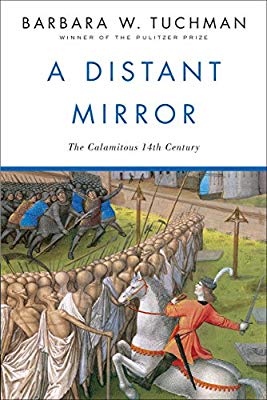 During a hard time in my life, when I was really struggling with despair over the state of the world, I found myself dragging through the nearly 800 pages of historian Barbara Tuchman’s
 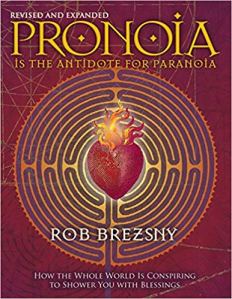 A few years later I ran across a far more directly life-enhancing book,
 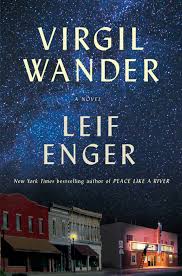 Virgil Wander
  Spoonbenders
 Priestdaddy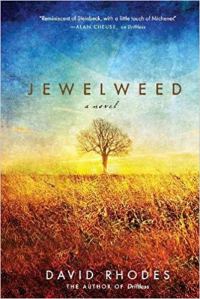

 ,
,  ,
,  ,
, 
 ,
, 
 ,
, 

 by Scott Russell Sanders,
  by Haven Kimmel, and
  by Paul Feig. Beautifully written, unforgettable novels such as
  by Anthony Doerr,
 by Ann Patchett, and
  by Leif Enger. Animal books, a worthy indulgence, including
  by Sy Montgomery and
  by Steven Kotler. Sci-fi like
  by Dorothy Bryant and
  by John Scalzi
 by David Eagleman. Really, read these books!

 . Oh, and be sure to bookmark his


 and
and 
 and
and  .
. and
and  .
. .
.




 Laura Grace Weldon