Ask any child. When adults meet them for the first time, standard questions include, “What do you want to be when you grow up?” right after classics like, “What grade are you in?” and “What’s your favorite subject?”
Such questions, unintentionally, gauge a child’s progress toward adulthood. That’s because adults tend to be future oriented. We’re distracted from the present moment by the need to plan and work toward any number of goals—what to do about dinner, how to juggle next week’s schedule, when bills can be paid. These distractions take our attention away from what is in the here and now. When we think ahead so often we have less time to notice, let alone appreciate, what makes up our lives minute by minute.
What is impatience except denying the value of the present moment? The watercolor effect of rain on the window, the meandering quality of a child’s conversation, the long wait for a pot to boil—these can be occasions to experience impatience or opportunities to breathe deeply and be present, gratefully.
Leaning so often toward the future unconsciously demonstrates to our children that later is more important than now. Yet as we know, later never comes. As long as we’re alive there’s always “later” to strive toward. Worse, we are surrounded by advertiser-driven messages telling us that we aren’t there yet, that we need to do more or become something more in order to have friends, be successful, find love.
The nature of early childhood is the perfect antidote to this hurry-up attitude. That is, if adults truly pay attention to the lessons the youngest model for us. Young children who are not yet pulled by the adult world’s messages are oriented to the present moment. When forced to disregard what is vital to their bodies and spirits—pretending, daydreaming, playing, snuggling—they rebel. They are who they are, where they are. They’re not caught up in the future tense which dimishes the here and now. They demonstrate the oldest way of knowing.
Pay close attention to the youngest children in your life. Let them help you learn solutions to our cultural overdrive.
As we slow down we have time to truly know each other and to truly know ourselves. We’re more aware of the messages our bodies send us and can act on those signals before they become symptoms. We have time to reflect. Time to remember our dreams when we awaken. After all, time is the only true wealth we have to spend.
While waiting with other members of our food co-op, someone who should think of other ways to start a conversation asked me a cuttingly critical question. I couldn’t even come up with an answer. That’s not like me. The best response I could muster was a fake laugh, as if to acknowledge that she must have been joking. (She wasn’t.) Her question seemed to be more curious than mean spirited but it forced me to think about how other people see me.
I thought I’d let Beauty go, along with her twin sister, Shame, long ago. Apparently not.
Some people look amazing all the time and at any age. They know what clothes are in, what accessories to use, how to walk in fussy shoes gracefully. I’m impressed by them even if they seem like a species only faintly related to my comfortably slouchy self.
My presence makes people who are fashion backward and technologically inept feel much better about themselves. Clearly there are perks for hanging out with me. But apparently I give so little thought to my appearance that others might come away with the wrong impression. As my questioner put it, “You really leave the house looking like that? It must be easy when you don’t care.”
I churn through my days trying, and sometimes succeeding, in doing what good I can do even if on the smallest scale. I talk to people and animals kindly, try to listen more than react, and when I’m upset ask myself what darkness in myself lets me see shadows elsewhere. I write about natural learning and sustainability and peace. I support good causes and when times are hard, as they tend to be, I attach myself to hope like a barnacle. This leaves very little energy for personal beautification. Heck, I rarely muster up the ooompf to keep weeds from towering over my vegetable plants so there’s no way I’ll get around to using a blow dryer or nail polish. I’ve never had the money let alone the inclination to have a manicure or pedicure, go to a spa, or have my hair styled. Well, I’ve never actually had a hair style….
When I came home I emailed a few close friends. I explained I’d been at the co-op, where we unload a truck and do other labors befitting less-than-great clothes, so I wore jeans and an old embroidered cotton shirt, my hair tied up and scuffed clogs on my feet. Because I’m no saint, I described the unflattering horizontal stripes of the shirt my questioner wore and how it was a so tight that her form-fitting pants pushed bulges of flesh through at least three of those stripes. (I try to be non-judgmental. That day I failed.) Then I asked the most important question. I’ve never steered that question to appearances before. My friends were all ridiculously nice when really, I was hoping to know if it’s time to start dying my hair or stop wearing my daughter’s hand-me-ups.
I know we broadcast something about our self-esteem via our appearance. Still, I’m not any more motivated than I was before that day at the co-op. I tweezed an eyebrow once, back when I was a teen. It hurt at the tears-in-my-eyes level. Won’t do that again. There’s no way I’ll bother wearing earrings or remembering hand lotion.
But I’ve realized an appearance-based truth from all of this. My body, like everyone else’s body, gets used up by life. And that’s exactly how it’s supposed to be. Years of changing diapers, gardening, canning, washing dishes, kneading dough, and taking walks no matter the weather have left me with creaking knees and hands that belong on someone much older. These are all ways of using my body for a purpose. When I stroll off the planet I want to know that I’ve enjoyed all the health, vigor, pleasure, and meaningful work my body can generate.
During yesterday’s walk the wind was intense and it started to rain. My face and hands were pelted with icy drops from a beautiful still-bright sky. I should have left the house with a scarf and gloves but I didn’t turn around. I walked right into the wind, letting it toss my hair as freely as it blew the last leaves off the trees. I felt completely alive.
Interesting problems and exciting risks are life’s calisthenics. They stretch us in directions we need to grow. Children are particularly oriented this way. They think up huge questions and search for the answers. They face fears. They puzzle over inconsistencies in what is said and done around them. They relentlessly challenge themselves to achieve social, physical, or intellectual feats that (from a child’s perspective) seem daunting. They struggle for mastery even when dozens of attempts don’t provide them any success. It’s a testament to courage that they continue to try.
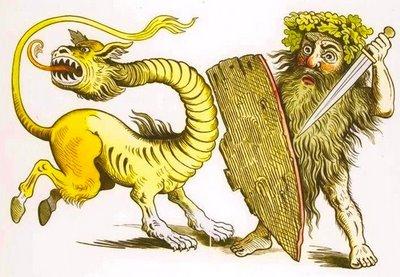
Illustration from ”Lustige Gesellschaft” by Franz, Count von Pocci
Sometimes children are accused of “looking for trouble” when they simply yearn to vanquish dragons of their own making. A child’s desire to challenge him- or herself is at times as unrelenting as physical growth.
As adults we do this in our own way. If we don’t have enticing challenges, we may develop a state of mental friction to compensate. It seems to be a very human trait to clutter up our days with trouble if we have no more engaging prospects. We worry, rehash old issues, overreact, or find complications where there may be none. As the roots of a plant become more tightly entangled once they are pot bound, an individual without the freedom to take on greater challenges often gets caught up in the same confining struggles.
Image by Keith Williamson
One thing we can learn from children is the way they are attracted to dilemmas that help them learn and grow. Children who are nurtured in a healthy, free range learning environment are invigorated by the challenges they seek out. They expand their own frontiers on a comfortable, self-regulating timetable. Perhaps people of all ages define themselves, in part, through the challenges they take on and the way they resolve those challenges.
Oftentimes we deprive children of normal day-to-day challenges because of our own time constraints. As adults we are often distracted and focused on moving forward. It takes considerable tolerance to keep from stepping in and doing for children what will take them much longer to do for themselves, such as solving problems, making choices, completing tasks, and accepting the consequences. But when we recognize that even these small challenges are catalysts for growth, it is easier for us to step back and let children face them as they occur. These are normal stressors. Dealing with them gives children the critical experiences that lead to self-reliance.
pdphoto.org
So much about today’s “managed childhood” has developed in order to prevent young people from making mistakes. We think we know the prescription for success, but as we’ve seen, a one-size-fits-all approach doesn’t allow individuals to thrive. It also denies them the very human right to learn in the way best for them and to listen to the callings that prompt them. The “right way” to proceed in our culture usually means health, popularity, good grades, attractiveness, college degree, career, marriage, mortgage, and so on. We’ve created these societal expectations largely to cushion our youth from mistakes. But error is inevitable even if we avoid all risks. That narrow, preordained path is anathema to genuine experience. Setting rigid standards for children sends a message. It says to them that failure is the worst outcome and that our acceptance is conditional.
What we might do instead is recognize that courage is required to go one’s own way, that mistakes are inevitable, and that the outcome is authenticity. The real challenge lies in accepting each person’s possibilities. That’s how each of us proceeds when we do what we can with what we have in order to live our lives fully. The path not taken may be the journey regretted forever. That’s why we need to honor mistakes as important passages in our lives too. They help us face the next challenge with a wry smile and new determination, knowing another lesson has been learned.
“We become what we think about all day long.” Ralph Waldo Emerson
Anastasiya Markovich
Long before I became an adult I launched a quest. This was inspired by a something that weighed on my childish mind, an urgent calling to alleviate the suffering of others. Even when I was a misbehaving little girl who ignored her chores and fought with her sister (often), I still felt the weight of this obligation. My parents cancelled their subscriptions to news magazines to avoid my questions as well as my despair over every sorrowful photograph. And my entire family dreaded driving past a chained puppy or crying baby, knowing that I would agonize the rest of the day over this momentary glimpse out the car window.
For some reason my quest took the form of trying to understand why people acted cruelly. So in my spare time I read everything I could find on the history of suffering, evil, and misery. I learned about the Inquisition, U.S.betrayals of Native Americans, the Holocaust, the genocide ordered by the Khmer Rouge in Cambodia—if it was awful I studied it. I worked my way through every book and resource possible.
Fritz Fuhrken
This project of mine stretched well into my teen and early adult years. It was grim. It haunted my dreams and colored what should have been youthful optimism. I began to realize that every single human has the capacity for cruelty. We just pretend we don’t. A bad mood may be contagious but the shadow we hide can wreak havoc on a personal and even a global level.
One day as I sat in the sunshine while my firstborn played nearby in the grass, my dear friend Leslie came over for a visit. She found me reading yet another horrific book, a stack of similarly dire non-fiction at my side. And she’d had it. She told me I was ignoring the beauty all around me to immerse myself in misery. She told me to look at the light shining on my child’s face, the bright green grass, and all the love in my life.
She was right, of course.
Still I defended my quest. I told her it was an obligation to know what was wrong with the world in order to right it. I waved around books that described the evils of pesticides, the horrors of factory farms, and the title I was currently reading, something about political prisoners.
She disagreed. She said it was time to focus on what was good.
I told her I was I finding good. What I read exposed me to heart-expanding accounts of people who demonstrated the best of humanity no matter their circumstances. Those who were dying of hunger, yet gave their last bit of food to others. Those who had no reason for hope but who kept art and music alive. Those who faced the worst despair, but did not give in to it. The best lesson I learned from years of study? Every single person has a choice, even if it seems there are no choices. That choice is the attitude they take.
Fluxx
It was time to work on my own attitude.
Gradually I stopped trying to understand and fight against all the reasons for suffering. I also became a little less frantic about doing everything possible to counterbalance the wrong I saw everywhere. I noticed that people in activist groups I belonged to faced the world with the same despair I felt, battling evil so fiercely that they had no way to expand on all the good that also flourishes.
So I began volunteering less time to lost causes, marched in fewer protest rallies, and gave up stomping around with petitions. I did more that seemed to boost the positive—gardening, singing to my babies, and guerilla acts of encouragement.
I became certified to teach non-violence workshops which I taught to school systems, incarcerated teens, and senior citizens. As I taught, the lessons sunk in ever more deeply. The long and life-affirming history of non-violence can’t help but heal a heart heavy with the world’s troubles. The process of non-violence—reacting with love rather than hate—is more empowering than any other force we humans have ever used. It transforms greed, intolerance, and cruelty. It’s humanity’s way forward.
It may seem difficult to sustain a positive outlook these days. My own family has been through grief, injustice, unemployment, and other sorrows. And our world struggles while formerly stable structures crumble. Just look at what’s happening to prescribe-and-placate medical models, inflexible financial institutions, condemning religious frameworks, and rigid corporations. But I believe these current conditions of breakup, economic chaos, and environmental decline are exactly those which are (slowly) leading to beneficial change. Collectively we’re waking up to the weakness of limited thinking and short-term fixes. Hopefully we’re also waking up to the reality that we’re in this together—rich and poor, developed and developing nations, young and old, left and right.
Jules Henri Lengrand
I’ve come to believe a better world is made by building on what works rather than focusing on what’s broken, as long as the truth is told about that brokenness and healing is sought.
The world has seen a 70 percent decline in the number of high-intensity conflicts since the end of the Cold War era. Genocide is down 80 percent. Weapons sales between countries have diminished by 33 percent and the number of refugees has fallen by 45 percent. Even measuring from as little as 15 years ago, the number of armed conflicts has dropped from 44 to 28.
Why? Project Ploughshares credits peace building efforts.
Chances are, the reasons for peace are complex. Yet a stronger international resolve to focus on peace building and basic human rights is taking place. Imagine the far larger potential for enduring peace if we intentionally educate our children and ourselves in the proven methods of non-violence—-negotiation, mediation, reconciliation, even basic listening skills.
2. Freedom is stretching across the planet.
By evaluating variables including civil liberties, democratic institutions, and independent media it’s possible to assess how free each nation in the world really is. Back in 1973, 29 percent of nations were deemed free, 25 percent partially free, and 46 percent not free.
In a little over 35 years, the number of nations ruled by authoritarian regimes dropped from 90 to 30. Countries around the world considered to be free increased by 50 percent while those not free had dropped by more than half.
Independence has a long way to go. But positive signs—protests, dissent, political upheaval show us that ordinary people are speaking up for freedom.
3. Longevity is improving yet total population faces a downturn
Fulfilling the cherished hopes of their parents, more children around the world are born healthy. Mortality rates for those under five years of age have fallen by 60 percent since 1960.
Meanwhile, life expectancy has risen 21 years since the mid 1950’s. Try to suppress your optimism while looking at this analysis of longer lived well-being around the world.
This doesn’t mean the planet will be too crowded. Overall population will continue to rise for several more decades but we’re facing a major downturn. Already birth rates are near or below replacement rate in countries all over the world. Increased education and affluence tend to inspire women, no matter what country they live in, to invest their time and resources in fewer children. As Fred Pearce clearly explains in The Coming Population Crash: and Our Planet’s Surprising Future, our little Earth will likely reach a (painful) peak of 8 billion people around the year 2040, then the total number of human will begin to decline so rapidly that nations will struggle to keep their populations levels from slipping too low. They may create perks for becoming parents and incentives to attract immigrants.
4. Literacy rates continue to improve.
Global adult literacy rates have shot up from 56 percent in 1950 to nearly 84 percent today, the highest ever.
Women’s rates haven’t risen as quickly due to inequality and poverty, but in some areas, particularlyEast Asia, 90 percent more girls are able to read than 10 years ago. As female literacy goes up, other overall positive indicators tend to follow including decreased domestic violence, improved public health and greater financial stability.
5. Intelligence is on an upswing.
From generation to generation, we’re getting smarter. In fact, to accommodate continuously increasing intelligence the IQ test must be renormalized (standardized to keep the average test results at the 100). This is called the Flynn Effect.
Between 1932 and 1978, mean IQ scores in theU.S.rose 13.8 points. If your grandparent received IQ score results of 98 back in 1932 they’d have been deemed of average intelligence. That same grandparent, if administered today’s tests, would be considered to have a borderline mental disability by current scoring standards. IQ scores have risen even higher in some other countries. Of late, developing countries seem to be experiencing the biggest surge.
Plenty of explanations have been proposed, but the increase can’t be definitively pinned on genetic improvements, improved nutrition, greater familiarity with testing or better schooling.
According to Cornell professor Stephen J. Ceci, the most direct gains are not in subjects that aretaught (math, vocabulary) but are shown in parts of the test that seem unrelated to schooling (matrices, detecting similarities). In fact, test gains have been enormous in areas requiring the child to apply his or her own reasoning, such as arranging pictures to tell a story or putting shapes in a series. Although teaching children does return positive results, what a child learns through the natural stimulation of everyday life has a more profound effect. For example, a study to determine the effect of schooling on rural children inIndia found that the increase in overall intelligence from a year of age is twice the increase from that of attending a year of school.
IQ test scores don’t relate to what truly provides satisfaction in life. But the Flynn Effect is intriguing. Factors we can’t completely explain are giving us the intellectual capacities to deal with an ever more challenging world.
6. Compassion is huge.
Never before in history have so many people worked tirelessly and selflessly to benefit others. Paul Hawken writes in Blessed Unrest: How the Largest Movement in the World Came into Being and Why No One Saw It Coming that the abolitionist movement was the first major movement by human beings to advocate on behalf of others without seeking advantage for themselves or their particular social or political group. Since that time, such efforts have grown with astonishing vigor.
There are now over a million organizations on the planet working for environmental stewardship, social justice, the preservation of indigenous cultures, and much more. These groups don’t seek wider acclaim, they seek to make a difference for the greater good.
Humanity, which is clever and kind enough to bring about so much improvement, is also awakening to the vital importance of living more sustainably on Earth.
I know we can live more peacefully and wisely.
Thank you Leslie.
Salvatore Di Giovanna
“When I despair, I remember that all through history the ways of truth and love have always won. There have been tyrants, and murderers, and for a time they can seem invincible, but in the end they always fall. Think of it … always.” Mahatma Gandhi
I’m waiting in a movie theater line behind two women who are clearly friends. And rivals.
“Max won front line seats to this weekend’s game. It’s the first month the school is offering prizes for the highest overall score and Max is their first winner. Already we can see the advantages of this new school.”
“That’s so nice for him. Jeffrey really prefers playing football to just sitting there watching it. The coach keeps telling us that Jeffrey is a natural and sure to get a Big Ten scholarship.”
“Don’t you worry about him tackling when he’s so young? I heard that high school football players can get brain damage and Jeffrey is only 14, probably smaller than the other players. It’s such a risk.”
“That’s so sweet of you to be concerned. But Jeffrey isn’t taking a risk. He’s learning to look out for himself. That makes a difference in the real world. I’m more concerned for Max, insulated by that private school from experiences that could toughen him up. He’s such a nice guy, I’m worried for him.”
Barbed remarks just kept coming from their smiling mouths.
Yes, I’m a biased observer. I prefer what’s gentle, inclusive, and nature-based. This generally works for me. I say “generally” because I’m hampered when communicating with certain people—those who one-up each over with how perfect their lives are or, conversely, spar about who has it worse. I’m well aware that it’s best to listen with empathy but sometimes I can’t help myself. I just want to get out of the way. That’s because these conversations remind me of angry primates flinging poo.
Turns out there’s something to that image. Biological anthropologist Gwen Dewar noted that the “verbal sniping, snobbery, one-ups-manship, and cruelty” of mean moms has a striking parallel in the animal kingdom. Yup, she’s talking about monkeys and apes.
Females in certain monkey societies live in dominance hierarchies. There are perks for those at the top of the social ladder such as better food and first choice of sleeping places. In bad times, higher ranking females and their offspring are more likely to survive. Social rankings don’t budge. Top monkey moms make sure their daughters share their status. Low-ranking monkey moms can’t do anything to help their daughters move from up from the bottom. And middle-ranking moms can only ensure that their daughters stay in that relatively comfortable spot.
This stratification happens because monkey mothers are pushy. Top monkey moms enlist their powerful relatives in an ongoing campaign to make low-ranking monkeys defer to their daughters. As Dewar puts it, “These girls learn to be snobs. To form social cliques. To harass their social inferiors and toady to their social betters.” At a young age, monkeys know who pushes and who gets pushed. They work hard to assert their own status in order to pass that status (and the survival benefits) along to their daughters.
The analogy isn’t perfect. Humans are pushy for reasons more complex than access to food and better choices of sleeping spots. Plus, we have even more reasonsnot to be pushy.
But even primates are hard to categorize. Only certain species, like baboons, live in groups with the female dominance hierarchies that Dewar likened to “mean moms.” Other species are wonderfully egalitarian, with strong female alliances, like the bonobos.
Bonobos live in matriarchal peace-loving groups. One of the many ways they get along is by frequently offering each other casual sexual stimulation, which rules out suggesting bonobo style friendship to moms waiting in line at the movie theater.
Putting that particular bonobo feel-good formula aside, what primate-like politics do you observe in your fellow humans? How about you? Baboon or bonobo?
“All sorrows can be borne if you put them in a story or tell a story about them.” Isak Dinesen
The woman wrapped blankets around her children, a small boy and a smaller girl. The little ones clamored for their nightly story. It didn’t seem to matter to them that they huddled in what was left of their home. They didn’t seem disheartened after spending another day searching for food. Their mother began the story as she always did, “Not far from here and not long ago.”
The children stepped into the story.
Some of her stories ended the same night they began. Most went on night after night. Each story started with some kind of yearning that turned into a quest. Many times the characters in the story had to step aside to wait or go another way before continuing on. They were confronted by danger, hunger, and riddles. The characters learned to be patient and clever.
Sometimes decisions they made earlier came back to help them or hinder them. In one story they were grateful to find humble roots growing along their path. Weak from starvation the characters dug them up, rinsed them in a nearby stream, and boiled them over a tiny fire. Just as they were finally about to eat some fellow travelers came by asking if they had food to share.
“Careful,” the boy and girl’s mother interrupted the story. “Notice the travelers’ eyes and their hands. Are they thieves? You must show them your strength as well as your kindness. What would you do?”
The boy and girl said they would share. As the story went on these same thieves protected the characters from an enemy but later stole the only stone that warded off a trickster’s wicked prank. When the boy and girl exclaimed that it wasn’t fair their mother explained that the characters saved four lives by sharing the food, which was good, but they’d forgotten thieves could never be trusted. The children nodded as their mother went on with the story.
The characters in the story were always a mother with her boy child and girl child. They weren’t always people. Sometimes they were animals searching for their rightful place in the world. Or elf-like creatures seeking to restore lost magical powers. Or a queen traveling with the prince and princess, gathering clues to unlock a mystery. Often they were joined in their quest by other characters. Some of these characters had wisdom to offer. Others tricked and cheated them. Others ignored them entirely.
Image courtesy of eliq.deviantart.com
The children protested each night when their mother’s voice grew increasingly hoarse and she finally told them it was time for sleep. They felt as if they’d fallen from the story world. But she always promised there would be more to tell the next evening.
The family spent years waiting. For what, exactly, the children weren’t sure. A better home awaits us, their mother assured them, but it’s a long way away and not all will be easy once we arrive. During the daytime she taught them to speak a language no one else knew. It sounded like birds chirping and scratching on the roofline. Sometimes she taught them songs while they ground grain or chopped vegetables for stew. Mostly she taught them to be wary and watchful. The little ones barely noticed as they got taller except that it was a struggle to keep them in clothes that fit. They rarely had jackets or shoes. Sometimes they had no food either.
The nightly stories grew longer. Sometimes it took weeks to finish one tale. The story’s characters found many obstacles in their way and often, just when the troubles were unendurable and the characters ready to give up, the story would change in ways they couldn’t have imagined. The only thing that seemed to matter was that the characters didn’t lose heart.
Then everything changed. The mother showed the boy and girl a packet she had carefully hidden in the folds of her sweater. “Passports and documents,” she whispered. That very day the family left on their own journey away from the place they’d lived their whole lives. The children had never before encountered such hurry and so many crowded places. They stayed close to their mother as they waited in lines, were scrutinized by men behind tall counters, and had papers stamped. Before long they were strapped into seats on a huge craft. As it began to move the mother told a story. They didn’t know it would be her last.
There were three characters, a mother wolf traveling with a female pup and a male pup nearly as large as his mother. Although they lived in a land filled with sunsets that inspired beautiful wolf songs to rise from every hilltop, they were driven away by something worse than hunger. Their journey took them to a bridge so long they couldn’t see the other side. Behind them were wolves like themselves, thin and desperate. They weren’t sure what kind of creatures lived on the other side of the bridge but still, they were determined to get there. Suddenly in front of them loomed a fearsome beast with no eyes but many claws. He made the bridge shake so hard that they tumbled off, all except for the young male wolf who clung to the underside. He tried to pull himself up as he challenged the beast to fight. The beast loomed over him, roaring loudly with breath that crackled and smoked. Still the young wolf struggled to get back on the bridge. Then he felt something grab his feet from below. He kicked with all his strength but couldn’t loosen the hold. It wasn’t until he looked down that he saw his mother and sister wolves pulling his feet. They hadn’t fallen far. Just below the bridge was a forest of fruit and nut trees with branches reaching nearly to him. But he wouldn’t let go. He hauled himself up for battle. Just then the huge creature stomped down on his paw. His leg curled up at the monster’s touch as if scorched by fire and the wolf fell down, down, down to land on his mother wolf and sister wolf where they crouched in a tree. When he opened his eyes his mother was unable to speak and his sister unable to hear and his leg was twisted.
The story went on through the night. The boy and girl sat enraptured as their mother unfolded a tale rich as legend. The wolf characters trekked through strange forests finding nourishment that slowly began to heal them. Brightly colored birds taught them to fly. When the rocks under their feet started to crumble the wolf family lifted in the air, soaring toward mirrored mountains that appeared in the distance. The mother wolf could now speak in a whisper, the female pup could hear loud sounds, and the nearly grown male pup’s leg was nearly straight. Their fur prickled in fear but their journey had made them powerful in ways they were only now beginning to recognize. By the time they landed they knew that together they were invincible.
The story ended as the craft came to a halt. The girl held back, looking out the window at the unfamiliar surroundings. The mother stood, taking the boy and girl’s hands. “We have arrived,” she said. “No more of my stories. It is time for you to tell stories to me.”
Passengers streamed past them, people whose clothes and skin looked as foreign as mythical creatures. Most of them looked straight ahead but some of them smiled at the family. Their mother said to her children in a voice fierce with pride, “Always remember the word “immigrant.” It means you are one of the strong.”
We are one being, linked in profound and essential ways even though we rarely pause to consider them.
The surface of Earth is seventy percent water just as we are made up of seventy percent water. This is the same water that has been on Earth for four and a half billion years. It flows in and out of each one of us. In cycles too infinite to imagine this water has been drawn up in plant cells, swirled in oceans, circulated in bloodstreams, sweated, excreted, wept out tearfully, drunk up thirstily, formed into new life, risen into vapor, and locked into ice. The saliva in your mouth is made of water molecules intimately shared with beings that lived long ago and will be shared with all who come after us.
We breathe about 600 million breaths in a lifetime. The air we rely on is a balance of nitrogen, oxygen, argon, carbon dioxide, and a dozen or so other gases perfect suited to our existence. It circulates through endless forms and uses, moved by the wind of our planet and by each exhale of living beings—-trees, crows, humpback whales, and newborn babies. It recycles just as the calcium in your jawbone may well have been quicklime poured on a criminal’s grave, a garnet on a nobleman’s finger, cheese carried by a nomadic herder, and a coral reef in a tropical ocean.
Nothing about our bodies is separate from what’s around us. We are nourished by what has grown from the sun’s energy and we remake ourselves constantly, replacing millions of cells every second using only the materials that have been on this planet for millennia.
Quantum physics tells us the principle of entanglement explains how particles, once linked, can remain connected even when physically separated by vast distances, possibly even by time. Entanglement occurs between living beings as well, both human and animal, indicating a greater connection same call a morphic field and others call a holographic universe.
On this planet we are linked to every particle and every life form so intimately that science is beginning to echo what poets and sages have been saying for thousands of years. We. Are. One.
Each person is truly your kin. Our human connection begins with common ancestors. Genealogist Gary Boyd Roberts estimates that everyone on the planet is at least a 40th cousin. That’s because the family tree expands as each generation traces back. You have eight great-grandparents. Their parents had 16 parents. Go back 40 generations and you’d find a trillion grandparents at a time when there were fewer than 15 million people on the planet. That means we share 40th great-grandparents. In that way you are connected to eighty percent of the people on this planet. That includes the guy driving the delivery truck right outside your window and the woman thousands of miles away struggling to find water in a drought.
The smallest children seem to recognize that existence is an “alive poem.” They find kinship with rocks, animals, as well as people. Our human family, built on kindness and cooperation, helps one another heroically. We are waking to the ways our Earth sustains us, working harder than ever to restore justice and ecological balance. We are reaching out to share, laugh, explain, and find kinship with one another.
We are entangled in a universe so holographic that we can’t help but sense the oneness that has been there all along.
I was brought up to be so damn polite that I smiled right through humiliation, pain, even crimes committed against my person. Not healthy. I renounced the whole Good Girl burden long ago. Getting past it isn’t speedy process, although I do aspire to be a badly behaved old lady some day. (My kids insist I’m veering off the mark, heading directly toward strange.)
I may be seeking greater authenticity but I still recognize smile power. I’ve smiled, by choice, despite problems too awful to send to your screen. I’m smiling right now as my family moves on from recent difficulties. The heavy sorrow of losing loved ones is rounding into grateful memory, our falling down house is getting fixed, and my husband has gotten a job after two and a half years of unemployment. Smiling got us through. Plus plenty of snuggling and silliness and resolutely looking at the Big Picture.
Nobody likes to be told to cheer up and put on a happy face. But there’s a lot to be said for the curative powers of a big toothy smile.
1. A genuine smile is easy to identify. Kids as young as six can tell when you’re faking it. A real smile is known as a Duchenne smile, named after 19th century French doctor Guillaume Duchenne. He noted that such smiles engage specific muscles around the mouth as well as those around the eyes. Non-Duchenne smiles (fake smiles) don’t indicate true emotion since people have little control over the outer portion of their eye muscles. It’s not easy to come up with a genuine smile when you don’t feel like it. But the humor found in surprise or the laughter of others can jolt us right into real smiles.
2. When we witness a fleeting smile, even one so rapid we don’t consciously recognize it, our zygomatic major muscles (used in smiling) move in response. We’re biologically primed to mimic the facial expressions we see.
3. Mirror neurons deep in our brains activate when we watch someone else, just as if we are doing or experiencing what they are. This mirroring process surely helps us learn as well as empathize. It also indicates that the examples around us are phenomenally powerful. We can’t help but mirror the emotions of people who are angry, cynical, or miserable any more than we can pick up on and experience for ourselves the emotions of those who are enthusiastic, compassionate, or happy. As Marco Iacoboni writes in Mirroring People: The Science of Empathy and How We Connect with Others, “Mirror neurons are brain cells that seem specialized in understanding our existential condition and our involvement with others. They show that we are not alone, but are biologically wired and evolutionarily designed to be deeply interconnected with one another.”
4. We’re not only wired to respond and take on the moods of others, it’s nearly impossible to keep a straight face around people who are grinning. Acts of kindness are contagious too.
5. Another person’s smiling face doesn’t just affect our feelings. Seeing a smiling face, even in a photo, has a powerful cognitive impact. It cues us to higher level, more abstract thinking.
6. According to neurologists, the regular practice of smiling strengthens the brain’s ability to maintain a positive outlook, actually interrupting mood disorders. Smiling also activates brain circuitry that boosts empathy and promotes social interaction.
7. A smile makes a great first impression. Smiling makes us seem more attractive to others. That’s in part because the smile muscles lift our faces but also because people are drawn to positive expressions.
8. People prefer women without make-up who smile over the same women in make-up who don’t smile.
9. When we smile, our bodies release endorphins, the natural “all is good” neurotransmitter.
10. A genuine smile is linked to happy marriages and life satisfaction. It’s also linked to a much longer life —seven years in one study. (Even a fake smile gives a boost of five years over non-smilers.)
Pro-smiling evidence doesn’t mean any of us should suppress our true feelings. But I’ve discovered a smile and a positive outlook eases those unavoidable miseries life tosses my way. Besides, it’ll confuse people as I advance my plot to become a badly behaved old lady.
It’s upon us in full force, the biggest buying season of the year. A giant transfer is taking place. The life energy we call money (representing hours of work) or credit (hours of future work) is exchanged for stuff. Lots of stuff—toys, clothes, perfume, electronics, fancy foods, plus those novelty items that no one ever uses. (Okay, I actually wear the silly socks given to me and wear them with glee. I may be the only one.)
We transfer more than time and money. That’s because there’s meaning embedded in our gifts. We have certain intentions as we shop, wrap, anticipate giving, and finally offer the gift. Our efforts try to say something.
What? It’s complicated. Our gifts say different things to different people. A well-made carving knife for a friend who has recently taken up woodcarving shows you pay attention to what brings him delight and what you hope will enhance that delight. A box filled with birthday, get-well, sympathy, and thank you cards plus a roll of stamps for a great grandparent shows that you appreciate the way she keeps in touch with the extended family. It also helps her keep up that tradition now that she’s no longer driving.
Of course what we try to say with our gifts differs depending on whether we’re giving them to our children, our lovers, or our bosses. Still, most of us hope for that rare happenstance, when our gift brings our recipient more joy than we could have imagined. It’s almost like magic.
Maybe I take this too seriously. The first time I bought gifts on my own I was five years old. That year our church set up a Santa Shop in the basement where kids with a handful of change could buy gifts. Volunteers dressed as elves led each child to tables where merchandise was arrayed. After making selections and paying, these elves helped the child wrap and tag each gift. The elf outfits didn’t fool me. These were the same nice older ladies whose wrinkled hands pretty much ran the whole church.
The elf who walked me from table to table was patient as I tried to choose. I knew that money wasn’t to be spent carelessly. My frugal parents always impressed upon me the importance of saving money. They made do with what they had, using it up until it was worn out and then fixing it to last a little longer. That was true of our car, the floorboards recently patched so I could no longer see the road rippling past in a dizzying gray stripe as we drove. That was true of my hand-me-down clothes, sagging at the knees and stitched at the elbows. So I shopped carefully.
I spent fifty cents on a super-sized paperclip for my schoolteacher father. I spent a quarter on a plastic optical illusion toy for my older sister. I couldn’t find anything for my mother. The elf told me a large strangely shaped bottle of perfume would be perfect. She nodded so much as she talked that the bell on her hat tinkled and the flesh under her chin wobbled. The liquid inside the bottle was dark. She unscrewed the cap and let me smell it. It smelled awful. She told me it was the best deal there. I knew “deal” meant a good thing. I’d heard my parents use that word. So I bought it, even though it cost a dollar and twenty-five cents.
The days before Christmas weren’t filled with delicious anticipation. I woke each morning with a heavy feeling. My Santa Shop gifts under our Christmas tree were terrible. I’d wanted to get my father a gift that would make him feel like whistling little tunes all day, the way he did when he was lighthearted. I’d wanted to get my sister something she liked so much that she’d never let me play with it. And I’d wanted to get my mother something special. When I thought of that bottle of perfume I knew it was what she called “vulgar.” It hit me then, the days leading up to my kindergarten year Christmas, that no gift could show people how much I loved them. It was a sad realization, particularly when every holiday commercial on TV told me the opposite.
I’m a lot more cheerful than my five-year-old self but I keep trying to give gifts that say the impossible. Every birthday and holiday I try. I realize holiday gift-giving is overhyped. Are we really supposed to show someone we care by presenting them with a mass-produced item? “I got you one of the 3 million identical objects made by underpaid workers in an overseas factory. Merry Christmas!”
I love to give all sorts of gifts. Books, music, tools. Handmade gifts (or gifts others make by hand). Gifts of service, do-gooder gifts , gifts that support non-profit organizations, Fair Trade gifts, gifts to local restaurants/theaters/galleries, and of course, specific gifts the recipient requested. What I want to give is so much more. I want each person to know how much they are cherished. That can’t be wrapped.
If the cliché “it’s the thought that counts” really counted, my gifts would shimmer with magic. Instead my loved ones may be getting this year’s equivalent of a paper clip, plastic toy, and vulgar bottle of perfume despite my best attempts.
Do you suffer from gift-related dilemmas? What are you really trying to say with your gifts? What gifts have you given that were downright wondrous? Rest assured, one of my favorite gift-giving memories is finding a bagpipe action figure (that made farting sounds rather than pipe music) for a certain teenager. Sometimes silliness is magic too.
Do you turn on TV news most days? You’re probably not doing yourself or your family any favors.
What you bring into your home is tragedy, violence and the worst of human behavior. Study after study has shown that news programming tends to breed cynicism and helplessness.
Yes it’s important to be informed, but the kind of coverage found in network and cable news is usually superficial. And worse, it’s skewed to visuals and headlines chosen for shock value. That’s what boosts rating. In-depth information that advances real comprehension isn’t what TV news delivers. As a result, viewers are more likely to become pessimistic, fearful and unable to gauge reality.
Yes, really.
The phenomenon is called Mean World Syndrome.
It’s based on the research of George Gerbner. His analysis showed that the violent content of news and entertainment convinces viewers that the world is more dangerous than it actually is. Back when Gerbner did the bulk of his work, media was a smaller and quieter place. Now we have 24 hour access to news channels, movies, and shows as well as all kinds of net content.
Our studies have shown that growing up from infancy with this unprecedented diet of violence has three consequences, which, in combination, I call the “mean world syndrome.” What this means is that if you are growing up in a home where there is more than say three hours of television per day, for all practical purposes you live in a meaner world – and act accordingly – than your next-door neighbor who lives in the same world but watches less television. The programming reinforces the worst fears and apprehensions and paranoia of people.
And those who are convinced the world around them is a highly dangerous, unpredictable and unforgiving place have more than a heightened sense of insecurity. They are more likely to see violence as a solution to problems rather than to reason in more nuanced ways. Fear also drives them to take hard-line political and social attitudes.
When Gerbner testified before a congressional subcommittee in 1981, he said
Fearful people are more dependent, more easily manipulated and controlled, more susceptible to deceptively simple, strong, tough measures and hard-line measures…
Hmmm.
Fact is, the world is NOT more violent.
Center for Media and Public Affairs did a study on network coverage of murder. Between 1990 and 1995, the murder rate in the U.S. went down thirteen percent. (It continues to go down.) But during that same period, network coverage of murders increased three hundred percent.
Try this antidote, an excerpt of a Steven Pinker article titled “We’re Getting Nicer Every Day: A History of Violence,”
The criminologist Manuel Eisner has assembled hundreds of homicide estimates from Western European localities that kept records at some point between 1200 and the mid-1990s. In every country he analyzed, murder rates declined steeply–for example, from 24 homicides per 100,000 Englishmen in the fourteenth century to 0.6 per 100,000 by the early 1960s.
On the scale of decades, comprehensive data again paint a shockingly happy picture:
Global violence has fallen steadily since the middle of the twentieth century.
According to the Human Security Brief 2006, the number of battle deaths in interstate wars has declined from more than 65,000 per year in the 1950s to less than 2,000 per year in this decade. In Western Europe and the Americas, the second half of the century saw a steep decline in the number of wars, military coups, and deadly ethnic riots.
Zooming in by a further power of ten exposes yet another reduction. After the cold war, every part of the world saw a steep drop-off in state-based conflicts, and those that do occur are more likely to end in negotiated settlements rather than being fought to the bitter end. Meanwhile, according to political scientist Barbara Harff, between 1989 and 2005 the number of campaigns of mass killing of civilians decreased by 90 percent.
The decline of killing and cruelty poses several challenges to our ability to make sense of the world. To begin with, how could so many people be so wrong about something so important? Partly, it’s because of a cognitive illusion: We estimate the probability of an event from how easy it is to recall examples. Scenes of carnage are more likely to be relayed to our living rooms and burned into our memories than footage of people dying of old age.”
Yes, we face harsh realities. I hardly need to recount them to you. But when crime, disaster, ecological devastation, famine, and other tragedies are presented as random occurrences nothing constructive is gained. Emotions like anger, fear, and sorrow can rouse us to positive action but only if action is an option. Sometimes that’s direct action, sometimes it’s seeking deeper understanding of how to prevent these occurrences from happening again.
Problems portrayed on movies and shows, problems relentlessly hyped in the news and by pundits—-well, they just seem so pervasive, so disconnected from causes, so impossible to change that we feel helpless to do anything about it. That’s another effect of Mean World Syndrome.
We end up pessimistic, which is bad for our own health and bad for the planet.
True, we humans may be more likely to pay attention to negatives than positives, a trait that probably helped us to survive in saber-tooth tiger days. But long progress of humanity has much more to do with our tendency to cooperate, form close relationships, and to care. We are hard-wired for compassion, not for the imaginary mean world.








 , “Mirror neurons are brain cells that seem specialized in understanding our existential condition and our involvement with others. They show that we are not alone, but are biologically wired and evolutionarily designed to be deeply interconnected with one another.”


 Laura Grace Weldon