Design Revealed


Design Revealed


Heart leaping faster

than my limbs

I answered each cry,

rocking tiny ones

till lashes closed

into worlds past me.


I nodded at mantras chanted

by women my mother’s age

enjoy them while they’re young

this time goes too fast

though so weary

my skeleton ached for rest.


Motherhood’s origami

folded and creased me

in unfathomable patterns,

as together we composed songs

for the Milky Way

on late night walks,

blessed insects we set free

from window-bound prisons,

danced through days

far from time’s imagination.


Mantras come true.

Those little ones now

lean over me,

pausing gently

before hurrying

toward worlds beyond.


Last night

I dreamed of fallen fruit

ripe unto bursting.

I offered this bounty to children

but in house after house

they had been fed.


Waking,

I see design revealed.

I feel the beauty

of greater unfolding.


Laura Grace Weldon, from Tending

So much good is happening in the lives of my beloved children, each one out of my lap and into the world. This poem is for them.

Poetry’s Origin Story or Why Drink Skáldskapar Mjaðar

I have never heard the Norse version of how poetry was created. But thanks to Sam, who is reading The Prose Edda for the sheer pleasure of it, I now know about Skáldskapar Mjaðar: the Mead of Poetic Inspiration.

origins of poetry, Norse study, homeschooling,

Sam reading The Prose Edda using a Pomeranian bookrest.

Here’s the story as I understand it.

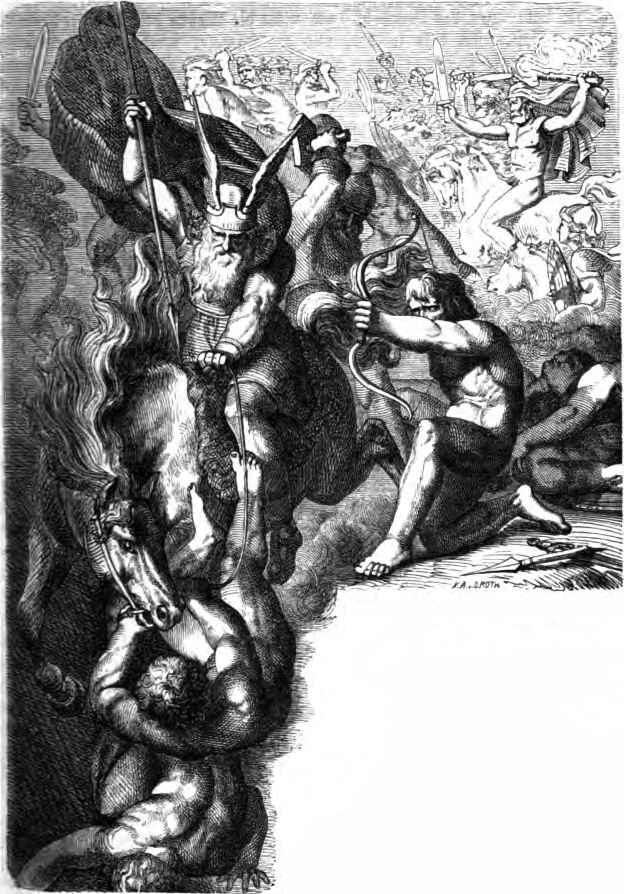
The Æsir Against the Vanir (wikimedia.org)

The Æsir Against the Vanir (wikimedia.org)

Groups of warmongering Norse gods, Vanir and Æsir, agreed to a truce after a long and bitter battle. Each side spat in a vat to preserve the peace.  The gods decided to keep the agreement safe by shaping their spittle into the form of a man they named Kvasir.

Kvasir was the wisest man on earth. He traveled the world— teaching, spreading knowledge, and correctly answering every question posed to him. (A lesson on the benefits of peace…)

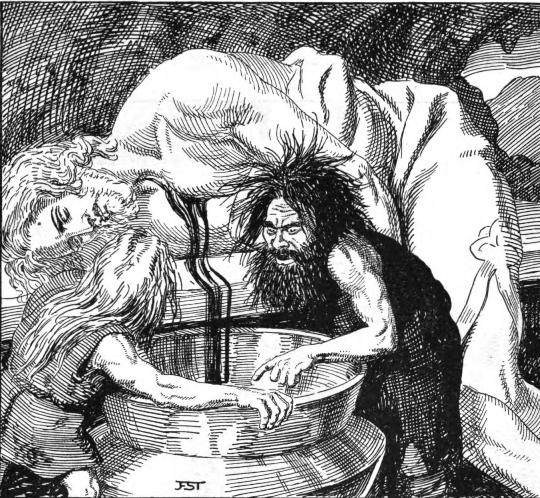
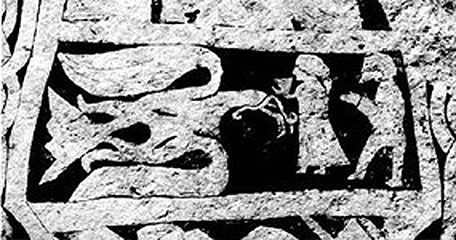
But alas, evil dwarves Fjalar and Galar murdered Kvasir. They drained his blood and distilled it in Odhrǫrir, the magic caldron. (Apparently smarts are a downfall. The dwarves told the gods that Kvasir’s intelligence had suffocated him.)

Draining Kvasir's blood. ( germanicmythology.com)

Draining Kvasir’s blood. ( germanicmythology.com)

Kvasir’s blood was mixed with honey to create the Mead of Poetic Inspiration. Poetry had once been the province of gods. But this drink held the power to turn all who imbibed it into skalds (poets) and blessed them with wisdom. Thus, skaldship spread.
child 2

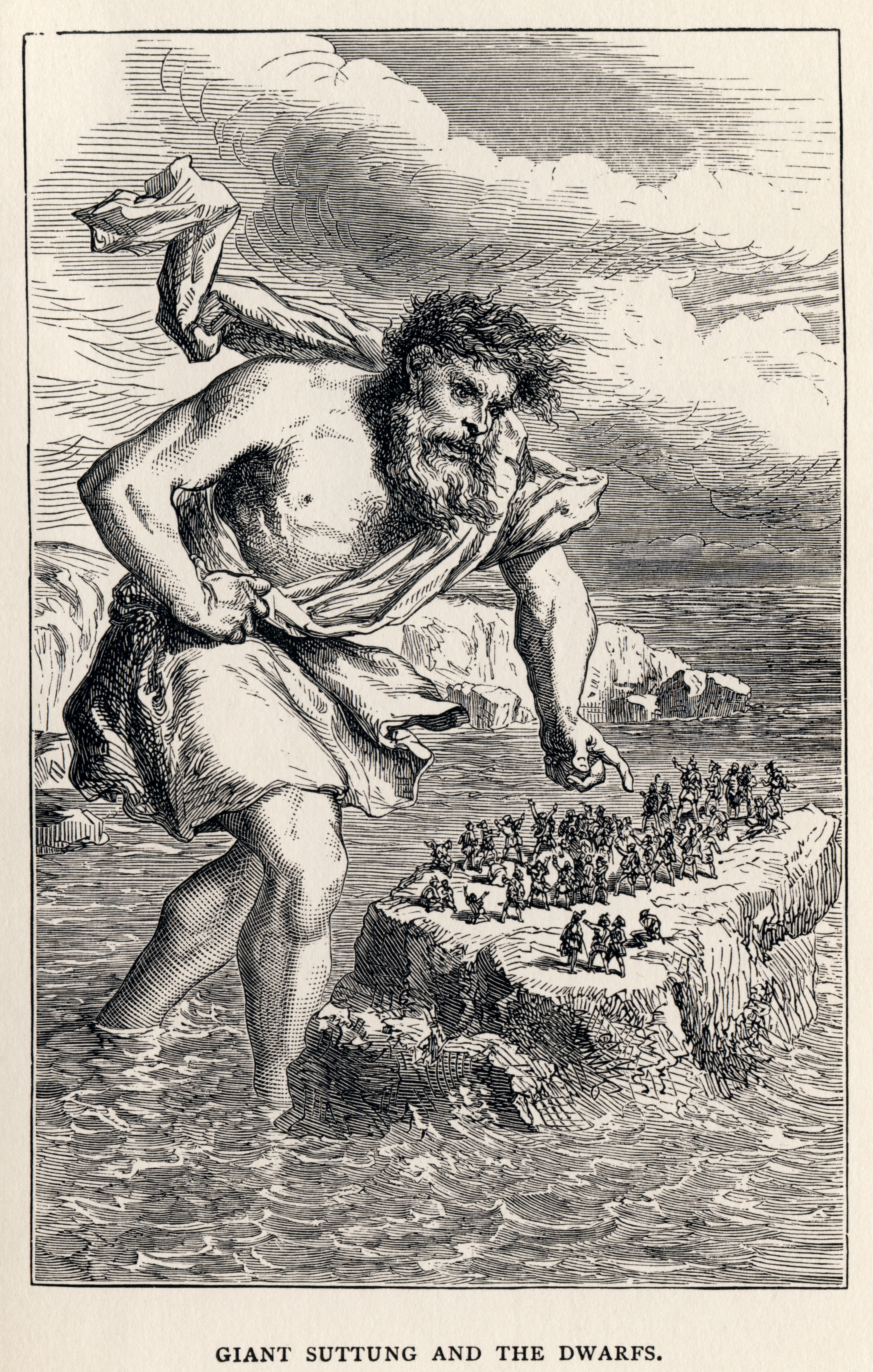
Along came the giant Suttung. He sought revenge on the dwarves because they had killed his father, the giant Gilling, for sport. Suttung seized their precious mead and hid it in the center of a mountain with his daughter Gunnlöð standing guard.

Gunnlöð (wikimedia.org)

Gunnlöð (wikimedia.org)

But Óðin (a.k.a. Odin) was displeased that so vital a nectar was hidden in a remote cavern. Óðin was a biggie in the Norse pantheon. He was known as King of Asgard, ruler of the Aesir, father of the thunder god Thor and associated with battle, victory, death, wisdom, prophecy, and the hunt.

Òðinn (no.wikipedia.org)

Òðinn (no.wikipedia.org)

So Óðin disguised himself as a man and wooed Gunnlöð. After three nights of sex he got her to agree to offer him three sips of the mead. But he tricked her (or by some accounts she succumbed entirely to his charms). He emptied the first vessel with his first sip. His second swallow emptied the second vessel. His last swallow emptied the last vessel. Holding all the divine mead in his mouth, Óðin changed into an eagle and headed back to Asgard.

Óðin as an eagle. (norse-mythology.org)

Óðin as an eagle. (norse-mythology.org)

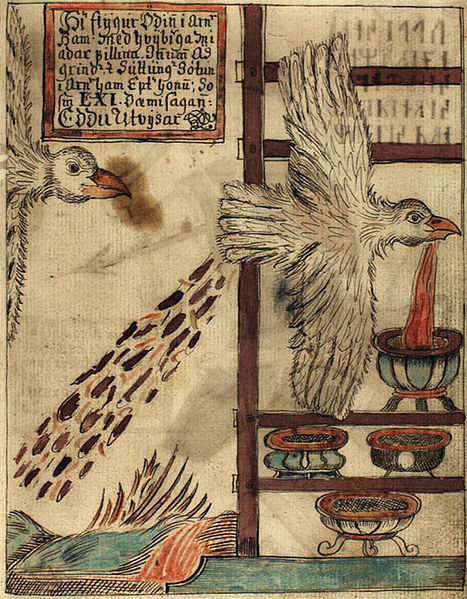
Suttung transformed into an eagle as well and gave chase. Óðin hurtled over the mountains. His people saw him coming and put out vessels in the courtyard. Óðin swooped low and spat the blessed mead into those containers. In the frenzy of the pursuit some of the mead came out “backwards.”

Yes, Óðin shat it.

Anyone that wants it can take that portion. It’s called skáldfífla hlutr, the rhymester’s share. It’s the portion for inferior poets.

Óðin pursued by Suttung, both in eagle form. Note the Mead of Poetic Inspiration being spat into vessels, with the mead for inferior poets coming out the other end. (en.wikipedia.org)

Óðin pursued by Suttung, both in eagle form. Note the Mead of Poetic Inspiration being spat into vessels, with the mead for inferior poets coming out the other end. (en.wikipedia.org)

Hey, I’ll take whatever portion I can get.


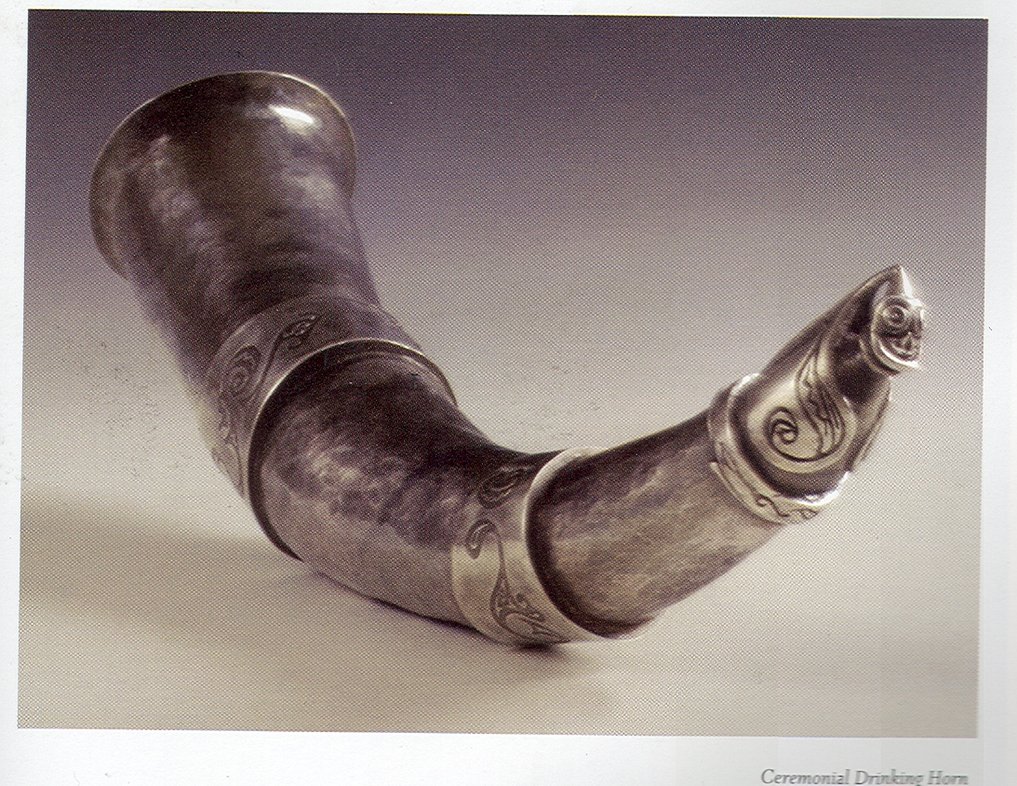
Ceremonial drinking horn. (smithing-chick.deviantart.com)

Ceremonial drinking horn. (smithing-chick)

A Dozen Ways To Revel In Poetry

poetry fun, celebrate poetry, exquisite corpse, traveling poetry, set poems free,

It’s all about how the letters are arranged. (mosswaterss)

1. Leave poems where they’ll be discovered. Write a poem on the sidewalk with chalk, crayon it on your child’s lunch napkin, tack it on your market’s public notice board, or tuck it into a friend’s coat pocket.

2. Pull a poem from a hat. Romanian poet Tristan Tzara was denounced by his fellow Surrealists when he proposed making a poem by pulling words from a hat. Try the “Dada Manifesto on Feeble & Bitter Love” method.

Take a newspaper. Take some scissors. Choose from this paper an article the length you want to make your poem. Cut out the article. Next carefully cut out each of the words that make up this article and put them all in a bag. Shake gently. Next take out each cutting one after the other. Copy conscientiously in the order in which they left the bag. The poem will resemble you. And there you are—an infinitely original author of charming sensibility, even though unappreciated by the vulgar herd.

3. Dine with poetry. Linger over some beautiful lines as you savor each mouthful.  The poems don’t have to be about food, but that can add to your pleasure. Find a rich assortment in The Hungry Ear: Poems of Food and Drink edited by Kevin Young and in Appetite: Food as Metaphor: An Anthology of Women Poets edited by Phyllis Stowell and Jeanne Foster. Or let these poems nourish you.

~”From Blossoms” by Li-Young Lee

~”Perhaps the World Ends Here” by Joy Harjo

~”Love Poem with Toast” by Miller Williams

~”The Invention of Cuisine” by Carol Muske-Dukes

~”Onions” by William Matthews

4. Sign up for poem-a-day sites. This month my wonderful library system is offering 30 days of poetry by email, featuring the work of local poets along with prompts for your own work.  You may also want to subscribe to Poetry Daily.

5. Watch poetry-infused movies.

6. Play Exquisite Corpse. This strangely fascinating game was created by the Surrealists in Paris. To play with several people, each person writes a phrase on a sheet of paper, folds the paper to conceal the words, and passes it on to the next player to contribute the next line. Each participant must be unaware of what the others have written, thus producing an absurd but often delightful poem.

7. Let yourself fall in love with spoken word poetry. 

~”Human the Death Dance” by Buddy Wakefield

~”Drunk Text Message to God” by George Watsky

~”OCD” by Neil Hilborn

~”Shrinking Woman” by Lily Myers

~”Accents” by Denise Frohman

~”Place Matters” by Clint Smith

8. Go on a poetry diet.

9. Set poetry books free. Leave them where strangers can find them, perhaps a coffee shop, a hospital waiting room, a dentist’s office, a barber shop, or a muffler repair shop’s waiting room.  If you’d like, register them with BookCrossing.com to see where they travel.

10. Take a poem into nature. It doesn’t have to be wilderness, simply under a tree or near water, and the poems don’t need to reference nature although these do.

~”Catechism for a Witch’s Child” by J.L. Stanley

~”The Silence of the Stars” by David Wagoner

~”The Seven of Pentacles” by Marge Piercy

~”Sometimes” by Sheenagh Pugh

~”Hum” by Mary Oliver

11. Hang on to poetic life lines. Some lines read long ago wait in our memories, rising to awareness at just the right time. The Academy of American Poets offers some time-honored life lines.

This line by art historian Bernard Berenson came to my mind recently as a friend struggled with cancer.  “I would have stood at street corners hat in hand begging passers by to drop their unused minutes into it.”

12. Curate a collection of your favorite poems. If a poem truly resonates with you, save it. Print such poems out out and paste them in a lovely scrapbook, or copy them by hand in a journal, or calligraph them on fine paper, or (as I do much less artfully) keep them in a word doc. After a few years you’ll have a highly personal, completely invaluable collection.

Why Write Poetry

write poetry, why poetry, becoming a poet,

Image: karrr.deviantart.com

I started to write poetry when I was eight or nine years old and continued until I was 13. The highlight? Winning a poetry contest in Mrs. Barker’s third grade class. The prize was a large chocolate bar.

The few scraps of writing I’ve found from those years consist of a child’s earnest questions and the comfort sought in a forest that once stood behind my parent’s home. Most lines are drenched with early existential dread. I’m not sure why I stopped writing. It could have been the surprisingly arduous trials of growing up or simple self-consciousness.

A moment from my 12th year comes to mind. I was in sixth grade, trying very hard to be like the other girls, never discussing the concerns that kept me awake most of the night. During the day, sleep-deprived into silliness, it often seemed to me that the conventions people took for granted were absurd. I did lots of laughing. One afternoon, walking out of class toward the playground for recess, I was telling a funny anecdote. A cluster of friends not only walked with me but jockeyed to be closest to me. The sun was shining on gumdrop green grass and I felt completely alive as I reached the best part of my story. I thought for a blindingly self-absorbed instant that this was what it was like to be popular. The next second I walked straight into a tall pole.

I hit it so hard I was thrown back. Dizzy, I made a joke about not seeing what had been there all along. My friends acted concerned but that was it, my brief encounter with popularity. Maybe I lost the secret habit of writing poetry because it seemed too much like an unseen pole, the sort of fullness that can erupt into a poem but might also raise a welt.

I never walked entirely away from poetry. As an adult I created poems from the phrases given to me by nursing home residents, crediting them separately for each line that eventually appeared in a book titled Gathering Our Thoughts. I led support groups for victims of abuse, hearing poetry as they shared their anguish in grace-laden detail. I taught non-violence workshops using poetry to emphasize the message of each session. I sent the work of my favorite poets to dear ones as a way of celebrating their joys and sharing their sorrows.

Yet I rarely encountered people living nearby who talked about, read, or wrote poetry. Far from our little farm I’m aware that poetry speaks for itself in slam festivals and readings, that it takes up residence in MFA programs and literary journals. Those worlds seem distant.

Poetry still feels like an indulgence. It hear it rustle in my head, trying to shuffle impressions into form, but I focus on my usual work of writing articles, editing, gardening, bringing in firewood, feeding cows, and other ordinary tasks. Besides, those impressions never entirely fit into words. I usually hush them till they are quiet. The ones that continue to pester I allow to fall onto paper although they don’t fully capture what’s just beyond language. When I took my manuscript to the post office to be weighed, addressed to “Poetry Editor,” I felt faintly ashamed, as if publicly admitting I squander time that could be devoted to more useful pursuits. The Puritan ethic dies slowly.

But the articles I write and the books I’m working on center around letting each person’s unique radiance shine. I believe this has to do, in part, with claiming both the light and dark in our lives so we can move toward a world of deeper mutuality. I know I’m not true to my ideals unless I live them. So I’m learning to treat the poetry writing impulse more gently. It feels starkly revealing, as liberation does.

The pieces in this collection have to do with beginning, uprooting, gathering, and abundance. They rise from the simple daily rituals that nourish me and from the loved ones who shape my life. They’re a way of walking into something hard without falling backwards.

publish poetry, why write poems,

Image: xxju.deviantart.com

Endless thanks to the intrepid souls who helped shape this book. The first ms readers: my beloved siblings Dale Piper and Cynthia Piper. My merry writing group: Connie Gunn, Margaret Swift, and Sarah Vradenburg. Those discerning individuals who commented on later drafts: Laurie Kincer, Leslie Nielson, Katherine Clark, and Mark Hersmann. I’m endlessly grateful. 

My New Book is Out!

Tending rises from my life on the farm and my fascination with the world at large. Informed by quietly ordinary days, these poems look into the nature of things with questions that circle the stars. I’m thrilled that the cover photo is by talented artist (and my sister) Cynthia Piper.


“Laura Grace Weldon employs radical empathy to enter into the hidden lives of rutabaga, cows, the neighborhood bully, and the beating heart of life itself.  Playful, curious, sensual, she aims to open the reader’s eyes and heart.”

Alison Luterman, author of See How We Almost Fly  and The Largest Possible Life.


“Laura Grace Weldon’s poems remind us that our world’s necessary brushes between nature and technology, human and animal, are not necessarily ones of friction. Instead, Weldon sees these moments as truly wondrous ones, available to us not only on the farm, but also in the back pocket of a window washer, swinging among the skyscrapers.”

Brad Ricca, author of American Mastodon and Super Boys.


“Memory, faith, and the natural world as both witness to the cycle of human life and healer to a questioning heart are at the core of this lovely and lyrical collection of poems. The weather changes, people come and go from cities and towns, babies are born, grow up and depart from their parents’ arms, but still, the countryside and its rituals sustain the people and creatures who know how to read the signs of the seasons. In these pages, Laura Grace Weldon shares those signs with us; her poems are the fruit of a wonderful harvest.”

Eleanor Lerman, author of The Sensual World Re-emerges: Poems and Mystery of Meteors.


“Laura Grace Weldon’s poems are concrete, allusive, and rich.”

 Diane Kendig, author of The Places We Find Ourselves.


“These are calming poems, set deep in the specifics of this life.”

David Budbill, author of Moment to Moment: Poems of a Mountain Recluse
and Happy Life.


Published by Aldrich Press. Order HERE.

(My friend Penny, from Dubai, suggests I share a sample. Here’s a poem from the first section, one no journal accepted although there are so few odes to root vegetables…)

Rutabaga

You darken as my knife slices

blushing at what you become.

I save your thick leaves

and purple skin

to feed the cows. 


A peasant guest at any meal

you agree to hide in fragrant stew

or gleam nakedly

in butter and chives.


Though your seeds are tiny

you grow with fierce will

grateful for poor soil and dry days,

heave up from the ground

under sheltering stalks

to sweeten with the frost.


Tonight we take you into our bodies

as if we do you a favor—

letting your molecules

become a higher being,

one that knows music and art.


But you share with us

what makes you a rutabaga.

Through you we eat sunlight,

taste the soil’s clamoring mysteries,

gain your seed’s perfect might. 

Laura Grace Weldon 

peace in tragedy, energy fingerprint, what we leave behind, act in crisis,

Image:andrewpoison.deviantart.com

The Trouble With Principles

what should a poet do, living up to one's ethics, sticking to principles,

Image courtesy of amythepirate.deviantart.com

I’m struggling with a decision that should be easily made. It isn’t a heady question of global importance. Nope. It’s much more mundane.

It’s a question of principle.

sigh

I’ve spent some time (and even more time ) writing about how the Teach & Test approach to education screws up our species’ wonderful inborn drive to seek out learning and retain that learning.

I’ve also spent a bit of time writing poetry. I authored a collaborative chapbook (long since out of print) back when I wrote poetry in partnership with nursing home residents. My poems are published here and there for the six people who read tiny literary journals and the three people who buy small press poetry anthologies. And a collection of my poetry, Tending,  has been published.

The engine fueling a non-fiction writer’s work is entirely different than the inspiration that sparks a poet’s poems into being. The non-fiction writer wants to get ideas across. The poet wants her words felt.

These two motivations probably shouldn’t tussle.

Today they are. That’s because this poet was asked something that made this non-fiction writer snort. A poem of mine, published last year in the Christian Science Monitor, has been selected for use in tens of thousands of high school assessment tests.

Yes, those same tests I rail against.

I don’t for a moment assume that my poem was selected on its merits. The piece happens to be riddled with imagery and metaphor, well suited to torture teenagers with questions designed to make them further detest poetry.

But I didn’t turn down the request right away. I’m not sure why (except that I’m a weak weak person to whom they’re offering $350 for the rights). The very concept violates my principles.

I also have the desire to let that poem stay alive. Poems live only while they’re read or when their lines are remembered. Most poems have a lifespan comparable to that of a mayfly. And yes, I have a ridiculous hope that one teen in the midst of a test might feel the poem.

I’ll probably send the official multipage form back with permission denied written where my signature should be. But I haven’t done it yet.

What would you do?

(And if you’re curious, here’s the poem.)

*

                        Why the Window Washer Reads Poetry   

for Michael, who carried poems in his work shirt pocket


He lowers himself

on a seat they call a cradle, rocking

in harnesses strung long-armed

from the roof.

*

Swiping windows clean

he spends his day

outside looking in.

*

Mirrors refract light into his eyes

telescopes point down

photographs face away,

layers of dust

unifying everything.

*

Tethered and counterbalanced

these sky janitors hang,

names stitched on blue shirts

for birds to read.

Squeegees in hand they

arc lightly back and forth across

the building’s eyes

descend a floor, dance again.

*

While the crew catches up

he pauses, takes a slim volume from his pocket

and balancing there,

36 stories above the street,

reads a poem or two

in which the reader is invariably placed

inside

looking out.

*

Laura Grace Weldon


Poetry Diet

struggling poet, making money as a poet, appreciating poets, life of a poet,

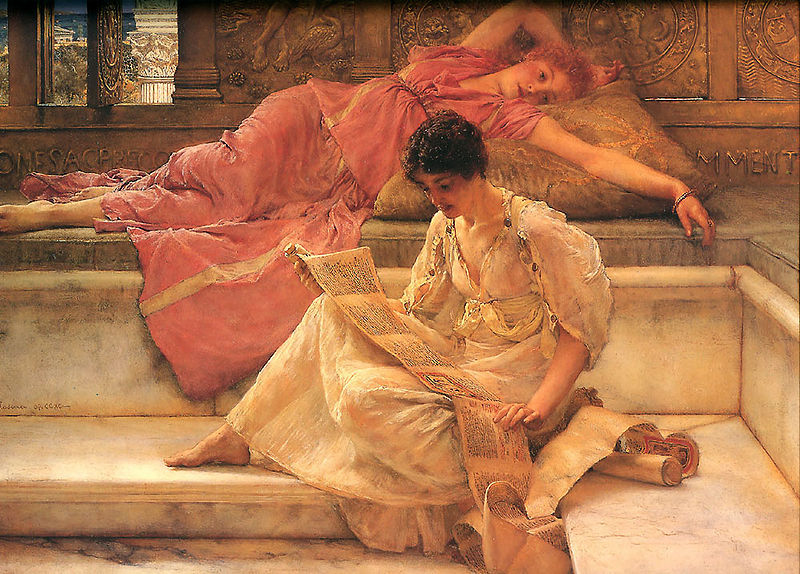
“Favourite Poete” by Lawrence Alma-Tadema

Poetry is thoughts that breathe, and words that burn.  ~Thomas Gray

The term Poetry Diet might imply a rare appetite. The sort of longing only appeased by words strung spare and stark, like a meal so desired that imagination keeps creating it anew.

Ink runs from the corners of my mouth
There is no happiness like mine.
I have been eating poetry.
~Mark Strand

Or Poetry Diet could imply hunger for that rare current some call inspiration, the elusive muse carrying phrases from ether to pen.

Everything in creation has its appointed painter or poet and remains in bondage like the princess in the fairy tale ’til its appropriate liberator comes to set it free.  ~Ralph Waldo Emerson

However in this case, what I’m calling the Poetry Diet is something much more mundane.  It simply means to eat nothing but what is purchased with money earned from one’s poetry. Reading, teaching, publishing, wearing them on your naked body, selling poems painted on scrap metal, whatever it takes. If I started a Poetry Diet now I’d be svelte in a week, thin rather soon. Before long, starving artist might be a literal (hah!) condition.

Surely a Poetry Diet would provide a vast incentive to write and, here’s the rub, send out one’s work. It could also leave the poet so imperiled that friends might stage a poetry reading to raise funds to feed the annoyingly hollow wordsmith.

Thus far I’m not dedicated or foolhardy enough to attempt a Poetry Diet. Mostly because I’m already trying to live by patching together the Essay Diet, Columnist Diet, and Editor Diet. But also because I know how long it takes from inspiration to paycheck. Right now I’m waiting for one of my poems to appear in Christian Science Monitor, two in Trillium Literary Journal, two more in J Journal. The total pay will amount to, well, let us not speak of actual numbers. I wouldn’t last long on the Poetry Diet. Surely that says something about the quality of my poetry but it also says something about our culture as well.

Poets aren’t very useful
Because they aren’t consumeful or very produceful.
~Ogden Nash

I hardly expect to live by poetry alone, although I have been sustained by the work of other poets in ways more vital than any meal. I long to see greater support for artists of all kinds. I have dear friends who devote their lives to perfecting a craft. They act, compose, weave, calligraph, paint, weld, invent, write, bake, work with wood, sing, and throw pots. They are driven to explore the intersection of art and cosmology, continually refining what it means to create. Yet most of them spend their days at jobs that are unrelated in order to survive. They wait tables or work in accounts receivable. Their real gifts emerge during precious hours plucked from mundane obligations.

It’s quite possible to attend a production at a local playhouse and see performances that shift the way you experience the world. You walk out a changed person for the extraordinary art you’ve enjoyed. Chances are that director, those actors, that playwright are unable to support themselves with their work, vital though it is.

I’m certainly not in league with those whose work is transformative. My poetry is about ordinary things like opening doors, moving stones, forgetting a name.

Perhaps I should head in a new direction—food poems. That way I’d feel nourished while contemplating the swirling curds and whey in the next batch of cheese I make. I’d also be answering Chesterton.

Poets have been mysteriously silent on the subject of cheese.  ~G.K. Chesterton