38 Unexpected Ways To Revel In Snail Mail

literacy skills, mail art, mail exchanges, snail mail fun,

The Force is strong with snail mail. (Image: CC by 2.0 Wikimedia Kev pittsburgh,pa)

Most of us don’t get anything interesting in the mail. Opening a personal letter seems like a pleasure from another era, irrelevant as a starched collar. Lets reclaim that experience. (The letter, not the collar.)

But first a rant. Here in the U.S. our postal service is often described as inefficient and unprofitable. I beg to differ. When I mail a letter in Ohio, it’s often delivered in Boston or Denver the next afternoon. I’ve mailed plenty of letters to distant countries. They show up in a week, tops. A few ounces of paper arrives in the one place in the world I want it to go, all for less than a buck. That’s pretty impressive. And the post office lets me mail unwrapped shovels too (more on that later).

Unprofitable? That’s not the real issue, unless you count the postal system having to pre-fund it’s retirement system 70-some years in advance. Name a company that can do that and stay in business.

I’m all about going postal. Sending and receiving mail helps us slow down, savoring time in a way that’s often missed in our terabyte-speed lives. Here are some ways you can make snail mail a pleasure.

Mail something unwrapped.

1. Try mailing a full-sized paintbrush, a basketball, a flip flop. All you need is a legible address and the correct postage. You might feel a little silly standing in line at the post office with an address-adorned plastic dinosaur, but it’ll be worth the look on your recipient’s face. I’ve mailed all sorts of silly things to a friend, mostly in response to oddities she mails to me. The strangest thing I’ve sent was a two foot metal shovel with a wooden handle. I used a permanent marker to write a note to her on the handle and the address on the metal part. It got there just fine.

2. For more ideas on what you can send through the mail, check out the Pinterest board 13 ounces or less. Check USPS regulations on what cannot be sent by mail.

Investigate the peculiar history of unwrapped mail.

3. In 1914, five-year-old Charlotte May Pierstorff was sent via U.S. mail as a package to visit her grandparents. It was the only way her parents could afford the trip. My kids and I learned about her journey from the picture book, Mailing May, by Michael O. Tunnell. She’s not the only person to be sent as cargo.

4. The most inspiring example is Henry Box Brown, who in 1849 was enslaved in Virginia. Using his savings to pay for the clandestine delivery, he had himself mailed to an abolitionist in Philadelphia. The trip took 27 hours, much of it upside down despite “this side up” instructions on the box.

5. The quirkiest unwrapped mail history I’ve run across involves W. Reginald Bray. In 1898 this British accountant began to send all sorts of unwrapped objects via mail. That included, but wasn’t limited to, a rabbit skull, a bowler hat, a turnip, his Irish terrier, and a bicycle punk. He also mailed himself, twice. He liked to test the logic of postal employees by mailing cards with addresses written as puzzles or clues. You can find out more about Bray in, The Englishman who Posted Himself and Other Curious Objects by John Tingey.

Get back in the habit of writing letters.

6. Send a letter to your great aunt or a former neighbor.

7. Write letters to deployed service members.

8. A mailed letter has a greater impact on your elected officials than calls or emails, so if an issue is troubling you take the time to write out your concerns. Only a tiny fraction of the country’s citizens have ever done this.

9. Write to an author (his or her publishing house will forward your letter).

10. Write to a business. My son once wrote to a pen company to settle a bet he had with me. He said my habit of leaving pens uncapped  would dry them out. He not only got a response confirming that he was correct, but the pen company’s PR person sent eight different pens for him to enjoy as well as an admonition to keep after his pen-wrecking mother. For other ways to inspire kids (or the kid in you) to write letters, check out any of Letters from a Nut books by Ted Nancy.

11. Groups of kids (classes, scouts, homeschool groups) can participate in letter exchanges with Peace Corps volunteers through the Coverdell World Wise Global Connections correspondence program and with long distance truckers via Trucker Buddy.

12. Find a snail mail correspondent through The Letter Exchange.

Make your own envelope out of something unexpected.

13. Use a leftover scrap of wrapping paper, a torn out magazine page, a file folder scribbled with equations, an old map, whatever you’d like.The simplest way is to pull apart an envelope to use as a template, sealing your new envelope with a glue stick once you’ve popped a letter inside. For more detailed instructions, head over to Instructables.

14. If you don’t want to seal your one-of-a-kind envelope with ordinary tape or glue, make your own flavored envelope glue.

15. Or hide your letter from prying eyes using ancient techniques of letterlocking.   These are clever methods of tucking, folding, and sealing used before envelopes were invented. One version is called the “daggar-trap!” More about that here.

Let your stamp make a statement.

16. There are amazing USPS stamps out there reflecting practically every interest, but they don’t stick around (stick, hah) very long. Every time I go to the post office I check to see what they’ve got available. No flag stamps for me. I’m particularly fond of stamps commemorating nature, science, and the arts.

17. You can also make your own customized postage. Our cows’ faces could be stamps, the smiling cactus your kid drew could be stamps. USPS authorized vendors include stamps.compictureitpostage.com, and zazzle.com.

Send postcards, get postcards.

18. Register with Postcrossing. When you send a postcard you’ll receive a postcard back from another participant anywhere in the world. So far, 16 million Postcrossing postcards have been exchanged.

19. To set up a specific postcard exchange (or other snail mail swaps) put up a request on Swap-Bot.

20. When you’re out, even on a day trip, encourage young children to mail postcards to themselves or their siblings. Just a quick sentence helps establish the day as memorable (and reinforces literacy skills). It’s also fun when that postcard arrives at your home in a day or two.

Get involved with or instigate a mail exchange.

21. I love art exchanges. I’ve participated in them on and off over the years, writing and decorating a page in a journal before sending it along to the next person or contributing to themed art challenges. My favorite was a Barbie art challenge. I glued a Barbie’s long hair into stiff twisting strands, gave her some theatening-looking facial features, and mounted her disembodied head into a tiny cardboard replica of a TV set with a “Medusa” remote. Find mail art calls through the International Union of Mail-Artists as well as Mail Art Projects.

22. Propose a mail exchange on a forum, blog, or other group. Make it themed, for example followers of a food blog send each other local foodstuffs. Fans of a particular musician send each other her lyrics re-imagined as comics or movie scenes.

23. All sorts of parenting lists host exchanges for kids who want a postcard from each state, a letter answering the same 10 questions from 100 participants, or favorite jokes. Suggest an exchange your kids would like.

Write to kids.

24. Chances are you know children who would adore getting mail addressed to them, either your own kids or kids in your extended family. Try for at least a once-a-year tradition like a note on the child’s birthday. Or more memorably, on a quirky day. How about a letter every year on Waffle Day (March 25) or Go Barefoot Day (June 1)?

25. Consider writing letters as if from an imaginary creature telling a series of tales, perhaps the adventures of a rollerblading squirrel and her sidekick, a jogging possum. No less than J.R.R. Tolkien wrote and illustrated a holiday letter for his children every year, arriving as if from the North Pole. See his drawings and text in Letters From Father Christmas

26. Write about your experiences when you were the child’s age.

27. Encourage return communication when you write to kids. At the very least, send them pre-addressed envelopes with stamps. You might write with a challenge. (Okay, a better one than the following example!) How about enclosing a length of string and the question: How many ways can you use this string?  Maybe offer a prize if they write back with more than a dozen ideas.  Or send response letters you’ve made with fill-in blanks to answer questions like:  This week I was surprised when ________. If I could go anywhere tomorrow I’d like to go _________. If I ran the country, the first thing I’d do is __________. Most people don’t know that ______.

28. Write to toddlers well before they can read. Print a simple sentence or two, replacing some nouns and verbs with rebus pictures. (If you’re not familiar with this, it means drawing a cat face instead of writing the word “cat.”) Add something to the envelope that the child might find interesting, like stickers.

Mail a simple thank you note.

29. Even a few lines of thanks come across differently when they’re written on paper and sent by mail. They seem more earnest and carry more meaning than the same few lines in a text or email. John Kralik discovered this when he was at the lowest point in his life and vowed to mail one thank you note every day for a year. Somehow, the effort of thanking others  brought unexpected returns to his life including business success, weight loss, and richer friendships. Read his story in A Simple Act of Gratitude: How Learning to Say Thank You Changed My Life.

30. Send a thank you to a favorite teacher, a former mentor, the local bookstore owner whose business you appreciate, someone who did you a kindness that you haven’t forgotten.

31. Consider writing a letter to someone you see everyday. Your child, your spouse, your co-worker. Tell them something you cherish about them or how they enrich your life.

When the situation calls for it, tell your truth with an un-thank you note.

32. Of course it’s best to handle negative situations immediately, but I’ve gotten some dire predictions from professionals that proved false over time. This surgery is absolutely necessary. You’ll have a maladjusted child if you homeschool. Ritalin is the only solution for that behavior.  It’s my contention that sending a respectful letter updating a doctor, teacher, or other expert is a kindness to the people they will advise in the future. There are ways to write a useful unthank you note. Chances are you won’t get a response but you’ll feel lighter.

33. If you want to tell the world the truth anonymously, mail a postcard to PostSecret. Keep up with these powerful, often artfully shared secrets via Facebook and check out the TED talk by founder Frank Warren.

  Use handwritten notes to advance professionally.

34. It seems counterintuitive when there are faster ways to communicate, but that’s the point. A letter to a business contact makes a lasting impression and does so at just the right speed.

35. The go-to guide for this is Business Notes: Writing Personal Notes That Build Professional Relationships by Florence Isaacs.


Inspire yourself to write letters by reading epistolary novels.

36. The Color Purple is told through letters and if you haven’t read it, this book isn’t to be missed. The Historian centers on a medieval book that opens clues to Dracula’s existence. The Guernsey Literary and Potato Peel Pie Society reveals memorable characters living on the island of Guernsey during the Nazi occupation. Any of the Griffin & Sabine books have intriguing tiny envelopes inside, giving the reader the sense of peeking at private correspondence.

37. For teens: Sorcery and Cecelia or The Enchanted Chocolate Pot, about two cousins drawn up in a alternative universe complete with romance, wit, and magical chocolate. Or for more romance plus intrigue at Australian high schools, two very popular books by the same author, Feeling Sorry for Celia and The Year of Secret Assignments

38. For young children: Help Me, Mr. Mutt!: Expert Answers for Dogs with People Problems as well as any of the many books starring the ever-clever letter-writing dog Ike LaRue.

For more motivation, spend time with those who exult in snail mail.

365 Letters

Mail Me Art

Letter Matters

Letters of Note

Always First Class: The Pleasure of Personal Letters

How To Raise Word Nerds

word games for kids, free word games, dictionary fun, play with dictionary, vocabulary-building games, vocabulary fun, family word games,

Dictionary, unplugged. (crdotx’s flickr photostream)

When I tried to throw our dictionary out my oldest threw a fit.

This is a very old dictionary. It was owned by my Great Aunt Mildred. The book is huge, with indents along the side for each letter of the alphabet. It’s also not in good shape. Threads are hanging out of a nearly wrecked spine and the pages are yellowing. Until recently it sat on our living room trunk, ready to answer all inquiries. As my kids got older and Google got ever closer to our fingertips, I figured we didn’t need it. According to my son, I am wrong. He has more than a sentimental attachment. He knows what this book holds — the power to create word nerds.

Here’s how.

In part, we used the dictionary to settle disputes, which happened more often than you might imagine. I’d be happily snuggled on the couch reading aloud to my kids and run across a word new to them. I’d tell them what it meant but one of those little darlings would invariably question my expertise. Having a writer for a mother may make kids more feisty when it comes to words, I don’t know. They’d rush off to drag the huge volume back to the couch where I’d read the definition aloud. Then we’d wrangle over what the definition really meant. Maybe things are more peaceful at your house.

My kids also used the dictionary for games. Something about having that whale of a book right there in front of them inspired word play. Well, that and a few other factors like parental limits on electronic entertainment.

The games my kids played with the dictionary roughly fall into three categories.

Bet You Don’t Know This Word:   Sibling one-upmanship is rarely pretty, but I can overlook it when it’s a vocabulary builder. Simply open the dictionary, find a tough word, and challenge a sibling to define it. The kid with a finger on the word has to pronounce it correctly, otherwise the challenge doesn’t count. (This meant they’d run to me with pronunciation questions until they got a better grip on phonetic spelling.) Winner on either side may torture family with the word the rest of the day. Other family members should sigh in exasperation, but we know the more a word is used the more likely it is to be understood. Win for vocabulary expansion!

Guess the Right Definition:  There are better ways to play this but our made-up version is easiest. Find an esoteric or outdated word to use as a challenge. On the same page find another word with an entirely different (hopefully strange) definition. Or find two other words to make it harder. Read aloud the challenge word, then mix up the different potential definitions as they’re read aloud. Again, winner may torture the family with the word the rest of the day.

Blackbird: (This is such a favorite that Blackbird is the title of a recent book of mine.) Think of a question (one that can’t be answered with a simple yes or no) and ask it aloud, like “Why is my hair curly?” or “Should we get a pet hamster?” Then open the dictionary at random and, without looking, put a finger on the page. Look at the word under your finger and read aloud its definitions. It may take some stretching (a nice use of reasoning powers) to make it fit as an answer, but it usually works. For example, my curly-haired child placed a finger on the word “law.” One of the definitions is “binding force or effect” and another is “regularity in natural occurrences.” That led to a nice discussion about genetics and hair. The hamster question led to the word “fury” which takes little effort to decode, especially when one definition is “angry or spiteful woman.” That would be me, faced with one more pet in this house.

  • So leave a (newer, sturdier) dictionary out in your house. Let your kids see you use it regularly. Help them use it and display interest as you do.
  • Play some word games when boredom hits. Need another? Pick three words at random and challenge your kids to make up a story or song or nonsense rhyme on the spot using those words. Yes, your turn is next using three words they pick. This works nicely in the car. Maybe you need a pocket dictionary in the glove compartment.
  • Tsk tsk a little when they look up “bad” words (otherwise it’s no fun for them).
  • Act as if it’s completely normal when your nine-year-old describes a problem as a predicamentimpasse, paradox,or quandary.

If you choose to allow a dictionary to assume this power in your family, I have one warning. Dictionary silliness will lead to language savvy. If your kids use a lot of obscure words in their everyday discourse they’ll need a droll sense of humor, the better to handle their flummoxed peers.

Throw Strangely Amusing Parties

throw an art party,

We used to throw strangely amusing parties on a more regular basis. Box parties where kids made forts and mazes and castles out of huge boxes. Tie dye and batik parties that were a messy extravaganza of color. Science-y gatherings where everyone worked on the same ridiculous experiment with vastly different results. Even an election commiseration event where everyone had to bring a few jokes about a certain president whose name rhymed with “tush.”

The longest lasting tradition? Our summer pig pen parties. These were grand messy BYOB affairs, as in bring your own bucket—of dirt. It was dumped in a backyard kiddie pool and mixed by all children in attendance into perfectly creamy mud, which they used to coat themselves until they were recognizable only by bathing suit outlines. We put a garden hose at the top of our slide and the kids careened down in glorious streaks of mud. We handed out cans of shaving cream for use as body décor (with firm instructions to avoid faces because it’s not fun in the eyes). We brought out ample water balloon supplies. And we insisted the kids eat without utensils or hands, just direct face to plate. Like pigs. Of course these parties got out of hand once the grown-ups refused to sit in lawn chairs watching their kids have all the fun. Some neighbors showed up in pig masks, others showed up with water balloons sneakily hidden in baby strollers and red wagons, others brought massive auxiliary supplies of shaving cream. Normally well-behaved men used hoses to fill garbage cans with water, which they dumped over the heads of the few civilized mommies who thought they’d keep their hair looking nice. One year the entire assemblage of pig pen partiers were incensed that a regular pig pen attendee decided to stay home to repair a fence. All of us walked down to the street in wet, muddy, shaving cream streaked glory to drag him to the party. His police chief father who was there helping him make the repairs looked seriously alarmed. We dragged him anyway.

I’ve been fantasizing about a backyard Jackson Pollack party where everyone brings leftover paint to fling at canvases, maybe even using the giant trebuchet our kids built for some super-charged paint tossing. I can just see us all in splattered clothes, posing for a group picture with candy cigarettes hanging out of our mouths. What’s stopping me? I live with practical people who wonder if paint will get tracked in the house because partygoers are human and will eventually need to use the bathroom.

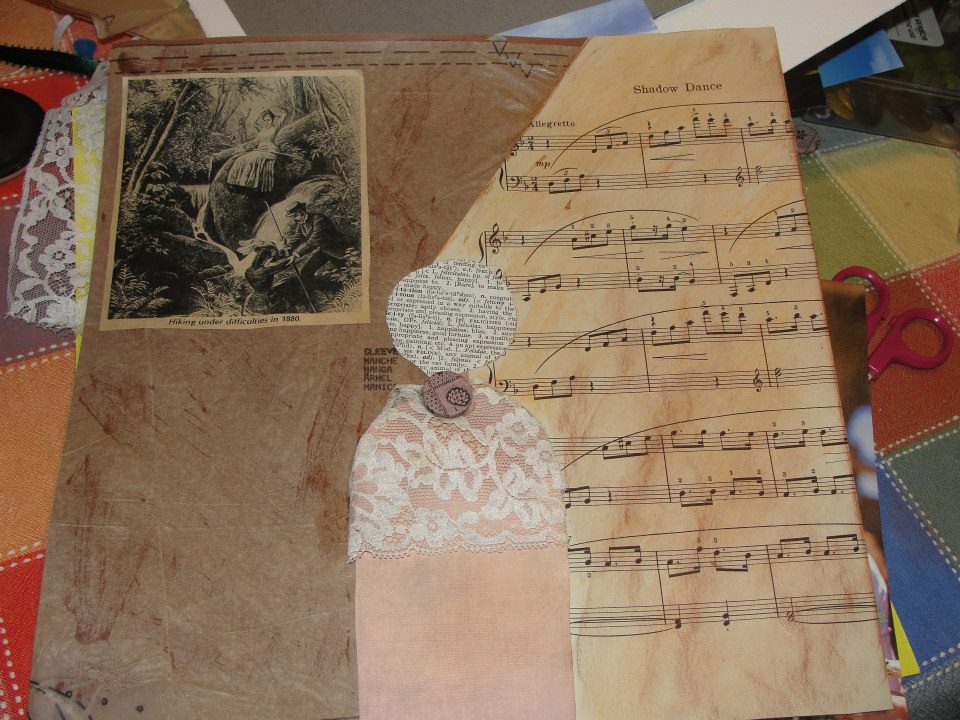
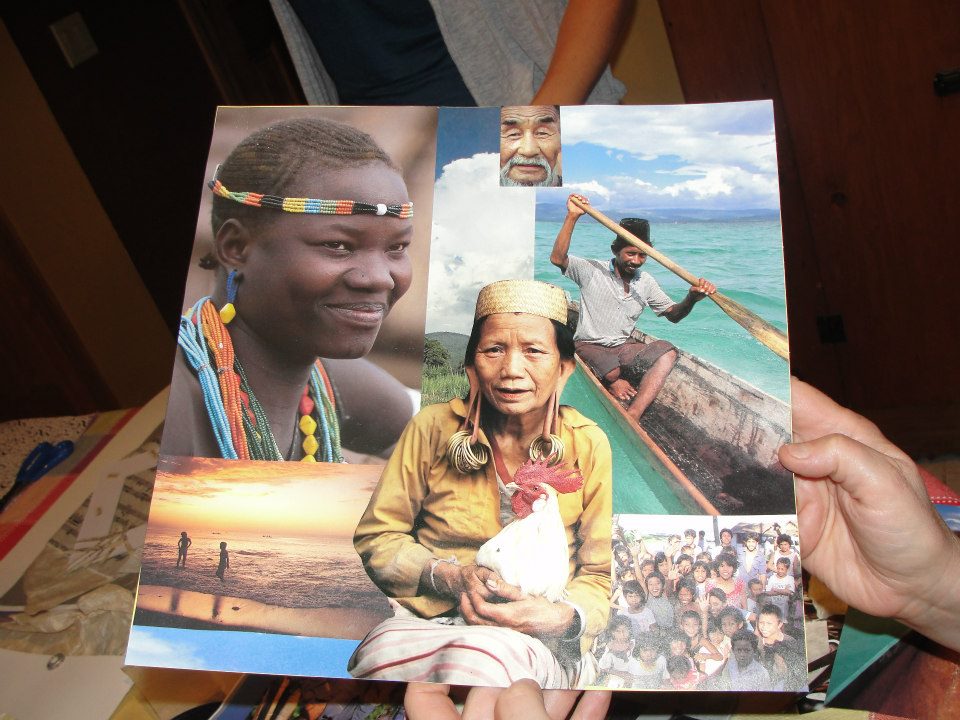
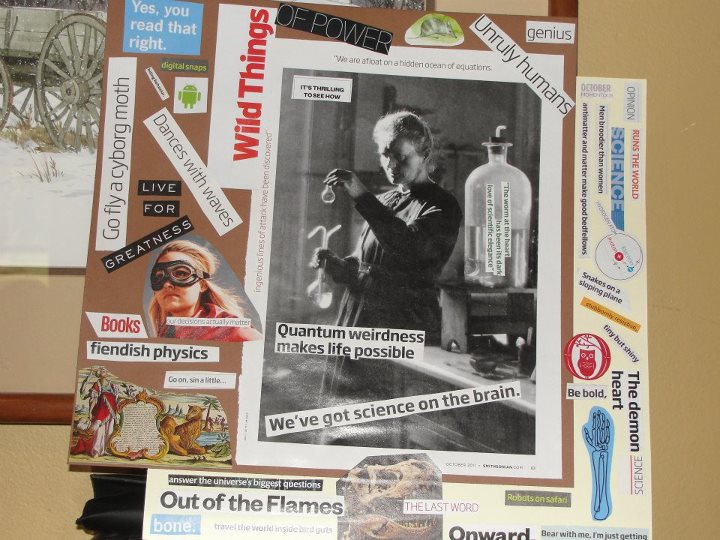
My recent event was a quietly civilized affair: a collage party for some artful cutting and pasting. I have all sorts of glue-able stuff here. Old sheet music, sewing patterns, stockbooks, wallpaper, tiny do-dads, lace, game pieces. All I asked people to bring were their own scissors, marked with their names (because scissors are migratory beasts) and a potluck offering. They brought a lot more glue-able stuff to share. I thought we’d stick down some background, let it dry while we ate and drank, then finish and move on to a second or third one each. But my friends ate and drank and talked while collaging. They didn’t want to stop cutting and arranging. It’s as if we all have too little time for something as simply satisfying as placing a scrap of paper on a page exactly as it pleases us. The event was less lively than the average pig pen party, that’s for sure. But it was restorative. No phones. No screens. Nothing else to do but indulge in the kind of play we call creating. I guess that doesn’t happen unless we make time for it.

Here’s a sample of collage party creations. (Some are backgrounds awaiting finishing touches.)

And let me know your ideas for strangely amusing events. I plan to steal them.

turn junk into collage,

art party,

make a collage, throw a collage party,

science collage,

Reading Readiness Has To Do With The Body

reading readiness, kids sit too much,

Today’s kids sit more than ever. Babies spend hours confined in car seats and carriers rather than crawling, toddling, or being carried. As they get older their days are often heavily scheduled between educational activities and organized events. Children have 35 percent less time for free play than they did a generation ago, and that’s before factoring in distractions like TV or video games.

Left to their own devices, children move. They hold hands and whirl in a circle till they fall down laughing. They beg to take part in interesting tasks with adults. They want to face challenges and try again after making mistakes. They climb, dig, and run. When they’re tired they like to be rocked or snuggled. According to the authors of A Moving Child Is A Learning Child, stifling these full body needs actually impairs their ability to learn.

Large muscle activities like climbing, running, lifting, carrying, rolling, jumping, throwing, and balancing not only build strength and coordination, they are also critical for reading and writing readiness since they develop proximal muscles (including trunk and upper arms). This in turn helps develop distal muscles in hands and fingers. Efficient coordination of large muscles progresses to the elbow, then wrist, then hand — making writing and drawing possible.

We know that our little ones walk and talk on their own timetables. No rewards or punishments are necessary to “teach” them. Yet children are expected to read, write and spell starting at five and six years old as if they develop the same way at the same time. Academics are pushed on young children with the assumption this will make them better students. This approach is not only unnecessary, it may be contributing to problems such as learning disorders, attention deficits, and long term stress.

Studies contrasting reading instruction at age five compared to instruction at age seven find earlier lessons may damage reading development. By the time children reach the age of 11, students who were instructed earlier show poorer text comprehension and less positive attitudes toward reading than children whose instruction started later.

Literacy isn’t easy. It requires children to decode shapes into sounds and words, to remember these words correctly in written and spoken form, and to understand their meaning. Allowing reading to develop naturally or teaching it later tends to create eager, lifelong readers. Why?

why pushing school-like lessons hinders learning,

Children pushed to read early (not those who naturally pick it up) tend to rely on right brain processes because that area matures more quickly. These early readers are likely to guess at unknown words using clues such as appearance, context, beginning and ending letters. Their main tactic is memorizing sight words. These are valuable methods but not a balanced approach to reading. Such children may quickly tire after reading short passages or read smoothly but have difficulty deriving meaning from what they read. The procedure they use to decode words can make the content hard to comprehend. These reading problems can persist.

On the other hand, children benefit when they learn to read naturally or are taught later. That’s because, as the left brain matures and the pathway between both hemispheres develops, it becomes easier for them to sound out words, to visualize meanings, and mentally tinker with abstractions. They memorize short sight words but sound out longer words, an approach that is less taxing. As they incorporate more words into their reading vocabulary they more easily picture and understand what they are reading.

developing eager readers,

In order for children to read, write and spell they must be developmentally ready. Some are ready at the age of four or five, some not for many years later. This readiness includes complex neurological pathways and kinesthetic awareness. It includes the proprioceptive sense developed through sensory receptors in the muscles, joints, and tendons: a form of maturation essential for a physical sense of self (even essential for learning how to modulate one’s voice and to hold objects carefully).

Such readiness isn’t created by workbooks or computer programs. It’s the result of brain maturation as well as rich experiences found in bodily sensation and movement.

These experiences happen as children play and work, particularly in ways that cross the midline. They includes expansive movements such as climbing, jumping, digging, swimming, playing hopscotch and catch, riding bikes, sweeping, running. They also include fine movements such as chopping vegetables, drawing, building, playing rhyming and clapping games, using scissors, and playing in sand. And of course there’s the essential growth that comes from snuggling, listening to stories, singing, trying new tastes,  enjoying make believe. Children are drawn to such experiences. Without these bodily experiences, warns pediatric occupational therapist Angela Hanscom,  they won’t have a strong foundation for learning. (Find out more in her book Balanced and Barefoot: How Unrestricted Outdoor Play Makes for Strong, Confident, and Capable Children.)

how to boost reading readiness,

These activities stimulate the child’s brain to develop new neural pathways. Such activities also build confidence, smooth sensory processing, and create a bank of direct experience that helps the child visualize abstract concepts. Well-intended adults may think a good use of a rainy afternoon is a long car ride to an educational exhibit. A young child is likely to derive more developmental value (and fun) from stomping in puddles and digging in mud followed by play time in the tub.

There are many other factors contributing to reading readiness. Perhaps most important is a supportive family life where play, reading, and conversation are an enjoyable part of each day. But it helps to remember that young children want to participate in the purposeful work of making meals, fixing what’s broken, and planting the garden. They also need free time without the built-in entertainment of specialized toys, television, or video games. Their development is cued to movement. These bodily experiences prepare children for the magic found when shapes become words, words become stories, and they become readers.

raising eager readers,

Portions of the post excerpted from Free Range Learning.