When Girls Think Their Looks Mean Everything

lookism, girls who hate their looks, moms helping girls love themselves, mean girls, geek girls,

As little girls, Elissa’s friends were rambunctious and wholly themselves. They pursued their own interests with no concern for other people’s opinions. They drew comics featuring hilarious dialogue, danced and laughed simultaneously until they fell down in breathless mirth, conducted basement science experiments, and pretended they had super powers. Their mothers talked about how freely their girls expressed themselves, grateful to have strong daughters.

Then it started.

Like a relentless viral infection, one by one these girls succumbed to our appearance-obsessed culture. Elissa watched angrily as her friends were laden with heavy new concerns. They worried about what they looked like and what others thought of them. By 11, 12, or 13 years old they hid their unique interests and suppressed their considerable talents. Instead they maintained a near constant awareness of hair, make-up, clothes, body shape, who said what, and how everyone else reacted.

Threats, screaming outbursts, bleak despair became common. And that was just their mothers’ reaction to their daughters’ behavior. Helplessly witnessing what has become a female ritual of relentless self-scrutiny causes many of us to lose it.  We know all too well that the effort to constrict oneself into a mold is exhausting.

But who can blame our girls, let alone the adult women who continue to suffer painful confidence wounds, when impossible standards are the norm?  It’s almost as if we females are set up to fail at this appearance game. Oh wait, we are. Even the Beautiful People aren’t beautiful enough.
photoshopping, mena suvari, celebrity photoshop, teen beauty,

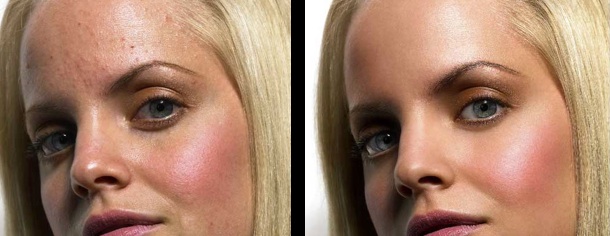
Celebrities “fail” too. Take a look at the already lovely Mena Suvari, model and actress whose acne is removed, pores eliminated, eyes brightened and skin smoothed.

Check out the before-photoshop pics of women like Kirsten Dunst, Alicia Silverstone, Christina Ricci, and others. Until they’re rendered plastic smooth and Barbie thin, they look somewhat like ordinary people.

And let’s not forget, reality shows have made transformation from ordinary to perfect an entertainment phenomenon in a society where make-overs for little girls and high heels for babies aren’t out of the question.

Image after image through their young lives, girls absorb an ever present lesson that females aren’t good enough as they are. Such lessons aren’t confined to images. Girls and women portrayed in movies are typically clad in sexualized clothes and lead one-dimensional lives.

What’s the effect?

Devastating, according to the American Psychological Association. Shame, anxiety, eating disorders, and depression. Girls judge their bodies harshly as young as the age of five.  No wonder a girl might choose keep the vitality of her true self hidden.

But there’s another side, often overlooked. Because Elissa and a few of her friends didn’t suffer (at least fully) the perils of lookism. They barreled through their pre-teen and teen years fueled by interests strong enough to hold them steady. Elissa poured her energy into a number of pursuits. She was a docent at the zoo, raised white rats, studied an ever increasing range of scientific interests, and moderated an online forum. One of her friends took up photography, becoming proficient in pinhole camera techniques and making albumen prints, while also advancing in a hockey league. Elissa noticed that girls who didn’t engage in the looks-first game were often ostracized by their more mainstream peers, but they also had strong friendships beyond school. Elissa, homeschooled through highschool, was one of those friends. She says she felt freer to follow her own interests without the pressures of school culture and advocated individuality to others.

As a teen, Elissa was angry at the influences that swayed so many of her other girlhood friends. She scorned their preoccupation with boys, clothes, body image, and interpersonal drama. But now Elissa is in her early 20’s. She’s reconnected with many of these same friends and learned a little about the adversity they suffered as they made their way through adolescence different than hers. One of her childhood friends became a mother at 15, another made multiple suicide attempts, still another struggles with bulimia. Elissa is sure the strengths from girlhood are still with all of them. She just doesn’t know how to let them know that their looks don’t define them.

Here are a few resources to light the way.

About Face

Adios Barbie

All Made Up: A Girl’s Guide to Seeing Through Celebrity Hype to Celebrate Real Beauty

Body Drama: Real Girls, Real Bodies, Real Issues, Real Answers

Body Outlaws: Rewriting the Rules of Beauty and Body Image

Can’t Buy My Love: How Advertising Changes the Way We Think and Feel

Mothers for a Human Future

New Moon Girls

Packaging Girlhood

Pink Stinks

Resolving the Confidence Crisis

Teen Voices

The Body Project: An Intimate History of American Girls

101 Ways to Help Your Daughter Love Her Body

*

*

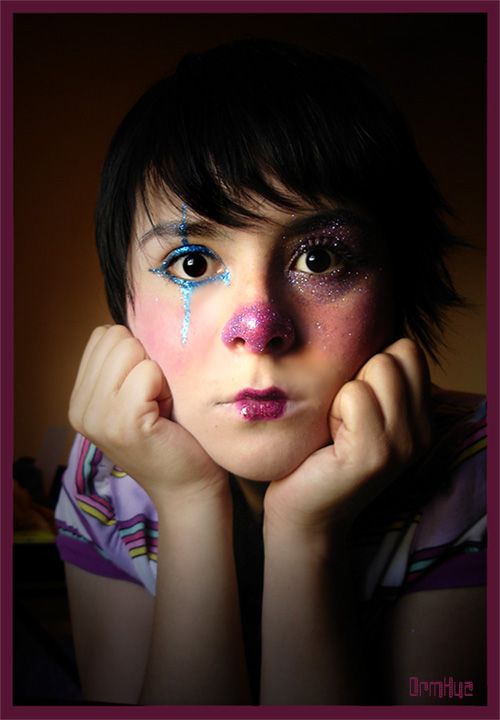
Trying to Be Happy courtesy of Orm Huz

Mom Knows Nothing

open to questions, don't know answers, kid's questions, being a mom,

“Why don’t you know any answers?” my then three-year-old asked me.

He was exaggerating. I always gave him a straight answer when he asked what we could have for dinner or when we were going to the library. But it was true, sometimes I had to look things up. That’s because I really didn’t know answers to questions he posed like, “Do bees have intestines?”

Still, I knew what he meant. I tended to respond to his questions with inquiries of my own. “What do you think?” or “Let’s find out.” Of course I was intentionally vague in order to spark the process of discovery. I didn’t know such a tactic might annoy a toddler who sometimes just wanted to know. Yes, I modified my approach, although he’ll tell you today that I’m just as annoying in other ways.

However the habit of putting questions where answers might be continues, at least in my head. The more I experience the sorrows and delights of life the more I recognize that answers aren’t the aim. So much is better understood as a question.

Today I walk out back with a pail of vegetable peelings and leftover oatmeal for the chickens on our little farm. Chickens look perpetually quizzical, perhaps that’s one reason I like them so much.

Our cows graze in the sunny part of the pasture. I can’t get past marveling at the mystery of plants eating sunlight, cows converting grass to milk, and milk transforming into cheese on my stove. I simply stand watching the cows in wonderment.

While I stand here I know that what we call gravity bonds me and everything I see to the planet. Without this force all of us would drop into the darkness of space. Earth holds us. Yet here on this perfect sphere we humans find reasons to hurt one another and harm the Earth. I hear humanity’s questions asked over and over in songs, poetry and the scriptures of many faiths, and I am comforted by our common quest for understanding.

There’s peace to be found right beyond the need for answers. This sense of calm I find puts the emphasis on love, not on what’s right. (It doesn’t hurt to recognize that those who have all the answers actually don’t.) I walk back to the house, taking in the way the water flows along the creek and the mud squelches around my boots. I’m glad to live with people who are astonished daily by this world’s wonders. Even if they continue to ask me what’s for dinner and expect an answer.

inchworm, questioning everything, appreciating the moment,

*

*

*

Question tree photo courtesy of Type Zero

If Jane Goodall Were An Alien

view of U.S. childhood, impeding humanity, how to better raise our children,

Imagine someone with Jane Goodall’s observational powers coming from outer space to observe us for a few days.

Let’s narrow this alien’s study down to something relatively simple. Our imaginary alien doesn’t have time to report on Earth’s progress toward peace, justice, and environmental balance. Our imaginary alien doesn’t even have time to cast her gaze across the whole planet.

Instead, the alien watches a few children in a typical American suburb before filing this report. (Alien disclaimer:  this report isn’t representational of all humans or all time spans on Earth.)

*

How to Impede Humanity

Each human is born with vast potential which unfolds in ways unique to that person’s talents and experiences. Human culture starts immediately to prevent that newborn’s potential from being fully realized.

The smallest humans are kept for much of their waking day in devices called car seats, booster seats, high chairs, playpens, cribs and strollers. Without sufficient and varied movement, learning can be impeded.

They are kept indoors most of the time. This limits their vision, their sense of connectedness, and their happiness.

Instead of foods harvested directly from nearby sources, the taste preferences of these small humans are developed on diets of lower nutrient but more expensive packaged substances. The health effects of these foods is beyond the scope of this report. It is, however, noted that transporting and purchasing these foods has an economic impact on the families of these small humans.

Humans are a people of story and image. As small humans get older they more readily absorb the lessons surrounding them from such objects as billboards, magazines, television, video games, and toys. These stories and images teach humans that success and happiness come through power, the right possessions, perfect appearance, rare skill, and of course, wealth. Small humans learn this quickly.

For example, appearance. They are repeatedly exposed to images of impossible bodies.  Note evidence—-a process called retouching applied to human Jennifer Anniston and to humans Twiggy and Keira Knightley.  As a result, five year old females judge their bodies harshly. By what humans call adolescence, 92 percent of females are unhappy with their bodily appearance.

Males also experience self-loathing due to impossible body images and behavior of heroes in movies, video games, and comics.

Movies, television, politics, and pundits teach small humans that the world is more violent than it is and games teach them that aggression is the best response.

The whole market-driven culture pushes materialistic values on young humans, which can leave them depressed, anxious and unhappy when they most need the powerful boost of optimism.

Even though young humans are perfectly suited to learn in ways matched to their abilities and interests without coercion, even though humanity has evolved throughout time by learning directly from wisdom-bearers in their own fields, these youth are put in institutions called schools. There each young human is judged by pre-determined standards. A large percentage don’t measure up.

It has been determined that the primary need of young humans is for self-expression, reasonably consistent guidance, and what on Earth is called love.

It is beyond the scope of this field report to discuss all the factors impeding humans but this observer notes that humanity flourishes due in large part to the overwhelming ability of human families to raise children using tools of kindness, laughter, and true affection. These behaviors are observed every moment, shared freely. This seems to be the essence of this species, so the report overall views humanity’s progress as positive.

(We prefer, however, that humans stick to their own planet. See the following video update.)

Image courtesy of Jean Kern’s flickr photostream 

For Brainpower & Focus, Try Clapping

Mom was right.

The older I get the more I recognize the wisdom my mother applied in parenting. For example, she believed that traditional games held their value. We played croquet in the back yard—-a lawn game that went out of fashion soon after the Victorian era. We played Battleship using only graph paper and pencils. And we played all kinds of clapping games, from Pat a Cake to silly counting rhymes.

Turns out I owe my mother thanks for more than my straight hair and tendency to burn immediately upon exposure to the sun. I owe her thanks for those games, particularly the hand-clapping ones.

New research finds hand-clapping rhymes and songs are directly linked to cognitive skills.

Dr. Idit Sulkin, of the Ben-Gurion University Music Science Lab, found that young children who naturally play hand-clapping games are better spellers, have neater handwriting and better overall writing skills.

Intrigued, she conducted further research. For ten weeks she engaged groups of children, ages 6 to 10, in a program of either music appreciation or hand-clapping. Very quickly the children’s cognitive abilities improved, but only those taking part in hand-clapping songs.

She also interviewed teachers and joined in when children sang in their classrooms. She was trying to understand why they tend to enjoy hand-clapping songs until a certain age, when other activities such as sports become dominant. Dr. Sulkin observed, these activities serve as a developmental platform to enhance children’s needs — emotional, sociological, physiological and cognitive. It’s a transition stage that leads them to the next phases of growing up.”

Interestingly, Dr. Sulkin also found that hand-clapping songs also benefit adults. When adults engage in these games from childhood they report feeling less tense and their mood improves. They also become more focused and alert.

Clapping and singing, clapping and chanting—-this is found across all cultures in religious ceremonies, solemn rituals, joyous celebrations and to accompany storytellers.  The experience of calling and clapping may speak to something deeper in us.  Maybe we all should play a round of Miss Suzy or Cee Cee My Playmate at the start of every political debate, business meeting or extended family get-together.

*

*

*

*

Clapping Hands sketch courtesy of  sycen

Don’t Bother Mom, She’s Blogging About Motherhood

child

Motherhood is oriented to firsts.

Our   baby’s first smile,

first step,

first word.

After the baby is born,

some firsts seem to take forever.

First smile, first tooth,

first time mom can have an uninterrupted conversation

or read a book and remember the contents.

The only hint that it’s

not all about firsts

comes from older women.

enjoy them while they're young,

They fuss over our darling babies with delight.

When they do,

our traitorous babies make liars of us:

cooing back as if they don’t have colic and diaper rash

and the incessant ability to dominate our lives.

These older women speak

in some kind of code

known only to those

whose babies are long grown up.

(Maybe a secret society.)

The way they operate is so

consistent that clearly

it’s a ritual of some kind.

child

There’s always a pause

in their baby chortling.

They look us in the eye

to say some version

of the very same thing.

“They’re little for such a short time.” Or,

“These years go by so fast.” Or,

“Enjoy every moment.”

They want us to know something they didn’t know,

that no one really knows fully

until their babies are grown


Despite the exhaustion and sleepless nights

and the loss of one’s free time

to the cutest loud smelly creature ever,

the earliest years

are packed with heart-filling wonder.

When our babies grow up

we see

motherhood is also

filled with lasts.

The last time we’ll change

a diaper is worthy of a

celebration, true.

There’s also a last

time holding a little

hand to cross a street,

the last tucking into bed,

the last book read aloud,

the last

of many

blessedly ordinary

expressions of love

once enfolded

into daily

life with a child.

Such “lasts” line the

way toward our child’s

adulthood. They

remind us to cherish

every moment.

As a mother who is now shorter

(okay, much shorter) than each of her four children,

I claim the right to coo over babies

and tell new mothers in all seriousness,

“these years go by so fast.”

I haven’t been invited into the secret society yet.

I hope there’s not a dress code.

I’m NOT wearing any damn red hat.

*

*

*

Creative Commons image credits

Baby hand http://www.flickr.com/photos/andrewmalone/1114928353/

Woman and baby  picasaweb.google.com/…/9NX5sOZc8XwaveIURkiqGw

Eye flickr.com/photos/43927576@N00/531269809

Woman and baby flickr.com/photos/jm_photos/2057212651/sizes/z/in/photostream/

Woman and baby flickr.com/photos/iandeth/1949150981/sizes/l/in/photostream/

Angel girl  flickr.com/photos/tianderson/286211866/

Baby  flickr.com/photos/50824868@N00/197011571

Little girl flickr.com/photos/40379737@N00/3812002166/

Boys in street flickr.com/photos/mcsimon/1266570816/

Reading aloud flickr.com/photos/j_regan/8197734711/sizes/c/in/photostream/

Boy in tree http://www.flickr.com/photos/takile/5809992860/sizes/z/in/photostream/

Crazy Busy

simplify holidays, crazy busy, holiday frenzy solutions,

Orin Zebest’s work on Flickr

Who isn’t busy all the time? But around the holidays we’re crazy busy. At least women are, and those lights in our lives we call children make the pace even more frantic.

Sure we make all sorts of efforts to simplify and de-stress but for most of us the joys of holiday shopping, gifting, cooking, decorating, visiting, hosting, and merrymaking have to fit right into our regular (overburdened) schedules.

It’s not like we can make more time where there is none. Well, maybe we can. Or at least use our time differently. I confess to the Crazy Busy Syndrome but I fight back with these tactics.

Renounce the How-Does-She-Do-It-All Disease. You know the symptoms. You show excessive responsible because you’re sure no one else will do it (or do it right). You uphold traditions your family counts on. You pay close attention to get just the right gifts. You worry about money more than usual. You try to keep the focus on intangibles like faith and togetherness. When the frenzy is over you end up with an empty feeling. I’m the first to stand and admit that I’m still in recovery from this disease.

The cure? Talk to your loved ones about what means the most to them, then slice away the rest. If there’s disagreement, slice anyway.

Shun Those Voices. They’re everywhere around the holidays. They seem so genuine and alluring but their sole aim is to make you feel insufficient. They speak to you from TV, magazines, websites, blogs, store displays— let’s admit they’re ubiquitous. These voices tell you that you’re not enough. To compensate you must do more. Dress beautifully, make elaborate meals, buy lavish gifts and wrap them more ingeniously.

This is the only diet you need to go on. Don’t watch a single cooking show, don’t open one slick women’s magazine, stay away from Pinterest, and avoid stores as much as possible. You’ll have a lot more time, plus you won’t have to reassemble what’s left of your self esteem.

Screw Tradition. No, I don’t mean avoiding your house of worship or shunning Grandma’s house. I do mean it’s possible to celebrate the season without so much of the heavy Gotta Do It weight hanging over you.

Some of my most memorable holidays have actually been those that veered wildly from tradition. My family will not forget a holiday dinner at Rebecca’s house complete with walls of wet paint, an oven on fire, and a dog getting sick everywhere. The zinger, she was eager to show foreign guests how we celebrate here in the U.S!

If you’ve always gone to the movie theater to see the newest holiday releases after a day of shopping, skip both and go to a play at your community theater. If you’ve accepted every holiday invitation despite the costs of babysitters and lost sleep, limit your yes RSVPs to those events that are the most warm and wonderful. If you’ve always accommodated your kids’ requests for gifts because it’s Christmas or Hanukkah or Kwanzaa, put new limits on materialism —try emphasizing non-toy gifts or give four gifts in the categories of Want, Need, Wear, Read. If you’ve always driven around to see the holiday lights, instead go outside on a frosty night to sing together (even if only to a lone tree lit by moonlight). You’ll not only save time and money, you’ll also create new traditions.

Rethink Gift-Giving. Things have gotten out of hand. Children in this country once looked forward to a fresh orange, maybe a piece of candy and if they were lucky a toy or useful gift like a pocketknife or sewing kit. Historian Howard Chudacoff writes in Children at Play: An American History that most toys co-opt and control a child’s play. They’re better off with free time and objects they can use to fuel their imaginations (yes, a cardboard box).

I admit things got out of hand in my own house. In a quest for meaning (let’s rephrase that to my quest for meaning) we’ve always had handmade holidays. Yes, I’m one of those annoying people….. Meals from scratch, homemade organic cookies, handmade gifts. Each of my four children made gifts for everyone every year, gifts that took substantial effort such as woodworking, felting, and ceramics. My teens still make some of the gifts they give although thankfully I’m not the one coming up with the ideas and supervising the process. The last few years economic realities have made hand made gifts ever more necessary, for other gifts I turn to non-profit and artisan sources. Try products offered by non-profits you support, works of art sold at local galleries, and these resources for simple holiday giving.

Last Resort. This tactic is heavy duty, the one I bring out when I start to feel sorry for myself. Because we’re not crazy busy in comparison to women throughout history. We think we’re stressed? Our foremothers hauled water; carded, spun and sewed clothes; chopped firewood and maintained the stove they cooked on; ground grain and made bread each day; planted and weeded gardens, then canned or dried the harvest; stretched limited food reserves with careful planning to last until the next harvest; cared for babies, children and the elderly with no professional help; treated the sick, stitched wounds and prepared the dead for burial; well, you get the idea.

Worse, many many women in the world still do this sort of grinding labor each day. Typically, women in developing countries work 17 hours a day.  Our sisters receive a tenth of the world’s income while performing two-thirds of the world’s work. These harsh realities put any concept of busy or stressed right out of my head. For more information and ways to help, check out the wonderful book Half the Sky: Turning Oppression into Opportunity for Women Worldwide.

So fight the Crazy Busy Syndrome with all you’ve got. Remember to count your blessings, including the joy of not eating my homemade buckwheat cookies!