Emphasis On Testing Cheats Everyone

testing bad for kids, testing hurts world competivness, opt out of testing, why to opt out of testing, SAT cheating, why kids cheat,

SAT language scores aren’t near the levels seen in the early 1970’s.  Some test-takers resort to cheating, most recently seven teens from Great Neck, NY who hired an impersonator to stand in (well, sit in) for them. The company that administers the SAT estimates cheating, mostly by collaboration, occurs in only one-tenth of 1 percent of the 2.25 million students who take the test annually. That seems insignificant, but it underscores a larger problem—our test-obsessed educational system.

E. D. Hirsch Jr., author of The Making of Americans: Democracy and Our Schools wrote in a recent New York Times op-ed that declining verbal scores have to do with enduring school days stripped of “substantial and coherent lessons concerning the human and natural worlds…” He goes on to note,

The most credible analyses have shown that the chief causes were not demographics or TV watching, but vast curricular changes, especially in the critical early grades. In the decades before the Great Verbal Decline, a content-rich elementary school experience evolved into a content-light, skills-based, test-centered approach.

I don’t agree with Hirsch’s basic stance that a core curriculum be taught in every U.S. school but he’s got a point. It’s not a new point. Learning has taken a hit heavy hit from the emphasis on standardized tests. The zombifying effect on schools, teachers and kids brought by high stakes testing isn’t pretty.

Even in the best districts, attaining those all-important numbers eliminates opportunities for innovation and time to work with students’ interests. Less stellar districts see their schools under test-heavy siege charged with getting results or getting eliminated.  This drive also shapes the kind of material students see, relentlessly preparing them to reach higher for the Almighty Score while giving scant attention to more complex yet essential skills for higher learning like critical thinking, creativity, initiative, and persistence.

Why this emphasis on testing? We assume policy-makers know what they’re doing. Surely they haven’t been restructuring education based on bare numbers unless they have substantial proven results. Greater competiveness on the world market or at least greater individual success?

Nope.

Here are some eye-opening facts from my book:

National test scores

It’s widely assumed that national test score rankings are vitally important indicators of a country’s future. To improve those rankings, national core standards are imposed with more frequent assessments to determine student achievement (meaning more testing).

Do test scores actually make a difference to a nation’s future?

Results from international mathematics and science tests from a fifty-year period were compared to future economic competitiveness by those countries in a study by Christopher H. Tienken. Across all indicators he could find minimal evidence that students’ high test scores produce value for their countries. He concluded that higher student test scores were unrelated to any factors consistently predictive of a developed country’s growth and competitiveness.

In another such analysis, Keith Baker, a former researcher for the U.S. Department of Education, examined achievement studies across the world to see if they reflected the success of participating nations. Using numerous comparisons, including national wealth, degree of democracy, economic growth and even happiness, Baker found no association between test scores and the success of advanced countries. Merely average test scores were correlated with successful nations while top test scores were not. Baker explains, “In short, the higher a nation’s test score 40 years ago, the worse its economic performance . . .”   He goes on to speculate whether testing [or forms of education emphasizing testing] itself may be damaging to a nation’s future.

Individual test scores

What about individual success?

Educational reformer Alfie Kohn explains, “Research has repeatedly classified kids on the basis of whether they tend to be deep or shallow thinkers, and, for elementary, middle, and high school students, a positive correlation has been found between shallow thinking and how well kids do on standardized tests. So an individual student’s high test scores are not usually a good sign.”

Why do we push standardized tests if it has been demonstrated that the results are counterproductive? Well, we’ve been told that this is the price children must pay in order to achieve success. This is profound evidence of societal shallow thinking, because the evidence doesn’t stack up.

Research shows that high test scores in school don’t correlate with later accomplishments in adulthood such as career advancement or social leadership.

We’ve known this for a long time. Back in 1985, the research seeking to link academic success with later success was examined. It was appropriated titled “Do grades and tests predict adult accomplishment?

The conclusion?

No.

The criteria for academic success isn’t a direct line to lifetime success. Studies show that grades and test scores do not necessarily correlate to later accomplishments in such areas as social leadership, the arts, or the sciences. Grades and tests only do a good job at predicting how well youth will do in subsequent academic grades and tests. They are not good predictors of success in real-life problem solving or career advancement.

Kids certainly cheat because they haven’t prepared for the test, but they also may cheat because they simply see the whole testing game as a farce.  A survey of 43,000 high school students showed that 59 percent admitted cheating on a test during the past year.

What can we do?

Some of us homeschool.

Some parents submit compelling letters telling schools they will not permit their children to be tested, part of a larger opt out movement.

Some are heartened by the ever-growing list of four year colleges that don’t require the ACT or SAT for admission.

Do you think high-stakes testing cheats our kids?

Fun Theory

I’m not aware of any official Fun Theory in the field of learning. But fun shimmers under the surface of motivation and focus like a very big fish. And the fish named Fun shouldn’t be ignored.

I lifted the term Fun Theory from an old Volkswagen campaign. One of their videos shows busy commuters choosing an escalator instead of a staircase. People are rarely motivated to do otherwise. But when the same stairs were transformed into a giant electronic piano sixty-six percent more people chose to hop, dance and run up those musical steps. Fun works. (It also sends the Volkswagen logo around the world in a great example of viral marketing.)

It’s no surprise that pleasure is motivating, although what one person finds enjoyable may not be remotely engaging for the next person.

That’s the key. Fun is highly individual. It can’t be easily pre-packaged, even though promoters of textbooks, curricula, and enrichment programs assert their products do just that.

You can tell when educational materials and experiences don’t engage the young people in your life. They exhibit, shall we say, obvious symptoms. I won’t list them here. These symptoms tend to cause us all kinds of angst.

A child’s stubborn insistence that learning be meaningful and interesting is actually a sign of positive selfhood. We need to pay close attention to each child to really see what sparks enthusiasm, evokes awe, sharpens focus, builds on interests, and challenges abilities. That’s what advances learning.

The elements that make an activity or interest compelling for any one person can’t be neatly summed up, nor should they. A person is too complex to reduce to a List of Handy Motivators. But you might want to consider such factors if you’d like to understand why your child prefers to do things his or her way, or why some enriching activities “work” and others don’t. Below you’ll find brief notes about some of the factors that make learning intrinsically pleasurable and interesting. Think of your child as you read over the list. Think of yourself too. You’ll recognize many unique ways that lively, engaged learning happens quite naturally.

                Trial and Error 

Learning is fun when errors don’t feel like failures. Watch a group of friends figure out what tools and design elements they’ll use to make bracelets from a cast-off metal objects. Their initial results will likely be both positive and negative. Their mistakes will help to guide and refine their progress. Thomas Edison said of trial and error, “Results! Why man, I have gotten a lot of results. I know several thousand things that won’t work.”

When your child is building a fort out of branches she may experiment with several approaches. This open-ended process allows her to repeat successes and learn from errors, getting ever closer to the desired result. Trial and error often pulls the learner forward to greater mastery. It’s also tremendously enjoyable.

                 Meaning  

Full engagement in any pursuit that is meaningful to the individual may not sound like a prescription for fun. But it is, because it tends to lead to what is called flow:  a sense of focusing so fully that we lose sense of time, discomfort, even self.

Artists and athletes aren’t the only ones who experience flow, children easily merge into this state. A child may experience flow while engaging in make-believe, drawing, swinging on a backyard swing, playing the guitar, fixing a bicycle, even organizing a shelf.

You may not be able to predict what has meaning for your child, but chances are it fuels learning. Your daughter’s fascination with horses may lead her to equine-related mathematics, history and science. Her learning is enlivened with wonder and purpose. That absorption is also fun.

                Discovery/Exploration    

Discovery is highly motivating and feels quite a bit like fun. It lures babies to put everything into their mouths. It propels us to try new music, peer around forbidden corners, travel to distant places.

When a friend brings up an obscure bit of information, your preteen may check it out later only to find an unexpectedly engaging exploration through subjects that never interested her before. Or perhaps your son’s curiosity is piqued by a new venture he wants to try like making homemade cheese. The project opens up to ever wider explorations such as homesteading skills, the claims of raw milk advocates, and recipes using artisan cheeses. For most of us independent discovery has the greatest allure.

                Novelty

What is new and unexpected heightens attention and activates all kinds of interest. That’s why marketers are constantly coming out with newer versions of the same thing. Novelty leads readily to exploration or play. By itself, novelty wears off quickly. (Those commuters will tire of the musical stairs and probably go back to using the escalator.)

You can rely on something new to stimulate interest. Just remember that too much reliance on novelty doesn’t help children build their own deeper resources of attention and interest.

                Play

Play isn’t “just” for fun. It’s an essential component of learning. Stuart Brown, author of Play: How It Shapes the Brain, Opens the Imagination, and Invigorates the Soul said in an interview, “…evidence continues to accumulate that the learning of emotional control, social competency, personal resiliency and continuing curiosity plus other life benefits accrue largely through rich developmentally appropriate play experiences.”  Unstructured free play is particularly important. We already know it’s fun.

                Direct Experience

Hands-on efforts make learning come alive with pleasure and satisfaction. Frank R. Wilson notes in  The Hand: How Its Use Shapes the Brain, Language, and Human Culture that brain and hand use have always been connected. When a young child is put in charge of preparing vegetables for a stir fry dinner his efforts may not be entirely helpful, but the sensory experience of washing, chopping, and tasting offer him much more than growing competence in meal preparation. The sensory experiences enhance comprehension and lock in learning. When a child expresses interest in puppetry she may want the opportunity to make puppets, stage puppet shows, and go to puppet guild meetings. The more fully involved a child can be the more direct (and lasting) his or her learning will be.

                Challenge 

Challenges are fun as well as educational because they keep us right at the edge of our competence, pushing us on to the next level (exactly why video games are so compelling). A ten-year-old may enjoy the logical challenge of debating his older brother, the practical difficulties of planning and filming his own scary movie, the physical and social risks of showing off at the skating rink. These self-selected activities push him to advance a whole range of abilities. Challenges keep us too absorbed to grin but for our own good reasons.

There are plenty of other “fun in learning” factors such as relationship development, collaboration, sensory pleasure—surely you can think of more. All these elements are intertwined so completely that they only make sense when we see them as connected.

I think that’s why we need to pay attention to what’s fun about learning. Yes it’s different for each person. But what’s universal is that each of us is capable of fascination, excitement, and wonder. Why fish around for methods to motivate and sustain a child’s attention when joy is right there, showing us the way?

Portions of this post excerpted from Free Range Learning.

Yes, Diet Can Affect A Child’s Behavior

research diet and behavior, food intolerance and mood, food intolerance and school problems,

USDA Commons

I’m one of those annoying people.  I grow enough organic produce to put up hundreds of jars of home canned goods each year. I grind grain to make fresh flour, use coconut oil instead of canola, even make my own herbal tinctures. I was probably a little nutty about nutrition before I had kids. I got a lot nuttier afterwards. All of my health-foodie ways didn’t ward off my third child’s problems. He was born with a hole in his heart. Even after that was resolved he rarely seemed fully healthy. He had asthma, chronic skin irritations, an ever-stuffy nose, and low resistance to any passing germ. He never complained and his disposition was so sunny that we believed the doctors who told us there was no reason to worry. I reassured myself that his life was full of good food, wonderful experiences, and plenty of nurturing from our close extended family. But that sunny disposition didn’t ease the way for him at school.

ADHD and diet,

Image mountainwaves’ Flickr photostream

His kindergarten teacher said he was cheerful but he preferred helping other kids to completing his own work.  The next year it got worse. His first grade teacher complained that he was distracted, didn’t get his work done, and tended to sit with his hands folded over his head in a posture that enraged her. At her insistence we took him to a psychologist. He was diagnosed with ADD.

I was sure we could find a solution, maybe by further perfecting his already healthy diet. So we took him to a pediatric allergist for a series of tests. The outcome shocked us. My little boy reacted strongly to nearly everything I’d been feeding him. Worse, the doctor warned us that our son’s breathing was dangerously impaired during food intolerances may surprise you,  and after the test, which indicated that his food allergies were serious. Final test results showed that my son was allergic to soy, to nearly a dozen fruits, and to every grain but rice. The foods I had long suspected, including chocolate and dairy, were not a problem at all.

The doctor was so concerned by my son’s asthma flare up that he advised the gold standard, an elimination test to uncover additional food intolerances. We went home with a long list of dietary and environmental allergens to avoid. My son’s dinner that night was a bowl of rice cereal. Ever the optimist, my son noted that he’d be happy to live on chocolate milk.

For decades experts have denounced any link between diet and behavior problems. They often poo poo’d a connection between common health problems and food as well. Back in the 1970’s, parents who insisted their children thrived on the Feingold Diet were told the evidence was entirely anecdotal. Studies that disproved diet and behavior links, despite questionable procedures, were widely publicized. One such study examined children’s reaction to food dyes. Both the experimental and control group of children were given beverages containing sweeteners and artificial flavoring, only the experimental group’s beverage also contained food dye. Both groups of children behaved similarly after the drink. Claims for a connection between diet and behavior were then denounced although press releases rarely mentioned how the tests were conducted. But scientific evidence is accumulating to prove what parents have suspected all along.

research diet and child behavior, diet and mood, diet and ADHD,

Wikimedia Commons

Our children’s minds and bodies are built by what they eat. Some children (like mine) are much more sensitive than others. Previous studies have shown that even children who are not diagnosed with ADHD or other behavioral disorders react to drinks containing artificial color and sodium benzoate. Not just a mild reaction. They typically increase their activity levels by one-half to two-thirds, in league with their ADHD peers.

But everywhere our kids turn, marketers push processed and nutritionally devoid foods at them. In fact, more than a third of the calories U.S. children consume now come from junk food.  Is it worth fighting the battle against these overwhelming influences? Certainly seems that way. More and more data is piling up to prove the point. And it’s compelling. Research shows that a junk food diet is linked to a lower IQ and a greater likelihood of school failure. And it’s not just junk food. We might feed our kids the healthiest foods, but if they don’t tolerate these foods well chances are they will react.

One study took a close look at the way ADHD behavioral problems may be caused or accelerated by diet. One hundred children with ADHD symptoms, ages 4 to 8, took part. Fifty of the children and their parents were counseled about healthful diets. The other fifty children were put on diets limited to foods unlikely to cause reactions: rice, turkey, lamb, carrots, lettuce, pears, and other hypoallergenic items.

elimination diet, food intolerance,

Image from jimforest’s Flickr photostream

By the study’s end the majority of the children on the limited diet showed significant improvement on a variety of behavioral ratings. Before the diet their symptoms put them in the moderate to severe range of ADHD, but diet intervention reduced to symptoms to those classified as mild or non-clinical. That’s big news.

In my son’s case, changing his diet wasn’t easy. But we could see the difference in a week’s time. His stuffy nose cleared. The bumps on his skin smoothed out. And we discovered that he kept his arms folded over his head so often because it expanded his lungs and help him breathe, something he didn’t need to do as his asthma got better. My son didn’t stick with all the new dietary limitations all the time, especially as he got older. And a restricted diet wasn’t the whole answer.

Together we learned that school wasn’t the right place for his particular gifts to flourish. Once we started homeschooling we were free to explore more natural learning. Without the pressure of cafeteria lunches, classroom snacks, and school parties it was much easier to feed him the foods his body tolerated well. Including chocolate milk. Being the nut I am, I took even chocolate milk to the extreme. Now we have dairy cows.

26 Ways To Make History Relevant


put your child in history, family history activities, make history fun,

History is always relevant.

It’s the quiet reminder found in old buildings, tall trees and important decisions. It is present in the way we do things, although we rarely stop to realize that we do things a certain way because it was done that way in the past. When children ask “why” we often realize we don’t know. Figuring out the answer invariably leads us back to history.

Each of us is the product of history. Our lives today are evidence that our ancestors survived unbelievable odds stretching back to prehistory. The ground we stand on and the flesh we are composed of is not new, each atom has history.

Taking a fresh look at the past is a great way to provide meaning for our lives today. Here are some ways to make history come alive for you and your family.
history of natural places, seeing hidden history, making history come alive,  

Imagine history. Take a walk in a natural area while thinking about how earlier peoples used resources they encountered. What could be utilized to hold water, provide shelter and heat, to cut or pound foods, to heal, to defend? How would natural conditions affect the stories, celebrations and religion of the region? What evidence might be left behind by the earliest inhabitants?

Take a walk in the city and ask children to imagine it as it was long ago. Notice buildings that were standing more than 100 years ago, talk about what sounds may have been heard then, ask what sort of businesses and transportation they would have seen.

Investigate the past in your backyard. See what you find in the ground before putting in a new garden or extending the patio. Learn about the people who lived in the area long before you by researching the settlement of the town, early explorers, and original inhabitants. Discover what you can about the history of your home and previous owners. Check out Discovering the History of Your House: And Your Neighborhood by Betsy J. Green.

Develop a book of family lore. Compile family recipes and any anecdotes that go with these foods. Add family sayings, funny stories, traditions, timelines, anything you’d like to record for coming generations.

Enjoy history brought to life. Check out Living History offerings to witness life as it was in the past. Enter terms such as “open air museum,” “folk museum,” “living history” and “living farm museum” into a search engine to find listings for your area. Such places provide immersion experiences, hands-on workshops, and history theater.

Don’t forget historical reenactments. Reenactment organizations use meticulous care to replay pivotal events. And there are the ever popular Renaissance fairs filled with entertainment, jousting tournaments, art and foods.

Emphasize the importance of primary documents. Rather than relying on the interpretations of others, discover what history has to say through letters, photos, deeds and more. Consider Eyewitness to History and American Memory Project. For information on using primary documents go to The National Archives.

Use the past today. When facing an ordinary quandary, think back to how the same sort of problem was handled in the past. This is particularly effective on a personal level.  History helps us learn from the actions of others. We can see the long term effects of mistakes and faulty reasoning. We can also see the results of highly ethical choices. A consideration of history helps develop good judgment.
explore your ethnic roots,

Explore your heritage. It’s likely your family tree branches out into several regions or countries. Find out about the stories, customs, foods, inventions, struggles, and successes that make up your cultural background.

Dig into archeology. This field connects history, anthropology, art, geography and more. History is underground awaiting discovery, just as our era will someday be a mystery to future archeologists. Children may be inspired to set up a backyard dig. They may want to wire bleached chicken bones back into a skeleton or excavate a garbage can for lifestyle “clues.”

Dig offers links, art and a state guide to educational events. For younger children, try  Archaeologists Dig for Clues by Kate Duke. For preteens, look into Archaeology for Kids: Uncovering the Mysteries of Our Past by Richard Panchyk.

Maintain a special trunk, box or storage container as a personal history cache for each child. Keep copies of photos, artwork, letters, special ticket stubs and programs, mementos such as a forgotten toddler toy, notes about the child’s humorous sayings, a lock of hair, even a few baby teeth saved from the Tooth Fairy.

See history as a mystery. The clues in letters, photographs and everyday items tell the story of people who can no longer speak for themselves. Books that children will enjoy are   The Mary Celeste: An Unsolved Mystery from History and Roanoke: Roanoke: The Lost Colony–An Unsolved Mystery from History both by authors Jane Yolen and Heidi Elisabet Y Stemple. For older youth, enjoy Unsolved Mysteries of American History
by Robert Stewart.

Indulge in biographies and autobiographies. This is a great way to learn how the conditions of the time impacted individual lives. It also gives insight into character formation. It’s helpful to let your child choose who he or she would like to read about. Even if your child tends to prefer specific biographies, say only sports bios, he’ll be learning how different eras shape a person’s life.

Gain perspective by playing historical games. Playing long-forgotten games helps us recognize that people in earlier eras were also youngsters who longed to have fun. For example, nineteenth century immigrant children in crowded U.S. cities played games that fit on stoops, sidewalks or a section of the street. Classic pastimes like stickball, scully (bottle caps), marbles, and hopscotch were inexpensive amusements for children even in the poorest families. Enjoy games from other cultures. Check out or the book Kids Around the World Play!: The Best Fun and Games from Many Lands by Arlette N. Braman

Value stories from your own family history. Tell your children stories of your childhood and what current events were going on at the time. Solicit stories from older members of the family. Encourage your children to ask their elders questions such as, “What made your family come to this country?” and “What was your first job?” and “What was it like when you were my age?” Display photos of ancestors and mention what you knew of their history. This provides children with a sense of continuity. It also helps them recognize that those who came before them contributed to who they are now.

Record oral history. Family members are a good way to start, but consider those in the community as well. Everyone has stories to tell, it’s a matter of finding out what topics are the catalyst. Be prepared with questions but remember to avoid interrupting. Start out with comfortable topics and work toward any that may be more intense. Let the interviewee talk and the conversation go in unexpected directions.

You may want to collect oral histories of a specific era, relevant to your ancestry or on a topic of interest. Augment this oral history with photographs, music and artwork.
history activities for families, history for kids,

Springboard into history using interests.  If your daughter is an adventurer at heart, she can learn how explorers, inventors, navigators, and wanderers changed the course of history with the same intrepid desire to “find out” that she has. If your son likes cartoons, he can discover similar drawings made for political commentary, social satire, and storytelling that show such artists as unafraid to advance ideas through deceptively simple sketches. Those earlier cartoonists made the medium what it is today.

There’s a historical angle to any interest. Whether your child has a passion for airplanes, stand-up comedy, glassblowing, or skiing there’s a back story to be discovered that makes history relevant to who your child is right now.

Act it out. Learning about Napoléon? As a child the future emperor was bullied by older students, that is until he led younger boys to rout their elders in a successful snowball battle (hinting at his nascent leadership skills).  It might look something like this.  Dramatic moments in history are perfect to reenact in the back yard or park.

Learn about time capsules. Documents and artifacts are vital historical evidence. Sometimes such evidence is discovered hidden away in an attic, trunk or archeological dig, creating a kind of unintentional time capsule. Many people leave time capsules, either to be opened themselves a few decades later or to leave for future generations. Make a time capsule together, filling it with personally and historically relevant items.

Learn about Golden Record included in both Voyager spacecraft launched in the late 1970s. Find out what it included and why. This message was sent along: “This is a present from a small, distant world, a token of our sounds, our science, our images, our music, our thoughts and our feelings. We are attempting to survive our time so we may live into yours.”

Put yourself in history with fiction. Good books help young people imagine themselves in another place or era. Try an activity mentioned in the book such as darning a sock, shooting a slingshot, or foretelling the future through dreams. A Book in Time offers a chronological list of children’s books, plus crafts and other project ideas.

history enrichment ideas, making history fun, history for kids,

Time travel. Ask yourself “what if” questions to stimulate thinking about different outcomes. “What if the Black Plague never occurred?” or “What if the Allies had lost World War I?” Ask what event or decision in history you would most like to see altered, and why. Ask what person from the past you would most like to meet, and what you would ask him or her.

Let periodicals bring history to your door. A freshly delivered magazine is enticing. There are wonderful historical and cultural magazines for children including Calliope: World History for Kids, Cobblestone: American History for Kids and Faces: People, Places and Cultures.

Make a gift of family history. Give the tiny leather case with great grandma’s reading glasses to your daughter, along with your memory of this lady who loved to write. This might mean a great deal to a teenager who harbors ambitions of becoming a novelist. The pocketknife from a great uncle who left to seek his fortune as a merchant marine, and who sent letters from ports all over the world may be a meaningful gift for your son who talks of setting off on his own travels.

cook historically, history activities, family history fun,

Cook historically. Try some of the characteristic foods and preparation techniques from the past. Cook stew over a fire, taste plantain, make hasty pudding, grind buckwheat. Ever wonder when people began eating certain foods or developing distinct recipes? The Food Timeline offers a look back, with each foodstuff clickable to an historical article.

Hold a fair. Some homeschool and enrichment groups have a yearly fair oriented toward history or social studies. Consider a biography fair, genealogy fair, history fair, or international fair. For example, at an international fair each young person sets up a display for the country or region they’ve chosen. They might have posters, projects, foods to sample, crafts and interactive activities. Each participant comes prepared to lead a game from the country they studied, making the fair a lively event. Some groups might also require each participant to provide a hand-out so that everyone leaves with information about all countries featured at the fair.

explore graveyards with kids,

Visit graveyards. Cemeteries have stories to tell. Children can learn about family size, immigration and wartime. They can look for the most unusual names, notice the frequency of childhood death in different eras, write down interesting epitaphs. Discuss in advance the necessity for showing respect for gravesites and acting with decorum.

Oakland Chinatown StreetFest

Explore the impact of culture. Immerse yourself in a culture’s art, music and stories. Learn about legends and beliefs. How do these aspects affect the way those people organized their societies and lived their lives? Who would you be in that society? How would your worldview change if that were your culture? Notice similarities and differences in current times.

Look at your life as an historian or anthropologist might. What’s called “folklife” is simply the everyday creativity surrounding us right now. Jump rope chants, ghost stories, jokes, the way your parents or grandparents warn you to behave, celebrations and daily rituals—these are folklife. The memories you are building right now are history in the making.

These ideas are excerpted from Free Range Learning: How Homeschooling Changes Everything.  

Additional Resources

Online

Odyssey provides interactive learning about the Near East, Egypt, Greece, Rome, Africa, and ancient Americas.

BBC History offers a wealth of information from ancient to recent history through in-depth articles, animations, games and videos.

History Matters emphasizes the use of primary sources in text, image and audio.

HyperHistory Online presents world history through interactive timelines, maps, images and text files.

World Digital Library offers multilingual primary materials to promote current and historical understanding.


Books

Around The World Crafts: Great Activities For Kids Who Like History, Math, Art, Science And More! by Kathy Ceceri

A Street Through Time by Anne Millard

A City Through Time by Philip Steele

Constitution Translated for Kids  by Cathy Travis

Turn of the Century by Ellen Jackson

We Were There, Too!: Young People in U.S. History by Phillip Hoose

Accepting Challenges, Embracing Mistakes

children need challenges, mistakes can be good,

Escalera al cielo by David Oliva

Interesting problems and exciting risks are life’s calisthenics. They stretch us in directions we need to grow. Children are particularly oriented this way. They think up huge questions and search for the answers. They face fears. They puzzle over inconsistencies in what is said and done around them. They relentlessly challenge themselves to achieve social, physical, or intellectual feats that (from a child’s perspective) seem daunting. They struggle for mastery even when dozens of attempts don’t provide them any success. It’s a testament to courage that they continue to try.

let children face challenges,

Illustration from ”Lustige Gesellschaft” by Franz, Count von Pocci

Sometimes children are accused of “looking for trouble” when they simply yearn to vanquish dragons of their own making. A child’s desire to challenge him- or herself is at times as unrelenting as physical growth.

As adults we do this in our own way. If we don’t have enticing challenges, we may develop a state of mental friction to compensate. It seems to be a very human trait to clutter up our days with trouble if we have no more engaging prospects. We worry, rehash old issues, overreact, or find complications where there may be none. As the roots of a plant become more tightly entangled once they are pot bound, an individual without the freedom to take on greater challenges often gets caught up in the same confining struggles.

challenges are necessary, life without risk, take risks,

Image by Keith Williamson

One thing we can learn from children is the way they are attracted to dilemmas that help them learn and grow. Children who are nurtured in a healthy, free range learning environment are invigorated by the challenges they seek out. They expand their own frontiers on a comfortable, self-regulating timetable. Perhaps people of all ages define themselves, in part, through the challenges they take on and the way they resolve those challenges.

Oftentimes we deprive children of normal day-to-day challenges because of our own time constraints. As adults we are often distracted and focused on moving forward. It takes considerable tolerance to keep from stepping in and doing for children what will take them much longer to do for themselves, such as solving problems, making choices, completing tasks, and accepting the consequences. But when we recognize that even these small challenges are catalysts for growth, it is easier for us to step back and let children face them as they occur. These are normal stressors. Dealing with them gives children the critical experiences that lead to self-reliance.

accept challenges, embrace mistakes,

pdphoto.org

So much about today’s “managed childhood” has developed in order to prevent young people from making mistakes. We think we know the prescription for success, but as we’ve seen, a one-size-fits-all approach doesn’t allow individuals to thrive. It also denies them the very human right to learn in the way best for them and to listen to the callings that prompt them. The “right way” to proceed in our culture usually means health, popularity, good grades, attractiveness, college degree, career, marriage, mortgage, and so on. We’ve created these societal expectations largely to cushion our youth from mistakes. But error is inevitable even if we avoid all risks. That narrow, preordained path is anathema to genuine experience. Setting rigid standards for children sends a message. It says to them that failure is the worst outcome and that our acceptance is conditional.

What we might do instead is recognize that courage is required to go one’s own way, that mistakes are inevitable, and that the outcome is authenticity. The real challenge lies in accepting each person’s possibilities. That’s how each of us proceeds when we do what we can with what we have in order to live our lives fully. The path not taken may be the journey regretted forever. That’s why we need to honor mistakes as important passages in our lives too. They help us face the next challenge with a wry smile and new determination, knowing another lesson has been learned.

Excerpt from Free Range Learning: How Homeschooling Changes Everything

Creating A Better World

“We become what we think about all day long.”
Ralph Waldo Emerson

positive thinking, the shift, better world attitude,

Anastasiya Markovich

Long before I became an adult I launched a quest. This was inspired by a something that weighed on my childish mind, an urgent calling to alleviate the suffering of others. Even when I was a misbehaving little girl who ignored her chores and fought with her sister (often), I still felt the weight of this obligation. My parents cancelled their subscriptions to news magazines to avoid my questions as well as my despair over every sorrowful photograph. And my entire family dreaded driving past a chained puppy or crying baby, knowing that I would agonize the rest of the day over this momentary glimpse out the car window.

For some reason my quest took the form of trying to understand why people acted cruelly. So in my spare time I read everything I could find on the history of suffering, evil, and misery. I learned about the Inquisition, U.S.betrayals of Native Americans, the Holocaust, the genocide ordered by the Khmer Rouge in Cambodia—if it was awful I studied it. I worked my way through every book and resource possible.

right thought, optimism changes world, hope,

Fritz Fuhrken

This project of mine stretched well into my teen and early adult years. It was grim. It haunted my dreams and colored what should have been youthful optimism. I began to realize that every single human has the capacity for cruelty. We just pretend we don’t. A bad mood may be contagious but the shadow we hide can wreak havoc on a personal and even a global level.

One day as I sat in the sunshine while my firstborn played nearby in the grass, my dear friend Leslie came over for a visit. She found me reading yet another horrific book, a stack of similarly dire non-fiction at my side. And she’d had it. She told me I was ignoring the beauty all around me to immerse myself in misery. She told me to look at the light shining on my child’s face, the bright green grass, and all the love in my life.

She was right, of course.

Still I defended my quest. I told her it was an obligation to know what was wrong with the world in order to right it. I waved around books that described the evils of pesticides, the horrors of factory farms, and the title I was currently reading, something about political prisoners.

She disagreed. She said it was time to focus on what was good.

I told her I was I finding good. What I read exposed me to heart-expanding accounts of people who demonstrated the best of humanity no matter their circumstances.  Those who were dying of hunger, yet gave their last bit of food to others.  Those who had no reason for hope but who kept art and music alive.  Those who faced the worst despair, but did not give in to it.  The best lesson I learned from years of study? Every single person has a choice, even if it seems there are no choices. That choice is the attitude they take.

the shift, making the shift, the secret in action, the secret applies to peace,

Fluxx

It was time to work on my own attitude.

Gradually I stopped trying to understand and fight against all the reasons for suffering. I also became a little less frantic about doing everything possible to counterbalance the wrong I saw everywhere. I noticed that people in activist groups I belonged to faced the world with the same despair I felt, battling evil so fiercely that they had no way to expand on all the good that also flourishes.

So I began volunteering less time to lost causes, marched in fewer protest rallies, and gave up stomping around with petitions. I did more that seemed to boost the positive—gardening, singing to my babies, and guerilla acts of encouragement.

I became certified to teach non-violence workshops which I taught to school systems, incarcerated teens, and senior citizens. As I taught, the lessons sunk in ever more deeply. The long and life-affirming history of non-violence can’t help but heal a heart heavy with the world’s troubles. The process of non-violence—reacting with love rather than hate—is more empowering than any other force we humans have ever used. It transforms greed, intolerance, and cruelty. It’s humanity’s way forward.

peace through non-violence, achieving world peace, optimism,

Solveigamundsen

Growing more positive, I began to find value in mistakes, doubt, crisis. A lifelong insomniac, I started sleeping a little better. Always one who tried to laugh rather than cry, I found myself laughing more— about falling downawkward encounters, and my near constant ability to embarrass myself.

It may seem difficult to sustain a positive outlook these days. My own family has been through grief, injustice, unemployment, and other sorrows. And our world struggles while formerly stable structures crumble. Just look at what’s happening to prescribe-and-placate medical models, inflexible financial institutions, condemning religious frameworks, and rigid corporations. But I believe these current conditions of breakup, economic chaos, and environmental decline are exactly those which are (slowly) leading to beneficial change. Collectively we’re waking up to the weakness of limited thinking and short-term fixes. Hopefully we’re also waking up to the reality that we’re in this together—rich and poor, developed and developing nations, young and old, left and right.

signs of hope in the world, peace emerging,

Jules Henri Lengrand

I’ve come to believe a better world is made by building on what works rather than focusing on what’s broken, as long as the truth is told about that brokenness and healing is sought.

I see beings on this planet linked in ways that defy description and see my fellow humans as heroes in the making.

And I see SO much good happening, good that’s too often overlooked. Consider:

1. War and global violence continue to decline.

Armed conflicts aren’t going up, they’re going down.

The world has seen a 70 percent decline in the number of high-intensity conflicts since the end of the Cold War era. Genocide is down 80 percent. Weapons sales between countries have diminished by 33 percent and the number of refugees has fallen by 45 percent. Even measuring from as little as 15 years ago, the number of armed conflicts has dropped from 44 to 28.

Why? Project Ploughshares credits peace building efforts.

Chances are, the reasons for peace are complex. Yet a stronger international resolve to focus on peace building and basic human rights is taking place. Imagine the far larger potential for enduring peace if we intentionally educate our children and ourselves in the proven methods of non-violence—-negotiation, mediation, reconciliation, even basic listening skills.

2. Freedom is stretching across the planet.

By evaluating variables including civil liberties, democratic institutions, and independent media it’s possible to assess how free each nation in the world really is. Back in 1973, 29 percent of nations were deemed free, 25 percent partially free, and 46 percent not free.

In a little over 35 years, the number of nations ruled by authoritarian regimes dropped from 90 to 30. Countries around the world considered to be free increased by 50 percent while those not free had dropped by more than half.

Independence has a long way to go. But positive signs—protests, dissent, political upheaval show us that ordinary people are speaking up for freedom.

3. Longevity is improving yet total population faces a downturn

Fulfilling the cherished hopes of their parents, more children around the world are born healthy. Mortality rates for those under five years of age have fallen by 60 percent since 1960.

Meanwhile, life expectancy has risen 21 years since the mid 1950’s. Try to suppress your optimism while looking at this analysis of longer lived well-being around the world.

This doesn’t mean the planet will be too crowded. Overall population will continue to rise for several more decades but we’re facing a major downturn. Already birth rates are near or below replacement rate in countries all over the world. Increased education and affluence tend to inspire women, no matter what country they live in, to invest their time and resources in fewer children. As Fred Pearce clearly explains in The Coming Population Crash: and Our Planet’s Surprising Future, our little Earth will likely reach a (painful) peak of 8 billion people around the year 2040, then the total number of human will begin to decline so rapidly that nations will struggle to keep their populations levels from slipping too low. They may create perks for becoming parents and incentives to attract immigrants.

4. Literacy rates continue to improve.

Global adult literacy rates have shot up from 56 percent in 1950 to nearly 84 percent today, the highest ever.

Women’s rates haven’t risen as quickly due to inequality and poverty, but in some areas, particularlyEast Asia, 90 percent more girls are able to read than 10 years ago. As female literacy goes up, other overall positive indicators tend to follow including decreased domestic violence, improved public health and greater financial stability.

5. Intelligence is on an upswing.

From generation to generation, we’re getting smarter. In fact, to accommodate continuously increasing intelligence the IQ test must be renormalized (standardized to keep the average test results at the 100). This is called the Flynn Effect.

Between 1932 and 1978, mean IQ scores in theU.S.rose 13.8 points. If your grandparent received IQ score results of 98 back in 1932 they’d have been deemed of average intelligence. That same grandparent, if administered today’s tests, would be considered to have a borderline mental disability by current scoring standards. IQ scores have risen even higher in some other countries. Of late, developing countries seem to be experiencing the biggest surge.

Plenty of explanations have been proposed, but the increase can’t be definitively pinned on genetic improvements, improved nutrition, greater familiarity with testing or better schooling.

According to Cornell professor Stephen J. Ceci, the most direct gains are not in subjects that are taught (math, vocabulary) but are shown in parts of the test that seem unrelated to schooling (matrices, detecting similarities). In fact, test gains have been enormous in areas requiring the child to apply his or her own reasoning, such as arranging pictures to tell a story or putting shapes in a series. Although teaching children does return positive results, what a child learns through the natural stimulation of everyday life has a more profound effect. For example, a study to determine the effect of schooling on rural children inIndia found that the increase in overall intelligence from a year of age is twice the increase from that of attending a year of school.

IQ test scores don’t relate to what truly provides satisfaction in life. But the Flynn Effect is intriguing. Factors we can’t completely explain are giving us the intellectual capacities to deal with an ever more challenging world.

6. Compassion is huge.

Never before in history have so many people worked tirelessly and selflessly to benefit others. Paul Hawken writes in Blessed Unrest: How the Largest Movement in the World Came into Being and Why No One Saw It Coming that the abolitionist movement was the first major movement by human beings to advocate on behalf of others without seeking advantage for themselves or their particular social or political group.  Since that time, such efforts have grown with astonishing vigor.

There are now over a million organizations on the planet working for environmental stewardship, social justice, the preservation of indigenous cultures, and much more.  These groups don’t seek wider acclaim, they seek to make a difference for the greater good.

Humanity, which is clever and kind enough to bring about so much improvement, is also awakening to the vital importance of living more sustainably on Earth.

I know we can live more peacefully and wisely.

Thank you Leslie.

global indicators of hope, better world emerging, the shift happening, the secret on a global scale,

Salvatore Di Giovanna

“When I despair, I remember that all through history the ways of truth
and love have always won. There have been tyrants, and murderers, and
for a time they can seem invincible, but in the end they always fall.
Think of it … always.”   Mahatma Gandhi

The Youngest Have The Oldest Way Of Knowing

children as deep ecologists, seeing people as animals, older ways of wisdom, living the Gaia theory,

itallant.deviantart.com

I had a translation problem when I was very small. Like any other reasonable preschooler, I knew full well that people had names just as I had a name. But I saw people’s faces as having their own animal faces too. I wasn’t sure why everyone else couldn’t see this. Many of the animals I saw flickering right under the surface of outward human appearances were creatures I didn’t recognize. Some kind of deer or antelope on one face, an unusual hound on another. This was fascinating and distracting. It also meant I had to translate in my head from what I saw as a person’s animal identity into their given name. I never slipped, never called my kindergarten teacher a hawk or referred to the boy down the street as a dolphin. I was polite enough to realize this would have been rude, although I couldn’t understand why animals were so much lower on the scale of importance.  I grew out of it by the time I was five or six.

I’m probably making my childhood self sound like a complete ninny. (And I’m still a ninny in other ways.) But I still remember “seeing” animal identities in people.

Young children have a very creative sense of reality. That’s exactly the way they’re supposed to be. Adults may teach children that the night’s dreams have nothing to do with the next day, that the wind doesn’t have a voice, that a beloved toy can’t feel their adoration. Still, children know what they experience. They sense potent meaning in everything.

We forget that human-centered reasoning is a cultural thing. A recent study compared children who live in direct contact with nature to urban children who have somewhat limited contact with the natural world. Researchers found striking differences in outlook. Children who are raised close to nature, and who are sensitive to certain beliefs, are more likely to call animal communication talking and to see water as alive. They seem to grasp what ecophilosopher Arne Naess termed deep ecology. The deep ecology worldview recognizes the intrinsic value of all beings and the complex interdependence of all natural systems.

This affirms what our species long understood and only recently forgot. We are inextricably connected to the natural world for sustenance, meaning, learning, and perhaps most intimately, for our sense of self. Looking at the whole swath of human existence, we are barely out of the hunter-gatherer era. Each of us is tuned to nature’s wavelength. Yet we conduct our lives as if we are separate. The youngest children among us may sense how wrong this is.

In one of the last books by ecologist Paul Shepard, Nature and Madness, he speculates that what ails civilization is a kind of arrested development. From birth each of us is cued toward greater wholeness through deep interconnection with one another and the natural world.  We require elders who understand this and guide us. But these days, Shepard writes, we’re not likely to grow to maturity in this way.

“Adults, weaned to the wrong music, cut short from their own potential, are not the best of mentors. The problem may be more difficult to understand than to solve. Beneath the veneer of civilization, in the trite phrase of humanism, lies not the barbarian and the animal, but the human in us who knows what is right and necessary for becoming fully human: birth in gentle surroundings, a rich nonhuman environment, juvenile tasks with simple tools, the discipline of natural history, play at being animals, the expressive arts of receiving food as a spiritual gift rather than as a product, the cultivation of metaphorical significance of natural phenomena of all kinds, clan membership and small-group life, and the profound claims and liberation of ritual initiation and subsequent stages of adult mentorship. There is a secret person undamaged in each of us, aware of the validity of these conditions, sensitive to their right moments in our lives.”

I think we can still raise children this way, pushing back against our rushed and fragmented world. More and more people seek natural birth, attachment parenting, child rearing balanced between freedom and responsibility, and free range learning. Nature-based living isn’t out of the equation, no matter where we live. It is restorative to spend time in wild places, but it takes only a shift in awareness to to immerse ourselves in nature wherever we are. As adults, we model for children how to treat all life with respect. In turn, children model for us many ways to find awe, metaphor, magic, and oneness in what we long ago learned to disregard. That is, if we pay attention.

Some might dispute that paying attention to such wonderment remains relevant in today’s world. Some may want to know what’s to be gained by dreams, imagination, watchfulness, and nature-centered thinking. Acknowledging the primacy of these wonders doesn’t point away from the path of achieving one’s potential. If we need an individual example, look to Lilian “Na’ia Alessa, a cell biologist who advances science by incorporating Western and traditional ways of knowing in her work.

Or wider examples. When psychologist Abraham Maslow developed his well-known hierarchy of needs he placed self-actualizers at the pinnacle. He defined such people as reaching “the full use and exploitation of talents, capacities, potentialities, etc.” Among those Maslow considered to be self-actualizers:  Spinoza, Goethe, Eleanor Roosevelt, Albert Schweitzer, Ralph Waldo Emerson and Joseph Haydn. These people didn’t “unlearn” older ways of knowing. In fact, the characteristics of self-actualizers sound quite a bit like children who aren’t limited to human-centered reasoning. Self-actualizers are spontaneous, they see things in fresh and often unconventional ways, they are interested in the unknown, they aren’t limited by other’s perceptions, they transcend cultural rigidity, and they feel compassion for all life. Some self-actualizers have what Maslow called “peak experiences.” A defining characteristic of a peak experience is a sense of unity with everything and everyone, a complete oneness. This too sounds like the children we’ve been discussing, those who haven’t yet been taught to stop seeing vibrant meaning around them.

So much is to be gained by a wider way of knowing. Let’s not unlearn all that we knew as children. Let’s see everything for what it can teach us. As poet Joy Harjo tells us, “Remember the plants, trees, animal life who all have their tribes, their families, their histories, too. Talk to them, listen to them. They are alive poems.”


Making Heroism Happen

Notice similar statements when people who have committed heroic acts are interviewed? They tend to say, “I wasn’t trying to be a hero, I was just doing what anyone would have done.”  (This from a man who climbed into a burning car to save a woman.)

we can all be heroes

Hero: Wesley Autrey

Or  “I don’t feel like I did something spectacular” (this from a man who leaped in front of an oncoming subway train to pull an unconscious man from the tracks.)

Hero: Jencie Fagan

Or “I think anybody else would have done it.” (This from a teacher who stopped a school shooter by embracing him in a bear hug.)

The same rationale is heard from people who rise to heroic acts despite living with difficult circumstances of their own.

A homeless man who tried to tackle robbers during an attempted hold-up of a Brinks truck and memorized the license plate of their get-away car said, “You just gotta look out for what’s happening with people around you other than yourself.”

A teen with an extensive criminal record stole a bus to drive victims of Hurricane Katrina to safety. He explained, “The police was leaving people behind. I had to pick up people on the bus. The police didn’t want to do nothing. We stepped up and did what we had to  do.”

And a homeless man lost his few possessions after jumping into an icy river to rescue a drowning woman. He said “I just did what needed to be done because someone needed my help.”

what it takes to be a hero

Hero: Adan Abobaker

In their own words heroes continue to tell us that what they have done is not at all extraordinary. If we hold heroes apart from us as superhuman and describe their actions as unfathomably brave, we deny that all of us have the capacity to be heroes if the need arises.

We can develop that capacity. When I lead non-violence workshops we start by working on issues of empathy (identifying with the emotions, ideas, and attitudes of others) as well as empowerment to act on that empathy. Both are necessary to break through what’s been called the “bystander effect.” This was first identified by Ervin Staub, who survived under Nazi rule due to the kindness of others. Dr. Staub explains in  The Roots of Evil: The Origins of Genocide and Other Group Violence that it takes the willingness of those who are uninvolved (bystanders) to step in, advocating for the victim or victims, in order to halt the escalation of violence and to uphold the common good. Without such bystanders, atrocities such as war and genocide are “permitted” to happen.

The bystander effect is active on a smaller scale as well. Studies show if an emergency unfolds before a group of people they’re less likely to take action, basing their decisions on the behavior of those around them. If that same emergency presents itself in front of one person they are more likely to take action. We’ve all heard of these situations precisely because they’re so heinous.

What’s the difference between those who ignore suffering and those who are moved to alleviate suffering? People who have imperiled their lives for months or years to help others can give us some insight. Svetlana Broz, author of Good People in an Evil Time: Portraits of Complicity and Resistance in the Bosnian War, says it requires at least three attributes.
1. The courage to think for oneself, resisting conformity even at the risk of one’s own safety.

2. A moral core that inspires action.

3. The capacity to empathize with those who are dissimilar.

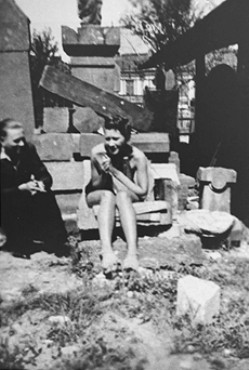
Hero: Zofia Baniecka, rescued 50 Jews during Holocaust

Eva Fogelman, author of Conscience and Courage: Rescuers of Jews During the Holocaust, writes that heroic acts tend to come from a deep sense of common humanity. The roots of this behavior may stem from early upbringing. Fogelman notes that many Holocaust rescuers themselves suffered and were sensitized to the suffering of others. They also tended to have been raised in loving families where self-worth was fostered and reason rather than punishment was used as discipline.

Social scientists still know quite a bit more about aberrant behavior than why people choose to do good. That’s changing according to Philip Zimbardo, author of The Lucifer Effect: Understanding How Good People Turn Evil.  Zimbardo conducted the now infamous 1971 Stanford Prison Experiment (check it out on this slide show) which demonstrated that psychologically normal people will instigate and take part in atrocities. Now Zimbardo is devoting himself to bringing forth the brighter side. He’s started an organization called  Heroic Imagination Project which aims to teach the rudiments of heroism.
Currently a pilot project, it consists of four main educational components taught over four weeks.

  1. Students initially learn about us versus them attitudes, unthinking obedience to authority, and other human tendencies which unwittingly allow cruelties to happen.
  2. Next they work on building empathic responses through listening, paying attention, and “walking a mile in the other guy’s shoes.”
  3. Then they study heroic stories, seeking role models and discovering that compassionate action does inspire.
  4. And finally they practice heroic behavior on a daily basis by translating their good intentions into action, no matter how small.

We don’t have to wait for a course. The steps taught by the Heroic Imagination Project are the building blocks of human decency, things we should teach our children every day and should continue to develop in ourselves.

We’re captivated by real heroes in the news and imaginary heroes in the movies because they call out the best in us. Such stories ask us to live up to our values, not only when we’re in extreme situations.

It’s also time to recognize unsung heroes around us everywhere. They don’t get publicity because their deeds don’t seem extraordinary. Unselfish acts performed a million times a minute weave us together as a caring species. We tend to the helpless, comfort the sorrowful, share knowledge, and create happiness. Such kindness is contagious, each act of compassion and cooperation spreading out in enlarging waves of goodwill. Such efforts may seem small, but they are the basis for making heroism happen.

Waiting For Superman, Really?

"waiting for superman," alternative education, democratic schools, test scores meaningless, charter schools bad, corporate influence in schools, educational freedom,

School in the old days may not have been ideal, but good teachers made all the difference. My father taught elementary school back when teachers had real options in the classroom. At least in his district, as long as his students generally covered the subject areas he was free to innovate. So he did. His fifth graders performed experiments, took care of the classroom snakes and rats, started school-based businesses, and perhaps most importantly, read and wrote about what they found interesting. Those days weren’t perfect by any means for students let alone teachers. But they’ve gotten worse. My father skedaddled out of the teaching business before standardized tests really hit education. But he saw the zombifying effect on schools, teachers and kids brought by high stakes testing.

Even in the best districts, attaining those all-important numbers eliminates opportunities for innovation and time to work with students’ interests. Those left behind see their schools under test-heavy siege charged with getting results or getting eliminated.  This drive also shapes the kind of material students see, relentlessly preparing them to reach higher for the Almighty Score while giving scant attention to more complex yet essential skills for higher learning like critical thinking, creativity, initiative, and persistence.

Test Scores are not the Last Judgment

We might believe policy-makers know what they’re doing. Surely they haven’t been restructuring education based on bare numbers unless they had substantial proven results. Greater competiveness on the world market or at least greater individual success?

Nope.

Here are the actual results in this excerpt from Free Range Learning:

It’s widely assumed that national test score rankings are vitally important indicators of a country’s future. To improve those rankings, national core standards are imposed with more frequent assessments to determine student achievement (meaning more testing).

Do test scores actually make a difference to a nation’s future?

Results from international mathematics and science tests from a fifty-year period were compared to future economic competitiveness by those countries in a study by Christopher H. Tienken. Across all indicators he could find minimal evidence that students’ high test scores produce value for their countries. He concluded that higher student test scores were unrelated to any factors consistently predictive of a developed country’s growth and competitiveness.

In another such analysis, Keith Baker, a former researcher for the U.S. Department of Education, examined achievement studies across the world to see if they reflected the success of participating nations. Using numerous comparisons, including national wealth, degree of democracy, economic growth and even happiness, Baker found no association between test scores and the success of advanced countries. Merely average test scores were correlated with successful nations while top test scores were not. Baker explains, “In short, the higher a nation’s test score 40 years ago, the worse its economic performance . . .”   He goes on to speculate whether testing [or forms of education emphasizing testing] itself may be damaging to a nation’s future

What about individual success?

In remarks to a Cato Institute Policy Forum, Alfie Kohn said, “Research has repeatedly classified kids on the basis of whether they tend to be deep or shallow thinkers, and, for elementary, middle, and high school students, a positive correlation has been found between shallow thinking and how well kids do on standardized tests. So an individual student’s high test scores are not usually a good sign.”

Why then do we push standardized tests if it has been shown that the results are counterproductive? Well, we’ve been told that this is the price children must pay in order to achieve success. This is profound evidence of societal shallow thinking, because the evidence doesn’t stack up.

Back in 1985, the research seeking to link academic success with later success was examined. It was appropriated titled “Do grades and tests predict adult accomplishment?”

The conclusion?

No.

The criteria for academic success isn’t a direct line to lifetime success. Studies show that grades and test scores do not necessarily correlate to later accomplishments in such areas as social leadership, the arts, or the sciences. Grades and tests only do a good job at predicting how well youth will do in subsequent academic grades and tests. They are not good predictors of success in real-life problem solving or career advancement.

For-Profit Charters are not the Promised Land

Now the much-touted documentary Waiting for Superman indicts today’s schools. The film hasn’t opened yet, but advance publicity makes it clear that solutions include whipping the teacher’s union into submission while tossing money at the problem. Waiting for Superman follows five families as they try to spare their kids the fate of bad public schools by enrolling them in promising charter and magnet schools.  These are surely among the best charter and magnet schools in the country. But with our tendency to simplify any message, this film will surely be used to advance public perception of all charter schools. And that’s a very short-sighted approach.

Yes, there are some good ones, even some great ones out there. But let’s consider for a moment that many charter schools are run by for-profit companies. Making public education into an opportunity for entrepreneurs is not the solution. Owners have to make money somewhere. As a result they pay teachers very little, emphasize public relations, and provide little more than a rote McSchool education. Meanwhile they rake in stacks of taxpayer cash. Some charter schools provide nothing more than all-day computer based curricula for students to use at home (co-opting the term “homeschooling”) or in poorly run facilities. Unlike public schools, many charter schools can handpick their students, resulting in better overall test and behavioral outcomes. Even when children gain entrance by random pick, there’s an undeniably positive effect on students and their families who feel they’ve gained a leg up.

I’m not against entrepreneurs. I’d simply prefer to see them turn their attention to wind turbines and solar cells. My concerns are based on what’s happening in my home state. Here in Ohio, White Hat Management, owned by David Brennan, is the largest charter school operator in the state and the third-largest in the U.S.  They may have the most dedicated teachers and support staff possible but management is out for the money. Currently 10 White Hat run schools are suing the company hoping to get out of contracts. Why?

An attorney for the charter schools comments, “White Hat Management is a for-profit company. Its interest in making a profit often conflicts with the schools’ goal to educate and show student progress. There are no real rules in place to make White Hat fully account for the nonprofit dollars they receive to manage Ohio charters.”

A Columbus Dispatch article noted Brennan was making nearly $1 million for each charter school his company operated.

It’s not as if charters are better. According to a Stanford University study, charter schools here in Ohio underperform compared to public schools.

That’s true across the nation as well.

Comparing data from 70 percent of all charter students in the country, attending one of 2,403 charter schools, it was found that these schools were no better and often worse than their public school counterparts. Comparing math achievement, charter students had gains in 17 percent of the cases. But charter schools had no impact in 46 percent and a negative impact in 37 percent.

We knew this back when President Bush enthusiastically promoted poorly ranked charter schools. Now we know, at least in the case of some for-profit ventures, the concerned voices of parents and community members aren’t likely to be heard beyond “press one for public relations.” They may, as in Ohio, have to sue to free themselves from money-changers right there in the temple of learning.

No Need to Wait, We’re the Super Heroes

The big changes in our society have come about as the result of ordinary people demanding accountability while making changes themselves. Everything from civil rights and environmental protections to natural childbirth—- our ideals, our struggle.

Waiting for Superman urges us to insist on similar changes in our schools. But change isn’t about throwing more money at the problem. It certainly isn’t about letting corporations get a stronger foothold in schools where BP writes science materials and advertising is ubiquitous.

The change highlighted in the film is spurred by concerned parents and amazing teachers like Jeffery Canada. I’m a big admirer of Canada’s work I read both his books Fist Stick Knife Gun: A Personal History of Violence in America and Reaching Up for Manhood: Transforming the Lives of Boys in America when they came out. The other teachers showcased in the film are equally creative, brilliant and caring.

Do we see the irony here? This film showcases innovative teachers and child-centered programs, holding them up as the last hope to “save” kids from bad public schools. Exactly the sort of conditions that benefitted my father’s public school classroom before high stakes testing and business models got in the way.

There’s no “silver bullet.” We’re talking kids here, kids who start out with curiosity and eagerness. Sure, we can funnel a few lottery winners into trendy themed schools like Q2L or we can recognize that all children are born to learn in the way that best suits them, as they do in Democratic Schools.

While tests measure what kids have yet to achieve, kids themselves more naturally seek to  engage in the wonderfully exciting work of mastery, guided by parents, teachers, grandparents, clergy, friends and the world around us. The strictures of school tend to limit learning, as I explain at length in my book which is one reason a few million of us homeschool, creating every day the kind of responsive and individualized education that best suits our children.

But that’s not workable for everyone. So let’s figure out what changes will really benefit our children and our communities.

1. Let’s find out about the holistic, uneven and delightfully unique ways that children learn.

2. Let’s look beyond trends, reading publications written by parents and teachers such as Education Revolution Magazine,  Rethinking Schools, and Encounter: Education for Meaning and Social Justice.

3. Let’s pay attention to the thoughtful, experience-informed work of today’s unsung educational luminaries including Ron Miller, Jerry Mintz, Chris Mercogliano.

4. And perhaps most importantly, lets pay attention to what those who love to learn have to say. Our kids tell us how they learn best each day not only through their enthusiasm but also through their stubbornness, anger, despair and numbness. They need to participate in meaningful work, to apply real skills, to pursue their own interests, to advance at their own speed in their own way, to model themselves after people they admire and to face challenges that inspire them. Every day. That’s how humanity advances.

The future is too important to do otherwise.


Six Ways Introduce Fine Arts Using The Happy Idiot Method

Artwork by Samuka

“You’re a frigging idiot.”

That’s what the guy behind us said. He spoke so loudly that two rows of concert-goers heard it. He didn’t even wait until the intermission to announce he considered us boorish.

I’m still not sure what upset him so much. My seven-year-old daughter had begged to attend what she called a “real performance” after enjoying a number of the Cleveland Orchestra’s Musical Rainbows concerts for young children. Nearly every day since she’d been three years old she put on recordings such as Beethoven Lives Upstairs,
Prokofiev – Peter and the Wolf,  Song of the Unicorn, and Mr. Bach Comes to Call.Sometimes she played,  sometimes she danced but mostly she drew pictures as she listened to compelling music woven around stories.

Going together to the concert was a rare night out for the two of us but I knew her three brothers weren’t as entranced by classical music. So that evening she and I dressed up, taking our eagerness to velvety seats not far from the stage. As the concert hall filled many people greeted us kindly. The musicians began to tune up and my daughter nodded at me. She knew this was her cue to be quiet until intermission.

Then the man behind us arrived. He squeezed past others, sat down and said aloud, “Oh no.” Because he exhaled so repeatedly and in such an exaggerated manner I wondered if he’d sat on something awful. Nope, the something awful was us.

Just as the conductor lifted his baton, the man behind us leaned forward as if to whisper, but his hissed words weren’t quiet at all. He said, “I paid good money for this seat. Your kid better not wreck it.” Then he muttered “idiot” under his breath. I turned around to look at him, more surprised than annoyed, but he wasn’t looking at me. He was glaring hatefully at my beautiful child.

The performance started and my daughter was enraptured. At times she looked over at me, squeezed my hand or leaned her head against me. Sometimes her hands floated just above her lap as if carried by sound. I paid close attention, hoping to hold the whole experience in my memory.

As the applause died down after the first piece the man behind us started sighing in exasperation. And he kept it up. I tried to notice what might have been bothering him. My daughter didn’t speak, didn’t hum along. She simply adored the music. But when the man started bumping my seat I turned my head to look at him. He was still glaring at my child.

For reasons of his own he was fed up. He looked at me and said loudly, “You’re a frigging idiot.”

The moment intermission began he stomped off and didn’t return. I hoped he’d find some peace despite possession by keep-children-out-of-concert-halls demons. But I’m no saint, I was pretty thrilled he left.

The woman next to my daughter assured us we weren’t the problem. An elderly gentleman at the end of our row, an orchestra patron for thirty years, said he hoped to see more children who loved classical music. By the time the musicians filed back some people had chatted with my daughter, happy to learn about her specific knowledge of that evening’s program. Others said, quite tactfully, that it was rare to see youngsters attend an evening concert.

A common perception is revealed by this experience. Fine arts and eager children don’t go together.

It’s not just one guy convinced the presence of a kid will ruin his evening. Most people set the arts aside as something special or worse, something for those who really know what they’re reading/seeing/hearing.

To me that’s the sort of separatist thinking that keeps fine arts in the underfunded, under appreciated realm where nearly extinct things go to die. But that’s how they’re introduced to most young people. Arts are imposed using the old “eat this spinach or you’ll be punished” method. Great way to inspire a hatred of spinach. And art. It isn’t woven into their lives and it doesn’t grab them (or at least many of them) in a way that’s personally meaningful. Instead fine arts are introduced in later grades. Students are lectured, assigned work, and graded. If they’re lucky they get extra doses of the arts doled out in guided museum visits and a class trip to see Shakespeare performed after weeks of preparation. The vitality is bled right out.

In Shakespeare’s time his plays were part of popular culture. People from all social classes crowded into the Globe Theatre where they enjoyed the bard’s social commentary, melodrama and comedy. Chances are they didn’t bother to analyze a thing. Chances are those plays did for them what art does when it means something to any of us, it illuminates.

I love the way young people discover and appreciate art when it isn’t imposed on them. These days my kids are older (teens and young adults). They enjoy fresh visual arts on YouTube, soaring new classical music scored for video games, and performances everywhere. Better yet, they aren’t passive. They connect and engage with it. During a recent discussion I overheard my kids relate the theme of a recent movie to Homer’s Odyssey, tie that to quotes from a Terry Pratchett book, then they were off parodying the theme using quotes from movies and song lyrics. Lightening fast, funny, and sharp. No curricula could possibly keep up.

My kids swam in the current of fine arts from the very beginning, as it flowed naturally with all the other influences in their lives.

Here’s the enjoyment-based, jump-right-in way we’ve always gotten comfy with fine arts in my family. (Caution, some may deem it idiotic.)

  1. Build in some fun. If you’re going to a concert in the park take along silent amusements for small people—a tiny stuffed animal that just might want to dance on its owner’s lap, drawing materials to capture impressions of the performers or the feeling of the music, a small treat that’s specific to concerts (consider bending that no lollipop rule). And if it isn’t much fun don’t stick around. Mosey off and wait until your children are older. And once your kids are older the experience is a greater pleasure for them if you let them invite a friend. We were often surprised to find that our 10th trip to a museum, where my kids clamored to see favorite sculptures and new exhibits, was the first trip for their friends.
  2. Make it an adventure. When you journey any distance to see a music performance, attend a play, or ramble through galleries make that stop one of several anticipated events.  Try to spot murals or other public art on the way. (When they were little my kids knew we’d arrived when they waved at the Guardians of Traffic pylons as we drove over the bridge to Cleveland.) Take a break in an ornate big city library, eat a packed lunch in a park, stroll through an open air market, pick up unusual snacks at an ethnic grocery, and let your child’s curiosity help guide the day’s events.  If part of the day incorporates a lot of sit down time (including the ride to and fro) be sure to balance that with movement, exploration, and sensory adventure.
  3. Tune it to the child’s level. Let preschoolers stroll as interest leads them through museums, especially art museums. You might decide to look for something specific on the way (one of my sons liked to spot animals, another son made it his quest to find anything airborne—birds, planes, angels, flying carpets).Make galleries a place of discovery. chat, ask questions, and when they lose interest it’s time to go.
  4. Make it an ordinary part of life. As with anything, it’s what you pay attention to that you magnify. Conversations about music, philosophy, or logic are just regular mealtime topics, brought up with the same casual interest as sports or the weather. Literary discussion with a four-year-old is easy. Simply talk about the picture book you’ve just read together. How could it have ended differently or gone on longer? Why do you think the main character acted that way or made that decision? Which character would you like to be in the story? Why?
  5. Start early. Listen to music as you nurse babies to sleep, imagining the wonderful association that child is making between sound and comfort (whether Bach or the blues). Hold up tiny ones to get a better look at paintings or sculpture. Indulge in sock puppet conversations with your toddlers. Dance and sing together unselfconsciously. Display your child’s artwork in frames and on shelves. Make CD’s available to kids for bedtime listening or quiet time, especially those by professional storytellers such as Odds Bodkins (who started my kids’ love of Homer’s Odyssey) and Jim Weiss. A great selection is available at Gentle Wind, Chinaberry, and your local library.
  6. Enjoy it the way you choose. Shakespeare’s work may spark fascination in a lavishly illustrated picture book such as Coville’s William Shakespeare’s The Tempest (Picture Yearling Book), an early chapter book such as Mayer’s The Tempest, or maybe a graphic novel like The Tempest The Graphic Novel (American English, Original Text). See The Tempest in any number of movies from productions done in 1928 to the newest, recasting Prospero as a woman. Check out how The Tempest has been interpreted by artists throughout the years. My kids appreciate a stage performance best after they know the story well, on their own terms, after bumping into it in books or movies or music. After seeing the play, one of my kids noted that it was written 400 years ago but names from The Tempest are still popular today— Miranda, Ariel, Antonio,Iris, Sebastian. That reminds me that the roots of what we care about today go much farther back than we imagine.

*

Find more suggestions in Free Range Learning.

*

*


*