Children are drawn to challenge themselves. They need to take risks of all kinds—physical, social, emotional, intellectual—in order to grow into mature self-reliance.
Where do such challenges most naturally occur? Outdoors. As detailed in Last Child in the Woods, when children spend time in natural areas their play is more creative and they self-manage risk more appropriately. They’re more likely to incorporate each other’s ideas into expressive make-believe scenarios using their dynamic surroundings—tall grasses become a savannah, tree roots become elf houses, boulders become a fort. Their games are more likely to incorporate peers of differing ages and abilities. Regular outdoor experiences not only boost emotional health, memory, and problem solving, they also help children learn how to get along with each other in ever-changing circumstances. Free outdoor play with others, especially when it’s not hampered by adult interference, teaches kids to interact with others while also maintaining self-control. Otherwise, no one wants to play with them. It’s the best sort of learning because it’s fun. Sounds like the perfect way to raise bully-proof kids doesn’t it?
But the opportunity for free play and risk is funneled into very narrow options for today’s children. They are shuttled from one adult-run activity to another. Time between these obligations is often spent indoors. And children’s outdoor play is restricted by excessive rules designed to keep them safe from dangers out of proportion to any real safety issue.
So kids don’t get natural challenges like climbing trees, exploring fields, building forts. They are deprived of the rich lessons of cooperation and self-control found in free play. And they don’t develop biophilia, that essential sense of connection with nature. Then we expect them to get along and recognize real risk. Any wonder that bullying is a growing problem?
Here are examples of playground designs that, in institutions like schools and daycare programs, foster free play using natural materials. Sensory play, places for solitude, and opportunities for physical risk are built in and, no surprise, children get along better.
It’s a step in the right direction. A few steps farther and we’ll let kids back in nature herself, playing in woods and fields and beaches. Too bad all the money thrown at anti-bullying programs aren’t used to fling open the doors to the natural world. “Go out and play,” may very well be the best anti-bullying advice yet.
“Self-trust is the first secret of success.” Ralph Waldo Emerson
No one wants to be cajoled, forced, or coerced. Some of us resist mightily. Such resisters are called all sorts of names: underachieving, non-compliant, difficult, withdrawn, eccentric, or worse.
Human beings naturally resist when our autonomy is threatened. And autonomy is most threatened in childhood because many adults (particularly in the western world) believe children require moment-to-moment instruction, advice, and entertainment. Unlike most of previous human history, children’s lives today are heavily monitored and controlled. Adults keep kids in pre-planned activities, insist that education proceed in a linear fashion, intervene to minimize difficulties, and provide distractions to prevent even momentary boredom. They do so assuming these efforts will advance learning and boost success.
Yet this puts character development at risk, because children are attracted to dilemmas that help them learn. Learning from mistakes, taking on challenges, and developing a growth mindset are pivotal for success. So is preservation of a trait found in people at the top of their fields in science, the arts, and entrepreneurship—curiosity. And curiosity arises in unique and unpredictable ways, often appearing after a child has traveled from boredom to inspiration on his or her own.
Coercion also puts the child in an uncomfortable position, because all this control comes from adults with the best intentions. Usually adults who love them. So children, who don’t like overt control any more than you do, typically react somewhere on the spectrum between compliance and resistance. Extreme compliance and they’re less likely to think for themselves, developing an external rather than internal locus of control. Extreme resistance and they’re likely to face ever more punitive efforts to get them to comply. Neither reaction is what adults want or expect.
Which leads me to a story about Transcendentalist writer, Ralph Waldo Emerson. He and his son Edward were trying to get a calf through a barn door. Emerson pushed from behind while his son pulled on the calf’s ear. The heifer wouldn’t move an inch despite a great deal of effort exerted by the two men. Emerson thought back over his scientific and literary readings in hopes of figuring out some way of getting the reluctant animal to move but didn’t come up with any solutions. They continued trying, to the amusement of a servant woman who was passing by. She offered a finger to the calf. Easily led by its desire to suckle, the calf followed her at once.
The wisdom of capitalizing on natural tendencies is the key to good animal husbandry. It’s probably a key to decent human relationships as well. I’m not for a moment suggesting that children are calves. (In fact, I’d rather see calves left with their mothers to suckle than led into a barn by capitalizing on that unmet need.) Children need rules, responsibilities, and the expectation that they’ll treat others with compassion. They need to be nurtured by adults who understand that pushing and pulling aren’t useful ways to help children mature. And they need the freedom to learn in ways that are best for them. At any age, those of us who aren’t oppressed by coercive relationships or controlling institutions gladly seek out advice as we need it, find role models who inspire us, and advance in the direction of our greatest gifts.
“No human right, except the right to life itself, is more fundamental than this. A person’s freedom of learning is part of his freedom of thought, even more basic than his freedom of speech. If we take from someone his right to decide what he will be curious about, we destroy his freedom of thought. We say, in effect, you must think not about what interests and concerns you, but about what interests and concerns us.” John Holt
Something happened the night Worry appeared to me.
Some of us are chronic worriers. There’s probably an adaptive reason for this, since humans who envisioned potential dangers would be more likely to survive and pass on their genes. But saber-toothed tigers aren’t lurking by our front doors these days. I know for a fact that worry generates misery while producing absolutely no benefit. Giving it up, however, isn’t an easy matter. Worry runs in our heads like movies of disaster to come, unbidden yet powerful, making some of us wary of the smallest choices.
I worried from the earliest time I can remember. It may have an adaptive start in my life too. As a tiny child I spent many nights struggling to breathe through asthma attacks. When I was five years old I got a bit of food lodged in my esophagus. When my worried mother called the doctor he said it couldn’t possibly still be stuck hours later, I was just overreacting. I stayed awake all night spitting my saliva into a bowl, since even a moment’s inattention caused it to run down my windpipe and sent me into fits of choking. The next morning my parents took me to the ER where a surgeon removed a very stuck bit of food. The year I turned nine my grandparents all died, catapulting me into years of obsessive worry that everyone else I loved would die too. I was assaulted by an adult when I was 13, telling no one until years later. The focus of my worry widened as I spent years searching for the causes of evil and suffering. Worry continued to be my companion when I hit my 20’s. Each of my babies were born with medical problems. The unknown dangers threatening even the most innocent lives suddenly resided in my house. Chances are my chronic insomnia has roots in all this worry.
One night as I lay awake worrying, I had an experience that profoundly changed me. That night I had plenty of things to worry about: serious concerns about my children’s health, our finances, and other problems. Normally I fought off worry with gratitude—focusing on the comfort of my family sleeping safely nearby and the many blessings in my life. But worry was there haunting my mind and hollowing my body.
Sudden as a car crash, something happened.
I know it sounds bizarre but it was as real as the lamp on my desk is now. I became aware of a huge black column next to my bed. It was comprised of the most immense energy I’d ever experienced. It was dark and powerful with a presence that seemed alive and completely aware of my thoughts.
I had the sense that it was of such infinite size and strength that it went through the floor and out the roof, stretching far in both directions. I should have been more frightened, but the moment this column appeared I realized, as if the message hit all my cells at once, that I had summoned this darkness.
It was born of my own intense worry. It was a profound lesson that went through me the way wisdom does, filling not just our brains but also our bodies and souls. Lying there, I resolved to bring forth every ounce of light I could muster.
The instant I thought to do this, whatever that column was disappeared.
I woke my husband to tell him. He kindly assured me that I was nuts. Until this post I’ve only told one other friend. But in today’s atmosphere of worry, I wanted to share this image—of fear so huge that it manifests next to you. It taught me that worry is a kind of unintentional evil. It presupposes things will go wrong. It’s the opposite of faith.
I’m not entirely cured of worrying nor would I ever change those earlier years of worry. They’ve made me stronger, more open to the beauty found just beyond despair, and left me with a positive quest. But ever since that moment, years ago, I have made a conscious effort to reorient myself.
Ironically, my family has been through times more difficult than I could have imagined back when this happened—crime, financial hardship, loss, and grief. But I know the antidote—to shine forth with all the light I can. Some days I’m practically optimism’s parasite.
But really, if all my moments of hope coalesce into some kind of vision, I can’t wait to see it.
Why do we take any one path in our lives? Perhaps a mix of choices and abilities are simply stirred in the cauldron we call childhood. Or maybe there are elements we can’t fathom.
Here’s one reason for my wonderment.
I was one of those kids who worried about every chained dog and crying baby. I wanted to understandwhy the world contained cruelty and more, how I could fix it. When I was ten years old I learned about the splitting of the atom. It struck me with cold horror, although I couldn’t articulate why. Before that I assumed most adults were looking out for the welfare of kids and trees and animals under their care. But once that information sank in I was afraid that grown ups were terribly misguided. When I asked questions I found out my country had dropped two atom bombs on Japan and that it now used nuclear power. Adult logic suddenly seemed like a fairy tale. It wasn’t until years later that I heard what J. Robert Oppenheimer, called the “father of the atomic bomb,” thought when the first one was detonated. A verse from the Bhagavad Gita came to his mind: “Now, I am become Death, the destroyer of worlds.” Cold horror indeed. Even on sunny daysI thought about death.
As the child of conservative parents, I don’t recall any family discussions about nuclear weapons or nuclear energy, pro or con. The few times I asked I was told the bombs had to be dropped to end the war and nuclear power was a safe, clean form of energy. I kept to myself the chilling fear I felt whenever I thought about the splitting of atoms. That is, until my father’s old college roommate was in town. Before his visit I was told he was a smart man who had done well for himself. (In other words, little girls must be extra polite.) And I knew my father hadn’t seen this friend since before I was born. All good reasons to mind my manners and listen quietly to the adults talk. Which I did, until I heard him mention he was an engineer for a nuclear power plant. I gasped (not a polite response) and asked him about the dangers of radioactive waste.
He gestured to the light switch on the wall dismissively, asking, “Do you expect the lights to go on or do you know how to generate your own electricity?” As a child still afraid of the dark, I didn’t have much to say. But his response didn’t ease my concerns. That experience taught me to get the facts before I introduced a subject and also todosomething about my concerns. Thank you sir.
I’m sure my ten-year-old self would be disappointed with me. I haven’t devoted myself to freeing the world of nuclear waste and nuclear weapons, nor to advancing peace. But it’s an issue that has resounded in my life. I worked with anti-nuclear weapons activist groups for years and taught nonviolence workshops even longer. I campaigned and testified against the opening of two nuclear plants in Ohio (unsuccessfully) and against a five state radioactive waste dump (successfully). When my children were small we attended Hiroshima Day observances each year, floating traditional lantern boats with messages of peace to commemorate the lives lost. We also hosted a child from the Chernobyl region for five summers, a child we grew to love and whose health is still threatened by elevated background radiation in her homeland.
Then I learned what splitting the atom meant to me, personally.
My father never had much to say about serving in the U.S. Navy in the closing months of World War II except that he had been a radar man. But in the last years of his life we heard more. He told us about one day in particular. He and the entire crew of their ship were called on deck. They thought it was to formally welcome a new commander. Instead they were given a classified briefing.
They were told all leaves were cancelled and all communication with home would be heavily censored. Their ship was being retrofitted to leave for an upcoming top-secret coordinated air and sea attack on Japan. Their ship would be third in line of the first fleet. It was considered a “sacrifice” ship. My father, a quiet religious teen who got drafted right out of high school, faced certain death along with the rest of his shipmates.
The US had commissioned a study on the human toll of invading Japan. It was estimated that somewhere between 1.7 to four million Allied casualties with between 400,000 to 800,000 lives lost, while a far more horrific five to ten million Japanese lives lost. The United States manufactured a half million Purple Hearts they expected to award after this invasion, so many that today they’re still using of the stockpile of those medals 80 years later.
A very short time later, the U.S. dropped two atomic bombs on Japan. My father lived to attend college, become a teacher, get married, and have a family because of the unspeakable violence wrought by those bombs. I am alive because of those bombs.
That I’ve felt driven since earliest childhood to advance a peaceful, nuclear free world now seems to have roots more mysterious than I can comprehend. I don’t know if that’s destiny at work, but it calls me to believe that our paths are far more complex than we imagine.
The science of epigenetics shows that the choices we make today will resonate in the minds and bodies of our grandchildren.
How? Each of us has biochemical markers that signal our genes in response to input such as nutrients, toxins, even behavior. As a result potential gene expression is switched on or off.
Nucleosome Wikipedia
These epigenetic changes persist well after the original stimulus for change is gone. Some of them pass on through generations like biologic memories of what our ancestors ate and breathed, as well has how they felt about their experiences. This also means that our personal choices today can become a living inheritance sent on to those we won’t live to see.
As Duke University genetics researcher Randy Jirtle, Ph. D recently commented,
We can no longer argue whether genes or environment has a greater impact on our health and development, because both are inextricably linked. Each nutrient, each interaction, each experience can manifest itself through biochemical changes that ultimately dictate gene expression, whether at birth or 40 years down the road.
Image courtesy of corazondedios.deviantart.com
Much of the research about epigenetics correlates to earlier studies showing that parental stress has a negative and long-lasting effect on their children, often well into adulthood. That’s true of the effect of prenatal stress, parental stress during early childhood, parental depression, conflict in the home, unemployment, poverty, and homelessness. Epigenetics may, in part, explain the strong correlation between these stressors and resulting poor mental and physical health in the next generation.
But there’s good news too. Studies have shown that early nurturance can flip “dimmer switches” on genes related to stress, permanently shaping offspring to be calmer and better able to handle new situations. Healthier too.
Chances are good that I was born with genes predisposing me to anxiety or depression. My sorrowful grandmother nurtured my own mother as best she could despite very stressful circumstances. In turn, I was lovingly nurtured and well attached to my parents. As a result, these predispositions were more likely to be dimmed or switched off in me. I hope to carry on this legacy of positive epigenetic changes by gently parenting my children. Epigenetics show us that grandparents and parents can bless children to come (including foster children and adopted children) even if they don’t live to see those children.
As a society, we’ve known for a long time that serious parental stress leaves a legacy of pain into the next generation. Maybe the science of epigenetics will be enough to convince us that parental support and nurturance doesn’t just benefit the child. It also benefits society as a whole.
The principles of non-violence are little known and desperately needed. Here’s a simple take-away lesson. One major characteristic of violence, verbal as well as physical, is that it tends to escalate. It is most easily reversed at the beginning and becomes progressively more difficult to stop as it spirals into more intense violence. Those who study the effects of intervention in violent situations have found that when others object or actively intervene, their efforts tend to slow or stop the violence. Dr. Ervin Staub, who survived under Nazi rule, reports in The Roots of Evil, that the Khmer Rouge in Cambodia and the Nazis in Germany began their campaigns of genocide with small persecutions which citizens allowed to continue. He reports that action by “bystanders” (those who are not victim or perpetrator) empowers the victim and diminishes the power of the aggressor. But ignoring the suffering of others allows the violence to escalate.
We’ve seen this principle in action more recently. Hate talk spread unchecked across all forms of media played a major part in creating the horrific ethnic violence in Serbia, in Rwanda, and in the Congo. Yes, there were reasoned objections but they weren’t loud enough or frequent enough to turn the tide.
Hate talk and repressive policies put into place sounds familiar. Today Muslim headscarves are banned in France, the construction of minarets are banned in Switzerland, Muslim travelers are profiled, and pundits advance the cause of prejudice unchecked. And now, the recent horrific acts of violence by Anders Breivik, an anti-Muslim terrorist.
Step beyond a limiting cultural framework. If you have no Muslim friends, seek to make them in your community.
Take action when newscasters and pundits utter anti-Islamic rhetoric. Contact the network with your objections. Also let the sponsors of the show know you’ll boycott their products if these violations continue.
Take action when politicians use anti-Islamic rhetoric. Contact them to explain you’ll be voting them out of office.
Actively object if you hear anti-Islamic rhetoric in a personal conversation. Silence is generally taken for agreement.
Actively object if you witness prejudice against any Muslim person. This means intervening in your school or workplace as well as in public. Here are some tactics for non-violent intervention.
Sophie is a single mother raising a five-year-old boy. She’s working to establish her own house cleaning business after losing her job nearly two years ago. Sophie and her son live in a small trailer home.
Marissa and Jack run a thriving dental practice while raising five-year-old twin daughters. They live in a suburban home on several acres.
The five-year-olds from these families are at opposite ends of the economic spectrum. But their parents are raising them in remarkably similar ways. Frugally.
Although Sophie would prefer a more reliable income, she wouldn’t spend a cent more than she already does on herself or her son. She adheres closely to simple living tenets. Sophie grows as much food as possible in a community garden plot and makes meals from scratch. She and her son fully enjoy the free benefits of the local library and park system. On weekends, Sophie’s folk band crowds into her trailer for practice sessions. Her son is already learning how to play the harmonica and fiddle. Sophie believes he should rely on his imagination for fun rather than on toys. When she does buy him gifts, they tend to be modest items such as crayons or socks, or ones that have long- term use such as simple tools or sheet music.
Marissa and Jack choose to live simply in their own way. They buy clothing and their children’s playthings from thrift stores, exchange only homemade gifts, and emphasize having fun outdoors. They carefully consider expenditures based on their ethics. Health is a priority, so they buy only organic foods and belong to a CSA. Supporting the arts is another priority so they invest in original works to hang on their walls and regularly attend plays, concerts, and gallery events. They strongly believe in the importance of international travel. When they go to far-off places, they get around by bike or local mass transit, a method they find brings them closer to the cultures they’re visiting.
Many of us are living more frugally. It certainly eases financial strain. It also makes a difference in wider ways, from reducing our ecological footprint to promoting social justice.
Today’s relentlessly materialistic culture tells young people in every way possible that their identity is built on wearing, playing with, and using the very latest consumer products. That’s a heavy tide to fight against on the home front. But that tide is worth turning.
Living simply puts the emphasis on exactly the conditions that are best for our kids, now and as they grow into adulthood.
Shelter From Commercialism
Humanity has always raised her children with the stories, foods, rituals, and values of particular meaning to the people close to them. While there are undeniable benefits to today’s connections and conveniences, a major drawback is the way advertisers have insinuated themselves into the lives of even the youngest children. Nowadays, a child’s stories, foods, rituals, and values are more likely than ever provided by the marketplace. And we know what’s preached there – that meaning comes from what can be bought.
Every year, a 15 to 17 billion dollar marketing industry is aimed at our kids. That money is spent because it’s effective. It’s estimated that 565 billion dollars in purchases are influenced by four- to twelve-year-olds.
Susan Linn, who teaches psychiatry at Harvard Medical School, notes in Consuming Kids: The Hostile Takeover of Childhood, that psychological and neurological research is used to exploit the vulnerabilities of children. She writes, “The explosion of marketing aimed at kids today is precisely targeted, refined by scientific method, and honed by child psychologists – in short, it is more pervasive and intrusive than ever before.”
These strategies are not only employed in advertising itself but are embedded in Internet sites, video games, television, and movies. They’re designed into packaging, implicit in many playthings, and nearly ubiquitous in schools.
Those of us who live simply shelter our kids in different ways and to differing degrees. No matter what approach we take, it’s neither possible nor desirable to shelter teens the same way we shelter toddlers. That’s why it’s vital to raise our kids to be critical thinkers with a strong sense of self. Then they’re empowered to make their own fully informed choices.
Delayed Gratification
This is a biggie in the “you’ll thank me later” department because kids who are able to delay gratification are much more likely to do well as they grow up.
We model delayed gratification each time we choose to save, make do, or make it ourselves. We demonstrate it when the whole family adds coins to a jar until there’s enough to finance an anticipated event. We teach it when we help children find ways to earn and save for their own aims. And we show that it’s expected whether our kids have to wait to see a movie until it’s available at the library or wait until the next birthday for a new pair of jeans.
This may seem negative, particularly when popular culture constantly screams “have it now” and “get what you want.” But there are enormous positives. Our children become familiar with the pleasures of anticipation, which multiplies the eventual delight when a goal is reached. They also begin to internalize the ability to delay gratification. In multiple studies (cited in Daniel Goleman’s book Emotional Intelligence) children who were able to defer gratification grew into teens and young adults who were more socially competent, better able to deal with frustration, more dependable, reached higher educational attainments, and were effectively able to make and reach long-term goals.
Delayed gratification is related to impulse control. Research shows that a child’s ability to control his or her impulses at an early age is predictive of success even decades later as a healthy, financially stable, and positive member of the community. There are many ways to help kids gain the positive coping skills that help them control their impulses and delay gratification. It may be about waiting, but the outcome is extraordinary.
Happiness
Despite advertisers’ images of happy children playing with new toys and giddy teens dancing in designer hoodies, the facts are glaringly obvious. Things don’t make us happier. Children seem to understand the “time is money” conundrum. When their parents spend more time away from home earning an income, they have less time to spend with the family. In a nationwide poll of American kids ages nine to fourteen, ninety percent said they’d prefer increased time with friends and family over material possessions. And when asked if they could have one wish to change their parents’ jobs, sixty-three percent said they would like their mom or dad to have a job that gave them more time to do things together. Only thirteen percent wished their parents made more money.
The more materialistic young people are, the unhappier they tend to be. According to research cited in The High Price of Materialism by Tim Kasser, people who hold materialistic values are more likely to suffer from a whole dumpster load of problems. This includes aggressive behavior, insecurity, depression, low self-esteem, narcissism, even physical maladies. And when people place high value on material aims, they’re prone to have trouble with interpersonal relationships and intimacy. Materialism is also related to less independent thinking and lower value placed on being “true to oneself.” Of course, we want to spare our kids this festering personal mess.
How? We recognize that a sense of well-being depends on intangible qualities like warm interpersonal relationships and reasonable autonomy in one’s choices, exactly those things that money can’t buy. But what’s interesting is that materialism and unhappiness seem to “cause” each other. We all know people who exemplify this. Unhappy people tend to seek status and satisfaction in more transitory ways such as acquisition and appearance. When they do, they feel a temporary boost in happiness, which reinforces even greater materialism.
Studies show that happiness has much more to do with experiences than with possessions. A family camping trip will provide more lasting pleasure than a large purchase. That may be due to the way we access memories. Long after the experience is over, we have fuller sensory-based recall that’s invariably richer than any a purchase can provide.
It’s important to model a cheerful approach to simple living for our kids, but that’s not enough. To ward off materialistic attitudes, our children need the personal strength found in the self- worth that comes from supportive relationships and a sense of accomplishment. In a marvelous example of synchronicity, these are precisely what simple living reinforces in our daily lives. We consciously choose to do for our- selves, to spend more family time together, and to focus on active rather than passive entertainment.
Creativity and Enthusiasm
Many adults seem determined to keep kids busy by enrolling them in supervised activities. And they provide kids with plenty of distractions like toys, video games, and television. Unintentionally, these efforts teach children that fallow time is undesirable. But brain studies show that daydreaming, contemplation, even that uncomfortable condition we identify as “boredom” is vitally important. These natural periods of down time are necessary to incorporate higher level learning and to generate new ideas.
If we expect children to resolve their own boredom without resorting to electronic or other distractions, we help them access a wellspring of ideas that seem to come from nowhere, a wellspring they discover within. Frugal living is one way to preserve a slow pace and minimal distraction load, letting our children become familiar with generating their own ideas.
When we live frugally, we also tend to avoid popular methods of “enriching” our children’s lives such as academic preschool, specialty classes, coached sports, and other paid programs. That saves on fees. It also fosters the kind of expansive learning that’s natural for our species. Research continues to show that when adults are highly directive and exert influence even in the form of rewards or evaluation, their efforts actually diminish a child’s motivation, enthusiasm, creativity, and ability to innovate. Well-intended efforts to hone a child’s abilities through early instruction tend to be counterproductive.
That’s also true of play. Our kids don’t need expensive toys or games. Children’s creativity and resourcefulness flourish when they play without the structure imposed by most playthings. Imagination flows freely when they use what they find in the backyard to play act, build hideouts, or create their own games. In contrast, a toy linked to a movie release or a game with structured rules has predetermined uses and children are much less likely to innovate.
Stuart Brown and Christopher Vaughn write in Play: How it Shapes the Brain, Opens the Imagination, and Invigorates the Soul that, “play lies at the core of creativity and innovation.” It enhances development in areas such as emotional health, social skills, motivation, confidence, a sense of justice, and much more. Young people who maintain a playful nature into adulthood are, according to Brown and Vaughn, remarkably well suited for success. A playful adult is more flexible, humorous, optimistic, and efficient. They note that throughout life, “the ability to play is critical not only to being happy, but also to sustaining social relationships and being a creative, innovative person.”
When our frugal homes provide plenty of raw materials necessary for play without up-to-the-minute popular toys, we’re putting into place the best conditions for sustaining creativity and playfulness.
Self-Reliance And Responsibility
There’s a resoundingly positive impact on our children when we include them in the real work of maintaining our family home, yard, vehicles, and more. Children growing up in frugal households often have regular chores. While some complaining is natural, chores help children understand how things work. They see the benefits of saving as they do calculations for the family budget. They recognize what happens if they forget to take the dog out or don’t bring the laundry in from the line before it rains. They take extra pleasure in the warm fire from firewood they helped to stack. Chores also enable children to master useful skills that will help them become more self-reliant adults.
Taking on early responsibility brings long-term consequences. A study, starting in the 1930s, followed men from young adulthood to death. These men had very different lives; some were affluent Harvard graduates and others were impoverished inner city residents. The men who helped out with regular tasks starting at a young age were most likely to enjoy stability and good mental health.
And there’s more evidence. A long-term study followed children from early childhood to their mid-twenties. What led to success? Balancing all other variables, it was found that the best predictor of a young adult’s success was participation in household tasks at a young age. And we’re talking resounding success – including educational attainment, high intellectual capabilities, a career, and good relationships with family and friends.
The optimum age to get started is three or four years old. According to researchers, starting in the preteen or teen years doesn’t have a strong association with success, although children who take an active role early continue to help out as teens. It’s important to gear the task to the child. Parents should take care to present tasks that aren’t too difficult and that fit the child’s learning style, and not to “pay” for tasks directly or through an allowance tied to the work. Researchers also suggest that children be involved in choosing tasks, perhaps through family meetings or rotating chore charts.
They key to success may also lie in the sensory riches gained by hands-on tasks. Those of us who live simply tend to do more for ourselves. We may grind our own grain and make our own bread, we may raise chickens and barter the extra eggs for a local beekeeper’s honey, we may fix rather than replace what’s broken. And when our kids take part they also gain learning experiences that apply to many other areas of life.
Neurologist Frank Wilson explains in The Hand: How Its Use Shapes the Brain, Language, and Human Culture that brain development and hand use is inextricably connected. And Wilson found a transfer effect. As he studied people who were masters in all sorts of fields (surgeon, puppeteer, and guitarist to name a few), he found each of them had engaged in regular hands-on efforts during their formative years. Whether they grew up doing farm work, playing a musical instrument, or helping grandpa build birdhouses,Wilson says the hand-brain link activated “hidden physical roots . . . of passionate and creative work.”
Starting our kids on tasks at an early age blesses them with self-reliance and a greater likelihood of success. It also demonstrates to them day after day that their efforts are needed. A child can see the outcome of his or her efforts in a meal the whole family worked to get on the table. It feels good. It feels even better is when a parent says, “Thanks, I couldn’t have done it without you.” There’s not a commercial product out there that can create the same genuine satisfaction.
Sophie’s little boy and Marissa and Jack’s twin daughters know that satisfaction. Their young lives have ample time for play, working alongside adults, and warm family conversation. The children soak up their parents’ values while learning and growing largely free of commercial influences, at least for now. Their parents have never met each other but they have the same focus. They see simple living as an integral way to bring forth a more conscious and life sustaining future for their children.
Interesting problems and exciting risks are life’s calisthenics. They stretch us in directions we need to grow. Children are particularly oriented this way. They think up huge questions and search for the answers. They face fears. They puzzle over inconsistencies in what is said and done around them. They relentlessly challenge themselves to achieve social, physical, or intellectual feats that (from a child’s perspective) seem daunting. They struggle for mastery even when dozens of attempts don’t provide them any success. It’s a testament to courage that they continue to try.
Illustration from ”Lustige Gesellschaft” by Franz, Count von Pocci
Sometimes children are accused of “looking for trouble” when they simply yearn to vanquish dragons of their own making. A child’s desire to challenge him- or herself is at times as unrelenting as physical growth.
As adults we do this in our own way. If we don’t have enticing challenges, we may develop a state of mental friction to compensate. It seems to be a very human trait to clutter up our days with trouble if we have no more engaging prospects. We worry, rehash old issues, overreact, or find complications where there may be none. As the roots of a plant become more tightly entangled once they are pot bound, an individual without the freedom to take on greater challenges often gets caught up in the same confining struggles.
Image by Keith Williamson
One thing we can learn from children is the way they are attracted to dilemmas that help them learn and grow. Children who are nurtured in a healthy, free range learning environment are invigorated by the challenges they seek out. They expand their own frontiers on a comfortable, self-regulating timetable. Perhaps people of all ages define themselves, in part, through the challenges they take on and the way they resolve those challenges.
Oftentimes we deprive children of normal day-to-day challenges because of our own time constraints. As adults we are often distracted and focused on moving forward. It takes considerable tolerance to keep from stepping in and doing for children what will take them much longer to do for themselves, such as solving problems, making choices, completing tasks, and accepting the consequences. But when we recognize that even these small challenges are catalysts for growth, it is easier for us to step back and let children face them as they occur. These are normal stressors. Dealing with them gives children the critical experiences that lead to self-reliance.
pdphoto.org
So much about today’s “managed childhood” has developed in order to prevent young people from making mistakes. We think we know the prescription for success, but as we’ve seen, a one-size-fits-all approach doesn’t allow individuals to thrive. It also denies them the very human right to learn in the way best for them and to listen to the callings that prompt them. The “right way” to proceed in our culture usually means health, popularity, good grades, attractiveness, college degree, career, marriage, mortgage, and so on. We’ve created these societal expectations largely to cushion our youth from mistakes. But error is inevitable even if we avoid all risks. That narrow, preordained path is anathema to genuine experience. Setting rigid standards for children sends a message. It says to them that failure is the worst outcome and that our acceptance is conditional.
What we might do instead is recognize that courage is required to go one’s own way, that mistakes are inevitable, and that the outcome is authenticity. The real challenge lies in accepting each person’s possibilities. That’s how each of us proceeds when we do what we can with what we have in order to live our lives fully. The path not taken may be the journey regretted forever. That’s why we need to honor mistakes as important passages in our lives too. They help us face the next challenge with a wry smile and new determination, knowing another lesson has been learned.
“I ask once or twice a year,” she told me. “But it’s a powerful question. It should only be used wisely.”
I was interviewing a woman I’ll call Ms. C. for an article on faith and spirituality. She was truly an elder. I don’t mean age-wise, although she appeared to be in her mid-seventies or beyond. By elder I mean the sort of person who lives deeply and gladly passes along what she has learned.
Ms. C. dressed up for our meeting. She wore a navy blue suit and dazzlingly patterned silk shirt, a tiny hat perched on her elaborately coiffed hair, and bright red lipstick that made her dark skin glow. The pants and sweater I’d tossed on looked pretty casual by comparison.
Ms. C talked about seeing the divine in all things. She spoke precisely, with poetic imagery, but also slid easily into humorous retorts. I felt a wondrous enlargement of spirit in her presence and was, frankly, reluctant to end our interview.
Then she mentioned that she employed the most powerful question of all.
I waited to find out what that might be.
She told me that it should be asked only when the questioner felt strong and ready for the answers. And it should only be asked of those who loved you and could be trusted to tell the truth.
She told me she asked her husband (of 42 years) every now and then. She also asked her sisters and close friends, usually when she felt prompted by some unknown impulse.
The question seems simple: “Is there something I should know?”
She said the answers it evokes are rarely simple.
When Ms. C. kept receiving important and sometimes surprising answers to that question it inspired her friends to take up the question too. She gave me a few examples.
~A neighbor was told by everyone she asked that she needed to seek medical help for a condition she thought was under control.
~A friend was advised to stop wearing clothes that were too tight and too young for her.
~A fellow churchgoer found out that his son was back on drugs.
~One person was informed that a long-standing habit of his infuriated his best friend.
~A former co-worker learned that she came across as haughty and cold, and needed to learn how to get past her shyness to let people see her warmth.
~A friend was told that a secret he thought had been buried long ago was out but no one had wanted to break the news to him.
Ms. C. says that she mostly listens to what the Quakers call the “small still voice” inside her but she has one ear open to what else she might need to know.
I tend to think there’s peace right beyond the need of answers but I won’t deny that Ms. C’s question has its uses. Nor will I deny that truth-telling feels wonderfully liberating.
Do you have a truth just itching to get free, if only a certain person would ask you?
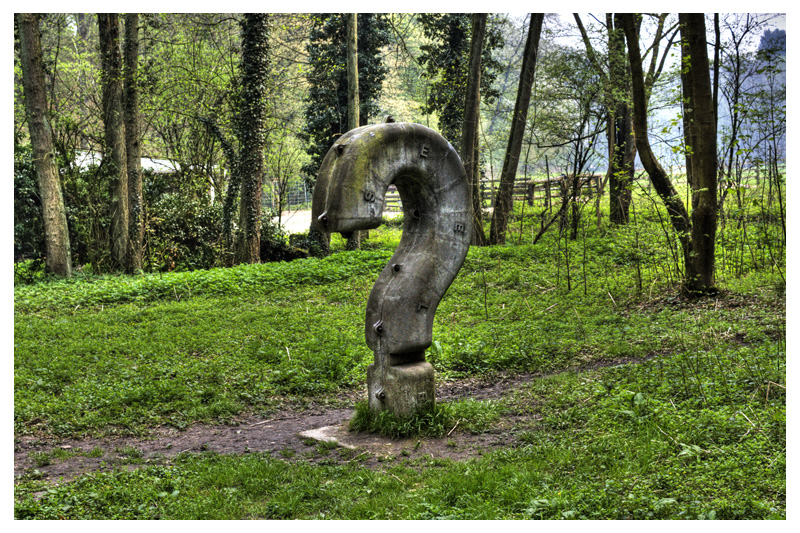
And what about truth seeking? Will you be asking the most powerful question?
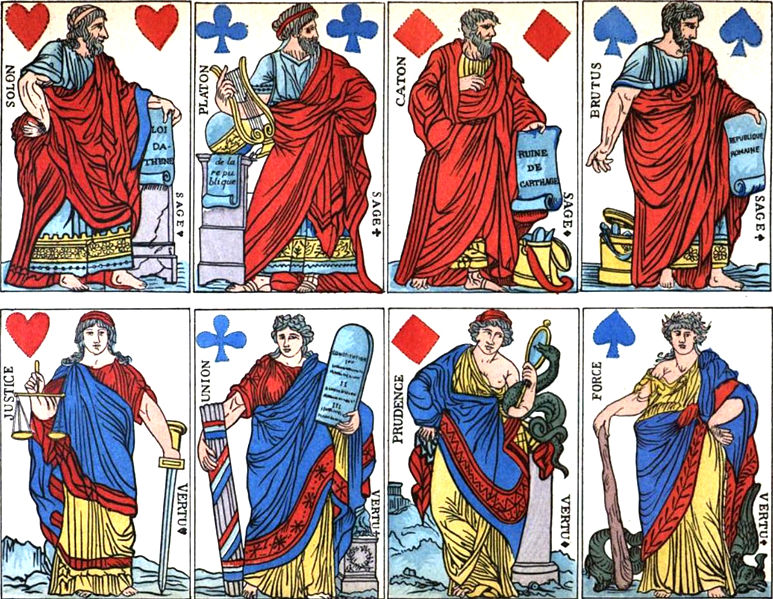
A Deck of Cards Dating Back to the French Revolution Where Kings Have Been Replaced With Wise Men (Solo, Plato, Cato, & Brutus), and Queens With Virtues (Justice, Union, Prudence, & Force) La Bibliofilia
The parent I would become was changed by history. Or at least by revelations history can offer.
At 18, I signed up for a college history course simply to fulfill a requirement. Although I’ve forgotten the professor’s name, I’ll never forget the man. He was oddly proportioned with a short round body that didn’t match his oversized head. His florid face, full lips, and bulging eyes gave the impression that he was continually strangled by an unseen hand. Stadium seating in our introductory history class of nearly 100 students made him look even more foreshortened as he stood below us at the front of the room. He used no visual aids, no videos, only an occasional map that he drew himself on the board. He spoke without notes about a subject that impassioned him. As he lectured his voice started to quaver, his hands trembled in front of him, and he leaned forward looking at us with red-rimmed eyes. He was overwhelmed with the task. His lessons had to sink in.
That lesson was the same no matter what era we studied. He taught us to look at all of history using one pivotal question.
What happens when people are deprived of (or otherwise separated from) the consequences of their words and actions?
We studied the elite in various societies throughout history who were insulated from the consequences of their actions, even if the working poor around them suffered more and more from decisions made by the elite. We analyzed the larger impact this had on the culture over time. Then we narrowed it down. We looked at rulers who were typically brought up with all the advantages of privilege. Those who rarely experienced the consequences of their actions from childhood on tended to make decisions that resulted in tragedy, sometimes immediately, sometimes in ways that resounded for generations.
Any time we stumble on truth we see how it interconnects with larger truths. That was the case with my history professor’s question. I saw that theme, consequences, everywhere I looked—- in literature, in politics, and in the news being reported each day. I saw it in relationships around me. And on weekends, while volunteering with a project that offered services to teen addicts, I saw it there too.
So I vowed to use what I’d gained from my history professor when I became a parent. When my toddlers made a mess, even spilling a drink, I offered them a rag and some assistance cleaning it up but I didn’t do it for them. That work was their own. As they got older I expected them to give me three reasons when they wanted to do something outside our normal rules. They learned impeccable logic in the service of their own interests. And when they were teens I didn’t keep them from taking reasonable risks, knowing that they had developed a fine awareness of their own abilities. I certainly suffer at times from parenting this way. My kids expect ME to deal with the consequences of my own words and actions. I can’t rant about an idiot driver on the road without one of my kids telling me it’s an opportunity to practice inner peace. That’s what happens when my words come back to bite me.
Too many kids are deprived of the consequences on a small scale. When parents help a child on and off playground equipment for fear of falls, the child is taught she can’t trust her own body. If a parent takes over building a model when the child becomes frustrated, the child is taught he is incompetent. If a parent refuses to let a child take the blame after hurting another child, she is being taught to avoid responsibility (and empathy). These aren’t the messages parents intend to convey. They’re hoping to make things safer, easier, and happier for their children. But frustration, embarrassment, even a few bruises are important parts of the maturing process. Attempts to make childhood frictionless are misguided. Worse, the consequences of words and actions on a larger scale may be much harder for these children to understand. At least that’s what history tells us.





 by Richard C. Francis
 by Dawson Church
 by David Shenk
 , that the Khmer Rouge in Cambodia and the Nazis in Germany began their campaigns of genocide with small persecutions which citizens allowed to continue. He reports that action by “bystanders” (those who are not victim or perpetrator) empowers the victim and diminishes the power of the aggressor. But ignoring the suffering of others allows the violence to escalate.
 by Chris Hedges and
  by Reza Aslan.

 , that psychological and neurological research is used to exploit the vulnerabilities of children. She writes, “The explosion of marketing aimed at kids today is precisely targeted, refined by scientific method, and honed by child psychologists – in short, it is more pervasive and intrusive than ever before.”
 by Tim Kasser, people who hold materialistic values are more likely to suffer from a whole dumpster load of problems. This includes aggressive behavior, insecurity, depression, low self-esteem, narcissism, even physical maladies. And when people place high value on material aims, they’re prone to have trouble with interpersonal relationships and intimacy. Materialism is also related to less independent thinking and lower value placed on being “true to oneself.” Of course, we want to spare our kids this festering personal mess.
 that, “play lies at the core of creativity and innovation.” It enhances development in areas such as emotional health, social skills, motivation, confidence, a sense of justice, and much more. Young people who maintain a playful nature into adulthood are, according to Brown and Vaughn, remarkably well suited for success. A playful adult is more flexible, humorous, optimistic, and efficient. They note that throughout life, “the ability to play is critical not only to being happy, but also to sustaining social relationships and being a creative, innovative person.”
 that brain development and hand use is inextricably connected. And Wilson found a transfer effect. As he studied people who were masters in all sorts of fields (surgeon, puppeteer, and guitarist to name a few), he found each of them had engaged in regular hands-on efforts during their formative years. Whether they grew up doing farm work, playing a musical instrument, or helping grandpa build birdhouses,Wilson says the hand-brain link activated “hidden physical roots . . . of passionate and creative work.”






 Laura Grace Weldon