Mother & Child Are Linked At The Cellular Level

fetal cells heal mother, life long benefits of pregnancy, baby's cells help mother,

Fetal cells remain to heal a mother throughout her life. shortgreenpigg.deviantart.com

Today is my youngest child’s birthday. As my mother used to tell me, we always carry our children in our hearts. I know this is true emotionally. Apparently it’s also true on the physical level.

Sometimes science is filled with transcendent meaning more beautiful than any poem. To me, this new research shows the poetry packed in the people all around us.

It’s now known that cells from a developing fetus cross the placenta, allowing the baby’s DNA to become part of the mother’s body.  These fetal cells persist in a woman’s body into her old age. (If she has been pregnant with a male child it’s likely she’ll have some Y-chromosomes drifting around for a few decades too). This is true even if the baby she carried didn’t live to be born. The cells of that child stay with her, resonating in ways that mothers have known intuitively throughout time.

Fetal cells you contributed to your own mother may be found in her blood, bone marrow, skin, kidney, and liver. These fetal cells appear to “treat” her when she is ill or injured.   Researchers have noticed the presence of these cells in women diagnosed with illnesses such as thyroid disease and hepatitis C. In one case, a woman stopped treatment against medical advice. A liver biopsy showed “thousands of male cells” determined to be from a pregnancy terminated nearly 20 years earlier. These cells helped her body recover just as fetal cells you gave your mother rush to help repair her from within when she’s unwell.

Fetal cells may influence a woman’s autoimmunity, although it’s not yet known if they are always beneficial. According to fascinating accounts in Do Chocolate Lovers Have Sweeter Babies?: The Surprising Science of Pregnancy, the more fetal cells there are in a woman’s body, the less likely she is to have conditions such as multiple sclerosis and rheumatoid arthritis. That’s not always the case. It’s thought that sometimes a mother’s body may instead battle those cells, thus provoking autoimmune disorders. (Apparently family dynamics are complicated even at the cellular level.)

There’s evidence that fetal cells provide some protection against certain cancers. For example, they’re much more prevalent in the breast tissue of healthy women than in those with breast cancer. Fetal cells are less common in women who developed Alzheimer’s disease, suggesting they provide late-life protection. Fetal cells can contribute stem cells, generate new neurons in the mother’s brain, even help to heal her heart. Her heart!

Look around at your family. Any woman who has ever been pregnant, even if she miscarried so early she never knew she was with child, is likely to be a microchimera (a person who carries the cells of another person).  Fetal cells have the imprint of her child’s father and his ancestry. Fetal cells can be shared from one pregnancy to another, meaning the cells of older siblings may float within younger siblings. These cells are another reminder of the ways we are connected in a holographic universe.

Overall, the presence of fetal cells in a woman’s body is associated with substantially improved longevity, with an overall mortality rate 60 percent lower than women whose bodies don’t contain such cells.

I’d like to think that my fetal cells helped my mother battle the congestive heart failure that eventually took her life. I like to consider that I carry within me my older sister’s fierce intelligence and that my talented younger brother benefits in some way from the cells of both his sisters. Knowing that I carry the cells of my four living children as well as babies I lost makes my heart ever more full on this special day.

We heal our mothers and our children heal us. Again poetry takes a back seat to nature’s awesome secrets.

The Antidote Is Awe

cure for stress, coffee ritual, easing worry, finding peace,

My husband and I seek refuge on the porch each afternoon in a ritual known simply as “time for coffee.” Somehow just out the door we’re a step away from the pull of obligations and worries. Here we feel centered by the light through the trees or the sounds of birds or the strange lumbering grace of a bumblebee in the flowers.

Our lives, and yours too, are twisted into knots so complicated we can’t see where they start or end. Those complications are made of bills to be paid, old arguments that didn’t heal, long hours and too little sleep, by endless political bluster and the fallout it causes. It’s good to let go of those tangles, even for a while.

Today on the porch we watched an insect we’d never seen before. It skittered without visible wings, its body open like the spokes on a wheel or the arms of a star. It looked improbable as an undersea creature swimming in the air. We gaped in quiet wonder until it was out of sight.

A few moments of awe are all it takes to remind us that our lives aren’t about those knots. We are pulsing, breathing wonders ourselves in a world bursting with miracles.  It takes looking closely at only one thing to see those miracles, whether watching a spider spin her web or looking at fungi that seemed to spring up overnight.  We exist for so short a time on this beautiful planet. We clamor over concerns when our lives may be better measured by how much awe we allow ourselves.

I have things to do, but it’s time for coffee. I’m heading for the porch. Hope you do the same.

We are, perhaps, uniquely among the earth’s creatures, the worrying animal. We worry away our lives, fearing the future, discontent with the present, unable to take in the idea of dying, unable to sit still.   Lewis Thomas 

Reprint from my farm site Bit of Earth Farm

Who We Are In A Crisis

how people act in disaster, survivor, true survivor behavior,

Versions of Survivor are watched all over the world. Forty-five countries have pitted contestants against the odds and shows are still filmed in Denmark, Croatia, Italy, Norway, Serbia, France, India, Israel, Spain, Sweden, Turkey, and the U.S. These series drop people in inhospitable places with minimal resources and ask them to cope successfully with unexpected challenges. It’s called “reality” television, although people in the real world face harder challenges every day.

Survivor shows have to be carefully structured with authoritarian rules and imposed competition. Otherwise contestants might resort to a very natural state. Not Lord of the Flies levels of cruelty and exclusion. No, something far worse for ratings. Cooperation.

In our non-reality TV lives we don’t live as separate entities battling for limited resources like wanna-be stars on an island bristling with cameras. We humans are wired to live in interdependent networks of people based on mutual support and compassion. Ninety-nine percent of humanity’s time on earth took place while we lived as nomadic hunter-gatherers, a time when we did not make war against each other. Anthropologists tell us that our species never would have survived without structuring our lives around sharing food and resources. This responsive caring is basic to who we are.

But somehow, after years of schooling where collaboration is redefined as cheating and recreation where play is turned into supervised competition, we adopt the idea that people are essentially selfish. Popular culture feeds this concept by elevating what’s superficial and materialistic, the better to shape us into perpetual consumers. Worse, we seem to think that selfishness can easily erupt into brutally dangerous behavior when disaster strikes. According to a remarkable book, A Paradise Built in Hell: The Extraordinary Communities That Arise in Disaster, the opposite is true.

Author Rebecca Solnit takes a close look at disasters including earthquakes, floods, and explosions. She finds tragedy and grief, but something else too, something rarely noticed. During and after these horrific crises there shines from the wreckage something extraordinary. People rise up as if liberated, regardless of their differences, to act out of deep regard for one another. They improvise, coordinate, create new social ties, and pour themselves into work that has no personal gain other than a sense of meaning. Such people express strangely transcendent feelings of joy, envisioning a greater and more altruistic community in the making. Even those suffering the most horrific misfortune often turn around to aid others and later remember it as the defining moment of their lives. This is a testament to the human spirit, as if disaster cracks us open to our better selves. As Solnit says, “The possibility of paradise is already within us as a default setting.”

Disaster is often compounded by those who believe that human nature is selfish and cruel. In many cases this is the drumbeat sounded by the media and acted on by authorities. An analysis of disasters shows that official efforts to deal with disaster tend to focus on this aspect, suppressing the efforts of ordinary people to help one another while increasing militaristic control. This deprives people of helping one another and compounds the crisis.

Solnit says that the enlivening purpose that truly comes to the fore as a result of disasters tells us something about ourselves. “Each of us enlarges the world by idealistic passion and engagement. Meaning must be sought out; it is not built into most people’s lives. The tasks that arise in disaster often restore this meaning.”

No one wants their blessedly ordinary lives wiped away by something unimaginably horrible. But it’s good to know, as Solnit says, who we are in a crisis gives us a “glimpse of who else we ourselves may be and what else our society could become.”

who we are in a crisis, humanity at its best in crisis,

This article first published in Wired

Successful Teen Homeschooling: Two Vital Factors

homeschooling teens, meaningful work for teens, responsibility for teens, teen interests,

The teenaged years are actually the most rewarding of the homeschooling years. That’s what we’ve found with our four homeschooled children. And that’s what I was told by many of the 110 families I interviewed for my book Free Range Learning:: How Homeschooling Changes Everything. People in Ireland, Australia, India, Germany, and the U.S. described coming to this realization in similar ways. Their concerns about helping a young child master the basics or their struggles to find the right homeschooling style gradually resolved. Parents grew to trust the process of learning much more completely and, perhaps as a result, they saw their children mature into capable and self-directed young people.

Homeschooling isn’t the cure-all, by any means, for a culture that barely recognizes a young person’s need for identity and meaning. But homeschooled teens are not limited to the strictures of a same-aged peer culture or weighed down by a test-heavy form of education. They also have more time. This provides ample opportunity to stretch and explore in ways that can benefit them for life.

There are a number of pivotal elements in the period we call adolescence. Two significant ones are the pursuit of interests and meaningful work. These factors are just as important for teens in school as those who are homeschooling. But homeschoolers are freer to fill their time with what’s significant to them. That can make all the difference.

INTERESTS

Pursuing interests builds character traits that benefit us for life.


In my family, we’ve noticed that interest-based learning builds competence across a whole range of seemingly unrelated fields. For example, as a preteen one of my sons put together a few rubber-band powered airplanes at a picnic. When they broke, he tried fashioning the pieces into other workable flying machines. This got him interested in flight. He eagerly found out more through library books, documentaries, museum visits, and You Tube. Soon he was explaining Bernoulli’s principle to us, expounding on changing features of planes through the last century, and talking about the effect of flight on society. He designed increasingly sophisticated custom models. He read biographies of test pilots, inventors, and industrialists. He won a state award for one of his planes through 4H and got a family friend to take him for a ride in a small plane. What he picked up, largely on his own, advanced his understanding in fields including math, history, engineering, and physics. All inspired by learning that felt like fun.

This particular passion didn’t last, but the pursuit of his interests continued. He built spud guns with friends, played bagpipes in a highland band, bred tarantulas, repaired recording equipment, and tried his hand at woodworking. He wasn’t always at full tilt (never missing a chance to sleep in). Now a college student, he’s surprised that his fellow students are so turned off by learning.

Interests engaged him, as they do each one of us, in the pleasure of exploring and building our capabilities. They teach us to take risks, make mistakes, and persist despite disappointment as we work toward mastery. Making sure that a young person pursues interests for his or her own reasons, not the parent’s, keeps motivation alive and passion genuine. Research backs this up. Pursuing our interests builds character traits that benefit us for life.

Self-directed young people really take off in their teen years

Long-term homeschooling families know that self-directed young people really take off in their teen years. Comfortable with their ability to find out what they need to know, they often challenge themselves in their own ways. Some add ambitious schedules to previously unstructured days, others seek out heavy doses of academic work to meet their own goals, still others don’t appear to be remotely interested in conventional educational attainment but instead create new pathways for themselves.

Children as well as teens tend to have lengthy pauses between interests. A boy may not want to act in any more plays despite the promise he’s shown, a girl may not choose to sign up again for the fencing team just when she was starting to win most of her matches. During these slack times they are incorporating gains made in maturity and understanding before charging ahead, oftentimes toward totally new interests. The hiatus may be lengthy. They need time to process, daydream, create, and grow from within. They need to be bored and resolve their own boredom.

Decades ago educational researcher Benjamin Bloom wondered how innate potential was best nurtured. He was convinced that test-based education wasn’t bringing out the best of each child’s ability. So he studied adults who were highly successful in areas such as mathematics, sports, neurology, and music. These adults, as well as people significant to them (teachers, family, and others), were interviewed to determine what factors led to such high levels of accomplishment. In nearly every case, it was found that as children, these successful people had been encouraged by their families to follow their own interests. Adults in their lives believed time invested in interests was time well spent. Due to their interests, these individuals developed a strong achievement ethic and a drive to learn for mastery.

This makes sense. We recognize that young people gain immeasurably as they pursue their interests. And not only in terms of success. When caring adults support a teen who loves to play baseball, study sea turtles, and draw comics, he’s likely to recognize, “I’m okay for who I am.” The interests well up from within him and are reinforced by those around him, so there’s coherence between his interior life and exterior persona. This reinforces a strong sense of self. All of us need sturdy selfhood to hold us in good stead while so many forces around us emphasize unhealthy and negative behaviors.

Interests have a great deal to do with promoting a young person’s feelings of worthiness. There’s an enhanced quality of life, a sense of being completely present that’s hard to name but recognized by those who “find” themselves within a compelling pursuit. A girl may love speed skating, or writing short stories, or designing websites. When she’s engaged in her interests, she knows herself to be profoundly alive. That feeling doesn’t go away, even when she has to deal with other tasks which are not as entrancing. Everyone needs to belong, contribute, and feel significant. The teen who knows his or her interests provide fulfillment is already aware that self-worth doesn’t come from popularity or possessions.

MEANINGFUL WORK

Teens want challenges and the accompanying responsibilities.


A group of homeschoolers touring a rural historical society noticed that storage areas were stuffed with uncataloged documents, some crumbling from age. They offered to digitally scan and reference these materials with the museum’s coordinator. Several other teens researched the requirements for a dog park in their suburb. Working with a group of interested citizens, they petitioned city council for a permit and eventually won a grant to construct the dog park. Another teen started a business fixing and modifying bicycles. He also earns revenue from videos of his mods. These examples from my book indicate how young people eagerly take on challenges and the accompanying responsibilities.

Throughout human history teens have fully participated in the work necessary to help their families and communities flourish. They were needed for their energy as well as their fresh perspective, and they built valuable skills in the process. Working alongside adults helped motivate them to become fully contributing adults themselves. Most of today’s young people are separated from this kind of meaningful work. They have fewer opportunities to encounter inspiring people of all ages who show them how to run a business or foster a strong community. Now that teens aren’t needed to run a farm or shop, they also don’t get as many real world lessons in taking initiative, practicing cooperation, deferring gratification, and working toward a goal.

Ideally young people have taken part in real work from an early age. Many studies bear out the wisdom of giving children responsibility starting in their earliest years. In fact, having consistent chores starting in early childhood is a predictive factor for adult stability.

Although work is largely valued for monetary reasons in our society, the kind of meaningful work I’m talking about has inherent worth. Chances are it is unpaid. (Here are dozens of service ideas for kids.)Through this work young people learn that it’s the attitude brought to any task, whether shoveling manure or performing a sonata, that elevates its meaning. Often an endeavor that’s inspiring doesn’t always feel like work. It may include establishing an informal apprenticeship, developing a small business, traveling independently, or volunteering with a non-profit.

It’s the attitude brought to any task that elevates its meaning.

What is meaningful work may be different for each person. A homeschooled teen may put up a shed for a neighbor, make a documentary with fellow parkour enthusiasts, perform puppet shows at a nearby daycare, help a zither club record their music, become a volunteer firefighter, assist an equine therapy program, coach a kids’ chess team, tend beehives, walk puppies at a dog shelter, or help a chemist in the lab. Through such work they tend to get more involved in their communities and connect with inspiring role models.

Meaningful work may not always be interesting, let alone fun. It has to do with putting in sustained effort to get results, even when the hours become long and the endeavor doesn’t feel rewarding. Through this work young people gain direct experience in making a valuable contribution. They know their efforts make a difference. That’s a powerfully rewarding experience at any age.

  Learning of the highest value extends well beyond measurable dimension. It can’t be fit into any curriculum or evaluated by any test. It is activated by experiences which develop our humanity such as finding meaning, expressing moral courage, building lasting relationships, channeling anger into purposeful action, recognizing one’s place in nature, acting out of love. This leads to comprehension that includes and transcends knowledge. It teaches us to be our best selves.

Originally published in Lilipoh Magazine, Winter 2012

Pride Goeth Before Tiny Bite Marks

raising non-compliant kids, non-conformist kids, when kids bite, biting toddler, kids labeled, parents learn from kids, parents don't know everything,

Image courtesy of biohazard-101.deviantart.com

I don’t take credit for my children’s many accomplishments. They are their own remarkable people.

As a new mother I didn’t have this quite figured out. Yes, I recognized that babies arrive on this planet with all sorts of traits wired in. I knew it’s up to us to gently nurture them, shelter them from harm (including the damage cynicism can do), allow them to take on challenges, help them learn to trust themselves, and let learning unfold in delight.

But I had a few early years when I thought, probably with obnoxious smugness, that my wonderful parenting had something to do with how well my kids were turning out. They were very young and so was I.

My oldest, a boy, was thoughtful and clever. He liked to take my face between his little hands and call me every superlative he could think of (“dear, sweet, wonderful Mama). Isn’t this positively swoonable? He rescued insects from the sidewalk, telling them “go in peace little brother,” a line he picked up from one of his favorite picture books. When his father and I tried to talk over our little one’s head about issues we thought he shouldn’t hear, we used Shakespearean language to obscure our meaning. We had to stop, because our toddler began regularly using words like “doth” and “whence.”  What made things work fascinated this little boy, from the bones in our bodies to the engine in our cars, and he insisted on learning about them.

My next child, a daughter, was assertive and talented. She drew, danced, and sang made-up songs of such pure wonder that, I kid you not, birds clustered in trees near her. The force of personality in that tiny girl led us all to laugh at her improbable jokes and enter into her complicated realms of make-believe. Born into a home without pets, her drive to be close to animals was so intense that she kept trying to make worms her friends. Entirely due to her persistence we ended up with several pets by the time she was three.

Although our beautiful little children had medical problems, we had money problems, and other crises kept popping up I felt as if I lived in paradise each day. There’s something remarkable about seeing the world anew through the eyes of the planet’s most recent inhabitants. It’s like using an awe-shaped lens.

But I still had plenty to learn about parenting.

I recall being quietly horrified at a Le Leche League meeting when one toddler bit another. I thought about it for days, wondering what sort of parenting resulted in such an impulsive child. All the parenting books I read, all the non-violence courses I taught assured me there was a right way. Of course my comeuppance would arrive.

My third child was born soon after. This endearing, curious, and constantly cheerful little boy possessed relentless energy. By the time he was 14 months old we had to twine rope around all the chairs, lashing them to the table between meals, otherwise this diapered chap would drag a chair across the room to climb on top of furniture in the few seconds it took me to fill a teakettle. Before he could say more than a few words he’d learned to slide open our windows, unclip the safety latches on the screens, and toss the screens to the ground. He liked to grab the hand vacuum for experiments on his sister’s hair, houseplants, and other normally non-suckable items. He watched with fascination as drips from his sippy cup fell into heat vents, the hamster cage, the pile of laundry I was folding. We had no idea he could climb out of his crib till the evening he opened all the wrapped Christmas presents I had hidden in my room (keeping them safe from him) while we thought he was in bed. The look of complete joy on his face nearly made up for the hours of work it took me to rewrap. I found myself making up new rules I never thought I’d utter, like:

“Don’t poop in Daddy’s hat.”

“We never run with straws up our noses.”

He became a little more civilized by the time he was three, but not, as you might imagine, before he bit a few children.

Utterly besotted by the bright-eyed charm and endless curiosity of this dear little boy, I never suspected the labels doctors and schools so easily affix on non-conformist kids might be slapped on my child.  I never realized how much he would teach me about what real motivation and learning look like. And I never imagined how much he’d show me about what it means to pursue success on one’s own terms.

Today he is one accomplished young man, in part because he continues to see the world through an awe-shaped lens. And I am still learning from the remarkable people who came to this world as my children.

Benefits of Special Interest Groups

teenage bagpipers, esoteric interests, kids' interests, excellence through interests,

We like spending time with people who delight in the same things that fascinate us. That might be playing bagpipes, reenacting history, making homemade cheese, or white water rafting. Who doesn’t love sharing a favorite topic? It’s certainly easy to build friendships that way. Shared interests also foster greater enthusiasm and motivate us to expand our knowledge. That’s why interest-based groups make so much sense for our kids.

In my family, interest-based groups have been an important part of homeschooling life. We formed a number of these groups over the years. Some, like a history club made up of eager parents and not-so-eager young children, barely lasted long enough for a few meetings. Others have lasted ten years.

kids science club,

Our Science Club

The most successful has been our boy’s science club. It was started by five families with nine boys between the ages of seven and eleven. When we began it was highly structured. We met regularly at each other’s homes. Parents took turns planning a project or experiment, got the materials, explained the educational principles underlying the activity, and if things didn’t turn out as planned (actually quite frequently) it was usually a parent who searched for answers.

As time went by, more and more control over the science club was naturally taken over by the boys. They planned what they wanted to do and figured out what they’d need in order to do it. They decided whose house was best for that activity and when the day came, together they carried out the project or experiment, often improvising with different approaches.  If things didn’t turn out they searched for their own answers. Although nearby, parents didn’t hover to assure safety nor insist that they officially learn the principles behind each activity.

Our boys remained safe, happy, and increasingly savvy about many branches of science while running their own science club. Their projects included various propulsion systems designed to shoot tennis balls, a 12 foot high trebuchet, and a hovercraft which managed to get off the ground but not (as they’d planned) with a passenger. Over the years one family moved away and another was welcomed to the club. The older boys have gone on to college, several into the sciences, one to Harvard graduate school on a full scholarship. Since they shared the honorary title of Science Club President over the years, it probably didn’t hurt to put that on the college application.

Making Interest-Based Groups Successful

There are some lessons we’ve learned that can help make any interest-based group successful.

1. Build on what your children love to do. If they adore taking hikes it’s easy to expand on that. Depending on what your children and others who join decide, the group may expand to bird watching, letterboxing, geocaching, nature sketching, Volksmarching, any number of related activities. Or they may choose to stick to the simple pleasure of hiking. Your children may not be hikers, but prefer fashioning swords from household objects to joust with their siblings. There are plenty of ways to expand on those interests as well. Consider forming a special-interest group to enjoy fencing, foam fighting, Society for Creative Anachronism, writing and enacting scenes from the times of knights or high seas pirates, or live action role-playing games. Just about any interest can spark friendship and learning in a group of children.

2. Consider factors such as age range, group size, and location before starting a group.  What factors are likely to contribute to interesting, enriching and fun experiences?  How far are you willing to travel? Flexibility is important. For example if your daughter is eager to start up a journaling group for girls ages 11 to 13, you might consider forming a group for younger siblings who can meet at the same time for their own interest-based group.

3.  Invite potential members. Some interest-based groups develop out of casual get-togethers between friends. Some are formed as sub-groups within larger organizations such as block clubs, churches, or homeschool support groups. And others are the result of invitations spread on forums, lists, library bulletin boards and across homeschool networks.  How do you want to form the group?

4. Get started. For older kids, you may want to hold an informal organizing get-together at the local park, library meeting room, or your backyard. Gather ideas from the kids in attendance by encouraging them to brainstorm what they’d like to do and how often they’d like to do it.  Toss out questions to keep the ideas flowing and write down their suggestions. If they’re teens, let them run this meeting on their own as much as possible. This first get-together is also the easiest time to get some guidelines established. Consider questions such as: Do you want to be open to new members once you’re established? Do you prefer to agree to some basic rules or accommodate as the need arises?  How will responsibility for group activities be shared?

Or simply launch into the first session instead of holding an organizing meeting. After making apple butter and dipping candles with your new heritage club, or enjoying an afternoon making puppets and putting on an impromptu puppet show with other new members, they’ll understand what group sessions entail. Their suggestions for activities, group name, and potential rules will more easily flow from that initial encounter.

5.  Once your get-togethers begin, make sure that unstructured time is included. Build in ample time for kids to spend together after the activities are over. Friendships are a strong factor in motivating kids to stick with special interest groups. Whenever possible, be open to the inevitable plans your children concoct with friends in these groups. It’s a powerful acknowledgement of one’s worth to spend time with friends who are equally crazy about model trains, skateboarding, manga, horses, or cake decorating.

6. Recognize that the group will grow and evolve.  It’s important to be open to changes. Get-togethers between friends often naturally drift toward other activities as interests change. More formal groups tend to continue on long after the originators have moved on. An interest-based group your children start may last only a short time, but it still provides learning as well as enjoyable experiences. Some families launch quite a few such groups as their children grow up. You may be doing the same thing without recognizing that toddler playgroups and older children’s regular enrichment activities function just as interest-based groups do.
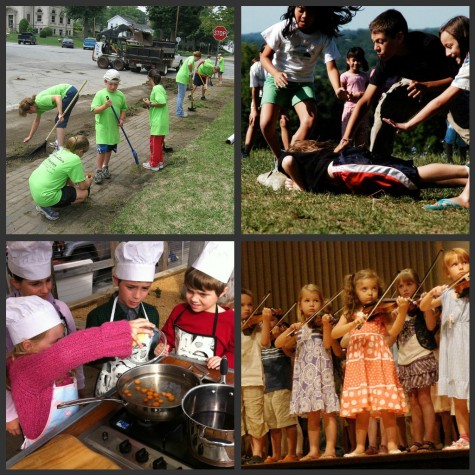
Image: Wikimedia Commons

Image: Wikimedia Commons

Examples of successful interest-based groups

~A cooking club for preteen girls meets at members’ homes to make (and eat) themed foods and plan recipes for next club event. They’ve made various ethnic meals, fancy desserts and food to donate.

~A multi-age group of stop motion movie-makers (youngest member five years old). They chat online about individual projects and also make collaborative movies. They have hosting screenings of their short films for an appreciative audience of relatives.

~A nature sketching and journaling group made up of families who schedule hikes in different wilderness areas to write, draw, and share their work.

~A boys’ book group based on sci-fi and adventure books. They vote on which book to read, read it the month before the meeting, then after the book discussion take part in activities such as scavenger hunts, making costumes and re-enacting scenes, testing tactics used in the book, or using repurposed materials to build something mentioned in the book.

~A multi-age rock climbing group which practices at indoor climbing walls as well as outdoor locations.

~A young children’s hands-on science club.

~A youth and adult fiber works group with projects, farm trips and visits to other spinning/weaving guilds.

~A group of families who get together to make costumes, chain mail and armor for re-enactments.

~A beachcombers group. Young children play along the waterside while adults and older children monitor ecological conditions for a non-profit organization.

~A debate and elocution society which prepares for regular memory-based recitations as well as occasional debating society competitions. The members’ aspirations include acting, politics, and law.

~A cartoonists’ meeting. Young members work on graphic novels, cartoon strips, and cards.

~A multi-age sculptor’s group. They meet to hear guest speakers which have included welders and mineralogists. They go on field trips and occasionally meet at one another’s homes to work on projects together.

You may find, as my family has, that interest-based groups are a favorite activity with extraordinary benefits. You may even notice that your child’s eagerness rekindles interests of your own. Maybe it’s time to enjoy the fellowship of other enthusiasts as you master the bagpipes or learn to make cheese.


Originally published in Wired. Portions of this article excerpted from Free Range Learning

What’s To Love About Pinterest

5 reasons to use Pinterest, why like Pinterest, pinning on Pinterest,

Creativity103's Flickr photostream

Are you on Pinterest?

This virtual pinboard lets us create, organize, and share what we find online. Because it’s a visually-oriented site, it attracts us using something other social media sites haven’t done nearly as well: images. While online we tend to be seekers. We look for information, distraction, connection, and inspiration. Pinterest lets us find (and revel in) all these things through compelling images.

The site was launched in March 2010. One of the founders, Ben Silbermann, said in an interview that the idea stemmed from his penchant for collecting. As a child he was particularly taken with entomology. He realized that collecting bugs said something about him, just as any of our interests say something about us. Co-founder Evan Sharp noted that he too was a collector as a child. As an adult that tendency shifted to amassing images in folders on his desktop. So they, along with the third co-founder, Paul Sciarra, developed Pinterest as a way for users to collect and share related images, linking back to the originating site.

Pinterest didn’t catch on immediately. But within a few months users began applying it in ways the founders hadn’t anticipated. They posted travel hacks, home renovation ideas, Etsy items, wedding plans, and craft tutorials. And it’s really taking off.  From Oct 2010 to March 2012, Pinterest went from 40,000 to 18 million monthly unique visitors.

Articles about Pinterest often focus on how it can drive sales or be used as a PR tool. For example TechCrunch predicts Pinterest could change consumer behavior, causing them to seek out goods favored by other Pinterest users. This may be true.

But what’s noted but little understood is that the primary users of Pinterest, at least so far, tend to be women.  A regular look at the Everything front page indicates that these users aren’t necessarily on Pinterest primarily to share consumer recommendations, although there are plenty of tempting pins for fashion and home décor products. They’re using it to share inspiration for ways to live; with more humor and less angst, with beauty found in an evocative landscape, with clever ideas for raising kids or making gifts or building a garden shed. This in itself makes Pinterest seem like a blessed relief from the endless marketing found online.

I’ve fallen for it for several reasons.

1. It’s hubbub free. Unlike FB, Twitter, or G+ you don’t need to scroll past drama or post repeats, nor do you need to hop in regularly lest it seem you’re ignoring ongoing conversations. Instead of all those voices clamoring for your attention, Pinterest has a peaceful vibe. It’s like moseying through a quiet gallery of images, each one ready to tell you more with a click.

2.  It’s a wonderful method of storing visually inspiring ideas for later use. Going back over your own boards can be like flipping through magazines made entirely of what you love. Previous pins can help you find that entree you want to make today, the shelves you want to build in your kitchen next summer, and the song that teaches your kids about the periodic table as soon as they’re old enough.

3. It’s a way to browse freely and casually within any interest you might have. Yes, you can create circles on G+ and lists on Twitter, but on Pinterest it’s easy to follow any chosen user’s specific boards. Whether you want ideas for DIY projects or images of trees or ways to preserve family peace, you’ll find it on Pinterest.

4.  Marketers assume Pinterest will drive sales and yes, there are plenty of luscious products pinned. But I wonder if it might actually serve as an antidote to materialism.  Sorting and sharing images may satisfy the urges often channeled into shopping or ordering online. If purchasing has something to do with acquiring and keeping, maybe, just maybe, acquiring and keeping images may fill the same need.

5. It’s a way of sharing what simply delights us. By organizing what appeals to us, we make it easier for other people to find interesting ideas and images. It’s heartening, in a way, to find that a woman I know as a writer of math books also has a thing for Spanish architecture, punk t-shirts, frothy cocktails, and Daniel Craig movies.

Connect with me on Pinterest!

We Choose Our Own Role Models

role models, mentors, how role models shape, impact of role models,

Image courtesy of s2-s2.deviantart.com

There’s no predicting who we choose as our role models. Teachers, coaches, and religious leaders are held out as exemplary choices and for good reason, since mentors are linked to greater success in adulthood. Despite adults’ well-meaning efforts to foster or even assign mentors, each one of us is drawn to people we find inspiring. It’s only in looking back that we can see more clearly how our childhood role models play a part in shaping who we become.

This is obvious looking at my husband’s growing up years. He wanted to understand how the world around him worked, and like most children, he wanted to find out by getting right in the midst of what fascinated him rather than play with plastic hammers and screwdrivers. So he sought out neighbors who let him fix cars alongside them and who welcomed his help running their small businesses. What he gained from these experiences still benefit him.

It’s not as obvious in my life so I have to strain to make those connections. I had plenty of freedom to ride my bike and play without too much parental supervision, but seeking out other grown-ups never occurred to me. In fact I can only think of a single adult outside my family who made a lasting impression. Her name was Mrs. Dosey.

I met her during a criminal investigation. Well, sort of.

When I was around eight, my older sister developed a brief infatuation with espionage. She deemed herself a private investigator and permitted me to be her sidekick. We practiced sidling around without being seen, took notes on people’s behavior, and looked for a mystery to solve. My sister hit the jackpot when she discovered bones in a field across the street. Bones! This could be dangerous. My sister identified the house in closest proximity to the bones. It seemed like a strange place. The yard had almost no grass. Instead the front was crowded with strangely cropped trees and the back sported a clothesline (unheard of in our suburban neighborhood) and a jumble of fenced-in areas—sinister indeed. We practically trembled with fearful anticipation.  My sister instructed me to remain completely silent, she’d question the suspect.

When she rang the doorbell it was promptly opened by a sturdy middle-aged woman wearing an apron and orthopedic shoes, her hair mashed down by a hairnet. When she invited us in I noticed she had a trace of an accent. Against all parental advice about strangers, we walked meekly inside.

Mrs. Dosey was busy in the kitchen but gladly welcomed two girl detectives. She didn’t raise an eyebrow when questioned about bones. She explained that she raised ducks, which she slaughtered for meals on special occasions. Although it wasn’t the murder we anticipated, it was death nonetheless. My sister and I shivered.

Mrs. Dosey talked to us as she went back to her culinary project. We learned that the cropped trees in her front yard were an apple orchard and the back yard was crowded with vegetable gardens, berry bushes, and poultry pens. She served us milk and homemade cookies. We stayed quite a while, curiously watching her work.

Mrs. Dosey was assembling a wedding cake she’d made from scratch. She showed us how she was separating the layers using tiny soda bottles between them, to be covered by flowers from her yard. Finally she said we could come back another time, she had a few more things to finish before her daughter’s wedding that was taking place the next day. My sister and I weren’t even disappointed that our murder case had collapsed. We’d met someone who seemed like a different creature than the frosted hair moms of our generation.

It didn’t occur to me till years later that Mrs. Dosey was completely matter-of-fact about two little girls sitting at her kitchen table, inches from this towering confection. She was entirely unruffled on a day most mothers of the bride are harried, even though she’d made the dress, the cake, and if memory serves, was making the reception food as well.

I never knocked on Mrs. Dosey’s door again. My sister and I dropped the private eye business to become girl scientists. We waded into the pond in sight of Mrs. Dosey’s house observing duck behavior and slogged home covered with what we optimistically called “duck muck.” My mother, who began buying apples from Mrs. Dosey every fall, seemed to regard the woman as an oppressed version of her gender. She pointed out Mrs. Dosey’s heavy labor around the house and yard, noting that this woman rode a bike with a basket to the store every few days for groceries. The emphasis seemed to rest on evidence that Mr. Dosey didn’t share those burdens. To me, Mrs. Dosey seemed remarkably happy. And savvy as well. She waved when my sister and I were out but was wise enough to spare us that social indignity if we were waiting with friends at the school crossing near her house. I saw her on that bike for years after I left home. She never looked any older or any less cheerful.

I credit my husband’s role models for helping him grow up to be capable, positive, and wonderfully open-hearted. But not for a single moment have I ever linked my own life choices to Mrs. Dosey’s example. After all, I planned to change the world by elevating peace, ecological harmony, and justice. If I had time I hoped to fit in writing novels. And parenting. Okay, I also wanted thick hair and thin thighs.

None of that happened. I’m not a UN peace negotiator, my activism is local and my writing is gentle. I’m not blocking whaling ships with my fellow Greenpeace buddies, instead I tend to vegetable gardens and haul buckets of kitchen scraps to our livestock. My choices look more like Mrs. Dosey’s, although I can’t pretend for a moment that I’ll ever have her patience. I was raised to believe I could be accomplish anything if I worked hard enough but I’m learning that we can save the world right where we are. In part, that means opening the door on our busiest day ever to welcome the questions of little girls.

Who in your growing years made an impression on you and how do you see their impact in your life today?

Global Village Construction Set

It’s possible to plant 50 trees in one afternoon.

To press 5,000 bricks from the dirt beneath your feet in one day.

To build an affordable tractor in six days.

It’s possible thanks to the members of Open Source Ecology (OSE). They aren’t armchair visionaries. These engineers, farmers, and developers are dedicated to making communities sustainable and self-reliant. They’re taking on scarcity and inequality with open source enthusiasm

OSE got its start when Marcin Jakubowski’s tractor broke.  Well, lets back up a little. After Jakubowski earned a PhD in the physics of fusion energy, he bought a farm in Missouri where he grew fruit trees and raised goats. One day his tractor broke. He didn’t have the hands-on experience to fix it himself. But he hauled out some can-do attitude along with his welder and torch. He realized a tractor is simply a box with wheels, each powered by hydraulic motors.  So he bolted together square steel tubing to make one from scratch. It worked.

This inspired him to look beyond pricey, commercially made machines. He began to come up with versions that were hardy, low-cost, and constructed out of locally sourced or repurposed materials. His posted designs generated lots of enthusiasm and input. Participants began showing up to help build prototypes on project days, becoming OSE collaborators.

The idea evolved. They considered what it takes to build independent, sustainable communities that support farming, construction, small manufacturing,  and power generation. They came up with a list of the 50 machines most important for modern life including a hay baler, bakery oven, laser cutter, drill press, solar concentrator, and truck.  Low cost, industrial strength, DIY versions of these machines became known as the Global Village Construction Set.  The motors, parts, and other fittings of these machines are designed to be interchangeable. All the 3D designs, schematics, and instructional videos are posted on the OSE Wiki.

On average, constructing these machines costs about eight times less than comparable machines made by industrial manufacturers. As Jakubowski explained in his recent TED talk, “Our goal is a repository of published design so clear, so complete, that a single burned DVD is effectively a civilization starter kit. ..The implications are significant: a greater distribution of the means of production, environmentally sound supply chains, and a newly relevant DIY Maker culture can hope to transcend artificial scarcity.”

So often hope seems abstract.  This is tangible hope, made of steel. It puts independence and equality in reach for people in both the developed and developing world.  Welding never seemed so inspiring.

Originally published at Wired.com

Eat Your Dandelions

dandelion recipe, dandelions for health, eat dandelions, don't kill dandelions,

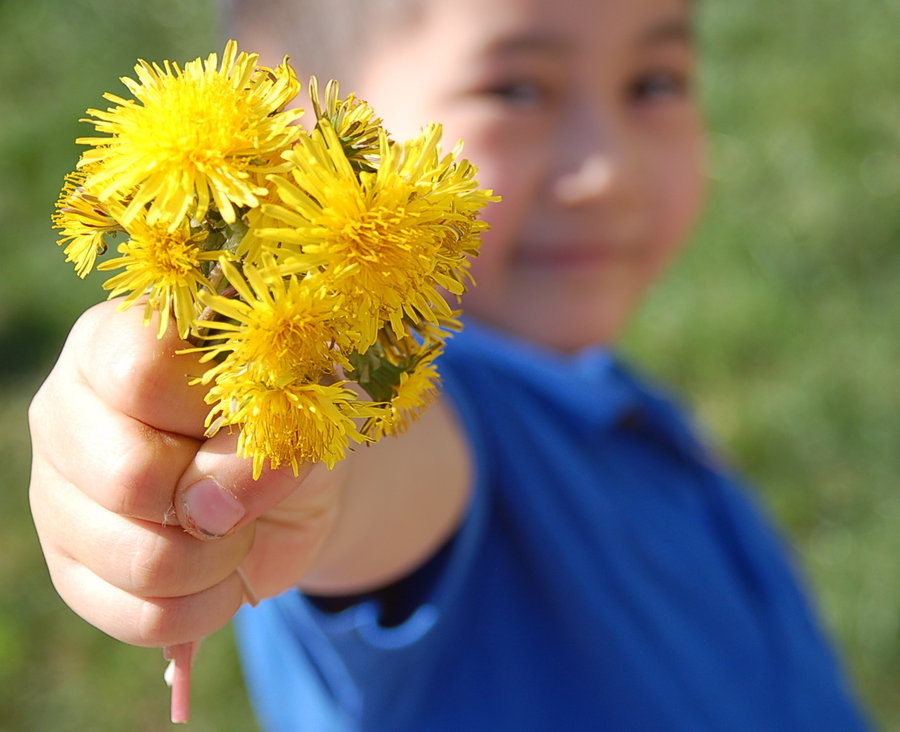
Image courtesy of thaowurr.deviantart.com

“You EAT them?” a little boy new to the neighborhood asks. He leans forward for the answer, his face ready to constrict in doubt.

Children already well acquainted with our family’s springtime ritual stop picking.

“Yeah!” they eagerly assure him, “They’re really good.”

They aren’t referring to a new vegetable in our garden. They’re talking about dandelions.

Herbalists tell us exactly what we need grows nearby. Those plants we call “weeds” may in fact remedy what ails us. They are so common that their properties are easily overlooked in a culture searching for packaged wellness. Plantain, mullein, comfrey,mint, mugwort,St. John’s wort, chicory and purslane spring up wild in my untreated lawn and garden. Weeds, but also powerful healers.

Today we’re picking dandelions in full flower. It isn’t about finding a remedy. For me the harvest is has to do with celebrating spring and affirming the beauty around us. For my children and our neighbors it’s about fun. I wait until the blooms are at their peak. Then I call friends and neighbors to announce, “Today is the day!”

Children spread out across the yard holding little baskets. A girl squats in front of each plant, pausing a long moment before she reaches out to pluck a flower from its stem. The  oldest boy in the group walks by many dandelion plants to pick only those growing in clusters. And the newest little boy falls silent, as the rest of the children do, taking delight in the seriousness of the harvest.

European settlers brought the dandelion plant to this continent for food and medicinal purposes. The perennial spread easily across most states. It’s a testament to the power of herbicide marketers that such a useful plant became so thoroughly despised. Standing under today’s blue sky, I look at exuberant yellow rosettes growing in bright green grass and feel sheer aesthetic pleasure.

After the children tire of picking we sit together on the porch and snip off the dandelion stems right up to the flower. We mothers look over their busy heads—blonde, brown, black—and smile as we watch them stay at this task with the kind of close attention children give to real work. One girl remarks that the flowers look like the sun. Another child says her grandmother told her that in the Old Country they call the plant by the same name as milk because of its white sap. The newest boy chooses to line the stems neatly along the wide porch planking, arranging and rearranging them by length.

Every aspect of a ritual holds significance so I pay attention to the warm breeze, the comfortable pulse of friendship, and flowers so soft against my fingers they remind me of a newborn’s hair.

When we’re done the flowers are rinsed in a colander, then it’s time to cook them. I’m not a fan of frying. There are better ways to preserve the flavor and nutrients in food. Consequently I’m not very skilled. But this is easy. The children, their mothers and I drop the flowers in a thin batter, scoop them out with slotted spoons and fry them a dozen at a time in shallow pans.

After the blossoms cool slightly on paper towels they’re put on two platters. One is tossed with powdered sugar and cinnamon, the other sprinkled with salt and pepper. Handfuls are eaten in the kitchen while we cook. Then we carry the platters outside. Children run off to play in grass polka dotted with bright yellow flowers. We adults sit on the porch laughing and talking.

It’s suggested that we should be eating healthfully prepared dandelion greens and roots rather than indulging in delectable fried blossoms. That sentence fades into a quiet moment as a breeze stirs new leaves on the trees and lifts our children’s hair. I feel enlivened. Everywhere, around me and inside me, it is spring.

eat dandelions, healthy dandelions, dandelion flower recipe, fried dandelions, dandelion blossom recipe, Flower Power Recipe

Gather dandelion flowers from areas free of chemical treatments or fertilizer. Pick in a sunny part of the day so the flowers are fully open, then prepare right away so flowers don’t close.

Cut away stem, as this is bitter, leaving only the green part holding the flower together.
Douse briefly in salt water (to flush out any lurking bugs). Dry flowers on dish towels while you prepare batter.
Ingredients
3 to 4 cups dandelion flowers, prepared as above

1 cup milk (dairy, soy, almond, coconut, any variety)

1 egg (or equivalent egg replacer product)
1 cup flour (slightly smaller amount of any whole grain alternative)
½ teaspoon salt
oil (frying is best with healthful oils which don’t break down at high temperatures, try safflower oil, coconut oil or olive oil)

Method

1. Combine milk, egg, flour and salt in wide bowl. Mix well. Heat an inch or two of oil in skillet (350-375 degrees).
2.  Drop a dozen or so blossoms into the batter, stir gently to coat. Lift out with slotted spoon or fork. It’s best to hold the bowl over the skillet as you drop each blossom into the hot oil.
3. Turn flowers over to brown on both sides. Remove with slotted spatula to drain briefly on paper towels. Continue to fry remaining flowers using same steps. Toss cooked dandelions with sugar and cinnamon. Or salt and your choice of savory flavoring such as garlic, pepper or chili powder.
4. Making flower fritters is a speedier method than frying individual flowers. Simply drop flowers and batter into the oil by the spoonful, then turn like a pancake. Serve with jam, maple syrup or honey. Or try savory toppings like mustard, ketchup or barbeque sauce. These fritters are endlessly adaptable. Try adding sunflower or sesame seeds to the batter and serve with either the sweet or savory toppings.

a (2)

What You May Not Know About Dandelions

The common dandelion, Taraxacum officinal, has been used in traditional medical systems around the world to boost nutrition as well as treat conditions of the liver, kidney and spleen; slow abnormal growths; improve digestion and more. Recently science has taken a closer look at this often scorned plant. No surprise, traditional wisdom holds up under scrutiny.

~Dandelion root stimulates the growth of 14 strains of bifidobacteria. This is good news, because bifidobacteria aid in digestion. Their presence in the gut is correlated with a lower incidence of allergies.

~Dandelions appear to fight cancer. Researchers testing for biologically active components to combat cancer proliferation and invasion note that dandelion extracts have value as “novel anti-cancer agent[s].” Their studies show dandelion leaf extract decreases growth of certain breast cancer cells and blocks invasion of prostate cancer. The root extract blocks invasion of other specific breast cancer cells  and also shows promise inhibiting skin cancer.

~Dandelions work as an anti-inflammatory and pain relieving agent.

~Dandelion extract lowers cholesterol. This, plus its anti-inflammatory and antioxidant qualities leads some researchers to believe that the plant may reduce the risk of atherosclerosis (hardening of the arteries).

~The plant’s leaves are an effective diuretic.

~Dandelion shows promise in diabetic treatment. It slows the glycemic response to carbohydrates, thereby helping to control blood sugar.

~Dandelion extract increases the action of estrogen and progesterone receptors. It may prove to be a useful treatment for reproductive hormone-related problems including PMS.

~ Leaves, roots and flowers of the humble dandelion are fully edible. USDA National Nutrient Database analysis proves that a festive array of nutrition awaits any lawn harvester. One cup of chopped fresh dandelion greens are extremely rich in vitamins K, A and C as well as good source of vitamin E, thiamin, riboflavin, vitamin B6,  calcium, iron, ,magnesium, manganese, fiber and omega-3 fatty acids.

~The flavonoids found in dandelions are valuable antioxidants and free radical scavengers.


This post is reprinted from an article that first appeared in Natural Life Magazine.