All around the world, mothers gently murmur some version of “hush, hush,” or “shhhh, shhhh” to crying newborns. It’s said this calms babies because it mimics the sound they heard in utero — her heartbeat.
Babies actually hear a whole symphony of sound before they’re born. Physicist Robert Chuckrow describes what makes up this orchestra in a paper he wrote back in the 1960’s, titled “Music: A Synthesis of Prenatal Stimuli.”
Walking: As a pregnant woman walks or climbs stairs, Dr. Chuckrow writes, her steps send “a thud-like vibration through her body, similar in sound and periodicity to that of the beat of a drum. ”
Breathing: Each inhale and exhale, according to Dr. Chuckrow, makes a “…recurring sound rich in high frequencies and is similar to the sound of cymbals in music. In popular music especially, the sound of cymbals ‘crashing’ is very suggestive of the sound of the pregnant mother breathing.”
Heartbeat. Complex patterns are formed by varying rates of two heartbeats. A mother’s heart rate changes depending on her activity level and emotions, usually ranging somewhere between 60 and 100 beats per minute. In contrast, her baby’s heart rate fluctuates between 120 to 160 beats per minute, making for an ongoing jazz-like improvisation.
Speech: A mother’s conversations are another acoustic pattern. Research shows newborns not only recognize their mother’s voices, they also show a preference for sounds from the language their mother speaks.
Other input: A fetus is surrounded by the internal hubbub of its mother chewing, swallowing, and the rest of the digestive processes. Her laughing, crying, coughing, yawning, sneezing, and scratching are also part of its moment-to-moment soundtrack. Add to that sounds heard from outside her body — whoosh of a shower, vibration from riding on a bus, clatter in a restaurant, drama of a movie she’s watching.
These aren’t just sounds. They come into the baby’s awareness accompanied by fluctuations in movement, pressure, and chemical signals. Sound pairs with sensation, over and over, throughout the pregnancy. It is the earliest form of meaning, long before words make sense.
Take, for example, the effect when a mother experiences stress (even positive emotion). Her heart rate goes up while her baby’s heart rate doesn’t immediately increase. Instead, the uptick of her heartbeat would “…produce in the fetus a state that is the prenatal analog of emotional tension.” Dr. Chuckrow likens this to the way music creates emotional tension, especially when an “…increase in tempo or changes in rhythm produce such tension in the listener, and the rhythmic effect is increased by an increase in dynamic intensity.”
Or another example; the unborn baby’s experience of its mother’s laughter. As she laughs, her abdominal muscles contract around the uterus. Her larynx closes somewhat, making air intake irregular. And the noises she makes range from low giggles to shrieking cries. Dr. Chuckrow writes, “For the mother, laughter would be accompanied by an exultant state and changes in her heart rate, breathing, and blood concentrations of oxygen and hormones. These changes would be expected to affect the fetus. The associated patterns involve a climactic change of acoustic, tactile, and chemical stimuli associated with a state of maternal well-being.”
Maybe these truly formative responses help to explain why music enters a place in us that’s deeper than words, beyond the limitations of thought. We’re shaped by an essential mother-specific melody.
“Many say that life entered the human body by the help of music, but the truth is that life itself is music.” ~Hafiz
“A lie travels round the world while truth is putting her boots on.” French
“A society grows great when old men plant trees whose shade they know they shall never sit in.” Greek
“The big thieves hang the little ones.” Czech
“What you see in yourself is what you see in the world.” Afghan
“If you sit in a hot bath, you think the whole town is warm.” Yiddish
“Keep a green tree in your heart and perhaps a singing bird will come.” Chinese
“What you give you get, ten times over.” Yoruban
“Sometimes I go about pitying myself, and all the time I am being carried on great wings across the sky.” Ojibway
A long-forgotten adage can rise into our awareness at an opportune moment and we hear it as if for the first time. Please share sayings that have stuck with you in the comments.
What our mothers give us is too complicated to fit on a greeting card. It’s too essential to fit into a perfunctory holiday one day out of the year.
Your mom is unlike anyone else’s (even your siblings’ experience of the same mom). And what she gave you has a great deal to do with what you have accepted as a gift.
I asked a few friends to share a glimpse of what they got from their mothers. I’m eager to read your stories in the comment section.
Susan:
I am strong and determined, as was my mother and my mother’s mother. All three of us were the first-born and blessed with considerable energy. I once stumbled upon my 76-year-old grandmother on scaffolding as she painted the exterior of her house. My mother worked day and night to paint murals in her grandchild’s bedroom, determined to finish before she drove three hours back to Cleveland late into the night. I also throw myself into projects with great energy, and I believe that one day I will have something lasting to show for all of the effort as it is in my blood.
Damien:
Brains, toughness, and no tolerance for excuses. She’s a single mom still raising my two younger brothers and a superhero as far as I’m concerned.
Laurie Kincer:
The assurance that, whatever the issue, there was always one person on my side
Leo:
Her drug problems and lockup blistered what time I might have had with her. Now I see the fire she was putting out all the while. She kept me from burning in it by leaving me with her sister. Her gifts to me are staying clean seven years now and being one hell of a fun 53-year-old grandma to my kids.
Ginny Douglas:
My Mom turns 96 in a couple of weeks. Here’s something of what I’ve learned from her – so far.
Trust God. Things will get better, or they won’t. Either way, trust God.
Tithe; in other words, give away 10% of your income to church and/or charities.
The way to get through today, is to do what worked yesterday. Get up, get dressed, say a prayer, eat breakfast; assume you can do what you did yesterday unless there is overwhelming evidence to the contrary.
Of course, she also passed along her excessive fear of thunderstorms and tornadoes. But even at that, all of the above still applies.
Now with her failing memory and frustrating limitations, Mom is showing me how to age with grace. I’m grateful we still have her with us.
A love of talking: to her babies, to her children, to every stranger in the grocery store. My New England husband is just amazed at this in me. (Not in a good way, when we are in Maine.)
A love of her family’s stories and songs: her grandparents’, her parents’, her children’s and grandchildren’s. Welsh folk sayings, train engineer tunes and lullabies. I know them all.
A love of preparing a simple meal with great joy. Her last journal records making macaroni and cheese and setting out flowers to go with it. Me too. We sit down together for every meal.
A love of taking in the stranger. She didn’t love to travel so much, but every missionary visiting our church and many foreign doctors at the hospital ended up at our table. She was raised in a neighborhood of immigrants– mostly Eastern European– and from the age of 10, helped them learn English and study for the citizenship test, then remembered all their stories and songs and passed those and the love of immigrants on to me. She would be so sad at the immigrant conversation plaguing our country just now. It makes me want to weep.
She hated injustice, prejudice, and the Republican party (though many of her friends were Republican). She loved, loved, loved unions, social organizations, and the Democratic party. I have to say, she handed all those down to me, too. And she got them all from her mother, who was once challenged by a son-in-law, “Mom, if Jesus Christ were running as a Republican, you’d still vote Democrat,” to which she replied, “Why would Jesus change parties now?”
Bill Boomer:
Here is a thought communicated often to us from my mom (Clementine – everyone called her Clem ). “The Bible says you have to love your neighbor. It doesn’t say you have to like them! Some people are just not like-able. Treat ’em with respect but keep them at a distance.”
Wise mom! And that’s the way she acted too!
Leslie Boomer:
An appreciation of home gardening and the joy it brings into our lives. From early spring blooms to the changing beauty of the flowers and vines we plant in the spring and appreciate all summer – I share this love of life-giving planting and tending. It’s one of life’s little pleasures to walk slowly and look at what’s growing with my Mom.
Jason:
A passion for reading. She read aloud to us in the strangest places when we were little, like on the bus and while we were taking baths. Her favorite books always leaned towards horror like Christopher Pike and Stephen King. She didn’t know I had so many bad dreams because I’d stay up late reading her books after she’d finished them.
Beth Whitson:
Love of family. She would do anything for her children or her grandchildren. Anything. Every sacrifice was worth it to her. I can remember something as silly as maybe something we had for dinner. My dad would get the choice piece, then it was split up between us kids. IF there was anything left she got it and if we said anything, she’d say she wasn’t all that hungry. I feel like I do the same thing. And the funny thing I learned is that it doesn’t feel like a sacrifice at all. It just “is.”
Hard work and doing a job to the best of your ability. My mom didn’t believe in doing a job halfway. You put your heart and soul into it. When you were done, you could be proud of it, even if no one else noticed. I may not do some things as good as professionals, but I’ve learned to do my very best, even in the little things.
And my mom taught me never, ever, EVER to use her good fabric scissors on anything but fabric! If I did, I somehow ruined the scissors for eternity and I also learned that I would hear about it that long as well.
My mom, who had a high school education but was second in her class, was very smart although completely untrained psychologically. She anticipated the 50 years of research on positive psychology and was always saying to me when I would talk myself down, Honey you have to gear your thinking.
I’m not even sure what that meant because gear isn’t really a verb but she said it with such conviction that I was totally persuaded. And of course the gist was what you’re telling yourself is not going to get you where you want to go so pick another frame for this event, tell yourself a different thing. In other words gear your thinking and you have a better chance of coming through this in a growth-full way. Since she became a single parent in 1955, supported me, and got me through Catholic high school and college on a secretary’s salary I’m guessing she had a lot of practice at gearing her thinking. Probably part of the force behind it was I knew she was walking the talk.
That phrase became kind of an in-joke with my own children who also needed that advice, as we all do from time to time, but I chose not to put it in any more sophisticated language because hers was so powerful and we still all say it to each other half-laughing/half-serious to this very day. And I’m sure we’re all still trying to practice it.
Mateo:
My mom sang in clubs when I was growing up. In the mornings she was tired and her hair smelled like cigarette smoke. After a long night of singing covers she sang whatever she liked at home, mostly traditional Mexican songs and her own music. She made sure I took lessons and stayed in school music programs. She used to say she’d be singing till her last day. That turned out to be true. Every time I think of her, I hear her singing in my mind.
Lori Scelina:
I’ve always felt that I have an amazing mom. She always seemed tireless and always had time for us. My goal has always been to try and just come close to the example she set.
One thing I got from her is my love of all things Christmas. She always made the season so special, starting the day after Thanksgiving when we would brave the crowds and shop with my aunt and cousins to the traditional family cookie baking, to the beautiful huge Christmas tree that we would all decorate together.
When my two kids were young she would take off work every Wednesday in the summer. We called them “Grandma’s Days” and we would go on adventures. Some days we would start at 10 in the morning and not get home until 10 or 11 at night. It was exhausting but fun. I had trouble keeping up with her!
When my mother was in the ICU, shortly before she died, she told me she learned a lot about being a mom by watching me with my kids. She had been comatose, and I had been there daily My kids were six and nine, and I didn’t know where I should be: I was a mom, a daughter, a wife, a sister. She woke up, looked at me, and said, “Go home, with my blessing.”
Gifts come in all kinds of packages, and only some of them are tied with a ribbon and a bow.
Laura Grace Weldon:
I knew that my mother cared about my perspective even if she disagreed with me, because she always listened. When I attempted comic impersonations of my teachers she laughed. When I disputed her edicts she gave credence to my protests. And when I listened back she often surprised me. Yes, she gave me her straight hair, weak knees, and fear of heights. She also gave my voice a reason to exist.
“In our play we reveal what kind of people we are.” ~Ovid
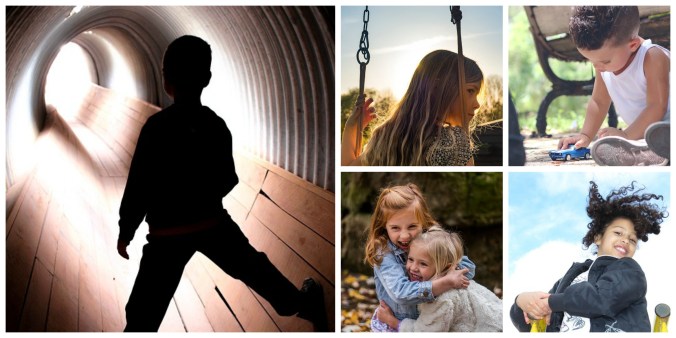
What is play? It has nothing to do with structure imposed by adults. Psychiatrist Stuart Brown, founder of the National Institute for Play, describes play as most basically “purposeless, repetitive, pleasurable, spontaneous actions.” Sometimes this is driven by curiosity and the urge to discover. Sometimes it is imaginative play. Sometimes it’s rough and tumble play, the kind that necessarily puts the player at risk and involves anti-gravity moves such as jumping. This description is true whether we’re talking about puppies, otters, crows, or people.
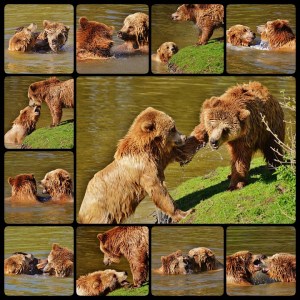
A research team led by ethologists Robert and Johanna Fagan spent 15 years, many of them sitting in trees, studying how bears play in the wild. Of the bears they observed, the individuals that played more often as cubs and through adulthood lived longer and healthier lives. They also left behind more offspring.
A study of ground squirrels found those that played were more coordinated (a big deal for squirrels) and grew up to be more successful parents.
And we know a lot about the importance of play for rats. They even laugh (a rat version of laughter) when tickled. Compelling research shows the more young rats actively played, the more rapidly their brains grew and their learning abilities increased. (The same correlations seem to be true for children’s play as well.)
Young creatures, including humans, play has to do with movement and excitement. It’s a highly sensory way to experience socially important peaks and lows, winning and losing, threat and relief from threat. It helps participants learn to understand the intentions of others. It also lets them learn to handle stressors and practice different reactions, gradually teaching them through experience to respond appropriately when they face much more demanding emotional and physical challenges later in life.
This is helpful to remember when kids are wrestling, climbing, chasing, running, giggling, tumbling, and making a mess. It’s even more helpful to remember when they’re arguing, grabbing, yelling, complaining, shrieking, and otherwise demonstrating that melodrama is inseparable from play. All of that physical and emotional energy is important practice for becoming reasonable, responsible adults.
Play can also tell us a great deal about what’s forefront in children’s lives.
When my oldest child started kindergarten his play reflected the more authoritarian structure he was adjusting to and interactions with the different people he encountered each morning. He balanced that by seeking out more time in the garage hammering nails into scrap wood, more time riding his bike, and more time playing Legos than before he’d started school —- all reassuringly favorite activities to discharge the day’s emotions. And he and his best friend Sara started playing “school bus.” They sat in chairs or on the ground behind each other while acting out what they observed on their daily bus rides. They took turns quite politely repeating some pretty awful slurs they heard from kids on the bus, and then repeating back the driver’s rather belligerent responses. Their play not only helped them work through their experiences, it helped us alert the school to what was happening.
Play can also inform us about temperament, innate abilities, and about where different individuals find joy. Here are two examples, taken from Free Range Learning, of children expressing who they are through play.
A little girl creates chaos with her toys. She won’t put blocks away with other blocks nor put socks in her dresser drawer. As a preschooler she creates groupings that go together with logic only she understands. One such collection is made up of red blocks, a striped sock, spoons, and marbles. She sings to herself while she rearranges these items over and over. The girl is punished when she refuses to put her puzzles away in the correct box or her tea set dishes back together. She continues making and playing with these strangely ordered sets but hides them to avoid getting in trouble. This phase passes when she is about nine years old. Now an adult, she is conducting post-doctoral studies relating to string theory. She explains her work as a physicist has to do with finding common equations among disparate natural forces.
A young boy’s high energy frustrates his parents. As a preschooler he climbs on furniture and curtain rods, even repeatedly tries to scale the kitchen cabinets. When he becomes a preteen he breaks his collarbone skateboarding. He is caught shoplifting at 13. His parents are frightened when he says he “only feels alive on the edge.” Around the age of 15 he becomes fascinated with rock-climbing. His fellow climbers, mostly in their 20’s, also love the adrenaline rush that comes from adventure sports but help him gain perspective about his responsibility to himself and other climbers. His ability to focus on the cliff face boosts his confidence on the ground. At 19 he is already certified as a mountain search and rescue volunteer. He is thinking of going to school to become an emergency medical technician.
Stuart Brown says that looking back at our own unique “play history” can tell us a great deal about ourselves. He asks us to let ourselves drift back to our earliest and most resonant play memories. He suggests asking older family members about what we played when we were very young. He goes on to say,
Explore backwards as far as you can goto the most clear, joyful, playful image that you have whether it’s with a toy, on a birthday, or on a vacation. And begin to build to build from the emotion of thatinto how that connects with your life now. ..
How to rediscover play if you’ve let it slide? Move your body. Dig up your memories of what brought you pleasure as a child. Take cues from “the experts” — the children in your life today. Do what makes you happy, and what transports you beyond a sense of the clock, your schedule, that deadline — beyond time.
Playfulness is a practice that shapes our souls. It connects us. It is an act of belief in ourselves, a vehicle whose wheels are powered by our faith in life, bringing us to places of wonder, moments of joy. It is almost the last thing to leave us before we leave all together forever.
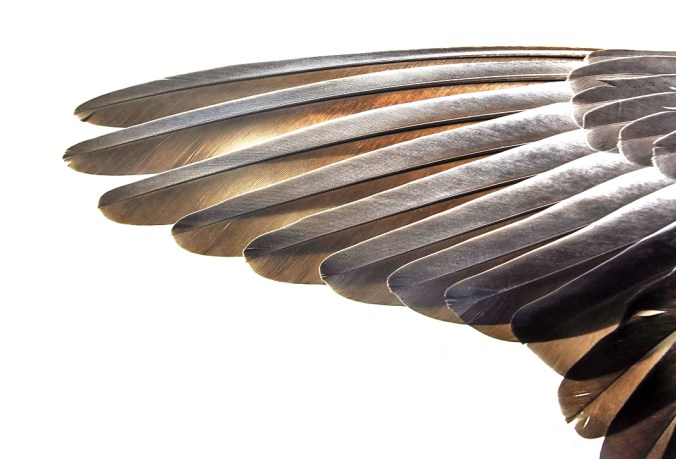
Some mornings when I get up, I walk to the front door to let the dogs out while flapping my wings. I waft them up and down as if they’re moving me through thermals high in the air, then when I get to the hall I pull them in and flap a bit more fervently as if my bird-self is flying through a narrow pass. By the time I open the door for the dogs I’m just a regular frowsy-haired morning person staring out at the dawn. My wings are arms again.
I act pretty normal most of the time, although I do have moments. I sing made-up songs, balance silly things on my head, quietly misbehave to keep myself amused in restaurants, laugh at the inopportune times, and am chronically too curious for my own good. I’m not sure this qualifies me as officially eccentric but it has been known to tax the patience of people who love me.
My family hasn’t bothered to ask me why, in the privacy of our home, my arms occasionally turn into wings. I haven’t wondered why either until I thought about it this morning while in that Realm of Insight, the shower.
Two thoughts occurred to me. One is a faint memory of an adult telling me to put my arms down and behave myself. I recall this as happening in a cinder block room that smelled faintly musty, so probably Sunday school. I may have been happily twirling in my Sunday dress with my arms up like a ballerina or been a fairy sprinkling magic dust or been, as now, a bird. I’m guessing I was probably four or five years old since the adult in this memory is visible only as legs and hips. That memory is colored by vast shame. (I must have been a ridiculously sensitive child.) A thousand similar reminders to be a good girl left me with my arms down, flying nowhere. I can assure you, that’s no fun. I’m still in recovery from excessive politeness. I’m progressing well, thank you.
The other thought is how darn good it feels to move this way. My arms and hands move, of course. They reach upper kitchen shelves, lift eggs from nest boxes, greedily stack up library books, hug dear people —- but much of the day my arms and hands are in pretty static positions typing or reading or driving. Basic body boredom. Biomechanist Katy Bowman, author of Move Your DNA, says our bodies crave natural movement. Instead of regimented exercise, she advocates moving throughout the day in lively ways that feel nourishing to us. She calls this nutritious movement. Try flapping your arms like wings. Does it feels wonderful to you too?
Our bodies are internal guidance systems with immeasurable storehouses of wisdom to share with us, as long as we actually take the time to pay attention. I understood my baby’s world better when I let his movements choreograph my own. Mirroring my children’s actions took me back to what it was like to be a child. I even got some surprising insight into my own poor posture when I gave myself a few minutes to go fully into a slumped position, ready to find out what that slump had to tell me.
Maybe bodies are on my mind because I’ve had a bit of a health setback and spent a few days in the hospital recently. I still feel like someone hit me with a shovel, although thankfully now it doesn’t feel like as big a hit with as large a shovel as it did before.
We may think we’ve already learned the lessons difficult times have to teach, but there’s always more to learn. Here are some lessons I’ve revisited lately:
The bright light of gratitude has a way of shining fear away (even in the terrifying confines of a closed MRI) and it’s possible to be grateful for the dark stuff too.
It always helps to pay attention to where in our bodies we feel good — right now for me it feels marvelous to breathe deeply, to stretch, to laugh, to sleep.
What feels healing is different for different people. For me it’s time in nature, hugs, time to create, stories other people share, good books, new ideas, playfulness, and more hugs. (Pretty much the same joys I’d list any time.)
When our arms want to be wings, let them be wings.
You don’t have to stretch your movie-watching habits far to include movies infused with poetry. Here’s a short, by no means comprehensive list.
Biopics (often loosely) based on poets’ lives
Neruda dramatizes the search for the Nobel Prize-winning Chilean poet during the 1940’s, when he became a fugitive in his own country due to his Communist leanings.
A Quiet Passion explores Emily Dickinson’s life from her school days to her later years.
Kill Your Darlings looks at a 1944 murder that draws together beat generation poets Allen Ginsberg, Jack Kerouac and William Burroughs.
Howllooks at the 1957 obscenity trial against Allen Ginsberg.
Set Fire to the Stars portrays a week in 1950, when aspiring poet John Brinnin takes his idol, Dylan Thomas, on a retreat in hopes of readying the legendary poet for a series of poetry readings in the U.S.
Reaching for the Moon Elizabeth Bishop took a trip to Rio in 1951, intending to stay only long enough to battle her drinking problem, but met and fell in love with famed architect Lota de Macedo Soares, staying 20 years.
Total Eclipseis a dramatized account of Arthur Rimbaud’s affair with Paul Verlaine.
Sylvia tells of the relationship between poets Ted Hughes and Sylvia Plath.
The Basketball Diariesis a harrowing story of athleticism, addiction, and redemption based on poet Jim Carroll’s autobiography.
Barfly is based on Charles Bukowski tumultuous life.
Before Night Fallsis adapted from the memoir of Cuban poet Reinaldo Arenas, who was jailed for ‘ideological deviation’ and forced to denounce his own work.
Piñerotells the story of Puerto Rican poet-playwright Miguel Piñero, whose urban poetry is recognized as a forerunner to rap and hip-hop.
An Angel at my Table tells the story of Nene Janet Paterson Clutha, a New Zealand woman who published under the name Janet Frame. After years of psychiatric institutionalization, Frame was scheduled for a lobotomy that was cancelled when, just days before the procedure, her début publication of short stories was unexpectedly awarded a national literary prize.
Endless Poetry portrays Alejandro Jodorowsky’s young adulthood of the 1940s and 50s, in the electric capital city of Santiago. There, he decides to become a poet and is introduced into the bohemian and artistic circle of the time.
Patersontakes place during one week of a poetry-writing bus driver’s life, and includes a meeting with a stranger who loves poetry.
Poetry, detailing an elderly woman’s first poem, gets a rare 100 percent rating on Rotten Tomatoes.
Elling is a deadpan comedic Norwegian film about two men, Elling and Kjell, who are released from a state institution. Elling discovers he is a poet and bring his work to the public in an unusual way.
Henry Fool is about an ex-convict who encourages a friend to become a poet.
Big Bad Love highlights the struggles of a poet and writer dealing with his own war memories and alcoholism. Based on the short stories of Mississippi writer Larry Brown, Brown’s own poems and those of William Carlos Williams, are in the film.
Slamis about a young man’s dedication to spoken word poetry after his release from prison.
Dead Poets Society—Robin Williams plays an English teacher in an East Coast boys’ prep school who inspires his students to love poetry, among other life lessons. The film, which popularized the tradition of carpe diem poems, features verse by Frost, Tennyson, and Shakespeare.
Shakespeare in Love—The endeavors of a young William Shakespeare, with allusions to Shakespeare’s later work.
The Kindergarten Teacher is the story of an Israeli kindergarten teacher who is convinced that one of her students is a poetry prodigy, and becomes obsessed with what she perceives as his ability.
“Coincidence is the word we use when we can’t see the levers and pulleys.” ~Emma Bull
Sometimes the book you need just appears. You never imagined it exists and then suddenly bam, it’s right there in your hand.
Maybe that book sets you off on a new quest, or lightens your weighted heart, or snaps on a mental light switch. You’re never quite the same afterwards.
This happens to me pretty often.
Most commonly, the book I need drops from the shelf or persistently gets in my way when I’m looking for another book at the library. This occurred more frequently back in those golden-hued days when my favorite library was tightly packed with tall stacks of books. It required some wandering and often some teetering on a wooden stool to find a particular book. That gave a book that needed to find me a chance to fling itself in my direction.
The right book for me also once appeared in a used book inside the wrong dust cover and another time was left on a dirty seat next to me in a muffler repair shop.
Such delightful happenstance isn’t confined to books. Utterly necessary articles, quotes, interviews, and poems appear as if by magic in my life as well. In The Roots of Coincidence, Arthur Koestler calls this literary synchronicity the work of “library angels.”
British author Rebecca West told Koestler about her experience with a library angel back in 1972. She had been researching a specific episode of the Nuremberg war crimes trials.
I looked up the trials in the library and was horrified to find they are published in a form almost useless to the researcher. They are abstracts, and are cataloged under arbitrary headings. After hours of search I went along the line of shelves to an assistant librarian and said, “I can’t find it, there’s no clue, it may be in any of these volumes.” I put my hand on one volume and took it out and carelessly looked at it, and it was not only the right volume, but I had opened it at the right page.
Aleksandr Solzhenitsyn writes about another such strange coincidence in The Gulag Archipelago. While he was incarcerated in Leningrad, a new prisoner was brought in. The man was a renown physicist who happened to be obsessed with working through a technical problem, but it required certain mathematical tables. There was no chance of getting those tables, since the only books permitted in the prison were works of Party propaganda distributed to the cells at random. One week a library worker came around and passed out the very book the physicist needed. The scientist memorized the necessary tables before the mistake was noticed and the book confiscated.
My library angel experiences aren’t as gobsmackingly surreal as these two examples by any means, but I’ll take all the positive coincidences I can even ifI don’t know what mysterious force to credit. Library angels? A benevolent God who speaks to the bookish among us on our own wavelength? The universal consciousness at work? (They’re all names for Mystery well beyond our understanding anyway…) It doesn’t matter, when a book shows up unexpectedly I have learned to pay attention.
I’d love to hear your stories of coincidence, word-related or otherwise.
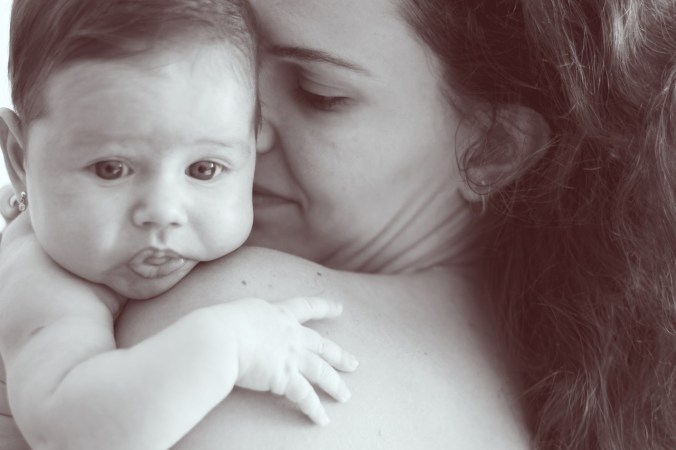 All around the world, mothers gently murmur some version of “hush, hush,” or “shhhh, shhhh” to crying newborns. It’s said this calms babies because it mimics the sound they heard in utero — her heartbeat.
 “Do a good deed and throw it into the sea.” – Egyptian
 “The death of an elder is like a burning library.” Ivorian
 “A book is like a garden carried in the pocket.” Arabic
 “A thief believes everybody steals.” unknown origin
 “A clear conscience is a soft pillow.” German
 “A lie travels round the world while truth is putting her boots on.” French
 “A society grows great when old men plant trees whose shade they know they shall never sit in.” Greek
 “The big thieves hang the little ones.” Czech
 “What you see in yourself is what you see in the world.” Afghan
 “If you sit in a hot bath, you think the whole town is warm.” Yiddish
 “Keep a green tree in your heart and perhaps a singing bird will come.” Chinese
 “What you give you get, ten times over.” Yoruban
 “Sometimes I go about pitying myself, and all the time I am being carried on great wings across the sky.” Ojibway