To Be, Or To Multitask

multitasking, busy, mindfulness, I.Q., cell phone, distraction,

I did it again. Deleted unwanted emails while on the phone, just trying to be efficient. No, I wasn’t reading the emails. Honestly I started out just deleting. But I had to scan quickly through a few to make sure I wasn’t missing something important. And next thing you know it was time to end the conversation. Sadly our entire interaction felt flat, as if we never really connected. I know why. I wasn’t really part of it. Chances are the very busy person I was talking to wasn’t either. Yay for multitasking.

This is the opposite of my true intentions. I keep writing about the importance of paying attention, connecting with nature, and centering our lives on what’s positive.

I try, I really do. But even when we live simply it takes real effort to avoid being rushed and over-obligated.

My mother was an early adherent of multitasking. She liked to say there was no sense doing just one thing at a time. I wasn’t too thrilled about it, however, when she spent requisite quality time playing a board game with me while heating her curler-bedecked head under the hairdryer (those 70’s models were as loud as leaf blowers) and talking on the phone. I was never sure how the person on the other end of the phone heard her over that hairdryer; that person may have been loudly washing dishes, making them both disconnected multitaskers.

It’s much easier to multitask now. In fact, we’re rewiring the way we operate minute-to-minute. We’ve tuned ourselves to distraction. That seems to make us uncomfortable with distraction’s opposite—-the powerfully real time spent in contemplation or conversation.

A recent study found that people asked to forgo media contact for 24 hours (no texting,email, Facebook, TV or cell phone use) actually suffered withdrawal symptoms. They experienced anxiety, cravings and preoccupations so overwhelming that their ability to function was impaired.

When we multitask it feels as if we’re accomplishing more. Who can’t stir a pot of noodles, listen to music and still maintain a decent conversation?  That’s easy.  Although we’re not really paying attention to that music or honoring the conversation with eye contact and full awareness (let alone mindfully attending to the noodles).

The major multitasking whammy comes from doing similar functions at the same time, as I was doing by talking on the phone and checking email. That’s because the brain doesn’t really do both task simultaneously, it goes back and forth, relentlessly switching attention.

All that switching causes our performance to plummet.  Studies show multitasking makes us up to 40 percent slower or causes the same lack of concentration as giving up a night’s sleep.

Perhaps even worse, we don’t recognize the stress it imposes.  As our brains focus and refocus, our bodies release cortisol and adrenaline.  We may work faster, but also feel more frustration and pressure, and the ability to concentrate becomes increasingly impaired.

Talking on the phone and reading email doesn’t just make me somewhat inattentive, studies find that multitasking can functionally lower one’s I.Q. by as much as ten points.  In my case, I suspect it’s quite a bit more.

So many parts of our lives seem to require multitasking. Parenthood certainly does, nearly every job does too. But I want to be, really be. Multitasking subtracts from that.

I’m taking a vow to walk away from any screen any time I pick up the phone. I’m vowing to spend less time using technology, more time in nature. Any vows you’ve taken? How’s that going for you?

*

*

*

“To live in the present moment is a miracle. The miracle is not to walk on water. The miracle is to walk on the green Earth in the present moment, to appreciate the peace and beauty that are available now.”

Thich Nhat Hanh Touching Peace: Practicing the Art of Mindful Living

*

*


photo courtesy of Jayo

Lament of an UnNerd

*

Gray-haired guys in line ahead of me at the coffee shop text with casual ease, order fabulously complicated drinks and manage to pay in one smooth motion.

I’m too cheap to have texting as an option on my phone and too clumsy to text anyway. I’m not confessing anything about dropping change I meant to put in the tip jar or knocking over biscotti on display (although really, that display was clogging up counter space).

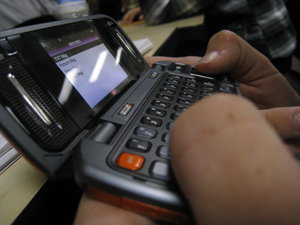
The upside of no texting? I read and write unimpeded at that same coffee shop while all around me tiny rectangles brrrr and thumbs tat in a display remarkably similar to old sci fi versions of humans controlled by robotic forces. The downside of no texting? I’m forced to leave voice mails on my cell phone. According to the hilarious (frightening) site How Not To Act Old leaving voice mail decidedly marks a person as well beyond their 20’s. Not a problem, the casual observer could tell that about me from my boring hair and tendency to knock over biscotti.

*

My son’s 80-something bagpipe instructor pirates and shares music.

I still buy CD’s and don’t own an iPod. I’m glad that wind through the trees is the soundtrack to my daily walk, but really, if I got around to gathering music in handy digital form I’d spend forever assembling it. I’d cheerfully search out lost tracks from vastly unappreciated musicians like Frazier & Debolt. I’d linger over the task while choosing a ridiculous array of opera, Scandinavian folk and Mongolian throat singing. Then with my short attention span I’d probably weary of each piece after one listen.

Wind in the trees is free.

*

And one last lament. Thank Gawd I live with tech support. I happen to love these people but their presence here is also vital to my work life. If I don’t get immediate help when trying to deal with simple problems like unzipping old files sent by certain maniacal interview subjects I tend to shriek at the blameless screen.

That scares the dogs sprawled at my feet, which activates my ever-ready guilt, forcing me right out of the house and off for a walk with wind as my soundtrack or, if the tech problem is really serious, off to a coffee shop where an innocent display is just waiting to tip over. Perhaps it’s a message that I should develop a taste for biscotti.

*

*

*

*

Creative Commons images

texting thumbs courtesy of TheKat11 http://thekat11.deviantart.com/art/Texting-100020644

pirate image courtesy of mrs.mcD’s photostream flickr.com/photos/cordandme/492100572/

biscotti image courtesy of La Mia Cucina’s photostream  flickr.com/photos/25901168@N00/313577580/

All Day Every Day Video Game Learning

All day, every day video game based schooling. Great.

A Popular Science article (print version, Jan 2010) extolls the virtues of a recently opened school in Manhattan designed around a  spanking new videogame curricula. Called Quest to Learn (Q2L) the school is heavily funded by interests (such as Intel) outside the NYC school district. And yes, every subject is taught via the medium of video games.

Another oh-gosh-isn’t-this-fabulous article appeared in the mass market magazine Parade and the flurry of media attention continues to accelerate. Soon every school child will be agitating to replace the boredom of classwork with the excitement of gaming.

Their eagerness will be nothing compared to the frenzy of those who make Big Decisions in education. Anything having to do with technology seems to make these folks feel they’re finally hip. Actually, they toss money at any curricula that promises to keep the little darlings quiet, busy and able to pass proficiency tests. In a few years you won’t be able to spit without hitting a school district boasting a version of this all day, every day video game schooling. Just great.

Q2L sounds impressive. Designed by the (soon to be rolling in bucks) Institute of Play, its curricula isn’t structured around ordinary educational games. Learning is integrated between subjects, offers hands-on components and promises to put the student in charge of his or her education. Q2L promotional materials assure parents their kids won’t be glassy-eyed screen droolers. But, and this is a huge but, it’s all day, every day.

Research tells us that high quality video games are known to promote rapid decision-making, logic, visual-spatial skills, risk assessment and intense focus. Author Steven Johnson notes in Everything Bad is Good for You that today’s technologies offer complex intellectual challenges that engage students in ways never before seen. All great. Except for a little thing we call balance.

Candy substituted for every meal, even with all the required vitamins, fiber and omega 3 fatty acids packed into it by a clever non-profit candy making institute, may make kids wildly happy but it still isn’t a real meal. An all day video gaming educational model may be new, shiny and sound perfectly thrilling but without balance it’s simply another way to train the next generation of workers to ignore the vital need for balance in their lives.

A truly balanced education is one that can’t be prescribed or predetermined by any curricula developer because each child is different. That’s that beauty of Democractic Schools, relaxed styles of homeschooling and unschooling. Those of us who educate this way know from experience that children, when raised in an atmosphere of loving trust and fully involved in the life of the community around them, tend naturally toward balance.

Video games may indeed be a wonderful way to learn but not all day, every day. They can be part of a wider concept of education.  It would be wonderful to see schools reverse the trends that have segregated and stymied the maturation of young people ever since modernization forced them into mandatory schooling.

For starters, today’s students could use a whole lot more of these missing elements to restore balance in each educational day.

Play. Not the sort of play that happens on carefully designed liability-friendly playgrounds or within the limits of       supervised games, but unstructured free play.  This sort of fun is actually essential for the development of imagination and innovative thinking as well as social and cognitive maturation.

Creative, hands-on engagement in open-ended work. The high scoring Icelandic and Finnish schools that keep our educational Big Deciders in a jealous froth aren’t test happy. Instead they include daily arts such as knitting, woodwork and felting while U.S. school kids rarely get to work with metal or wood in shop class let alone have the opportunity to paint at an easel.

Pursuit of interests. There may be no greater motivator than the ability to engage in one’s interests for hours, days, weeks or longer plus the freedom to move on when those interests are depleted.

Community involvement. Schools segregate young people from vibrant adults in the community precisely at the developmental stages when kids are primed to imitate, help and adhere to role models. No rote field trip or Skype interview can come close to collaboration and engagement in the real world around them.

Nature. People of all ages are missing out on the invigorating and focusing effects of spending regular time in nature.  Most of us suffer from Nature Deficit Disorder without recognizing how much is missing from our lives.  Even our eyes indicate that we’re intrinsically structured to be outdoors. New research indicates children who spend more time outdoors are much less likely to need eyeglasses. Something about the intensity of sunlight or the benefits of looking across wide open spaces seems to be a protective factor.

All day, every day video game based schooling. Another example of an educational trend taken too far in one direction. How great is that?

*

*

Creative Commons image credit http://www.glyphjockey.com/pix2/nsg2.jpg