.
When my oldest entered the crawling stage, he was as enthralled as any baby with this new power of mobility. He’d zoom off on hands and knees at top baby speeds, sit abruptly to gaze around from an upright position, then drop back down for more high speed locomotion. He was just as thrilled with his new ability as I’d have been if I suddenly found I could fly. One afternoon he sat up mid-crawl, looked around, and flung himself down again to crawling mode as usual except he’d stopped near a corner and whacked his dear little head on it.
After being consoled back into good humor, he did something unusual. He cautiously crawled back to the spot where his head had unexpectedly smacked the wall. As he approached it he made quiet sounds of distress, as if talking to himself, then carefully leaned his head forward to touch the corner several times, each time doing an imitation of himself crying. He didn’t want to be distracted or picked up. This was his work, to understand what hurt him. To gain some mastery over it. I was watching a very young storyteller re-tell his own story to himself before he even had words.
For the next few months he did the same thing when he was hurt or scared by something – he’d go back to reexperience on his own terms. When he was able to speak well enough to talk about what he’d experienced, he told us his stories instead.
It’s hard work to make sense of everything we undergo. This is true in all of life’s stages. It’s an ongoing process, because we understand with a wider perspective as the decades go by and the storehouse of experiences we draw on expands. That’s true of wonders and joys. Even more true for the wrongs done to us and the wrongs we’ve done to others, however ignorantly or unintentionally. Oftentimes, like a cosmic lesson, we go through similar difficulties over and over as we gradually grasp ever deeper insights they offer. Making sense of our experiences and sharing what we’ve learned with others may, truly, form the foundation of life’s meaning.
That’s why we humans do not need machines to do our thinking and creating for us. It’s hard to compose that honest apology note, to come up with just the right eulogy through your tears, to give the heartfelt graduation speech you wrote. That it is hard is the point. Even writing an interoffice email that says what you want it to say the way you want to say it can be painstaking. Yet each time you make yourself do this, you get better at doing it.
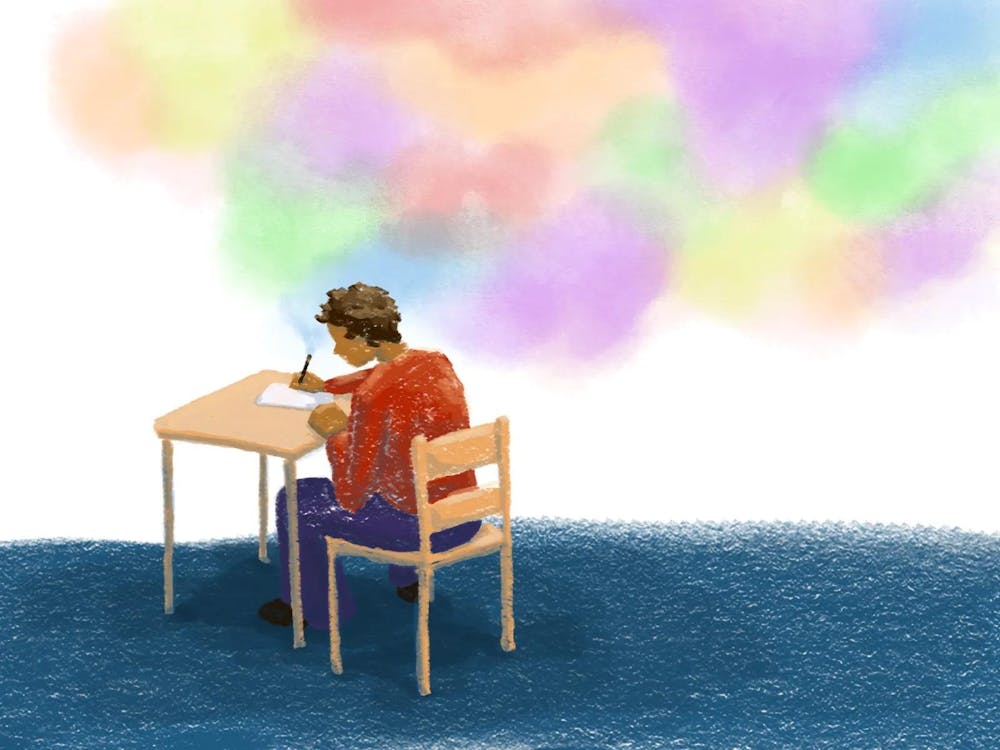
When we write we activate our reasoning, our creativity, and the intangible us-ness in the right now. The process of writing helps us understand aspects of ourselves we didn’t recognize until that moment. As Elie Wiesel say, “I write to understand as much to be understood.” That’s true of the most emotionally challenging things we’ll ever write. It’s also true of the very real intellectual muscle we build in necessary writing – informing our child’s teacher there’s no research-backed reason to impose homework on students, telling our congressional representatives why we hope they will vote a certain way, respectfully explaining to HR why a new policy is ridiculous.
It is also remarkably healing to write about difficulties we’ve endured. Expressive writing gives us just enough distance to better reflect on and draw meaning from our traumas. Repeated studies show that people who wrote about their most negative life experiences reported higher life satisfaction, fewer physical and mental health problems, improved sleep, and better relationships. Before and after medical tests showed (in relation to the patient’s preexisting health problems) improved immune function, lower blood pressure, better lung function, reduced pain, reduced viral load, better liver function, and more. Many of these improvements persisted for weeks!
As we write, we build ever-greater reasoning capabilities along with a greater ability to see things from another person’s perspective. Balancing our individual wants with consideration of others has been essential throughout all of humanity’s time on earth. When reciprocity fails, families fall apart. Communities fall apart. Civilizations fall apart. In this time of planetary crisis we need more than ever a world of people who can think for themselves, respond rationally to high-pressure persuasion campaigns, read and consider long form writing, use logic in forming opinions, and see beyond what billionaire interests want us to see. A not-inconsiderable part of those abilities come from reading as well as writing even the most mundane communications, rather than handing it over to AI.
Words regurgitated by a machine are not considered. Not generated by our ideas. They are not our words. What will we lose if we let AI take over our writing tasks—texts, workplace emails, court appeals, medical school essays, movie scripts, love letters? We lose ourselves.
Artificial “intelligence” cannot possess genuine feeling. It cannot collide, as we sometimes do, with the crushing desire to put into words feelings so large that they are essentially inexpressible.
What you write is truly unique to you. David Adger, a linguistics professor, explains, “Human language is amazingly creative. If you make up a sentence of any complexity, and search for that exact sentence on the Internet, it’s almost never there. Virtually everything we say is novel.”
I realize there are useful applications for AI. It can help whale researchers code thousands of hours of cetacean recordings (as described in How to Speak Whale by Tom Mustil). It can advance medical research by combing through every published drug study to find existing medications that can also treat rare diseases (which is what David Fajgenbaum’s Every Cure organization does). It can decipher 2,000 year old scrolls buried by the eruption of Mount Vesuvius. But there is no valid reason for the vast number of environmentally devastating and potentially democracy threatening data centers going up everywhere. There is no valid reason for AI to be imposed on all of us at school, work, medical centers, government agencies, and businesses we interact with every day.
From our earliest days, what we have to say and how we say it has a lot to do with who we are—to our very core. Let’s not give that up.
“What is our gift? And how shall we use it?…Other beings can fly, see at night, rip open trees with their claws, make maple syrup. What can humans do? We may not have wings or leaves, but humans do have words. Language is our gift and our responsibility. I’ve come to think of writing as an act of reciprocity with the living land. Words to remember old stories, words to tell new ones, stories that bring science and spirit back together.”
~ Robin Wall Kimmerer, “People of Corn, People of Light”


 Laura Grace Weldon