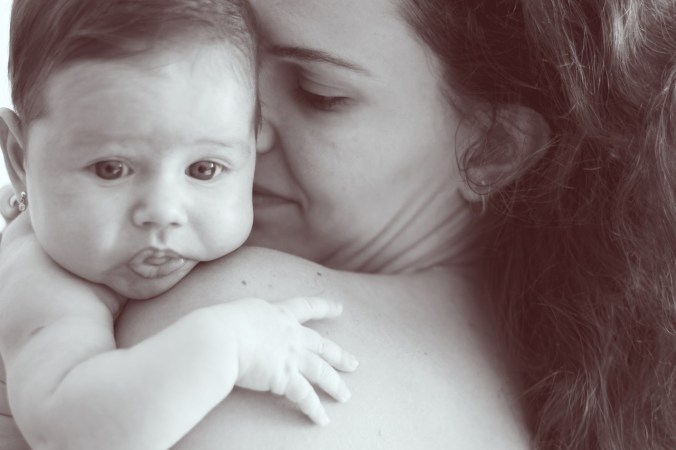
 All around the world, mothers gently murmur some version of “hush, hush,” or “shhhh, shhhh” to crying newborns. It’s said this calms babies because it mimics the sound they heard in utero — her heartbeat.
Babies actually hear a whole symphony of sound before they’re born. Physicist Robert Chuckrow describes what makes up this orchestra in a paper he wrote back in the 1960’s, titled “Music: A Synthesis of Prenatal Stimuli.”
Walking: As a pregnant woman walks or climbs stairs, Dr. Chuckrow writes, her steps send “a thud-like vibration through her body, similar in sound and periodicity to that of the beat of a drum. ”
Breathing: Each inhale and exhale, according to Dr. Chuckrow, makes a “…recurring sound rich in high frequencies and is similar to the sound of cymbals in music. In popular music especially, the sound of cymbals ‘crashing’ is very suggestive of the sound of the pregnant mother breathing.”
Heartbeat. Complex patterns are formed by varying rates of two heartbeats. A mother’s heart rate changes depending on her activity level and emotions, usually ranging somewhere between 60 and 100 beats per minute. In contrast, her baby’s heart rate fluctuates between 120 to 160 beats per minute, making for an ongoing jazz-like improvisation.
Speech: A mother’s conversations are another acoustic pattern. Research shows newborns not only recognize their mother’s voices, they also show a preference for sounds from the language their mother speaks.
Other input: A fetus is surrounded by the internal hubbub of its mother chewing, swallowing, and the rest of the digestive processes. Her laughing, crying, coughing, yawning, sneezing, and scratching are also part of its moment-to-moment soundtrack. Add to that sounds heard from outside her body — whoosh of a shower, vibration from riding on a bus, clatter in a restaurant, drama of a movie she’s watching.
These aren’t just sounds. They come into the baby’s awareness accompanied by fluctuations in movement, pressure, and chemical signals. Sound pairs with sensation, over and over, throughout the pregnancy. It is the earliest form of meaning, long before words make sense.
Take, for example, the effect when a mother experiences stress (even positive emotion). Her heart rate goes up while her baby’s heart rate doesn’t immediately increase. Instead, the uptick of her heartbeat would “…produce in the fetus a state that is the prenatal analog of emotional tension.” Dr. Chuckrow likens this to the way music creates emotional tension, especially when an “…increase in tempo or changes in rhythm produce such tension in the listener, and the rhythmic effect is increased by an increase in dynamic intensity.”
Or another example; the unborn baby’s experience of its mother’s laughter. As she laughs, her abdominal muscles contract around the uterus. Her larynx closes somewhat, making air intake irregular. And the noises she makes range from low giggles to shrieking cries. Dr. Chuckrow writes, “For the mother, laughter would be accompanied by an exultant state and changes in her heart rate, breathing, and blood concentrations of oxygen and hormones. These changes would be expected to affect the fetus. The associated patterns involve a climactic change of acoustic, tactile, and chemical stimuli associated with a state of maternal well-being.”
Maybe these truly formative responses help to explain why music enters a place in us that’s deeper than words, beyond the limitations of thought. We’re shaped by an essential mother-specific melody.
“Many say that life entered the human body by the help of music, but the truth is that life itself is music.” ~Hafiz


 Laura Grace Weldon