Seeing Each Other As Loves

If there’s a deep end, I just jumped in.

I have long used endearments when addressing humans I love but also dogs, cats, cows, goats, birds, insects, and yes, the beings most consider inanimate objects. I’ve probably been in above my head for a long time because I can’t help myself from addressing participants in my writing classes as “dear people” and “beloved writers” and worse.

But today I was checking out at the local market. I always put my fabric bags on the belt before loading my items. The cute young checkout person was preoccupied talking to the cute young bagging person, and I was preoccupied with ineptly “tapping” my card, so none of us noticed right away that the bagger was loading my things into plastic despite the sturdy cloth bags in front of her. “Oh, sorry love,” I said “but I brought cloth bags.” She looked up, startled. Then she said, “I’ve never been corrected so sweetly.” She went back to talking to the cute checkout guy.

I recognize calling a stranger “love” is likely a step too far. I know some people actively detest being called “honey” or “dear” or other overly familiar words. That’s their right and I want to respect that. Actually, I rarely use endearments when speaking to strangers. But some people have a gleam so noticeable to me, even if they seem shut down (maybe especially if they seem shut down) that I can’t help myself.

Brief conversations with strangers filled with dry wit, shared insight, and surprising alignment seem to happen more often for me now. That’s a side benefit of getting older. Those of us who are dismissed as irrelevant are, in a way, freer. Who expects to have a moment where they are seen, really seen, by someone who comfortably goes about unseen?  

I used to call only the people I love “loves.” Maybe I’ve watched too many UK series or read too many old British novels, but that word is stuck now. It’s the way I hope to see others — as loves. As beautiful people. As complex and strange and conflicted as we all are.

Seeing others as whole people is particularly difficult when we’re pitted against one another by systemic forces that place seemingly insurmountable barriers between us. <gestures broadly at world>

And yet, some people step beautifully beyond these divisions. Last week I read about an LA man who approached a phalanx of federal agents working for ICE, all of them heavily armed and masked up to their eyeballs. Much as I like to think I am a pacifist, I see them as poorly paid* enemies of justice and compassion and democracy itself. The man who approached them was carrying little white slips of paper that turned out to be copies of his most recent two-week pay stub. He walked along the line attempting to pass out these slips, saying some version of, “I know everyone needs a paycheck, but you don’t have to do this.  Come work with us. This is what a union carpenter makes.” 

This man saw these armed agents as fellow human who need to work, just as he does. Seeing others in their full humanity is the heart of nonviolent action. Fact-filled or expletive-filled rants against someone is useless in changing their minds, and is likely to more firmly entrench their views. As Stephen Jay Gould noted, “leave an escape hatch for your opponent so that he can gracefully swing over to your side without an embarrassing loss of face.”

Open dialogue with the very people she condemned is what inspired Megan Phelps-Roper to renounce her membership in the extremist Westboro Baptist Church. It’s what led neo-Nazi skinhead Christian Picciolini to stop spreading hate and work to lead others away from such ideologies. It’s how Daryl Davis, a Black man, befriends Ku Klux Klan members in hopes they will have a change of heart.

Oh, I did another quick errand at another locally owned store. My cashier was a beautiful young man with the fluffiest of Afros. We commiserated over the bankruptcy of a longstanding area business. Somehow, in the magical way conversations happen, he told me he was a “survivor” of hideous corporate policies from his last job and we agreed rapacious capitalism was destroying our country and I told him about our food co-op. As I left, he blew me a kiss.  

*These federal agents are no longer poorly paid. Thanks to the horrific tax overhaul bill recently signed, the budget for ICE enforcement is larger than Russia’s total military budget. ICE is now the highest-funded federal law enforcement agency in history, with more money than the budgets of the DEA, ATF, FBI, US Marshals, and Bureau of Prisons combined. Starting this week, these masked warrantless federal agents will be offered a signing bonus of 42K and a six-figure salary.

A Glorious Shade of Purple

I was stuck in the miseries this morning due to small funked up health problems and huge funked up world problems. I try, as a practice, to have a silent but earnest conversation with my insides when the miseries have a grip on me. I say to pain or fear or despair I see you, I acknowledge you, help me learn from you and beyond you. (Okay, sometimes my inner conversation isn’t all that polite.)

And I try, as a practice, to look around me with gratitude even if, like this morning, it felt like I was spreading a thin layer of appreciation over a turbulent inner mess. As I drove to meet someone I love for our weekly walk, I did what I could to savor the air’s spring freshness. I did what I could to notice light flickering through the trees, flower baskets hanging from storefronts, and the kindness of a driver waving another car ahead.

My mind drifted right back to the morass.

I don’t know how any of us go on with our ordinary lives lately. I am among those privileged enough to have my days largely unchanged, so far, despite—among other tragedies—a climate pushed past the tipping point, despite the ongoing genocide of the Palestinian people, despite all three branches of government stomping directly into authoritarianism. I’m aware my puny efforts to protest, write letters, support good causes, even drive around with a handmade protest sign on my car aren’t enough. I simply hope it’s a teensy contribution toward the transformative 3.5 percent rule invoked by Erica Chenoweth, author of Why Civil Resistance Works. After researching hundreds of social/political change movements over the last century, Dr. Chenoweth found that nonviolent campaigns are twice as likely to achieve their goals as violent campaigns. And although the exact dynamics depend on many factors, her data shows it takes around 3.5% of the population actively participating in the protests to ensure serious political change. But what are the chances it can happen here, I grumbled to myself.

And then I drove past a dumpster. A beautiful dumpster.

It was a deep purple, a purple most often seen in delphiniums, pansies, hydrangeas, and irises. The sort of purple that would look good as a velvet dress or painted across a domed ceiling scattered with gleaming constellations. My mind gladly rested on that color purple for the rest of the drive.

On my way home after the walk and an appointment, I went the long way just so I could take that dumpster’s picture. It was right outside a small locally owned flooring shop. As I got out of the car I realized the dumpster had recently been painted. I could almost see the former lettering under its shiny new color. Someone, maybe the shop owner, had chosen that color. Chosen to grace this useful, much-maligned object with beauty. For all I know, it’s the only dumpster that color for thousands of miles.

I’m plotting to drag my spouse to that shop to see if we can afford to do something about our kitchen’s falling apart linoleum. Whether we can or can’t, I’m going to tell the shop owner how much that glorious purple dumpster lifted my sagging spirits. As Alice Walker wrote in her magnificent The Color Purple, “I think it pisses God off if you walk by the color purple in a field somewhere and don’t notice it.”

Maybe that applies to the color purple anywhere we find it.

Honoring The Impulse To Thrive

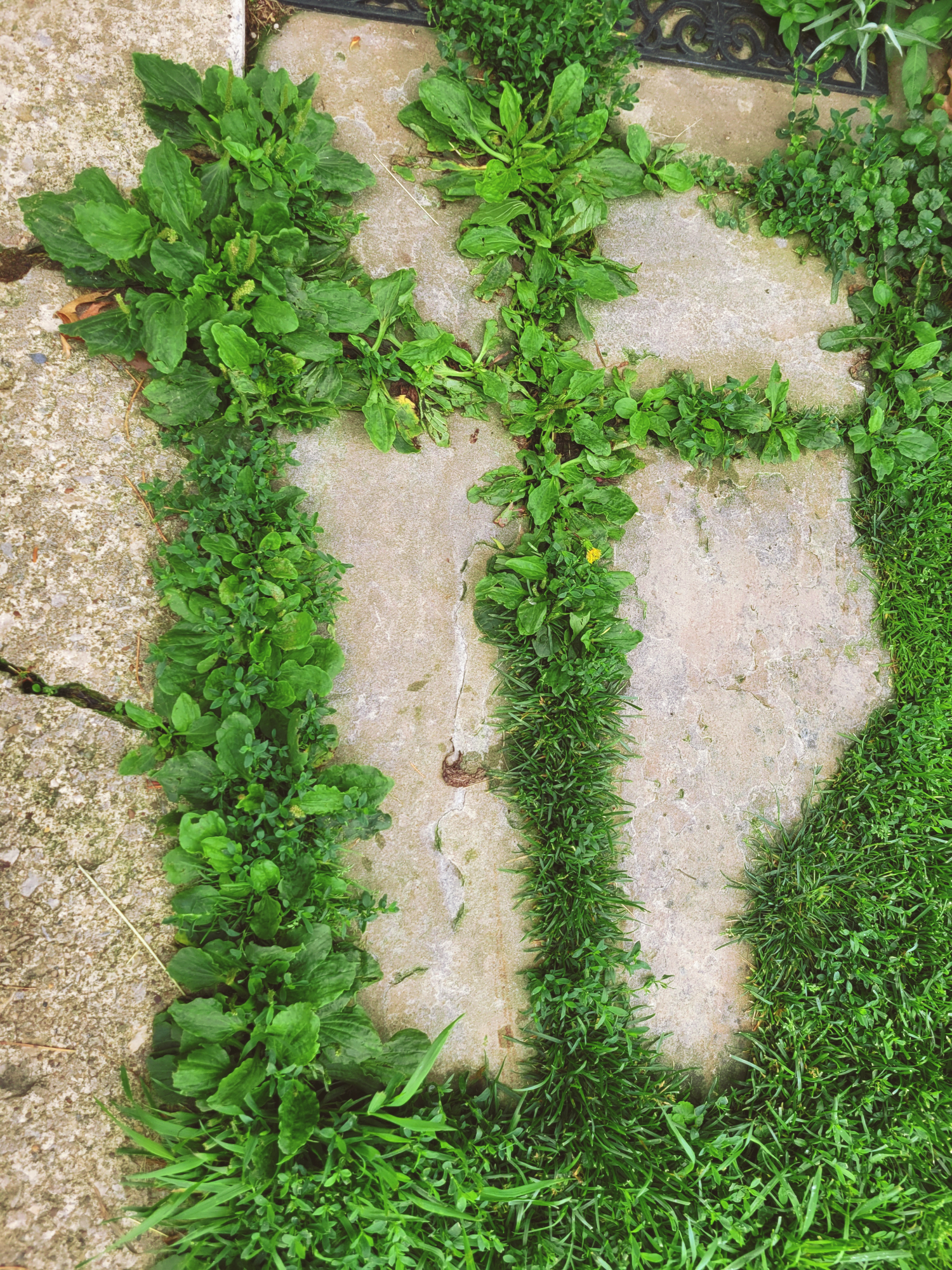
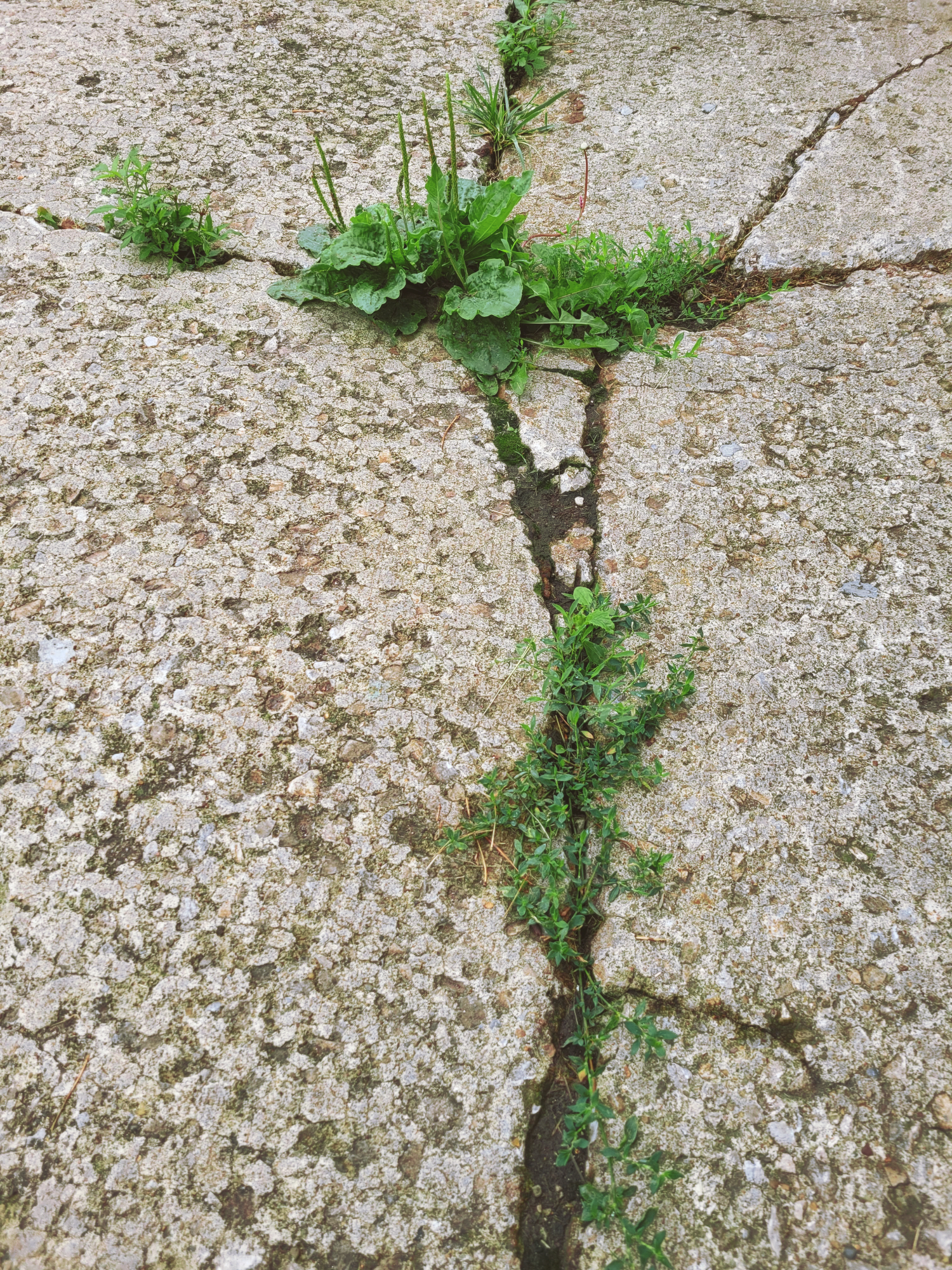
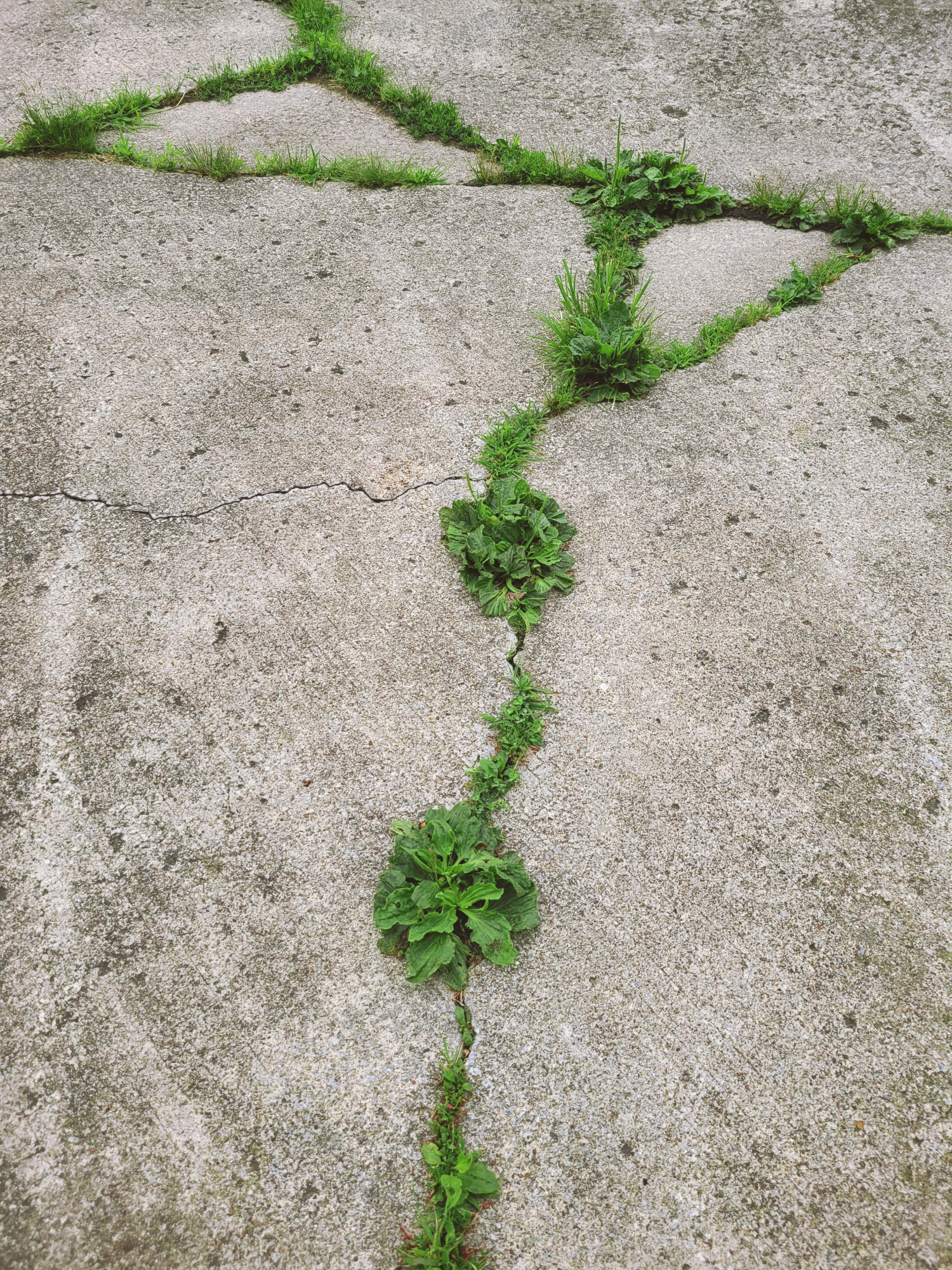
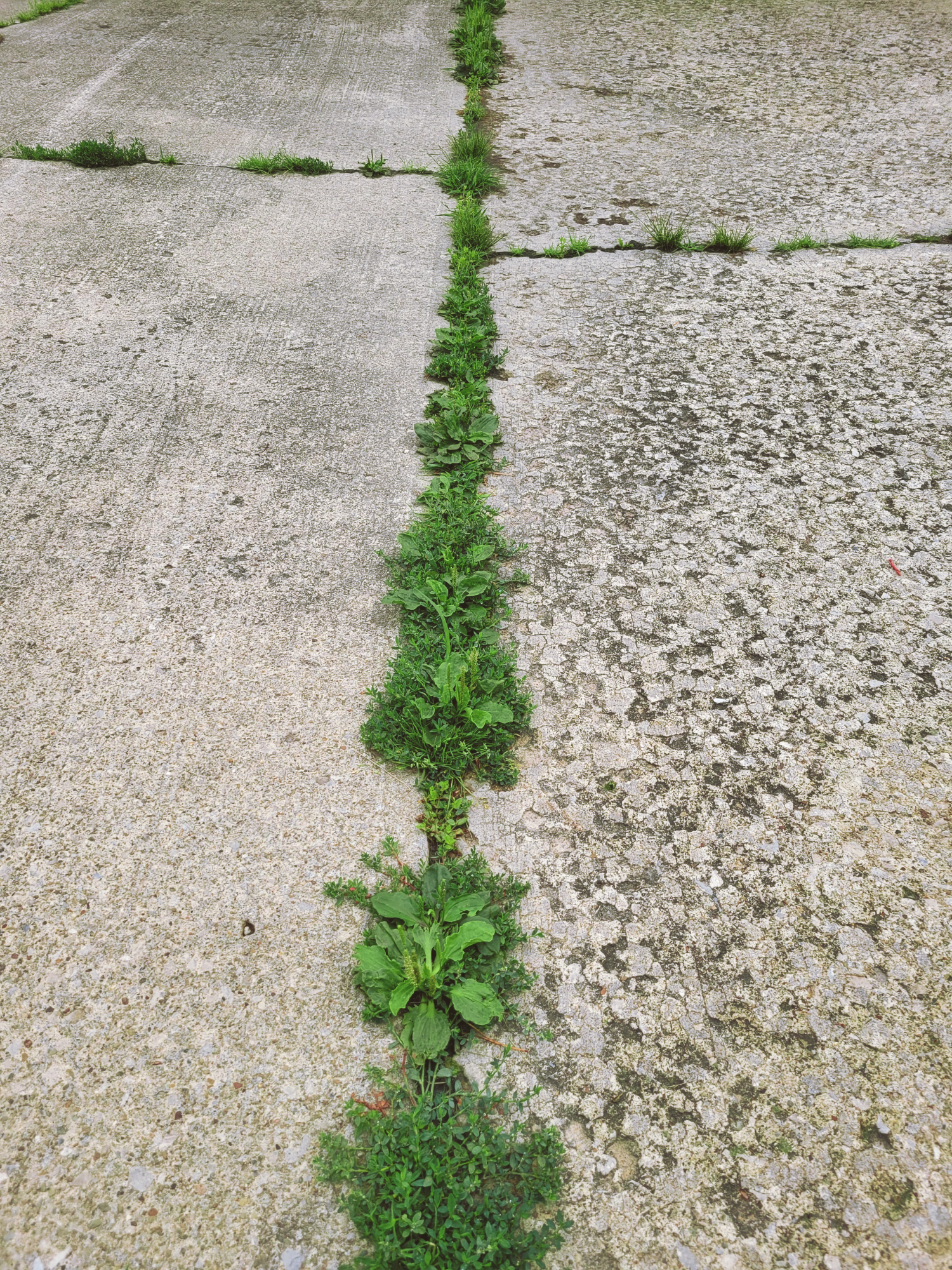
Our driveway is crazed with cracks. I can’t help but appreciate plants springing up through these narrow possibilities. These are native plants, many with health-enhancing properties as human food, but also exquisitely cued to the lifecycles of crawling, flying, hopping creatures reliant on them. All these lifeforms follow nature’s essential precepts of diversity, adaptability, balance, and interdependence. Although our driveway does not, it’s heartening to see how easily life takes over.

I used to wonder about the soil under the sidewalk where I trudged to school each day. What happened when graders and rollers and cement trucks imprisoned it? Did all the life in that soil perish without sunlight and oxygen? How could any living thing survive so much pressure and heat? What would happen if we paved over too much of Earth’s surface? I was a child who Worried About Things.

These plants springing from cracked pavement remind me of nature’s beautiful impulse for life. It restores my hope everywhere I find it. A handful of dry lentils taken from my cupboard, after a few days of soaking and draining, grow into cheery little sprouts I can use in salads, or feed to the chickens, or plant to grow into another generation of lentils. Seeds brought from Cyprus decades ago, shared by a friend, grow each year into giant hardy winter squash that keeps well until late winter –providing nourishing meals along with more seeds to save and share. Organic potatoes in my pantry wrinkle around tiny rosettes and from them, pale tendrils fragile with new life reach out in search of sunlight. I plant these eyes two or three times each season, from late March to late August, for fresh harvests of tender heirloom potatoes.

Life’s impulse can’t always survive what we humans are doing to this planet. As a direct result of human activity, the rate of species extinction is up to 10,000 times higher than the natural, historical rate. Research published in the journal Proceedings of the National Academy of Sciences shows ocean heating is equivalent to between three and six 1.5 Hiroshima-size atomic bombs per second. The UN says “climate change is out of control” and experts in Earth’s climate history are convinced this current decade of warming is more extreme than any time since the last ice age, about 125,000 years ago. It’s exhausting to think about, let alone act on, this spiraling disaster.

We need new stories that reawaken us to the lived wisdom of this planet’s First Peoples and lead us to the most ethical, scientifically grounded regenerative lifeways going forward. It helps when we recognize nature isn’t just what sprouts from cracked pavement. It isn’t confined to wild places we long to visit. We are nature, right down to the life processes of every cell. It helps when our new stories speak to our descendants. It helps when they answer our ancestors.

HOPEFUL RESOURCES

books

Nurturing Our Humanity: How Domination and Partnership Shape Our Brains, Lives, and Future (indie link) Riane Eisler and Douglas P. Fry

Active Hope (revised): How to Face the Mess We’re in with Unexpected Resilience and Creative Power (indie link) Joanna Macy

Restoring the Kinship Worldview: Indigenous Voices Introduce 28 Precepts for Rebalancing Life on Planet Earth (indie link) by Wahinkpe Topa and Darcia Narvaez

The Evolved Nest: Nature’s Way of Raising Children and Creating Connected Communities  (indie link) Darcia Narvaez and G.A. Bradshaw

Why the World Doesn’t End, Tales of Renewal in Times of Loss  Michael Meade

We Are the Middle of Forever: Indigenous Voices from Turtle Island on the Changing Earth (indie link) by Dahr Jamail and Stand Rushworth

Breaking Together: A freedom-loving response to collapse   Jem Bendell

Living Resistance: An Indigenous Vision for Seeking Wholeness Every Day (indie link) Kaitlin B. Curtice

Mystical Activism: Transforming A World In Crisis (indie link) by John C. Robinson

Local Voices, Local Choices: The Tacare Approach to Community-Led Conservation (indie link) by the Jane Goodall Institute

Becoming Kin: An Indigenous Call to Unforgetting the Past and Reimagining Our Future (indie link) Patty Krawec

organizations

Transition Network

Deep Adaption Forum

Work That Reconnects

Black Earth Institute

I’d love to hear what books, organizations, and other resources can help us all reawaken to and bring about these new stories.

Hate Is Biodegradable

I know a woman who once hated her ex with such fury that she soothed herself by imagining all the ways she might kill him. She and he did the acrimony dance through lawyers long after their finances were left in ruins. Somehow they both believed they spared their daughter, having agreed to remain cheerful in her presence. The girl surely saw the grimaces inside their smiles.

Their loathing simmered for years until their child, at nine, was diagnosed with cancer. Both parents went to her appointments and treatments. They cried and prayed and hoped together. Their daughter survived. She grew up smart and strong. She recently got engaged.  

My friend is happily remarried and her ex lives with a much adored life partner. The two couples have been vacationing together for years. They laugh, they reminisce, they dance in ways that give each couple space. They talk about buying a big house or property with two homes so the four of them can move in together. They imagine a backyard roomy enough for their daughter’s wedding. Imagine it scattered with trees perfect for their someday grandchildren to climb. They message each other real estate listings all the time.

I think of countries around the world that were once at war, but are now on friendly terms. They read each other’s literature, savor each other’s cuisines, celebrate each other’s accomplishments. Tourists visit parks where war memorials stand under flowering trees. Suffering and loss can decompose over time into something nourishing, as nature so patiently shows us.  

This isn’t a perfect analogy in a time of division, especially when so many refuse to look at longstanding structural inequities and ongoing injustices. And trauma needs time and acknowledgement to start healing. But there’s hope. My friend just texted me a picture of a listing the four of them are considering. “It isn’t perfect,” she writes, “but its got so many possibilities!”

Same

I haven’t seen my favorite eight-year-old since Christmas Eve. Her parents are, again, being careful because of Covid case counts in our area. Although I miss her and her younger siblings so much I feel tearful writing this sentence, our occasional phone call lets me talk one-on-one with her in a way we rarely get to do during visits.

Today, our nearly 90 minute call started with guessing games. What Am I Thinking is her favorite. Some of today’s correct guesses turned out to be ladybugs, clouds, and atoms. Then we played Would You Rather, which simply consists of taking turns making up questions like, “Would you rather travel by hot air balloon or sailboat?” and “Would you rather be an elephant or a whale?” but she’s so darn mature these days that she tends to say, “I’d like to experience both.” This lasts until our questions get much sillier, like “Would you rather eat worms or garbage?”

She switched screens to show me her room which she recently cleaned and organized. Her large stuffed bear, who she’s named Friendly Bear, holds its own toy animal pal under one arm and a book under another. “I know you’ll like this,” she said, “because books are your favorite thing.”

We discussed which superpowers we’d choose. I said healing, so I could help heal the world. She said she’d like to be able to fly. “I’d fly over right now to hug you.”

We discussed what it’s like to talk to animals and trees. She and I agreed, they are very good listeners. “Especially when you’re sad,” she said. I told her I don’t hear dogs or trees answer in a way I can hear with my ears, but I sometimes I feel what they say inside of me. “Me too!” she said, “We’re just the same!”

Then she talked about how her mind likes to go so wild that she doesn’t notice time passing. She said, “I look around and say to myself, ‘How is this real? How am I real?”” I said, “Me too! We’re just the same!”

July 20, 1969

I was a little kid the day Earthlings landed on the moon. I stood in a campground’s crowded rec room, stopover on one of our lengthy summer trips. Each summer our parents drove us place-to-place in a small car hauling a 15-foot Scotty travel trailer for the most frugal, yet educational, travel possible. That’s why we were here, looking up at a TV mounted near the ceiling. I could barely see due to all the people around me and still remember the press of strangers’ sweaty skin on mine.

My family had entered the room with celebratory excitement about this history-making event. But the prevailing mood here was far different. People seemed to anticipate disaster with unsettling eagerness. I’d never heard grown-ups talk around kids as these people did. There was rampant speculation that astronauts would “blow up in their suits,” or be stranded on the moon to die, or return carrying undetectable germs likely to infect our whole planet. A loud man in front of me said, “You won’t know aliens snuck back with them till it’s too late!” My calm and reasonable parents were somewhere in the crowd, along with my two siblings, but I didn’t risk taking my eyes off the screen to look for them.

The static-filled TV images I managed to see were hard to decipher. It was even harder to understand what the astronauts were saying. But I could easily hear Houston’s Mission Control. The very idea that people on the ground were speaking to people on the moon, a moon small as a sugar cookie in the night sky, gave me a sense we were all connected. Perhaps improbably, it reminded me of a scene I loved from the 101 Dalmatians movie, where people gave up looking for stolen puppies, but intrepid dogs never gave up. At twilight they barked and barked, their voices moving from attic window to alley to hilltop across improbable distances in a mutual effort to save those puppies.

We’d recently learned about space in elementary school. I was troubled by the concept of endless galaxies because it made me think of the tiny place everyone I loved occupied in the vastness of space and time. But this mission to the moon felt like an antidote to smallness. These astronauts were also tiny in the context of space and time, yet they went ahead anyway. They packed up their smarts and their faith in science to head off for an improbable adventure that, we were told, would benefit all mankind.

There are always people who are afraid (I know plenty about fear) but the engine of hope can’t help but lift us.  I was wildly proud of Science, Humanity, and the USA back when those blurry figures bounced like tiny cartoon characters on the moon. I’m still hopeful. It’s amazing what we can do when we have resolve and act on it, together.

Holding Up

“Hope sleeps in our bones like a bear waiting for spring to rise and walk.”   ~Marge Piercy

People used to ask “what’s new?” or “how’s work?” or “what’s the family up to?” but this year’s standard inquiry seems to be “how are you holding up?”

I don’t know about you, but the holding and the up both are pretty tenuous. Every day seems to pose a more serious threat to democracy, the environment, to justice. This week we are breaking records for Covid-19 hospitalizations and deaths, with experts warning of a “dire winter.” I know people who are currently suffering with Covid-19. I know people who have died. I also know people who say concern over the virus is “overblown” and continue to go to the gym and to large gatherings although we’ve now hit daily death tolls exceeding those on 9/11.

Sometimes it feels like I’m polishing every splinter of hope I can find. But when I pay closer attention to what’s holding me up, I find a vast scaffolding. Here are a few rungs on this month’s ladder.

An ash tree in our yard continues to thrive despite invasive ash borers. I greet this tree every time I walk past. Like the sycamore, dogwood, hawthorn, and maple trees around our house I consider this tree a friend. It’s the first tree I see when I look out our back windows, its branches almost always full of twittering birds. I know ash trees are in serious decline. Millions of U.S. ash trees have already died due to the invasive ash borer, including hundreds of trees in the woodland part of our property. But some trees continue to thrive. They’re called “lingering ash.” Somehow these trees, untreated by insecticides, carry on. Their genes seem to resist predation. Science hopes resistant ash can perpetuate the species. This tree’s resistance to annihilation can’t help but inspire me. Let’s hope we can be the lingering best versions of our own species.

Although I’m getting less accomplished overall, I am honored to have recent work published in One Art, Feral: A Journal of Poetry & Art, Revolution Relaunch, Friend’s Journal, and Channel Magazine. I’m also surprised and honored to be one of the winners of Cultural Weekly‘s Jack Grapes Poetry Prize.

Out here, although you can’t see him, Boris the Duck and his unnamed friend paddle around in peace. Boris is flightless due to a healed broken wing. I look for him many times a day and each time his presence amplifies the peace I feel here. Whether making coffee near dawn or washing dishes near dusk, seeing Boris settles something in me.

I love teaching, even via Zoom. I never thought we could achieve a strong sense of connection by screen, but it’s possible. The magic of writing and sharing our work isn’t as high wattage as in-person classes but it’s remarkable. I come away from each class entirely nourished.

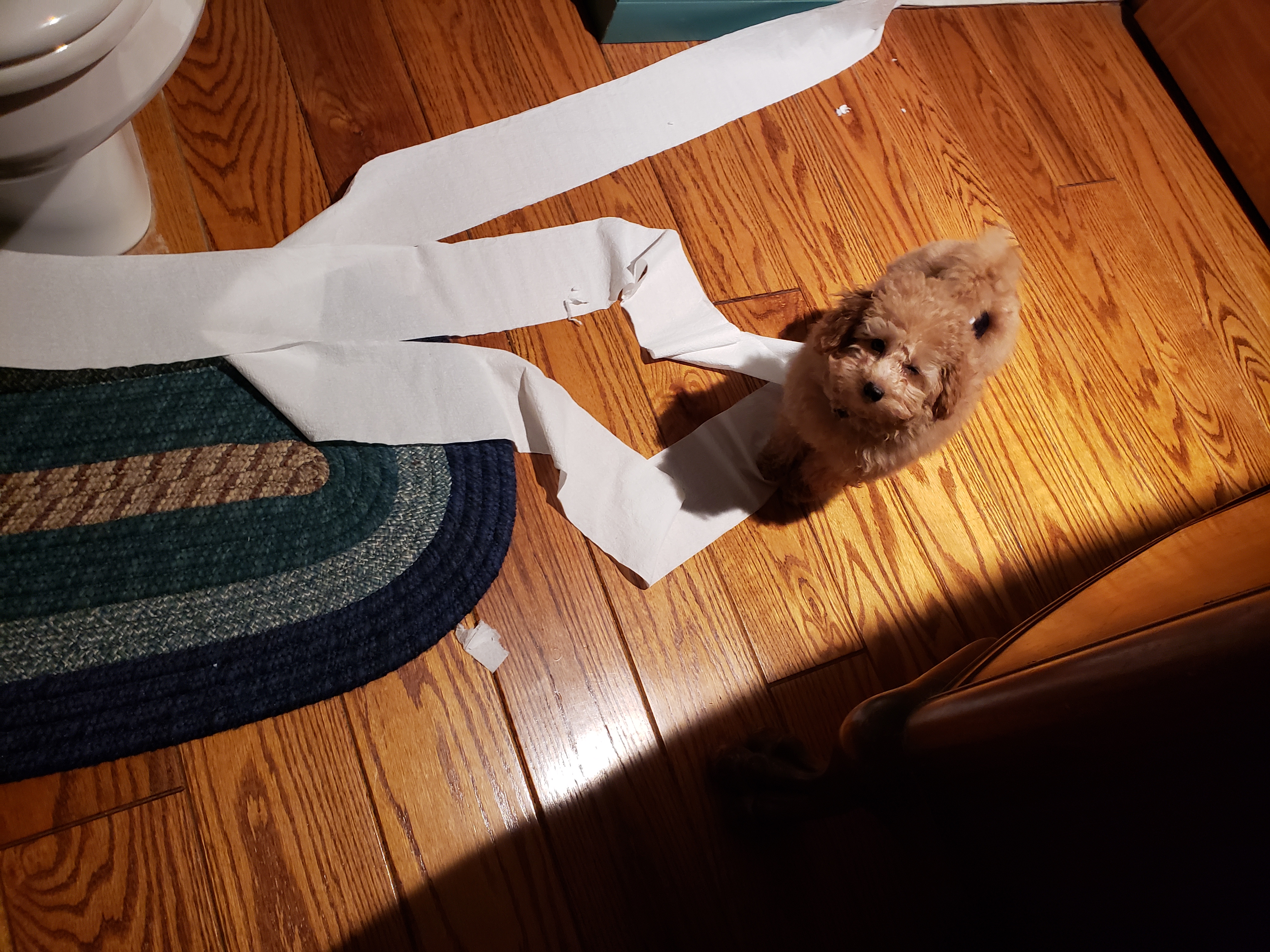
And of course there’s the new puppy. Imagine the joy Festus feels right now. Despite his considerable shortness, he discovered the magic of unrolling, carrying, and decorating. May your day hold at least that much happiness.

It May Happen For You

Here in the Midwest we say, “You won’t meet a nicer person” and that perfectly describes Sam Richards. Sam is married to my cousin Becky (another one of those truly kind people). The geographical distance separating us means we only see each other every decade or so, but nearly two years ago Becky and Sam came from Missouri to stay with us for a few days. Sam had been diagnosed with Parkinson’s disease and because his symptoms were worsening they wanted to cross off as many bucket list items as possible before travel became too difficult. They went to parks, museums, visited extended family in the area, and walked around the tree-lined streets of Oberlin College where Becky’s father had graduated. It was an absolute delight to spend time with them, even though shadowed by our concern for Sam’s health. It was gutting to think this supremely capable and generous man was facing decline.  

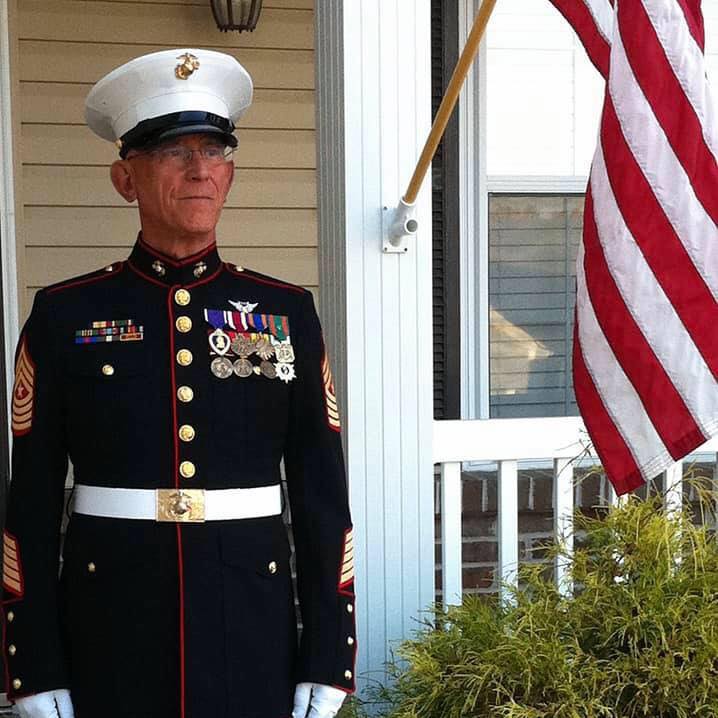
Sam served in the U.S. Marine Corp for 23 years. He continued a life of public service as a police officer and code enforcement officer. His commitment didn’t end there. He served a total of eight years on two different city councils, nearly 20 years on a regional EMS board of directors, as well ongoing work on the executive council of their Methodist church.  He was asked to run for mayor of their city, Festus, but couldn’t consider it due to his health.

Later that year, Becky called with the most amazing news. It was discovered that Sam didn’t have Parkinson’s after all. A medication he was taking for another condition caused side effects that mimicked the disease. With a change of medication, his future was once again wide open. I could have laughed and cried at the same time. With everything going on in the country and the world, this was the best news we’d heard in a very long time.

It got better.

Last year, on April 2nd, Sam Richards was sworn in as mayor of Festus, Missouri.

                                                                     ~~~

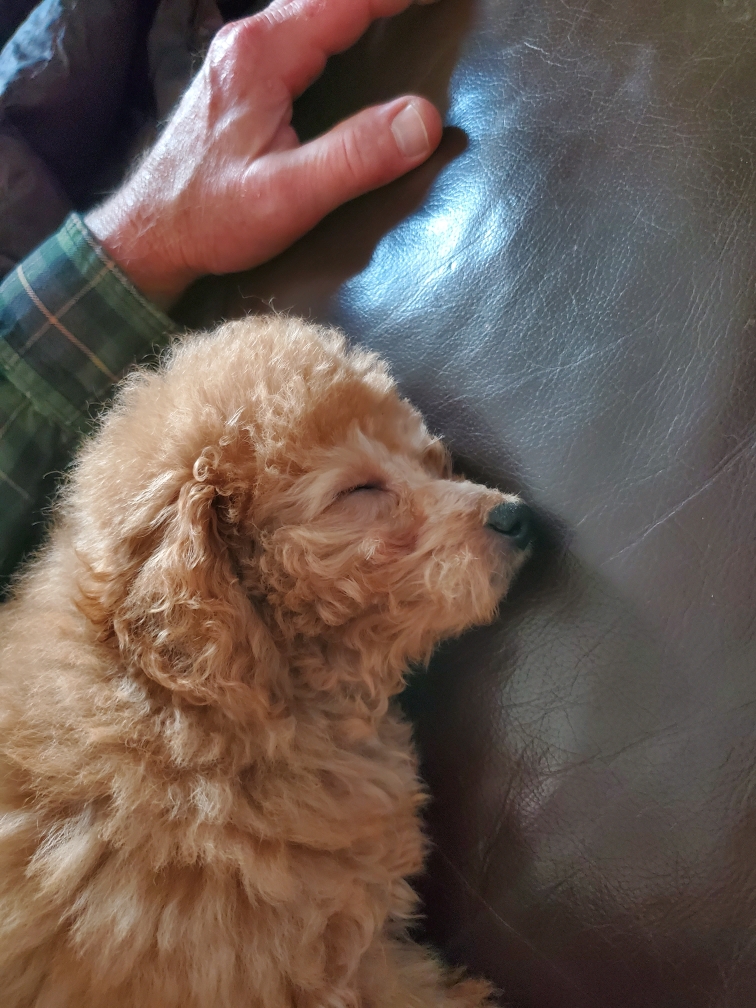
Which brings me to today. Our new puppy arrived this afternoon. Many of the dogs we’ve had over the years came to us already named – among them Jedi, Winston, and Cocoa. But this little guy was ours to name. In these difficult times, I want a daily reminder that extraordinarily wonderful things are possible. That a good thing happened to a good man. That a town got a fine mayor. That there’s always hope. So of course, our new dog’s name is Festus.

He is an affectionate, playful, constant tail-wagging fluff ball. First nap of the afternoon.

SOMETIMES

Sometimes things don’t go, after all,
fom bad to worse.  Some years, muscadel
faces down frost; green thrives; the crops don’t fail,
sometimes a man aims high, and all goes well.

A people sometimes will step back from war;
elect an honest man; decide they care
enough, that they can’t leave some stranger poor.
Some men become what they were born for.

Sometimes our best efforts do not go
amiss; sometimes we do as we meant to.
The sun will sometimes melt a field of sorrow
That seemed hard frozen: it may happen for you.

~Sheenagh Pugh  

How Do You Stay Hopeful?

We are living in times that can overwhelm even the sturdiest among us. Each day’s news seems increasingly hard to bear. As the months drag by it wears us down in different ways. Outrage and anguish can fray our bodies. Addressing too many issues can fracture our effectiveness. Cynicism or complacency can hide our hearts, even from ourselves.

I reached out to friends on Facebook and Twitter seeking to find what others are doing to hold themselves up.  My question:

Please tell me what you are doing to remain hopeful in these times. If you are doing something, anything, to help turn the tide toward ethics and common sense please share that too.

A welcome tide of hope rushed back at me. I found it interesting that nearly all of it had to do with nurturing — nurturing relationships, creativity, possibilities, balance, and compassion. Here are some of the hope-inducing insights friends shared with me.

Find balance

Strengthening myself with compassionate activities like gardening, yoga and reading books by great minds. Really trying to be a better listener without feeling the need to always respond. Trying my best to raise empathetic kids who in turn will carry the torch on their own.

I kind of feel like light shines twice as bright in so much darkness.   ~Tobias Whitaker

Almost every Monday morning since the inauguration a small group of us meet at a local coffee shop and write postcards to our legislators. We also make phone calls and send faxes. Being with like-minded people helps. This week I am spending time with a great group of women in a cottage at a lake, eating, drinking, discussing books and authors and recharging my batteries.   ~Betty Kramer

I’ve never done anything that fills me with more hope than raising my little boy. The equation seems so clear. I put in love, reasonable limits, and real time in the moment and he grows up curious and kind. I reach out to  make our apartment a gathering place for other mothers too. We have a lot of hope that our generation can make a difference.   ~Rosie

I have planted seeds and trees, and I’ve spent time with the littles in the family. I’m doing some stuff in the studio, making things I love. I’ve registered young people to vote, and stood on a street corner on a cold winter morning honoring the kids who are organizing for change. I walk and/or hike almost daily. I drink good coffee. I send wee gifties to folks I care about, and leave things in public places to be found by strangers.

I rarely read the news, knowing that there is a lot of tough stuff going on. I am selective in what I listen to on the radio. I just, as my English mother-in-law used to say, keep chunking along.   ~Debra Bures

I keep working on getting people to vote. Two new voters yesterday! They previously did not vote because they did not like any of the options, but now see their responsibility…  Also, I get out in nature, with grandchildren, garden, sing, throw pots (but not against the wall). I’m involved with an amazing herbal healing group and love the alternative focus. I joined and participate in the Crooked River Timebank and that is a strong community building, for Mama Earth and her people, positive fun thing to be part of.    ~Carolyn Rames


Build connections

I talk to the person checking out my groceries. I ask the guy panhandling at the corner how he’s doing every single day and wait to hear what he’s got to say. I sit down with the maintenance guy in my building for a beer if he comes by. Clicking in with people does me good. The more people ignore each other the worse they make it.     ~Elgin

I find hope (lots and lots of hope) in the work of a group called Better Angels – here’s why. While attending our first convention I enjoyed three days of stimulating conversation with folks who politically are polar opposites and yet, because of a common desire to depolarize our country, we approached each other with positive intent and listened to one another with love. The goal? To learn to listen to understand how people think and believe – period. Not to debate to win or change another person’s mind. Just listen with love to hear and understand.  It was inspiring to say the least and, a universally positive experience for those who attended. As a result, my husband and I as well as many others both left and right leaning are committed to being trained to facilitate the peaceful exchange of ideas. We need to depolarize our country and we know that we can.   ~Leslie Boomer

Hone down to what you can do

I am working on getting my backyard certified as a backyard habitat for the National Wildlife Federation. I am also working at a glacial pace on 7 personal goals. I am trying to control a small portion of the world and make it better.   ~Katherine Clark

I am raising money to provide legal representation for immigrant children separated from their parents.   ~Brett

I decided to focus any activist leanings I have this year towards getting people to vote. I joined the local League of Women Voters and am trying to help with their events when I can.   ~Kathy

I stay involved in my community….serving on the board of directors and being active in my local community theatre, serving as President of the Friends of the Library and volunteering for the county parks. Being the change I want to see in the world starts with my neighborhood, imo. And I am raising daughters who are following my example.   ~Lissa

Look for what’s good

Focus on the world around and closest to you, those you love and touch and see and hear in your everyday life. We live in a time when choosing to separate yourself from the noisy, chaotic, distractions in the world is more difficult than ever, but even more essential. Essential for your own individual well-being, but I believe critical to humanity.

…Focus on the good. I guarantee if you look carefully at the world within your sphere of influence, those close to you, you will find goodness, strength and hope. You will be able to contribute to that. You will, in a very real sense, help to create peace in this world. I believe we can all do that. And if we did, can you imagine the impact?   ~Cheryl

Amplify beauty and meaning

My job as a music programmer for Crazy Wisdom in Ann Arbor is a huge help — booking musicians, hosting the shows and just being alongside people as they take a weekly break from all the craziness around us is a positive high point in every week. In a similar vein, hosting our house concert series keeps me grounded in my home, neighborhood and local community and gives me yet another opportunity to serve musicians, friends and family–all of whom are creative, vibrant, caring people doing their bit, every day, to “get us all back to the garden” which is my aim and goal as well. I post poetry on FB and I’ve been doing a “poetry post card” project with a friend of mine–we write a poem a day—or try to–on a postcard, sometimes adding a bit of art or whimsy to the cards–and we pop them in the post to each other. This also necessitates a walk into town to the PO (our postal carriers often neglect to pick up mail so I take it directly to the post office instead) and the walk takes me into my neighborhood–I get to see people, say “Hi” and maybe stop for a chat–I get some exercise and clear my head. I’m committed to doing everything I can to keep the world around me sane, centered and peaceful so I try to be deliberate in my choices, to choose, always, “the things that make for peace.”

I do experience discouragement–I sometimes feel that I’m not doing enough but I know that what I am doing is true to who I am–to my temperament, gifts and abilities and part of my effort is tuned to encouraging others who don’t feel as though they quite fit into the “activist” personality that they are still needed and that their gifts–their poetry, essays, music, food, presence–is “enough” because the last thing we need is a lot of people feeling helpless or getting the idea that there’s only one, right way to be “active” in making the world a better place.   ~Michelle Wilbert

Art, art, art (which includes writing). All forms of creative play. NOT watching or reading (so much of) the news. Meditation/chant/quiet time. And I’m a big subscriber to this way of thinking, as Cinelle Barnes said, “Sometimes, I think, laughing is a form of resistance. There’s nothing more annoying for an oppressor than to see the oppressed thriving in the midst of struggle. Joy is resistance, and so is hope.”   ~Paula Lambert

Do work that makes a difference

What brings me hope is how uncommonly simple it is to make peace person-to-person. This is my daily practice. I work front office for a high volume tire company dealing with customers, reps, employees, whatnot all day long. I do what needs to be done and at the same time consciously choose to see the person I’m dealing with as a Child of God (or soul or stillpoint or whatever you want to call it). It doesn’t take a second longer to pay attention with my eyes AND my spirit.  This changes everything for the better, believe me.   ~name withheld

The interviews I do for The MOON almost always inspire me. This morning I spoke with Earth Guardian Xiuhtezcatl, who has been a vocal champion for the Earth since he was six. He’s also a hip-hop artist and published author. His new book is “We rise.” Thank God.     ~Leslee Goodman

I am working with a local school to create a racially inclusive and safe community as well as advocate for youth.   ~Malaka

I find my job as a family therapist incredibly meaningful. I work with people who are greatly impacted by the political and economic realities, but who are also very resilient. For their sake I am able to rise above apathy. The personal relationship I develop with struggling clients fuels me to take greater steps in advocacy. By walking with them, just a little bit, I learn about the network of social services that is available. It seems that this network is fragile and not enough, but I meet incredible unsung professionals (social workers, teachers, therapists) who are good stewards of resources. There is energy in numbers. Oh, and I also don’t work more than my agency job description calls for. I go home and enjoy people I love.   ~Jennifer Olin-Hitt

My job is poorly paid and gets little respect, but I bring my all to it. I’m an aide in the 3 to 4-year-old section in one of St. Louis daycare companies. These little people are learning to express themselves, validate emotion, share, care, and analyze everything around them. No price can be put on their enthusiasm and love. I don’t know why today little kids don’t matter (or the people who watch them), but this is the future. After work I go home knowing I did my best.  ~Tiff

I signed six children up for Summer Reading today. And I accepted a donation of five hundred books from a woman’s mother’s estate; they will be sold to support educational programs for Cleveland youth at The Reading Room CLE.

I try to do what I can, and not spend energy on things I can’t control. So when the news went out that ICE was operating a checkpoint at 150th and Lorain, I shared the information, hoping to help people avoid the intersection. I don’t know what to do about this technically legal but horrifying behavior. Do we go take pictures? Protest? Knock over the ICE truck? I don’t know. I don’t know. But instead of spending the next three hours grieving into Facebook, I put down my computer, went out in my garage, and boxed books for the Reading Room. After three hours, I was exhausted, sweaty, and dirty. But those three hours will help children learn to read. I feel like that’s better than weeping into my laptop, alone, for an evening.

One more thing: all that weird, oddball stuff I do? My art, my performance poetry, my quirky fashion choices? People ask me where I get the ideas for these hobbies, what motivates me to spend my time on this stuff. But those are coping skills. They build my strength so I can stay healthy and help others. Our culture and economy depends on people using entertainment and pleasure-seeking to cope with the everyday brokenness of our lives. It works better, for me to be kind and creative. It works better than mani-pedis and salt baths and chocolate cake.    ~L.S. Quinn 

Take care of yourself

I’m immersed in news all day long. When I get home from work I ignore my phone. I go for a run with music in my ears and space between, have some dinner with my partner, then let the body tell me what it wants to do.  ~Jaxxon:

Spend as much time outside in the sunshine as humanly possible. (I can weep for humanity and get vitamin D at the same time!)   ~Kris Bordessa

I find that I have to continually pull myself back into the present moment to avoid being sucked into the maelstrom – to instead see from a more level-headed perspective. I try to remember to recenter and refrain from letting my body be impacted. I take care of refreshing my body, which is so closely connected to where the mind goes, and I get out into nature to keep an even bigger perspective.   ~Lillian Jones

I am cooking at home more. I’m growing pots on my balcony with peppers, tomatoes, and beans. When I make something homemade my senses are busy and I don’t think about how bad everything is getting, you know?  ~Franco

I’ve quit watching TV. And I’ve ramped up showing kindness to strangers and every person I meet at the library. Also, sending unspoken blessings to people on the highway as I commute. Finally, I’m donating food and money to the Sandusky immigrant cause. Just trying to turn up the light.   ~Laurie

As a friend of mine always says, “Read more poetry, eat more chocolate!”   ~Virginia Douglas

What about you? How do you stay hopeful?


9 Amazing Reasons To Be Optimistic

world betterment, global optimism, oneness, hope, peace, all will be well,

If you could scroll through history searching for an era where you’d like to spend a lifetime, what would attract you?

Probably peace and prosperity. Probably a time when the arts flourish and science is open to new wonders. Probably too, a time period when people behave morally, care for one another, and uphold higher ideals than selfishness.

Does it make a difference to your answer if you don’t get to choose where on Earth you’ll be born?  Into what class, gender, creed, and ability?

You’ll probably want to stay right here, right now.

Our 24 hour media attention on what’s terrifying and what’s superficial steers us away from the big picture.  That picture, looking at the wider view, is actually pretty heartening.

*

1. War and global violence continue to decline.

Armed conflicts aren’t going up, they’re going down.

The world has seen a 70 percent decline in the number of high-intensity conflicts since the end of the Cold War era. Genocide is down 80 percent. Weapons sales between countries have diminished by 33 percent and the number of refugees has fallen by 45 percent. Even measuring from as little as 15 years ago, the number of armed conflicts has dropped from 44 to 28.

Why? Project Ploughshares credits peace building efforts.

Chances are, the reasons for peace are complex. Yet a stronger international resolve to focus on peace building and basic human rights is taking place. Imagine the far larger potential for enduring peace if we intentionally educate our children and ourselves in the proven methods of non-violence—-negotiation, mediation, reconciliation, even basic listening skills.

*

2. Freedom is stretching across the planet.

By evaluating variables including civil liberties, democratic institutions, and independent media it’s possible to assess how free each nation in the world really is. Back in 1973, 29 percent of nations were deemed free, 25 percent partially free, and 46 percent not free.

In a little over 35 years, the number of nations ruled by authoritarian regimes dropped from 90 to 30. Countries around the world considered to be free increased by 50 percent while those not free had dropped by more than half.

Independence has a long way to go. And what we may not recognize as positive signs—protests, dissent, political upheaval—may very well be ordinary people speaking up for freedom.

*

3. Affluence is on the increase.

A shifting focus away from war, conflict, and chaos means that countries are better able to meet the needs of their citizens. Those 151 countries deemed free or partly free account for 95 % of the world’s gross domestic production (GDP).

The number of people living in poverty has dropped by 500 million people, although most of those successes are in a few key countries.  Since 1975 the world’s poor have seen their incomes grow faster than the world’s wealthy, meaning economic equality is increasing.

Of course, we make a mistake when we confuse affluence with well-being. After certain (surprisingly minimal) levels of health and safety are reached, money doesn’t buy happiness.

Current global conditions of institutional breakup, financial chaos, and environmental decline are exactly those which seem to be (slowly) leading to long-term beneficial change. Collectively we’re waking up to the limitations of short-term fixes and relentless economic expansion. Hopefully we’re also waking up to the reality that we’re in this together—rich and poor, developed and developing nations, young and old, left and right. We see in our own lives that what’s important can’t be measured by dollars alone. Things like good health, supportive relationships and a vital ecosystem.

There are plenty of other ways to define affluence. A fascinating measure of wealth lies in a quick look at how many hours of labor it once took the average worker to pay for light.  In ancient Babylonia it took over 50 hours to pay for an hour of poor light from a sesame-oil lamp. At the start of the last century, it would have taken the average worker a thousand hours to earn the money to buy candles equaling the light of a single 100 watt bulb. Today’s high efficiency lighting costs us less than a second of work.

*

4. Fewer people are hungry.

Hunger continues to drop although we have a long way to go. It’s staggering to realize that 925 million people are chronically hungry. But according to The Improving State of the World: Why We’re Living Longer, Healthier, More Comfortable Lives on a Cleaner Planet by Indur Goklany, global food supplies increased 24 percent per capita in the last 40 years. In developing countries the food supply increased at an even greater rate, 38 percent more food per person. Since 1950, the real global price of food commodities has declined 75 percent.

No one should go hungry. The future of global food justice relies on efforts to restore and protect biodiversity, stop the spread of genetically modified crops, and assure water rights.

*

5. Longevity is improving yet total population faces a downturn

Fulfilling the cherished hopes of their parents, more children around the world are born healthy. Mortality rates for those under five years of age have fallen by 60 percent since 1960.

Meanwhile, life expectancy has risen 21 years since the mid 1950’s.

This doesn’t mean the planet will be too crowded. Overall population will continue to rise for several more decades but we’re facing a major downturn. Already birth rates are near or below replacement rate in countries all over the world. Increased education and affluence tend to inspire women, no matter what country they live in, to invest their time and resources in fewer children. As Fred Pearce clearly explains in The Coming Population Crash: and Our Planet’s Surprising Future, our little Earth will likely reach a (painful) peak of 8 billion people around the year 2040, then the total number of human will begin to decline so rapidly that nations will struggle to keep their populations levels from slipping too low. They may create perks for becoming parents and incentives to attract immigrants.

*

6. Health continues to improve.

Studies conducted by Robert W. Fogel, a Nobel laureate and economic historian at the University of Chicago, show that in a few hundred years human biology has changed in startling ways. We are more resistant to ill health, more likely to recover when faced with disease and less likely to live with chronic disability. We are also smarter and live longer. Fogel calls this radical improvement “technophysio evolution.”

An interview quotes Fogel as saying, “The phenomenon is not only unique to humankind, but unique among the 7,000 or so generations of human beings who have inhabited the earth.”

Fogel doesn’t necessary attribute the changes to genetic shifts.  Improvements in medical care, nutrition, sanitation and working conditions may cause epigenetic changes. These are shifts in gene expression that can last through many generations without altering underlying DNA.

Information amassed by Fogel indicates that chronic diseases such as arthritis, heart disease and lung ailments are occurring 10 to 25 years later in life than they did 100 or 200 years ago. Interestingly, well-being may be more strongly affected by conditions each individual faces in utero and during the first few years of life than previously suspected.

These remarkable health gains don’t diminish our current struggles with cancer, diabetes, Alzheimer’s disease, autism and other serious health conditions on the increase. Despite the blessing of bodies more resilient and healthy than those of our ancestors of just 150 years ago we suffer the effects of environmental toxins and nutritionally inferior diets. To fully accept the gift of health and energy from our ancestors, we need to make the right choices to pass those benefits to our descendants.

*

7. Literacy rates continue to improve.

Global adult literacy rates have shot up from 56 percent in 1950 to nearly 84 percent today, the highest ever.

Women’s rates haven’t risen as quickly due to inequality and poverty, but in some areas, particularly East Asia, 90 percent more girls are able to read than 10 years ago. As female literacy goes up, other overall positive indicators tend to follow including decreased domestic violence, improved public health and greater financial stability.

*

8. Intelligence is on an upswing.

From generation to generation, we’re getting smarter. In fact, to accommodate continuously increasing intelligence the IQ test must be renormalized (standardized to keep the average test results at the 100). This is called the Flynn Effect.

Between 1932 and 1978, mean IQ scores in the U.S. rose 13.8 points. If your grandparent received IQ score results of 98 back in 1932 they’d have been deemed of average intelligence. That same grandparent, if administered today’s tests, would be considered to have a borderline mental disability by current scoring standards. IQ scores have risen even higher in some other countries. Of late, developing countries seem to be experiencing the biggest surge.

Plenty of explanations have been proposed, but the increase can’t be definitively pinned on genetic improvements, improved nutrition, greater familiarity with testing or better schooling.

According to Cornell professor Stephen J. Ceci, the most direct gains are not in subjects that are taught (math, vocabulary) but are shown in parts of the test that seem unrelated to schooling (matrices, detecting similarities). In fact, test gains have been enormous in areas requiring the child to apply his or her own reasoning, such as arranging pictures to tell a story or putting shapes in a series. Although teaching children does return positive results, what a child learns through the natural stimulation of everyday life has a more profound effect. For example, a study to determine the effect of schooling on rural children in India found that the increase in overall intelligence from a year of age is twice the increase from that of attending a year of school.

IQ test scores don’t relate to what truly provides satisfaction in life. But the Flynn Effect is intriguing. Factors we can’t completely explain are giving us the intellectual capacities to deal with an ever more challenging world.

*

9. Compassion is huge.

Never before in history have so many people worked tirelessly and selflessly to benefit others. Paul Hawken writes in Blessed Unrest: How the Largest Movement in the World Came into Being and Why No One Saw It Coming that the abolitionist movement was the first major movement by human beings to advocate on behalf of others without seeking advantage for themselves or their particular social or political group.  Since that time, such efforts have grown with astonishing vigor.

There are now over a million organizations on the planet working for environmental stewardship, social justice, the preservation of indigenous cultures, and much more.  These groups don’t seek wider acclaim, they seek to make a difference for the greater good.

Humanity, which is clever and kind enough to bring about so much improvement for one another, is awakening to the vital importance of living more sustainably on Earth. Unless we pull another planet out of the galaxy’s pocket in the next decade or two, we have to stop using up our precious blue green Earth. It’s time to turn our ingenuity to living well within our means. Peacefully, wisely, and with optimism.

world peace, ending world hunger, ending war, ending illiteracy, global optimism, heartening optimism,

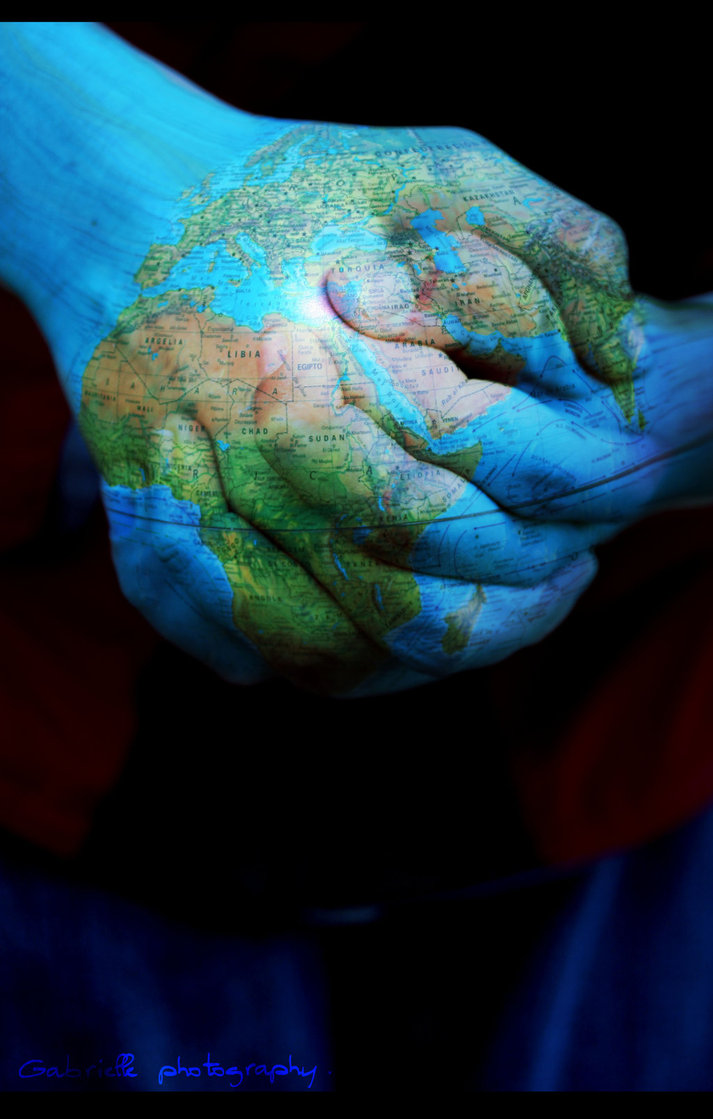
Hand Globe image courtesy of HapciuMadam

Hummingbird image courtesy of PhapPuppy