I spent years teaching nonviolence to teachers, church congregations, incarcerated people, and others. Most knew very little about the long and powerful history of nonviolence.
Nonviolence doesn’t mean living without anger or conflict. Strong emotions like anger can be a positive catalyst for change; fueling us to become more aware, to take action, or to seek help. Conflict is an inevitable part of human interaction. Dealing with conflict constructively, creatively, and with mutual regard allows conflict to serve a useful purpose.
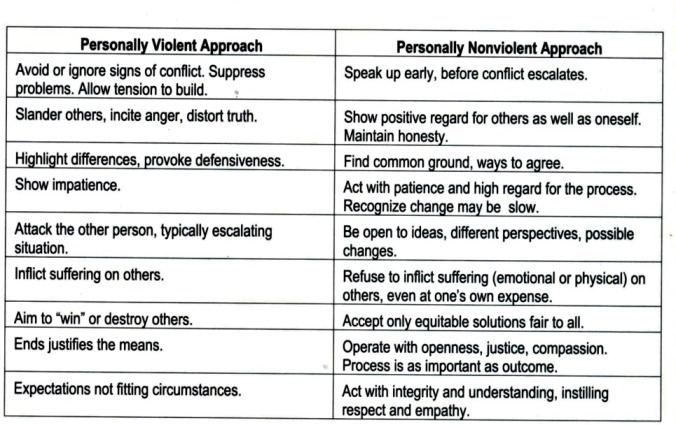
Here’s a comparison of violent versus nonviolent responses, developed by the late John Looney, founder of the Peace Grows course, Alternatives to Violence.
What’s the first nonviolence principle we should know? De-escalation. A major characteristic of violence, verbal as well as physical, is that it tends to escalate. It is most easily reversed at the beginning and becomes progressively more difficult to stop as it spirals into more intense violence.
Those who study the effects of intervention in violent situations have found when others object or actively intervene, their efforts tend to slow or stop the violence. Dr. Ervin Staub, who survived under Nazi rule, reports in The Roots of Evil: The Origins of Genocide and Other Group Violence, that the Khmer Rouge in Cambodia and the Nazis in Germany began their campaigns of genocide with small persecutions which citizens allowed to continue. He reports that action by “bystanders” (those who are not victim or perpetrator) empowers the victim and diminishes the power of the aggressor. But ignoring the suffering of others allows the violence to escalate.
Mass violence tends to start with hate speech. Large-scale atrocities like the Armenian massacre, the Holocaust, the Bosnian war, and the Rwandan genocide can be traced back to hate speech.
Broadly defined, hate speech is any speech, gesture, or conduct which may incite violence or prejudicial action against an individual or group on the basis of ethnic origin, religion, gender, race, sexual orientation, or disability.
Hate speech inflames and escalates violence. It’s often stirred up by those who seek to hide their own power-seeking machinations. They use it to distract and create conflict between the very groups most likely to suffer from their actions.
Hate speech must be stopped. If not, it escalates, causing increasing repression and violence — sometimes to horrific levels. And yet we’re living at a time in history when hate speech attracts media attention and political adulation. It may seem incomprehensible, but it’s happening. Yes, I’m referring to Mr. Trump’s utterances. Here’s a sample.
Slurs and dangerous accusations against people based on ethnic origin.

Slurs and prejudicial actions based on religion.

Violent and demeaning untruths based on religion.

To which the Council on American-Islamic Relations responded, saying Mr. Trump’s “rhetoric has crossed the line from spreading hatred to inciting violence… By directly stating that the only way to stop terrorism is to murder Muslims in graphic and religiously-offensive ways, he places the millions of innocent, law-abiding citizens in the American Muslim community at risk from rogue vigilantes. He further implies that our nation should adopt a strategy of systematized violence in its engagement with the global Muslim community, a chilling message from a potential leader. We pray that no one who hears this message follows his gospel of hate.”
Advocating gross violations of the Geneva Conventions. “…and if it [torture] doesn’t work, they deserve it anyway for what they do to us”.

Advocating even more gross violations of the Geneva Conventions.

Advocating and applauding violence against protesters.

Mr. Trump fondly reminisces about the days when protesters were viciously beaten, saying, “people like that would be carried out on a stretcher.”

When an African-American protester from Black Lives Matter was punched and possibly choked, Mr. Trump later said in an interview, “Maybe he should have been roughed up.”

Some Trump supporters are inspired to commit hate crimes based on Mr. Trump’s views. For example, Boston brothers Scott and Steve Leader were charged for beating a homeless Mexican man, punching as well as hitting him with a metal pole. One of the men justified the assault, telling police, “Donald Trump was right — all these illegals need to be deported.” When asked for his reaction, Trump said,
“I will say that people who are following me are very passionate. They love this country and they want this country to be great again. They are passionate. I will say that, and everybody here has reported it.” Donald Trump
At a North Carolina rally, Trump supporter John McGraw punched a protester in the face. Mr. McGraw later said in an interview, “Next time we see him, we might have to kill him.” and “We don’t know who he is,” he said. “He might be with a terrorist organization.”
Spitting, punching, elbowing, shoving, name-calling, and death threats have become increasingly common at Trump rallies with particularly ugly vehemence directed at African-Americans. Rally-goers have threatened reporters, flashed Hitler salutes, and screamed “light the motherfu**** up.”
According to the World Policy Institute, it can get worse. Much worse. “The power and influence of the figure addressing the speech to a particular audience, along with the contextual factors of that speaker and that audience (i.e. creating false scenarios of self-defense, in which the targeted group are accused of undue murderous acts), are substantial factors in distinguishing hate speech from incitement to genocide.
Remember, the principle of de-escalation. When bystanders (those who are not victim or perpetrator) don’t intervene, hate speech and its consequences escalate.
We’re all bystanders.
Get involved. Speak up. Vote. Protest. Don’t let this happen.
[Update, September 2020. “Since the beginning of Trump’s 2016 presidential campaign, domestic terrorism has more than doubled in the United States. During the Obama administration’s two terms, the U.S. averaged 26.6 incidents of domestic terrorism per year, according to the Global Terrorism Database. The most active year, by far, was 2016, which saw 67 attacks, more than double Obama’s overall average. During the first two years of Donald Trump’s presidency, 2017 and 2018 – the latest year for which data are available – domestic terror activity stayed that high, with 66 and 67 attacks, respectively.” Reported by in The Conversation.]
 Laura Grace Weldon