The Benefits of Natural Math

natural math, exploratory math, hands-on learning,

images: public-domain-image.com

Math as it’s used by the vast majority of people around the world is actually applied math. It’s directly related to how we work and play in our everyday lives. In other words it’s useful, interesting, even fun.

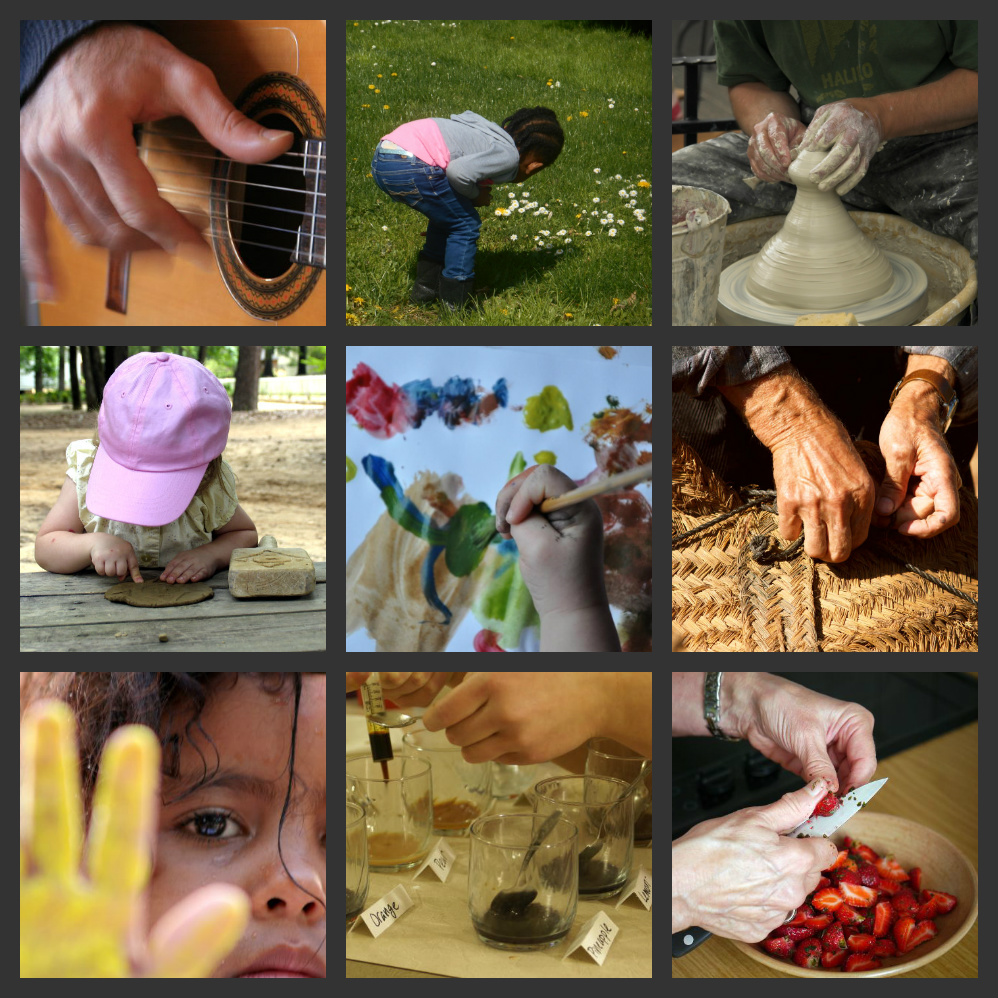
We now know babies as young as five months old show a strong understanding of certain mathematical principles. Their comprehension continues to advance almost entirely through hands-on experience. Math is implicit in play, music, art, dancing, make-believe, building and taking apart, cooking, and other everyday activities. Only after a child has a strong storehouse of direct experience, which includes the ability to visualize, can he or she readily grasp more abstract mathematical concepts. As Einstein said, “If I can’t picture it, I can’t understand it.”

As parents, we believe we’re providing a more direct route to success when we begin math (and other academic) instruction at a young age. Typically we do this with structured enrichment programs, educational iPad games, academic preschools, and other forms of adult-directed early education. Unfortunately we’re overlooking how children actually learn.

Real learning has to do with curiosity, exploration, and body-based activities. Recent studies with four-year-olds found, “Direct instruction really can limit young children’s learning.” Direct instruction also limits a child’s creativity, problem solving, and openness to ideas beyond the situation at hand. Studies show kids readily understand math when they develop a “number sense,” the ability to use numbers flexibly. This doesn’t come from memorization but instead from relaxed, enjoyable exploratory work with math concepts. In fact, math experts tell us methods such as flash cards, timed tests, and repetitive worksheets are not only unhelpful, but damaging. Teaching math in ways that are disconnected from a child’s life is like teaching music theory without letting them plunk piano keys, or instructing them in the principles of sketching without supplying paper or crayons. It simply makes no sense.

One study followed children from age three to age 10. The most statistically significant predictors of math achievement had very little to do with instruction. Instead the top factors were the mother’s own educational achievements and a high quality home learning environment. That sort of home environment included activities like being read to, going to the library, playing with numbers, painting and drawing, learning letters and numbers, singing and chanting rhymes. These positive effects were as significant for low-income children as they were for high income children.

There’s another key difference between kids who excel at math and kids who don’t. It’s not intelligence. Instead it’s related to what researcher Carol Dweck terms a growth-mindset. Dweck says we adopt certain self-perceptions early on. Some of us have a fixed mindset. We believe our intelligence is static. Successes confirm this belief in our inherent ability, mistakes threaten it. People with a fixed mindset may avoid challenges and reject higher goals for fear of disproving their inherent talent or intelligence.  People with a growth mindset, on the other hand, understand that intelligence and ability are built through practice. People with this outlook are more likely to embrace new challenges and recognize that mistakes provide valuable learning experience. (For more on this, read about the inverse power of praise.)

Rather than narrowing math education to equations on the board (or worksheet or computer screen) we can allow mathematics to stay as alive as it is when used in play, in work, in the excitement of exploration we call curiosity. Math happens as kids move, discuss, and yes, argue among themselves as they try to find the best way to construct a fort, set up a Rube Goldberg machine, keep score in a made-up game, divvy out equal portions of pizza, choreograph a comedy skit, map out a scavenger hunt, decide whose turn it is to walk the dog, or any number of other playful possibilities. These math-y experiences provide instant feedback. For example, it’s obvious cardboard tubes intended to make a racing chute for toy cars don’t fit together unless cut at corresponding angles. Think again, try again, and voila, it works!

As kids get more and more experience solving real world challenges, they not only begin to develop greater mathematical mastery, they’re also strengthening the ability to look at things from different angles, work collaboratively, apply logic, learn from mistakes, and think creatively. Hands-on math experience and an understanding of oneself as capable of finding answers— these are the portals to enjoying and understanding computational math.

Unfortunately we don’t have a big data pool of students who learn math without conventional instruction. This fosters circular reasoning. We assume structured math instruction is essential, the earlier the better, and if young people don’t master what’s taught exactly as it’s taught we conclude they need more math instruction. (“Insanity: doing the same thing over and over again and expecting different results.”)

But there are inspiring examples of students who aren’t formally instructed yet master the subject matter easily, naturally, when they’re ready.

1. The experiment done over 85 years ago by Louis Benezet showed how elementary school children can blossom when they’re free of structured math instruction.

2. Homeschooling and unschooling families around the world devote much less time to formal mathematics instruction. Studies indicate their children grow up to succeed in college, careers, and life with greater self-reliance and focus than their schooled peers. Interestingly, two different surveys of grown unschoolers showed that a much higher number of them work in STEM careers than schooled adults. The samples were small but intriguing. More proof? Many of our greatest science, technology, engineering, and mathematics contributors have already emerged from the homeschool community.

3. Democratic schools where children are free to spend their time as they choose without required classes, grades, or tests. As teacher Daniel Greenberg wrote in a chapter titled “And ‘Rithmetic” in his book Free at Last, a group of students at the Sudbury Valley School approached him saying they wanted to learn arithmetic. He tried to dissuade them, explaining that they’d need to meet twice a week for hour and a half each session, plus do homework. The students agreed. In the school library, Greenberg found a math book written in 1898 that was perfect in its simplicity. Memorization, exercises, and quizzes were not ordinarily part of the school day for these students, but they arrived on time, did their homework, and took part eagerly. Greenberg reflects, “In twenty weeks, after twenty contact hours, they had covered it all. Six year’s worth. Every one of them knew the material cold.” A week later he described what he regarded as a miracle to a friend, Alan White, who had worked as a math specialist in public schools. White wasn’t surprised. He said, “…everyone knows that the subject matter itself isn’t that hard. What’s hard, virtually impossible, is beating it into the heads of youngsters who hate every step. The only way we have a ghost of a chance is to hammer away at the stuff bit by bit every day for years. Even then it does not work. Most of the sixth graders are mathematical illiterates. Give me a kid who wants to learn the stuff—well, twenty hours or so makes sense.”

We know all too well that students can be educated for the test, yet not understand how to apply that information. They can recite multiplication tables without knowing when and how to use multiplication itself in the real world. Rote learning doesn’t build proficiency let alone nurture the sort of delight that lures students to higher, ever more abstract math.

Conventional math education may also limit our concept of what math can do. As Stanford mathematician Keith Devlin notes in a post titled “Most Math Problems Do Not Have a Unique Right Answer,”

One of the most widely held misconceptions about mathematics is that a math problem has a unique correct answer…

Having earned my living as a mathematician for over 40 years, I can assure you that the belief is false. In addition to my university research, I have done mathematical work for the U. S. Intelligence Community, the U.S. Army, private defense contractors, and a number of for-profit companies. In not one of those projects was I paid to find “the right answer.” No one thought for one moment that there could be such a thing.

So what is the origin of those false beliefs? It’s hardly a mystery. People form that misconception because of their experience at school. In school mathematics, students are only exposed to problems that (a) are well defined, (b) have a unique correct answer, and (c) whose answer can be obtained with a few lines of calculation.

Interestingly, people who rely on mental computation every day demonstrate the sort of adroitness that doesn’t fit into our models of math competence. In a New York Times article titled “Why Do Americans Stink at Math?” author Elizabeth Green (who defines the term “unschooled” as people who have little formal education) writes,

Observing workers at a Baltimore dairy factory in the ‘80s, the psychologist Sylvia Scribner noted that even basic tasks required an extensive amount of math. For instance, many of the workers charged with loading quarts and gallons of milk into crates had no more than a sixth-grade education. But they were able to do math, in order to assemble their loads efficiently, that was “equivalent to shifting between different base systems of numbers.” Throughout these mental calculations, errors were “virtually nonexistent.” And yet when these workers were out sick and the dairy’s better-educated office workers filled in for them, productivity declined.

The unschooled may have been more capable of complex math than people who were specifically taught it, but in the context of school, they were stymied by math they already knew. Studies of children in Brazil, who helped support their families by roaming the streets selling roasted peanuts and coconuts, showed that the children routinely solved complex problems in their heads to calculate a bill or make change. When cognitive scientists presented the children with the very same problem, however, this time with pen and paper, they stumbled. A 12-year-old boy who accurately computed the price of four coconuts at 35 cruzeiros each was later given the problem on paper. Incorrectly using the multiplication method he was taught in school, he came up with the wrong answer. Similarly, when Scribner gave her dairy workers tests using the language of math class, their scores averaged around 64 percent. The cognitive-science research suggested a startling cause of Americans’ innumeracy: school.

And Keith Devlin explains in The Math Gene that we’re schooled to express math in formal terms, but that’s not necessary for most of us—no matter what careers we choose. People who rely on mental math in their everyday lives are shown to have an accuracy rate around 98 percent, yet when they’re challenged to do the same math symbolically their performance is closer to 37 percent.

We have the idea that memorizing, practicing, and testing is the only way to higher achievement. It’s hard to imagine why we still believe that when studies show that high test scores in school don’t correlate with adult accomplishments (but do line up with interpersonal immaturity).

There are all sorts of ways to advance mathematical understanding. That includes, but isn’t limited to, traditional curricula. It’s time to broaden our approach. Let’s offer the next generation a more intrinsically fascinating, more applied relationship to math. Let’s foster analytical and critical thinking skills across all fields. The future is waiting.

This article is one in a series of three on natural math. 

Math Instruction versus Natural Math: Benezet’s Experiment. What happened when formal math instruction was eliminated? 

Natural Math: 100+ Activities and Resources. Finding and learning from math in daily life. 

Portions of this article are excerpted from Free Range Learning.

Understanding Children Through Imitation

follow your child's example, what it feels like to be a child, child's experience,

Mirror a child’s movements. (morguefile)

So much of a child’s experience, from infancy on, is constantly being shaped by adults. Their behavior, posture, movement, and sound are restricted by structured activities, confining seats, and grown-up expectations . If we allow ourselves, we can drop into a child’s world for few moments by replicating his or her movements. It’s a form of listening at the bodily level that can be instructive as well as enlightening.

I’ve admitted to trying this the very first time as a new mother, imitating my newborn’s movements in an experience so profound it felt like a ceremony.

I didn’t try it again until I was the mother of three kids under six. I’d dashed over to a friend’s house to drop something off, feeling rushed to get back to my nursing baby. My friend’s children weren’t home. I stood in her quiet kitchen telling her how much I wanted to sit down and chat, but couldn’t spare the time. She answered my complaint with mock outrage, “Don’t you dare relax! What were you thinking?”

In my best imitation toddler voice I said, “WANT TO!”

She wagged her finger. “That’s enough out of you. Do what you’re told right this minute.”

Then I dropped to the floor in a full-on act of defiance; lying on my back, kicking my legs, and squalling, “You can’t maaaaaake me!”

By this time our hilarity was well out of proportion to this brief moment of improv. When I got up I felt different—wonderfully de-stressed and energized.

I insisted my friend give it a try. She resisted, until I admonished her with the same phrases I’d heard her use on her kids. I even flung out her full name accompanied by finger wagging. That did it. She twirled around whining “Noooooo. No no no!” till she was out of breath, with hair in her mouth and a smile on her face.

We both agreed we felt incredible.

I don’t for a minute suggest you do this, ever, in front of any child. Self-expression should never be ridiculed. But if they’re not home, give it a try. What this did, for me as well as my friend, was let us fully express strong emotions through our bodies as our children do, as we used to do when we were children. We may have been well-educated, reasonably sophisticated women but the need to indulge in some primal venting hadn’t left us. A little method acting gave us both new insight into what our children experience.

After that, I looked for ways to learn from my children through imitation. We adults do this all the time when we play with our kids. We chase and let them chase us. When they pretend to be an animal or make-believe character we join in. We’re the big bad wolf blowing down a child’s fort made of cushions. We’re the sotto-voiced doll talking to another doll or the train engine struggling up an imaginary hill. Playing is a window into a child’s experience, and remarkably restorative for us as well.

But what truly let me honor my children’s world was letting them choreograph my movements. Sometimes we’d play what we called “mirror”— standard actor training done face to face. The child is the leader, the parent the “mirror.” As the child makes gestures, facial expressions, and hand movements the parent tries to duplicate the movements exactly. Then we ‘d switch so the child got a turn being the mirror. I always ended up laughing first.

Sometimes we played a variant of this, making each other into emotion mirrors. One would call out a feeling like “surprised” or “angry” or “wild” and the other would try to convey the word through facial expression. (This is also a great way to advance emotional intelligence.)

My favorite imitation was through dance. We’d turn on some lively music and I’d try to copy my child’s dance moves. This is much more difficult than it sounds. It’s nearly impossible to keep up with a child’s energy level for long!

My kids are past the stage where they want me to imitate their dance moves. But I haven’t forgotten how much letting my kids choreograph my movements taught me. Even now, they’ll catch my eye across a crowded room for a brief moment of mirroring. It’s funny, warm, and lets us both feel understood.

Don’t miss this wonderfully expressive choreography by Zaya, imitated by real dancers.

Why Learning Must Be Hands-On


hands-on learning, hands-on education, hand and brain connection, direct learning,

images: morguefile

Children are drawn to explore the world through their senses. (We all are, at any age.) When they are fully involved, what they learn is entwined with the experience itself. A child’s whole being strains against the limitations of curricula meant only for eyes and ears, or that assigns closed-ended tasks.

A typical school or school-at-home lesson intended to teach a child about worms may have diagrams of a worm’s body to label and a few paragraphs about the importance of worms, followed by comprehension questions. If the child musters up enthusiasm to learn more about worms despite this lackluster approach, there’s no time to do so because directly after the science lesson the child must go on to the next subject. When education is approached in this disconnected manner, the brain doesn’t process the information in long-term storage very effectively. It has no context in the child’s experience and no connection to the child’s senses.

On the other hand, a child encountering a worm while helping in the garden gains body memories to associate with the experience. The heft of a shovel, sun on her face, fragrant soil on her knees, and the feel of a worm in her hands provide her with sensory detail. She also encodes the experience with emotion. Her father likes to read books about soil health and sometimes she looks at the pictures. When she asks about worms he answers the few questions she has. And when she is satisfied he doesn’t go on to give her more information than she can handle. Next time they go to the library or get online they may decide to find out more about worms. She may be inspired on her own to draw worms, save worms from the sidewalk after the next rain, or otherwise expand on that moment in the garden. She is much more likely to retain and build on what she has learned.

The difference between these two approaches is worlds apart. Separating children from meaningful participation, as in the first example, doesn’t simply impair comprehension. It changes the way learning takes place. The child is made a passive recipient of education designed by others. Then the excitement of learning is transformed into a duty.

Education that treats the brain apart from the body will ultimately fail. Our senses cannot be denied. They inform the mind and encode memory. We must see, hear, smell, touch and, yes, taste to form the kinds of complex associations that make up true understanding. We humans are direct hands-on learners.

Brain development and hand use are inextricably intertwined. When neurologist Frank R. Wilson interviewed high achievers to understand this connection, he found that people credit their success to attributes learned through hands-on activities.  In The Hand: How Its Use Shapes the Brain, Language, and Human Culture Wilson writes:

I was completely unprepared for the frequency with which I heard the people whom I interviewed either dismiss or actively denounce the time they had spent in school. Most of my interview subjects, although I never asked them directly, said quite forcefully that they had clarified their own thinking and their lives as a result of what they were doing with their hands. Not only were most of them essentially self-taught, but a few had engineered their personally unique repertoire of skills and expertise in open retreat from painful experiences in a school system that had dictated the form and content of their education in order to prepare them for a life modeled on conventional norms of success.

Hands-on experience makes learning come alive. For example, principles of geometry and physics become apparent while children work together figuring out how to stack firewood. They develop multiple layers of competence as they solve tangible problems. Their bodies are flooded with sensation, locking learning into memory. Such experiences develop a stronger foundation for working with abstract postulates, theorems, and formulas later on. (Household responsibilities are actually a vital way to incorporate more hands-on experience, with amazing long-term benefits.)

When we’re engaged hands-on something greater can come into being. We gain a sense of effortlessness, of becoming one with the movement. Then it seems we’re longer working with things, but with material partners in a process of co-creation. Work and play are one, we are whole within it.

direct learning, hands-on learning, hand and brain connection,

image: morguefile

Portions of this article excerpted from Free Range Learning.
 

Free Range Chickens & Free Range Learning

free range learning, captive kids, natural learning, confined chickens,

“Don’t help, Mom,” Claire says as I go to pick up the three-day-old chick. So I watch instead. It’s peeping helplessly at the side of the ramp leading up to the chicken coop. The mother hen and her other chicks are already at the top but this chick can’t find the way. The hen answers each of its cheeps of distress with distinctive low clucks. After repeated attempts to hop directly up to its mother the chick turns and scurries back, finds the bottom of the ramp, and hurries to the comfort of her waiting wings.

“See?” Claire says. “It’s already learning.”

I’m amazed that a chick that tiny could learn to go away from the sound of its mother’s voice in order to find her, but it did. I guess I still need to trust that things tend to work out fine without well-intended intervention.

Reams of instructional books once languished on our shelves. Shiny packaged educational programs with CDs sat waiting for my children to learn foreign language, history, and math. But they always had better things to do. Sometimes that looked a lot like reading a book on the couch, looking things up on the net, or lying by the pond with the dogs. Other times that looked like gathering oddities from the dusty basement for an experiment. Or like all of us hustling off to a field trip with friends. The textbooks came in handy as references; the fussier educational materials were packed away in boxes to pass along. We knew another new homeschooler would need to go through the same ritual of grumbling over them.

My children have ample opportunities to explore their interests out here in the country. Currently Ben restores old farm equipment in anticipation of running his own farm some day. He’s so busy that some of his projects have become long-term decor out near the beehives. Flowering vines decorate hay rake tines and birds nest atop a combine. Right now he’s making a custom desk out of a circular saw blade for a friend. The garage glows as he welds, one of the many skills he taught himself.

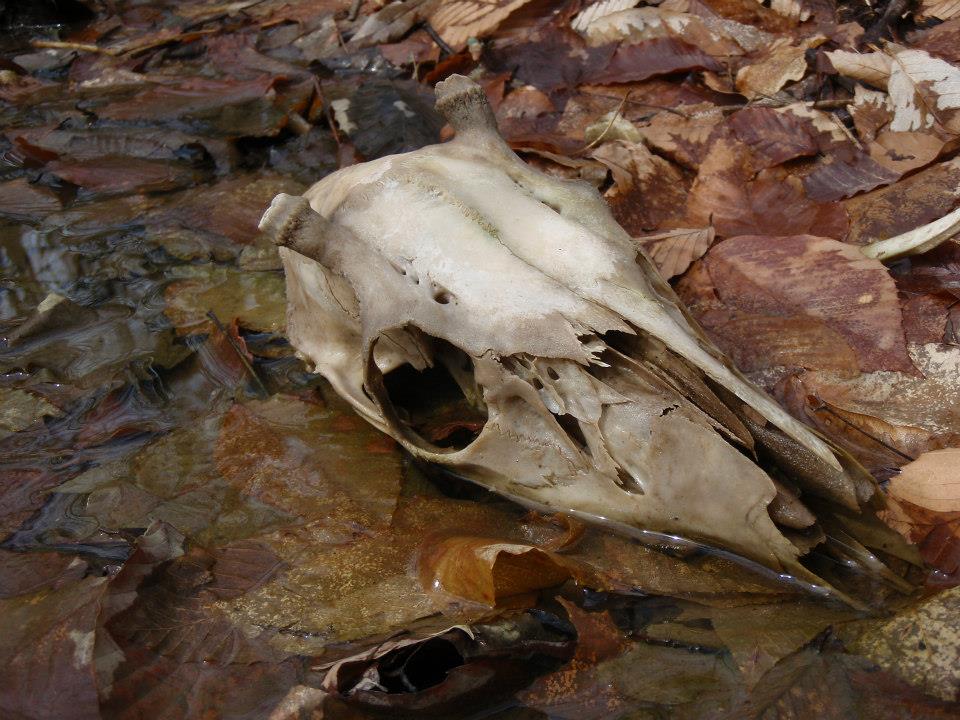
Claire observes everything with a scientist’s eye. She journals about her hikes in the woods, her daily farm chores, and her volunteer work rehabilitating birds of prey. One summer she made a practice of examining a dead muskrat as the decomposition process reduced it to a skeleton. Her descriptions of it (yes, at the dinner table) clearly demonstrated how wondrous she found the natural world, even though her age group is depicted as finding more meaning at the shopping mall.

When Kirby isn’t playing his guitar or bagpipes or computer games, he likes to stroll around with a camera. His photos show that he sees things in a different light. He’s interested in the science and art of sound, and using the money he earned from cleaning stalls at local horse farms he’s made his bedroom into a recording studio. Friends come to record their music. He can edit out the laughter.

Sam, who was once the master of finding snakes and toads everywhere on our property, is now intrigued with greater feats than grabbing hapless creatures. He investigates the engineering behind propulsion systems and then conducts his own experiments. This involves shooting tennis balls, potatoes, or pumpkins long distances (often in collusion with his brothers). He’s been talking about designing advanced fuel systems for cars. And he’s started restoring a vintage Opel he bought with his own savings although he’s not old enough to drive.

While Claire and I watch chickens, she points out how the newly hatched chicks are perfectly suited to learn naturally. Days old, these tiny fluff balls listen and respond to different sounds from their mother which clearly tell them where to find food and when to run for cover under her wings. They range across our property while staying close to their mother. They locate each other through the underbrush, ramble into the pasture under the cow’s feet safely, and come into the coop at dusk as the older chickens do.

“Compare them to chicks we bought from the hatchery,” Claire says.

I see what she means.

Many times we have purchased a batch of day-old chicks and kept them in a large indoor pen. We brought them out of the house each day to a grassy enclosure so they could forage, but the chicks raised for their first two months with their age-mates were very different from the chicks hatched by their mothers and raised with the flock. The confined chicks were more sickly, panicked easily, and were more overtly aggressive or passive. Even after they were released out with the flock it took them quite a while to catch up. They didn’t problem-solve as easily. And it took them longer to react naturally, such as taking flight and roosting in low branches when sensing danger. Overall they were less likely to survive.

Interestingly, agricultural extension offices and poultry manuals insist that the treatment we’ve given the confined chicks is the only correct way. Their expert advice includes maintaining them on a diet of protein-enhanced feed, keeping them under warming lights, and watching over them carefully for their own good. Not being hatched by and raised by a hen.

Aside from small family farms like ours there are few chickens living in natural conditions—roaming freely in pastures and woods without fences, choosing their own food and affiliation groups, living with mixed age flock. (Right now we have 30 laying hens, five  roosters, three chicks, a few geriatric hens.) Even chickens described as “free range” are left inside with a small door open to a cramped outdoor pen to meet that definition. This door can be a single opening inaccessible to the hundreds of chickens in the flock.

Claire, who has experienced both schooling and homeschooling, can’t help but see a comparison. “Doesn’t that remind you of how people treat children? Experts supposedly know what’s right for them. I mean, how can anyone learn if they’re stuck in the same situation all the time? You learn as things come up.”

Confinement education, especially when based on tactics that feel like coercion to students, isn’t a whole education. Children thrive as free-range learners. They want to be a meaningful part of family and community, aware of their place as both givers and receivers. They’re cued to advance the growth of their minds, bodies, and spirits in ways unique to them. Their curiosity prompts them to explore and challenge themselves, gradually integrating what they’ve learned to advance their own possibilities. Although there are worlds of difference between raising children and raising chickens, we can trust that learning freely comes naturally to them both.

free range kids, free range learning,

Image: superfry

This is a throwback post, originally published in Home Education Magazine

Recognizing Each Child’s Particular Genius


Free Range Learning, children's gifts,

A child’s gifts can be difficult to recognize, perhaps because they tend to unfold in mysterious ways. What we might consider idiosyncrasies or problems may very well indicate a child’s strengths. Oftentimes we can’t see the whole picture until long after the child has grown into adulthood. It’s worth remembering we can’t easily see our own gifts either, even though they have whispered to us of destiny or wounded us where they were denied.

A little girl creates chaos with her toys. She won’t put blocks away with other blocks nor put socks in her dresser drawer. As a preschooler she creates groupings that go together with logic only she understands. One such collection is made up of red blocks, a striped sock, spoons, and marbles. She sings to herself while she rearranges these items over and over. The girl is punished when she refuses to put her puzzles away in the correct box or her tea set dishes back together. She continues making and playing with these strangely ordered sets but hides them to avoid getting in trouble. This phase passes when she is about nine years old. Now an adult, she is conducting post-doctoral studies relating to string theory. She explains her work as a physicist has to do with finding common equations among disparate natural forces.

A young boy’s high energy frustrates his parents. As a preschooler he climbs on furniture and curtain rods, even repeatedly tries to scale the kitchen cabinets. When he becomes a preteen he breaks his collarbone skateboarding. He is caught shoplifting at 13. His parents are frightened when he says he “only feels alive on the edge.” Around the age of 15 he becomes fascinated with rock-climbing. His fellow climbers, mostly in their 20’s, also love the adrenaline rush that comes from adventure sports but help him gain perspective about his responsibility to himself and other climbers. His ability to focus on the cliff face boosts his confidence on the ground. At 19 he is already certified as a mountain search and rescue volunteer. He is thinking of going to school to become an emergency medical technician.

James Hillman explains in his book, The Soul’s Code,

I want us to envision that what children go through has to do with finding a place in the world for their specific calling. They are trying to live two lives at once, the one they were born with and the one of the place and among the people they were born into. The entire image of a destiny is packed into a tiny acorn, the seed of a huge oak on small shoulders. And its call rings loud and persistent and is as demanding as any scolding voice from the surroundings. The call shows in the tantrums and obstinacies, in the shyness and retreats, that seem to set the child against our world but that may be protections of the world it comes with and comes from.

Yehudi Menuhin, one of the preeminent violinists of the 20th century, became fascinated when he heard classical music on the radio as a three year old. He wanted to feel the same rich notes coming out of a violin in his hands. His parents lovingly presented him with a toy fiddle. He drew the bow across the strings and was horrified at the cheap squawk the toy made. Enraged, he threw the instrument across the room and broke it. His imagination had already taken him to the place in himself where beautiful music was made and he was unable to bear that awful sound. We normally call that behavior a “tantrum.”

Then there’s R. Buckminster Fuller, whose young adult years were marked with struggle. As a college student he hired an entire dance troupe to entertain a party, and in that one night of excess he squandered all the tuition money his family saved to send him to school. In his 20’s he was a mechanic, meat-packer, and Navy commander before starting a business that left him bankrupt. After his daughter died of polio he began drinking heavily. By conventional wisdom he’d be considered a total failure at this point. But while contemplating suicide, Fuller decided instead to live his life as an experiment to find out if one penniless individual could benefit humanity. He called himself Guinea Pig B. Without credentials or training Fuller worked as an engineer and architect, inventing such designs as the geodesic dome and advancing the concept of sustainable development. He wrote more than 30 books and registered dozens of patents. Fuller once said, “Everybody is born a genius. Society de-geniuses them.”

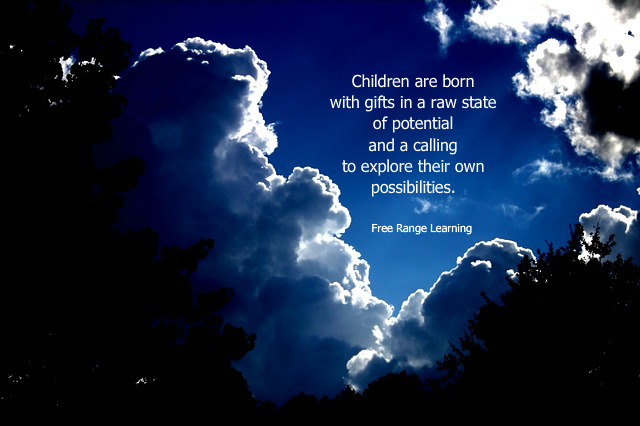
Few young people have clear indications of their gifts. Most have multiple abilities. A single true calling is rarely anyone’s lot in life as it is for a legendary artist or inventor. Instead, a mix of ready potential waits, offering a life of balance among many options. When we emphasize a child’s particular strengths we help that child to flourish, no matter if those gifts fall within mainstream academic subjects or broader personal capacities. Traits such as a highly developed sense of justice, a way with animals, a love of organization, a contemplative nature, the knack for getting others to cooperate—-these are of inestimable value, far more important skills than good grades on a spelling test.

Free Range Learning, all kids geniuses,

Although society confuses genius with IQ scores, such scores don’t determine what an individual will do with his or her intelligence. In fact, studies have shown that specific personality traits are better predictors of success than I.Q. scores. Genius has more to do with using one’s gifts. In Roman mythology each man was seen as having a genius within (and each woman its corollary, a juno) which functioned like a guardian of intellectual powers or ancestral talent.

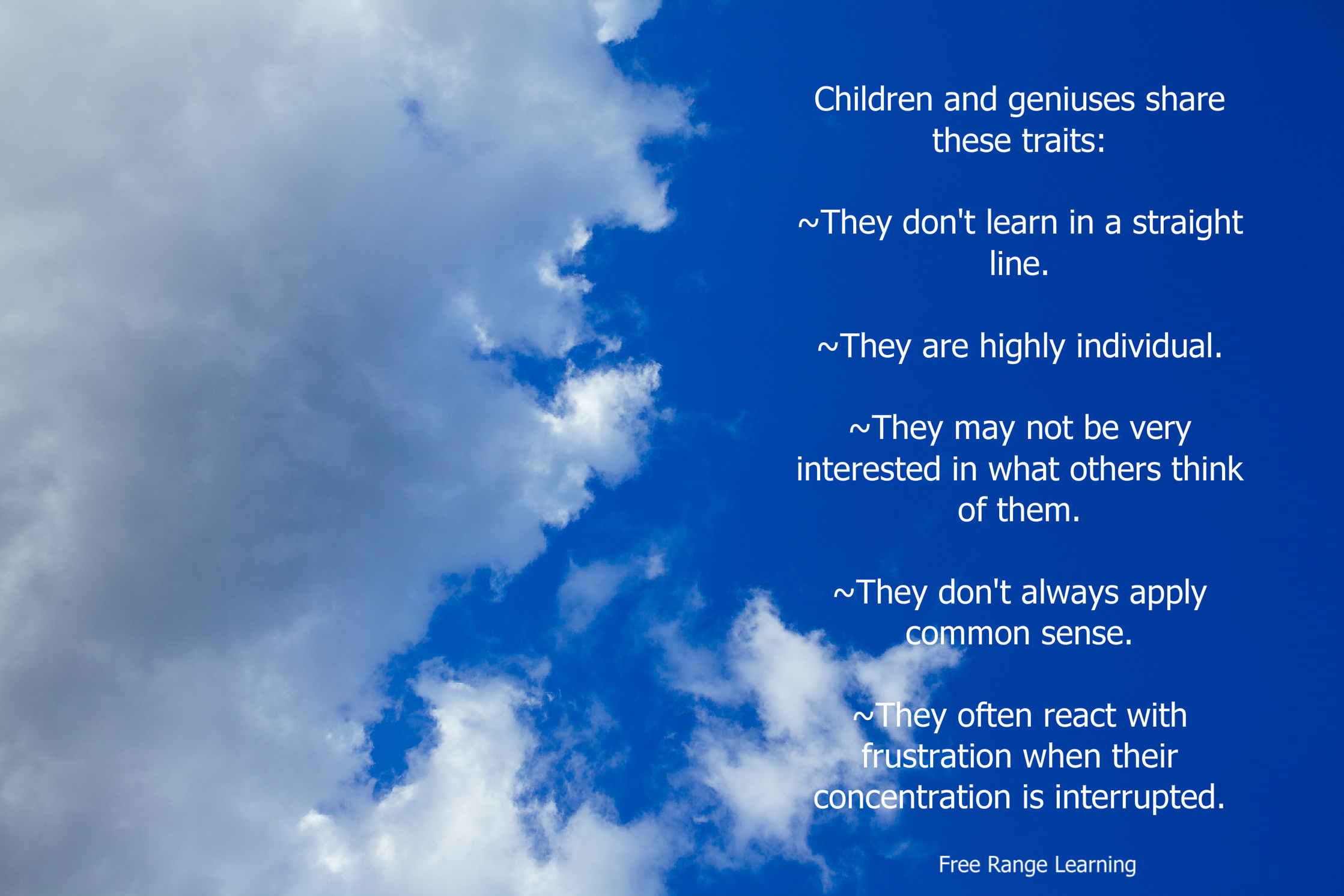
What today’s innovators bring to any discipline, whether history or art or technology, is a sort of persistent childlike wonder. They are able to see with fresh eyes. They can’t be dissuaded from what they want to do and often what they do is highly original. Sometimes these people have a difficult personal journey before using their gifts. Their paths are not easy or risk-free, but the lessons learned from making mistakes can lead to strength of character.

We must leave ample space for these gifts to unfold. This takes time and understanding. The alternative deprives not only the child, it also deprives our world of what that child might become.

Acknowledging that each person is born with innate abilities waiting to manifest doesn’t imply our children are destined for greatness in the popular sense of power or wealth. It means that children are cued to develop their own personal greatness. This unfolding is a lifelong process for each of us as we work toward our capabilities for fulfillment, joy, health, meaning, and that intangible sense of well-being that comes of using one’s gifts.


This article is an excerpt from the book Free Range Learning. It was also published in Life Learning Magazine

Five Ways to Transcend the School Mindset

child

School-like instruction has been around less than a fraction of one percent of the time we humans have been on earth. Yet humanity has thrived. That’s because we’re all born to be free range learners. We are born motivated to explore, play, emulate role models, challenge ourselves, make mistakes and try again—continually gaining mastery. That’s how everyone learns to walk and talk. That’s how young people have become capable adults throughout history. And that’s how we have advanced the arts, sciences, and technology. In the long view, school is the experiment.

But it’s hard to see beyond the school mindset because most of us went to school in our formative years. So when we think of education, we tend to view school as the standard even if we simultaneously realize that many parts of that model (found also in daycare, preschool, kids’ clubs, and enrichment programs) aren’t necessarily beneficial. Narrowing the innate way we learn can interfere with the full development of our gifts.

Here are five ways to get past the school mindset.

build divergent thinking, creative children, more imagination, creativity builds leaders, nurture divergent thinking,

Welcome divergent thinking

In today’s test-heavy schools the emphasis is on coming up with the correct answer, but we know that the effort to avoid making mistakes steers children away from naturally innovative perspectives. Divergent thinking generates ideas. It’s associated with people who are persistent, curious, and nonconforming. Research going back to the 1970’s shows that this generation of children are less imaginative and less able to produce original ideas. An extra whammy may very well be coming from increased participation in organized sports: more than a few hours a week appears to lower a child’s creativity.

This is dire news, because creativity is actually much more closely linked to adult accomplishment than IQ. In fact, 1,500 CEO’s listed creativity as the leading indicator of “leadership competency.

We don’t have to instruct kids in divergent thinking, just nurture it. Children are naturally inclined to question and explore. Remain open to their enthusiasms, encourage them to identify and solve problems no matter how unusual, and welcome the learning power of mistakes.

exercise and learning, overtaxed impulse control, full body learning, sensory education,

Value full body learning

School-like learning emphasizes the brain over the body. It narrows from there, emphasizing one hemisphere of the brain over the other with its focuses on left-brain analytical thinking. But children don’t learn easily when they spend so much time sitting still, eyes focused on a teacher or lesson or screen, their curiosity silenced and their movements limited. Children ache for more active involvement.

Research shows us that the rules necessary to keep a classroom full of kids in order all day, like being quiet and sitting still, can overtax a child’s ability to resist other impulses. The mismatch between school-like expectations and normal childhood development has resulted in millions of children being diagnosed with ADHD. (One of those kids was my third child, whose “symptoms” disappeared once we took him out of school and figured out how to homeschool such an active child.) 

What we need to remember is that the mind and body are exquisitely tuned to work together. Movement allows sensory input to stimulate the brain as it absorbs a flood of information. This is the way the brain builds new neural pathways, locking learning into memory. (Check out A Moving Child Is a Learning Child by Gill Connell and Cheryl McCarthy, Balanced and Barefoot by Angela Hanscom, as well as Spark by John J. Ratey for more on this.) Active, talkative, curious children aren’t “bad.” They’re normal.

If we look at movement we realize that even a very brain-y activity, reading, has to do with the body. Young children develop reading readiness in a variety of ways, including conversation and being read to, but also through physical activities that help their neurological pathways mature. These are activities children will do whenever given the opportunity, like swinging, skipping, climbing, walking, and swimming.

All the relentless activity of early childhood may very well be a sort of intrinsic wisdom built into them, because movement is key to keeping an active brain. Children who are more physically active actually increase the areas of their brains necessary for learning and memory. That doesn’t mean the antidote to the school mindset is a constant frenzy of activity. It does mean that children tend to self-regulate within loving safeguards. Every child needs to balance physical activity with other essentials like snuggling, daydreaming, and sufficient sleep. We simply need to remember that movement isn’t an enemy of education.

goldilocks effect, individualized education,

Build on the “Goldilocks effect”

This term came from researchers who demonstrate that we are cued to ignore information that’s too simple or too complex. Instead we’re drawn to and best able learn from situations that are “just right.” Sort of like the educational equivalent of Goldilocks on a porridge-testing quest.

The Goldilocks effect means you are attracted to what holds just the right amount of challenge for you right now.  Usually that means something that sparks your interest and holds it close to the edge of your abilities, encouraging you to push yourself to greater mastery. That’s the principle used to hold a player’s attention in video games. That’s what inspires artists, musicians, and athletes to ever greater accomplishments. That’s how kids who follow a passion of their own tend to learn and retain more than any prepared lesson could teach them.

Our kids tell what they’re ready to learn. They tell us through what bores them and fascinates them, what they’re drawn to and what they resist. They’re telling us that, until they’re ready, learning doesn’t stick.

 too much adult-run learning, stubborn kids, child-led learning, natural learning,

Diminish the focus on instruction

The school mindset leads us to believe that children benefit from lessons, the newest educational toys and electronics, coached sports at an early age, and other adult-designed, adult-led endeavors. Well-intentioned parents work hard to provide their children with these pricey advantages. We do this because we believe that learning flows from instruction. By that logic the more avenues of adult-directed learning, the more kids will benefit. But there’s very limited evidence that all this effort, time, and money results in learning of any real value. In fact, it appears too many structured activities diminish a child’s ability to set and reach goals independently. 

When we interfere too much with natural learning, children show us with stubbornness or disinterest that real education has very little to do with instruction. Learning has much more to do with curiosity, exploration, problem solving, and innovation. For example, if baby encounters a toy she’s never seen before, she will investigate to figure out the best way or a number of different ways to use it. That is, unless an adult demonstrates how to use it. Then all those other potential avenues tend to close and the baby is less likely to find multiple creative ways to use that toy.

Studies show that “helpful” adults providing direct instruction actually impede a child’s innate drive to creatively solve problems. This experience is repeated thousands of times a year in a child’s life, teaching her to look to authorities for solutions, and is known to shape more linear, less creative thinking.

This isn’t to say that all instruction is bad, by any means. It does mean that six long hours of school-based instruction plus afterschool adult-organized activities in sports or recreation or screen time supplants the kind of direct, open-ended, hands-on activity that’s more closely associated with learning. Most of the time this kind of learning is called play.

free play benefits, play versus learning, chores, self-regulation,

Recognize free play is learning 

Before a young child enters any form of schooling, his approach to as much of life as possible is playful. A walk is play, looking at a bug is play, listening to books being read is play, helping with chores is play. The school mindset separates what is deemed “educational” from the rest of a child’s experience. It leads us to believe that learning is specific, measurable, and best managed by experts.

A divide appears where before there was a seamless whole. Playful absorption in any activity is on one side in opposition to work and learning on another. This sets the inherent joy and meaning in all these things adrift. The energy that formerly prompted a child to explore, ask questions, and eagerly leap ahead becomes a social liability in school. But play is essential for kids, for teens, for all of us. (For more check out these two marvelous and very different books: Free to Learn by Peter Gray and A Playful Path by Bernie DeKoven.)

Free play promotes self-regulation and this is a biggie. It means the ability to control behavior, resist impulse, and exert self-control  —all critical factors in maturity. Play fosters learning in realms such as language, social skills, and spatial relations. It teaches a child to adapt, innovate, handle stress, and think independently. Even attention span increases in direct correlation to play.

That doesn’t mean a child’s entire day must be devoted to free play. There’s also a great deal to be learned from meaningful involvement in household responsibilities as well as community service.

why homeschool, democratic schools, raise successful children,

I want to nurture my children in such a way that they define success on their own terms. I hope that means they craft a life based on integrity, one that brings their unique gifts to the world. Homeschooling, for my family, gives us the freedom to go beyond narrow roads to success. (Democratic schools can also provide that freedom.) This is the way young people have learned throughout time. I’ve come to trust the way it works for my family.

Portions of this post excerpted from Free Range Learning.

Getting Science On Everything

raising scientists, toddler science, teen science, unschooling science, supporting kids' curiosity, science at home, science happens naturally,

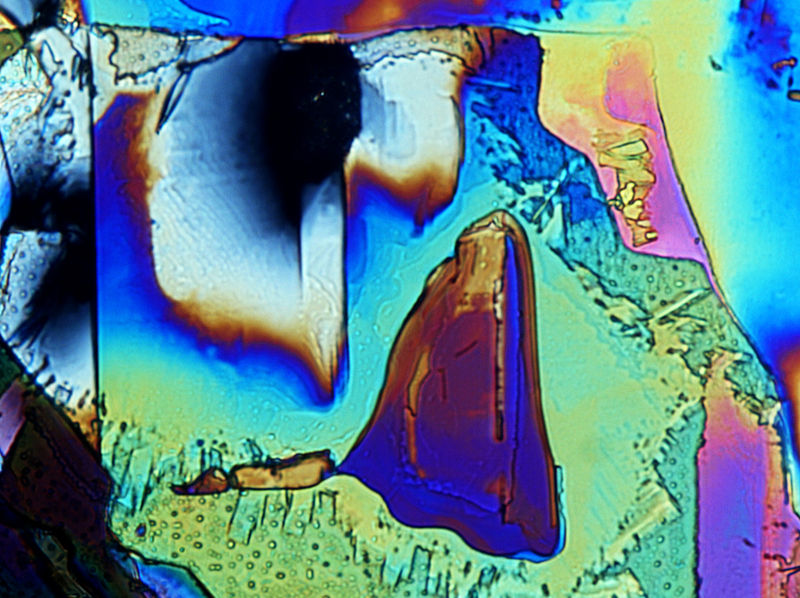
crystals of vitamin B6 ( CC by 3.0 Josef Reischig)

 We spread thick layers of science on everything at our house. Yes, occasionally it smells.

Sometimes our science-y obsessions are entirely nonsense, such as a typical dinner table conversation about how many citrus batteries it might take to start a car. Ideas were proposed for this never-to-occur project, including the use of lemon juice instead of whole fruit.

Sometimes that science is pseudo-educational, such as the time we swabbed between our toes and let the bacteria grow in petri dishes. The “winner’s” dish had such virulent growth that she felt sure it deserved to live. She gave it a name and tried feeding it extra glucose and agar. It quite effectively kept her siblings out of her room. I insisted she throw it away when it began creeping past the lid. I am still blamed for the demise of this biological fright.

encouraging young scientists, love of science starts early,

Sometimes it goes on and on. My offspring seem driven to find out. They can’t spot a spider without observing it, wanting to identify it, and then going on about the hydraulic features that are basic arachnid operating equipment. Then there was a certain months-long project that involved observing and sketching the decomposition of a muskrat. They have to discuss all possible angles of a problem, often in such depth that my far more superficial mind drifts off. They tend to walk into a room announcing odd factoids which invariably leads to strange conversations about recently de-classified Russian research, turbo charged engines, or riparian ecology. Or all three. They insist I look at video clips that go on much longer than my attention span. Woe to me if I question a postulate put forth by one of my kids. They will entertain my doubts playfully, as a cat toys with a mouse, then bombard me with facts proving their points. Lots of facts. I’ve tried to uphold my side in science disputes but it’s like using a spork to battle a light saber.

making math relevant, raising young scientists,

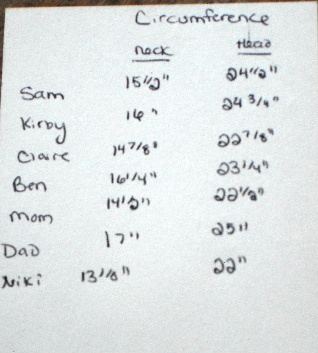
Other family homes probably have video game controllers. Our house has stacks of books and periodicals (who took the neutrino issue of New Scientist, someone yells); tubs overflowing with one son’s beakers, tubing, and flasks; culturing products in the kitchen (like the jar with a note that says “Leave me alone, I am becoming sauerkraut”); and random sounds of saws, welders, and air compressors as something entirely uncommon is being constructed or deconstructed. I know other families have nice normal pictures on their refrigerators. Ours tends to post odd information. The longest-running fridge feature here is a card listing the head circumference of every person in the family. By the time the youngest was 11, my head was the smallest.

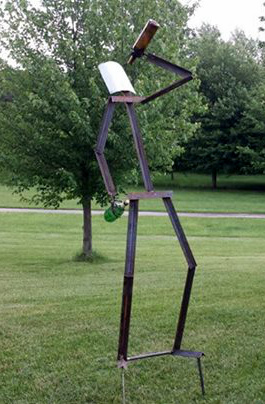
And then there’s the front yard. By the garage door a headstone leans. It has nothing to do with Halloween. Our youngest is teaching himself stone carving using hand tools. This stemmed from his interest in ancient Norse language and myth and lifestyles. That led to a study of runes, leading to old runic carvings, well, you get the idea. He’s already carved runes in a few stones. So of course his brother got him a headstone as a birthday gift. Entirely natural. Also in the yard, a giant sculpture another son welded out of scrap metal. He’s never taken a welding course, or an art course for that matter. No problem. He measured his own limbs to translate into the correct human form. He thought it was funny to make it a two-fisted drinker. I’m plotting to put a trumpet in one of the metal man’s hands so it looks like a rowdy jazz player. And recently my daughter spent the afternoon in front of the house cleaning an entire deer skeleton she found in our woods. She was entirely happy identifying bones, scrubbing, and assembling it into the likeness of a very hungry  deer. Maybe our front yard is why our mail carrier seems a little wary.

raising scientists, natural curiosity makes scientists,

Science shouldn’t be confined to a formal study. My husband and I have never worked in science fields. But we’ve found that keeping scientific curiosity alive isn’t hard.  It’s about an attitude of “yes.” Projects that are messy, time-consuming, and have uncertain outcomes are a form of experimentation. They are real science in action. When a kid wants to know, they want to find out. Not later, not next week, right away. Finding out is engaging. It leads to ever widening curiosity. In our family this process of discovery-to-mastery started early.

When my oldest was just a baby he was horrified by vacuums. Even the sight of one made him scream with This Will Kill Me volume. So we let him learn he could control the “off” and “on” switch. His horror turned to fascination, leading him toward ever greater curiosity, heading in all sorts of directions.

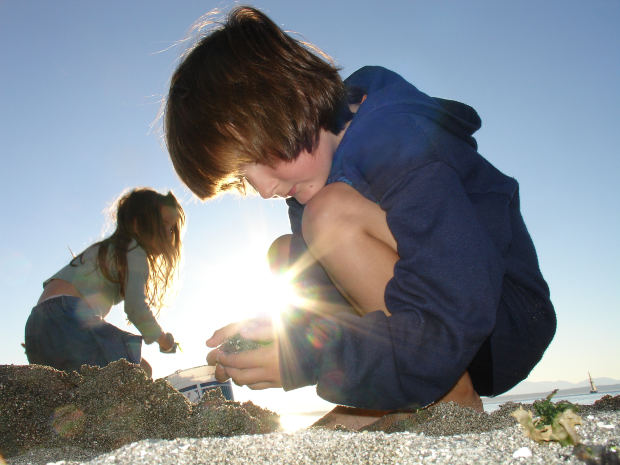
When my daughter was barely able to walk, around 11 months old, she was fascinated by the stones at the end of our driveway. Day after day she wanted to toddle close to the street just to pick up those stones. It occurred to me that it would be a lot easier to satisfy her curiosity than to keep saying no and turning her back toward the house. So she and I went there together and sat in those stones. She was enthralled. I marveled at all the different ways she chose to experience them. Holding, dropping, picking up one at a time then picking up handfuls, handing them to me and taking them back, rubbing the smooth ones and, once I showed her, holding them up to the light. Sometimes she’d raise a stone to her mouth, then shake her head, reminding herself that stones weren’t for eating. Once or twice a stone did touch her lips. The result? I told her we were all done, picked her up, and went back to the safety of the lawn near the house. She remembered. I let her investigate stones day after day until she was done, her desire to know satisfied.

When one of my boys was three he was entranced by the lighters and matches his grandmother used to light her cigarettes. Since she lived with us and on occasion unintentionally left those fire generating devices out, his intense curiosity concerned me. He knew that children shouldn’t touch anything that makes fire, but he was so intensely curious and active (I’ve already described his chimpanzee-like abilities as a toddler) that I knew it was a matter of time before her forgetfulness might collide with his need for some hands-on experience. So, explaining this was only okay to do with an adult, I stood him on a stool at a sink full of water, letting him light match after match to drop in the water. He was a little afraid. His fingers were almost singed a few times. He also conquered the fascination with flame that compelled him to disobey. He asked a few times over a period of months to do this again. Then he was done. Warming about danger doesn’t have the same effect as a child getting close enough to know that matches do burn but can be conquered in the presence of a parent.

Some experiments shouldn’t have happened.  One of my little boys quietly carved a small hole in the drywall of his closet, then attempted to spackle it with the unlikely combination of toothpaste covered by an ostrich feather he’d saved from a field trip. We didn’t discover it until we were emptying that closet as he packed for college. We still laugh about that one.

My kids are much more science-savvy than I’ll ever be, but more importantly, they’re capable of discovering anything they want to know.

Educating Too Early

A1

My daughter started preschool a month before she turned three. She was too young. The facility was wonderful, the teachers kind, the activities entirely age-appropriate but she resisted the structure. It didn’t make sense to her that she was asked to learn color words she already knew. Or that she had to perform with her classmates at the annual holiday show after she’d already practiced the song and movement pieces well beyond her boredom tolerance. She did what she was told but she wasn’t happy.

I know why I was eager for her to start. Pregnant with her brother, I felt nauseated all the time and hoped preschool would feed her active mind. Or perhaps because she had been chronically ill nearly all of her first three years. Now she was finally better and I suspect, unconsciously, I signed her up to assure myself she was as healthy as any other little girl.

When I talked with her teachers about my child’s frustrations they emphasized how important it was to follow rules, even if she didn’t see the logic herself, because it prepared her to conform to many more rules in “real” school. That didn’t make sense to me either and we finally pulled her out of preschool.

Once she was a preschool dropout we went back to our ordinary, richly educational lives of chores and play. We played outside, hiked in the woods, made up songs, went to the library, visited friends and family, took trips to museums, snuggled, and read. She filled her free time with make-believe play as well as hours of drawing while listening to story tapes. If I had to do it over again, I’d have skipped preschool entirely. I’m not against the concept, just troubled by how much emphasis is placed on adult-led educational structure.

Take a look at promotional material for preschools in your area. Chances are they tout early math, pre-reading, and other academics. This approach sells.  Most people I know sign their children up at the age of two or three to attend specialized enrichment programs that claim to boost abilities in science, art, sports, music, or language. In addition, nearly everyone I know is sure their children benefit from a few hours each day using electronics that “teach.”

a1 (6)

Well-intentioned parents operate on a mindset that’s hard to dismiss in today’s society. They are convinced that learning flows from instruction. Logically then, early instruction will help maximize their child’s potential. But learning in young children (and perhaps at all ages) has much more to do with curiosity, exploration, and body-based activities. It has very little to do with structured activities, which may actually impair a child’s ability to set and reach goals independently.

Studies with four-year-olds show that, “Direct instruction really can limit young children’s learning.” Direct instruction also limits a child’s creativity, problem solving, and openness to ideas beyond the situation at hand. This is true when the instruction comes from parents as well as teachers.

As Wendy S. Grolnick explains in The Psychology of Parental Control: How Well-meant Parenting Backfires, research shows that rewards, praise, and evaluative comments actually undermine motivation and stifle learning in preschoolers as well as school-aged children. This is true when those actions come from parents or teachers.

Highly instructional preschool programs have been studied for years. Although they’re more popular than ever, the outcomes don’t hold up under scrutiny. 

a (1) (2)

Researcher Rebecca Marcon evaluated children in preschool and kindergarten programs falling within three categories: play based, academically oriented, and those that combined both approaches. Her study checked up on these students as they progressed through primary school. Students who had been in early academically oriented programs gradually declined, falling behind their peers. Children who’d been in a combined approach program also showed achievement gaps. Who benefited the most? Children who’d been in play-based programs. Their academic success was greater than those in the other two types of programs and continued to gain. Marcon concluded,

Children’s later school success appears to be enhanced by more active, child-initiated learning experiences. Their long-term progress may be slowed by overly academic preschool experiences that introduce formalized learning experiences too early for most children’s developmental status. Pushing children too soon may actually backfire when children move into the later elementary school grades and are required to think more independently and take on greater responsibility for their own learning process.

Another study confirmed that future success has to do with the kinds of abilities gained  through child-initiated, exploratory play. Compared to children in non-play-based preschool programs, the play-based group of children exhibited greater self-control, working memory, flexible thinking, and relational ability. These traits have more to do with academic success than testable abilities in math and reading, even more than IQ.

And when researchers  in the High/Scope study followed high-risk children who attended different preschool environments they found even more resounding results.  Some children were enrolled in an academic setting, others in a child-initiated play setting, and a third group in a preschool that balanced both approaches. By the middle grades, children from the play-oriented preschool were receiving the highest grades. They also showed the most social and emotional maturity.  Those who had attended the academic preschool lagged behind in a significant way— poorer social skills. The differences became more apparent as these children got older. By age fifteen, students from the academic preschool program showed twice as much delinquent activity as the other two groups. And in adulthood, former students of the play preschool and balanced preschool showed higher levels of success across a whole spectrum of variables. The academic group did not attain the same level of education as the play group and required more years of treatment for emotional impairment. They also faced more felony arrests than the other two groups.

And now a resounding new study (2022) is out. It followed children across Tennessee who had attended high quality pre-K programs staffed by teachers with bachelor’s degrees as well as early childhood certification, using the best available curriculum. These children were matched with those who did not attend such a program. The academic group initially performed better than the control group at kindergarten age, but by third grade they fell behind the control group in school. They were also more likely to be disciplined and to have a diagnosed learning disorder. By sixth grade the academic group was even more likely to have a diagnosed learning disorder and were also much more likely to have exhibited violent behavior at school.

a2

Today’s test heavy schools are burdening five-year-olds with a heavy load of academics. In 1998, 31 percent of kindergarten teachers studied believed students should learn to read in kindergarten. By 2010 that number had jumped to 80 percent. Play time, the arts, and recess had decreased in favor of worksheet and computer instruction. The study‘s co-author Daphna Bassok said, “We were surprised to see just how drastic the changes have been over a short period of time/ We expected to see changes on some of these dimensions but not nearly so systematically and not nearly of this magnitude.“

We know that free play, now so limited in the lives of most children, is actually essential for learning and character development. We also know that children learn more effectively when they’re the ones in charge of self-regulating. And we know loose parts play is far more valuable for a child’s development than adult structured activities.

My daughter mostly remembers the toy dinosaurs from preschool. I hope that pushing academics on toddlers itself becomes extinct.

a3

Additional resources

Free To Learn by Peter Gray

Reading Instruction in Kindergarten: Little to Gain, Much to Lose” summary of research by Alliance for Childhood

Balanced and Barefoot: How Unrestricted Outdoor Play Makes For Strong, Confident, and Capable Children  by Angela Hanscom

Play: How it Shapes the Brain, Opens the Imagination, and Invigorates the Soul by  Stuart Brown and Christopher Vaughan

Einstein Never Used Flashcards: How Our Children Really Learn–and Why They Need to Play More and Memorize Less by Roberta Golinkoff, Kathy Hirsh-Pasek, and Diane Eyer

The Power of Play: Learning What Comes Naturally by David Elkind