Recognizing Each Child’s Particular Genius


Free Range Learning, children's gifts,

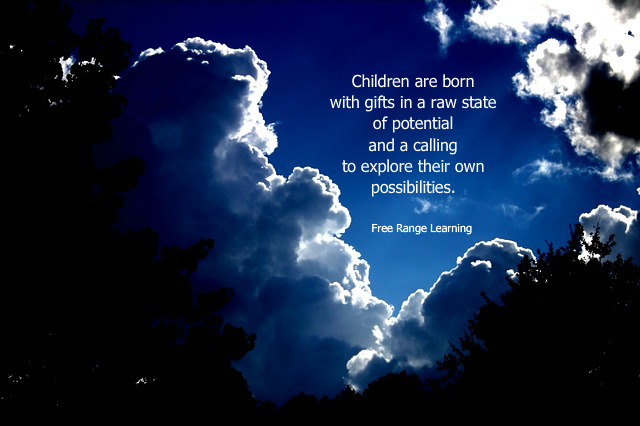
A child’s gifts can be difficult to recognize, perhaps because they tend to unfold in mysterious ways. What we might consider idiosyncrasies or problems may very well indicate a child’s strengths. Oftentimes we can’t see the whole picture until long after the child has grown into adulthood. It’s worth remembering we can’t easily see our own gifts either, even though they have whispered to us of destiny or wounded us where they were denied.

A little girl creates chaos with her toys. She won’t put blocks away with other blocks nor put socks in her dresser drawer. As a preschooler she creates groupings that go together with logic only she understands. One such collection is made up of red blocks, a striped sock, spoons, and marbles. She sings to herself while she rearranges these items over and over. The girl is punished when she refuses to put her puzzles away in the correct box or her tea set dishes back together. She continues making and playing with these strangely ordered sets but hides them to avoid getting in trouble. This phase passes when she is about nine years old. Now an adult, she is conducting post-doctoral studies relating to string theory. She explains her work as a physicist has to do with finding common equations among disparate natural forces.

A young boy’s high energy frustrates his parents. As a preschooler he climbs on furniture and curtain rods, even repeatedly tries to scale the kitchen cabinets. When he becomes a preteen he breaks his collarbone skateboarding. He is caught shoplifting at 13. His parents are frightened when he says he “only feels alive on the edge.” Around the age of 15 he becomes fascinated with rock-climbing. His fellow climbers, mostly in their 20’s, also love the adrenaline rush that comes from adventure sports but help him gain perspective about his responsibility to himself and other climbers. His ability to focus on the cliff face boosts his confidence on the ground. At 19 he is already certified as a mountain search and rescue volunteer. He is thinking of going to school to become an emergency medical technician.

James Hillman explains in his book, The Soul’s Code,

I want us to envision that what children go through has to do with finding a place in the world for their specific calling. They are trying to live two lives at once, the one they were born with and the one of the place and among the people they were born into. The entire image of a destiny is packed into a tiny acorn, the seed of a huge oak on small shoulders. And its call rings loud and persistent and is as demanding as any scolding voice from the surroundings. The call shows in the tantrums and obstinacies, in the shyness and retreats, that seem to set the child against our world but that may be protections of the world it comes with and comes from.

Yehudi Menuhin, one of the preeminent violinists of the 20th century, became fascinated when he heard classical music on the radio as a three year old. He wanted to feel the same rich notes coming out of a violin in his hands. His parents lovingly presented him with a toy fiddle. He drew the bow across the strings and was horrified at the cheap squawk the toy made. Enraged, he threw the instrument across the room and broke it. His imagination had already taken him to the place in himself where beautiful music was made and he was unable to bear that awful sound. We normally call that behavior a “tantrum.”

Then there’s R. Buckminster Fuller, whose young adult years were marked with struggle. As a college student he hired an entire dance troupe to entertain a party, and in that one night of excess he squandered all the tuition money his family saved to send him to school. In his 20’s he was a mechanic, meat-packer, and Navy commander before starting a business that left him bankrupt. After his daughter died of polio he began drinking heavily. By conventional wisdom he’d be considered a total failure at this point. But while contemplating suicide, Fuller decided instead to live his life as an experiment to find out if one penniless individual could benefit humanity. He called himself Guinea Pig B. Without credentials or training Fuller worked as an engineer and architect, inventing such designs as the geodesic dome and advancing the concept of sustainable development. He wrote more than 30 books and registered dozens of patents. Fuller once said, “Everybody is born a genius. Society de-geniuses them.”

Few young people have clear indications of their gifts. Most have multiple abilities. A single true calling is rarely anyone’s lot in life as it is for a legendary artist or inventor. Instead, a mix of ready potential waits, offering a life of balance among many options. When we emphasize a child’s particular strengths we help that child to flourish, no matter if those gifts fall within mainstream academic subjects or broader personal capacities. Traits such as a highly developed sense of justice, a way with animals, a love of organization, a contemplative nature, the knack for getting others to cooperate—-these are of inestimable value, far more important skills than good grades on a spelling test.
Free Range Learning, all kids geniuses,

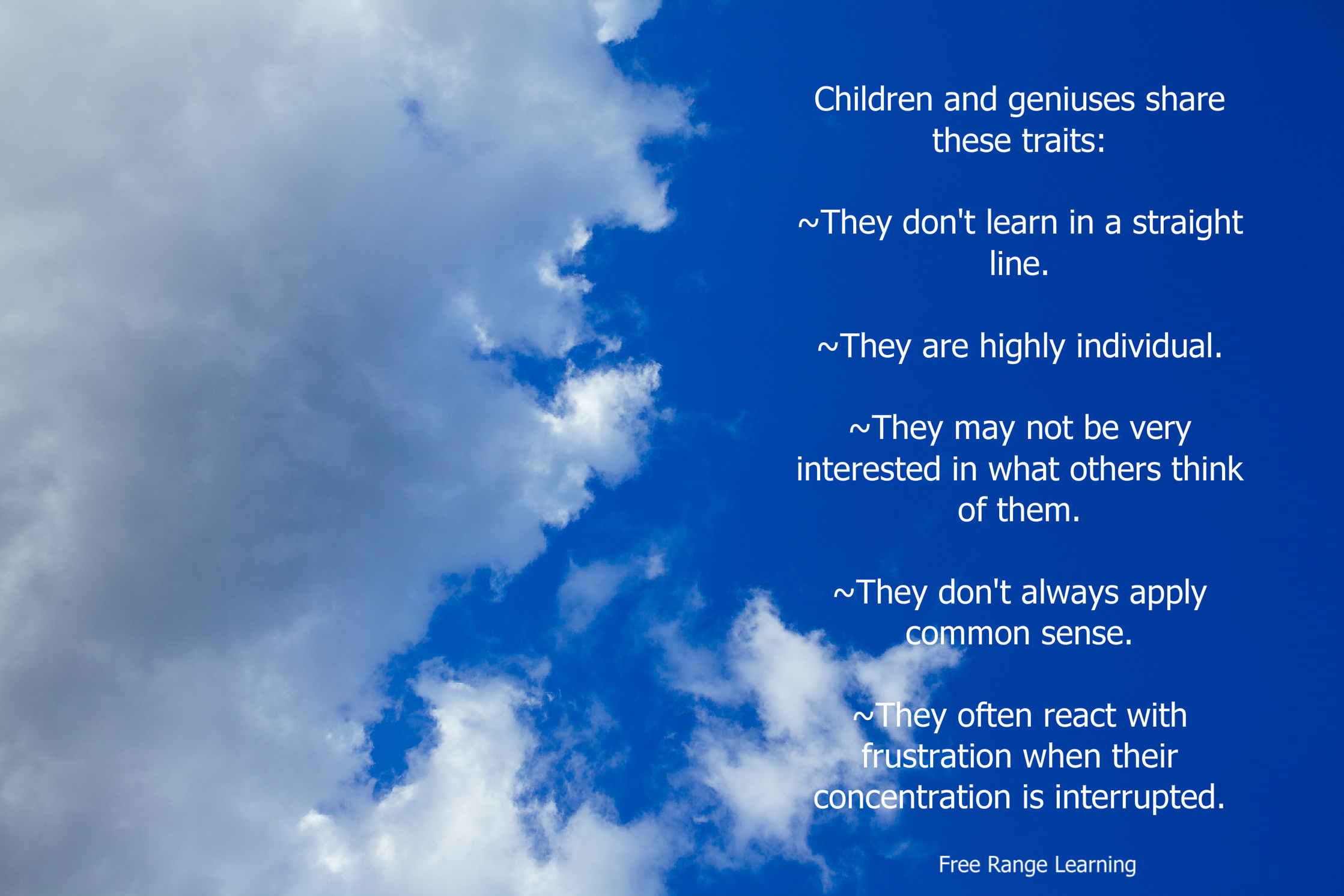
Although society confuses genius with IQ scores, such scores don’t determine what an individual will do with his or her intelligence. In fact, studies have shown that specific personality traits are better predictors of success than I.Q. scores. Genius has more to do with using one’s gifts. In Roman mythology each man was seen as having a genius within (and each woman its corollary, a juno) which functioned like a guardian of intellectual powers or ancestral talent.

What today’s innovators bring to any discipline, whether history or art or technology, is a sort of persistent childlike wonder. They are able to see with fresh eyes. They can’t be dissuaded from what they want to do and often what they do is highly original. Sometimes these people have a difficult personal journey before using their gifts. Their paths are not easy or risk-free, but the lessons learned from making mistakes can lead to strength of character.

We must leave ample space for these gifts to unfold. This takes time and understanding. The alternative deprives not only the child, it also deprives our world of what that child might become.

Acknowledging that each person is born with innate abilities waiting to manifest doesn’t imply our children are destined for greatness in the popular sense of power or wealth. It means that children are cued to develop their own personal greatness. This unfolding is a lifelong process for each of us as we work toward our capabilities for fulfillment, joy, health, meaning, and that intangible sense of well-being that comes of using one’s gifts.


This article is an excerpt from the book Free Range Learning. It was also published in Life Learning Magazine

We Need Hidden Worlds

room of one's own, hidden worlds, secret places,

When I was very small I liked to climb what I called a tree. It was actually a sturdy shrub. I sat between branches less than a foot off the ground, sure I was hidden, feeling mysterious as creatures that speak without words. I also used to retreat to the coat closet with my younger brother. We sat companionably in the dark under heavy coat hems, talking or just enjoying the quiet together. And we made pillow forts, draped sheets over furniture, and played under the folded leaves of the dining room table.

My favorite hidden place was in the woods behind our house. There was a small rise no bigger around than two desk tops. Tall trees grew at either side and a creek bed, dry most of the year, ran along one side. The whole area was covered with leaves. I tried to walk there soundlessly, as I fancied Native Americans walked, not cracking a twig or rustling the underbrush. I tried to identify plants I could eat or use if I lived in the woods, as the boy did in My Side of the Mountain . I’d sit alone in completely silence, hoping if I did so long enough the woodland creatures might forgot about me, might even come near. I snuck food out of the house to make that place a haven, as I’d read about in Rabbit Hill but I always came back to find the iceberg lettuce and generic white bread I left were still untouched.

Once I became a preteen I found a hidden world right outside my bedroom window. I climbed on a chair and hoisted myself up on the gently sloping roof that faced the back yard. When I started college at a large urban university I’d just turned 17. My hermit soul craved time to be alone and still. The only place I found was in a bathroom on the upper floor of the oldest building on campus. I’d retreat behind a heavy wooden stall door, close the antique latch, and meditate on the wood grain of that door until I felt restored. A necessary refuge, although hardly ideal.

Most children seek out small places to make their own. They find secret realms in couch blanket forts, behind furniture, and in outdoor hideaways. There they do more than play. They command their own worlds of imagination away from adult view, often listening to silence by choice.

a

Perhaps retreating somewhere cozy harkens back to our earliest sense memories, first in the sheltering confines of the womb and then in the security of loving arms. Yet at the same time, hidden worlds are also a way of establishing our independence. Children have surely always slipped out of sight in the cool shadows of tall cornstalks, the flapping shapes of sheets hung on clotheslines, the small spaces under back steps, behind furniture, and inside closets.

There are all sorts of tiny retreats that can be purchased for kids. Plastic structures made to look like ships or cabins, tiny tents, pre-made playhouses. These things lose their allure. Children want to discover hidden places on their own or to create them out of materials they scavenge like fabric, cardboard, scrap wood, whatever is handy. (The benefits of this play is described in the “theory of loose parts.”) These places tend to be transitory, lasting for a short time or changing into something else. They’re special because they’re unique to the child. These places contain the real magic of secret places.

Hidden worlds are made with blankets, indoors

a

or outdoors.

a

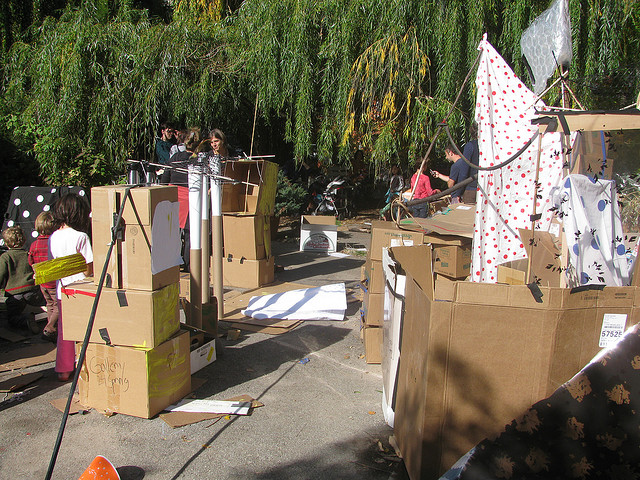
They’re found in cardboard boxes

a

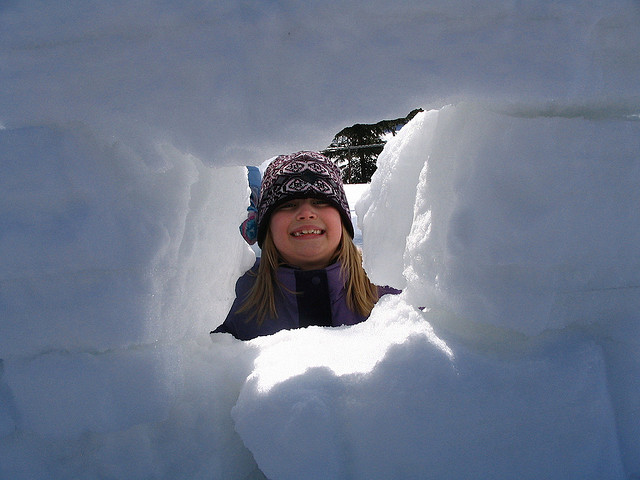
snow

a

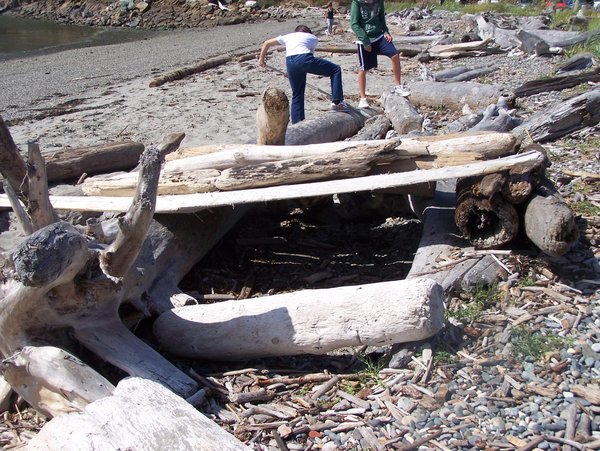
driftwood

natural play place, loose parts play,

and under trees.

a

They’re made out of old logs

a

old plywood

a

or branches.

a 

The hidden worlds I cherish these days have more to do with a quiet sense of peace found in moments of solitude. What’s paradoxical, these are also times when I most often feel the oneness that connects everything.

Maybe growing up with the freedom to retreat within hidden worlds, no matter what was going on, helped me to access this in myself. Hurray for blanket tents, for treehouses and spaces under tables, for all hidden worlds that let us gather up what is fragmented in ourselves and feel whole again.

How do you make time, and space, for hidden worlds in your child’s life and in your life?

a

Feeding Creativity With Constraints

Learning to Love You More, creativity thrives on constraints, innovation fueled by challenges, be odd, try something new,

Maybe an unusual assignment will amp up your creativity. Perhaps:

~make a poster of shadows

~write the phone call you wish you could have

~compose the saddest song

~describe your ideal government

~plant a surprise garden

~make a documentary video of a small child

These assignments were devised by artists Miranda July and Harrell Fletcher. Their work called them to be original every day, but they realized that their most enlivening experiences came when they worked under constraints. An assignment, a challenge, even an annoyance spurred them to different, sometimes more profoundly joyous productivity.

Although we set creative people off in a special category, being creative is simply part of the human experience. You’re creative all the time. You might change your approach to a difficult neighbor, tackle a work problem from a new angle, adapt a recipe to suit ingredients on hand, make up a game to amuse a fretful child, figure out another way to do your errands when a road is closed. We have to come up with new ideas and different tactics constantly. Often they’re imposed on us by obstacles. Annoying as constraints might be, as something original comes forth in response we’re likely to feel that zing of aliveness that creativity sparks.

Constraints can actually promote creativity. A study in The Journal of Personality and Social Psychology, titled “Stepping back to see the big picture: when obstacles elicit global processing” explains that obstacles blow open the approach we ordinarily take. This even has a spill-over effect into the way we approach other challenges. As the researchers explain,

These studies show that encountering an obstacle in one task can elicit a more global, Gestalt-like processing style that automatically carries over to unrelated tasks, leading people to broaden their perception, open up mental categories, and improve at integrating seemingly unrelated concepts.

That’s why artists July and Fletcher developed a project, called Learning to Love You More, back in 2002. The idea was to encourage the general public to take on assignments, then post the results on the project’s site. The assignments are themselves a sort of constraint, forcing us to do something within new boundaries, thereby provoking a shift in perception of ourselves and the world around us. Creativity has a way of doing that.

A few years ago I wrote an article about Learning to Love You More for the Canadian magazine Geez. To prepare for the piece I did about ten of the projects; some with friends, some with my kids, some alone. Each one felt entirely odd and yet liberating. And because they were so unusual, they stand out in my memory, as we want the moments of our lives to do. Some assignments felt delightfully silly, like drawing constellations made of freckles (#9). Some felt radical, like making a public information plaque to hang at the door of City Hall (#62). Some felt fun, like creating a wind chime from a coat hanger and old kitchen utensils to hang on a parking lot tree (#15). Some felt wrenchingly poignant as I carried out the assignment, like this one.

All Holy

Assignment #63:  Make an encouraging banner. I cut a worn blanket into squares and shaped felt into letters to create a banner reading, “It’s All Holy.” The blanket was once my mother’s. The project not only re-purposed a ripped blanket but also satisfied my restlessness, as the day I spent creating the banner was the first anniversary of her death.

I hiked through the snow to hang the message outside between winter-bare trees. Beyond the banner lay our land where carefully tended free-range cows and chickens live.  On the other side, the banner’s words faced a conventional farm where animals are confined and raised on unnatural feed. I believe it’s all holy, but faith isn’t easily applied to real life. Standing there on a bright cold day with those words lifting in the breeze I could almost imagine what it would mean to live beyond concepts of good and bad, sorrow and joy, ordinary and sacred.

Somehow creativity thrives on the limitations found within the constraints of a particular challenge. One family, captivated by the Learning to Love You More project, did every assignment together. They ended up showing their work at a local gallery, giving talks titled “Art is Where You Find It and Everyone Can Do Art.”

The site is no longer listing new assignments, although previous submissions can be viewed. And the founders have put out a Learning to Love You More book. But we carry it on as long as we recognize just how enlivening challenges can be for ourselves, our kids, our creative lives.  Constraints, annoying as they may be, can push us to engage in new ways of seeing and being.
A Few Creativity Generators

16 Ways to Spark Creativity

Don’t Say It, Draw It

Throw Strangely Amusing Parties

38 Unexpected Ways to Revel in Snail Mail

7 Ways to Make Your Day More Magical

Have some ideas for quirky, fun, or heart-expanding Learning To Love You More type assignments? Share them in the comments.

Respecting A Child’s Urge To Discover

theory of loose parts, kid innovators, creativity, learning is discovery, self-motivation,

misspenthopesxx.deviantart.com

The kids had a bunch of boards, some old nails, a hand saw, and a few hammers. They also had the two most important ingredients, the desire to make something and the freedom to do so.

They spent an afternoon planning their tree fort, enthusiastically arguing over whose plan was best. Their first few attempts failed spectacularly. They were undaunted, even bragged a little bit about the noise the boards made falling down. Several of them asked family members for advice. A few others paged through books and watched YouTube videos as they tried to figure out basic construction techniques. They started again, measuring more carefully as they built a frame. The process took much longer than they’d expected but they stuck with it. When they ran out of materials they scavenged tree lawns on garbage pickup day, dragging back pieces of wood. They got a few cuts and bruises. They were proud of those too. As they worked they talked about how they’d use their clubhouse. It didn’t occur to them how much they were learning.

Conventional thinking tells us that children benefit from the newest educational toys and electronics, lessons, coached sports, and other adult-designed, adult-led endeavors. Well-intentioned parents work hard to provide their children with these advantages. They do this because they believe that learning flows from instruction. By that logic the more avenues of adult-directed learning, the more their children will benefit.

But learning has much more to do with curiosity, exploration, problem solving, and innovation. For example, if baby encounters a toy she’s never seen before, she will investigate to figure out the best way or a number of different ways to use it. That is, unless an adult demonstrates how to use it. Then all those other potential avenues tend to close. Studies show that “helpful” adults providing direct instruction actually impede a child’s innate drive to creatively solve problems. This experience is repeated thousands of times a year in a child’s life, teaching her to look to authorities for solutions, and is known to shape more linear, less creative thinking That’s true of a baby as well as older children and teens.

Young people are also cued to ignore information that is too simple or too complex. Research indicates that people are drawn to learn from situations that are “just right” for them.  They may make plenty of mistakes along the way, just as babies fall when learning to walk, but facing those challenges and making those mistakes are pivotal steps in maturity.

It’s also well-known that a child’s natural motivation tends to diminish in adult-led activities. Unless they’ve been raised on a steady diet of ready-made entertainment, children are naturally drawn to free play. They pretend, make up games, daydream, wonder, and launch their own projects. They are discovering not only the world around them but a rich inner life as well.

Of course adults are vital to young people’s lives. They provide safety, guidance, love, and much more. Kids know they can ask trusted adults for help or advice. They do so more eagerly when they recognize these adults won’t overwhelm them with information, quiz them on what they are learning, or take over. Adult responses simply need to stay in proportion to a young person’s request.

For an example of how powerful the drive to discover can be, let’s take a brief detour to two Ethiopian villages. These places may be rich in intangibles like family and tradition, but they are poor in every other way. The illiteracy rate is practically 100 percent. There aren’t even written words around for children to see: no books, no labels on packaged foods, no street signs. That’s where the One Laptop Per Child (OLPC) project dropped off 1,000 tablet PCs with solar chargers. They weren’t handed out in a school, but to kids. The devices were pre-loaded with English-language operating systems and software that tracked how the tablets were used. The boxes were taped shut, with no instruction given at all.

In less than five minutes, one child (who’d never seen an on/off switch) powered up a system. The kids collaborated as they learned. Within a few days they were using 47 apps per child, within five months they were taking pictures. That took a while since the kids had to teach themselves to hack Android because the tablet cameras were mistakenly deactivated. The OLPC project is finding, all over the world, that kids are learning to read and speak in multiple languages. They easily search, program, and connect using inexpensive tablets. These kids are also teaching adults in their villages to read and use computers. They’re doing it without adult instruction.

So how did our fort-builders do? They had three sides framed and were working on the fourth when one boy’s father stepped in to help. His help may have been welcomed if they’d asked or if he simply contributed to the team effort, but this very well-meaning man decided the kids weren’t doing a good job. He took over, telling the kids to re-do some of their work and to build the rest of it according to his instructions. They did, but without much gusto. The resulting fort was more sturdily built yet they only used it a few times.

A year or so later they scavenged some boards from it to make a go-cart, and then another go-cart. This time they welcomed the help of another child’s grandfather who worked alongside them, learning together as the project unfolded. Their enthusiasm had returned.

How To Grant Wishes

fostering success, partnering for success, making dreams happen, goal group, fostering goals,

Image:helen-carter.deviantart.com

When I was a child an elderly neighbor shared her life-long dream. Lottie Borges had always wanted to get behind the wheel of a semi, start it up, and drive. I got a glimpse of a yearning that couldn’t be hidden by her apron and heavy orthopedic shoes. Years later when I heard she’d died I was sorry the thrill she longed to experience driving an 18 wheeler had never come to pass.

Each one of us has dreams. Sometimes they’re suppressed so long that it’s not easy to remember them or the spark of vitality they once roused in us. We forget because we’re busy meeting our family’s need, what the boss wants, what amusements can fill the moments we have left over. We set aside the goals we once held dear. They are not gone, just dormant.

Our culture emphasizes personal effort. It’s assumed that failure to achieve our aims lies entirely with the individual. But that’s not how wishes usually come true. They happen in the context of relationships. When we talk about our goals with people dear to us we infuse our ideas with energy. It’s a way of activating a network of people who, along with us, envision our dreams taking place. That network may help bring about the exact circumstances necessary to achieve our goals. Perhaps if my former neighbor had shared her wish with someone other than a child she might have connected with a truck driver who’d have gotten a kick out of letting her take his rig for a run around a back lot.

A few years ago I got together with a group of friends and, on the spur of the moment, we decided to write down our long-held wishes. We laughed, wondering if old fantasies (such as running away with a teen idol) should be included. But the challenge was compelling so we started writing. When my friends shared their goals I saw sides to them they rarely revealed. Here are some of their wishes:

  • I will get a lead role in community theater.
  • I will travel to Ethiopia.
  • I will master class 5 white water rafting.
  • I will record my parent’s reminiscences.
  • I will have a graphic novel published.
  • I will get a master’s degree in library science.
  • I will become a foster parent.
  • I will take a class in conflict resolution.
  • I will paint wall-sized murals.
  • I will build a clay oven in the back yard.
  • I will finish the quilt my grandmother started.
  • I will learn to speak Russian.
  • I will be elected to city council.

We realized that we should meet occasionally to support each other’s dreams. By discussing what we are doing to reach our goals and how we can help each other, we’re more likely to turn intention into reality.

If you’re interested in our wish granting process, here’s the method we’re using.

1. Get together with at least one other person with whom you have a mutually supportive relationship.

2. Brainstorm. Call up the longings you had as a child, the grand plans you envisioned as a young adult, the places your mind wanders when you daydream.

3. Write down those yearnings. Word them concretely. It is easier to check off a goal such as “Complete a pottery class” than a vague listing such as “Try making pottery.” Instead of vowing to “appreciate people more,” expect yourself to “Write letters to six people telling them why you appreciate them.” Include a range of possibilities— creative, professional, interpersonal, physical, and inspirational. Make some challenging, some just for fun.

4. Make the list as long as possible. Shoot for 50 or 100. Pushing yourself to write so many goals forces you to look inward, uncovering deep desires that you may have buried.

Such a list will take some time, but you may find that long-suppressed dreams ease back into your consciousness only after you’ve written down goals that seem silly or impossible.

5. Put stars by at least five of the most important dreams. Remember your list isn’t a set curriculum. It can change as your goals evolve. 

6. Talk about what steps you need to take to accomplish them and how can you support each other in these steps. Often it’s helpful to plan on baby steps, starting small and recognizing there may be tumbles as you work your way up to bigger steps.

7. Write yourself a note to be opened three months from now. Or write an email using futureme.org timed to arrive in three months. This note should be in present tense and action oriented, “I am saving $50 a week towards my trip” or “I am practicing Russian each evening and looking for a native speaker to build my language skills.” This is a great way to promote progress. Then write another message to yourself, to be opened in another few months.

8. Keep the wishes shared by others alive through encouragement but also through your belief that the vision will be reached. Continue to pay attention to circumstances that may be helpful to others as you work toward your dreams together.

Something happens when goals are written down. When we make a conscious decision to guide our lives in the direction of our dreams, possibilities begin to open. And when we share that process with others, we have the delight of helping them make their wishes come true.

By the way, the wish lists written with my friends are already adorned with check marks.

Get Kids To Predict The Future

Back in 1964, sci-fi writer Arthur C. Clarke introduced a program on future predictions by stating:

The only thing we can be sure of about the future is that it will be absolutely fantastic. So, if what I say to you now seems to be very reasonable then I’ll have failed completely. Only if what I tell you appears absolutely unbelievable have we any chance of visualizing the future as it really will happen.

Among other developments, Clarke predicted the emergence of the Internet, telecommuting, and remote surgery.

Fantastic. More science fictions are becoming science facts all the time.

Just like the predictions kids gave when I asked them about the future at a multi-age enrichment program. The youngest ones jumped in eagerly.

“Robots will do all our chores.”

“Dogs will come in a bunch of different colors.”

“Kids can fly little space cars around wherever they want.”

“You’ll think of anything you like to eat and it’ll appear.”

What the teens predicted was more complex and somewhat darker. They talked about the necessity of space exploration to seek out scarce resources on other planets. They discussed enhanced ESP abilities for communication and intuitive powers to diagnose illness, although those topics raised a lot of debate. Most of them hoped teleporting would eventually replace the difficulties of travel. And quite a few envisioned grim scenarios of global scarcity complicated by the use of advanced weaponry.

The future may hinge on optimists with a can-do attitude. So after the group discussed their predictions I headed the conversation in a more positive direction. We discussed what kind of future the kids wanted to live in, what steps were already underway to make that happen, and how the kids themselves could take part. By the close of our session the kids were energized about envisioning and creating a hopeful future, one that included space cars as well as peace. Envisioning that future is the first step.

I wish I’d had the participants in my enrichment program write down their predictions so their parents could save those speculations for a decade or two. Better yet, I wish I’d copied all the predictions so that someday the kids could find out which of their many ideas had come to fruition.

Consider asking your kids to make their own predictions.  It’s an interesting way to stimulate conversation about their hopes and fears. Written or recorded predictions are also a wonderful contribution to a scrapbook, family blog, or time capsule.

Let us know in the comment section what your kids had to say. Consider making your own. And go one step farther than I did. Remember to save them!

kids see future, kids predict future, arthur c. clarke future,

deadly-wanderer.deviantart.com

Global Village Construction Set

It’s possible to plant 50 trees in one afternoon.

To press 5,000 bricks from the dirt beneath your feet in one day.

To build an affordable tractor in six days.

It’s possible thanks to the members of Open Source Ecology (OSE). They aren’t armchair visionaries. These engineers, farmers, and developers are dedicated to making communities sustainable and self-reliant. They’re taking on scarcity and inequality with open source enthusiasm

OSE got its start when Marcin Jakubowski’s tractor broke.  Well, lets back up a little. After Jakubowski earned a PhD in the physics of fusion energy, he bought a farm in Missouri where he grew fruit trees and raised goats. One day his tractor broke. He didn’t have the hands-on experience to fix it himself. But he hauled out some can-do attitude along with his welder and torch. He realized a tractor is simply a box with wheels, each powered by hydraulic motors.  So he bolted together square steel tubing to make one from scratch. It worked.

This inspired him to look beyond pricey, commercially made machines. He began to come up with versions that were hardy, low-cost, and constructed out of locally sourced or repurposed materials. His posted designs generated lots of enthusiasm and input. Participants began showing up to help build prototypes on project days, becoming OSE collaborators.

The idea evolved. They considered what it takes to build independent, sustainable communities that support farming, construction, small manufacturing,  and power generation. They came up with a list of the 50 machines most important for modern life including a hay baler, bakery oven, laser cutter, drill press, solar concentrator, and truck.  Low cost, industrial strength, DIY versions of these machines became known as the Global Village Construction Set.  The motors, parts, and other fittings of these machines are designed to be interchangeable. All the 3D designs, schematics, and instructional videos are posted on the OSE Wiki.

On average, constructing these machines costs about eight times less than comparable machines made by industrial manufacturers. As Jakubowski explained in his recent TED talk, “Our goal is a repository of published design so clear, so complete, that a single burned DVD is effectively a civilization starter kit. ..The implications are significant: a greater distribution of the means of production, environmentally sound supply chains, and a newly relevant DIY Maker culture can hope to transcend artificial scarcity.”

So often hope seems abstract.  This is tangible hope, made of steel. It puts independence and equality in reach for people in both the developed and developing world.  Welding never seemed so inspiring.

Originally published at Wired.com

1,000 Ways To Play With A Cardboard Box

imaginative play, cardboard box playthings, build your own toys, cardboard village,

CC 2.0 Flickr photostream mollypop

A large appliance box waiting at the curb has always been a call to action. We’ve done whatever is necessary to get it home, mostly dragging it behind our bikes or lashing it to the car roof. That because every refrigerator or washing machine box (as well as every smaller box) has another life waiting for it. One dreamed up by children.

When I was a little girl, we played for months with a tall furniture box. My mother fashioned a door and windows that opened like shutters. It stood in our basement ready to serve as a palace, fort, or playhouse. This box was large enough to fit my sister and me and a few of our friends. It lasted through the winter before sagging into uselessness. (Check out a wonderful gallery of cardboard creations on MyMakeDo.)

build a cardboard city, play with cardboard boxes, host a box party, Bring Your Own Box party, let kids build with cardboard,

CC 2.0 edenpictures Flickr photostream

One of my favorite events to throw for the kids of friends and neighbors is a BYOB gathering. As in Bring Your Own Box. Guests are invited to show up with cardboard boxes of all sizes. We supply masking tape, duct tape, markers, paint, and plenty of room on our property. The adults wield mat knifes, cutting where the kids direct. Sometimes more than a dozen huge boxes are transformed into cardboard rooms featuring turrets and rope-opening drawbridges. Sometimes they are a connected series of tunnels leading to a fort under a tree. Once the kids made a child-sized passageway they invited to adults to enter, giggling as we stooped and crawled and squeezed our way through. The biggest thrill for kids seems to be in the planning, arguing for one vision or another, then working together to make the project a reality. Of course, playing in it afterwards is fun too. The benefit of hosting it here? Plenty of days to play in the box creation after the event is over.

A cardboard box-related program we ran at enrichment classes was a hit. We called it Junk Science. We saved cardboard boxes and cardboard tubes of all sizes, along with string, rubber bands, lids, paper clips, yogurt cups, and other creativity-inspiring loose parts. Each child or team was given equal amounts of this “junk” and on free days allowed to build whatever he or she choose. On other days they were given a specific challenge, similar to the old TV series Junkyard Wars.  The kids built sorters that sent pennies down one chute and dimes down another, bridges that held weight, catapults that tossed ping pong balls, and much more. They preferred the specific challenges to free days, perhaps enjoying the way their ideas took off while solving a problem.

I know a boy who used to make vehicles and trains out of cardboard boxes. He hitched them together with ropes and dragged them around. This made cleaning up toys more fun, and conveying groceries from the front door to the cupboards became his favorite job. And I know a girl who used to make mazes out of boxes for her pet rats to scurry through, kissing them on their pink noses when they emerged to find a treat at the end.

I also know a child who made a world out of a refrigerator box, a world that continutes to absorb his interest for hours on end day after day.

You may have thought I’d list 955 other ways to play with cardboard boxes but any child can do that. Who wants to limit creativity to a list anyway? Start saving those free toys called boxes.


The Boy With No Toys

why toys are bad for kids, overstimulated kids,

Before he was born, his mother decided her son would have no toys. Abandoned by the father, she was already a single parent. She made a living cleaning for other people. Most days she took the bus to affluent streets where children never seemed to play outside. As she vacuumed and scrubbed beautiful homes overfilled with possessions she paid close attention to what children did all day. Often they were gone at lessons, after school programs, or playdates. When they were home they usually sat staring at screens. Toys in their carefully decorated rooms appeared to be tossed around as if the small owners had no idea how to play, only how to root restlessly for entertainment.

She thought about it, talked to the oldest people she knew, and read everything she could. Then she informed anyone who cared to listen that her child would not have toys. Not a single purchased plaything.

Will (name changed) and his mother live in a small mobile home park. By most standards they are poor. Their income is well below the poverty line. They don’t have a TV or computer (although Will uses the computer at the library and watches the occasional TV program at babysitters’ homes). But their lives are rich in what matters. Together Will and his mom grow food on several shares of a community garden, bartering when they have extra produce. They make all their meals from scratch. These routines activate a whole array of learning opportunities for Will, quite naturally.

They are close to most of their neighbors in proximity as well as in friendliness. While his mother is working Will is cared for by several different seniors in their trailer park. He not only likes to help his mother garden, cook, and take care of their small home but he also likes to take part in helping his neighbors with small tasks. He carries groceries for certain ladies, helps an older gentleman with a birdhouse building hobby, and sometimes gets to assist another neighbor in automotive repairs.  He gets a lot out of these meaningful tasks.  Children long to take on real responsibility and make useful contributions. Giving them these opportunities promotes their development in important ways.

Sounds nice. But what about play?

natural play best for kids, free play, no toys,

When Will was a baby his mother made all sorts of toys. Most took no time at all. Food containers became stacking toys, a small water bottle with beans inside became a rattle, a sock stuffed with drier fuzz and tied in knots became a soft animal.

Will is now six years old. He plays as any child naturally does. He makes up games and turns all sorts of objects into toys. His mother saves money by not owning a car, so Will has commandeered a large portion of the shed that would normally be used as a garage. Mostly he uses it to stockpile his own resources. He has scrap wood, a few tools, and cans of nails. He likes to straighten bent nails for future projects, working carefully now that he recently discovered what smacking his fingers with a hammer feels like. Recently he found a discarded lawn mower tire, so he’s looking for three more tires to make a go-cart. In the evenings he likes to draw elaborate pictures of this upcoming project. He particularly enjoys playing in the soft dirt along the side of the shed where “robot men” he makes out of kitchen utensils use their potato peeler and wisk limbs to churn through the soil, leaving tracks as they clink. When he visits friends he happily plays with their toys, although he doesn’t always “get” that certain TV or movie-themed toys are limited to the plot-related storylines. So far he seems to have no urge to possess the same toys.

What about birthdays and holidays? Will’s mother does give him gifts. But she limits her gifts to useful items—crayons, clothes, tools, a compass. Each weekend her folk band practices at their mobile home. Will quickly mastered the harmonica and begged for time on the fiddle, so her big gift to him this year was a used child-sized fiddle. She urges the other adults in his life to gift him with experiences—a trip to the beach, a day of horseback riding, a visit to a museum. Out-of-town relatives now renew a children’s magazine subscription and send him regular snail mail letters, both of which are helping him learn to read with very little prompting.

natural child development,

Will’s childhood has a lot in common with the way children have learned and grown throughout history. As historian Howard Chudacoff notes in Children at Play: An American History, play is vital to development. It’s has everything to do with autonomy, exploration, imagination, and fun. It has very little to do with purchased playthings. In fact, structured programs and commercial toys actually tend to co-opt play.

Studies with rodents show those raised in enriched environments (toys and changing items in cage) have enhanced brain development compared to rats raised in a standard environment (plain cage, unchanging). We’ve misinterpreted these results. Rats don’t naturally live in boring, unchanging cages. They live in nature, which is by definition a challenging often constantly changing environment. In nature rats have far more complex lives than they ever might in a cage. Such an interesting life IS an enriched environment. It’s the same for children.

Sure there are devices that will “read” to a child. These are not more enriching than being read to by a responsive adult. And there are all sorts of adult-designed games. They’re not more fun or enticing than games kids make up on their own or with friends.

In fact, the overstimulation of blinking, beeping, passive entertainment isn’t beneficial for children. Joseph Chilton Pearce wrote in Evolution’s End: Claiming the Potential of Our Intelligence that the overload of television, electronics, and too many toys limits a child’s sensory awareness. Their brains and nervous systems accommodate intense bursts of sound, light, and color during their earliest years. Rather than developing the subtle awareness fostered by time spent in nature, in conversation, and in play they instead are wired to expect overstimulation. Without it, says Peace, they’re bored.

And yet, so many people are amused when tiny children are clearly pushed to the limits by a toy too overwhelming for them. (Every search for a video to illustrate this seems to think “baby scared by toy” is funny.)

The children Will’s mother cleans for, who are kept busy in adult-run programs and have access to electronic distractions, don’t have Will’s advantages. As he plays and innovates he’s actually promoting the kind of learning that translates to a lifetime of passionate interests. Studies show that children who are free to explore their interests without adult pressure and interference  are more autonomous, eagerly pursuing excellence through healthy engagement rather than heavy-handed adult pressure.

Ask the oldest person you know to share some memories about play from his or her childhood. Chances are you’ll hear about pick-up games, handmade toys, and free time that spun long summer days into marvels of imagination. That’s what Will’s mother wants for her child.

play develops intelligence, benefits of free play, deprive your kids of toys, handmade toys,

First published in Natural Life Magazine

7 Ways To Make Your Day More Magical

try on new identity, pretend to be someone else,

Creative Commons image Flickr photostream of Estadão.com.br

1. Head off to an interesting destination with your family or friends for an Alternative Identity Day. On the way, everyone makes up his or her own identity. Throughout the day make an effort to play along with that identity: call each other by the chosen faux names, enjoy elaborating on your character’s backstory, and interact with strangers through that identity. At the end of the experiment talk about how it felt to try on an alternative self. And if you’ve taken photos, check to see if anyone held their faces or bodies differently. The sense of observing yourself from the lens of another persona can be illuminating.

toast, ritual of the toast, make today significant, make today magical,

Wikimedia Commons

2. Start your meal with a toast. It may be as simple as raising your glass of orange juice in the morning, saying “Here’s to a wonderful day ahead.” Or as heartfelt as an unexpected toast to a friend in thanks for all you’ve shared. A toast is a ritual for adding significance to the moment. Why not make more moments significant?

Creative Commons image from Flickr photostream of Gj IMAGEWORKS

3. Don’t let a day go by without generating some music. You might sing along with the radio or whistle to make a chore go faster. If you play an instrument, even if you haven’t practiced in a long time, get it out (suspending all judgment) and get reacquainted. If you’ve always hankered to play an instrument but never tried, sign up for some introductory lessons.

An easy way to incorporate music into your life is to make up lyrics to familiar tunes. This is particularly satisfying when you’re annoyed. (Whoever passed down the traditional “Rock A Bye Baby” lullaby knew that grumpy lyrics go quite nicely with a sweet tune.) To the tune of “Row, Row, Row, Your Boat” try singing,

Wait, wait, wait on hold
Till I want to scream
Knowing from experience
Service is a dream.
 

See what other experiences you can transform using music.


encouraging banner,

Image: L. Weldon

4. Make an encouraging banner. This project was inspired by the collaborative art project Learning To Love You More. Assignment number 63 was to make an encouraging banner and hang it.  Participants hung banners in their bedrooms, across overpasses, in junkyards, alongside roadways, in parking lots—all over the place. In all sorts of colors and shapes their banners announced:

Don’t forget you are beautiful
It’s okay to ask for help
Life is art
Let’s hear it for love
Lose track of “I”
This is the land of milk & honey
You are incomparable
Less do, more be
You can trust what you can’t explain
Farm magic
 

What phrase gives you hope? Make a banner, either one you plan to hang in your home or to share with the public. You might want to photograph it in various places. The phrase you love comes alive in different settings.

treehouse, what you wanted as a child,

Creative Commons image from Flickr photostream of Karen Roe

5. Sketch something you wanted as a child. The perfect treehouse, a fairy godmother, that toy Santa never brought, a first place trophy, a real best friend. Maybe make a few sketches to get the details just the way you want them. Add some labels if that helps. Now close your eyes, imagine yourself as a child, and give this earlier version of yourself that gift. You may scoff but the disappointed child in you just might appreciate the attention.

Creative Commons image from Flickr photostream of Tomorrow Never Knows

6. Look for metaphors in the ordinary. Challenge yourself to discern a “message” in the first news item you hear in the day or the first visual that appears when you flick on the TV. Ask yourself why a certain song is playing in your head—does it remind you of something, perhaps a feeling or memory the music evokes? Ask yourself why you might have a certain ache, is your body is speaking to you the only way it can? Look for coincidences, synchronicity, and little delights—these can be signposts indicating you are exactly where you need to be.

In particular, pay attention to the messages found in your dreams. Before going to sleep tell yourself that you will remember your dreams. You may want to ask a question before drifting off. When you wake, don’t jump right out of bed. Instead lie quietly and let dreams rise to your awareness. Although their images and stories often make no logical sense dreams speak in symbols with meaning specific to you. Let those symbols linger with you through the day. Even last night’s giant parking meters demanding soup may start to make sense, metaphorically speaking.

eyebombing, fun with googly eyes,

Creative Commons image from Flickr photostream of katerha

7. Heard of eyebombing? Very simply, it’s the act of putting sticky googly eyes on inanimate objects. As described on eyebombing.com, “Ultimately the goal is to humanize the streets, and bring sunshine to people passing by.”

This is an inexpensive and intentionally silly exercise.  Buy a package or two of googly eyes and start looking for where they belong. For inspiration, check out the eyebombing flickr group.  Then enjoy your quest.  Anthropomorphizing a mustard bottle never seemed so right.