It’s Not Us Vs Them

Connie Lim, who performs as MILCK, co-wrote “Quiet” ten years ago. It was a very personal song in response to sexual assault and abuse she experienced in her teens. She sang it, along with a cappella singers, at the Women’s March in 2017. Their performance, captured on a phone, still brings tears to my eyes.

I was there at the march (late, because our bus broke down) along with a half million other marchers. There were military vehicles parked on street corners to deal with what the new administration assumed would be violence but, of course, it was an entirely peaceful rally. Many homeowners had welcome signs on their lawns, some put out offerings of water bottles and snacks. Everywhere we went our fellow marchers as well as DC businesses were gracious and helpful. After the march was over it took hours for thousands of buses to load up and head out from the parking lots, returning marchers to all parts of the country. On that dark January night they looked like ribbons of light pulling out onto the roads. 

Recently, Ms. Lim was asked by a woman if she, as a Republican, could also sing “Quiet.” On her Instagram page, Ms. Lim wrote,

“As a musician, a woman, and survivor of domestic violence, I felt grief to know that politics would create division to the point that someone would wonder if a song of survival could be for her, too. What if we can looked beyond… and wonder about what we have in common? I want to offer bridges through art. To create innovative coalitions that rise above the illusions of categories. We are entering a time where we must resist binary thinking. To seek the river beneath the river.”

We are not as polarized as we’re said to be here in America. Hear me out! I know there are vast differences in the spectrum from left to right. But in poll after poll, it’s clear we want stronger practices in place to keep our our water clean, our food safety assured, our roads and bridges maintained. We want decent workplaces and the best possible lives for our children.

Whatever our partisan affiliation, most humans want the same things. An affordable home, access to good food, meaningful work, quality healthcare, and enough time outside of work to do what brings us joy. We also want the rights assured by law including due process, equal protection under the law, the right to worship as we choose, to protest, and to vote in fair elections. Nearly all of us want our tax dollars do some good for actual people rather than giving it to big corporations and billionaires.

A recent Pew report showed 86% of Americans believe small businesses have a positive effect on this country. Only 29% believe the same about large corporations. A Navigator study found 7 out of 10 Americans say big corporations and the ultra rich are more responsible for the amount of taxes they pay than poor Americans who don’t pay taxes. And Americans are not doing well, financially. Overall, 76 percent of people in households making less than 100K describe themselves as struggling to make ends meet or unable to make ends meet.

New research shows striking bipartisan consensus on the challenges facing the next generation and the solutions to address them. When asked if the federal government should prioritize policies that benefit young people 88% of Republicans, 83% of Democrats, and 75% of independents agreed. Across parties, three-quarters or more of parents say a paid family, parental, and medical leave program for workers who need to provide short-term care for family members would make the lives of American children better, as well as more tax credits for programs that support families, and more government funding to help parents afford child care and after-school programs.

A recent Gallup poll showed 48 percent of Americans see climate change as a serious threat and 37 percent say they have been personally affected by an extreme weather event in their area within the past two years. The majority of people polled in 2024 agree climate change is human-driven. Three-quarters of Americans, regardless of where they live, say they experienced unusually hot or cold days this year. About half experienced extreme storms, 43 percent experienced flooding, 35 percent experienced droughts and water shortages, and a quarter experienced a wildfire. To avoid these extreme climate events, 1 in 5 Americans say they would consider moving. Six out of 10 Americans say they would support wind turbines and solar farms being built in their communities — that number includes over half of Republicans.

A sweeping majority of Americans, including Republicans, oppose cuts to Social Security, Medicare, and Medicaid. Sixty-two percent of U.S. adults, the highest percentage in more than a decade, say it is the federal government’s responsibility to ensure all Americans have healthcare coverage.

Let’s just take the well-being of children as an example. However people voted, it’s hard for me to imagine most of us really want the FDA to suspend quality control testing of milk, while also suspending programs ensuring accurate testing for bird flu and pathogens in dairy products. I don’t think we want to halt research on environmental hazards faced by children, including exposure to wildfire smoke, effects of pesticide exposure, and preventing forever chemicals like PFAS  from contaminating the food supply. I don’t believe most of us want funding indefinitely withdrawn that covers: investigations of child sexual abuse and internet crimes against children; response to reports of missing children; and preventing youth violence. I don’t think we want the farm-to-school grants cancelled—the ones buying fresh food from small local farmers for healthier school lunches. And there’s talk of eliminating Head Start programs altogether. These are just a few examples—from this week!— of the vicious cuts that stand in counterpoint to the lavish benefits afforded to the super rich as well as the largest corporations.

(I am still unable to imagine why anyone wants our tax dollars—somewhere in the region of 25 billion so far—to finance the ongoing genocide of the Palestinian people. Currently the number of unique and precious lives lost is 50,810 Palestinian and 1,706 Israeli human beings. Maybe my imagination is faulty.)

We are told, lectured, screamed at that the “other side” is out to get us. A majority of Americans polled say that legislators, pundits, and TV news personalities increase division in the country. At the same time, one in three Americans get most of their political information from friends both in real life and on social media. When our social circles are a monoculture of opinion we don’t learn from the stories and life experiences of people whose beliefs and opinions differ from ours. This not only diminishes mutual understanding, it fosters increasingly extreme viewpoints.

For many decades, Americans got their news from mostly local newspapers along with national news broadcasts hosted by folks like Walter Cronkite. It gave each community a closer look at what was happening around them— house fires, crimes, high school sports, city council votes— as well as a common national narrative that made some space for different opinions. Now people have different opinions based on different “facts.” Deliberately false stories and memes spread with a force too fast for fact checkers. And many refuse to believe fact checkers when lies are exposed. Despite jibes against “left-learning” and “mainstream media,” when the audience size of popular online shows — podcasts, streams, and other long-form content–is assessed for right-leaning or left-leaning ideological bent, it turns out conservative shows dominate the ecosystem. That holds true even when the content is not explicitly political but oriented to comedy, sports, gaming, or entertainment. Historian Anne Applebaum writes in her book, Twilight of Democracy,

“The issue is not merely one of false stories, incorrect facts, or even the election campaigns and spin doctors: the social media algorithms themselves encourage false perceptions of the world. People click on the news they want to hear; Facebook, YouTube, and Google then show them more of whatever it is that they already favor, whether it is a certain brand of soap or a particular form of politics. The algorithms radicalize those who use them too…

Because they have been designed to keep you online, the algorithms also favor emotions, especially anger and fear. And because the sites are addictive, they affect people in ways they don’t expect. Anger becomes a habit. Divisiveness becomes normal. [Online content] already helps shape how politicians and journalists interpret the world and portray it. Polarization has moved from the online world into reality.”

Our nervous systems can easily become accustomed to daily, hourly, even minute-by-minute doses of anger. As an emotion, anger feels energizing. It stomps the brakes on moral and rational perspectives because it originates from the more primordial parts of our brain. It may provide a rush, similar to thrill-seeking activities that trigger dopamine releases— the way gambling might do for someone addicted to betting on poker. Anger can actually serve as a comfort zone, connecting us with other like-minded people and distracting us from uncertainty, emptiness, or fear.

My wise and entirely charming friend Michael said, at our recent book group meeting, “Hate is the new energy drink.” Except it’s not new. Those with wealth and power have long fostered hatred to achieve their own aims. People screaming about immigration or immunizations or who is using what bathroom are distracted while the elite grab more and more for themselves. More of your rights, your security, your future.

This needs to stop. Instead we need to talk to each other, person to person. We need to truly listen and hear the stories behind the anger.

Open dialogue with the very people she condemned is what inspired Megan Phelps-Roper to renounce her membership in the extremist Westboro Baptist Church. It’s what led neo-Nazi skinhead Christian Picciolini to stop spreading hate and work to lead others away from such ideologies. It’s how Daryl Davis, as an African American, befriends Ku Klux Klan members in hopes they will have a change of heart.

As Brandon Stanton writes in Humans,

“Our struggles connect us. We relate to the challenges of other people much more than we relate to their victories. We empathize with pain much more than joy. The moment we truly see ourselves in another person is when we realize that we’ve felt the exact same pain…. Maybe pain is the most universal feeling. Maybe there’s an invisible, connective thread that runs between the loneliness of an old man and the hunger of an impoverished child. Maybe pain isn’t divisible… Recognizing pain in another person is the primary driver of empathy. It’s the beginning of compassion.”


Honoring The Impulse To Thrive

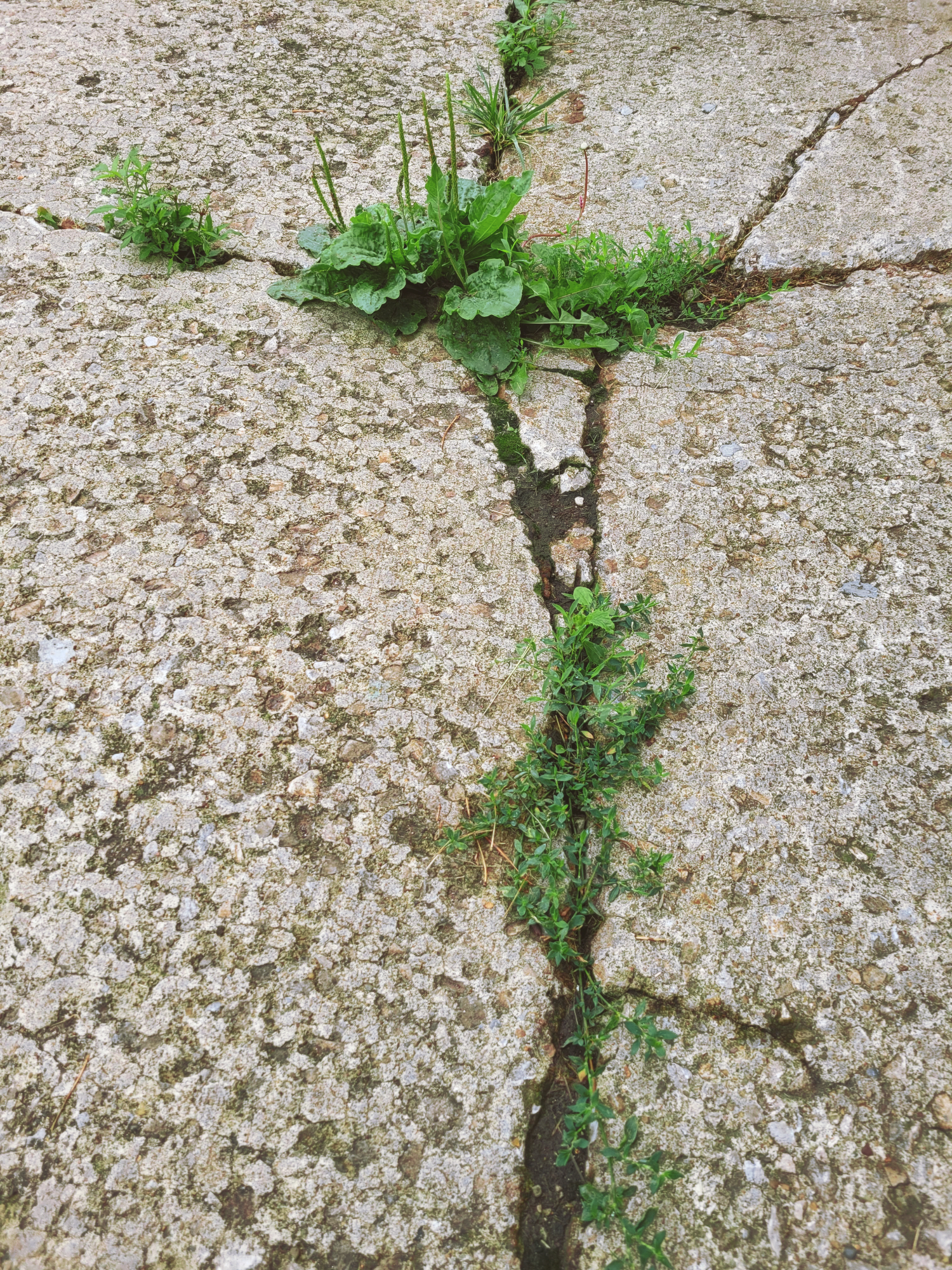
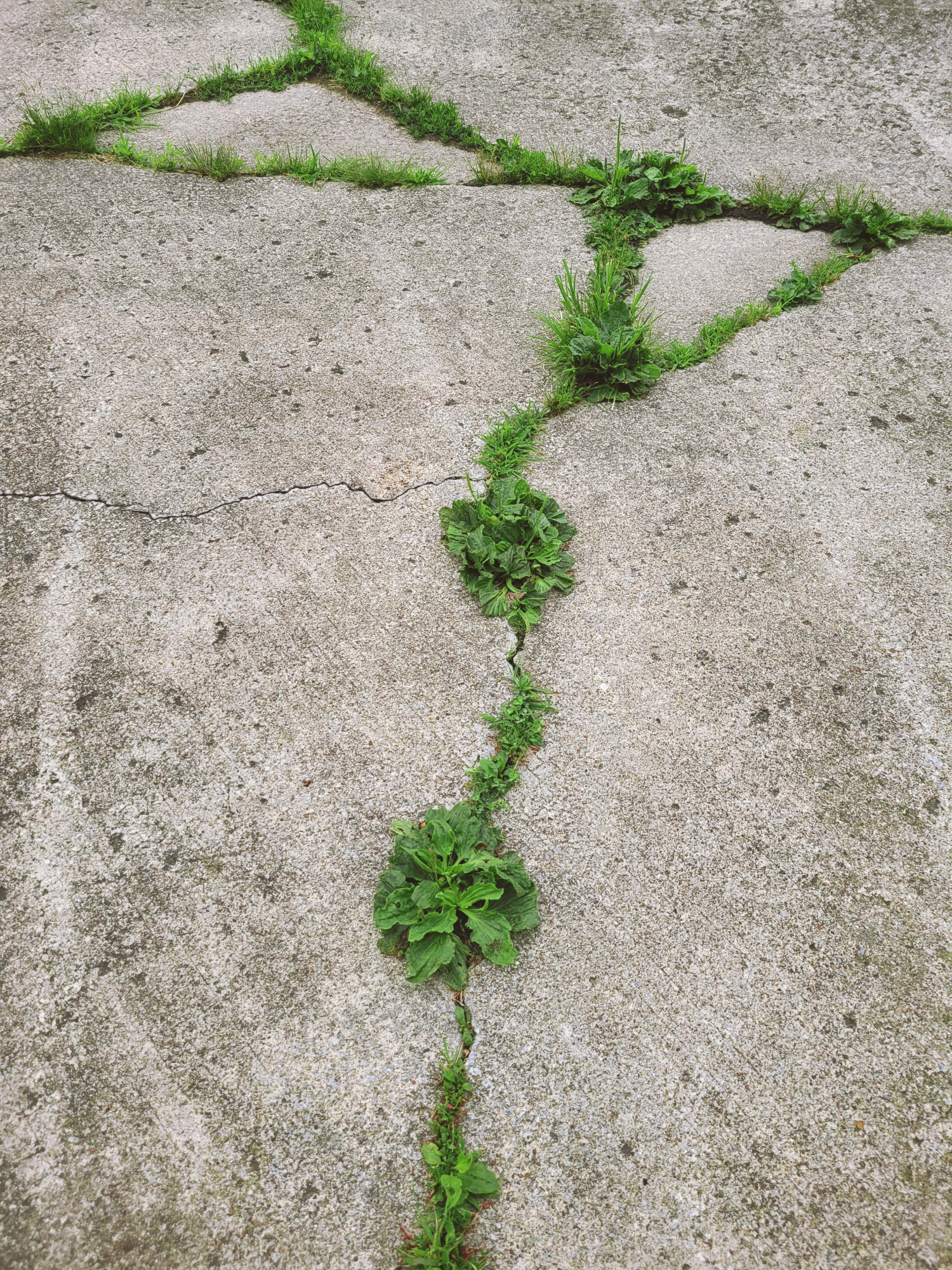
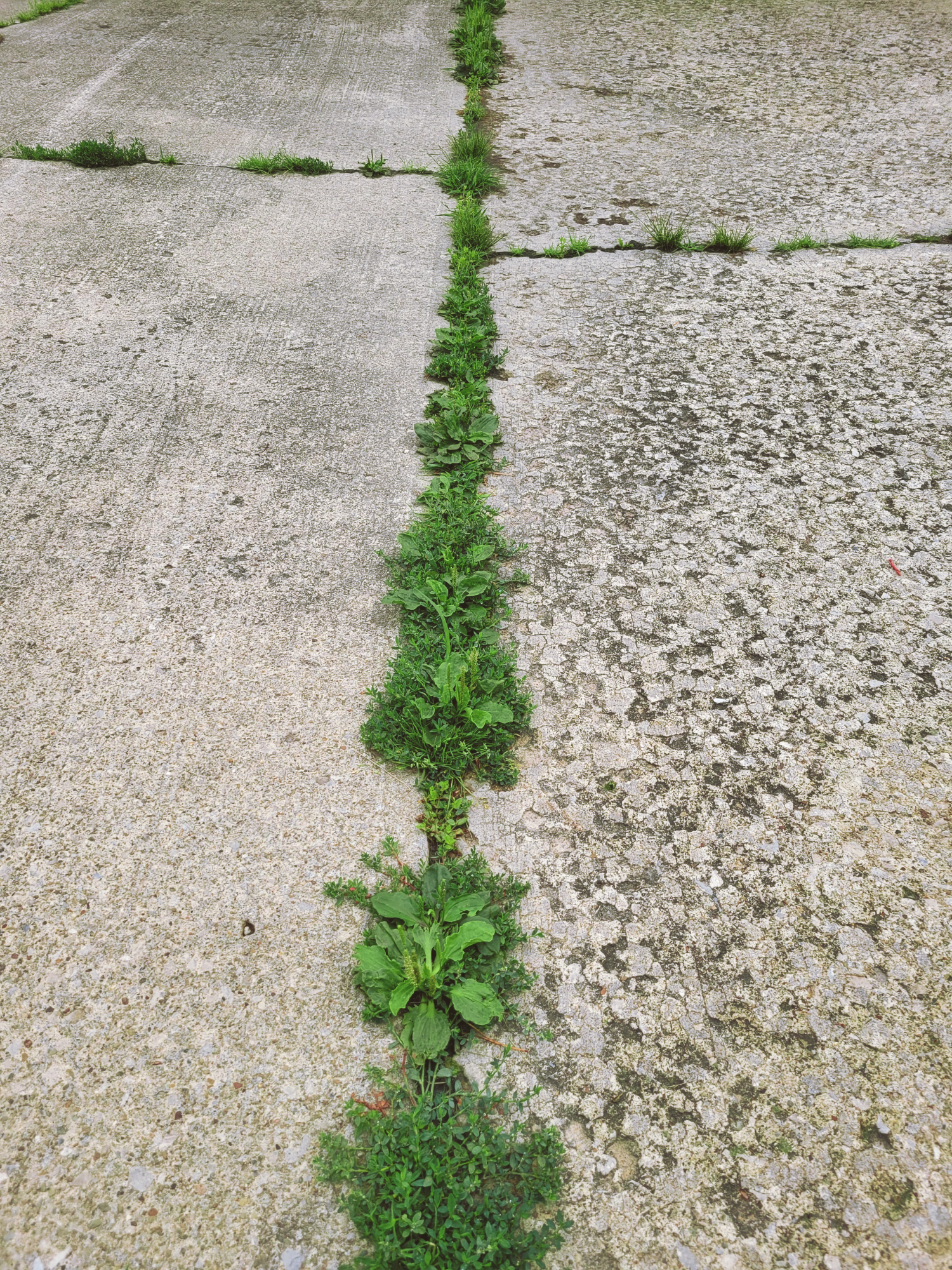
Our driveway is crazed with cracks. I can’t help but appreciate plants springing up through these narrow possibilities. These are native plants, many with health-enhancing properties as human food, but also exquisitely cued to the lifecycles of crawling, flying, hopping creatures reliant on them. All these lifeforms follow nature’s essential precepts of diversity, adaptability, balance, and interdependence. Although our driveway does not, it’s heartening to see how easily life takes over.

I used to wonder about the soil under the sidewalk where I trudged to school each day. What happened when graders and rollers and cement trucks imprisoned it? Did all the life in that soil perish without sunlight and oxygen? How could any living thing survive so much pressure and heat? What would happen if we paved over too much of Earth’s surface? I was a child who Worried About Things.

These plants springing from cracked pavement remind me of nature’s beautiful impulse for life. It restores my hope everywhere I find it. A handful of dry lentils taken from my cupboard, after a few days of soaking and draining, grow into cheery little sprouts I can use in salads, or feed to the chickens, or plant to grow into another generation of lentils. Seeds brought from Cyprus decades ago, shared by a friend, grow each year into giant hardy winter squash that keeps well until late winter –providing nourishing meals along with more seeds to save and share. Organic potatoes in my pantry wrinkle around tiny rosettes and from them, pale tendrils fragile with new life reach out in search of sunlight. I plant these eyes two or three times each season, from late March to late August, for fresh harvests of tender heirloom potatoes.

Life’s impulse can’t always survive what we humans are doing to this planet. As a direct result of human activity, the rate of species extinction is up to 10,000 times higher than the natural, historical rate. Research published in the journal Proceedings of the National Academy of Sciences shows ocean heating is equivalent to between three and six 1.5 Hiroshima-size atomic bombs per second. The UN says “climate change is out of control” and experts in Earth’s climate history are convinced this current decade of warming is more extreme than any time since the last ice age, about 125,000 years ago. It’s exhausting to think about, let alone act on, this spiraling disaster.

We need new stories that reawaken us to the lived wisdom of this planet’s First Peoples and lead us to the most ethical, scientifically grounded regenerative lifeways going forward. It helps when we recognize nature isn’t just what sprouts from cracked pavement. It isn’t confined to wild places we long to visit. We are nature, right down to the life processes of every cell. It helps when our new stories speak to our descendants. It helps when they answer our ancestors.

HOPEFUL RESOURCES

books

Nurturing Our Humanity: How Domination and Partnership Shape Our Brains, Lives, and Future (indie link) Riane Eisler and Douglas P. Fry

Active Hope (revised): How to Face the Mess We’re in with Unexpected Resilience and Creative Power (indie link) Joanna Macy

Restoring the Kinship Worldview: Indigenous Voices Introduce 28 Precepts for Rebalancing Life on Planet Earth (indie link) by Wahinkpe Topa and Darcia Narvaez

The Evolved Nest: Nature’s Way of Raising Children and Creating Connected Communities  (indie link) Darcia Narvaez and G.A. Bradshaw

Why the World Doesn’t End, Tales of Renewal in Times of Loss  Michael Meade

We Are the Middle of Forever: Indigenous Voices from Turtle Island on the Changing Earth (indie link) by Dahr Jamail and Stand Rushworth

Breaking Together: A freedom-loving response to collapse   Jem Bendell

Living Resistance: An Indigenous Vision for Seeking Wholeness Every Day (indie link) Kaitlin B. Curtice

Mystical Activism: Transforming A World In Crisis (indie link) by John C. Robinson

Local Voices, Local Choices: The Tacare Approach to Community-Led Conservation (indie link) by the Jane Goodall Institute

Becoming Kin: An Indigenous Call to Unforgetting the Past and Reimagining Our Future (indie link) Patty Krawec

organizations

Transition Network

Deep Adaption Forum

Work That Reconnects

Black Earth Institute

I’d love to hear what books, organizations, and other resources can help us all reawaken to and bring about these new stories.

Steadily Drained

Beady unblinking eyes, some red and some white, stare out from my phone charger, coffee maker, speakers, PC, printer, and elsewhere. The average U.S. home has about 40 electronic devices draining power, accounting for around 10 percent of one’s energy bill. Some call this leaking electricity or vampire energy.

Things I used to get done on a regular basis now seem to take forever. I never used to squeak right up against deadlines, beg out of regular obligations, fail to answer necessary texts, forget things like sympathy cards. Never, ever. But I have the last few years, excoriating myself all the while.

Adding up U.S. households, all this leaking energy totals the output of 26 power plants. This in a time when people in the U.S. use more electricity, per capita, than nearly anywhere else in the world. 

Sometimes I cancel a walk with a friend, a walk I’ve been looking forward to, because I just can’t muster up whatever it takes to get myself out of the house. Then I wonder what the heck is wrong with me when surely both my friend and I need the restorative pleasure of time in nature.

Energy consumption, especially in industrialized countries, is one of the main factors behind increasing and permanently destructive climate change. Disastrous floods and fires, extreme storms, record-breaking temperatures, drought, crop failure, and much more. The health impact on living creatures, including us, is already severe.

I manage to work, make meals, and sometimes floss my teeth, that’s about it. Books have always been one of my favorite ways to retreat. Thanks to insomnia I’ve gotten a lot of reading in over the years, but I’m reading more now. A lot more. (I try to track titles on Goodreads, because I find myself mistakenly checking out library books I’ve already read.)

Even half-measures political leaders try to put into place are failing, almost entirely thanks to greed. We don’t need to look much farther than Joe Manchin III, of West Virginia, who almost singlehandedly got the proposed U.S. climate agenda pulled from the current budget bill. This jobs-intensive program to replace much of the nation’s dependence on fossil fuel with renewable energy is gutted. I don’t understand why it isn’t against the law for elected officials to take legislative action that blatantly promotes their own or their family’s financial self-interest. Manchin is the top recipient of campaign contributions from coal, gas and oil, utilities, and other dinosaur industries while his family-owned coal brokerage firm Enersystems paid over one million to Manchin and his wife last year alone. Meanwhile people in his state rank dead last or darn close in areas such as economy, infrastructure, health care, education, and overall well-being, Heck, West Virginia comes in last in a “happiest states in America” ranking. It’s almost as if we haven’t noticed the damage done by rapacious partnerships between officials and fossil fuel companies over the last century. This sort of thing has gone on throughout history everywhere people have held power over others, but there’s no longer even an attempt to hide the appalling moral failings of those in charge, failings that will haunt this planet long after they are gone.

I’m a cool weather weirdo. While most people I know exult in summer’s bright heat, it depletes me. Give me a brisk autumn day with a breeze combing bright leaves into the air and I’m in bliss. Give me a sunny winter day with millions of ice crystals gleaming from the snow, bliss again. But summer’s heat and humidity persisted here in Northeastern Ohio through September and well into October. Temperature-sensitive crops like tomatoes, peppers, eggplant, and summer squash are still abundant in my gardens when normally we would have long since pulled out those plants. This feels inexpressibly wrong somewhere deep in my cells. I know anomalous weather wreaks havoc on the exquisitely timed needs of birds, pollinators, and other creatures. Only this week, three-quarters of the way through October, are we finally experiencing seasonal weather.  Well, except for the two tornadoes in our county this week.  

We’ve long been told that we as individual consumers are the world’s energy vampires. If we all stopped using straws and carried groceries home in fabric totes, the threat of climate change would melt into a concern no more worrisome than a few extra sunny days. Fingers of shame have been pointed at those who travel by air or eat meat. Individual action is important, but it also deflects from the world’s worst contributors to climate change. The U.S. is again ramping up the military budget when the U.S. military is already the world’s single largest consumer of oil, a worse polluter than as many as 140 countries. And for half a century, giant corporations have known and concealed the dangerous global effects of extracting, transporting, and burning fossil fuels. In a carefully orchestrated distraction, these companies have engaged in what a new report calls well-funded “cutting-edge propaganda” which cast doubt on climate science and steered media attention toward consumer responsibility. Twenty of these companies are responsible for more than a 35 percent of global greenhouse gas emissions, as noted in a Guardian article, where climatologist Dr. Michael Mann is quoted as saying, “The great tragedy of the climate crisis is that seven and a half billion people must pay the price — in the form of a degraded planet– so that a couple of dozen polluting interests can continue to make record profits.” Climate change, of course, hurts the poorest people the most both in the U.S. and around the world.

Something vital is drained from us when human decency is set afire by those in power. It saps hope and exhausts our strength to make positive change happen. For most of us, deadly racism, viciousness aimed at asylum seekers, the constant and cumulative trauma of far right extremism overlaid by an ongoing pandemic constantly drains our inner resources, depleting our mental and physical energy, making it hard to even get through our daily obligations. This happens even if much of it is below our minute-by-minute awareness. I still want to believe there is a core of true humanity within every person. I still want to do my part for the next seven times seven generations. Thank God our local library system doesn’t impose late fines any more…

I highly recommend what my wise and visionary friend Dr. John C. Robinson has to say about all this in his books and articles. In Climate Change: From Darkness To Hope , he asks us to “notice how your deep self responds to the climate threat” in order to find where we feel called to respond. As he writes, “we must learn to live again on this planet as if everything were new, unfamiliar, and sacred, and reorganize our communities to meet the dramatic needs of a new reality. No one can do this alone but all of us just might be able to do it together. Though still in my own personal alchemical transformation, I feel it happening, I trust it: I am moving from haunted to focused; I am preparing for a greater role in Creation’s evolutionary unfolding, as we all are.”

Earth’s Bright Future

I clicked on an article titled, “Study finds our galaxy may be full of dead alien civilisations,” thinking, Wow, a career in space archeology would be fascinating.

Researchers used an extended version of the Drake Equation, which determines the odds of extraterrestrial intelligence existing in our galaxy, to consider factors necessary for a habitable environment. They speculated that intelligent life may have emerged in our galaxy about 8 billion years after it was formed. (Here on Earth, humans emerged 13.5 billion years after the Milky Way was formed.)

Neat!

And then I got to the passage about “the tendency for intelligent life to self-annihilate…”

What? We know about the fall of empires but did we know science says our species’ selfishly destructive ways are likely take us all out? According to the article,

“While no evidence explicitly suggests that intelligent life will eventually annihilate themselves, we cannot a priori preclude the possibility of self-annihilation,” the study reads.

“As early as 1961, Hoerner suggests that the progress of science and technology will inevitably lead to complete destruction and biological degeneration, similar to the proposal by Sagan and Shklovskii (1966).

“This is further supported by many previous studies arguing that self-annihilation of humans is highly possible via various scenarios, including but not limited to war, climate change and the development of biotechnology.”

This is staggering to consider, especially while we are living through (well, hopefully living through) a tangled knot of crises including a pandemic, climate change, widening inequality, and political unrest. I’m pretty sure we don’t want to leave a dead planet relevant only to space archeologists, even if we currently seem to be heading that way.

I take refuge in hope. Here are a few of the many reasons why.

  1. Crisis has saved us in the past. After all, the Renaissance followed the Black Plague. And there’s much earlier evidence that crisis leads humanity forward. It appears a near-cataclysmic moment in the Upper Paleolithic period led to the preeminence of modern humans. Environmental degradation reduced our kind to near-annihilation. We emerged from this crisis only because we developed new collaborative practices such as trading with strangers and loyalty initiation rituals, engendered to create grudging trust. It took a near-extinction level events for humanity to socially evolve in the Paleolithic. Imagine how our response to this pandemic might move us forward.
  2. Nonviolent action is not only an ethical choice, it is actually the most powerful way to shape world politics. Erica Chenoweth, a political scientist at Harvard University, examined hundreds of social/political change movements over the last century, Chenoweth found that nonviolent campaigns are twice as likely to achieve their goals as violent campaigns. And although the exact dynamics depend on many factors, she has shown it takes around 3.5% of the population actively participating in the protests to ensure serious political change.
  3. A recent survey by World Economic Forum indicates an overwhelming desire for change. Out of the more than 21,000 adults from 27 countries who were questioned, 86% would prefer to see the world change significantly – becoming more sustainable and equitable – rather than revert to the status quo. Even on an individual level,  72% say they prefer their life to change significantly rather than go back to how it was before the COVID-19 crisis started. Numbers are somewhat lower for the U.S., but a majority support initiatives to combat climate change.

How to bring about real change? That’s a huge topic, but here are a few hopeful glimpses.

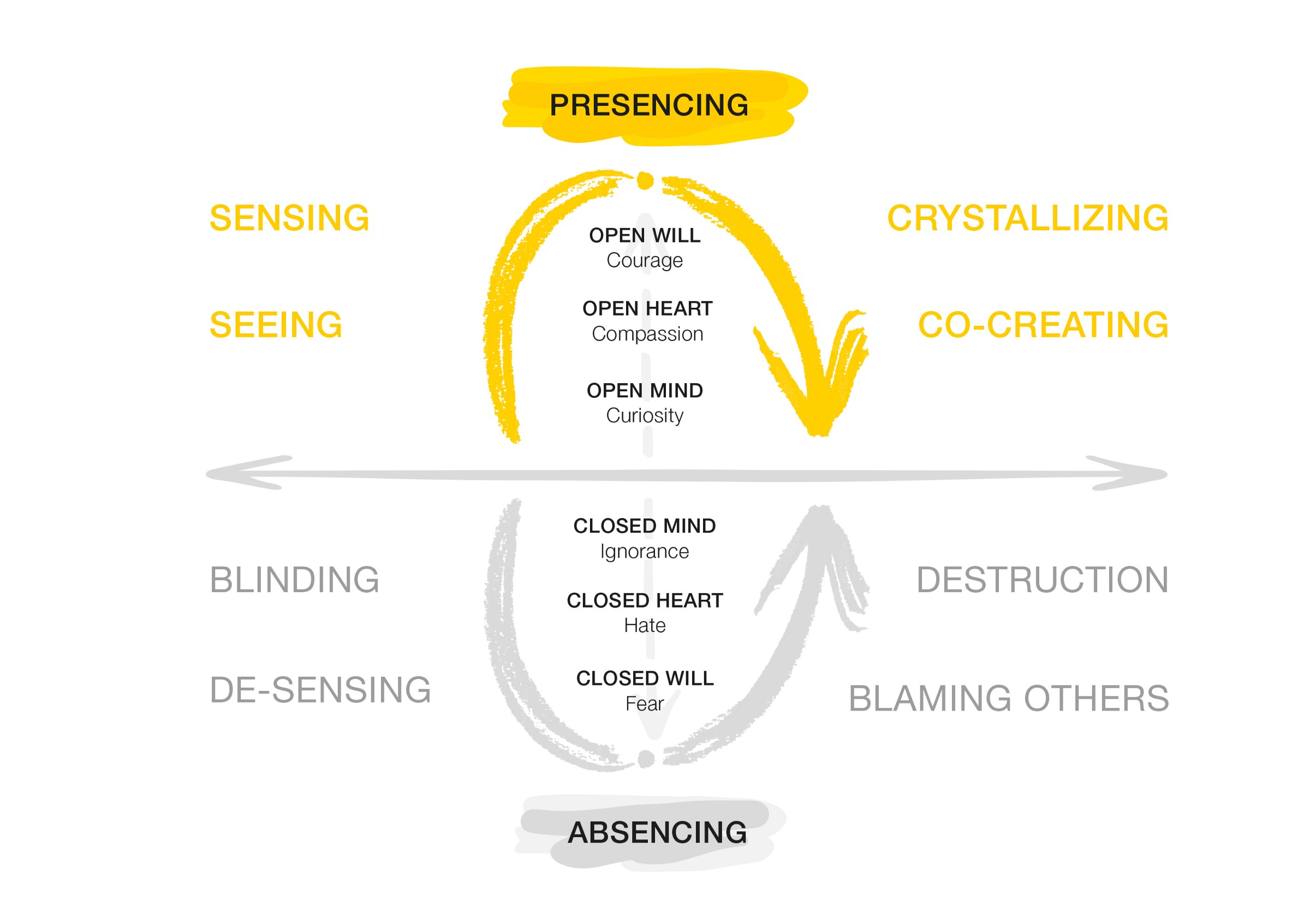
Increasing momentum for positive social change is happening around the world, especially among young people. Otto Scharmer, a senior lecturer at MIT, points out these movements differ from earlier student moments because they emphasize a change in consciousness, collaboration with people of all ages, and using technology in new ways to shift awareness toward solutions. Dr. Scharmer explains that this activates an axial shift in learning and human development, moving away from closed to open presence.

&&&&&

Cooperative behavior is not only natural, it’s contagious. When people benefit from the kindness of others they go on to spread the compassion. The tendency to “pay it forward’ influences dozens more in an enlarging network of kindness. And even more heartening, the effect persists. Kindness begats more kindness, blotting out previously selfish behavior. It doesn’t seem to matter how people are exposed to kindness. They might read about altruistic behavior, see it in a video, or witness it in person. It also doesn’t seem to matter if the person offering kindness was similar to them, or if the help was material (like money) or non-material (like comfort). We are influenced not only by the people around us but also what we’re exposed to online and in the media. Time to pay closer attention to our influences, amplifying the kindness that’s so intrinsic to our human nature.

&&&&&

Social justice makes us happier. Interviews with nearly 170,000 individuals across 28 countries show people whose countries emphasize social justice are happier, more pleased with their lives, and show greater trust in one another. Greater social justice demonstrates that people have value, which is crucial to psychological well-being. It also builds confidence in communities which, in turn, improves our relationships with others. It may help reduce prejudice as well. Social justice is shown to benefit the economy, including its gross national product. Countries with higher social justice showed higher GDP. To build a stronger economy plus a happier, healthier population, countries need to prioritize social justice policies. (Studies in the United States also show people experience greater happiness in states that spend more to promote the public good such as parks, libraries, public safety, and infrastructure.)

&&&&&

Covid-19 as well as climate change brings into sharp focus what we need to do to restore the environment. Emergency physician James Maskalyk and Dave Courchene, founder of the Turtle Lodge International Centre for Indigenous Education and Wellness and chair of its National Knowledge Keepers’ Council, explain.

“The answer is already here, and has been known for thousands of years. It is in the wisdom and sacred teachings of Indigenous people across the world. They have the deepest connection to the spirit of the Earth and its history, and from this intimacy, healing can occur.

This is neither speculation nor fantasy. A 2019 study from the University of British Columbia, looking at biodiversity in Canada, Australia and Brazil, found more species of birds, animals and amphibians on land managed by Indigenous people, even greater than in national parks. In the same year, a collaboration involving 50 countries and more than 500 scientists, the Intergovernmental Science-Policy Platform on Biodiversity and Ecosystem Services (IPBES), concluded that human activity and the resultant lack of biodiversity allowed for five new diseases to emerge every year with the potential to infect humans. They noticed that Indigenous land, though it faced the same pressures, was eroding less quickly. Capturing their knowledge, and expanding their stewardship, was cited as necessary for a healthier world.

No one created the problems that threaten to overwhelm us from malice. Not the plagues, nor climate change, nor extinctions. They have occurred as side effects of a system whose rapid growth is both encouraged at all costs, and blind to natural limits.”

&&&&&

Creating a truly regenerative economy means moving into transformative change. Back in 1973, E.F. Schumacher, author of the influential book Small Is Beautiful, wrote about the importance of people and place-based economics built around relationship, craft, and environmental stewardship. While some of Schumacher’s observations don’t stand up nearly 50 years later, he would be pleased with today’s increasing focus on local food movements, ethical investment, worker-owned companies, and regenerative business models.  We are becoming more aware that we must shift our way of being on the planet from an exploitative to a regenerative presence. There are many inspiring paths to explore. I particularly appreciate Daniel Christian Wahl‘s book, Designing Regenerative Cultures, as well as Charles Eisenstein’s body of work including Climate: A New Story, The Ascent of Humanity, and Sacred Economics. For the most immediate collaborative solutions, I’m impressed by (and have written for) Shareable. Among other things, they offer 300 free home and neighborhood sharing guides. Here’s a bit about the sharing revolution, from their “about” page.

New and resurgent solutions are democratizing how we produce, consume, govern, and solve social problems. The maker movement, collaborative consumption, the solidarity economy, open source software, transition towns, open government, and social enterprise are just a sample of the movements showing a way forward based on sharing.

The sharing transformation shows that it’s possible to govern ourselves, build a green economy that serves everyone, and create meaningful lives together. It also suggests that we can solve the world’s biggest challenges — like poverty and global warming — by unleashing the power of collaboration. At the core of the sharing transformation is timeless wisdom updated for today — that it’s only through sharing, cooperation, and contribution to the common good that it’s possible to create lives and a world worth having.

And herein lay the engine of the sharing transformation: When individuals embrace sharing as a worldview and practice, they experience a new, enlivening way to be in the world. Sharing heals the painful disconnect we feel within ourselves, with each other, and the places we love. Sharing opens a channel to our creative potential. Sharing is fun, practical, and perhaps most of all, it’s empowering. 

&&&&&

You may be activating change right now by the content of your conversations, the ideas you see taking hold around you, the way you stay informed, the way you raise your children and treat other children, how you interact with others, how you choose to spend your money as well as not spend your money, the way you earn money, the causes you advocate and believe in, and how you interact with our living planet. You, like so many change-makers, may already be living through deeply felt, personally lived ethics. That itself causes rippling change. Torchbearers of the last century who brought about so much good could do so because awareness shifted and deepened. A side benefit is depriving alien archeologists of the chance to explore a ruined planet!

Historically, pandemics have forced humans to break with the past and imagine their world anew. This one is no different. It is a portal, a gateway between one world and the next. We can choose to walk through it, dragging the carcasses of our prejudice and hatred, our avarice, our data banks and dead ideas, our dead rivers and smoky skies behind us. Or we can walk through lightly, with little luggage, ready to imagine another world. And ready to fight for it. ~Arundhati Roy

Undivided

“Respect, I think, always implies imagination—the ability to see one another, across our inevitable differences, as living souls.”   ~ Wendell Berry

I’m afraid I’ve forgotten how to write non-political poems and some recent essays I turned in were just a few degrees shy of ranting. Over the last few years my usual peace/love/humor social media feed on Facebook and Twitter has started to read more like a women trying to jump higher than despair. Every morning it takes strength just to face the news. This isn’t who I want to be. Isn’t who I think we are.

Remember the bundle of sticks story, said to come from the enslaved storyteller Aesop over 2500 years ago?

A father is distressed by the constant quarreling among his sons. Nothing he says eases the discord. When their arguments became fierce, he asks one of his sons to bring him a bundle of sticks. He hands it in turn to each son, asking them to try to break it. None of them can. Then he unties the bundle and hands out individual sticks, which they break easily. “My sons,” says the father, “do you not see how certain it is that if you help each other, it will impossible for your enemies to injure you? But if you are divided among yourselves, you are no stronger than a single stick in that bundle.”

History tells us when ordinary people are pitted against one another, those divisions are fostered by people who benefit. Divisions keep the majority preoccupied while a tiny minority amasses ever more wealth and power. So-called divides are used to keep people tussling over religion, race, ethnicity, social issues, politics — all amped up by fear of change, fear of losing what little you’ve got to someone who isn’t just like you. Meanwhile, what little power and wealth ordinary people have is usurped easily as individual sticks are broken. When we don’t stand up for each other, we lose.

But we are not hopelessly divided. In fact, across so-called political divides we are growing closer on pivotal issues.

Climate Change

Results from a 2019 poll byThe Washington Post and the Kaiser Family Foundation show a strong majority of Americans — about 8 in 10 — say that human activity is fueling climate change.

There’s plenty of shared fear. Forty percent overall believe action to combat climate change must come in the next decade to ward off the worst consequences while 12% believe it’s already too late. These concerns cross party lines and are a significant change from a few years ago, when a 2014 Gallup poll found people ranked climate change among their lowest concerns, with a majority caring little or not at all about the issue.

How to tackle the problem? Nearly two-thirds of people polled support stricter fuel-efficiency standards for the country’s cars and trucks. While many are willing to pay more in taxes and utilities, a majority agree on two methods for funding climate action. Seven out of 10 say the money should come from increasing taxes on wealthy households. And six out of 10 favor raising taxes on companies that burn fossil fuels, even when told companies may pass costs along in the form of higher prices.


Immigrants 

A Pew Research Center fact sheet from early 2019 shows a strong majority of Americans (62%) say immigrants strengthen our country thanks to their hard work and talents. A total of 28% believe, instead, that immigrants burden the country by taking jobs, housing, and health care. This is a major reversal from attitudes prevalent 25 years ago, when a 1994 poll indicated 63% of Americans believed immigrants burdened the country while 31% said they strengthened it.

There are differences in opinion. Democrats overwhelmingly agree immigrants strengthen the nation (83%) while nearly half of Republicans saying they burden the nation (49%). But views among younger Republicans challenge older party views, with a majority (58%) of those under 39 years of age agreeing that immigrants strengthen the country. Notice again an increasing convergence of viewpoints.


Healthcare

The Commonwealth Fund’s 2019 survey found than two-thirds of people (68%) in states that have not expanded Medicaid favored expanding the program. A majority of Democrats (91%) and independents (74%) were in favor. Only 42% of Republicans overall approved, but 57% of Republicans most likely to be affected (making less than $30,350 annually) approved of expansion.

Despite confusion around this complicated issue, Americans are increasingly interested in some form of universal healthcare. A Kaiser Family Foundation poll found 58% of people approved when asked about  “a national health plan, sometimes called Medicare for All, in which all Americans would get their insurance from a single government plan.” In a CNN poll, over half (54%) said the government should provide a national health insurance program funded by taxes, although only 20% agreed it should entirely replace private health insurance. While there are strong differences of opinion a survey by RealClear Politics found healthcare was the top concern of voters, even Republicans were evenly split on supporting or not supporting Medicare for all.

Overall a significant majority of Americans believe workers should receive paid medical leave (85%) as well as parental leave (82%) following birth/adoption.


Economy and Money’s Influence    

 A 2020 Pew Research Center study on economic inequality found seven out of ten adults agree the U.S. economic system unfairly favors powerful interests.

Americans overall agree which groups have too much power over the economy. Eighty-four percent say politicians, 82% corporations, and 82% say the wealthy. Three-quarters agree health insurance companies have too much power, 64% say banks and other financial institutions, 61% say technology companies. There are differences of opinion within these categories, for example Republicans are more likely to say labor unions have too much power while Democrats believe corporate power is a greater concern, but there’s still plenty of common ground.

Americans in general also tend to dislike special interests interfering with elections. Eighty-four percent think money has too much influence in elections. Nearly 8 in 10 favor limits on both raising and spending money in congressional campaigns. Meanwhile, 78 percent of Americans, including 80 percent of Republicans, want to overturn the Supreme Court’s 2010 Citizens United decision that further opened the floodgates to corporate campaign spending, including spending from undisclosed sources.

What will it take to revive hope and work together for the common good?

My friend John Robinson, author of Mystical Activism: Transforming A World In Crisis, spoke in a recent interview about Earth’s sacredness and the peril our planet is in. He compared it to driving down the road and seeing a two-year-old wander into the street.  As he says, “You don’t keep driving and think to yourself, ‘that’s interesting, I wonder what’s going to happen.’ You jump out of the car, you stop all the other cars, and you grab that child to save him. That’s the kind of response that happens when we suddenly get how much in danger we are in and start responding to the world.”

It’s an apt analogy, not only because our instinctual response is to save the child no matter if leaping into the road endangers us, but also because it is an unconscious act of love. That’s where we are now. Life on earth is that child and the politics of the drivers going by don’t matter, the child is in peril.

That word “love” may be key. It’s found in what we are lacking, including a sense of community and shared purpose.  Across all so-called divides, we truly want the same things. Things like safety, freedom, meaning, a sense of belonging, hope for the future, a say in decisions that affect us. We may believe there are different routes to achieve these goals, but the goals are darn similar. That’s common ground.

We’ve been led to believe a brighter, more collaborative future is unrealistic, even impossible, but that’s a narrative that divides and breaks us just as effectively as tearing apart Aesop’s bundle of sticks. Howard Zinn reminded us in this article written a few years before his death,

There is a tendency to think that what we see in the present moment will continue. We forget how often we have been astonished by the sudden crumbling of institutions, by extraordinary changes in people’s thoughts, by unexpected eruptions of rebellion against tyrannies, by the quick collapse of systems of power that seemed invincible….

I keep encountering people who, in spite of all the evidence of terrible things happening everywhere, give me hope. Especially young people, in whom the future rests.

Positive change takes place when people work together regardless of naysayers, regardless of divisions fostered by those who seek to consolidate ever greater wealth and power. We’re here for more than short-term satisfactions. Leap up, save the baby from the road.