Mom Knows Nothing

open to questions, don't know answers, kid's questions, being a mom,

“Why don’t you know any answers?” my then three-year-old asked me.

He was exaggerating. I always gave him a straight answer when he asked what we could have for dinner or when we were going to the library. But it was true, sometimes I had to look things up. That’s because I really didn’t know answers to questions he posed like, “Do bees have intestines?”

Still, I knew what he meant. I tended to respond to his questions with inquiries of my own. “What do you think?” or “Let’s find out.” Of course I was intentionally vague in order to spark the process of discovery. I didn’t know such a tactic might annoy a toddler who sometimes just wanted to know. Yes, I modified my approach, although he’ll tell you today that I’m just as annoying in other ways.

However the habit of putting questions where answers might be continues, at least in my head. The more I experience the sorrows and delights of life the more I recognize that answers aren’t the aim. So much is better understood as a question.

Today I walk out back with a pail of vegetable peelings and leftover oatmeal for the chickens on our little farm. Chickens look perpetually quizzical, perhaps that’s one reason I like them so much.

Our cows graze in the sunny part of the pasture. I can’t get past marveling at the mystery of plants eating sunlight, cows converting grass to milk, and milk transforming into cheese on my stove. I simply stand watching the cows in wonderment.

While I stand here I know that what we call gravity bonds me and everything I see to the planet. Without this force all of us would drop into the darkness of space. Earth holds us. Yet here on this perfect sphere we humans find reasons to hurt one another and harm the Earth. I hear humanity’s questions asked over and over in songs, poetry and the scriptures of many faiths, and I am comforted by our common quest for understanding.

There’s peace to be found right beyond the need for answers. This sense of calm I find puts the emphasis on love, not on what’s right. (It doesn’t hurt to recognize that those who have all the answers actually don’t.) I walk back to the house, taking in the way the water flows along the creek and the mud squelches around my boots. I’m glad to live with people who are astonished daily by this world’s wonders. Even if they continue to ask me what’s for dinner and expect an answer.
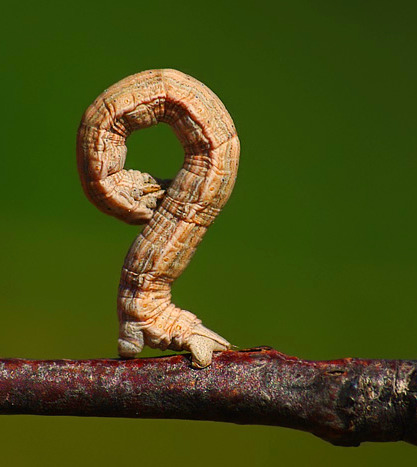
inchworm, questioning everything, appreciating the moment,

*

*

*

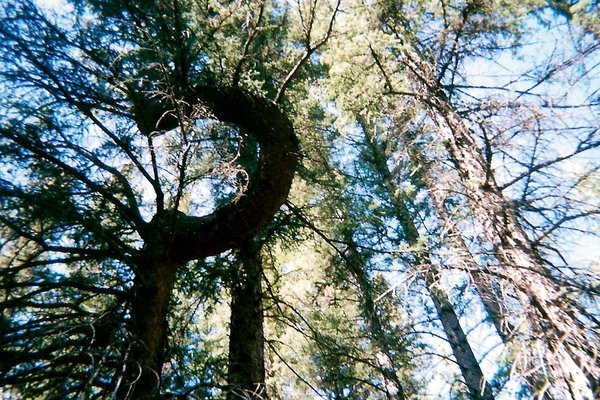
Question tree photo courtesy of Type Zero
How to Make Spiders Your Teachers, Trees Your Guides

amateur naturalist, spiders, mindfulness, nature, paying attention, field guide, children,

Pay close attention to anything. In it you’ll find wonders.

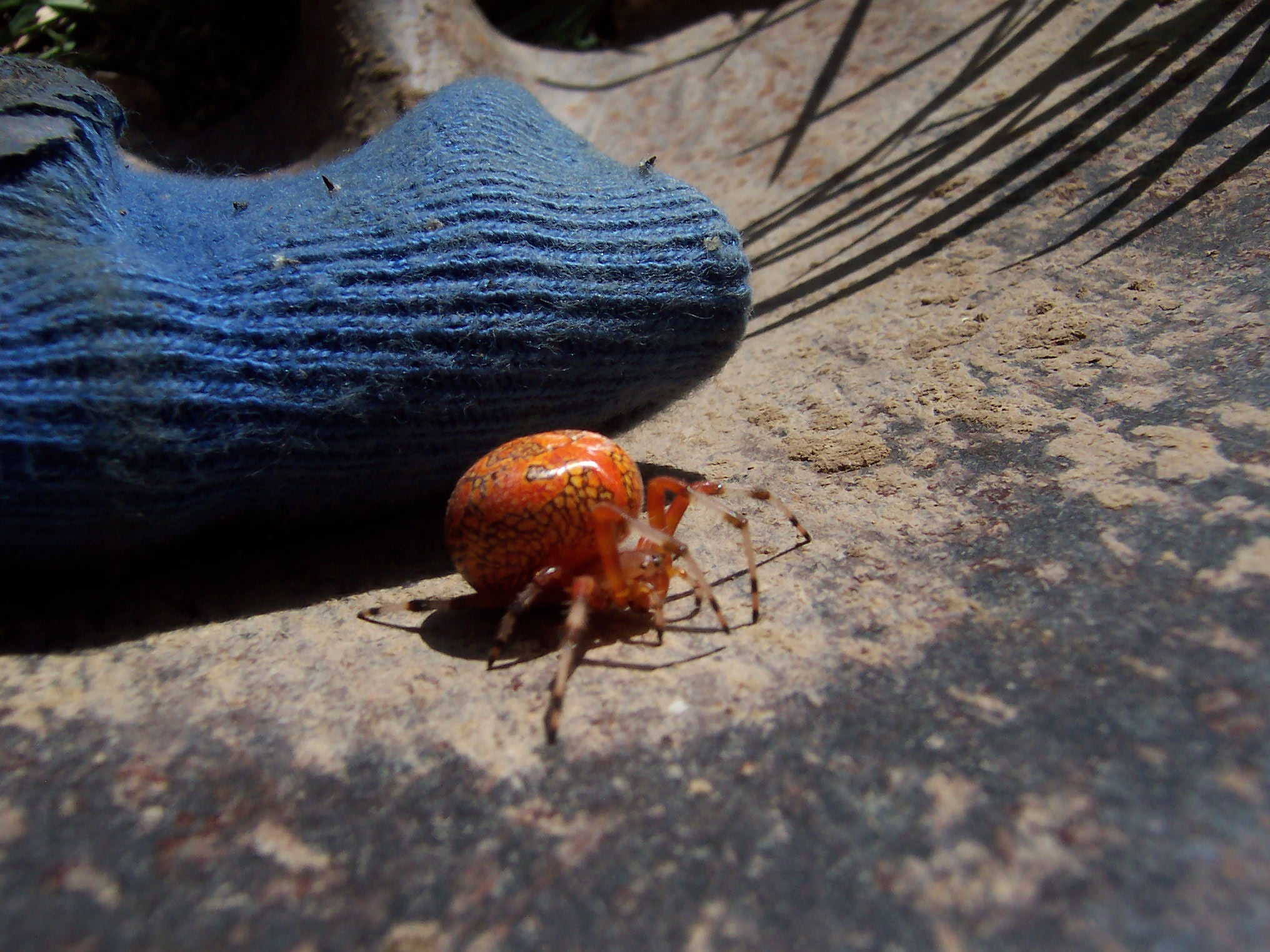
Consider the spider.

We appreciate spiders in our family. A large orb weaver lives just outside the front door. Every night when we take the dogs out before going to bed we pause to appreciate the intricate web she’s rewoven. It has a lot to teach us about strength, symmetry, impermanence and beauty.

I probably shouldn’t admit it, but a spider also hangs out on the ceiling of our pantry. Its continued presence means there are enough insects in the vicinity to keep it fed, which logically means there are that many fewer beasties getting into our potatoes, dry beans, oats and other stored foods. It has a lot to teach us about interdependence. I’m actually cheered to see it up there, a quiet brown chap making a life for itself high above my canning jars.

When we find the occasional spider elsewhere in the house we move it gently outdoors, unless it’s winter in which case we move it to a large potted plant. (I prefer spiders be relocated to basement plants but I suspect my family members free them in more conveniently located houseplants.)

No, our home isn’t teeming with creepy crawlies. It’s the same as your house. We’re all part of an ecosystem beyond our awareness. Our fellow Earth inhabitants proceed with lives of purpose everywhere around us whether we know it or not. As an example, beneficial bacteria reside in your gastrointestinal tract, contributing not only to digestion but overall health. These microbes outnumber the cells in your body 10 to 1, their types varying widely from person to person—perhaps accounting for major differences in weight, energy and wellness.

No amount of clean living sets us apart from the wider ecosystem we’re in.

It’s easier to think of nature as “out there” in the pristine wilderness. But we’re a part of nature every moment. It is air we breathe, plants we eat, birdsong we hear, weather slowing this morning’s traffic, our very cells dividing and yes, that high pitched whine signifying a mosquito is hovering nearby.

Tiny creeping and flying things around us are the creatures we’re most likely to encounter, reminders that we share our ecosystem with others. It’s even possible to notice them with pleasure.

My kids particularly appreciate spiders so we pay closer attention to these creatures. I don’t know much about arachnids, but what I learn through my offspring helps me to see more complexity, beauty and worth that I could have imagined.

I think it’s easier to pay attention when we keep the joyous curiosity we’re born with but it’s possible to recapture it, to expand it into awe at the wonders everywhere around us.

Consider making a nature study of a something nearby. A tree’s lifecycle through the seasons, the activity around a wasp nest in the eaves, the behavior of birds at a feeder. We’ve learned some techniques for the amateur naturalist from Lyanda Lynn Haupt’s wonderful book Crow Planet: Essential Wisdom from the Urban Wilderness.

  1. Learn names, proper as well as colloquial. Learn details about habitat, health and interdependence with other life forms.
  2. Have patience. The practice of seeing, really seeing, takes more than time. It also takes cultivated watchfulness.
  3. Respect wildness.
  4. Cultivate an obsession. Let questions unfold into more questions and whenever possible, find a community of fellow enthusiasts.
  5. Keep a notebook. Writing observations and making drawings are wonderfully wider ways to learn.
  6. Maintain a field trip mentality. Keep up your observations wherever you go.
  7. Make time for solitude.
  8. Stand in the lineage. Vital knowledge has been gained by a long history of people no different than you, people who let the world around them teach its wonders to those whose eyes are open.

*

*

*

To Be, Or To Multitask

multitasking, busy, mindfulness, I.Q., cell phone, distraction,

I did it again. Deleted unwanted emails while on the phone, just trying to be efficient. No, I wasn’t reading the emails. Honestly I started out just deleting. But I had to scan quickly through a few to make sure I wasn’t missing something important. And next thing you know it was time to end the conversation. Sadly our entire interaction felt flat, as if we never really connected. I know why. I wasn’t really part of it. Chances are the very busy person I was talking to wasn’t either. Yay for multitasking.

This is the opposite of my true intentions. I keep writing about the importance of paying attention, connecting with nature, and centering our lives on what’s positive.

I try, I really do. But even when we live simply it takes real effort to avoid being rushed and over-obligated.

My mother was an early adherent of multitasking. She liked to say there was no sense doing just one thing at a time. I wasn’t too thrilled about it, however, when she spent requisite quality time playing a board game with me while heating her curler-bedecked head under the hairdryer (those 70’s models were as loud as leaf blowers) and talking on the phone. I was never sure how the person on the other end of the phone heard her over that hairdryer; that person may have been loudly washing dishes, making them both disconnected multitaskers.

It’s much easier to multitask now. In fact, we’re rewiring the way we operate minute-to-minute. We’ve tuned ourselves to distraction. That seems to make us uncomfortable with distraction’s opposite—-the powerfully real time spent in contemplation or conversation.

A recent study found that people asked to forgo media contact for 24 hours (no texting,email, Facebook, TV or cell phone use) actually suffered withdrawal symptoms. They experienced anxiety, cravings and preoccupations so overwhelming that their ability to function was impaired.

When we multitask it feels as if we’re accomplishing more. Who can’t stir a pot of noodles, listen to music and still maintain a decent conversation?  That’s easy.  Although we’re not really paying attention to that music or honoring the conversation with eye contact and full awareness (let alone mindfully attending to the noodles).

The major multitasking whammy comes from doing similar functions at the same time, as I was doing by talking on the phone and checking email. That’s because the brain doesn’t really do both task simultaneously, it goes back and forth, relentlessly switching attention.

All that switching causes our performance to plummet.  Studies show multitasking makes us up to 40 percent slower or causes the same lack of concentration as giving up a night’s sleep.

Perhaps even worse, we don’t recognize the stress it imposes.  As our brains focus and refocus, our bodies release cortisol and adrenaline.  We may work faster, but also feel more frustration and pressure, and the ability to concentrate becomes increasingly impaired.

Talking on the phone and reading email doesn’t just make me somewhat inattentive, studies find that multitasking can functionally lower one’s I.Q. by as much as ten points.  In my case, I suspect it’s quite a bit more.

So many parts of our lives seem to require multitasking. Parenthood certainly does, nearly every job does too. But I want to be, really be. Multitasking subtracts from that.

I’m taking a vow to walk away from any screen any time I pick up the phone. I’m vowing to spend less time using technology, more time in nature. Any vows you’ve taken? How’s that going for you?

*

*

*

“To live in the present moment is a miracle. The miracle is not to walk on water. The miracle is to walk on the green Earth in the present moment, to appreciate the peace and beauty that are available now.”

Thich Nhat Hanh Touching Peace: Practicing the Art of Mindful Living

*

*


photo courtesy of Jayo