Regain A Missing Sense

“Awe is the beginning of wisdom.” Matthew Fox

We’re missing a sense integral to a fully-lived life. Not a sense like hearing, seeing, tasting, or feeling—although these senses should come into play too. I’m talking about a capacity that has dulled significantly since you were a very young child.

Back then everything was wondrous. You crouched down to watch a bug on the ground, curious to see how it moved through tall grass, thrilled when it lifted off on shiny transparent wings. The sun on your face, the smell of the dirt, and experience of running with your arms out in imitation of that flying creature are all still held in your bodily memory. As a small child, you lived within moments of wonder.  The sense we’re missing is awe— a heightened state of being, a sort of enhanced aliveness.

Sure, it’s necessary to become somewhat dulled to the world we live in just to get on with what we think is the real business of being an adult, but it’s easy to take it too far. Muting the capacity to be struck by wonder subtracts from who we are, even from how completely we remember our days. That’s probably why we seek out new experiences. We know we’ll catapult into wonderment when we travel to Bali or try white water rafting for the first time. Without some element of surprise it’s hard to feel fully alive. Days blend into the sameness of weeks, months, years. We hunger for surprise to waken our curiosity and if we’re lucky, to waken awe as well.

The antidote isn’t necessarily Bali or rafting (although if you’ve got the time and money get going). The antidote is freshly seeing and being present to your own life, letting it continue to surprise and awaken you.

Here’s one way to practice this.

Every single day, choose to find at least one moment that snags a loop of wonder and pulls at it. This may not be easy. But you already pay attention when there’s even a slight alteration to your routine. You may travel on the same road day after day. But when you’re stopped by construction or traffic, you tend to see details that had previously escaped your awareness. You might even convince yourself that those details are new, otherwise how can you explain never before noticing a stain on the side of a convenience store that’s shaped like a wizard or a the dinosaur-themed curtains in the window of a house or heck, not even realizing the store or house were there at all as you regularly swept by in the flow of traffic?

So you might allow your thoughts to slow and really hear the teakettle come to a boil, or really notice the intricate loops in a child’s scribbles, or really smell the green aliveness as you walk through the park.

To maintain this practice of wonderment, tell someone (even if it’s your journal) what provoked your awe, using as much detail as possible. You’ll notice that you have to pay a great deal more attention. Perfect. This puts you right in the moment, away from ruminating about the past or speculating about the future. It forces you to use your senses. Sometimes the only thing you can find that surprises you is a sound you can’t identify (investigate, or make up a fantastical reason for the sound, or try to make it yourself) or a person’s facial expression so extreme that it’s caricature-like (you might imagine a backstory or make the next song you hear explain it). If you don’t want to tell someone or write it down, sketch it. (Here are some drawing hacks for non-artists like me.)

Staying on the lookout for surprises is one way to consciously alter your outlook. You’re more wide awake to wonder, just like the child you once were.


Mindful

Everyday
I see or hear
something
that more or less

kills me
with delight,
that leaves me
like a needle

in the haystack
of light.
It was what I was born for —
to look, to listen,

to lose myself
inside this soft world —
to instruct myself
over and over

in joy,
and acclamation.
Nor am I talking
about the exceptional,

the fearful, the dreadful,
the very extravagant —
but of the ordinary,
the common, the very drab,

the daily presentations.
Oh, good scholar,
I say to myself,
how can you help

but grow wise
with such teachings
as these —
the untrimmable light

of the world,
the ocean’s shine,
the prayers that are made
out of grass?

Mary Oliver, from Why I Wake Early

Angry Stranger’s Gift

angry stranger, gift of impatience, tolerance, soul moment,

Years ago I waited in a convenience store line in complete desperation. I was still bleeding after giving birth to my daughter and needed pads. The customer ahead of me was working her way into a snit because the store was out of an item she wanted. She refused to buy similar products the clerk offered. I stood behind this customer trying to keep from judging her (and failing). She was middle-aged or older, wearing expensive clothes and fussily styled hair, but what really defined her was the kind of self-absorption that turns a minor inconvenience into a personal offense. She demanded someone check the back room where she was sure the product languished due to employee laziness. She demanded to see the manager, who wasn’t there. She. Wouldn’t. Leave.

I was so exhausted that I simply wanted to curl up on the floor. It was the first time I’d left my baby’s hospital bed for more than a few minutes. My newborn suffered from a serious malady that hadn’t yet been diagnosed. She was increasingly losing weight and vigor. All the while I missed my three-year-old fiercely. I hadn’t seen him for days aside from brief hugs in the parking lot. I spent all my time by my baby’s side. It was a triumph when I could get her to nurse for a few moments. Sleep deprived and terrified for my baby girl, I clung onto hope like a parasite.

The customer ahead of me was now yelling. I assumed she’d had no greater trouble in her life than being deprived of a convenience store product. I realized that she may have been older than my own mother, but she had less maturity than my firstborn who knew enough to respect other people and more importantly, to care about them.

I’d been in the hospital environment for so many days that simply driving to the store was a sensory overload. Bright sunlight, traffic, people engaged in daily activities were all so overwhelming that I felt like a tourist visiting for the first time. Maybe that’s why I felt a sudden tenderness for the customer ahead of me. It was as if some surface reality melted away to expose this woman’s beautiful soul. I didn’t know if she was going through a difficulty that left her frantic to have her needs, any needs, recognized. Or if she had experienced so few difficulties that she hadn’t developed any tolerance for disappointment. It didn’t matter. I saw her as utterly perfect. In that moment I felt nothing less than love.

Just then she whirled around and left. I exchanged a look of solidarity with the clerk, made my purchase, and drove back to the hospital. That encounter not only gave me a powerful surge of energy, it also boosted my spirits in a way I can’t explain. It was a boost that lasted. All these years later I remain grateful.

Leaving Little Love Letters

mother's love notes,

Image: Ebineyland

My mother regularly wrote little love letters to her children.  They started appearing on our pillows when we could first read, at least one every month or so. Sometimes her notes would reference something we did or said but mostly they simply gushed with affirmation. Her standard ran along the lines of, “You are the nicest, most wonderful seven-year-old in the whole world.”

Her one or two sentence notes were usually written on a scrap of paper. My mother made “scratch” paper out of junk mail and school fliers. She tore paper on the fold lines, getting three pieces out of a standard letter-sized sheet. This made the flip side of her little love letters unintentionally quirky, with references to bank policy or reminders about choir practice. My brother and sister got their own notes but we never mentioned them to each other. They were a private and cherished connection between mother and child.

By the time I was nine or ten years old I wrote little love letters to her too, hiding my notes in her shoe or tucked into her jewelry box. It was easy to tell when she’d found one. She’d dole out a big hug and whisper a line I’d written back to me.  It seems these notes meant as much to her as they did to me. After she died I ran across some of them stuffed into her favorite cookbook, effusive words penciled in my best handwriting.

I know all too well that family life sometimes scrapes us like sandpaper against those closest to us. We don’t talk enough about what amuses or delights us because we’re busy saying that the towels aren’t hung up, shoes are blocking the door, and food is left out on the counter. We may also be dealing with doubts kindled by worry and annoyances that can spark into anger.

Sure, we linger over tender moments that we wish could last forever. We praise the effort (as all those relationship experts tell us to do). But there’s something special when we take the time to write down our very best feelings for one another.  A note is a tangible expression unlike any other.

I won’t kid myself that I’ll ever write as many tiny love letters as my mother wrote in her life. But today I’ll be writing a few sentences to my loved ones and hiding those notes where they’ll find them. I know there’s a sense of completion when we say what’s in our hearts.

We Warp Time

slow time down, live each moment,

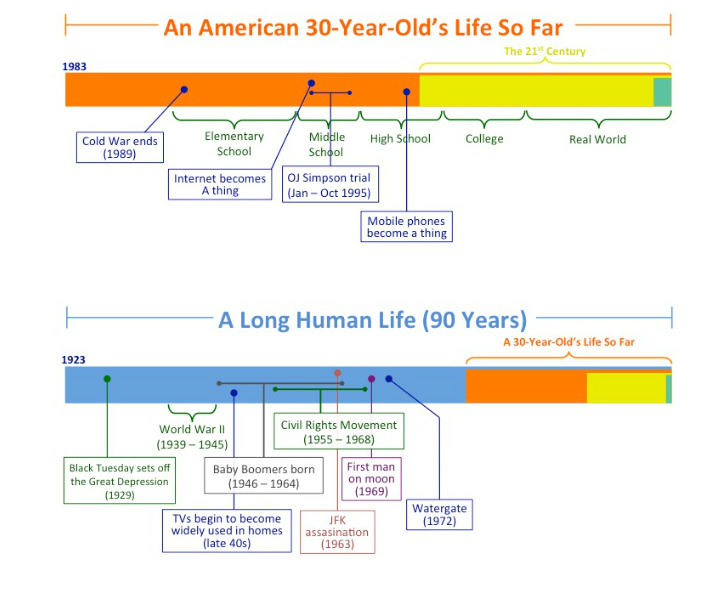
Remember sitting in third grade watching the minute hand move so slowly that dismissal time seemed weeks away?  Remember how your ninth birthday took almost forever to arrive? Yeah, that was childhood. Now months zip by with such speed that it’s becoming clear our elders hang on to handrails because time is practically knocking them down as it whips past.

This concept is brilliantly depicted at Wait But Why.

waitbutwhy.com/2013/08/putting-time-in-perspective.html

waitbutwhy.com/2013/08/putting-time-in-perspective.html

See how our perspective of time changes as the years go by?

Researcher Robert Lemlich studied the way we perceive this. According to him, 80 year olds have gone through 71 percent of their subjective experience of time by the age of 40, making the years between ages 60 and 80 seem like 13 percent of their lives. By his calculations, when we’re 20 years old we’re halfway through the felt experience of our lives, meaning that 60 additional years will seem to pass as quickly as the first 20. That’s a nasty blow.

It makes me wonder how the youngest among us sense time. If a baby cries when a parent leaves, does it feel like an eternity of sorrow to him? If a toddler’s plaything is grabbed by another toddler, does that frustration seem to stretch out forever? Maybe that’s not far from the truth.

It illustrates why our experience of time isn’t entirely explained by the proportional theory. If we think about it, we realize our perception of time has a great deal to do with what we’re experiencing. Time actually warps. Notice that it moves grindingly slow when we’re in physical or emotional pain. Time also elongates (far more wonderfully) when we’re fully present,  making even the most ordinary moments—a child’s squeal of laughter or a sip of cool water—into something larger. It stretches even further when we’re immersed in a wholly new experience—say first love or scuba diving or public speaking.

Far too often, our personal time warp goes the other way. It gathers speed because we’re busy, we’re multitasking, we’re in a rut, and thus less mindful of the passing moments that make up our days, weeks, and years.

We can get all quantum-y about it. There’s an experiment that seems to explain why time moves slower and faster according to our perception. But we don’t really need to study entangled photons to figure it out. We want to fully live the time we’re allotted on this planet.

I’m working on making my time more warpable. How do you stretch your sense of time?

slow down time, perception of time,

“The only reason for time is so that everything doesn’t happen at once.”  ~Albert Einstein

Decision To Make? Ask Your Body

I tend to fuss over decisions, considering all possible options while weighing the benefits and risks for everyone involved. Sometimes I choose the most difficult path even when it clashes with my admittedly Hobbit-like nature, in part because I have the annoying idea that growth comes from taking on new challenges.

Unfortunately the process of logical decision-making tends to wedge us into what we intellectually determine is best even if it doesn’t feel right. (I’ve gotten myself into plenty of tough situations doing exactly that.) Many of us tap into our intuition as well, but we usually give much more weight to what reason has to say.

These days I’m trying to rely less on my head and more on gut feelings for decisions large and small. It doesn’t take much to realize the glad expansiveness in my chest is a “yes” while a heavy clenched feeling in my throat is a “no.”

I don’t always succeed at this. Recently I agreed to give a series of talks and already dread them. The process of trying to be more aware of what’s authentically right for me is gradual. (NOT public speaking, my body retorts.) I suspect many of us push ourselves until our bodies force us to start paying attention….

Let’s remember, each one of us is a whole person with intelligence coming from our hearts, our guts, maybe all of our cells. But our culture teaches us from our earliest years to be in our heads while ignoring, even shutting off inner knowing. When inner promptings are so strong they override the left hemisphere of the brain, children are often labeled something else entirely—-lazy, reluctant, stubborn, headstrong, picky, anxious, timid, fussy. In reality, our bodies are telling us we need:

1. time to process or time do things at a pace natural to us

2. to step away from a particular person/situation/food/obligation

3. to honor the voice inside that already knows the answer

This is the kind of awareness that people have used since the beginning of humankind to make decisions fully, in ways we rarely access in today’s world.

Here’s a recent example of what can happen through listening to body wisdom. I have poor posture. I fight it, when I think about it, by holding my head up straight for as long as I can remember and more recently, by learning to practice natural posture. But when I’m working at the computer my head tends to sink forward until I’m hunched like a half-conscious orangutan. I know that listening to the body means, in part, paying attention to the body’s messages. So one afternoon I stopped resisting, just for a few minutes.

I listened to what my slumped posture had to tell me. It didn’t say “sit up straight!” It said go with the slump. Feeling a little silly, I let my head sink forward to a ridiculously exaggerated degree. Instantly I recognized in my body the way my father slouched when he was sad, the way my mother’s head jutted forward and down with disappointment. Their postures are in me, speaking to me. I didn’t analyze this, I just sat with it, paying attention to my body in that posture. Strangely I felt relief, even comfort, as my upper body curled like a fetus.

Then I tried the opposite. I pulled my head up into rigid “good posture”and was surprised when tears came to my eyes. My throat felt vulnerable and exposed, as it did when I was a little girl and couldn’t sleep unless my throat was covered. Again, I didn’t analyze right away, I just sat with it.

The whole process took about three minutes. Yet afterward I felt a wonderful strength up my spine. My posture felt buoyantly upright. The feeling lasted all afternoon. It was astonishing to get so much benefit from such a short body-awareness experience.

What I am saying is that your internal guidance system is there, ready to be accessed. You possess logic, which is invaluable as you consider variables and imagine outcomes. You have remarkably instructive emotions—you may feel excited, a little scared, a little eager, and pretty relieved when you imagine yourself going forward with one decision while you may feel let down, hesitant, and resistant when you imagine going forward with a different decision. Just past logic and emotion are actual body sensations. You may feel tightness in your jaw or churning in your stomach or tension in your back. You might feel the urge to stretch or dance or take a deep breath.

Simply remember, when you have a decision to make, consult your thoughts and emotions and body wisdom. The answer is there, waiting for you to pay attention.

For more on this, check out:

7 Ways To Access Your Body’s Unique “Knowing”

Free Fix For What Troubles Us

The Little Trick To Make Any Moment Better

body wisdom, gut feeling, body intelligence,

Inner Cosmos by memzu.deviantart.com

Odd Second Saturday Suppers

Odd Second Saturday Suppers, potluck inspiration, easiest party ever,

Image: 8o-clock.deviantart.com

The happiness glass fills when we spend time with people we love.  It’s startling and appalling to me how many friends I adore, but almost never see. When we do get together we can pick up right where we left off, laughing as well as diving into the deepest topics, yet we don’t make time to see each other very often. That’s just wrong. (I’ll keep myself from using the newest curse word although it applies here.)

Years ago we spontaneously invited friends over for dinner all the time. We hosted wildly silly kid events like BYOB parties (bring your own box) and pig pen parties. But lassitude set in after years of constant financial strain and the sadness of dealing with our parents’ last years. Lately I’ve been fighting back.

At the start of 2013 I decided to commit to a series of events at our house. I named them Odd Second Saturday Suppers. Last January I sent emails to a few friends who live nearby inviting them to potlucks here on the second Saturday of every odd month. That meant we committed in advance to hosting parties in January, March, May, July, September, and November. Because they were planned well in advance, I bypassed the vague “Oh we really should get together” intentions that are unlikely to happen. Here’s the invite:

Odd* Second Saturday Suppers

We’re starting a new tradition.

We are inviting friends to a regular gathering at our home for food, conversation, and simple relaxation. These will take place the second Saturday on odd months.

 I’ll send out reminders at the beginning of those odd months. We’ll provide an entree or two. Bring something to share if you can: beverage, appetizer, side, or dessert. Not sure about the time, I was thinking around five-ish but let’s stay flexible. Different months may offer different possibilities. You are invited to all but of course, come to the ones that best fit your schedule.**

 We also welcome new friends, so feel free to bring along a guest or two.

 Here are the dates:

January 12th

March 9th

May 11th

July 13th

September 14th

November 9th

*Odd as in quaint, funny, unusual. Also odd as in unevenly numbered months.

**If you abhor the idea or plan to be busy every one of those Saturdays let me know and I’ll spare you the reminders.

Sometimes as the date got closer we didn’t feel ready to have a houseful of guests. But when the day arrived we were eager to see everyone. Each event has been slightly different. We’ve sat out back to enjoy a bonfire, we’ve played Cards Against Humanity, I even cajoled people into playing absurd outdoor games, but mostly we’ve focused on eating and chatting. Because these are potlucks there’s minimal fuss. (Also, my husband and kids are great about hustling in advance of events to straighten the house, mow grass, and generally help prepare.)

By the last scheduled Odd Supper we weren’t sure if we’d continue. Difficulties cropped up as they do—a house needing repair, a job lost, a refrigerator that no one wanted to clean even if the Queen herself might be arriving.  But really, it’s not hard at all. It’s wonderful. (I was kidding about cleaning the refrigerator, we don’t invite people who care about my semi-awful refrigerator.)

So in 2014 year we’re throwing the invite list open a little wider and asking friends from a little farther away. And they won’t all be Odd Suppers. I’m plotting that several dates will be art parties or adventures far from our little farm.

How are you fighting back against the forces that keep you from enjoying friends near and far?

Delight-Driven Willpower

positive habits, joyous willpower, happy habits,

Willpower isn’t a trait mastered by the strongest among us. It’s a form of energy that wears down if overused.

When you exert a lot of effort to stop several habits, you may be subtracting the very energy necessary to fulfill your intentions. For example, if frugality is new to you, you might vow to give up the morning latte, lunch out, buying magazines at the newsstand, and scrolling through online stores. You may give up so many habits at once that your willpower is taxed and you find yourself spending more or drinking more or arguing more once the weekend arrives. I don’t have a spending problem, not even close, but I do have plenty of habits I’d like to drop. They jangle at me like annoying wind chimes made entirely of what I want to change about myself.

We’re more likely to be successful when we take on one or two changes at a time, letting them become comfortable patterns before adding more. It’s commonly said that it takes at least 21 days to create a habit. Not too sure about that. If it’s a rewarding new habit it may have significant sticking power in a few days. If it’s a tough habit to drop (like my departure from eating wheat), it may still seem alluring years later. I know all about this. (Pizza, why do you call my name?)

And we have to remember there’s typically a gap between what we know and how well we apply it to our lives. A big gap that extends through four stages of competence. No wonder it’s hard to change.

We often associate self-discipline with the loss of short term pleasure (lose weight, save money, stop wasting so much time on Facebook). But for some of us with pretty decent impulse control, self-discipline can too easily tip into self-berating. Negativity gets us nowhere. It’s essential to be attuned to the positive, to see how we’re making progress rather than focusing on where we’re going wrong.

I think we should use willpower to cultivate delight in our lives rather than seeing it as a way of dropping bad habits. Those lovely new joys we’re practicing may very well nudge out what we don’t want in our lives as a side benefit.

Oh, and one more thought. Sharing our goals is a way of augmenting our willpower. That’s why I’m sharing my list.

Delights to Cultivate

1. Be a person who wears interesting hats.

2. Lie in the grass whenever possible.

3. Lean toward single-tasking. (That means you Pinterest.)

4. Tune in to sensory pleasure: birdsong, soft blankets, wind in the trees, warm soup. 

5. Keep ice water by my desk to inspire hydration (not to inspire klutz moves that might dampen my keyboard or phone).

6. Say positive things about myself (no more predicting future klutz moves).

7. Sigh whenever I want to, because it stimulates the vagus nerve. Ahhhh, that feels good.

8. Go barefoot more often.

9. Send oddities via snail mail.

10. Use gifts given to me rather than setting them aside for “good.”

11. Develop life lists.

12. Stretch my creativity by sketching for fun, without judgment.

13. Be happy with what I’m getting done rather than focus on what I haven’t accomplished.

14. Go on out-of-the-ordinary dates with my beloved. Maybe I can talk him into glassblowing lessons!

15.  Dye my hair pink. Okay, maybe a few streaks.

16. Honor the wisdom found in doing nothing.

What delights do YOU want to cultivate?

positive willpower, habits of joy,

Image:pixoti.deviantart.com

Look Up

nature exposure linked to nearsightedness, cloud appreciation, cloud collectors,

Summer. Perfect for lounging around doing nothing more than gazing at clouds. It’s a completely free pastime.

The traditional spot to indulge in this pleasurable activity is sitting in the grass. Better yet, lying on the grass. Stay there as clouds drift into view over treetops and roofs, slowly changing form. Linger long enough, you might insist you can feel the planet moving.

Looking at clouds is a perfect way to disengage from all the buzzing, ringing distractions that claw our attention to shreds. Those puffs of air vapor seem to invite contemplation. And that’s good. Daydreaming is so rejuvenating that it can boost creativity. It also helps us to relax, review emotion-laden situations calmly, generate new ideas, and get to know ourselves better.

When we let our minds wander, we’re in what neuroscience calls the “default mode network.”  An L.A. Times article titled, “An Idle Brain May Be The Self’s Workshop” notes,

“Just as sleep appears to play an important role in learning, memory consolidation and maintaining the body’s metabolic function, some scientists wonder whether unstructured mental time — time to zone out and daydream — might also play a key role in our mental well-being. If so, that’s a cautionary tale for a society that prizes productivity and takes a dim view of mind-wandering.”

Even when you don’t have time to lie in the grass, take the time to look up. You may notice there’s really no such thing as a less-than-fascinating sky. Raining, snowing, overcast, starry, it’s all lovely and always in a slightly different way.  It has to do with seeing, really seeing.

I learned this when I helped conduct a psychology study in college.  We went to urban office buildings and asked people two questions. First, we asked each person to describe his or her mood. Second, we asked them to describe the current appearance of the sky. These people were in their offices or hallways when we talked to them and the windows in most buildings were shuttered with horizontal blinds ubiquitous during that decade, so the only way they could have described the sky is if they had paid attention on their way to work or during a break. Here’s the interesting part. The people who identified themselves as pessimistic, angry, depressed or in other negative terms were also the ones unable to describe the sky’s appearance. You guessed it. The happiest and most optimistic people either correctly described the sky or came very close.

That study was never published, but research these days now indicates that pausing to experience nature in our daily lives is powerfully positive. Just a few minutes of regular exposure has been shown to improve our emotional and physical health. It leads us to be more generous, to enhance relationships and value community. The effect of nature, even looking out a window at nearby trees, seems to lead us, as one researcher noted, to be “our best selves.”

Go ahead, look at some clouds right now. You may see a cloud pig sailing a cloud boat. The sailboat may morph into French fries before the whole thing breaks apart into a shape resembling a bongo-playing octopus. Good thing the images we see in clouds aren’t a meterological Rorschach test.

stress relief, look at the sky,

Resources

Find out how nature-deprivation can affect your child’s eyesight.

Check out the Cloud Appreciation Society.  You can post photos to the online gallery, chat about all things cloudy on the forum, and live by their manifesto which includes a pledge to fight “blue-sky thinking.”

Consider becoming cloud collectors. Bird watchers keep a life list of their sightings, now cloud watchers can do the same with The Cloud Collector’s Handbook by Gavin Pretor-Pinney. Packed with beautiful photos, this is a perfect book for adults and kids to share as they “collect” different cloud types.

You might want to keep a handbook near a window or in your car, ready to help with identifications. Two of the best are The Cloudspotter’s Guide: The Science, History, and Culture of Clouds also by Gavin Pretor-Pinney and The Book of Clouds by John A. Day, who was known through his long career as Cloudman. Check out resources on Cloudman’s site including instructions for making a cloud discovery notebook, tips for photographing clouds, and cloud history.

More information available through the National Oceanic and Atmospheric Administration.

family fun cloud watching,

How To Grant Wishes

fostering success, partnering for success, making dreams happen, goal group, fostering goals,

Image:helen-carter.deviantart.com

When I was a child an elderly neighbor shared her life-long dream. Lottie Borges had always wanted to get behind the wheel of a semi, start it up, and drive. I got a glimpse of a yearning that couldn’t be hidden by her apron and heavy orthopedic shoes. Years later when I heard she’d died I was sorry the thrill she longed to experience driving an 18 wheeler had never come to pass.

Each one of us has dreams. Sometimes they’re suppressed so long that it’s not easy to remember them or the spark of vitality they once roused in us. We forget because we’re busy meeting our family’s need, what the boss wants, what amusements can fill the moments we have left over. We set aside the goals we once held dear. They are not gone, just dormant.

Our culture emphasizes personal effort. It’s assumed that failure to achieve our aims lies entirely with the individual. But that’s not how wishes usually come true. They happen in the context of relationships. When we talk about our goals with people dear to us we infuse our ideas with energy. It’s a way of activating a network of people who, along with us, envision our dreams taking place. That network may help bring about the exact circumstances necessary to achieve our goals. Perhaps if my former neighbor had shared her wish with someone other than a child she might have connected with a truck driver who’d have gotten a kick out of letting her take his rig for a run around a back lot.

A few years ago I got together with a group of friends and, on the spur of the moment, we decided to write down our long-held wishes. We laughed, wondering if old fantasies (such as running away with a teen idol) should be included. But the challenge was compelling so we started writing. When my friends shared their goals I saw sides to them they rarely revealed. Here are some of their wishes:

  • I will get a lead role in community theater.
  • I will travel to Ethiopia.
  • I will master class 5 white water rafting.
  • I will record my parent’s reminiscences.
  • I will have a graphic novel published.
  • I will get a master’s degree in library science.
  • I will become a foster parent.
  • I will take a class in conflict resolution.
  • I will paint wall-sized murals.
  • I will build a clay oven in the back yard.
  • I will finish the quilt my grandmother started.
  • I will learn to speak Russian.
  • I will be elected to city council.

We realized that we should meet occasionally to support each other’s dreams. By discussing what we are doing to reach our goals and how we can help each other, we’re more likely to turn intention into reality.

If you’re interested in our wish granting process, here’s the method we’re using.

1. Get together with at least one other person with whom you have a mutually supportive relationship.

2. Brainstorm. Call up the longings you had as a child, the grand plans you envisioned as a young adult, the places your mind wanders when you daydream.

3. Write down those yearnings. Word them concretely. It is easier to check off a goal such as “Complete a pottery class” than a vague listing such as “Try making pottery.” Instead of vowing to “appreciate people more,” expect yourself to “Write letters to six people telling them why you appreciate them.” Include a range of possibilities— creative, professional, interpersonal, physical, and inspirational. Make some challenging, some just for fun.

4. Make the list as long as possible. Shoot for 50 or 100. Pushing yourself to write so many goals forces you to look inward, uncovering deep desires that you may have buried.

Such a list will take some time, but you may find that long-suppressed dreams ease back into your consciousness only after you’ve written down goals that seem silly or impossible.

5. Put stars by at least five of the most important dreams. Remember your list isn’t a set curriculum. It can change as your goals evolve. 

6. Talk about what steps you need to take to accomplish them and how can you support each other in these steps. Often it’s helpful to plan on baby steps, starting small and recognizing there may be tumbles as you work your way up to bigger steps.

7. Write yourself a note to be opened three months from now. Or write an email using futureme.org timed to arrive in three months. This note should be in present tense and action oriented, “I am saving $50 a week towards my trip” or “I am practicing Russian each evening and looking for a native speaker to build my language skills.” This is a great way to promote progress. Then write another message to yourself, to be opened in another few months.

8. Keep the wishes shared by others alive through encouragement but also through your belief that the vision will be reached. Continue to pay attention to circumstances that may be helpful to others as you work toward your dreams together.

Something happens when goals are written down. When we make a conscious decision to guide our lives in the direction of our dreams, possibilities begin to open. And when we share that process with others, we have the delight of helping them make their wishes come true.

By the way, the wish lists written with my friends are already adorned with check marks.

ADHD Meds Provide No Long-Term Benefits

no benefit to Ritalin, ADD drugs no long-term benefit, should I medicate my child's behavior,

Want to cause a ruckus? Criticize attention-deficit meds.

Over three million U.S. kids take these drugs. Parents may not be thrilled to dose their children but they are following expert advice.  They typically see results. And they don’t need to be judged.

But it helps to pay attention to what works for parents who don’t put or keep their kids on meds. My son was diagnosed with ADD when he was in first grade.  There was a great deal of pressure from his teacher to put him on medication. As many parents do, I struggled to find ways to alleviate the problem without drugs. We found significant improvement when we changed his diet but that wasn’t enough to make the school setting truly work for him. The way he learned best and the way he flourished simply didn’t fit in the strictures of the school environment. He wasn’t wired to sit still and pay attention for hours. Once we began homeschooling we discovered that without classroom and homework pressure, what appeared to be ADD symptoms largely disappeared.

The newest studies of attention-deficit disorder medications now indicate that the calming effect of these drugs don’t necessarily indicate that those who take them have any sort of “brain deficit.”  As L. Alan Sroufe, professor emeritus of psychology at the Universityof Minnesota’s Instituteof Child Development explains, such medications have a similar effect on all children as well as adults. “They enhance the ability to concentrate, especially on tasks that are not inherently interesting or when one is fatigued or bored, but they don’t improve broader learning abilities.”

Research shows the effect wanes in a few years without conferring any lasting benefit. Dr. Sroufe writes,

To date, no study has found any long-term benefit of attention-deficit medication on academic performance, peer relationships or behavior problems, the very things we would most want to improve.

While Dr. Sroute looks for a mental health answer, psychologist Bruce Levine looks to society. In a recent article he notes that rational responses to larger social conditions (depression due to economic crisis, for example) are being suppressed by medication rather than addressing underlying circumstances. In particular, he asserts that non-compliance with authority is labeled a mental health problem rather than a useful response. He writes,

Do we really want to diagnose and medicate everyone with “deficits in rule-governed behavior”?

Albert Einstein, as a youth, would have likely received an ADHD diagnosis, and maybe an ODD one as well.  Albert didn’t pay attention to his teachers, failed his college entrance examinations twice, and had difficulty holding jobs. However Einstein biographer Ronald Clark (Einstein: The Life and Times) asserts that Albert’s problems did not stem from attention deficits but rather from his hatred of authoritarian, Prussian discipline in his schools. Einstein said, “The teachers in the elementary school appeared to me like sergeants and in the Gymnasium the teachers were like lieutenants.” At age 13, Einstein read Kant’s difficult  Critique of Pure Reason— because he was interested in it Clark also tells us Einstein refused to prepare himself for his college admissions as a rebellion against his father’s “unbearable” path of a “practical profession.” After he did enter college, one professor told Einstein, “You have one fault; one can’t tell you anything.” The very characteristics of Einstein that upset authorities so much were exactly the ones that allowed him to excel.

This is a big issue. I am lucky I eluded being put on meds to treat the problems I had as a child. I wouldn’t give up those years of painful churning for anything. That’s exactly what formed me into a person with my particularly intense focus and purpose.

I think we need to widen our focus. The issue asks us to look at how today’s children are restricted in movement, have less time for free play, and are exposed to unnecessarily early academics.  It asks us to look at the quality of the air, water, food, and products in the lives of today’s children. It asks us to support all families as they are, recognizing that one-size-fits-all guidelines don’t embrace diverse ways of being. To me, particular hope lies in research showing that free time spent playing in natural settings significantly improved the behavior and focus of ADHD children. The more natural and wilderness-like the area, the greater the improvement.

Our wonderfully distractible, messy, impulsive children may be trying to tell us something.

For more answers beyond the prescription bottle, check out:

Ritalin Nation: Rapid-Fire Culture and the Transformation of Human Consciousness

The Gift of ADHD: How to Transform Your Child’s Problems into Strengths

Dreamers, Discoverers & Dynamos: How to Help the Child Who Is Bright, Bored and Having Problems in School (Formerly Titled ‘The Edison Trait’)

ADHD Without Drugs – A Guide to the Natural Care of Children with ADHD ~ By One of America’s Leading Integrative Pediatrician

Is This Your Child?

Healing ADD: The Breakthrough Program That Allows You to See and Heal the 6 Types of ADD