38 Unexpected Ways To Revel In Snail Mail

literacy skills, mail art, mail exchanges, snail mail fun,

The Force is strong with snail mail. (Image: CC by 2.0 Wikimedia Kev pittsburgh,pa)

Most of us don’t get anything interesting in the mail. Opening a personal letter seems like a pleasure from another era, irrelevant as a starched collar. Lets reclaim that experience. (The letter, not the collar.)

But first a rant. Here in the U.S. our postal service is often described as inefficient and unprofitable. I beg to differ. When I mail a letter in Ohio, it’s often delivered in Boston or Denver the next afternoon. I’ve mailed plenty of letters to distant countries. They show up in a week, tops. A few ounces of paper arrives in the one place in the world I want it to go, all for less than a buck. That’s pretty impressive. And the post office lets me mail unwrapped shovels too (more on that later).

Unprofitable? That’s not the real issue, unless you count the postal system having to pre-fund it’s retirement system 70-some years in advance. Name a company that can do that and stay in business.

I’m all about going postal. Sending and receiving mail helps us slow down, savoring time in a way that’s often missed in our terabyte-speed lives. Here are some ways you can make snail mail a pleasure.

Mail something unwrapped.

1. Try mailing a full-sized paintbrush, a basketball, a flip flop. All you need is a legible address and the correct postage. You might feel a little silly standing in line at the post office with an address-adorned plastic dinosaur, but it’ll be worth the look on your recipient’s face. I’ve mailed all sorts of silly things to a friend, mostly in response to oddities she mails to me. The strangest thing I’ve sent was a two foot metal shovel with a wooden handle. I used a permanent marker to write a note to her on the handle and the address on the metal part. It got there just fine.

2. For more ideas on what you can send through the mail, check out the Pinterest board 13 ounces or less. Check USPS regulations on what cannot be sent by mail.

Investigate the peculiar history of unwrapped mail.

3. In 1914, five-year-old Charlotte May Pierstorff was sent via U.S. mail as a package to visit her grandparents. It was the only way her parents could afford the trip. My kids and I learned about her journey from the picture book, Mailing May, by Michael O. Tunnell. She’s not the only person to be sent as cargo.

4. The most inspiring example is Henry Box Brown, who in 1849 was enslaved in Virginia. Using his savings to pay for the clandestine delivery, he had himself mailed to an abolitionist in Philadelphia. The trip took 27 hours, much of it upside down despite “this side up” instructions on the box.

5. The quirkiest unwrapped mail history I’ve run across involves W. Reginald Bray. In 1898 this British accountant began to send all sorts of unwrapped objects via mail. That included, but wasn’t limited to, a rabbit skull, a bowler hat, a turnip, his Irish terrier, and a bicycle punk. He also mailed himself, twice. He liked to test the logic of postal employees by mailing cards with addresses written as puzzles or clues. You can find out more about Bray in, The Englishman who Posted Himself and Other Curious Objects by John Tingey.

Get back in the habit of writing letters.

6. Send a letter to your great aunt or a former neighbor.

7. Write letters to deployed service members.

8. A mailed letter has a greater impact on your elected officials than calls or emails, so if an issue is troubling you take the time to write out your concerns. Only a tiny fraction of the country’s citizens have ever done this.

9. Write to an author (his or her publishing house will forward your letter).

10. Write to a business. My son once wrote to a pen company to settle a bet he had with me. He said my habit of leaving pens uncapped  would dry them out. He not only got a response confirming that he was correct, but the pen company’s PR person sent eight different pens for him to enjoy as well as an admonition to keep after his pen-wrecking mother. For other ways to inspire kids (or the kid in you) to write letters, check out any of Letters from a Nut books by Ted Nancy.

11. Groups of kids (classes, scouts, homeschool groups) can participate in letter exchanges with Peace Corps volunteers through the Coverdell World Wise Global Connections correspondence program and with long distance truckers via Trucker Buddy.

12. Find a snail mail correspondent through The Letter Exchange.

Make your own envelope out of something unexpected.

13. Use a leftover scrap of wrapping paper, a torn out magazine page, a file folder scribbled with equations, an old map, whatever you’d like.The simplest way is to pull apart an envelope to use as a template, sealing your new envelope with a glue stick once you’ve popped a letter inside. For more detailed instructions, head over to Instructables.

14. If you don’t want to seal your one-of-a-kind envelope with ordinary tape or glue, make your own flavored envelope glue.

15. Or hide your letter from prying eyes using ancient techniques of letterlocking.   These are clever methods of tucking, folding, and sealing used before envelopes were invented. One version is called the “daggar-trap!” More about that here.

Let your stamp make a statement.

16. There are amazing USPS stamps out there reflecting practically every interest, but they don’t stick around (stick, hah) very long. Every time I go to the post office I check to see what they’ve got available. No flag stamps for me. I’m particularly fond of stamps commemorating nature, science, and the arts.

17. You can also make your own customized postage. Our cows’ faces could be stamps, the smiling cactus your kid drew could be stamps. USPS authorized vendors include stamps.compictureitpostage.com, and zazzle.com.

Send postcards, get postcards.

18. Register with Postcrossing. When you send a postcard you’ll receive a postcard back from another participant anywhere in the world. So far, 16 million Postcrossing postcards have been exchanged.

19. To set up a specific postcard exchange (or other snail mail swaps) put up a request on Swap-Bot.

20. When you’re out, even on a day trip, encourage young children to mail postcards to themselves or their siblings. Just a quick sentence helps establish the day as memorable (and reinforces literacy skills). It’s also fun when that postcard arrives at your home in a day or two.

Get involved with or instigate a mail exchange.

21. I love art exchanges. I’ve participated in them on and off over the years, writing and decorating a page in a journal before sending it along to the next person or contributing to themed art challenges. My favorite was a Barbie art challenge. I glued a Barbie’s long hair into stiff twisting strands, gave her some theatening-looking facial features, and mounted her disembodied head into a tiny cardboard replica of a TV set with a “Medusa” remote. Find mail art calls through the International Union of Mail-Artists as well as Mail Art Projects.

22. Propose a mail exchange on a forum, blog, or other group. Make it themed, for example followers of a food blog send each other local foodstuffs. Fans of a particular musician send each other her lyrics re-imagined as comics or movie scenes.

23. All sorts of parenting lists host exchanges for kids who want a postcard from each state, a letter answering the same 10 questions from 100 participants, or favorite jokes. Suggest an exchange your kids would like.

Write to kids.

24. Chances are you know children who would adore getting mail addressed to them, either your own kids or kids in your extended family. Try for at least a once-a-year tradition like a note on the child’s birthday. Or more memorably, on a quirky day. How about a letter every year on Waffle Day (March 25) or Go Barefoot Day (June 1)?

25. Consider writing letters as if from an imaginary creature telling a series of tales, perhaps the adventures of a rollerblading squirrel and her sidekick, a jogging possum. No less than J.R.R. Tolkien wrote and illustrated a holiday letter for his children every year, arriving as if from the North Pole. See his drawings and text in Letters From Father Christmas

26. Write about your experiences when you were the child’s age.

27. Encourage return communication when you write to kids. At the very least, send them pre-addressed envelopes with stamps. You might write with a challenge. (Okay, a better one than the following example!) How about enclosing a length of string and the question: How many ways can you use this string?  Maybe offer a prize if they write back with more than a dozen ideas.  Or send response letters you’ve made with fill-in blanks to answer questions like:  This week I was surprised when ________. If I could go anywhere tomorrow I’d like to go _________. If I ran the country, the first thing I’d do is __________. Most people don’t know that ______.

28. Write to toddlers well before they can read. Print a simple sentence or two, replacing some nouns and verbs with rebus pictures. (If you’re not familiar with this, it means drawing a cat face instead of writing the word “cat.”) Add something to the envelope that the child might find interesting, like stickers.

Mail a simple thank you note.

29. Even a few lines of thanks come across differently when they’re written on paper and sent by mail. They seem more earnest and carry more meaning than the same few lines in a text or email. John Kralik discovered this when he was at the lowest point in his life and vowed to mail one thank you note every day for a year. Somehow, the effort of thanking others  brought unexpected returns to his life including business success, weight loss, and richer friendships. Read his story in A Simple Act of Gratitude: How Learning to Say Thank You Changed My Life.

30. Send a thank you to a favorite teacher, a former mentor, the local bookstore owner whose business you appreciate, someone who did you a kindness that you haven’t forgotten.

31. Consider writing a letter to someone you see everyday. Your child, your spouse, your co-worker. Tell them something you cherish about them or how they enrich your life.

When the situation calls for it, tell your truth with an un-thank you note.

32. Of course it’s best to handle negative situations immediately, but I’ve gotten some dire predictions from professionals that proved false over time. This surgery is absolutely necessary. You’ll have a maladjusted child if you homeschool. Ritalin is the only solution for that behavior.  It’s my contention that sending a respectful letter updating a doctor, teacher, or other expert is a kindness to the people they will advise in the future. There are ways to write a useful unthank you note. Chances are you won’t get a response but you’ll feel lighter.

33. If you want to tell the world the truth anonymously, mail a postcard to PostSecret. Keep up with these powerful, often artfully shared secrets via Facebook and check out the TED talk by founder Frank Warren.

  Use handwritten notes to advance professionally.

34. It seems counterintuitive when there are faster ways to communicate, but that’s the point. A letter to a business contact makes a lasting impression and does so at just the right speed.

35. The go-to guide for this is Business Notes: Writing Personal Notes That Build Professional Relationships by Florence Isaacs.


Inspire yourself to write letters by reading epistolary novels.

36. The Color Purple is told through letters and if you haven’t read it, this book isn’t to be missed. The Historian centers on a medieval book that opens clues to Dracula’s existence. The Guernsey Literary and Potato Peel Pie Society reveals memorable characters living on the island of Guernsey during the Nazi occupation. Any of the Griffin & Sabine books have intriguing tiny envelopes inside, giving the reader the sense of peeking at private correspondence.

37. For teens: Sorcery and Cecelia or The Enchanted Chocolate Pot, about two cousins drawn up in a alternative universe complete with romance, wit, and magical chocolate. Or for more romance plus intrigue at Australian high schools, two very popular books by the same author, Feeling Sorry for Celia and The Year of Secret Assignments

38. For young children: Help Me, Mr. Mutt!: Expert Answers for Dogs with People Problems as well as any of the many books starring the ever-clever letter-writing dog Ike LaRue.

For more motivation, spend time with those who exult in snail mail.

365 Letters

Mail Me Art

Letter Matters

Letters of Note

Always First Class: The Pleasure of Personal Letters

Changing The World One Choice At A Time


small steps big change, history is small decisions, change world through love, daily choices change world,

ArtbyJude CC by 3.0


When I was growing up I was told I could be anything I wanted to be if I worked hard enough. The examples I was given at school and church were daunting. Heroes who did no wrong and martyrs who suffered for a cause without wavering. The media showed me examples too. People who were celebrities because of their talent for acting or playing games or for their appearance alone. All these people seemed larger than life.

I didn’t want fame but I did want to accomplish important things. I wanted to find the source of sorrow, injustice, and suffering so that it could be alleviated. The urge to do this was constantly with me and often overpowering. When I was very small I wanted to bring peace to every caged puppy or crying baby I encountered. I couldn’t, although I did absorb the misery I perceived, turning it into questions that the adults around me couldn’t answer. As I approached my teen years I searched for my own answers. I learned all I could about the world’s wrongs, hoping to find out why greed and cruelty happened. I committed myself to do something important. An ordinary life that did nothing to turn the world around seemed unthinkable. Whatever I did, it had to be big. My time on earth had to make a difference.

My quest to understand all that was wrong turned me in the opposite direction from hope. It showed me the worst of humanity. Slowly I came to realize that building on what’s positive brings greater possibilities into being. My days as an adult have proceeded without accomplishing anything Big. But I’ve come to think it’s the countless small actions, even thoughts, that truly have significance. We’re faced with these choices every day.

  • Do I wave to my neighbor, the one who condemns me?
  • Do I give the cash in my pocket to a street person or do I look away?
  • Will I cook tonight’s dinner from scratch, perhaps making enough to bring some to a friend recovering from an illness?
  • Do I turn from what I’m doing to truly look and listen when someone talks to me?
  • Should I go to yet another activist meeting, surrounded by often despairing people? Would it be better to write an article about the issue or simply to focus my energy on new possibilities that make the issue obsolete?
  • Do I fritter away time on tasks that feel like “shoulds” even though time seems to be slipping away like escalator stairs?
  • Do I read too much, blotting out my own experiences, or is it fine to indulge this obsession of mine?
  • Do I believe that humanity is becoming more aware, more kindly, more open?
  • And because my answer is yes, do I live that yes?

None of these are major challenges, but how I answer such questions is how I live my life. They have to do with how I conduct myself and how I see the world around me. The questions aren’t clear-cut, so it’s not always easy to discern where on the scale my answer falls. Leaning toward loving attention or apathy? Joy or bitterness? Eagerness or weary resignation? Considering larger implications or thinking only of my whims?

I’m undisciplined and prone to stubbornness, so I make plenty of choices that wouldn’t pass an ethical stink test. Still, each one matters.

We’ve been taught that only Big people with “real” influence make a difference. That makes us feel powerless. Chances are, that’s what Big money and those who control it want us to think. If we feel powerless we give up before we try. After all, the advertisements surrounding us insist our major choices have to do with what we wear, the cell phones we use, the cars we drive, the vacations we take. Oh and having teeth so white they shine like LED lights each time we smile. Larger social, environmental, and political concerns may keep us in a state of anxiety but are nothing we have any control over. Or so we’re told. Hush about unemployment and income disparity. Hush about erosion of Constitutional rights, climate change, drone strikes. Just stimulate the economy like a nice shopper. As soon as the Big experts are done distracting us with their divisiveness they’ll handle it.

That’s true only if we agree with the idea that Big matters. Because all around us is the present, which appears little and inconsequential, but isn’t. Acting in the present may mean choosing to slow down, to meet our neighbors, to take a deep breath and be grateful, to speak up against a wrong, to step outside and look at the sky, to turn off all devices and spend time with someone, to eat while savoring each bite, to do something difficult with no assured outcome. It doesn’t mean ignoring injustice or wastefulness.

A response in the present is corrective. Even fixing the largest problems requires small steps. Incremental progress, both in attitude and action, is behind great social and environmental change.  In fact, the idea that only Big change can fix problems is part of the problem. When bureaucrats or corporations institute top-down changes they often make situations worse. Real progress happens when the same people who are affected by a problem take power over the choices and act on that power. This rises from small choices, values elevated to action.

We’ve all heard of the butterfly effect. A butterfly flaps its wings in the rainforest, as a consequence weeks later there are tornadoes in Texas instead of clear skies. The effect, coined by mathematician Edward Lorenz, basically says that small change in one place can result in large differences later. It’s a fascinating look at chaos theory, but it also means nothing we or anyone (even a butterfly) does is without consequence. Just as a butterfly in Brazil has no way of knowing it may affect weather patterns a continent away, we often can’t predict the consequences of our choices let alone understand the long term impact. Our choices are those butterfly wings. Who I am today might be a disappointment to the determined child I once was, but I know now that worthwhile doesn’t have to mean big. How I fill a day is how I fill a life.

Respecting A Child’s Urge To Discover

theory of loose parts, kid innovators, creativity, learning is discovery, self-motivation,

misspenthopesxx.deviantart.com

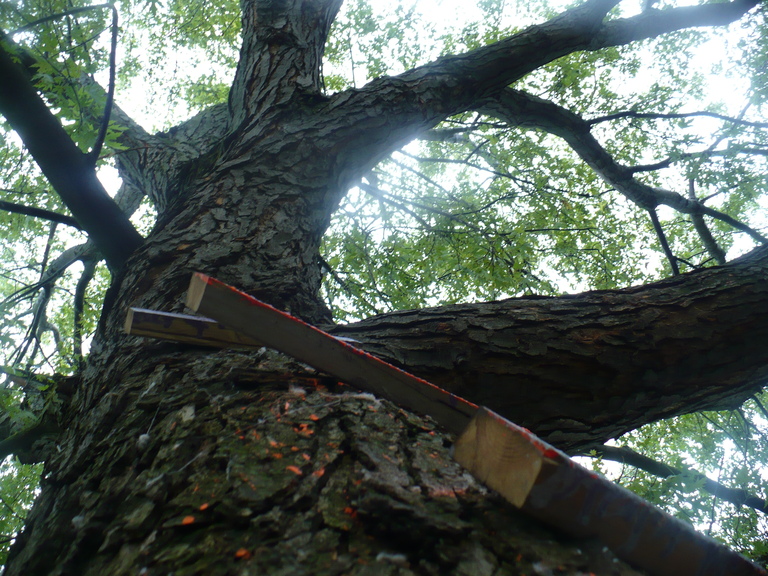
The kids had a bunch of boards, some old nails, a hand saw, and a few hammers. They also had the two most important ingredients, the desire to make something and the freedom to do so.

They spent an afternoon planning their tree fort, enthusiastically arguing over whose plan was best. Their first few attempts failed spectacularly. They were undaunted, even bragged a little bit about the noise the boards made falling down. Several of them asked family members for advice. A few others paged through books and watched YouTube videos as they tried to figure out basic construction techniques. They started again, measuring more carefully as they built a frame. The process took much longer than they’d expected but they stuck with it. When they ran out of materials they scavenged tree lawns on garbage pickup day, dragging back pieces of wood. They got a few cuts and bruises. They were proud of those too. As they worked they talked about how they’d use their clubhouse. It didn’t occur to them how much they were learning.

Conventional thinking tells us that children benefit from the newest educational toys and electronics, lessons, coached sports, and other adult-designed, adult-led endeavors. Well-intentioned parents work hard to provide their children with these advantages. They do this because they believe that learning flows from instruction. By that logic the more avenues of adult-directed learning, the more their children will benefit.

But learning has much more to do with curiosity, exploration, problem solving, and innovation. For example, if baby encounters a toy she’s never seen before, she will investigate to figure out the best way or a number of different ways to use it. That is, unless an adult demonstrates how to use it. Then all those other potential avenues tend to close. Studies show that “helpful” adults providing direct instruction actually impede a child’s innate drive to creatively solve problems. This experience is repeated thousands of times a year in a child’s life, teaching her to look to authorities for solutions, and is known to shape more linear, less creative thinking That’s true of a baby as well as older children and teens.

Young people are also cued to ignore information that is too simple or too complex. Research indicates that people are drawn to learn from situations that are “just right” for them.  They may make plenty of mistakes along the way, just as babies fall when learning to walk, but facing those challenges and making those mistakes are pivotal steps in maturity.

It’s also well-known that a child’s natural motivation tends to diminish in adult-led activities. Unless they’ve been raised on a steady diet of ready-made entertainment, children are naturally drawn to free play. They pretend, make up games, daydream, wonder, and launch their own projects. They are discovering not only the world around them but a rich inner life as well.

Of course adults are vital to young people’s lives. They provide safety, guidance, love, and much more. Kids know they can ask trusted adults for help or advice. They do so more eagerly when they recognize these adults won’t overwhelm them with information, quiz them on what they are learning, or take over. Adult responses simply need to stay in proportion to a young person’s request.

For an example of how powerful the drive to discover can be, let’s take a brief detour to two Ethiopian villages. These places may be rich in intangibles like family and tradition, but they are poor in every other way. The illiteracy rate is practically 100 percent. There aren’t even written words around for children to see: no books, no labels on packaged foods, no street signs. That’s where the One Laptop Per Child (OLPC) project dropped off 1,000 tablet PCs with solar chargers. They weren’t handed out in a school, but to kids. The devices were pre-loaded with English-language operating systems and software that tracked how the tablets were used. The boxes were taped shut, with no instruction given at all.

In less than five minutes, one child (who’d never seen an on/off switch) powered up a system. The kids collaborated as they learned. Within a few days they were using 47 apps per child, within five months they were taking pictures. That took a while since the kids had to teach themselves to hack Android because the tablet cameras were mistakenly deactivated. The OLPC project is finding, all over the world, that kids are learning to read and speak in multiple languages. They easily search, program, and connect using inexpensive tablets. These kids are also teaching adults in their villages to read and use computers. They’re doing it without adult instruction.

So how did our fort-builders do? They had three sides framed and were working on the fourth when one boy’s father stepped in to help. His help may have been welcomed if they’d asked or if he simply contributed to the team effort, but this very well-meaning man decided the kids weren’t doing a good job. He took over, telling the kids to re-do some of their work and to build the rest of it according to his instructions. They did, but without much gusto. The resulting fort was more sturdily built yet they only used it a few times.

A year or so later they scavenged some boards from it to make a go-cart, and then another go-cart. This time they welcomed the help of another child’s grandfather who worked alongside them, learning together as the project unfolded. Their enthusiasm had returned.

Celebrate Hug Your Librarian Day

librarians, celebrate books, Hug Your Librarian day, book crafts, library crafts,

movin.deviantart.com

March 1st may or may not be International Hug a Librarian Day. There’s some confusion online but librarians are too busy to keep up with fan clubs anyway. They don’t just find information, they also review, organize, assess, explain, figure out, calm small children, put up displays, run programs, read aloud, expand collections, apply laser-like focus to advance other people’s knowledge, and much more. Why limit librarian love to one day?

I have a chronic library habit myself. There are at least ten reasons to adore libraries and the professionals who make these places adoration-worthy,  so we probably need a more than just a Hug A Librarian Day. Perhaps a commemorative week or month. I’m thinking year round.

Here are some ways to celebrate.

Vote yes for library levies.

Surprise your favorite librarian with a hand-written thank you note.

Start or join a book club. Many libraries offer meeting space, some offer book club collections of the same book bundled with discussion questions.

Savor quotes from your favorite books by copying them onto a plate or mughand printing them on a scarf, or writing them on a shirt using a bleach pen.

Read This Book Is Overdue!: How Librarians and Cybrarians Can Save Us All.

Bring flowers, good coffee beans, homemade cookies, or a tray of fresh fruit for your librarians to enjoy.

Join your branch’s “friends of the library” organization.

Blast away any librarian stereotypes you harbor by taking a peek at some librarian blogs like Miss Information, Librarian Avengers, The Lipstick Librarian, The Laughing Librarian, The Society for Librarians Who Say MF, and Your Librarian Hates You.

Read Running the Books: The Adventures of an Accidental Prison Librarian.

Check out books that have been challenged or banned.

Start your own tiny library to benefit others.

Surprise your favorite librarian with a certificate for locally owned store, restaurant, or theater performance.

Keep an eye out for librarian characters (and inevitable stereotypes) in movies. Try these:

  • Goodbye, Columbus
  • Stephen King’s It
  • The Name of the Rose
  • The Mummy
  • Maxie
  • Kit Kittredge: An American Girl (kids) 
  • The Pagemaster (kids) 

Attend library programs and give positive reviews afterwards.

Shape snacks that look like books out of fruit leather, honey, and chocolate.

Or heck, volunteer to help your library run an Edible Book Festival.  Check out images from the Seattle festival and an international festival.

Organize your own book collection into a lending library using book pockets and library cards, perhaps putting your stamp on each volume with a custom book embosser. Or use an all-in-one library kit. This is particularly fun for kids.

Do everything in your power to keep your library system well-funded, lest they be forced to accept advertising dollars to stay open.

Make easy felt book covers , a more complex quilted composition book cover, or even try bookbinding.

Consider the possibility that you’re a Book Zombie.

When traveling, make a point of visiting libraries. For incentive, check out images of inspiring church libraries and public libraries.

Avoid saying the following to your librarian:

  • Must be nice to sit around reading all day.
  • You’re supposed to find me a job on the Internet, right? 
  • Do you volunteer here? 
  • I haven’t stepped in a library since ______.  
  • I hear that you will fill out my tax return.
  • Libraries just aren’t the same without card catalogs. 
  • Have you read all the books here? 

Read librarian-centered books to kids such as Librarian on the Roof! A True StoryThe Boy Who Was Raised by Librarians, and The Librarian of Basra: A True Story from Iraq.    

And if you know your librarian well enough, offer a hug.

How To Grant Wishes

fostering success, partnering for success, making dreams happen, goal group, fostering goals,

Image:helen-carter.deviantart.com

When I was a child an elderly neighbor shared her life-long dream. Lottie Borges had always wanted to get behind the wheel of a semi, start it up, and drive. I got a glimpse of a yearning that couldn’t be hidden by her apron and heavy orthopedic shoes. Years later when I heard she’d died I was sorry the thrill she longed to experience driving an 18 wheeler had never come to pass.

Each one of us has dreams. Sometimes they’re suppressed so long that it’s not easy to remember them or the spark of vitality they once roused in us. We forget because we’re busy meeting our family’s need, what the boss wants, what amusements can fill the moments we have left over. We set aside the goals we once held dear. They are not gone, just dormant.

Our culture emphasizes personal effort. It’s assumed that failure to achieve our aims lies entirely with the individual. But that’s not how wishes usually come true. They happen in the context of relationships. When we talk about our goals with people dear to us we infuse our ideas with energy. It’s a way of activating a network of people who, along with us, envision our dreams taking place. That network may help bring about the exact circumstances necessary to achieve our goals. Perhaps if my former neighbor had shared her wish with someone other than a child she might have connected with a truck driver who’d have gotten a kick out of letting her take his rig for a run around a back lot.

A few years ago I got together with a group of friends and, on the spur of the moment, we decided to write down our long-held wishes. We laughed, wondering if old fantasies (such as running away with a teen idol) should be included. But the challenge was compelling so we started writing. When my friends shared their goals I saw sides to them they rarely revealed. Here are some of their wishes:

  • I will get a lead role in community theater.
  • I will travel to Ethiopia.
  • I will master class 5 white water rafting.
  • I will record my parent’s reminiscences.
  • I will have a graphic novel published.
  • I will get a master’s degree in library science.
  • I will become a foster parent.
  • I will take a class in conflict resolution.
  • I will paint wall-sized murals.
  • I will build a clay oven in the back yard.
  • I will finish the quilt my grandmother started.
  • I will learn to speak Russian.
  • I will be elected to city council.

We realized that we should meet occasionally to support each other’s dreams. By discussing what we are doing to reach our goals and how we can help each other, we’re more likely to turn intention into reality.

If you’re interested in our wish granting process, here’s the method we’re using.

1. Get together with at least one other person with whom you have a mutually supportive relationship.

2. Brainstorm. Call up the longings you had as a child, the grand plans you envisioned as a young adult, the places your mind wanders when you daydream.

3. Write down those yearnings. Word them concretely. It is easier to check off a goal such as “Complete a pottery class” than a vague listing such as “Try making pottery.” Instead of vowing to “appreciate people more,” expect yourself to “Write letters to six people telling them why you appreciate them.” Include a range of possibilities— creative, professional, interpersonal, physical, and inspirational. Make some challenging, some just for fun.

4. Make the list as long as possible. Shoot for 50 or 100. Pushing yourself to write so many goals forces you to look inward, uncovering deep desires that you may have buried.

Such a list will take some time, but you may find that long-suppressed dreams ease back into your consciousness only after you’ve written down goals that seem silly or impossible.

5. Put stars by at least five of the most important dreams. Remember your list isn’t a set curriculum. It can change as your goals evolve. 

6. Talk about what steps you need to take to accomplish them and how can you support each other in these steps. Often it’s helpful to plan on baby steps, starting small and recognizing there may be tumbles as you work your way up to bigger steps.

7. Write yourself a note to be opened three months from now. Or write an email using futureme.org timed to arrive in three months. This note should be in present tense and action oriented, “I am saving $50 a week towards my trip” or “I am practicing Russian each evening and looking for a native speaker to build my language skills.” This is a great way to promote progress. Then write another message to yourself, to be opened in another few months.

8. Keep the wishes shared by others alive through encouragement but also through your belief that the vision will be reached. Continue to pay attention to circumstances that may be helpful to others as you work toward your dreams together.

Something happens when goals are written down. When we make a conscious decision to guide our lives in the direction of our dreams, possibilities begin to open. And when we share that process with others, we have the delight of helping them make their wishes come true.

By the way, the wish lists written with my friends are already adorned with check marks.

Escaping Into Novels

good novels, book addict, library addict, book zombie, novel recommendations,

fictionchick.deviantart.com

Books have been my escape mechanism ever since I started reading as a child. I’d load up with all the books I could carry from the library with absolute glee, launching into the first one in the backseat on our drive home. I couldn’t wait for the power of a story to overtake me.  While reading I was completely oblivious of my surroundings, caught up in another world entirely. This got me into trouble at school plenty of times. I’d read after getting an assignment done, never noticing as the class moved on to spelling or math or even lunch. That’s the down side to being what I call a book zombie.

I continue to have a pretty advanced case of library addiction and plunder the stacks on a weekly basis. Unlike my earliest years, I mostly read non-fiction. I don’t know why I’ve come to associate facts with the reading equivalent of a meal, necessary and good for me in a way that dessert is not. That doesn’t mean I don’t indulge in novels. In my reading-intensive life I usually stuff in a novel a week, plus several non-fiction books (and lots of online reading).

But this week I haven’t opened a single non-fiction book. I’m in complete escape mode—all dessert. That’s because my beloved husband has been in the hospital for some extensive spinal surgery. That first day I relied on a stack of novels to transport me away from his nearly seven hour surgery plus many more hours of waiting for him to get out of recovery. The next few days I found that, between visits, I didn’t have much gumption to get my work done. Okay, no gumption whatsoever. I kept sneaking back into novels where I lingered quite happily for hours. Thank goodness I stocked up. It’s like having a whole pantry full of goodies.

Here are a few I’ve been reading that you might enjoy.

Mr. Penumbra’s 24 Hour Bookstore by Robin Sloan is a clever and mysterious book. It’s a quick read but not remotely fluffy. On the surface it’s about the way the love of books intersects with the might of today’s computing power. But it’s also about magic, mystery, the awesomeness of Google, and the singular meaning of real relationships.  (Five stars!)

Truth in Advertising by John Kenney is sharp and funny. It’s follows a man whose current challenge is producing a diaper commercial, whose personal life is barely perceptible, and who takes a sardonic view of anything remotely sentimental. The passages skewering corporate absurdities and fast forward trendiness are delicious. That the story ends on a sentimental note provides a perfect balance. (Five stars!)

Tell the Wolves I’m Home by Carol Rifka Brunt. Set in the late 1980′s, this book is told through the eyes of an adolescent girl who had a close relationship with an uncle who recently died of AIDS. A few days after his funeral she receives a strange package, an artful teapot she and her uncle always used when they got together. It was sent by a mysterious man who asks to be her friend. And so begins an unusual relationship that teaches the girl, her family, and this man more than they might have imagined about forgiveness, love, adventure, and being true to oneself. Compellingly written and insightful, this story lingers. I can’t remember loving characters as much as I loved this girl’s uncle and the man who becomes her friend.  (Five stars!)

The 100-Year-Old Man Who Climbed Out the Window and Disappeared by Jonas Jonasson is translated from the Swedish language and has sold three million copies. As the title suggests, the tale has to do with an elderly gent who runs away. His life story happens to interconnect with major political happenings around the world, Forrest Gump-style, although this main character is far less innocent especially where explosions are concerned.   It’s a bit of a history lesson, entirely beyond credulity, but nonetheless entertaining. I’m guessing a movie will be forthcoming. (Four stars)

The House at Tyneford by Natasha Solomons isn’t my usual read. I am allergic to most anything with “romance” as a major plot point. But I read a review noting that this is the book for Downton Abbey fans and couldn’t resist. This is meatier, in some ways, than Downton Abbey. The main character is the daughter of a wealthy, cultured Viennese family who seeks asylum in 1938. She ends up in England as a servant. Her culture shock and class shock are interesting, so is life in the remote coastal area that has a unique historic angle. (Four stars)

The Red House by Mark Haddon (author of the absolutely wonderful The Curious Incident of the Dog in the Night-Time) is about family relationships, all happening within a holiday week. The style is faintly jarring, flitting from one point of view to another, sometimes in the space of two paragraphs, but it’s also full of the moments a reader waits for, those quiet but significant insights that are illuminating. (Four stars)

Maybe I’m working my way toward a more balanced reading diet. I still don’t have the slightest urge to pick up a non-fiction books, even the ones I’m supposed to be reviewing. It feels decadent and delightful, like skipping the salad and going right for the chocolate. In a few minutes I’ll be leaving to pick my husband up from the hospital. On the way I’ll be getting his prescriptions, a shower chair, and maybe, if there’s time, books I ordered that are in at the library.

Tell me what YOU are reading so I have more reasons to indulge.

A Child’s Place Is In The Kitchen

kids learn in the kitchen, kids learn by helping, kids help in the kitchen, what kids can cook,

flickr.com/photos/eyeliam

It’s easier to cook when kids aren’t in the way. Bubbling pots and sharp knives, after all, are hardly child-friendly. But the kitchen shouldn’t be off-limits to kids.

Yes, dinner takes longer to make when Mason snips the cilantro to shreds and Sophie reads the recipe out loud. And you’ve got places to go — probably places to take your darling children, like T-ball practice or that great science program at the museum.

But how much, really, do our beloved kids benefit from a steady schedule of, well, scheduled activities? Those educational, adult-led activities may very well be counterproductive. We tend to forget that ordinary things like cooking together are flexible, hands-on, purposeful learning experiences.

As they snip, read, and converse with us, our kids are learning physical, mental, and social skills. Here’s how cooking can be educational for them.

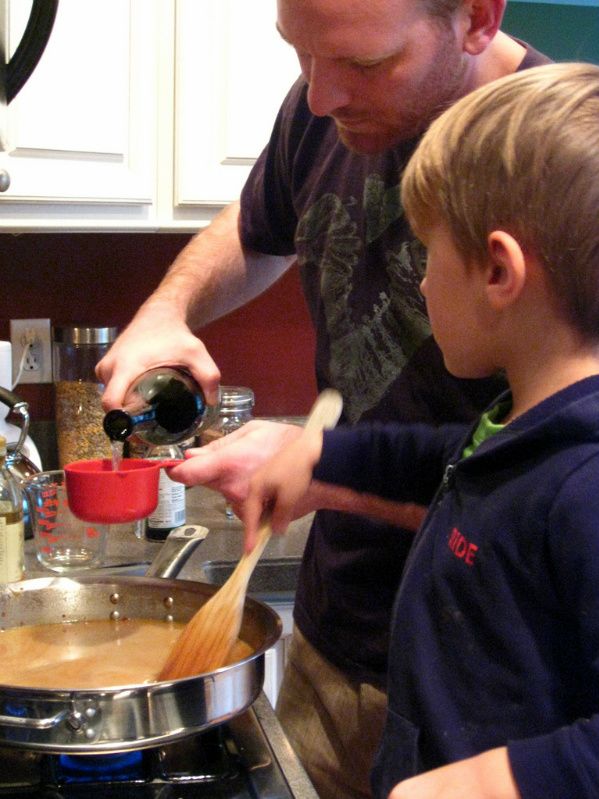
Mirror neurons. Even a baby in an infant seat benefits from time in the kitchen. She pays attention to your actions. She’s delighted when you talk to her and show her what you’re doing. Due to mirror neurons in our brains, all of us mentally duplicate actions and emotions we see. This inborn way of learning means that we’re continually participating in what we observe. Your baby’s mirror neurons allow her to vicariously experience what you’re doing. As she sees you wash, peel, and cut carrots, she’ll form a mental template for that task, essentially allowing her to practice in advance.

If you change an element of that familiar activity — perhaps by using garden-fresh carrots with long waving fronds instead of milled carrots from a plastic bag — your little one will pay heightened attention. If your knife slips and you cut yourself, she’ll react to your surprise and pain, making her understanding of sharp implements more real than any warning might accomplish.

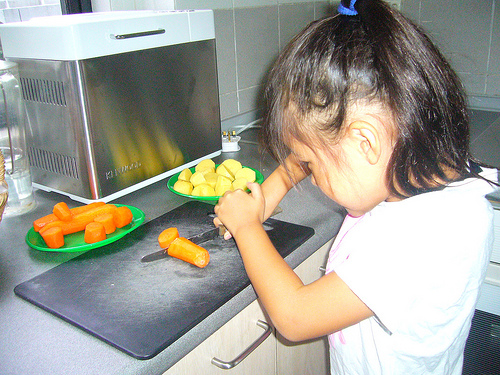
Meaning. Young children clamor to be included. When a preschooler begs to help prepare dinner, he doesn’t want to play with a toy cooking set; he wants to participate in the real work that’s taking place. It slows us down to let him cut fresh mushrooms with a butter knife (and restraint to avoid criticizing or re-cutting), but your child recognizes his contribution toward dinner. He’s also more likely to eat it.

Responsibility. Research has shown that children who participated in household tasks starting at age three or four were more likely to succeed in adulthood. I’m talking really succeed: educational completion, career success, and good relationships with family and friends. Even I.Q. scores had a weaker correlation with success than giving children early responsibilities. And waiting until children were older tends to backfire. We spend much time and money on enriching activities and products for our children, but if they don’t get the chance to take on real responsibilities, we’re depriving them of key components of adult competency.

Higher-level learning. Kitchen-related tasks allow kids to learn more than how dry pinto beans can transform into enticingly tasty refried beans. Kids begin to see scientific principles at work. They develop personal qualities such as patience. They are motivated to apply what they’re learning to more challenging endeavors. Sure, it doesn’t hurt to know what it takes to grow the tomatoes, make the sauce, and prepare the beans for tonight’s enchiladas. But more importantly, as children become proficient in the kitchen, they also see themselves as capable learners. That perception transfers across all endeavors. 

Sensory learning. Full sensory learning has staying power. Apart from nature, it’s hard to find a more sensory-rich environment than the kitchen. As your child’s little fingers crumble blue cheese into dressing, add raisins to a measuring cup, or tear mint leaves for chutney, the tactile and olfactory pleasure help encode specific memories. Perhaps the happiness your daughter feels making mint chutney with you today will be evoked each time she smells mint in the future. We humans must see, hear, smell, touch, and, yes, taste to form the complex associations that make up true comprehension.

Active learning. Childhood is a period of major neuroplasticity, when learning actually changes the brain’s functional anatomy. Hands-on experiences are particularly vital at this time. In fact, the child who spends plenty of time with manipulatives (arranging veggie on a platter, sifting flour, washing silverware) and using real-world math (measuring ingredients, counting celery stalks, following recipes) has a strong foundation of representational experience, which in turn enables better understanding of abstract mathematical concepts. These movement-oriented activities also contribute to reading readiness. Another benefit of kitchen learning? Cooking and tasting the results a short time later provides wonderful lessons in cause and effect.

Simplicity. Children accustomed to blinking, beeping toys and rapidly changing screen images may become so wired to this overstimulation that without it, they’re bored. The slower pace of kitchen conversation and cooking tasks can be an important antidote, especially when we’re willing to go at a child’s pace. Young children tend to balk when they’re hurried. They show us, stubbornly and often loudly, that there’s nothing more important to them than the here and now. So whenever possible, simplify so you can make your time together in the kitchen enjoyable. Slowing down is better for digestion, concentration, and overall happiness. Letting a small child spread his own peanut butter, cut his own sandwich, and pour milk from a tiny pitcher into his cup is a way of affirming the value of the present moment. It also makes for an effortless tea party.

Skill building. There’s no denying that children who help out in the kitchen pick up useful skills. They learn that a cake takes lots of mixing, but muffins very little. They can set the table, toss a salad, make a sandwich, and boil pasta. Not right away, but eventually. They also learn from the examples we show them, such as how to handle pressure and ways to learn from mistakes. Whether we’re four years old or 40 years old, gaining competency feels good. It doesn’t hurt to give credit where it’s due. So if your child has been busy peeling potatoes and crumbling bacon, try renaming the entrée “Max’s special potato soup” for extra reinforcement.

Purpose. When we prepare a family meal, bake a cake to celebrate a friend’s good news, or change a favorite recipe to accommodate Grandpa’s diabetes, our efforts have noticeable value. As our children participate along with us, they feel that same satisfaction. So many educational tasks put before our children serve no purpose other than to instruct. But when learning is connected to something truly purposeful, it can’t help but spark enthusiasm. Children feel honored to be included in real work that includes real challenges. If we pay attention, we’ll see that’s just what they pretend to do when they play.

kids help in the kitchen, how kids can cook, preschoolers help in kitchen,

flickr.com/photos/limevelyn

Getting Started

Even toddlers can help. Let small children cut mushrooms, pears, bananas, and other soft items with a blunt knife. Encourage them to stir (as long as you or they hold the bowl). They’ll be happy to add ingredients, tear lettuces, and grate cheese. When putting together forgiving dishes like soups or casseroles, have them help you choose herbs and spices by smell before you toss in a pinch or two.

Encourage your small fry to wash unbreakable items in a sink of warm soapy water. Let them clean up crumbs on the floor with a small whisk broom or handheld vacuum. Put them in charge of setting out napkins on the table and calling family members to dinner.

Give them the job of stacking unbreakable containers in a low cabinet. Solicit their opinions on aroma, taste, and appearance as you cook together. And remember to thank them for their assistance.

As they get older, children can read recipes, plan meals, and do nearly every task required to make the dishes they enjoy. The time will come when they won’t want you in the room explaining how to fix a lumpy cream sauce or talking about how Nana always mixed pastry dough with her fingers. They’re on their way to making the kitchen a proving ground for their own culinary adventures. Hopefully you’ll be invited to taste-test while you relax for a change.

Parking the kids in front of the TV while we dash to get dinner ready may be efficient, but it’s not the way young people have matured throughout human history. Children need to watch, imitate, and gain useful skills. They’re drawn to see how their elders handle a crisis, fix a car, create a soufflé, build a bookshelf, heal what’s broken, and fall in love.

So welcome your little ones into the kitchen. Let the cooking begin.


First published in Culinate.com

How To Raise Word Nerds

word games for kids, free word games, dictionary fun, play with dictionary, vocabulary-building games, vocabulary fun, family word games,

Dictionary, unplugged. (crdotx’s flickr photostream)

When I tried to throw our dictionary out my oldest threw a fit.

This is a very old dictionary. It was owned by my Great Aunt Mildred. The book is huge, with indents along the side for each letter of the alphabet. It’s also not in good shape. Threads are hanging out of a nearly wrecked spine and the pages are yellowing. Until recently it sat on our living room trunk, ready to answer all inquiries. As my kids got older and Google got ever closer to our fingertips, I figured we didn’t need it. According to my son, I am wrong. He has more than a sentimental attachment. He knows what this book holds — the power to create word nerds.

Here’s how.

In part, we used the dictionary to settle disputes, which happened more often than you might imagine. I’d be happily snuggled on the couch reading aloud to my kids and run across a word new to them. I’d tell them what it meant but one of those little darlings would invariably question my expertise. Having a writer for a mother may make kids more feisty when it comes to words, I don’t know. They’d rush off to drag the huge volume back to the couch where I’d read the definition aloud. Then we’d wrangle over what the definition really meant. Maybe things are more peaceful at your house.

My kids also used the dictionary for games. Something about having that whale of a book right there in front of them inspired word play. Well, that and a few other factors like parental limits on electronic entertainment.

The games my kids played with the dictionary roughly fall into three categories.

Bet You Don’t Know This Word:   Sibling one-upmanship is rarely pretty, but I can overlook it when it’s a vocabulary builder. Simply open the dictionary, find a tough word, and challenge a sibling to define it. The kid with a finger on the word has to pronounce it correctly, otherwise the challenge doesn’t count. (This meant they’d run to me with pronunciation questions until they got a better grip on phonetic spelling.) Winner on either side may torture family with the word the rest of the day. Other family members should sigh in exasperation, but we know the more a word is used the more likely it is to be understood. Win for vocabulary expansion!

Guess the Right Definition:  There are better ways to play this but our made-up version is easiest. Find an esoteric or outdated word to use as a challenge. On the same page find another word with an entirely different (hopefully strange) definition. Or find two other words to make it harder. Read aloud the challenge word, then mix up the different potential definitions as they’re read aloud. Again, winner may torture the family with the word the rest of the day.

Blackbird: (This is such a favorite that Blackbird is the title of a recent book of mine.) Think of a question (one that can’t be answered with a simple yes or no) and ask it aloud, like “Why is my hair curly?” or “Should we get a pet hamster?” Then open the dictionary at random and, without looking, put a finger on the page. Look at the word under your finger and read aloud its definitions. It may take some stretching (a nice use of reasoning powers) to make it fit as an answer, but it usually works. For example, my curly-haired child placed a finger on the word “law.” One of the definitions is “binding force or effect” and another is “regularity in natural occurrences.” That led to a nice discussion about genetics and hair. The hamster question led to the word “fury” which takes little effort to decode, especially when one definition is “angry or spiteful woman.” That would be me, faced with one more pet in this house.

  • So leave a (newer, sturdier) dictionary out in your house. Let your kids see you use it regularly. Help them use it and display interest as you do.
  • Play some word games when boredom hits. Need another? Pick three words at random and challenge your kids to make up a story or song or nonsense rhyme on the spot using those words. Yes, your turn is next using three words they pick. This works nicely in the car. Maybe you need a pocket dictionary in the glove compartment.
  • Tsk tsk a little when they look up “bad” words (otherwise it’s no fun for them).
  • Act as if it’s completely normal when your nine-year-old describes a problem as a predicamentimpasse, paradox,or quandary.

If you choose to allow a dictionary to assume this power in your family, I have one warning. Dictionary silliness will lead to language savvy. If your kids use a lot of obscure words in their everyday discourse they’ll need a droll sense of humor, the better to handle their flummoxed peers.

Free Fix For What Troubles Us

walking cures trauma, right way to walk, walk for inspiration, body-based trauma recovery, trauma recovery, depression recovery,

jodicox.deviantart.com

Most of my adult life I’ve taken a daily walk. A lot of those walks took place while pushing a stroller or hurrying behind tricycles. Now I walk while holding the leashes of three dogs on a rural road where vehicles are rare (when they pass they do so at high dog-frightening speeds). I try to use walks as a way of decompressing while paying attention to the moment I’m in rather than mulling over my current worries.

Apparently I could be getting much more from my walks. So could you.

I learned this in a roundabout way. I’ve been reading a lot the last few years about how we humans process trauma. What we perceive as traumatic can be any experience of fear or pain in which we feel helpless. This happens more often than we might imagine, particular in our earliest years. Consider being held down for a medical procedure as a small child. People loom over us, their words barely understood because we’re afraid or hurting, and we’re completely vulnerable. Trauma can be entirely emotional in nature too— sudden job loss or betrayal by a loved one or any of life’s common cruelties.

Normally, the support of people who care about us helps to ease trauma we’ve experienced, particularly if we’re free to exhibit shakiness and sighing along with other necessary bodily reactions. Plus, truly restful sleep helps to cool the heat of most traumas. As we enter the REM state of sleep, when our eyes zip back and forth under our eyelids, we’re processing stressors while refreshing ourselves for the upcoming day. (Even the happiest people have more negative than positive dreams, indicating that the dream state is a natural time to work through stressors.) Those who suffer from depression or PTSD often have disrupted sleep, leaving them with a build-up a unrelieved stress and trauma.

Talk therapy for trauma is important, yet research shows us that it’s not all in our heads. Trauma lodges in our subconscious and our bodies as well. That’s why innovative therapies such as Somatic ExperiencingEFT, and EMDR are so helpful.

As biologist Robert Sapolsky pointed out in Why Zebras Don’t Get Ulcers , despite constant vigilance, zebras still witness members of their herd, at times their own young, being torn apart and eaten by predators. Although animals are regularly exposed to such traumatic events, they don’t suffer from the health effects of chronic stress as humans do.   Are humans weaker? Hardly. We’re as self-healing as any other creature. Nature’s wisdom allows us to recover quite nicely from illness and injury. Nearly every generation of our ancestors have overcome hunger, disease, accidents, and yes, psychological trauma too. Chances are in the hunter-gatherer era, which made up 99 percent of human history, people could count on rituals to ease psychological trauma after getting through a famine, an attack, or an accident. Those rituals often involved dancing and drumming. And that’s where I get back to walking, because I discovered the mention of drumming and dancing as trauma-recovery methods in a book with an unfortunately self-help-y title, Walking Your Blues Away by Thom Hartmann.

Hartmann points out that such rituals are bilateral activities. So are many of the body-based trauma healing methods I mentioned. These methods all use bilateral movement while evoking what distresses us, dissipating the strong “charge” associated with trauma throughout the mind/body. Hartmann explains that bilateral movement (even of the eyes) is a fundamental and elegant mechanism for healing trauma.

In its simplest form, this mechanism involves rhythmic side-to-side stimulation of the body. This side-to-side motion, or bilateral movement, causes nerve impulses to cross the brain from the left hemisphere to the right hemisphere and back at a specific rate or frequency. This cross-patterning produces an organic integration of left-hemisphere “thinking” function with right-hemisphere  and brain-stem “feeling” functions. This integration is a necessary precursor to emotional and intellectual healing from trauma.

Hartman says that the rhythmic left-right-left-right of walking, paired with a visual/mental process, also stimulates this internal integration. Which makes sense. Because until relatively recently in the long span of history people spent a lot of time walking. Walking away from the hunt, the battle, or any misery helped our ancestors process trauma. Even long after mankind began using the wheel, people walked a good distance every day. Walking is just one of the many ways that a more active, collaborative way of life once entirely natural to our kind helped us to operate with both hemispheres of the brain fully engaged without significant hemispheric dominance. (Check out The Whole-Brain Path to Peace for more on this.)

Hartmann writes about a way of walking that helps to release emotional charge, even reawakens motivation and inspiration. It relies on simply walking with your arms freely moving as your legs stride forward. Not talking, window shopping, listening to music through earbuds, or walking with arms restricted (by strollers, leashes, carried items). Here’s the general method.

1. Define an issue that troubles you, even something small. If there’s no issue, then select an optimal future state for yourself and visualize it.

2. While walking, bring up the story around your issue and frame it in a few words or sentences. Notice the strength of your emotions around that story. Give it a number on a scale of 0 (don’t care) to 100 (extremely intense).  If instead you are taking an optimal future sort of walk, while holding your visualization also remember times in the past when you accomplished or felt something similar. Allow the emotional state of those positive memories to suffuse the hoped-for future state.

3. While walking, gently keep your attention on the issue or visualization/memories you’ve chosen. Walk at a relaxed speed, for about a half hour.

4. Notice how the issue changes. The charge around it may begin to fade, the memory remaining but in perspective. Let the process continue until you notice a shift in feeling. Retell the story to yourself, and again rate your emotions on a scale of 0 to 100. (For the story to become more useful and less painful, several walks may be required.) Whether taking an issue walk or optimal future state walk, allow yourself to feel the positive changes you’re incorporating. Stand up straighter, breathe deeply, experience the pleasure of your stride.

5. Anchor this new state by observing the new internal story and new feelings. Think of ways your new perspective is helpful to you, perhaps even framing how you might tell the story or see the future differently. You may want to create a gesture, word, or sound to anchor it further as you finish your walk. You may also want to talk to someone about it, or sketch, write a journal entry, or in other ways help yourself more firmly hold this expanded awareness.

Walking for our own peace of mind and to create new inspiration sounds wonderful. I may not be ready to give up walking with my dogs, but I’ll be out there swinging my leash-holding arms while envisioning a world of greater hemispheric balance.  What does walking or other body-based practice do for you?

resources

Walking Your Blues Away: How to Heal the Mind and Create Emotional Well-Being by Thom Hartmann

Any books by Peter Levine. The first one I read, In an Unspoken Voice: How the Body Releases Trauma and Restores Goodnesswasn’t aimed at the layperson but I was still captivated by its brilliance.

Somatics: Reawakening The Mind’s Control Of Movement, Flexibility, And Health by Thomas Hanna (his discussion of red light, green light response is illuminating) and the organization Somatic Experiencing

Focusing by Eugene Gendlin and The Focusing Institute

The EFT Manual by Gary Craig as well as the EFT organization 

Getting Past Your Past: Take Control of Your Life with Self-Help Techniques from EMDR Therapy by Francine Shapiro as well as EMDR Institute

Scared Sick: The Role of Childhood Trauma in Adult Disease by Robin Karr-Morse

Hope For Humanity: How understanding and healing trauma could solve the planetary crisis by Malcolm Hollick

Right Now You Are Activating Change

attitude change saves world, global consciousness, gay rights, human rights, change makers,

(ssuunnddeeww.deviantart.com)

My mother tried throughout her pregnancies to get hospitals and doctors to change their rules. She wanted a natural birth, she wanted her husband with her, she wanted to hold her babies after they were born. Instead regulations were followed— every decision excluding her. That meant her labors were induced, she was given painkillers, my father had to stay in the waiting room, and except for standard in-room hours her babies were kept apart from her in the hospital nursery. Such procedures made it easier for the institution and less trouble for doctors.

By the time I had babies her futile requests were standard policy. Every woman was encouraged to have one or more support people with her, to room in with her baby, and to give birth naturally. It took change-makers to turn those policies around. Those change-makers were ordinary people who had a vision of something better. Some of them actively worked to see those changes happen but I suspect most of them simply talked, read, wrote, and otherwise carried on with what looked like everyday lives while activating awareness in people around them.

This is how real progress happens. Yes, there’s the much cited quote by Margaret Mead, “Never doubt that a small group of thoughtful, committed citizens can change the world. Indeed, it is the only thing that ever has.” And yes, there are torchbearers for our big changes who are often misunderstood, even persecuted, while they lead the way. But lets not assume that we don’t qualify as “thoughtful, committed citizens” if we aren’t at the front of any movement. It’s about action but it’s also about attitude. Those attitudes make justice, ecological harmony, and peace possible.

Those “in charge” are often well behind the consciousness of the people they supposedly lead. Many in authority impose the same order, same rules, same limited thinking on people who have opened themselves to bigger possibilities. That’s true when we look at mainstream medicine, education, organized religion, finance and banking, government, science for hire, and multinational corporations. Such established institutions tend to become more rigid in response to vital change shaking their structures loose. The lower levels of moral reasoning that often hold those structures so restrictively in place (might makes right, or an eye for an eye, or conformity to norms) have less relevance when more and more people are in touch with deeper wisdom.

You may be activating change right now by the content of your conversations, the ideas you see taking hold around you, the way you stay informed, the way you raise your children and treat your friends, how you choose to spend your money and not spend your money, the way you make a living, the causes you advocate and believe in, and how you interact with our living planet. You, like so many change-makers, may already be living through deeply felt, personally lived ethics. That itself causes rippling change. Torchbearers of the last century who brought about so much good could do so because awareness shifted and deepened.

It may seem that small personal efforts make little difference when the problems facing the world are so huge. But bemoaning what’s wrong usually doesn’t effect much positive change. It may very well just entrench the feeling that we’re victims of all that’s Big and Bad. Instead we can see how truly interconnected everything is. Mind and matter, internal and external, thought and deed–all are aspects of the same essential aliveness in a universe where nothing is really separate.

My mother didn’t go looking for causes but when they were in front of her, she stood up for what was right. This happened often when she was a young registered nurse working in a large Chicago hospital. She defied rules requiring nurses to stop laboring women from delivering until a physician was present (perhaps to collect higher fees for attending the birth). Nurses were expected to keep women from pushing, and in extreme cases, to hold back the head of the emerging baby. As you might imagine, some infants were deprived of oxygen or worse. My mother refused to follow the policy, more than once delivering a baby herself if the doctor didn’t arrive in time. She also refused to follow the policy that restricted incubators to private pay patients. When necessary she simply went to another ward, took an incubator, and faced the consequences. She got in trouble over and over. She did it anyway.

Once she had children of her own, my mother spent much of her life as what she’d call a homemaker. She did all sorts of good on a small level. She herself been a lonely child, perhaps as a result she was remarkably skilled at staying closely connected with and supportive of people. My mother functioned as a sort of informal Wikipedia for her wide network of friends, always putting her hands on information to help others. I often didn’t agree with her political opinions but I saw from her example that activating change often has more to do with living as if compassion is not just necessary, it is essential.

Who or what in your life reminds you that progress is happening, even on a small personal level?