I write to my elected officials, I donate when I can, I hold a sign at rallies, I feel helpless.
After reading for a few hours, most nights I still lie awake trying to keep my mind from heading back to poet and activist June Jordan’s question, “How many gentle people have I helped to kill just by paying my taxes?”
Often I resort to a simple calming practice I began many years ago. It’s a sort of embodied metta or lovingkindness prayer. It all began with cattle.
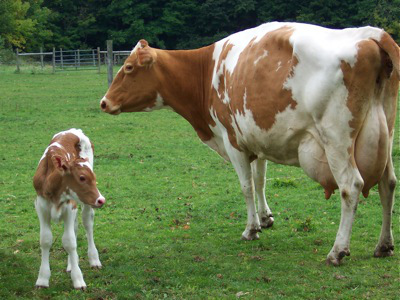
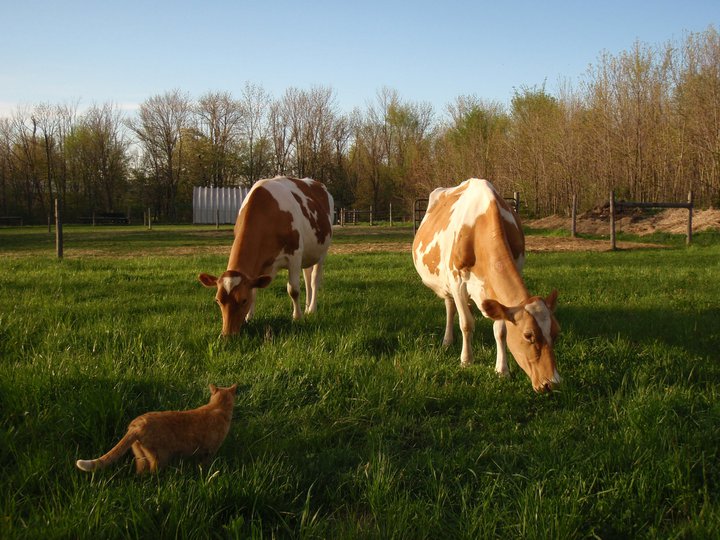
Thanks to my four handworking offspring, particularly my daughter’s dedication, we enjoyed nearly two decades with an intelligent, forthright, entirely marvelous Guernsey named Isabelle along with her adorable, equally forthright calves. Everything about the way our bovines lived was contrary to current agricultural practices. Here’s an excerpt of what I explain more fully here,
Most dairy calves are separated from their mothers soon after birth. It’s considered more cost-effective to isolate calves, feeding them “calf milk replacer.” This white fluid resembles cow milk only to lab analysts, as the ingredients may include wheat, soy, lard, fish, and animal plasma (often from pig blood).
When we were new to farming, everything we read warned that a calf left with its mother to nurse freely was likely to develop scours, a potentially fatal condition. We couldn’t imagine that nature had it wrong and agriculture manuals had it right. Besides, we had no intention of separating mother from calf. A little research showed that experts were looking at it the problem upside down. Scours is more likely to happen in calves taken from their mothers so soon that they’re deprived of sufficient antibody-rich colostrum that flows from their mothers’ udders right after birth.
Isabelle is an attentive mother. She teaches with nudges, head movements, and a variety of vocalizations. She stands still when her calves choose to nurse, moving no more than her tail to flick away flies. When a young calf wanders away, she hauls herself up with a bovine “ooof” to keep watch the way attentive parents do.
Each of Isabelle’s calves has been significantly bigger than the average for her breed, with no medical problems. And we’ve always had more than enough milk for our human family while she nurses a calf or two for a year.
On our farm, the bond we witness between cow and calf forces us to recognize the toll taken by standard agricultural practices. One day, we were at a nearby dairy when farmhands came to take a day-old calf from its mother. As the men approached, a dozen other cows in the pen formed a circle against them, keeping the mother and calf in the center. After losing the struggle to protect one of their own, the cows began bawling, and soon the cows in the other buildings joined in. We could hear them as we drove away.
All around us, dairy farms isolate calves in “calf huts,” where they’re fed calf milk replacer. Most often, their mothers live confined indoors, their sensitive noses smelling their own calves and green grass, both forever beyond their reach.
Our veterinarian tells us that in 26 years, he’s never seen dairy calves raised alongside their mothers except on our little homestead. He remains astonished by what he regards as the uncharacteristic size and robust health of the calves here.
Just around the corner from us was a large dairy operation. Every day I walked our dogs close to that farm. In spring we could hear the cows calling and the calves crying out for their mothers. It grieved me terribly, yet there was not a thing I could do about it. The way I can’t change much of anything about what my country is doing both within our borders and around the world. My grief over those confined cows would follow me home and linger so long that it was sometimes hard to get myself out the door the next day. When I walked near that dairy farm or drove near others, I began to remind myself of the natural tranquility of our cows out on their green pasture. I let the peace of their contented chewing and the calves’ happy gamboling fill me completely, right down to my inhales and exhales, until I was entirely peace. Then I sent that deep peace out to every confined creature. I knew it didn’t help any animal directly, although I imagined that in some energetic or spiritual way it was maybe possible.
I expanded on the practice and still do. At night when I’m in despair I fill myself with the grateful contentment of being wrapped in my weighted blanket, safe and warm next to the sleeping form of the man I love. I let that feeling expand in me until I am nothing but that safety, that warmth, feeling it all the way to my spine. Then I send it out beyond me wishing every person might know such comfort and peace.
When I’m driving to meet friends, troubled by yet another horror show news report, I let myself fill completely with the joyful connection I savor with friends of many years, feel it in the lightness of my heart and the smile already on my face, fill myself completely to bursting with this, then send it out with the force of prayer to everyone who despairs.
When I’m cooking for a gathering, intensely aware of hunger and suffering elsewhere, I summon appreciation for the abundant food in my cupboards, refrigerator, and garden that I am transforming into meals, along with gratitude for the people I love who will come to share it with us. I fill myself completely with these feelings, sense it most completely in my chopping-cooking-stirring hands, then send this fullness out to everyone who hungers for food and companionship.
I don’t pretend this does anything but calm my own despair. But despair doesn’t help anyone. I try to remember, everywhere around us there are people building a better future right now. They are taking part in community gardens and worker co-ops, starting mutual aid groups, expanding shareable neighborhoods, fundraising to pay off strangers’ medical debt, creating art with kids, standing up for others’ rights, sharing skills with the next generation, singing their resistance, living in communal arrangements, welcoming immigrants, developing buy-nothing lifestyles, listening to people across all sorts of divides, and so much more. There are as many reasons for hope as there are people.
“The way you look at things is not simply a private matter. Your outlook actually and concretely affects what goes on. When you give in to helplessness, you collude with despair and add to it. When you take back your power and choose to see the possibilities for healing and transformation, your creativity awakens and flows…” ~ John O’Donohue
The other day I was sitting in a medical facility waiting room while my husband was undergoing tests. I was trying to ignore various worries common to such tests while also attempting to ignore the wall-mounted television’s prattle. I normally bring a book but had forgotten this time. So I scrolled around to see what friends recently posted. I watched a few art process Insta posts that reliably soothe my fluster. I read several of the longform essays I enjoy on Emergence,Aeon, and Nautilus.
Still waiting.
I did another look around. There was the slumped teenager with headphones on, carefully avoiding eye contact. There was the expensive overcoat guy on his phone sounding bossy. And there was a gentle-faced man in a wheelchair. Whoever brought him (daughter? caretaker?) sat looking at the TV while he gazed around him with a look of quiet wonder. Maybe he was what some might call developmentally disabled or maybe he had dementia or maybe he was a saint, because few adults allow themselves such open and endearing expressions of interest in everything. I wanted to go over to sit by him. Heck, I wanted to kneel by his side and ask him for a blessing. When I caught his eye we indulged in a long smile at each other. His name was called soon after: Moses.
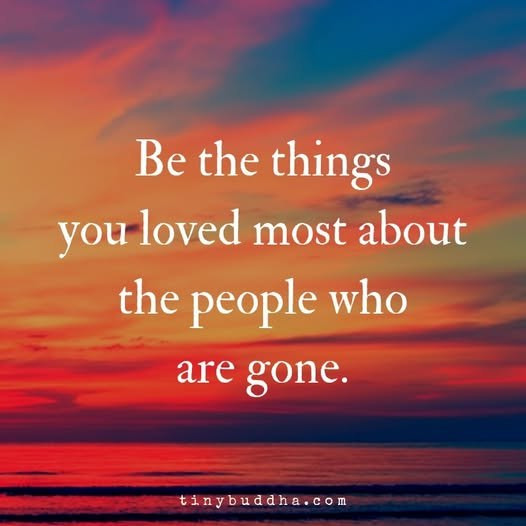
When I went back to scrolling. I came across this:
Be the things you loved most about the people who are gone.
What a beautiful place to take one’s mind.
I started with the easiest person for me, my mother. I loved most her hugs (oh, for another hug), her genuine interest in everyone she met, her endless committment to stay in touch, her detective-like pursuit of what she wanted to know, her storyform memories, her intuition (that woman could with great accuracy tell who was calling well before caller ID and invariably got in touch with people saying “you’ve been on my mind” only to find out there was a good reason for that).
Then my dad. I loved most his ability to offer undivided attention, the way he put children first, his more-spiritual-than-religious views (which he hid well in a lifetime of regular church attendance), his quiet presence, his wry sense of humor, the way he whistled when he was happy.
Then my friend Leia. I loved her soft laugh and bawdy humor, her light-up-the-room smile, her interest in exploring our mutual meaning of life questions, her insistence that everything was “perfect” despite the multiple sclerosis that put her in a wheelchair in her 30’s and nursing home in her 50s. Our meaning of life conversations got far more serious after her beloved daughter was shot and killed by muggers.
All of these listed qualities are far fewer than the many things I most love about these people. “Love,” I realize, remains a present tense verb because death doesn’t subtract love.
On nights when I can’t sleep, I try to remind myself to engage in this practice of listing qualities I adore most in the (too many) people who are now gone. And, yes, in animals I adore too. I don’t know if I can “be” these things. But recalling some of their finest traits helps me love those I miss in a way that goes beyond grief. It reminds me I still love them and will always love them. This is the way I suspect any of us would like to be remembered.
If you’d like, please share some traits of a person who has died that you’d like to emulate.
“People escape into other things; you don’t escape into poetry. You confront yourself when you are reading poems…” ~Mark Strand
I’m overwhelmed. Everyone I talk to is overwhelmed. There are so many crises happening simultaneously that it’s hard to keep paddling the little rowboats of our own lives through the ongoing cataclysms.
Anyone who has studied history surely wondered what it would be like to be alive during the fall of the Roman Empire or what they’d have done during the Nazi reign of terror. We may be finding out.
We live in a society that upholds profit as a de facto god. Bombs are dropped to enrich military contractors, schools are twisted to serve corporate test-makers, and the Supreme Court has given corporations the right to secret political spending–offering them vast influence over elections, laws, and federal policy. The average person is squeezed on all sides as billionaires grow every more wealthy while our (billionaire-owned) media fosters divisions between us.
Infuriating is not a strong enough word. I don’t think there is a term yet coined that sufficiently expresses how we feel let alone helps make sense of our anger. That’s where poetry comes in in all its beautiful, inspiring rage. Here are a few examples, with gratitude to the poets.
AGAINST PEACEFUL PROTEST
I want to run through every street in the country with my blouse on fire. Bang pots and plans. Wake up the criminals and scream like a barn door breaking. I want to break all the windows and steal all the money out of the embankment of billionaire arms dealers. I want to throw my own body, my precious bones and fingernails in front of every bomber that threatens a runway. I want to disrupt a nightly broadcast and ask the viewers Do you know how many babies have turned to ghosts since yesterday? I don’t want to sit quiet, meditating on a good example, Getting old by being played like some puppeteer’s pet mouthpiece. I want to run through the suburbs lighting the night on fire, frantic and unstoppable, until everyone steps out of their well-mannered houses, their feet touching frost, touching sand, sea water, gravel, asphalt, grass, starring at one another, shaking in their nightgowns, asking, Oh my god, what do we do now? What do we do?
I will not shoot myself In the head, and I will not shoot myself In the back, and I will not hang myself With a trashbag, and if I do, I promise you, I will not do it In a police car while handcuffed Or in the jail cell of a town I only know the name of Because I have to drive through it To get home. Yes, I may be at risk, But I promise you, I trust the maggots Who live beneath the floorboards Of my house to do what they must To any carcass more than I trust An officer of the law of the land To shut my eyes like a man Of God might, or to cover me with a sheet So clean my mother could have used it To tuck me in. When I kill me, I will Do it the same way most Americans do, I promise you: cigarette smoke Or a piece of meat on which I choke Or so broke I freeze In one of these winters we keep Calling worst. I promise if you hear Of me dead anywhere near A cop, then that cop killed me. He took Me from us and left my body, which is, No matter what we’ve been taught, Greater than the settlement A city can pay a mother to stop crying, And more beautiful than the new bullet Fished from the folds of my brain.
How much poison are you willing to eat for the success of the free market and global trade? Please name your preferred poisons.
For the sake of goodness, how much evil are you willing to do? Fill in the following blanks with the names of your favorite evils and acts of hatred.
What sacrifices are you prepared to make for culture and civilization? Please list the monuments, shrines, and works of art you would most willingly destroy
In the name of patriotism and the flag, how much of our beloved land are you willing to desecrate? List in the following spaces the mountains, rivers, towns, farms you could most readily do without.
State briefly the ideas, ideals, or hopes, the energy sources, the kinds of security; for which you would kill a child. Name, please, the children whom you would be willing to kill.
A group of grandmothers is a tapestry. A group of toddlers, a jubilance (see also: abewailing). A group of librarians is an enlightenment. A group of visual artists is a bioluminescence. A group of short story writers is a Flannery. A group of musicians is — a band.
A resplendence of poets.
A beacon of scientists.
A raft of social workers.
A group of first responders is a valiance. A group of peaceful protestors is a dream. A group of special education teachers is a transcendence. A group of neonatal ICU nurses is a divinity. A group of hospice workers, a grace.
Humans in the wild, gathered and feeling good, previously an exhilaration, now: a target.
In the new world, as the goddess dictated, each time a man touched a woman against her will, each time he exposed himself, each time he whistled, dropped something in her drink, photographed her in secret
she sprouted a wing from her spine. Not feathered, like birds or angels, not cellular, translucent, veined like dragonflies, but a wing like a blade, like a sword hammered flat, thin as paper. One wing per wrong.
At first, the women lamented. All their dresses needed altering, their blankets shredded, their own hair sliced off like a whisper if it grew down their backs. And those misused by fathers, bosses, drunken strangers
evening after evening were blade-ridden, their statures curved downward like sorrow under such weight. But this was not the old world of red letters or mouthfuls of unspoken names, not the old world of women folded
around their secrets like envelopes, of stark rooms where men asked what they’d done to deserve this. And the goddess whispered to the women in their dreams, and they awakened, startled, and knew the truth.
They pinned up their hair, walked out into the morning, their blades glittering in the sun, sistering them to each other. They searched for the woman with the most blades, found her unable to stand, left for dead, nearly crushed beneath the blades’ weight.
They called her queen. They lifted her with hands gentle as questions, flung her into the air, saw her snap straight, beat the wings at last, and they followed her, a swarm of them, terrible and thrumming, to put the blades to use.
Toward the end he sat on the back porch, sweeping his binoculars back and forth over the dry scrub-brush and arroyos,
certain he saw Mexicans moving through the creosote and sage while the TV commentators in the living room,
turned up loud enough for a deaf person to hear, kept pouring gasoline on his anxiety and rage.
In the end he preferred to think about illegal aliens, about welfare moms and healthcare socialists, than about the uncomfortable sensation of the disease
crawling through his tunnels in the night, crossing the river between his liver and his spleen. It was just his luck
to be born in the historical period that would eventually be known as the twilight of the white male dinosaur,
feeling weaker and more swollen every day, with the earth gradually looking more like hell and a strange smell rising from the kitchen sink.
In the background those big male voices went on and on, turning the old crank about hard work and god, waving the flag
and whipping the dread into a froth. Then one day my father had finished his surveillance, or it had finished him,
and the cable-TV guy showed up at the house apologetically to take back the company equipment:
the complicated black box with the dangling cord, and the gray rectangular remote control, like a little coffin.
God of tulips, God of lost children, God of prisoners and patients, God of Zaatar. God of Dar and homeland, God of viruses and vaccines, God of the first hour before they all wake up, God of the last hour before we sleep.
When the sky is on fire. Hold us. When the house is demolished. Hold us. When the hospital is hit. Hold us. When the lynch mob is on the streets. Hold us. When the boot is on the neck. Hold us. When the headlines forget. Hold us.
If you’re still reading, I simply want to say that fury helps us stand up to injustice together. But we also need respair. This archaic word is derived from the Latin respirare (“to breathe again”). It means “fresh hope” or “recovery from despair.” Singing helps. So does hiking, dancing, hugging, sharing, laughing, and of course, poetry on the hopeful side of things.
This year has been filled with its tender moments and quiet delights. 2025 has also been grindingly awful. Every day’s news packed with official lies, cruel slurs, new atrocities, more bridges to a bright future burned. Still, I am grateful for fervent and often playful resistance, brilliant science, awe-inspiring art, nature’s constant teachings, compassionate people everywhere. And of course for the way books help hold me together even when so much is falling apart. Thank goodness for the restorative, mind-stretching, soul-rejuvenating power of books. Here’s a nod to a few of the most memorable books I read this year.
~
IMMERSIVE AND AMAZING NONFICTION
~
Your Brain on Art: How the Arts Transform Usby Susan Magsamen and Ivy Ross. I deliberately read this book slowly, a chapter or two a month, letting it reawaken me to the deep place of joy and meaning accessed via the arts. It is not remotely a self-help book, but it got me back to dancing in the kitchen when I cook, doing a little sketch each morning, and taking more time to savor small beauties I encounter in daily life. If you love science-rich inspiration, this is a book for you.
“Art and play are like two sides of the same coin, with play being a part of artistic expression, imagination, creativity, and curiosity.”
“When you make art and you don’t know what’s going to happen, you’re involved in the mystery that life really is.”
“When you tap into the arts to foster a meditative state, the places in your brain responsible for judgment and personal criticism are quieted in your prefrontal cortex, and you can assess a more generous, perspective-taking point of view.”
The Serviceberry: Abundance and Reciprocity in the Natural Worldby Robin Wall Kimmerer. I love everything Kimmerer writes but this small and beautifully illustrated book is a perfect reminder for fans and a perfect introduction for those who may not be familiar with her work or the concepts she enumerates so beautifully. Here’s a favorite quote:
“In the Anishinaabe worldview, it’s not just fruits that are understood as gifts, rather all of the sustenance that the land provides, from fish to firewood. Everything that makes our lives possible—the splints for baskets, roots for medicines, the trees whose bodies make our homes, and the pages of our books—is provided by the lives of more-than-human beings. This is always true whether it’s harvested directly from the forest or whether it’s mediated by commerce and harvested from the shelves of a store—it all comes from the Earth. When we speak of these not as things or natural resources or commodities, but as gifts, our whole relationship to the natural world changes.”
Hope for Cynics: The Surprising Science of Human Goodnessby Jamil Zaki. This may well be my favorite read of the year. I’m convinced it’s not just my current lifeboat but essential reading for anyone in these hope-challenging times. Jamil Zaki, a recovering cynic himself, shows how our competitive culture overvalues cynicism. Most of us think cynics are more responsible, better able to assess people, make more considered decisions, become better managers and leaders. Instead, they are much worse than hopeful people at all these things. They are also more prone to prop up their own self-worth through putting others down. They are typically zero-sum thinkers, believing they can only gain if others lose. This makes neighbors, coworkers, strangers, even loved ones into rivals. Instead, the author gives us a pathway to embracing what hope can do for our mental health, relationships, community, and world. I’m buying a few copies to spread some hope.
“Optimism is idealistic; hope is practical. It gives people a glimpse of a better world and pushes them to fight for it.”
“Beliefs reflect what you think of the world; values reveal more about yourself. Confusing these two can be dangerous business. When someone attaches their self-worth to a belief—political, personal, or otherwise—they desperately need to be right. Challenges to what they think feel like threats to how they think—evidence they aren’t smart or good enough. The person screaming loudest is often most fearful of being wrong.”
“I have discovered that most people value compassion over selfishness, that donating money activates similar parts of your brain as eating chocolate, and that helping others through their stress soothes our own. The message of our work is simple: There is good in us, and it does good for us.”
Once and Future Myths: The Power of Ancient Stories in Modern Times by Phil Cousineau. An engagingly insightful look at the impact of myth in our times. Cousineau writes about his own stringent upbringing as well as joys and sorrows in each stage of his life. He moves effortlessly from cultural critique to discussing how Bushmen recognize two hungers—for food and for meaning. “Myths are the original soul stories, showing us, as my mentor Joseph Campbell used to say, how to live ‘with joyous participation in the sorrows of the world.'”
The Stranger in the Woods: The Extraordinary Story of the Last True Hermitby Michael Finkel. This is quite a story—impeccably researched and told well. The author brings in just the right amount of information on hermit traditions in history, about what might be a genetic basis for extreme introversion, and from his own conversations with Christopher Knight. I found it particularly interesting how people in the surrounding community reacted to several decades of “their” mysterious thieving hermit.
“Carl Jung said that only an introvert could see “the unfathomable stupidity of man.”
“He was confounded by the idea that passing the prime of your life in a cubicle, spending hours a day at a computer, in exchange for money, was considered acceptable, but relaxing in a tent in the woods was disturbed. Observing the trees was indolent; cutting them down was enterprising. What did Knight do for a living? He lived for a living.”
“Silence, it appears, is not the opposite of sound. It is another world altogether, literally offering a deeper level of thought, a journey to the bedrock of the self.”
Custodians of Wonder: Ancient Customs, Profound Traditions, and the Last People Keeping Them Alive by Eliot Stein. A respectful, heart-filling chronicle of people from ten countries who are the last few practitioners of disappearing arts. These include Indian mirror makers, Inca grass weaving bridge-builders, Sardinian pasta makers, cigar factory readers, a 27th generation West African griot, and the last night watchman in Ystad, Sweden. “In an age when everything has seemingly been explored and explained, and where cynicism so often overshadows curiosity and wonder, these cultural custodians remind us how much there still is to discover, and invite us to fall back in love with the world.”
The Woman in the Shaman’s Body: Reclaiming the Feminine in Religion and Medicine by Barbara Tedlock. The author discusses the shamanic powers women have long expressed in healing, body wisdom, trance and vision questing, as well as the spiritual energy in body cycles and childbirth, and much more– using evidence from prehistoric to modern times. Here’s a quick walk through her words.
“Despite the proof of language and artifacts, despite pictorial representations, ethnographic narratives, and eyewitness accounts, the important—no, the primacy—of women in shamanic traditions has been obscured and denied. That women’s bodies and minds are particularly suited to tap into the power of the transcendental has been ignored. The roles that women have played in healing and prophecy throughout human history have been denigrated… All too often women who enter medicine or the ministry still believe they’re stepping into a strictly men’s field; in fact, these are historically women’s fields that men have since entered…. It’s time to take another look at the evidence of millennia and of cultures around the globe. It’s time to reclaim the woman in the shaman’s body.”
Walk Till the Dogs Get Mean: Meditations on the Forbidden from Contemporary Appalachia edited by Adrian Blevins and Karen Salyer McElmurray. This is a powerful anthology. I was particularly drawn to works by Silas House, Ann Pancake, Mary Crockett Hill, and Tennessee Jones. In particular, I kept rereading passages by Jones. What a voice. He writes about handling what we’d now call trauma: “The people I loved and who loved me had stabbed me in the heart for as long as I could remember to try to prepare me for the hardness of the world. From this I learned to stab myself, again and again, just to see if I could stand it… I did not realize, then, that self-hate is perhaps the highest form of selfishness we can re-create. It is the oil that allows the wheels of the big evils to turn.” He writes about class divides: “I slowly began to realize I was not the same color white as my middle-class friends.” I could easily quote from every one of his paragraphs.
How to Kill a Witch: The Patriarchy’s Guide to Silencing Women by Claire Mitchell and Zoe Venditozzi. It’s hard to imagine a lively approach to this dire subject but, despite some repetition, this is that. I listened to the audio version, delightfully narrated by the authors. Since I only listened for about 30 minutes a day the hideous and deadly subjugation of women wasn’t as overwhelming as it could have been. A few apt quotes:
“When the going gets tough in any society, it is the most vulnerable who are accused of causing the damage.”
“Discovering that we both had a ridiculously detailed knowledge of real-life murders, we came up with a theory about why women in particular love true crime. In our view, it was down to a combination of the pragmatism of learning how not to get abducted and murdered (always useful), coupled with an element of bearing witness to all the women who were not so lucky.”
“No matter how terrible, history must be learned from and remembered.”
Patterns in Nature: Why the Natural World Looks the Way It Doesby Philip Ball. This may look like one of those coffee table books, likely because at features 250 color photographs showing the patterns shared in what seem to be distinctly different parts of the natural world including honeycomb, seashell spirals, soundwaves, forests, coastlines, galaxies. They are not only beautiful, they point to underlying unity around us. The accompanying text is minimal, making this very accessible, but no less profound.
~
IMMERSIVE AND AMAZING MEMOIRS
~
Written in the Waters: A Memoir of History, Home, and Belonging by Tara Roberts. The author brings us into her widening life after encountering Diving With A Purpose, a group of scuba divers dedicated to documenting the undersea wrecks of ships carrying enslaved people. She pulls together little-known histories, long-silent stories, ocean-based beliefs, and more. I had no idea one out of ten ships carrying enslaved people experienced coordinated resistance. I’d never heard of public archaeology: involving the community’s people as the center of scientific work. I’d learned the trauma of enslavement is carried through generations of descendants but never knew the Transatlantic Slave Trade left a legacy of ecological trauma as well. I knew about the Underground Railroad, but learned here there was also a very successful Maritime Underground Railroad. Throughout the book Roberts searches for her own sense of home, identity, and purpose.
She writes about a photo of her great-great grandparents. “I always thought both of them were really handsome people. I mean Grandpa Jack has on a suit—it looks like brown corduroy. And Grandma Mary, she wears a stiff white button-down shirt with a bow tie. A bow tie! She looks formidable but also soft. And they look like equals… I saw this kindness in both their eyes that just made me want to know them, you know? Like I would have liked to lean against Jack’s knee and hold his hand and hear his stories. And I feel like Mary would have swatted me on the butt affectionately and shared her lessons on how to live powerfully as a woman in the world.”
And she writes, “What if our displacement and enslavement—our unique ancestry and our very rootlessness—as African-descended people throughout the diaspora puts us on the leading edge of thought and creation? What if, through us, a new way of understanding identity can be articulated and lived—one that can help point a way forward for humanity.”
Holler Rat: A Memoir by Anya Liftig. Thoroughly engaging, thoughtfully written memoir by a woman whose early memories inform her performance art and whose experiences with classism reflect this country. Here’s a snippet: “On my mother’s side, identity was not only tied to the land, it was the land. Year after year, the place where your family had settled become more and more associated with your name and your people… To leave the land was to betray it. And by betraying it, you were also betraying yourself.”
Desert Flower by Waris Dirie. The book begins on a broiling hot day when Dirie faces down a lion with the same equanimity she displays by fleeing toward ever-greater freedom. She writes vividly of growing up in a nomadic Somalian family. There was hunger and danger, but also beauty. She describes a rare gathering with other herding families. “The people celebrate with our traditional dancing: the women clapping their hands and chanting, their low sweet voices humming across the desert night, and the men leaping high into the air. Everyone contributes food, and we eat.” She moves ever farther from her early life after fleeing an arranged marriage at age 13, eventually on to a modeling career and activism against the horrific practice of FGM. This memoir nearly vibrates with the author’s unshakeable belief in herself.
Toil & Troubleby Augusten Burroughs. A delight of a memoir about a witty but anxious gay man who has inherited the family gift of witchery. He uses second sight and the occasional spell to steer ahead as he moves from NYC to the country with his partner—what’s not to love? Burroughs is a masterful writer, making all his books flow with a storyteller’s ease, but in Toil & Trouble he also educates us as he was educated on the uses of magic. I’m happy to see witchcraft explained not as the glitter eyeshadow and fussy wand crap some reduce it to, but a real art known throughout human history. A few snippets:
“What I am certain of is that there’s something wonky going on beneath the surface of what we call reality. Things are not as they appear. They are much, much more.”
“We live in a physical world where the mere act of observation alone is enough to alter that which is observed, to change it from one form of matter into another. What is that if not magick?”
“I know that under the best, lowest-stress circumstances I am an absolute horror to live with, a halogen-illuminated fountain of anxiety, control, and catastrophe. Mental health would be nice, but there’s not time for that, so I do the next best thing: on a walk along the Hudson to loosen the phlegm in my chest, I stop at a deli and pick up a sack of twelve oversized butter cookies with multicolored sprinkles.”
The Perils of Girlhood: A Memoir in Essays by Melissa Fraterrigo. These are fine essays, some of them excellent hybrid pieces. Each is infused with quotidian details that bring small and large traumas into sharp focus. Fraterrigo writes about coming of age with struggles relevant to every woman I know while at the same time writing about marriage, motherhood, and what she wants for her girls. It’s hard to pick an excerpt because this book goes so many places, but here’s a sample:
“’Can you tell me what’s wrong? I can’t help you unless I know.’
After what seemed like days, she spoke. ‘I just don’t like myself.’
How to let her know I had sometimes felt this way at twelves and twenty-two and now, in my late forties?’
‘Just because you think something, doesn’t mean it’s true.’ Eva blinked and something rippled through me. It was what I wish I had been told. Eva hugged me hard and fast. It felt powerful all the same. Maybe in order for her to understand her own feelings, she needs to see me grappling with things that even now confuse and embarrass me.”
Life Is So Good: One Man’s Extraordinary Journey through the 20th Century and How he Learned to Read at Age 98 by George Dawson and Richard Glaubman. A journey through the life of an observant, intelligent, hardworking, deeply principled man. George Dawson brings history, social studies, and a philosophy of living alive. Life Is So Good would be an excellent addition to a middle school or high school reading list. “People forget that a picture ain’t made from just one color. Life ain’t all good or all bad. It’s full of everything.”
How to Stand Up to a Dictator: The Fight for our Futureby Maria Ressa. The author’s courage and integrity led her to win the Nobel Peace Prize. Her experience also forms a timely warning for those of us anywhere in the world where authoritarianism is taking over.
She writes, from experience, about surveillance capitalism’s algorithms affecting not only behavior but democracy itself. “Lies that are repeated over and over,” she writes, “exponentially change the public’s perception of an issue, something world powers have always known about propaganda but that gained new meaning and pitch in the age of social media… What happened in the Philippines in 2016 is a microcosm of every information operation launched in democratic countries around the world. The combination of bots, fake accounts, and content creators… infected real people like a virus, but often those unsuspecting citizens didn’t even know they had been infected.”
She also writes how difficult it is for fact-checked journalism to reach people in the grip of social media. She focuses almost entirely on Facebook but her assertions fit nearly all social media companies. She writes of her media company:
“We had standards and ethics manuals; we upheld freedom of expression…. We didn’t realize that those ‘content creators’ with their crude, sometimes lewd, manipulative posts, now passed as political pundits, even as journalists reports ‘facts.’ Those accounts were at the core of a propaganda machine that bullied and harassed its targets and incited its followers to violence… Facebook didn’t only provide a platform for those propagandists’ speech or even only enable them: in fact, it gave them preferential treatment because anger is the contagious currency of Facebook’s profit machine. Only anger, outrage, and fear led to greater numbers of people using Facebook more times a day. Violence has made Facebook rich.”
And, “Today, an emergent wave of right-wing populist leaders uses social media to question and break down reality, triggering rage and paranoia on a bed of exponential lies. This is how fascism is normalized and where political outrage meets terrorism…”
Although this book isn’t the most personal of memoirs, it offers glimpses of her growth as a person. She reveals, “I began to realize that the work of art you’re creating is your life; that the person you are today has been created by all your past selves… but that your actions today actually change those earlier versions of yourself.”
The Girl With No Name: The Incredible True Story of a Child Raised by Monkeys by Marina Chapman and Lynne Barrett-Lee. Quite a unique memoir. The chapters of Chapman’s life in the jungle, where she is slowly accepted by a troupe of monkeys, are so full of nuance that it’s hard to imagine she (as some claim) made any of it up. Specific personalities of the monkeys, the many life-saving things she learned by observing them, and the ways her traumatized little girl self left behind the human world feel authentic to me. As she writes, “I had only two concerns: to satisfy my basic needs and to satisfy my curiosity — the same simple life that the monkeys had.” Chapters after that are grim, but this resilient girl persevered and learned. I was heartened to look the author up and find that she went on to marry and raise a family, as she vowed to do back when she was a despised street child who saw too often what happened when babies were born to trafficked girls. This was a read-in-one-night book for me!
~
IMMERSIVE AND AMAZING NOVELS
~
Animal Life by Auður Ava Ólafsdóttir. Animal Life is a deep, refreshingly different book filled with musings on life, nature, the cosmos, our human responsibility to the earth, and meaning – especially the meaning inherent in birth and in light. The author begins by noting the most beautiful word in the Icelandic language, as voted by its people, is the word for midwife — “ljósmóðir” — variously translated as “lightmother” and “mother of light.”
The main character is a young midwife, one in a long ancestral line of midwives. I began to identify even more strongly with her grand-aunt, who had passed away and whose very full apartment the main character inherited. The grand-aunt had passionate concerns about human impact on the planet, an endless interest in science as well as poetry, and unfinished writing projects that were full of questions and contradictions. Ólafsdóttir writes, “It’s difficult to understand another person. But what is even more difficult to understand, difficult to know, what is most alien of all that is alien, unknown of all that is unknown, is one’s self.”
Wreckby Catherine Newman. I loved Wreck just as much as I loved her novel Sandwich, and for the same reasons–the intelligent wry bittersweetness of it all. Plus how much her kids remind me of my kids, although her offspring are not as annoying brilliant on nearly every topic as mine can be. And passages that simply gleam from the page, like this one about a stage her teenaged daughter went through:
“Back then, every molecule in her body recoiled, in horror, from every molecule of my own. I exhaled carbon dioxide that she was then forced to inhale! I manifested odors and opinions and existence, and all of it was unspeakable, intolerable. I felt, for a year or two, like I was kneeling soundlessly with a palmful of birdseed, hand extended, waiting for the wild animal of my daughter to approach me.”
The Outside Boy by Jeanine Cummins. Gorgeously written coming of age novel that roams across themes of loyalty, nature, Old Ways, compassion, prejudice, literacy, and love. It’s told through eyes of a teenaged boy raised as a Traveller. Here are two snippets:
“My mam and dad had fell in love over books, over sunlight and soil and simplicity, and I was the product of their bold, impossible love. I was the freest, happiest moment of their lives…”
“In Mass I wanted to talk to God, but I didn’t know if He’d recognize me. I couldn’t think of nothing to say. So instead I pictured my life as a shattered plate, a fine piece of crockery broke and splintered into a thousand tiny pieces. And then I spent the hour collecting up all them bits of colored wreckage, and one by one, I placed them shards into the invisible hands of God. I hoped He would maybe glue them back together for me.”
Heartwoodby Amity Gaige. This is a satisfying novel. Gaige has given us three very intelligent and determined women with distinctive lives. I was most closely drawn to the beautifully written journal entries like this one where Valerie muses on her earliest memories. “The nightly cataclysm: the mother leaves the room.” This compelling and redemptive novel kept me reading on a difficult day when a resounding disaster of a federal budget was passed in Congress. It allowed me to put off the news while I marveled at moss and sighed with gratitude for search/rescue volunteers. I am going to need more Amity Gaige books asap.
The Names by Florence Knapp. Three alternative trajectories explored for the same lives, hinging on which name was given to a baby. Not only well-written and thrumming with possibility, it also evokes our own “what if” thinking. Here are a few glimpses:
“Cora realizes her daughter has learned what to do. How to soothe, to placate. That just through watching, the first time she’s stepped into this role, she is already accomplished. If it doesn’t stop, Cora thinks, this pattern will repeat unendingly, the destiny of each generation set on the same course.”
“There’s something about that—when the quietest person, most reserved in their opinions, most reluctant to impose their thoughts on others, finally speaks; you hear. Oh. Oh, and you’re suddenly face to face with the truth.”
“She was still reading to me—to us—right up until the end. Whatever I chose from the school library. She never judged, never said, Not this one, or, You shouldn’t be reading that. I can still remember it. That feeling of being read to, of being wrapped up in her voice, those words, whatever place the story had taken us to. It sounds stupid, but it was like a magic carpet.”
Happy People Don’t Live Here by Amber Sparks. A strangely enlivening novel with a whole community of ghosts, neighbors, and what they cherish beyond all bounds. One main character is a magical-thinking child whose attempt at mystery-solving was enough to keep me up half the night reading. All that plus courage, kindness, and the necessity of making art.
Koan Khmer by Bunkong Tuon. The author’s powerful yet understated prose brings the reader right into the ongoing burdens of war, grief, and displacement as Samnang Sok adapts to a new (often hostile) culture. Koan Khmer is a universal coming-of-age story while also a complex account specific to the author’s experiences.
Beneficence by Meridith Hall. This novel comes across as a hauntingly sad song with an ongoing refrain made up of a farm’s rituals — milking, plowing, haying, feeding, milking again. It reminds me of older works by writers who describe the loveliness as well as brutal realities of rural life. Written with pathos and deep connection to the land.
The Road to Tender Hearts by Annie Hartnett. There are plenty of road trip books featuring some version of a curmudgeon who finds himself saddled with kids he doesn’t really know or want to know. Maybe there are plenty because there’s room in the plot for nearly anything. I started and finished The Road To Tender Hearts on a difficult day, which surely colors my assessment, but it was just the book I needed. Heavy topics like grief, addiction, estrangement, and death handled with wryly humorous insight by well-drawn characters including a uniquely gifted cat.
The Doorman by Chris Pavone. Not my usual thing but I found this a truly absorbing read. The doorman of a ritzy apartment building and the rich people who, mostly, care nothing about lives of less opulence than their own. The plot centers not only on these separate lives, but the divisions boiling over in the city around them. As in, “These apartments were more like vaults than residences. One sold for two hundred and twenty million dollars, a figure equivalent to spending nearly a thousand dollars per day, every day, for six hundred years. A scale that proved just how much was wrong with the world.”
Needle Lake by Justine Champine. A neurodivergent girl’s story that dives gradually into ever more alarming situations after her older cousin arrives for an extended visit. Insightful writing, powerful characters, and (for me) several unanticipated twists. I found myself thinking about the story well after I’d finished it. Here’s a moment when the main character Ida calms her entirely valid fears:
“I looked up at the sky and wished a funnel of light would come down, pass through the fog, and beam me up into the quiet vacuum of space. If a rocket full of aliens landed in the parking lot right then, I would’ve hopped right in, no question. I wiped my eyes, then tried to focus my gaze on the bark of the tree that grew in the curb planter in front of me. I tried to follow the patterns in the wood, find shapes in the grain. A rabbit, an apple, a baby’s round face. I leaned closer to the tree, squinting against the dim light. I ran my fingers over the bark.”
~
Ratings I left for nearly everything I read this year (191* books, I believe) are on my Goodreads page. I note plenty of 4 star books that almost made this list! No matter where you are, may books take you as far as you want to go. Wishing us all a brighter, more inclusive, more playful, more caring and just world in 2026.
*To clarify, I didn’t read 191 full length tomes. At least two dozen, probably more, were poetry books. Some were visual art and/or visual science books— more eye candy and mind candy than main course reading. There were several visible mending books. And some of the fiction and nonfiction making up my list were audiobooks. The numbers don’t matter. It’s about the joy in reading, whether you read one book a year or many.
Once each summer, I’d take my four kids to Ohio’s Geauga Lake, a now-closed amusement park. The park put out entrance fee coupons that made it almost affordable. They also permitted visitors to bring in their own food, unlike the more enticing (and expensive) Cedar Point. I’d drag our red wagon behind me packed with food, diaper bag, cooler of drinks, and whoever was a toddler at the time. When we finally got home I’d hustle them through a quick scrub, pull on their pajamas, and shorten our evening sing together time so they could get to bed well past their usual bedtime.
I was in my 20s, then my 30s, energetic enough to leap up each morning toward whatever the day held. But every summer, after our amusement park visit, I found myself beyond exhausted. My whole being simply on the fritz. I had no idea what the problem might be. I gradually realized it was overwhelm. A long day of constant vigilance at a crowded venue keeping my kids in view. A long day of noise without a moment’s peace to sit somewhere quiet for a spell. A long drive there and back.
I learned to avoid planning anything the next day or two after our annual amusement park visit. It wasn’t just me. The kids needed time to chill out too. They’d lie on the couch reading or play in the backyard or draw pictures while listening to audiobooks. They didn’t want to go anywhere, didn’t want friends over, they just needed to BE. We were like those creatures from Dr. Seuss’ Sleep Book, the Collapsible Frinks.
That’s what this year has felt like to me. Like post amusement park visit syndrome. Every day’s news packed with atrocities committed in our names against people around the world and people down the street. Gut-punch news about this administration’s war against the environment, healthcare, education, civil rights, even civility. Nearly everyone I know is beyond overwhelm, no matter if they voted for or against. I’ve barely been able to write this year— no essays published and only a few poems. To close, here’s one of those poems, this one published in One Art: a journal of poetry:
I DREAM OF HUBBLE’S LAW
I’m standing in front of my mother, head tugged while she braids my hair as she does every morning. I am seven years old, she must be mid-30s. Her lipstick is bright red, her hair nearly black. Taster’s Choice freeze-dried coffee in her cup, Cleveland news and weather on the radio. My baby brother bangs his spoon, smile-flinching each time it strikes. My sister and father are at the table, all of us unaware we’re in my dreamworld, unaware we are inexorably moving away from each other the way stars grow more distant. Stand still she says as she fastens a tiny rubber band at the bottom of each braid so I don’t turn around to hug her as I long to in my dream. I want to hang on for dear life as galaxies move apart ever faster in a universe widening toward absolute zero.
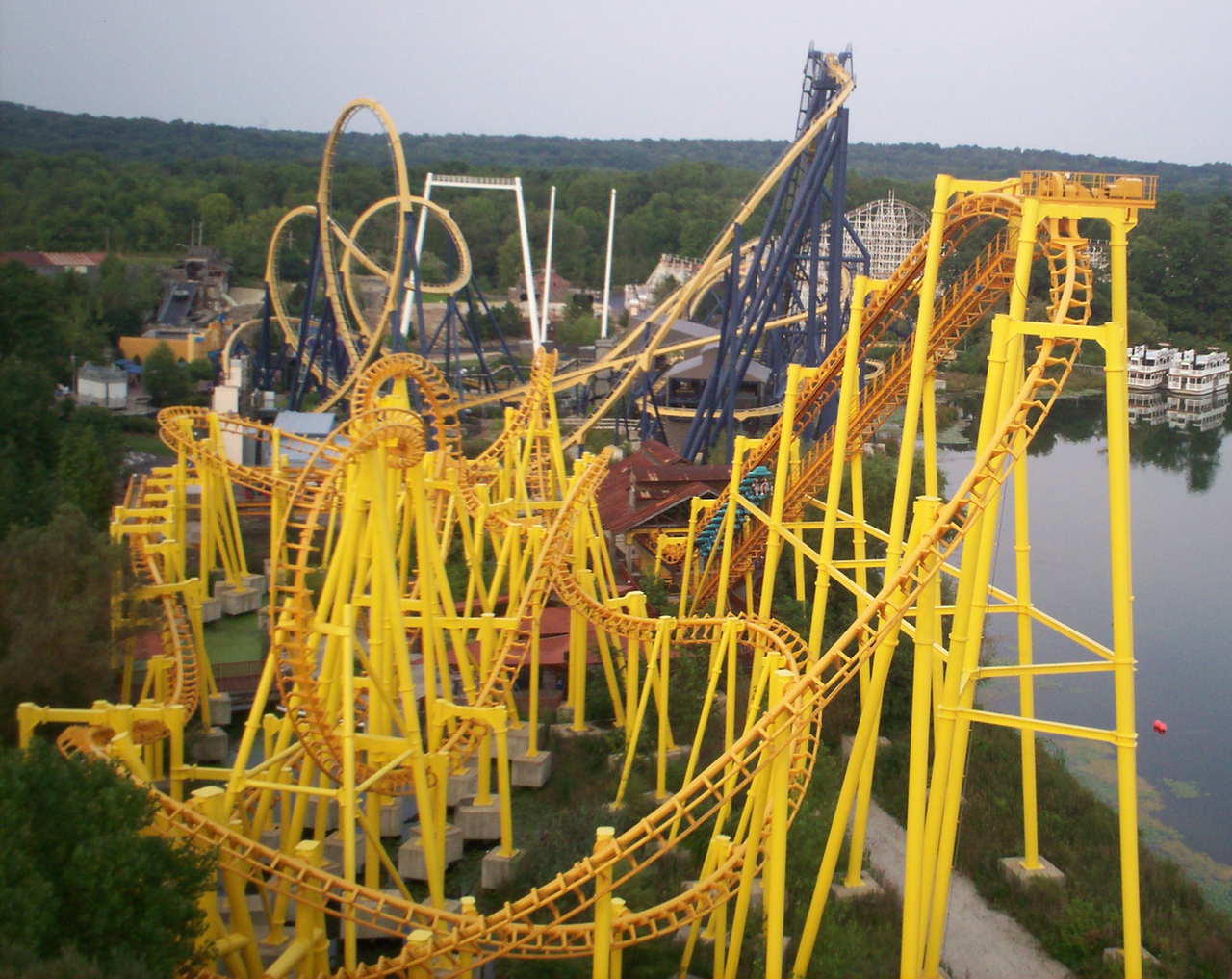
Roller coasters are fun, unless you can’t find a way to get off.
Because I had asthma as a child, I grew up without dogs. I wasn’t allowed to pet a dog. Or visit a friend’s home if that home contained dogs. I wished with my whole being to someday share my life with a dog.
I have now had dogs most of my adult years and, thanks to extensive tutoring by those dogs, I’ve finally learned how to open my life fully to them. Ours has evolved into a crate-free, pet food-from-scratch, dog-forward sort of home.
I have loved many dogs, each for being completely themselves, but never had an animal companion quite like this one. He is the only dog I’ve known who gives long hugs with his cheek against us and his front legs around us.
He is even more so an eye contact creature. He searches for my gaze in that deep pool of openness way that baby’s eyes do. He gladly does his own thing while I work at my desk, but when I’m on the couch or the floor he stays on my lap as I read a book or talk or look at my phone. Even though I rest one hand on him, scratch him lightly, sometimes it is not enough.
Look at me ,he says, his thoughts almost clear as speech. I do. I look into his eyes and wonder what he’s thinking and say a few sweet words to him and rub his little body, then go back to what I was doing.
No, he says. Really look. So I do, I really do.
I look and see a little ways beyond looking. I sink into the quiet awareness he offers any time I can settle myself into it. He’s not demanding attention, he’s giving it. He’s not seeking love, he is tutoring me in love’s mutuality.
As we gaze at each other I can’t help but draw in a deep breath and let out an even deeper exhale. This is what presence feels like. It’s an entry into the space/no space between us that Buber called I and Thou.
We’re all aware terror is being stoked and terror is happening in the US and around the world. I pay attention to news from a variety of sources. I do what I can to push back. But I simply can’t face it constantly. I find refuge in the powerful healing energy of stories written and shared in my writing classes. I find refuge in family gatherings, with the faces and voices of the people I love filling our home. I find it in quiet rituals of morning coffee with the spouse, taking walks, preparing meals. I find it in good books and good conversation. I find it sitting quietly with my guru.
Apparently there’s a newish fad in the horticulture world called “chaos gardening.” This is described in UK’sHouse and Garden as “inspired by the unruly growth of nature and a whiff of rebellion against the control and neatness of traditional horticulture.”
Oh honey, many of us have been chaos gardening for a very long time.
I’ve never had the energy, money, or interest to maintain neatly weeded and mulched gardens. The last time we spread mulch was at least eight years ago. It was free municipal mulch which I discovered to my discomfort, less than a day after spreading it, was full of chopped up poison ivy.
I have no garden beds in straight lines by choice. No plantings in straight rows either. I commonly don’t remember what I’ve planted until it grows. I’ve attempted to keep up on the weeding side of things, but have always failed. Laziness, mostly, but also a quiet delight in the marvelous plants we call weeds. (Well, it took me a long time to admit a grudging respect for thistles but I’m mostly there now.)
My husband and I have developed a nearly effort-free method of weed control that uses newspaper and the occasional tape-free stretch of cardboard between plants, with wide rows left free to grow vegetation we occasionally mow. By “occasionally” I mean we keep the growth low when young plants are establishing themselves. Then the weather gets too hot and we get too lazy to mow. By late August it’s a wildly alive mess of feral loveliness.
I’ve gardened since I was 18. (One of my first crops were apparently mistaken for magic mushrooms….) The obligation to keep up with the maintenance necessary for typical gardening used to slurp the joy right out for me. Instead I’ve learned to appreciate how perfectly the land cares for itself in concert with wildlife and weather and seasons. And yes, I’ve gone more and more toward the chaos end of things.
This year, however, I’m well beyond chaos gardening.
One side of the house is planted with bulbs, sedum, hydrangeas, and other perennials but is currently nearly overwhelmed by strawberries that self-seeded from pots on a nearby porch.
Another side of the house has struggled to grow almost anything. I finally discovered after years of trying to establish an herb bed that the problem was due to deeply embedded landscape “fabric” put down by the former owner. As I’ve written elsewhere, products like landscape fabric, plastic mulch, astroturf, and other so-called weed solutions suppress the development of mycorrhizal fungi essential to plant health. They also wreck the habitat for beneficial soil-dwelling creatures, overheat the ground, prevent organic matter from being incorporated into the soil, and impede the health of plant roots. Their presence wrecks the necessary carbon dioxide and oxygen exchange between soil and air—essentially suffocating the soil. If that’s not alarming enough, landscape fabric contains petrochemicals which break down into toxic substances including microplastics. One analysis shows that three feet of landscape fabric can release hundreds of millions of microplastic particles. I think we’ve dug up all that awful plastic, it’s long past time to haul compost from out back to spread over the bed and start over next spring.
The front garden bed I established using soil dug up for septic repair remains a flourishing mess. Ancient pine trees at either side of the bed grow a bit more brown every years. Clematis does its best to climb up the moon mosaic. Lamb’s ear spreads from its spot under the trumpet man sculpture to pop up everywhere (no surprise, as it’s related to mint). Most of the rest are weeds I’ve come to consider friends.
Then there are our vegetable gardens. The asparagus patch, by this time of year, is a towering mass of vegetation. It offers a marvelous hiding place for all sorts of creatures and I’m pretty sure a nesting site for various sparrows as well as the Eastern meadowlark family we’ve seen all summer.
The side vegetable patch is a productive jumble. I wade in to pick tomatoes, eggplant, peppers, cucumbers, chard, leeks, and other delights. Each step brings up a rustle of butterflies, crickets, and other creatures.
And our hoop house out back hasn’t had its rows mowed in many weeks. There, too, are heavy harvests of tomatoes and peppers, but mostly grapes. We have picked at least four five-pound pails of grapes the last few weeks and are so weary of canning juice that I’ve been giving grapes away.
The pasture where our cows once grazed, where I’d hoped we might have a herd of sheep or a few donkeys, is now a meadow of its own making.
The sides of our pond and creeks have always been left unmowed, growing only with what naturally wants to grow. Our wooded acres are riddled with fallen ash and beech trees quietly fostering new life. All of these places are beautifully alive.
I’m mostly at peace with the chaos here, although my better self would like to tend more closely to our gardens. But my husband and I just don’t have the gumption right now to do more. We are exhausted by a country in chaos. Democracy is being undermined by well-funded extremists, authoritarianism is marching in, inequality is compounded, genocide not only ignored but fostered, and all the while the climate every life form relies on to survive is being sacrificed for profit.
Chaos, I’m reminded by evolutionary cosmologist Brian Swimme, is one of the powers of the universe. We’re here thanks to the cataclysmic death of stars. Their explosions provided the iron circulating in our blood, the calcium making up our bones, the oxygen we inhale. Cataclysms on our planet have caused five major extinctions. (We humans are causing the sixth.) We have endured many other catastrophes including wars, famine, plagues. And yet, from the cataclysmic death of stars, we get to live on a planet graced by orioles, humpback whales, monarch butterflies, sunsets, tides, elephants, newborn humans. We are all part of one another, composed of star stuff.
May long and gentle rains like this one fall on every parched landscape. May beauty pair with chaos and peace rise from cataclysm.
I have long used endearments when addressing humans I love but also dogs, cats, cows, goats, birds, insects, and yes, the beings most consider inanimate objects. I’ve probably been in above my head for a long time because I can’t help myself from addressing participants in my writing classes as “dear people” and “beloved writers” and worse.
But today I was checking out at the local market. I always put my fabric bags on the belt before loading my items. The cute young checkout person was preoccupied talking to the cute young bagging person, and I was preoccupied with ineptly “tapping” my card, so none of us noticed right away that the bagger was loading my things into plastic despite the sturdy cloth bags in front of her. “Oh, sorry love,” I said “but I brought cloth bags.” She looked up, startled. Then she said, “I’ve never been corrected so sweetly.” She went back to talking to the cute checkout guy.
I recognize calling a stranger “love” is likely a step too far. I know some people actively detest being called “honey” or “dear” or other overly familiar words. That’s their right and I want to respect that. Actually, I rarely use endearments when speaking to strangers. But some people have a gleam so noticeable to me, even if they seem shut down (maybe especially if they seem shut down) that I can’t help myself.
Brief conversations with strangers filled with dry wit, shared insight, and surprising alignment seem to happen more often for me now. That’s a side benefit of getting older. Those of us who are dismissed as irrelevant are, in a way, freer. Who expects to have a moment where they are seen, really seen, by someone who comfortably goes about unseen?
I used to call only the people I love “loves.” Maybe I’ve watched too many UK series or read too many old British novels, but that word is stuck now. It’s the way I hope to see others — as loves. As beautiful people. As complex and strange and conflicted as we all are.
Seeing others as whole people is particularly difficult when we’re pitted against one another by systemic forces that place seemingly insurmountable barriers between us. <gestures broadly at world>
And yet, some people step beautifully beyond these divisions. Last week I read about an LA man who approached a phalanx of federal agents working for ICE, all of them heavily armed and masked up to their eyeballs. Much as I like to think I am a pacifist, I see them as poorly paid* enemies of justice and compassion and democracy itself. The man who approached them was carrying little white slips of paper that turned out to be copies of his most recent two-week pay stub. He walked along the line attempting to pass out these slips, saying some version of, “I know everyone needs a paycheck, but you don’t have to do this. Come work with us. This is what a union carpenter makes.”
This man saw these armed agents as fellow human who need to work, just as he does. Seeing others in their full humanity is the heart of nonviolent action. Fact-filled or expletive-filled rants against someone is useless in changing their minds, and is likely to more firmly entrench their views. As Stephen Jay Gould noted, “leave an escape hatch for your opponent so that he can gracefully swing over to your side without an embarrassing loss of face.”
Open dialogue with the very people she condemned is what inspired Megan Phelps-Roper to renounce her membership in the extremist Westboro Baptist Church. It’s what led neo-Nazi skinhead Christian Picciolini to stop spreading hate and work to lead others away from such ideologies. It’s how Daryl Davis, a Black man, befriends Ku Klux Klan members in hopes they will have a change of heart.
Oh, I did another quick errand at another locally owned store. My cashier was a beautiful young man with the fluffiest of Afros. We commiserated over the bankruptcy of a longstanding area business. Somehow, in the magical way conversations happen, he told me he was a “survivor” of hideous corporate policies from his last job and we agreed rapacious capitalism was destroying our country and I told him about our food co-op. As I left, he blew me a kiss.
*These federal agents are no longer poorly paid. Thanks to the horrific tax overhaul bill recently signed, the budget for ICE enforcement is larger than Russia’s total military budget. ICE is now the highest-funded federal law enforcement agency in history, with more money than the budgets of the DEA, ATF, FBI, US Marshals, and Bureau of Prisons combined. Starting this week, these masked warrantless federal agents will be offered a signing bonus of 42K and a six-figure salary.
I am sitting on the sand while my three beloved grandchildren run in and out of Lake Erie’s waves at Cleveland’s Huntington Beach. I’ve taken the day off work to savor our time together. I never even think to open the book I brought. Instead I am watchful while at the same time caught up in my own wonderings, the way elders have surely been for millennia.
From even a short distance every wet head bobbing up in the water is dark, every happy shout is unintelligible. Time shifts the way it sometimes does. This scene could just as easily be 100 years ago, when Cleveland Metroparks made this beach a public recreation area and summer-weary families came here to cool down. This could be hundreds of years ago, the shoreline rimmed by huge sycamore trees, land crisscrossed by bison trails, with the Erie peoples’ large palisaded villages a short walk away. This could be a thousand years ago, another grandmother sitting near the water’s edge.
I’m reminded how fully alive each person is in each era in every part of the world. A prehistoric teenaged boy proudly shared his first big kill with his tribe, strutting just a little as he went to sit by the fire with a full belly. A pregnant Norte Chico woman leaned back gratefully to let others braid her hair in what we now call Peru. Old men gossiped about their neighbors as they relaxed near a fountain in ancient Beijing. A Berber trader worried his load of goods might fetch less than the expected price when he reached the marketplace. A little Victorian-era girl gleefully tattled on her brother for cursing.
It seems strange that we don’t see our lives as an unbroken continuum with everyone who ever lived or will live. It seems impossible we aren’t fully aware that the person behind us in line at the store or the person continents away knows same thirst and same hunger we do; feels the same emotions as we do; wants to have a life of meaning as we do. Well into a future I hope is a kind and healthy one, people will surely be sitting in this same spot savoring a summer day.
Right now sunlight glints off the water. A line of ducks passes in a perfect procession. When the kids come to towel off I tell them I’m thinking this scene could be from any era — just happy people playing as people like to do. I am brought back from my musings by a child. This one points to the teenagers who just arrived and says, “It couldn’t be any moment in history, Nana, because they brought Super Soakers.”
I was stuck in the miseries this morning due to small funked up health problems and huge funked up world problems. I try, as a practice, to have a silent but earnest conversation with my insides when the miseries have a grip on me. I say to pain or fear or despair I see you, I acknowledge you, help me learn from you and beyond you. (Okay, sometimes my inner conversation isn’t all that polite.)
And I try, as a practice, to look around me with gratitude even if, like this morning, it felt like I was spreading a thin layer of appreciation over a turbulent inner mess. As I drove to meet someone I love for our weekly walk, I did what I could to savor the air’s spring freshness. I did what I could to notice light flickering through the trees, flower baskets hanging from storefronts, and the kindness of a driver waving another car ahead.
My mind drifted right back to the morass.
I don’t know how any of us go on with our ordinary lives lately. I am among those privileged enough to have my days largely unchanged, so far, despite—among other tragedies—a climate pushed past the tipping point, despite the ongoing genocide of the Palestinian people, despite all three branches of government stomping directly into authoritarianism. I’m aware my puny efforts to protest, write letters, support good causes, even drive around with a handmade protest sign on my car aren’t enough. I simply hope it’s a teensy contribution toward the transformative 3.5 percent rule invoked by Erica Chenoweth, author of Why Civil Resistance Works. After researching hundreds of social/political change movements over the last century, Dr. Chenoweth found that nonviolent campaigns are twice as likely to achieve their goals as violent campaigns. And although the exact dynamics depend on many factors, her data shows it takes around 3.5% of the population actively participating in the protests to ensure serious political change. But what are the chances it can happen here, I grumbled to myself.
And then I drove past a dumpster. A beautiful dumpster.
It was a deep purple, a purple most often seen in delphiniums, pansies, hydrangeas, and irises. The sort of purple that would look good as a velvet dress or painted across a domed ceiling scattered with gleaming constellations. My mind gladly rested on that color purple for the rest of the drive.
On my way home after the walk and an appointment, I went the long way just so I could take that dumpster’s picture. It was right outside a small locally owned flooring shop. As I got out of the car I realized the dumpster had recently been painted. I could almost see the former lettering under its shiny new color. Someone, maybe the shop owner, had chosen that color. Chosen to grace this useful, much-maligned object with beauty. For all I know, it’s the only dumpster that color for thousands of miles.
I’m plotting to drag my spouse to that shop to see if we can afford to do something about our kitchen’s falling apart linoleum. Whether we can or can’t, I’m going to tell the shop owner how much that glorious purple dumpster lifted my sagging spirits. As Alice Walker wrote in her magnificent The Color Purple, “I think it pisses God off if you walk by the color purple in a field somewhere and don’t notice it.”
Maybe that applies to the color purple anywhere we find it.






 Laura Grace Weldon