I write to my elected officials, I donate when I can, I hold a sign at rallies, I feel helpless.
After reading for a few hours, most nights I still lie awake trying to keep my mind from heading back to poet and activist June Jordan’s question, “How many gentle people have I helped to kill just by paying my taxes?”
Often I resort to a simple calming practice I began many years ago. It’s a sort of embodied metta or lovingkindness prayer. It all began with cattle.
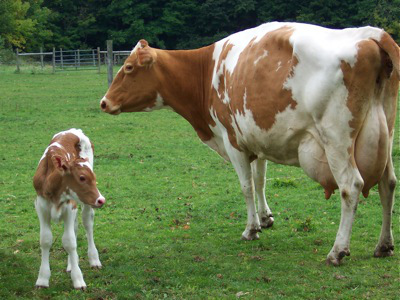
Thanks to my four handworking offspring, particularly my daughter’s dedication, we enjoyed nearly two decades with an intelligent, forthright, entirely marvelous Guernsey named Isabelle along with her adorable, equally forthright calves. Everything about the way our bovines lived was contrary to current agricultural practices. Here’s an excerpt of what I explain more fully here,
Most dairy calves are separated from their mothers soon after birth. It’s considered more cost-effective to isolate calves, feeding them “calf milk replacer.” This white fluid resembles cow milk only to lab analysts, as the ingredients may include wheat, soy, lard, fish, and animal plasma (often from pig blood).
When we were new to farming, everything we read warned that a calf left with its mother to nurse freely was likely to develop scours, a potentially fatal condition. We couldn’t imagine that nature had it wrong and agriculture manuals had it right. Besides, we had no intention of separating mother from calf. A little research showed that experts were looking at it the problem upside down. Scours is more likely to happen in calves taken from their mothers so soon that they’re deprived of sufficient antibody-rich colostrum that flows from their mothers’ udders right after birth.
Isabelle is an attentive mother. She teaches with nudges, head movements, and a variety of vocalizations. She stands still when her calves choose to nurse, moving no more than her tail to flick away flies. When a young calf wanders away, she hauls herself up with a bovine “ooof” to keep watch the way attentive parents do.
Each of Isabelle’s calves has been significantly bigger than the average for her breed, with no medical problems. And we’ve always had more than enough milk for our human family while she nurses a calf or two for a year.
On our farm, the bond we witness between cow and calf forces us to recognize the toll taken by standard agricultural practices. One day, we were at a nearby dairy when farmhands came to take a day-old calf from its mother. As the men approached, a dozen other cows in the pen formed a circle against them, keeping the mother and calf in the center. After losing the struggle to protect one of their own, the cows began bawling, and soon the cows in the other buildings joined in. We could hear them as we drove away.
All around us, dairy farms isolate calves in “calf huts,” where they’re fed calf milk replacer. Most often, their mothers live confined indoors, their sensitive noses smelling their own calves and green grass, both forever beyond their reach.
Our veterinarian tells us that in 26 years, he’s never seen dairy calves raised alongside their mothers except on our little homestead. He remains astonished by what he regards as the uncharacteristic size and robust health of the calves here.
Just around the corner from us was a large dairy operation. Every day I walked our dogs close to that farm. In spring we could hear the cows calling and the calves crying out for their mothers. It grieved me terribly, yet there was not a thing I could do about it. The way I can’t change much of anything about what my country is doing both within our borders and around the world. My grief over those confined cows would follow me home and linger so long that it was sometimes hard to get myself out the door the next day. When I walked near that dairy farm or drove near others, I began to remind myself of the natural tranquility of our cows out on their green pasture. I let the peace of their contented chewing and the calves’ happy gamboling fill me completely, right down to my inhales and exhales, until I was entirely peace. Then I sent that deep peace out to every confined creature. I knew it didn’t help any animal directly, although I imagined that in some energetic or spiritual way it was maybe possible.
I expanded on the practice and still do. At night when I’m in despair I fill myself with the grateful contentment of being wrapped in my weighted blanket, safe and warm next to the sleeping form of the man I love. I let that feeling expand in me until I am nothing but that safety, that warmth, feeling it all the way to my spine. Then I send it out beyond me wishing every person might know such comfort and peace.
When I’m driving to meet friends, troubled by yet another horror show news report, I let myself fill completely with the joyful connection I savor with friends of many years, feel it in the lightness of my heart and the smile already on my face, fill myself completely to bursting with this, then send it out with the force of prayer to everyone who despairs.
When I’m cooking for a gathering, intensely aware of hunger and suffering elsewhere, I summon appreciation for the abundant food in my cupboards, refrigerator, and garden that I am transforming into meals, along with gratitude for the people I love who will come to share it with us. I fill myself completely with these feelings, sense it most completely in my chopping-cooking-stirring hands, then send this fullness out to everyone who hungers for food and companionship.
I don’t pretend this does anything but calm my own despair. But despair doesn’t help anyone. I try to remember, everywhere around us there are people building a better future right now. They are taking part in community gardens and worker co-ops, starting mutual aid groups, expanding shareable neighborhoods, fundraising to pay off strangers’ medical debt, creating art with kids, standing up for others’ rights, sharing skills with the next generation, singing their resistance, living in communal arrangements, welcoming immigrants, developing buy-nothing lifestyles, listening to people across all sorts of divides, and so much more. There are as many reasons for hope as there are people.
“The way you look at things is not simply a private matter. Your outlook actually and concretely affects what goes on. When you give in to helplessness, you collude with despair and add to it. When you take back your power and choose to see the possibilities for healing and transformation, your creativity awakens and flows…” ~ John O’Donohue
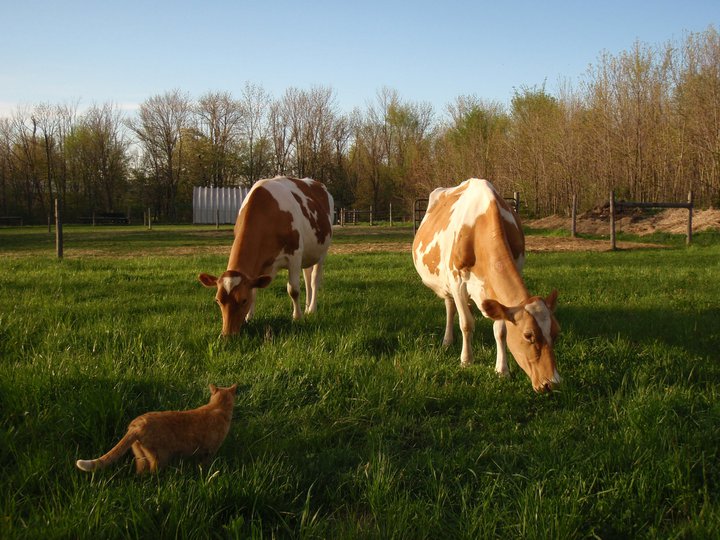
photos by Claire Weldon
 Laura Grace Weldon
Thanks, as always, Laura.
LikeLiked by 1 person
I’ve started and stopped quite a few posts because they were essentially rants, deciding to finally write about an antidote.
LikeLike
The cows on my parents farm stood for days – bawling around a mother who lost her calf. We seem to have a talent for finding a good reason for every heartless thing we do. When we bless our food, we can remember and bless the lives given that were never seen or acknowledged… the whole crop, and all the hands that worked to bring it from the field to the table. Thank you for sharing real life.
LikeLiked by 1 person
Milk in packages and meat on supermarket trays is far removed from what the animals’ lives are like. Here’s a poem I wrote two summers ago about three teenaged steers.
STEERS AWAY
Late summer, almost fair time,
4-H raised livestock
all destined for market
when three Holstein boys
tromp through broken fence
seeking freedom’s green glory.
The township Facebook page
is lively with sightings. Many
note how wily they are—
grazing close to tree lines,
bedding down far from lights.
A picture shows them leap with joy.
I’m rooting for them, imagine
a rogue cattle population
beyond the confines
of feedlots and dairy operations,
lowing at night in concert
with owls and coyotes.
Men in tractors soon bully them
back. Their captive brethren call out
as they hear them coming
and once the gate is shut
gather round to lay their necks
upon one another,
hearts again beating close,
facing together what
fate has in store—
a few more weeks before
they’ll lie on styrofoam trays
under supermarket lights.
LikeLiked by 1 person
It’s heartbreaking. God created a food chain… and every offering is a Sacred Sacrifice that deserves to be blessed and acknowledged. That’s why when I bless the food, I remember the whole family – the whole crop – for the lives that were given without an acknowledgement. I’ll double my prayers for the feed lots.
LikeLiked by 1 person
It occurs to me on a regular basis that if we just gave up being the “dominant creature” in our environment and settled in to the pace of nature around us everything would be better. This story of cows breaks my heart… but the reason for it is simply greed. It is the driving force behind much of what is happening in our world. I try and remind myself that my efforts against this current administration are nothing alone, but I am not alone… my efforts are part of a greater collective of people. There is strength in numbers… as well as some peace for my being. The camaraderie is a very good mood booster! Thank you so much for sharing your thoughts.
LikeLiked by 1 person
Amen!
LikeLike
It occurs to me in reading this beautiful piece that the most momentous moment in history was at the beginning when man believed he knew better than God. We were thrust out of paradise as a result.
I think God knew what he was doing and that you do too! Babies belong with their mothers whenever it is possible.
Thanks to your own baby, Claire, for sticking close to home and for the beautiful photographs.
LikeLiked by 1 person
It helps me to remember that 98 to 99 percent of humanity’s time on earth has been as hunter-gatherers. During that long era we lived in small, mostly peaceful, often matrilineal tribes —a part of rather than separate from paradise. I hope we can stop making profit and status our god, returning to a more gentle co-existence with nature.
LikeLike
The “modern age” removed most human babies from their mother’s milk and replaced it with formula without antibodies. Nowadays it’s changed a little. They recommend that mothers breast feed if they are able to. An odd thing is that human adults like cow’s milk but they don’t like the taste of human milk. There was one attempt to make human milk ice cream but it failed in marketing and in taste. I wonder if adult cows would like human milk or human ice cream. Maybe with artificial flavors. I think they’d say Mnoooo
LikeLiked by 1 person
Mammals’ milk is, essentially, a custom product for the animal’s own offspring. When a human baby is getting sick, its saliva and nasal secretions inform the mother’s body, which almost immediately begins producing milk to combat the infection. Mother’s milk is different for a preterm vs full-term baby, different at different stages of a baby’s development, and around the world babies are not weaned until sometime between ages 2 and 4, with four or older much more common in traditional cultures. Children weaned well into the second and third year are healthier and have much lower mortality rates than bottle-fed or early weaned babies. (Absolutely no shade on mothers who cannot or decide against breastfeeding.)
LikeLiked by 1 person
very interesting. I don’t know why there was such a big push to formula after WW2. There was even that scandal where Nestle dried up African women by giving them formula they couldn’t afford and then they wound up diluting it with water (sometimes contaminated). Allowing breast-feeding in public might be a better solution than pumps and the refrigerator. Learning and remembering dual purpose should be a learnable skill to avoid cravings if it were inculcated into the culture. Many married men can learn that women at work have a dual purpose and sex is not the one for them at work. Yes, sexual tension, anxiety, and politicians can be a problem. Maybe politicians could be controlled by having a Department of Prostitution where the women are well-paid and fully vetted to make sure they’re not spies. It might make more sense than gyms. Although I suppose they could change the name to Department of Love. I wonder who would make a good Secretary of Love.
LikeLike
Lately, my go-to “What is it really all about?” for parents has been that mathematics makes our hope credible.
LikeLiked by 1 person
Yes!
LikeLike
Beautiful practices. Sharing this with my spiritual direction group who will love it.
LikeLiked by 1 person
Thank you so much!
LikeLike
Pingback: Poetry Blog Digest 2026, Week 12 – Via Negativa