Build Community Using Bookish Goodwill

sharing economy, free books, little libraries,

You can’t have too much of a good thing, unless you’re averse to bliss. One of life’s Very Good Things, in my book (pun!) is the library. There’s a movement afoot to augment our public libraries with other ways of spreading bookish goodwill. This doesn’t just get books into more hands, it actually builds positive networks between people and strengthens our communities.

Roaming Libraries

One unique venture is BookCrossings.  Started in 2001, it’s a read and release method of sharing books. Once you’ve read and enjoyed a book, simply go online to print out a label, then leave your book in a public place like a coffee shop, hair salon, playground, or doctor’s office. The label assures others the book is free to anyone interested. The label also contains a code so readers can track and follow books as they are read, discussed, and released again elsewhere in the world. Currently over 8 million books are traveling through 132 countries.

Handmade Book Libraries

In the art world, hand crafted books of all kinds have long traveled on round robin circuits allowing artists to collaborate in making and appreciating these unique creations.

Handmade books are also released in limited runs to appreciative readers who share the works through lending programs such as the Underground Library in Brooklyn. Here experimental literature is bound using labor intensive traditional methods, then distributed to members who pass the book along to a dozen other people before it’s returned to the library.

Banned Book Libraries

Surely people have been sharing what authorities don’t want them to know long before information was stored on papyrus scrolls. Remember the parochial school student who stocked her locker with banned books, using a check out system and due dates to keep track? This may be an urban myth but we know full well when reading material is banned it attracts even more dedicated readers.

This is true even when real danger is involved. As Azar Nafisi described in her memoir, Reading Lolita in Tehran, after Ayatollah Khomeini banned Western influences she gathered students in her home to read and discuss books, some photocopied page by page, despite the risk.

Micro Libraries

Tiny libraries are appearing in all sorts of places. For example in San Jose four new libraries don’t have funding to hire staff.  Instead, volunteers run a Friends of the Library book lending program out of a small room in a community center.

In San Francisco, a few shelves in the Viracocha antique store have become a tiny library called Ourshelves which is “curated by local authors and readers eager to share their favorite works with fellow book lovers.”

Free-standing libraries, called Corner Libraries are popping up in NYC. These tiny buildings evade zoning requirements by remaining on hand trucks, usually chained to a stationery object. One is a four foot tall clapboard structure offering books, maps, even a CD featuring baby photos of world dictators. Another Corner Library, named the East Harlem Seed & Recipe Library, looks like a planter but has a drawer with seed packets and recipe cards.
Stranger Exchange boxes are also appearing, asking people to take or leave items of interest. In Boston the first such library, a repurposed newspaper box, has featured such items as CD mixes, hand drawn maps, batteries, party invitations, and artwork.

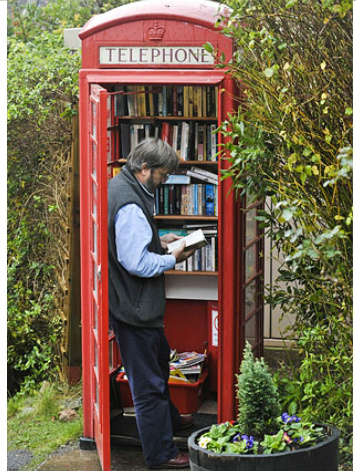
These free-standing libraries have a precedent in the UK, where a phone booth was turned into a 24 hour library,recently followed by a phone booth library in New York.

And a non-profit called Little Free Library aims to establish thousands of new libraries (no bigger than large bird feeders) all over the world.  It has inspired people everywhere, like 82-year-old Bob Cheshier, whose goal was to get little libraries outside of all 71 elementary schools in the Cleveland district. Teachers and kids loved him. He died recently, only partway to that goal, but the community is carrying on his vision.

The process is simple.

  • Figure out where you’d like to place a Little Free Library. A community garden, bike path, civic center, or your front yard?
  • Determine who will be the steward of the Little Free Library.
  • Decide if you’ll build it or order it pre-made to decorate as you choose. You may choose to endow it for someone else (tax deductible) or set it up to honor a certain person, place, or organization.
  • Build support. You may want to find business or civic sponsorship, host a design contest, and in other ways spread the word about your Little Free Library.
  • Contact Little Free Library to register your library on the map, get updates, and more
  • Enjoy. Encourage people to visit, keep it stocked, and watch how sharing affects your neighborhood.

I hope traditional libraries as we know and love them will always exist. They are vital, vibrant institutions ready to be an important part of every person’s life.

But these smaller exchanges actually enlarge our potential. They foster connections between us each time we share, lend, and collaborate. They’re another way of making our communities work.

More Community-Building Inspiration

Engage the Window Box Effect

Bring Kids Back to the Commons

Front Porch Forum

i-Neighbors

Better Together: Restoring the American Community

The Abundant Community: Awakening the Power of Families and Neighborhoods

All That We Share

community building through books, neighbor to neighbor, micro library, book sharing, birdhouse library,

Politeness Recovery In Progress


politeness recovery, good girl syndrome, kind versus nice,

deskridge.deviantart.com

Politeness is the dodo bird of our times. No one is quite sure what killed off civility but it’s obvious that two-year-olds aren’t growing out of tantrums or a sense of entitlement. Instead they just get bigger, becoming toddler adults. They drive like idiots, foster workplace stress, simultaneously overindulge and ignore their own kids, feed on the negative energy of angry pundits, and blame everyone else for their own problems. They need to learn a little empathy, or at least the rudiments of feigned empathy we call politeness.

But some of us are way on the other side of the spectrum. We’re so empathetic that we tremble with concern for the feelings of other people. And animals. And plants. (I even tremble with empathy for spiders.) It wouldn’t occur to us to put ourselves first or to act rudely (although my good intentions may come across as annoying, just ask my family).

Some may have been hardwired this way from birth. The rest of us were trained to be too polite for our own good. Right around the time we started crawling we were taught to be respectful and considerate at all times. No exceptions. If asked how we are, we learned the answer should always be affirmative followed by a kindly inquiry about the other person. Never mention any peril you may be in, the object is to focus on others. This means if you’re bleeding, you deny there’s any real problem (oh it’s nothing), don’t bleed conspicuously, and God forbid, don’t complain about whatever caused you to bleed. If you are offered a favor, graciously decline. Even if it’s chocolate. If someone is actively causing you difficulty, either put up with it without complaint or extricate yourself in a way that doesn’t embarrass the other person.

Maintaining this level of politeness rarely leads to an authentically lived life. It’s more like an affliction. We do our best to avoid winning games, getting the best grades, pushing ahead at work, sticking up for ourselves, saying what we mean unless it’s “nice.”  Being too polite actually put me in dangerous situations more than once. Nice at all costs has got to go. Kind, yes. Honest, yes. Nice, not always.

Politeness recovery is a slow process and often difficult. It’s complicated because I’m naturally opinionated, sardonic, and forthright. And sometimes silly. Suppressing that side of myself has never been easy. But I’m not giving up my polite side by any means. Politeness is essential if we’re to live together in any kind of harmony. I’ve found genuine politeness has a surprising way of bringing out the best in other people. It presumes they are basically good (a core principle of non-violence) and many times, that’s all that required. (Now, if only that principle were applied on talk radio and in snarky web threads.)

More importantly, I want to be authentic. Treating people with respect and understanding simply feels right. It comes from true compassion, far richer than any thin soup of poor self-worth. The generosity and love of kindness stimulates more of the same.

I aim to give up only the parts of my Good Girl upbringing that hold me back from my eventual goal of becoming a rowdy old lady. My politeness recovery is still ongoing but my friends are amazing role models. They’re well ahead, evolving before my eyes. Some days I’m swimming in the muck, other days I join them on land. I’m often awkward, occasionally splattering mud as I go, but I’m a creature in progress trying to be polite as well as real, empathetic as well as centered, serious but silly too. Like a dodo bird who hasn’t given up on her wings.


Links & News 5-20-13

Lots going on here, from peas and strawberries ripening in the garden to bigger excitements. I hope to start including weekend links and news along with my usual blog offerings. Let’s see if I can keep up.

I’m pleased to have an article in the creative education issue of Lilipoh magazine (print only) which will soon be available in Spanish and Chinese editions. And the biggie this week for me, I signed a contract with a small publisher to have a collection of my poetry published. I’m really thrilled about the news, but also feel suddenly shy. Poetry is so personal. Well, not so personal once it’s out in March 2014…

I share a lot of links via my Free Range Learning page on Facebook, but I recognize that plenty of people have better self-control than I do and stay off social media. So here are a few links for you to enjoy.  Continue reading

Pride Goes Before Tiny Bite Marks

prideful parents, mom's downfall, don't take credit for your kids, my child bites,

I don’t take credit for my children’s many accomplishments. They are their own remarkable people.

As a new mother I didn’t have this quite figured out. Yes, I knew that babies arrive on this planet with all sorts of traits wired in. I knew it’s up to us to gently nurture them, shelter them from harm (including the damage cynicism can do), allow them to take on challenges, help them learn to trust themselves, and let learning unfold in delight.

But I had a few early years when I thought, probably with obnoxious smugness, that my wonderful parenting had something to do with how well my kids were turning out. They were very young and so was I.

My oldest, a boy, was thoughtful and clever. He liked to take my face between his little hands and call me every superlative he could think of like“dear, sweet, wonderful Mama. (Isn’t this positively swoonable?) He rescued insects from the sidewalk, telling them “go in peace little brother,” a line he picked up from one of his favorite picture books. When his father and I tried to talk over our little one’s head about issues we thought he shouldn’t hear, we used Shakespearean language to obscure our meaning. We had to stop, because our toddler began regularly using words like “doth” and “whence.”  What made things work fascinated this little boy, from the bones in our bodies to the engine in our cars, and he insisted on learning about them.

My next child, a daughter, was assertive and talented. She drew, danced, and sang made-up songs of such pure wonder that, I kid you not, birds clustered in trees near her. The force of personality in that tiny girl led us all to laugh at her improbable jokes and enter into her complicated realms of make-believe. Born into a home without pets, her drive to be close to animals was so intense that she kept trying to make worms her friends. Entirely due to her persistence we ended up with several pets by the time she was three.

Although our beautiful little children had medical problems, we had money problems, and other crises kept popping up I felt as if I lived in paradise each day. There’s something remarkable about seeing the world anew through the eyes of the planet’s most recent inhabitants. It’s like using an awe-shaped lens.

But I still had a lot to learn about parenting.

I recall being quietly horrified at a Le Leche League meeting when one toddler bit another. I thought about it for days, wondering what parenting might create such an impulsive child. All the parenting books I read, all the non-violence courses I taught, assured me there was a right way. Of course my comeuppance would arrive.

My third child was born soon after. This endearing, curious, and constantly cheerful little boy possessed relentless energy. Evidence? I’ve got evidence.

  • By the time he was 14 months old we had to twine rope around all the chairs, lashing them to the table between meals, otherwise this diapered chap would drag a chair across the room to climb on top of furniture in the few seconds it took me to fill a teakettle.
  • Before he could say more than a few words he’d learned to slide open our windows, unclip the safety latches on the screens, and toss the screens to the ground. 
  • He liked to grab the hand vacuum for experiments on his sister’s hair, houseplants, and other normally non-suckable items.
  • He watched with fascination as drips from his sippy cup fell into heat vents, the hamster cage, the pile of laundry I was folding.
  • He liked to take off all his clothes and climb on the windowsill facing the street, hooting like a giddy chimpanzee as he danced in naked glee.
  • We had no idea he could climb out of his crib till the evening he opened all the wrapped Christmas presents I had hidden in my room (keeping them safe from him) while we thought he was in bed. The look of complete joy on his face nearly made up for the hours of work it took me to rewrap.

I found myself making up new rules I never thought I’d utter, like:

“I know throwing is faster but we carry things down the stairs.”

We never run with straws up our noses.”

“Don’t poop in Daddy’s hat!”

He became a little more civilized by the time he was three, but not, as you might imagine, before he bit a few children.

Utterly besotted by the bright-eyed charm and endless curiosity of this dear little boy, I never suspected the labels doctors and schools so easily affix on non-conformist kids might be slapped on my child.  I never realized how much he would teach me about what real motivation and learning look like. And I never imagined how much he’d show me about what it means to pursue success on one’s own terms.

Today he is one accomplished young man, in part because he continues to see the world through an awe-shaped lens. And I am still learning from the four remarkable people who came to this world as my children.

100 Companies Selling U.S. Made Products Only

no-sweatshop shopping, US only shopping, US company links, eco-friendly shopping,

The cart stops here.

Shopping is cheaper and more convenient at big box stores. And on that giant site that shares its name with South America’s longest river. But we know more all the time about the environmental and economic impact of our spending choices. Our wallets really do change the marketplace.

Yes, it’s more complicated than making an effort to buy what’s produced in our own country. We live in a globally interdependent world. What we use to communicate, fuel, and enhance our lives is a combination of innovation and resources from around the globe. Yes, I’ve read convincing articles about why people in the developing world need factory jobs to pull their families toward greater prosperity. I just have trouble reconciling that concept with the millions of child laborers still at work today, the grim details about sweatshops turning out electronics and shoes, the conditions at garment factories like those in Bangladesh where over 800 workers recently died in a building fire just one day after owners refused to evacuate when told it was unsafe. Know how much it would cost to afford decent working conditions? About ten cents more per item of clothing.

Besides, that gotta-have outfit on sale doesn’t feel like a great bargain when we look at wages. Most clothes coming to the US are made in China where the minimum wage is 93 cents an hour. Second largest importer is Vietnam, where wages are 52 cents an hour. Third largest is Bangladesh, where it’s 21 cents an hour. Ouch. Gotta have more fairness.

I’m not a fanatic, heck, I buy wonderful imports on purpose, but I’ve also walked out of Bed, Bath, and Beyond when I couldn’t find a single thing on a wedding registry that wasn’t imported from places in the world where working conditions and environmental standards are appalling. And I admit to a personal bias. My husband was unemployed for nearly three and a half years, his job loss related to outsourcing. He’s lucky to be back at work, considering the the US trade deficit set a new record.

In my house, we make our own or repurpose whenever possible. When we can’t, we do our best to buy from artists, craftspeople, and from ethical companies.  We also try to search for products locally as well as in our home country. Buying quality items means we need to purchase fewer goods. It’s a simple effort, really.

Here’s a list of goods made entirely in the U.S. Please add your own links in the comment section. And don’t forget to bookmark this list!  Continue reading