My New Book is Out!

Tending rises from my life on the farm and my fascination with the world at large. Informed by quietly ordinary days, these poems look into the nature of things with questions that circle the stars. I’m thrilled that the cover photo is by talented artist (and my sister) Cynthia Piper.


“Laura Grace Weldon employs radical empathy to enter into the hidden lives of rutabaga, cows, the neighborhood bully, and the beating heart of life itself.  Playful, curious, sensual, she aims to open the reader’s eyes and heart.”

Alison Luterman, author of See How We Almost Fly  and The Largest Possible Life.


“Laura Grace Weldon’s poems remind us that our world’s necessary brushes between nature and technology, human and animal, are not necessarily ones of friction. Instead, Weldon sees these moments as truly wondrous ones, available to us not only on the farm, but also in the back pocket of a window washer, swinging among the skyscrapers.”

Brad Ricca, author of American Mastodon and Super Boys.


“Memory, faith, and the natural world as both witness to the cycle of human life and healer to a questioning heart are at the core of this lovely and lyrical collection of poems. The weather changes, people come and go from cities and towns, babies are born, grow up and depart from their parents’ arms, but still, the countryside and its rituals sustain the people and creatures who know how to read the signs of the seasons. In these pages, Laura Grace Weldon shares those signs with us; her poems are the fruit of a wonderful harvest.”

Eleanor Lerman, author of The Sensual World Re-emerges: Poems and Mystery of Meteors.


“Laura Grace Weldon’s poems are concrete, allusive, and rich.”

 Diane Kendig, author of The Places We Find Ourselves.


“These are calming poems, set deep in the specifics of this life.”

David Budbill, author of Moment to Moment: Poems of a Mountain Recluse
and Happy Life.


Published by Aldrich Press. Order HERE.

(My friend Penny, from Dubai, suggests I share a sample. Here’s a poem from the first section, one no journal accepted although there are so few odes to root vegetables…)

Rutabaga

You darken as my knife slices

blushing at what you become.

I save your thick leaves

and purple skin

to feed the cows. 


A peasant guest at any meal

you agree to hide in fragrant stew

or gleam nakedly

in butter and chives.


Though your seeds are tiny

you grow with fierce will

grateful for poor soil and dry days,

heave up from the ground

under sheltering stalks

to sweeten with the frost.


Tonight we take you into our bodies

as if we do you a favor—

letting your molecules

become a higher being,

one that knows music and art.


But you share with us

what makes you a rutabaga.

Through you we eat sunlight,

taste the soil’s clamoring mysteries,

gain your seed’s perfect might. 

Laura Grace Weldon 

peace in tragedy, energy fingerprint, what we leave behind, act in crisis,

Image:andrewpoison.deviantart.com

Thanksgiving: A Holiday To Prevent War

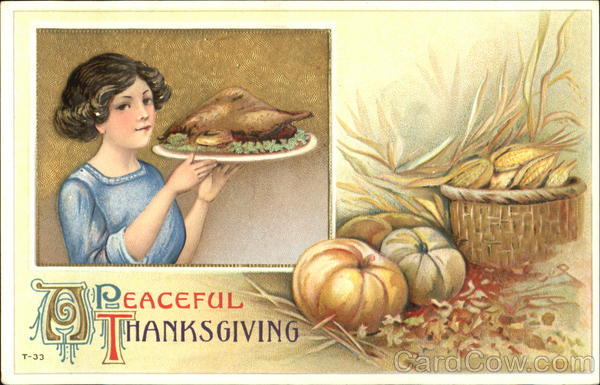
A Peaceful Thanksgiving cardcow.com

Kids draw bright crayoned versions pictures of the “first” Thanksgiving, although chances are they don’t depict the original celebrants eating venison and eel, or engaging in shooting demonstrations. It’s certainly not an event the Wampanoag would have recognized. The Thanksgiving holidays we celebrate today center around family and togetherness. That’s due to one woman, Sarah Josepha Hale (who incidentally was the author of the poem “Mary Had A Little Lamb,” later put to music).

Before Hale’s campaign to create a national holiday, Thanksgiving was held at different times in different jurisdictions on any date between October and January. Or not at all. And in the South the holiday was largely unknown.

Thanksgiving origins, Thanksgiving peace,

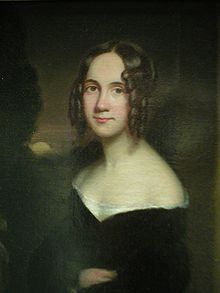
Sarah Josepha Hale, 1831, by James Reid Lambdin

But Hale was editor of the most widely circulated magazine of the time, Godey’s Lady’s Book. This publication, largely aimed at women, published influential poetry, art, and fiction, and under Hale, advocated for women’s educational attainment. Beginning in 1846, Hale used this platform to push for a national day of gratitude. She hoped such a holiday would help to unify the North and South, even prevent a Civil War. Violating the magazine’s policy against politics, she wrote editorials year after year asking the nation’s leaders to declare the last Thursday in November a national holiday–Thanksgiving Day.

In an editorial published November 1857 she wrote:

Consecrate the day to benevolence of action, by sending good gifts to the poor, and doing those deeds of charity that will, for one day, make every American home the place of plenty and rejoicing. These seasons of refreshing are of inestimable advantage to the popular heart; and, if rightly managed, will greatly aid and strengthen public harmony of feeling. Let the people of all the States and Territories set down together to the “feast of fat things” and drink, in the sweet draught of joy and gratitude to the Divine giver of all our blessings, the pledge of renewed love to the Union, and to each other; and of peace and good-will to all the world. Then the last Thursday in November will soon become the day of AMERICAN THANKSGIVING throughout the world.

She also steered public sentiment by promoting Thanksgiving recipes (including roast turkey and pumpkin pie), poems, stories, and drawings of families gathered at the Thanksgiving table. She wrote hundreds of letters to governors, presidents, and secretaries of state as part of her campaign.

Seventeen years later, in the midst of the Civil War, Abraham Lincoln issued a presidential proclamation that Thanksgiving Day be celebrated as a national holiday. This day, which many of this country’s original inhabitants consider a national day of mourning, is also a day established to promote peace and goodwill. Never underestimate the power of an idea, pushed by a pen and persuasive pumpkin pie recipes.

Mother & Child Are Linked At The Cellular Level

fetal cells heal mother, life long benefits of pregnancy, baby's cells help mother,

Fetal cells remain to heal a mother throughout her life. shortgreenpigg.deviantart.com

Today is my youngest child’s birthday. As my mother used to tell me, we always carry our children in our hearts. I know this is true emotionally. Apparently it’s also true on the physical level.

Sometimes science is filled with transcendent meaning more beautiful than any poem. To me, this new research shows the poetry packed in the people all around us.

It’s now known that cells from a developing fetus cross the placenta, allowing the baby’s DNA to become part of the mother’s body.  These fetal cells persist in a woman’s body into her old age. (If she has been pregnant with a male child it’s likely she’ll have some Y-chromosomes drifting around for a few decades too). This is true even if the baby she carried didn’t live to be born. The cells of that child stay with her, resonating in ways that mothers have known intuitively throughout time.

Fetal cells you contributed to your own mother may be found in her blood, bone marrow, skin, kidney, and liver. These fetal cells appear to “treat” her when she is ill or injured.   Researchers have noticed the presence of these cells in women diagnosed with illnesses such as thyroid disease and hepatitis C. In one case, a woman stopped treatment against medical advice. A liver biopsy showed “thousands of male cells” determined to be from a pregnancy terminated nearly 20 years earlier. These cells helped her body recover just as fetal cells you gave your mother rush to help repair her from within when she’s unwell.

Fetal cells may influence a woman’s autoimmunity, although it’s not yet known if they are always beneficial. According to fascinating accounts in Do Chocolate Lovers Have Sweeter Babies?: The Surprising Science of Pregnancy, the more fetal cells there are in a woman’s body, the less likely she is to have conditions such as multiple sclerosis and rheumatoid arthritis. That’s not always the case. It’s thought that sometimes a mother’s body may instead battle those cells, thus provoking autoimmune disorders. (Apparently family dynamics are complicated even at the cellular level.)

There’s evidence that fetal cells provide some protection against certain cancers. For example, they’re much more prevalent in the breast tissue of healthy women than in those with breast cancer. Fetal cells are less common in women who developed Alzheimer’s disease, suggesting they provide late-life protection. Fetal cells can contribute stem cells, generate new neurons in the mother’s brain, even help to heal her heart. Her heart!

Look around at your family. Any woman who has ever been pregnant, even if she miscarried so early she never knew she was with child, is likely to be a microchimera (a person who carries the cells of another person).  Fetal cells have the imprint of her child’s father and his ancestry. Fetal cells can be shared from one pregnancy to another, meaning the cells of older siblings may float within younger siblings. These cells are another reminder of the ways we are connected in a holographic universe.

Overall, the presence of fetal cells in a woman’s body is associated with substantially improved longevity, with an overall mortality rate 60 percent lower than women whose bodies don’t contain such cells.

I’d like to think that my fetal cells helped my mother battle the congestive heart failure that eventually took her life. I like to consider that I carry within me my older sister’s fierce intelligence and that my talented younger brother benefits in some way from the cells of both his sisters. Knowing that I carry the cells of my four living children as well as babies I lost makes my heart ever more full on this special day.

We heal our mothers and our children heal us. Again poetry takes a back seat to nature’s awesome secrets.

The Trouble With Principles

what should a poet do, living up to one's ethics, sticking to principles,

Image courtesy of amythepirate.deviantart.com

I’m struggling with a decision that should be easily made. It isn’t a heady question of global importance. Nope. It’s much more mundane.

It’s a question of principle.

sigh

I’ve spent some time (and even more time ) writing about how the Teach & Test approach to education screws up our species’ wonderful inborn drive to seek out learning and retain that learning.

I’ve also spent a bit of time writing poetry. I authored a collaborative chapbook (long since out of print) back when I wrote poetry in partnership with nursing home residents. My poems are published here and there for the six people who read tiny literary journals and the three people who buy small press poetry anthologies. And a collection of my poetry, Tending,  has been published.

The engine fueling a non-fiction writer’s work is entirely different than the inspiration that sparks a poet’s poems into being. The non-fiction writer wants to get ideas across. The poet wants her words felt.

These two motivations probably shouldn’t tussle.

Today they are. That’s because this poet was asked something that made this non-fiction writer snort. A poem of mine, published last year in the Christian Science Monitor, has been selected for use in tens of thousands of high school assessment tests.

Yes, those same tests I rail against.

I don’t for a moment assume that my poem was selected on its merits. The piece happens to be riddled with imagery and metaphor, well suited to torture teenagers with questions designed to make them further detest poetry.

But I didn’t turn down the request right away. I’m not sure why (except that I’m a weak weak person to whom they’re offering $350 for the rights). The very concept violates my principles.

I also have the desire to let that poem stay alive. Poems live only while they’re read or when their lines are remembered. Most poems have a lifespan comparable to that of a mayfly. And yes, I have a ridiculous hope that one teen in the midst of a test might feel the poem.

I’ll probably send the official multipage form back with permission denied written where my signature should be. But I haven’t done it yet.

What would you do?

(And if you’re curious, here’s the poem.)

*

                        Why the Window Washer Reads Poetry   

for Michael, who carried poems in his work shirt pocket


He lowers himself

on a seat they call a cradle, rocking

in harnesses strung long-armed

from the roof.

*

Swiping windows clean

he spends his day

outside looking in.

*

Mirrors refract light into his eyes

telescopes point down

photographs face away,

layers of dust

unifying everything.

*

Tethered and counterbalanced

these sky janitors hang,

names stitched on blue shirts

for birds to read.

Squeegees in hand they

arc lightly back and forth across

the building’s eyes

descend a floor, dance again.

*

While the crew catches up

he pauses, takes a slim volume from his pocket

and balancing there,

36 stories above the street,

reads a poem or two

in which the reader is invariably placed

inside

looking out.

*

Laura Grace Weldon


Poetry Diet

struggling poet, making money as a poet, appreciating poets, life of a poet,

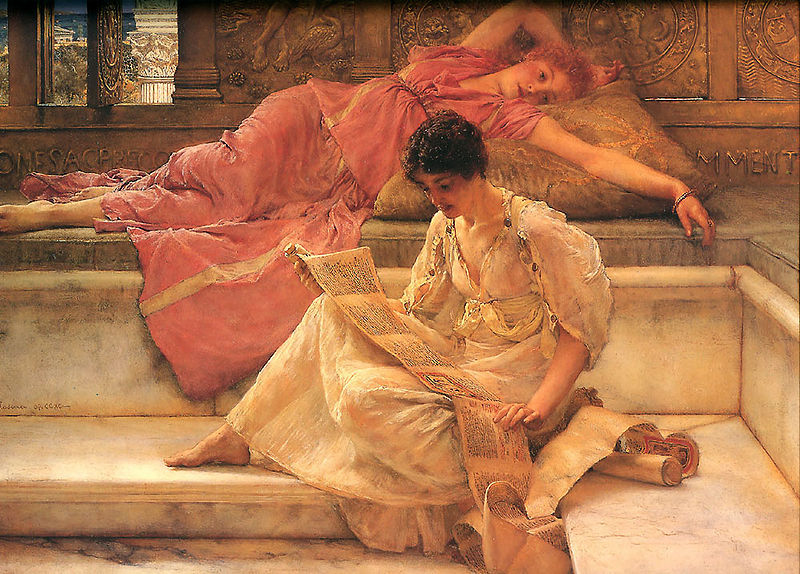
“Favourite Poete” by Lawrence Alma-Tadema

Poetry is thoughts that breathe, and words that burn.  ~Thomas Gray

The term Poetry Diet might imply a rare appetite. The sort of longing only appeased by words strung spare and stark, like a meal so desired that imagination keeps creating it anew.

Ink runs from the corners of my mouth
There is no happiness like mine.
I have been eating poetry.
~Mark Strand

Or Poetry Diet could imply hunger for that rare current some call inspiration, the elusive muse carrying phrases from ether to pen.

Everything in creation has its appointed painter or poet and remains in bondage like the princess in the fairy tale ’til its appropriate liberator comes to set it free.  ~Ralph Waldo Emerson

However in this case, what I’m calling the Poetry Diet is something much more mundane.  It simply means to eat nothing but what is purchased with money earned from one’s poetry. Reading, teaching, publishing, wearing them on your naked body, selling poems painted on scrap metal, whatever it takes. If I started a Poetry Diet now I’d be svelte in a week, thin rather soon. Before long, starving artist might be a literal (hah!) condition.

Surely a Poetry Diet would provide a vast incentive to write and, here’s the rub, send out one’s work. It could also leave the poet so imperiled that friends might stage a poetry reading to raise funds to feed the annoyingly hollow wordsmith.

Thus far I’m not dedicated or foolhardy enough to attempt a Poetry Diet. Mostly because I’m already trying to live by patching together the Essay Diet, Columnist Diet, and Editor Diet. But also because I know how long it takes from inspiration to paycheck. Right now I’m waiting for one of my poems to appear in Christian Science Monitor, two in Trillium Literary Journal, two more in J Journal. The total pay will amount to, well, let us not speak of actual numbers. I wouldn’t last long on the Poetry Diet. Surely that says something about the quality of my poetry but it also says something about our culture as well.

Poets aren’t very useful
Because they aren’t consumeful or very produceful.
~Ogden Nash

I hardly expect to live by poetry alone, although I have been sustained by the work of other poets in ways more vital than any meal. I long to see greater support for artists of all kinds. I have dear friends who devote their lives to perfecting a craft. They act, compose, weave, calligraph, paint, weld, invent, write, bake, work with wood, sing, and throw pots. They are driven to explore the intersection of art and cosmology, continually refining what it means to create. Yet most of them spend their days at jobs that are unrelated in order to survive. They wait tables or work in accounts receivable. Their real gifts emerge during precious hours plucked from mundane obligations.

It’s quite possible to attend a production at a local playhouse and see performances that shift the way you experience the world. You walk out a changed person for the extraordinary art you’ve enjoyed. Chances are that director, those actors, that playwright are unable to support themselves with their work, vital though it is.

I’m certainly not in league with those whose work is transformative. My poetry is about ordinary things like opening doors, moving stones, forgetting a name.

Perhaps I should head in a new direction—food poems. That way I’d feel nourished while contemplating the swirling curds and whey in the next batch of cheese I make. I’d also be answering Chesterton.

Poets have been mysteriously silent on the subject of cheese.  ~G.K. Chesterton

Mom Knows Nothing

open to questions, don't know answers, kid's questions, being a mom,

“Why don’t you know any answers?” my then three-year-old asked me.

He was exaggerating. I always gave him a straight answer when he asked what we could have for dinner or when we were going to the library. But it was true, sometimes I had to look things up. That’s because I really didn’t know answers to questions he posed like, “Do bees have intestines?”

Still, I knew what he meant. I tended to respond to his questions with inquiries of my own. “What do you think?” or “Let’s find out.” Of course I was intentionally vague in order to spark the process of discovery. I didn’t know such a tactic might annoy a toddler who sometimes just wanted to know. Yes, I modified my approach, although he’ll tell you today that I’m just as annoying in other ways.

However the habit of putting questions where answers might be continues, at least in my head. The more I experience the sorrows and delights of life the more I recognize that answers aren’t the aim. So much is better understood as a question.

Today I walk out back with a pail of vegetable peelings and leftover oatmeal for the chickens on our little farm. Chickens look perpetually quizzical, perhaps that’s one reason I like them so much.

Our cows graze in the sunny part of the pasture. I can’t get past marveling at the mystery of plants eating sunlight, cows converting grass to milk, and milk transforming into cheese on my stove. I simply stand watching the cows in wonderment.

While I stand here I know that what we call gravity bonds me and everything I see to the planet. Without this force all of us would drop into the darkness of space. Earth holds us. Yet here on this perfect sphere we humans find reasons to hurt one another and harm the Earth. I hear humanity’s questions asked over and over in songs, poetry and the scriptures of many faiths, and I am comforted by our common quest for understanding.

There’s peace to be found right beyond the need for answers. This sense of calm I find puts the emphasis on love, not on what’s right. (It doesn’t hurt to recognize that those who have all the answers actually don’t.) I walk back to the house, taking in the way the water flows along the creek and the mud squelches around my boots. I’m glad to live with people who are astonished daily by this world’s wonders. Even if they continue to ask me what’s for dinner and expect an answer.

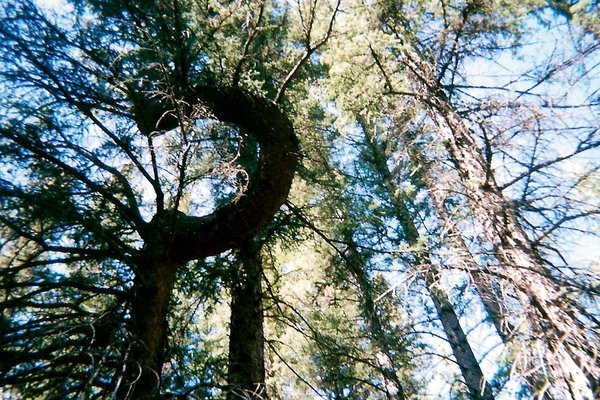
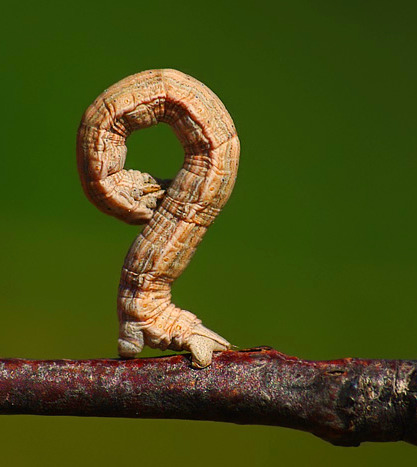
inchworm, questioning everything, appreciating the moment,

*

*

*

Question tree photo courtesy of Type Zero

Singing From the Inside Out

I can’t sneeze in a roomful of my friends without hitting a number of talented singer-songwriters who’d love to make a living through music. (Yes, a metaphorical sneeze.) Yet nearly every gifted artist any of us know has to ignore his or her gifts in order to make a living.

What cultural transformation might we see if those drawn to poetry, sculpting, composing, painting or other mediums of expression had some hope of living by their art?

Well here’s some hope.

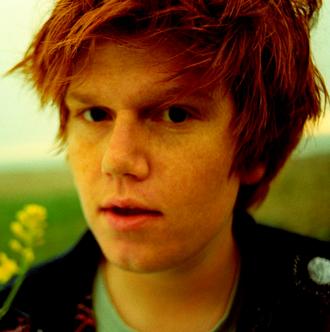
A homeschooled guy who chose to help out with a worthwhile project now appears with John Mayer, Sheryl Crow and the Dave Matthews Band. His songs are heard on House and Ugly Betty. And more importantly, he sings about what matters to him.

See if the questions posed by this deceptively beautiful piece, “Ain’t No Reason,” resound long after the music is over.

Brett Dennen grew up in rural California, homeschooled along with his brother and sister. In an interview with Frank Goodman for Puremusic.com Dennen describes his mother’s homeschooling approach as “experiential.”  He says, “…so she rarely had a lesson plan or anything like that. She would give us books, and we would read the books. And we did a lot of gardening, and we did a lot of science education through being outside. We took camping trips with other kids who were homeschooled. And when we were out camping, we learned about rivers and forests and mountains and geology. We’d take books out camping with us, and we’d read about it, and we’d look for what we’d read about. Experiential education basically means instead of being in a classroom and being taught or told something, to actually go out and see it, and see how it works and learn through experiencing it instead of learning through being taught or told it. And that was really valuable to me.”

Dennen took the same approach when learning music. As he says in the same interview, “Because of the way I was homeschooled, I got into the idea of trying to learn how to do things my own way. And so when I started playing guitar, I taught myself. I took lessons for a while, but I lost interest in them because I think I just didn’t like going to my lessons, I didn’t like my teacher, I didn’t like what I was learning. So then I quit. And after I quit, then I really started to learn.”

He went to college planning to become a teacher. While a student, Dennen met Lara Mendel at a wilderness-safety class and the two of them wrote a humorous song about backwoods diarrhea for a class assignment. Mendel happened to be developing a powerful hands-on program for children, one that tackles intolerance and violence head on. She named it The Mosaic Project. Dennen wrote songs to reinforce the activities. Now his music and her project teach hundreds of California children about acceptance, friendship and peace in each session of The Mosaic Project.

The creative and independent spirit of Dennen’s homeschooling background hasn’t left him. Goodman’s interview opens with these comments. “He’s like a new kind of human being to me, this Brett Dennen. After spending time with him this week, I feel that way even stronger than after the positively confounding impression that his new CD, There’s So Much More, left on me. If he’d said that he was an alien, I could have swallowed that; it would even have made sense to me. Because I’m simply not accustomed to meeting and spending time with people that appear to be so incorruptible, so odd and yet so self-assured; so, uh, enlightened and inner-directed, if I might venture all that.”

I don’t know if Dennen’s life up to this point says more about homeschooling or about doing the work of one’s heart. I do know there’s no separating the two.