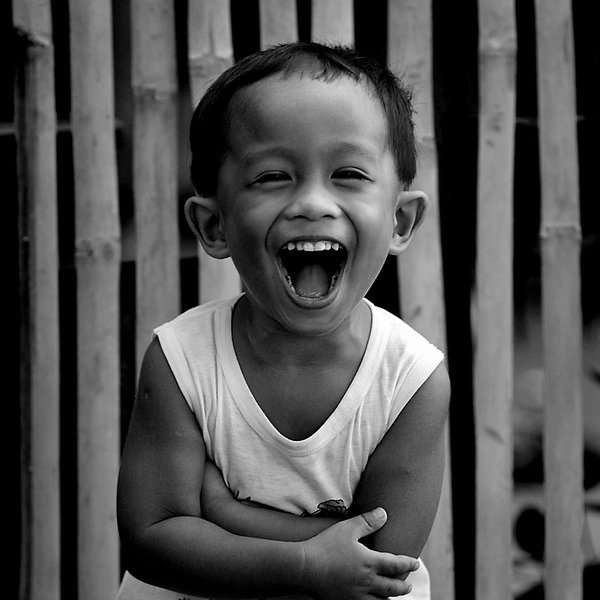
“Sound of Laughter” by Hersley
We’re primed to practice the generative power of laughter from our earliest years. As babies interact with their mothers, their laughter quadruples from three months of age to their first birthday. Interestingly, mothers laugh nearly twice as often in these interactions. By a baby’s second year, they laugh nearly as long and often as their mothers do, meaning the more mom laughs the more her child laughs!
Some scientists believe laughter was a precursor to language itself. As neuroscientist Jaak Panksepp explains,
“Neural circuits for laughter exist in very ancient regions of the brain, and ancestral forms of play and laughter existed in other animals eons before we humans came along with our ‘ha-ha-has’ and verbal repartee.”
Throughout life, from childhood on, most of our laughter comes from social interactions. Studies tell us we laugh 30 times more often in the presence of others than we do when we’re alone. Since laughter does so many good things for us, body and soul, it motivates us to spend time with the very people who make us happy. What a lovely feedback loop — instigating, reacting to, and inspiring more laughter —- bonding us to each other through delight.
Laughter can even become an epidemic. In 1962, three girls started giggling in Kashasha, a small town in what’s now Tanzania. It spread to 95 students in their school, lasting for hours. Within two weeks, similar laugh attacks infected kids in the nearby towns of Nshamba and Bukoba. It continued to spread, closing 14 schools before quarantines were enacted. It took 18 months before the epidemic slowed.
(In rare cases, you can laugh yourself to death.)
I am serious about all sorts of issues and will discuss them with you to death (a worse death, I’m sure, than death by laughter). But I’m also an unrepentant guffaw-er. I’m pretty sure this is a genetic condition, my very polite mother was also prone to fits of hilarity. Like her, I am capable of laughing normally, but sometimes I end up shrieking and cackling. Controlling such laughter is just about impossible. Once, as a teenager, I was swimming across a small lake with my friend Kathy. As we swam, we started laughing about how funny the other person looked swimming. Weakened by glee, we got to the point where we could only dog paddle in place. Seeing the other person dog paddling, wide-mouthed with laughter, made us laugh all the more. Soon we were barely able to keep our heads above water. After gulping too many mouthfuls of water, we finally staunched our laughter until we somehow managed to get ourselves onto dry land. There we lay exhausted, aware we’d nearly drowned, laughing again.
I mostly laugh about my own awkwardness (plenty of material there) like falling , eating a mouthful of dirt, and accidentally snorting in a stranger’s face. Snorting, by the way, got me laughing crazily the other day. For some reason Olivia was snorting with joy as Sam tossed her on the couch and for some reason that snorting set me off. I was trying to video this, but you can barely hear her snorts over my ridiculous shrieks.
Laughter’s contagious nature is more evidence that we humans are connected across all so-called boundaries. I’m writing about laughter today because my family has had a tough time lately and so has our country and so has our world. So I’ll leave you with these timely words by dear soul and wise sage, Bernie DeKoven. who writes in a post titled “Play, Laughter, Health, and Happiness,”
Playing and laughing together, especially when we play and laugh in public, for no reason, is a profound, and, oddly enough, political act.
Political, because when we play or dance or just laugh in public, people think there’s something wrong with us. It’s rude, they think. Childish. A disturbance of the peace.
Normally, they’d be right. Except now. Now, the peace has been deeply disturbed – everywhere, globally. And what those grown-ups are doing, playing, dancing, laughing in public is not an act of childish discourtesy, but a political act – a declaration of freedom, a demonstration that we are not terrorized, that terror has not won.
A Frisbee, in the hands of people in business dress in a public park, is a weapon against fear. A basketball dribbled along a downtown sidewalk, is a guided missile aimed at the heart of war. Playing with a yo-yo, a top, a kite, a loop of yarn in a game of cats’ cradle, all and each a victory against intimidation. Playing openly, in places of business, in places where we gather to eat or travel or wait, is a gift of hope, an invitation to sanity in a time when we are on the brink of global madness.
Yes, I admit, I am a professional advocate of public frolic. I am a teacher in the art of fun. I hawk my playful wares every time I get a chance, with every audience I can gather, war or peace.
But this is a unique moment in our evolution. America is no longer bounded by its boundaries. We are tied into a network of terror that crosses national divisions…
And I believe that we have far more powerful weapons than any military solution can offer us. And I believe that those weapons can be found in any neighborhood playground or toy store.
Like for play, laughter is also a political act, a declaration that fear and terrorism have not won. Incontrovertible evidence that there is hope.
May laughter’s gifts lift us all, together.


 , “Mirror neurons are brain cells that seem specialized in understanding our existential condition and our involvement with others. They show that we are not alone, but are biologically wired and evolutionarily designed to be deeply interconnected with one another.”


 Laura Grace Weldon