
That Guy

I’m standing in line at my usual Ohio-owned grocery. There are so many people in each register line that we’ve threaded ourselves into the aisles, people saying “I’m behind you” as they jockey their carts into place, with everyone leaving the center lane clear for shoppers still trying to finish shopping. Among people who don’t have their phones out, brief conversations pop up here and there over little things like the weather or an interesting item found in the clearance section. And then That Guy enters the line. Actually, cuts in the line until it’s pointed out to him that the line starts (hands waving) back there.

He’s an older man, maybe early 70s, hearty-sized in body and voice. He says a small aside to the woman he finds himself waiting behind, something about the long lines, and she briefly commiserates. That’s all it takes to get him started.

“Looks like nobody wants to work anymore,” he announces to everyone in the front of the store. “Bunch of losers these days,” he says, then looks around with pride as if his opinion sparkles.

I’m nearly to the register. The person waiting in front of me is a 20-something guy I’d insisted go ahead because he had only two items – a bouquet of flowers and a package of hot dog buns. He turned around at the commotion and we rolled our eyes at each other.

“Maybe he should apply to work here,” the younger guy says quietly.

I say, “Maybe the store needs to pay more.”

He nods. I add, “And maybe the millions of people with long covid can’t work.”

While we two are snarking, I realize the people now in line behind him as well as the woman in front of him are not snarking. “I worked 35 years. I earned my retirement,” he says. “I shouldn’t have to stand here like this.”

“The lines are moving pretty fast,” says the woman who had previously commiserated.

“What the hell is taking so long?” His voice goes up in volume. “Pardon my French, but all we’re trying to do is give this store our hard-earned money.” I think about all the checkout clerks whose difficult jobs are made worse by loud-mouths like him. About record-setting corporate profits driving inflation. About divisiveness stoked by pundits.

“I’m old,” he says. “I could die right here in line.”

A woman, probably about his age, is trying to get her cart past his to head down the cereal aisle.  “I’m a retired EMT, one of the first females to qualify in the state,” she says. “You won’t die as long as I’m here.”

I want to cheer at her take-no-crap kindness.

A couple sporting Cleveland Guardians hats are blocked as they try to pass. They stop for a moment, their round generous faces giving him the attention he so clearly needs. “I’m going to be retiring in a few years,” says the man. “Any advice?”

Asking advice, in so many circumstances, is one of the most respectful thing we humans can do for one another. I’m blown away by the wisdom of this question.

That Guy pauses in his general announcement-style monologue to give it a thought. “Yeah,” he says gruffly. “Don’t let your wife die before you do.”

Everyone seems to be listening now. The baseball fan woman rattles a jar in her cart. “Vitamins. I plan to stick around for a while.”

That Guy wishes them luck as they move on. His sadness briefly revealed, he gets back to his protective covering of bluster.

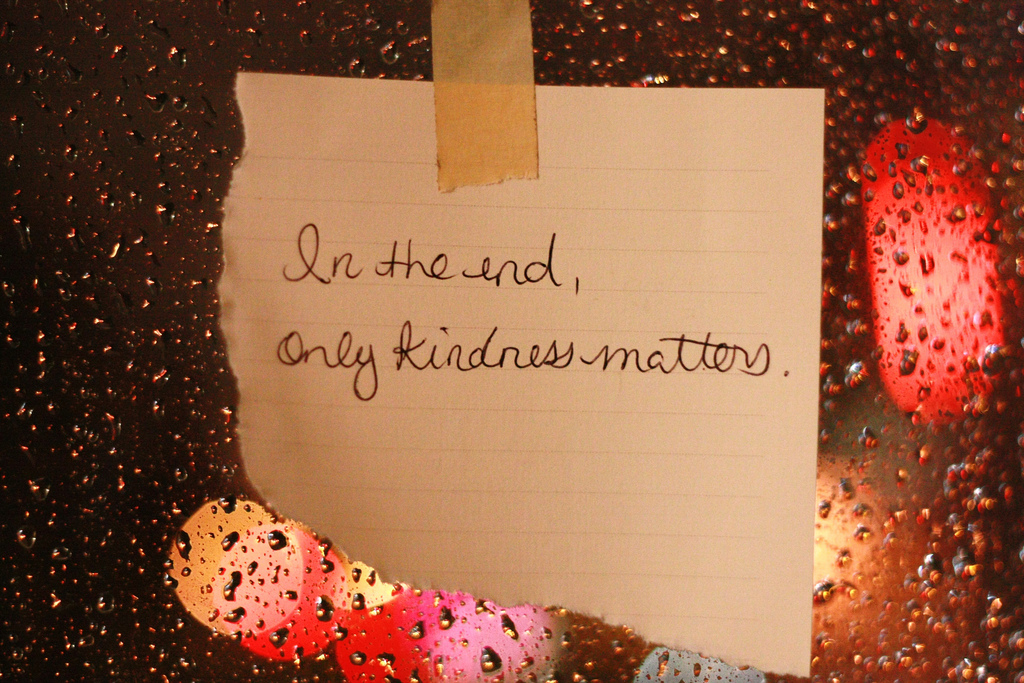
I just witnessed a lot more kindness than the zero kindness my thoughts showed this man. I know kindness is contagious. I know simply reflecting on our own gratitude can help others through the magic of heartbeat entrainment. It’s just not easy.

As I leave I see he is parked one car over from me. He shoves his cart over to the side, as if he isn’t planning to push it over to the cart carrel. “Want me to take that back for you?” I ask, fully expecting a snarl for an answer. “Naw, I got it, he says. “Here, let me take yours.”

“Thanks,” I tell him. “That’s really nice of you.”

He smiles, actually smiles back at me.

I’m going to try harder to see beyond behavior that rankles. And I’m going to keep fighting against every single thing his hateful bumper stickers proclaim.
Compassion By Design

The weight of other people’s suffering can be palpable, whether someone weeping in the next room or someone in agony across the globe. How do we go about our own lives knowing others are in anguish at the same moment? This question has haunted me, especially in my growing up years. I suspect such questions weigh more on children than we imagine.

By the time I was eight or nine years old, my parents had cancelled their subscriptions to news magazines because they couldn’t deal with repeated questions like, “Why is that village burning? Who hurt that man? Why isn’t someone helping that baby?” Even the most well-intentioned adult would rather not think about such questions, let alone answer them. Try to explain war to a child. No matter how you skew it, the answer comes down to whoever destroys more property and kills more people, wins. Try explaining poverty or prejudice to a child. It’s impossible to morally justify the indifference and greed that helps to prop up “normal” life in the face of truly open, honest questions.

Starting in babyhood, most children express empathy as well as a sense of connection to the natural world.  Many children, including some we call “gifted” and some we call “neurodiverse” are more strongly motivated by the search for justice, mercy, equality, and truth than by more superficial adult concerns like polite behavior.

Even new arrivals to the planet demonstrate this. By six months of age, babies show empathy for those who have been treated unfairly. Concern for others starts on day one. When hearing recorded cries, one-day old newborns are more likely to cry when hearing a recording of another baby crying than their own cries. Newborns also show more intense and longer-lasting distress when listening to others’ cries. This effect doesn’t diminish. Studies show babies continue to react with distress to other’s cries at one, three, six, and nine months.

As children show us, this is quite naturally who we are. Kindness is the way our species evolved. According to anthropologist Douglas Fry, author of Beyond War: The Human Potential for Peace,  for 98 percent of our human existence on earth we lived in small nomadic bands that did not make war, thriving precisely because our kind relied on cooperation and collaboration. The oldest and most longstanding child-rearing practices still support this way of being.

Historian Rutger Bregman, author of Humankind: A Hopeful History, says in a recent interview, “If I say most people are pretty decent that may sound nice and warm but actually it’s really radical and subversive and that’s why, all throughout history, those who have advocated a more hopeful view of human nature – often the anarchists – have been persecuted.”

Greed, and violence are not “human nature.”  We flourish best with gentle nurturance and ongoing cooperation.  Even our bodies are cued for compassion. In fact, research tells us our bodies pump out oxytocin when we’re stressed. Normally we think of it as a love hormone. It is. It prompts us to connect with and support one another. As we reach out, our bodies react with more oxytocin, helping us recover while strengthening relationships.

We are in a time of intense reexamination brought about by an unchecked global pandemic, systemic oppression, and ecosystem destruction.When we wall off our feelings of outrage, shame, and despair we’re walled off from ourselves.  It’s time to recognize the collective weight of suffering. Time to truly to listen to each other. This starts with the questions children ask, often the largest questions.

As Tobin Hart writes in The Secret Spiritual World of Children, our wide-awake presence in the lives of children “reminds us to listen for inner wisdom, find wonder in the day, see through the eye of the heart, live the big questions, and peer into the invisible. “

25 Ways To Spread Some Kindness

Image: SweetOnVeg’s flickr photostream

1. Take your compliments about an employee to management. Chances are you’ll never see the impact. Chances are, it’ll be greater than you imagine.

2. Give up a great parking space for the car behind you. Parking farther away simply gives you more exercise.

3. Call an elderly relative or neighbor once a week to chat. You may think you’re enriching that person’s life. They’re enriching yours too.

4. Hold the door open for the person behind you.

5. Write a thank you note. To see the powerful impact this practice can have, check out A Simple Act of Gratitude: How Learning to Say Thank You Changed My Life.

6. Write an anti-thank you. Sure, it seems counter-intuitive but it’s a way of using a  negative experience to help others.

7. Leave money in vending machines, especially in hospitals and detention centers.

8. Leave a positive review for a local business on Merchant Circle, ThinkLocal, or Yelp. And don’t forget writers. Leave stars on sites such as Goodreads and Amazon, recommend books you’ve enjoyed to friends, maybe give a shout-out on social media to authors whose work impacted you.

9. Listen. You know how it feels when someone really listens to you. They look into your eyes, they react to your words, and you feel understood. Check your listening skills against the Scale of Attuned Responses.

10. Meet your needs and those in your community, maybe with other new parents or people in your neighborhood, by collaborating. Check Shareable for all sorts of guides. These include How to Create a Walking School Bus in Your Neighborhood, How To Host a MamaBake Food Swap Session, How to Share an Education, How to Plant a Habitat Garden at the Local Playground, How to Build a Better Neighborhood, and How to Set Up a Neighborhood Exchange Box in 4 Easy Steps.

11. Give genuine compliments. You might want to challenge yourself to give compliments to five people a day. It keeps you on the lookout for truth and beauty. Tell a clerk she has a lovely voice, a child that his smile made your day, a loved one that their eyes are beautiful.

12. That kid who keeps hanging around, looking as you grill dinner or wanting to talk while you wash the car? He may be longing for encouragement. Even a few kind words may be the kind of mentoring he needs.

13. Help budding entrepreners through Kickstarter or Indiegogo. Make your money go farther by lending to a Kiva project.

14. Greet new people on your street with a small gift such as a houseplant or plate of cookies. The neighbors you’ve never met? Try online resources to connect such as NextDoor or front porch forum.

15. Give gifts that do some good.

16. See an act of aggression? Get involved even if it seems like none of your business. That’s a kindness too.

17. Set books free. Donate them to a good cause (a nearby school, your library’s book sale?) or leave them ala Book Crossing to find new readers.

18. Donate pet food to the nearest animal shelter. While you’re there, offer to walk a few dogs.

19. Patronize kids’ car washes and lemonade stands.

20. Be aware of newcomers to your workplace, school, house of worship, or other organization. Make a point of greeting them and introducing them to others.

21. Keep duplicates of your child’s toys and books in the diaper bag. When you encounter fussy children, offer an extra to their parents.

22. Smile. Find out 10 ways this face stretcher benefits you as well as those on the receiving end.

23. Donate blood. One pint of blood can save up to three lives.  

24. Designate a tiny container as your family’s Pass It Forward box. Tuck it somewhere one member of the family will find it (under the bed pillow works) with a little surprise inside (a loving note, a handmade coupon for an unexpected perk, some chocolates, a drawing, a map of a place you’re going that day, a compliment). That person is expected to put something else in the box and leave it for another family member, so kindness can circle around and around.

25. Set a good example, be kind to yourself.