Chaos Gardening

Apparently there’s a newish fad in the horticulture world called “chaos gardening.” This is described in UK’s House and Garden as “inspired by the unruly growth of nature and a whiff of rebellion against the control and neatness of traditional horticulture.”

Oh honey, many of us have been chaos gardening for a very long time.

I’ve never had the energy, money, or interest to maintain neatly weeded and mulched gardens. The last time we spread mulch was at least eight years ago. It was free municipal mulch which I discovered to my discomfort, less than a day after spreading it, was full of chopped up poison ivy.

I have no garden beds in straight lines by choice. No plantings in straight rows either. I commonly don’t remember what I’ve planted until it grows. I’ve attempted to keep up on the weeding side of things, but have always failed. Laziness, mostly, but also a quiet delight in the marvelous plants we call weeds. (Well, it took me a long time to admit a grudging respect for thistles but I’m mostly there now.)

My husband and I have developed a nearly effort-free method of weed control that uses newspaper and the occasional tape-free stretch of cardboard between plants, with wide rows left free to grow vegetation we occasionally mow. By “occasionally” I mean we keep the growth low when young plants are establishing themselves. Then the weather gets too hot and we get too lazy to mow. By late August it’s a wildly alive mess of feral loveliness.

I’ve gardened since I was 18. (One of my first crops were apparently mistaken for magic mushrooms….) The obligation to keep up with the maintenance necessary for typical gardening used to slurp the joy right out for me. Instead I’ve learned to appreciate how perfectly the land cares for itself in concert with wildlife and weather and seasons. And yes, I’ve gone more and more toward the chaos end of things.

This year, however, I’m well beyond chaos gardening. 

One side of the house is planted with bulbs, sedum, hydrangeas, and other perennials but is currently nearly overwhelmed by strawberries that self-seeded from pots on a nearby porch.

Another side of the house has struggled to grow almost anything. I finally discovered after years of trying to establish an herb bed that the problem was due to deeply embedded landscape “fabric” put down by the former owner. As I’ve written elsewhere, products like landscape fabric, plastic mulch, astroturf, and other so-called weed solutions suppress the development of mycorrhizal fungi essential to plant health. They also wreck the habitat for beneficial soil-dwelling creatures, overheat the ground, prevent organic matter from being incorporated into the soil, and impede the health of plant roots. Their presence wrecks the necessary carbon dioxide and oxygen exchange between soil and air—essentially suffocating the soil. If that’s not alarming enough, landscape fabric contains petrochemicals which break down into toxic substances including microplastics. One analysis shows that three feet of landscape fabric can release hundreds of millions of microplastic particles. I think we’ve dug up all that awful plastic, it’s long past time to haul compost from out back to spread over the bed and start over next spring.

The front garden bed I established using soil dug up for septic repair remains a flourishing mess. Ancient pine trees at either side of the bed grow a bit more brown every years. Clematis does its best to climb up the moon mosaic. Lamb’s ear spreads from its spot under the trumpet man sculpture to pop up everywhere (no surprise, as it’s related to mint). Most of the rest are weeds I’ve come to consider friends.

Then there are our vegetable gardens. The asparagus patch, by this time of year, is a towering mass of vegetation. It offers a marvelous hiding place for all sorts of creatures and I’m pretty sure a nesting site for various sparrows as well as the Eastern meadowlark family we’ve seen all summer.

The side vegetable patch is a productive jumble. I wade in to pick tomatoes, eggplant, peppers, cucumbers, chard, leeks, and other delights. Each step brings up a rustle of butterflies, crickets, and other creatures.

And our hoop house out back hasn’t had its rows mowed in many weeks. There, too, are heavy harvests of tomatoes and peppers, but mostly grapes. We have picked at least four five-pound pails of grapes the last few weeks and are so weary of canning juice that I’ve been giving grapes away.

The pasture where our cows once grazed, where I’d hoped we might have a herd of sheep or a few donkeys, is now a meadow of its own making.

The sides of our pond and creeks have always been left unmowed, growing only with what naturally wants to grow. Our wooded acres are riddled with fallen ash and beech trees quietly fostering new life. All of these places are beautifully alive.

I’m mostly at peace with the chaos here, although my better self would like to tend more closely to our gardens. But my husband and I just don’t have the gumption right now to do more. We are exhausted by a country in chaos. Democracy is being undermined by well-funded extremists, authoritarianism is marching in, inequality is compounded, genocide not only ignored but fostered, and all the while the climate every life form relies on to survive is being sacrificed for profit.

Chaos, I’m reminded by evolutionary cosmologist Brian Swimme, is one of the powers of the universe. We’re here thanks to the cataclysmic death of stars. Their explosions provided the iron circulating in our blood, the calcium making up our bones, the oxygen we inhale. Cataclysms on our planet have caused five major extinctions. (We humans are causing the sixth.) We have endured many other catastrophes including wars, famine, plagues. And yet, from the cataclysmic death of stars, we get to live on a planet graced by orioles, humpback whales, monarch butterflies, sunsets, tides, elephants, newborn humans. We are all part of one another, composed of star stuff.   

May long and gentle rains like this one fall on every parched landscape. May beauty pair with chaos and peace rise from cataclysm.

amen
Blessed By Weeds

natural weed control methods, benefits of weeds

Nature doesn’t appreciate the bare earth method we call “weeding.” The soil we count on to grow food and flowers isn’t just a blank medium for our use. It’s a fragile, complex, living system that’s home to bacteria, fungi, and other life forms busy beneath our feet.

Left alone, nature brings forth plants of all kinds that improve the soil’s ability to foster life. We call them weeds. They seem to spring up without reason other than to frustrate us. But nature has her reasons.

~Many of these plants boost the presence of mycorrhiza.  This beneficial fungi massively improves a plant’s ability to use the soil’s water and nutrients while providing protection from certain pathogens. Mycorrhizas are found in more than 90 percent of plant families but their presence is inhibited by too much fertilizer and can be destroyed by excessive digging, tilling, and soil compaction.

~Many of these plants help to break up heavy soil with strong root systems, aerating and improving drainage. This makes the ground a better home for the plants we prefer to grow.

~Many of these plants improve soil fertility. Two common categories of weeds are dynamic accumulators and nitrogen fixers. Nitrogen fixers are able to capture atmospheric nitrogen, and due to a symbiotic relationship with soil bacteria, these plants “fix” critically important nitrogen in the soil. Dynamic accumulators draw trace elements and other nutrients from deep underground and transport them closer to the surface

In places where soil is poor, the right plants to correct those particular deficiencies tend to spring up. In fact, botanists know that weeds are an indicator of soil properties such as pH and mineral levels. That’s nature’s wisdom at work.

Then we come in, gardeners and farmers, doing our darndest to get down to bare ground between rows of plants. Bare soil isn’t a natural state. The eroding effects of wind, water and sunlight wreak havoc on naked dirt. That’s where weeds pitch in, acting as protective ground cover by holding moisture and preventing topsoil loss. Think of weeds as self-appointed caretakers for vulnerable humus.

Weeds benefit more than the soil.

~In bloom, they attract natural pollinators such as bees, moths, and butterflies. They also provide habitat for many other helpful insects which balance out the pests you don’t want in your garden. Nature likes diversity.

~Plants we call weeds have been used for eons for food, oils, herbs, seasonings, and medications. Might as well celebrate dandelion season by frying up some dandelion flowers or making dandelion lemonade.  And during most of the growing season you can pluck some lambsquarters, plantain, purslane, chickweed, or other edible weeds to incorporate in your meals. (Identify them carefully and only pick plants that are not exposed to herbicides.) These foods are highly nutritious, and free for the picking. Weeds are the ultimate way to eat locally.

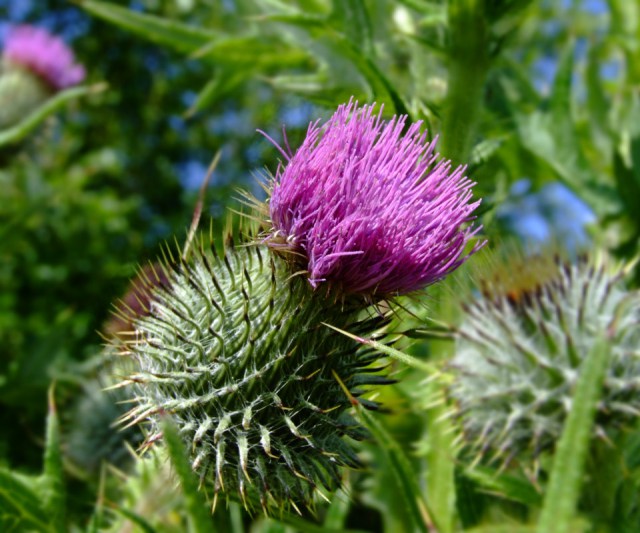
I want to understand the weeds that nature bestows on me. For example, I’ve learned to respect the fierce tenacity of thistles. Around here they can quickly grow taller than I am. And I can’t help but adore the beauty of those delicate flowers atop such a prickly stem.

They’ve visited most fiercely in our front flower bed, one that was mounded up from subsoil left when our septic system was excavated. Nature knows the soil there isn’t very hospitable to life. That’s exactly why thistles flourished there. I’ve augmented that bed with cow manure dragged from out back, stacked it with layers of straw and mulch, and pulled out as many thistles as  I can before my strength gives out.

Thistles are dynamic accumulators that work to bring up deep nutrients and their long roots break up poor soil.  Because they’re been actively improving the soil, fewer thistles appear in that bed every year, as if they’re completing a job started nearly 19 years ago. Other weeds are now taking their place, surely just as necessary.

But respect for weeds goes only so far. It’s not possible to grow peas, lettuce, and other delicate plants in a jungle of weeds. Besides, I am a low energy lazy gardener. Once summer heat rolls in I’m more inclined to hide in the shade with a book than sweat with Puritan righteousness in the sun.

So I have lots of experience with weed control methods.  (Other than chemical. I don’t go there.) Here are some thoughts on the matter.

  Hoeing. I’m not good at hoeing, although that may have something to do with using an antique implement that probably hasn’t been sharpened for decades. My hoeing technique also probably leaves something to be desired. Finally, the whole hoeing experience is impaired by having dogs out with me, dogs that like to dash after each other in wild canine exuberance which puts them right in the way of my hoe.

 Weeding. I’m not good at pulling weeds either but that’s the method I use most often. As I pull weeds, I lay their still-green bodies between the rows as a natural mulch. I tend to sit on the ground as I hand weed, and I happen to like how close that puts me to the smell of growth and the sight of tiny insects and an overall greater awareness of what’s going on in the garden. The size of my various gardens makes it impossible to do this well unless I want to spend many many hours a week on my butt pulling weeds, which I do until the blazing heat hits. Then I do so fewer hours with greater grumpiness.


 Landscape fabric or carpet discards. We were given reams of landscape fabric by a friend of a friend who used to run a greenhouse. It wasn’t easy to get between the rows and batten down with clips, but I covered it with heavy layers of grass clippings and it looked great. I was thrilled. It worked well until I pulled it off at the end of the growing season. The soil looked awful, cracked and strange as if it had boiled under all that black fabric. Rather than being soft and friable it was hard. I wanted to beg the dirt’s forgiveness. I was also rather bitter, as this was easy to use. It also has to be pulled up every year or it’ll accumulate so much biomass on its surface that plants will simply grow on top of it.

Years ago we tried using strips of discarded carpeting. I know, strange, but I read this back in some organic gardening magazine years ago. They claimed that carpet old enough to be torn out of a house doesn’t really have toxins to leach. Carpet kept down 100% of the weeds and, especially if it’s a bright color, gives your garden a Dr. Seuss sort of vibe. It was pretty darn amazing. But again, it has to be pulled up. And like landscape fabric, a great deal of biomass clings to the carpet and ends up being thrown out rather than becoming part of the soil.  Worse, I suspect it’s not really all that non-toxic…


 Newspapers and straw, or feed bags and straw. I read about the newspaper and straw method many years ago in Mother Earth News, and have been doing it on and off ever since. Basically you layer heavy, overlapping newspaper sections between the rows covered by straw or grass clippings. By the end of the growing season it’s largely biodegraded, becoming dirt by the next spring. I have a love/hate thing going with this method, probably because I’ve made all the mistakes possible. Too little newspaper, straw so flimsy that it doesn’t break into sections that firmly hold anything down. And the worst, trying to put down newspaper when there’s any breeze at all. One year I laid down quite a few rows and got the straw nicely set atop those papers but didn’t dampen it with rain barrel water because the sky threatened rain within minutes. Bad idea. That rain appeared only after heavy gusts of wind, meaning I was running around the yard trying to catch wind borne newspaper and stomping my feet in Rumpelstiltskin fits of frustration.

The past few years I’ve used heavy paper feedbags  which are even better than newspapers. We save livestock feed bags and also have our feed mill save us bags. Just cut open, spread out, cover with straw, and water. (Be careful to avoid feedbags with plastic lining! ) Unfortunately our feed mill is using mostly plastic bags, so I’ll be back to newspaper.


VLUU L200 / Samsung L200 Jeans, yes jeans. This is one of my stranger innovations. I got into the pile of jeans I’ve been saving to make a quilt (the kind perfect to keep in a car trunk for impromptu picnics). I slashed them apart, laid them between rows of emerging garlic plants while my kids laughed at crazy mom, then covered them with straw. They stay put well and biodegrade in about two years, although some heavy seams can be found here and there. Probably best to use between perennials. If you run across a cheap bolt of burlap or cotton fabric that should work too.


Garden, hopeful whack version. Weed whacking. I’ve been hankering after a small weed whacker for some time. I have a dreamy hope that, if I plant rows far enough apart, I can just cut weeds down to a reasonable height. I picture lawn-like strips between rows of gorgeous vegetables.  I haven’t tried this yet. Let me add that I have no known weed whacking skills. Chances are I’d accidentally decapitate innocent broccoli plants on my first try.

Thank you weeds. You haven’t forgotten your true value in our teeming, complex ecosystem.  As Ralph Waldo Emerson wrote, a weed is simply, “a plant whose virtues have not yet been discovered.”

What do YOU do to live with and live without weeds?


An earlier version of this post appeared on our farm site