This year has been filled with its tender moments and quiet delights. 2025 has also been grindingly awful. Every day’s news packed with official lies, cruel slurs, new atrocities, more bridges to a bright future burned. Still, I am grateful for fervent and often playful resistance, brilliant science, awe-inspiring art, nature’s constant teachings, compassionate people everywhere. And of course for the way books help hold me together even when so much is falling apart. Thank goodness for the restorative, mind-stretching, soul-rejuvenating power of books. Here’s a nod to a few of the most memorable books I read this year.
~
IMMERSIVE AND AMAZING NONFICTION
~
Your Brain on Art: How the Arts Transform Usby Susan Magsamen and Ivy Ross. I deliberately read this book slowly, a chapter or two a month, letting it reawaken me to the deep place of joy and meaning accessed via the arts. It is not remotely a self-help book, but it got me back to dancing in the kitchen when I cook, doing a little sketch each morning, and taking more time to savor small beauties I encounter in daily life. If you love science-rich inspiration, this is a book for you.
“Art and play are like two sides of the same coin, with play being a part of artistic expression, imagination, creativity, and curiosity.”
“When you make art and you don’t know what’s going to happen, you’re involved in the mystery that life really is.”
“When you tap into the arts to foster a meditative state, the places in your brain responsible for judgment and personal criticism are quieted in your prefrontal cortex, and you can assess a more generous, perspective-taking point of view.”
The Serviceberry: Abundance and Reciprocity in the Natural Worldby Robin Wall Kimmerer. I love everything Kimmerer writes but this small and beautifully illustrated book is a perfect reminder for fans and a perfect introduction for those who may not be familiar with her work or the concepts she enumerates so beautifully. Here’s a favorite quote:
“In the Anishinaabe worldview, it’s not just fruits that are understood as gifts, rather all of the sustenance that the land provides, from fish to firewood. Everything that makes our lives possible—the splints for baskets, roots for medicines, the trees whose bodies make our homes, and the pages of our books—is provided by the lives of more-than-human beings. This is always true whether it’s harvested directly from the forest or whether it’s mediated by commerce and harvested from the shelves of a store—it all comes from the Earth. When we speak of these not as things or natural resources or commodities, but as gifts, our whole relationship to the natural world changes.”
Hope for Cynics: The Surprising Science of Human Goodnessby Jamil Zaki. This may well be my favorite read of the year. I’m convinced it’s not just my current lifeboat but essential reading for anyone in these hope-challenging times. Jamil Zaki, a recovering cynic himself, shows how our competitive culture overvalues cynicism. Most of us think cynics are more responsible, better able to assess people, make more considered decisions, become better managers and leaders. Instead, they are much worse than hopeful people at all these things. They are also more prone to prop up their own self-worth through putting others down. They are typically zero-sum thinkers, believing they can only gain if others lose. This makes neighbors, coworkers, strangers, even loved ones into rivals. Instead, the author gives us a pathway to embracing what hope can do for our mental health, relationships, community, and world. I’m buying a few copies to spread some hope.
“Optimism is idealistic; hope is practical. It gives people a glimpse of a better world and pushes them to fight for it.”
“Beliefs reflect what you think of the world; values reveal more about yourself. Confusing these two can be dangerous business. When someone attaches their self-worth to a belief—political, personal, or otherwise—they desperately need to be right. Challenges to what they think feel like threats to how they think—evidence they aren’t smart or good enough. The person screaming loudest is often most fearful of being wrong.”
“I have discovered that most people value compassion over selfishness, that donating money activates similar parts of your brain as eating chocolate, and that helping others through their stress soothes our own. The message of our work is simple: There is good in us, and it does good for us.”
Once and Future Myths: The Power of Ancient Stories in Modern Times by Phil Cousineau. An engagingly insightful look at the impact of myth in our times. Cousineau writes about his own stringent upbringing as well as joys and sorrows in each stage of his life. He moves effortlessly from cultural critique to discussing how Bushmen recognize two hungers—for food and for meaning. “Myths are the original soul stories, showing us, as my mentor Joseph Campbell used to say, how to live ‘with joyous participation in the sorrows of the world.'”
The Stranger in the Woods: The Extraordinary Story of the Last True Hermitby Michael Finkel. This is quite a story—impeccably researched and told well. The author brings in just the right amount of information on hermit traditions in history, about what might be a genetic basis for extreme introversion, and from his own conversations with Christopher Knight. I found it particularly interesting how people in the surrounding community reacted to several decades of “their” mysterious thieving hermit.
“Carl Jung said that only an introvert could see “the unfathomable stupidity of man.”
“He was confounded by the idea that passing the prime of your life in a cubicle, spending hours a day at a computer, in exchange for money, was considered acceptable, but relaxing in a tent in the woods was disturbed. Observing the trees was indolent; cutting them down was enterprising. What did Knight do for a living? He lived for a living.”
“Silence, it appears, is not the opposite of sound. It is another world altogether, literally offering a deeper level of thought, a journey to the bedrock of the self.”
Custodians of Wonder: Ancient Customs, Profound Traditions, and the Last People Keeping Them Alive by Eliot Stein. A respectful, heart-filling chronicle of people from ten countries who are the last few practitioners of disappearing arts. These include Indian mirror makers, Inca grass weaving bridge-builders, Sardinian pasta makers, cigar factory readers, a 27th generation West African griot, and the last night watchman in Ystad, Sweden. “In an age when everything has seemingly been explored and explained, and where cynicism so often overshadows curiosity and wonder, these cultural custodians remind us how much there still is to discover, and invite us to fall back in love with the world.”
The Woman in the Shaman’s Body: Reclaiming the Feminine in Religion and Medicine by Barbara Tedlock. The author discusses the shamanic powers women have long expressed in healing, body wisdom, trance and vision questing, as well as the spiritual energy in body cycles and childbirth, and much more– using evidence from prehistoric to modern times. Here’s a quick walk through her words.
“Despite the proof of language and artifacts, despite pictorial representations, ethnographic narratives, and eyewitness accounts, the important—no, the primacy—of women in shamanic traditions has been obscured and denied. That women’s bodies and minds are particularly suited to tap into the power of the transcendental has been ignored. The roles that women have played in healing and prophecy throughout human history have been denigrated… All too often women who enter medicine or the ministry still believe they’re stepping into a strictly men’s field; in fact, these are historically women’s fields that men have since entered…. It’s time to take another look at the evidence of millennia and of cultures around the globe. It’s time to reclaim the woman in the shaman’s body.”
Walk Till the Dogs Get Mean: Meditations on the Forbidden from Contemporary Appalachia edited by Adrian Blevins and Karen Salyer McElmurray. This is a powerful anthology. I was particularly drawn to works by Silas House, Ann Pancake, Mary Crockett Hill, and Tennessee Jones. In particular, I kept rereading passages by Jones. What a voice. He writes about handling what we’d now call trauma: “The people I loved and who loved me had stabbed me in the heart for as long as I could remember to try to prepare me for the hardness of the world. From this I learned to stab myself, again and again, just to see if I could stand it… I did not realize, then, that self-hate is perhaps the highest form of selfishness we can re-create. It is the oil that allows the wheels of the big evils to turn.” He writes about class divides: “I slowly began to realize I was not the same color white as my middle-class friends.” I could easily quote from every one of his paragraphs.
How to Kill a Witch: The Patriarchy’s Guide to Silencing Women by Claire Mitchell and Zoe Venditozzi. It’s hard to imagine a lively approach to this dire subject but, despite some repetition, this is that. I listened to the audio version, delightfully narrated by the authors. Since I only listened for about 30 minutes a day the hideous and deadly subjugation of women wasn’t as overwhelming as it could have been. A few apt quotes:
“When the going gets tough in any society, it is the most vulnerable who are accused of causing the damage.”
“Discovering that we both had a ridiculously detailed knowledge of real-life murders, we came up with a theory about why women in particular love true crime. In our view, it was down to a combination of the pragmatism of learning how not to get abducted and murdered (always useful), coupled with an element of bearing witness to all the women who were not so lucky.”
“No matter how terrible, history must be learned from and remembered.”
Patterns in Nature: Why the Natural World Looks the Way It Doesby Philip Ball. This may look like one of those coffee table books, likely because at features 250 color photographs showing the patterns shared in what seem to be distinctly different parts of the natural world including honeycomb, seashell spirals, soundwaves, forests, coastlines, galaxies. They are not only beautiful, they point to underlying unity around us. The accompanying text is minimal, making this very accessible, but no less profound.
~
IMMERSIVE AND AMAZING MEMOIRS
~
Written in the Waters: A Memoir of History, Home, and Belonging by Tara Roberts. The author brings us into her widening life after encountering Diving With A Purpose, a group of scuba divers dedicated to documenting the undersea wrecks of ships carrying enslaved people. She pulls together little-known histories, long-silent stories, ocean-based beliefs, and more. I had no idea one out of ten ships carrying enslaved people experienced coordinated resistance. I’d never heard of public archaeology: involving the community’s people as the center of scientific work. I’d learned the trauma of enslavement is carried through generations of descendants but never knew the Transatlantic Slave Trade left a legacy of ecological trauma as well. I knew about the Underground Railroad, but learned here there was also a very successful Maritime Underground Railroad. Throughout the book Roberts searches for her own sense of home, identity, and purpose.
She writes about a photo of her great-great grandparents. “I always thought both of them were really handsome people. I mean Grandpa Jack has on a suit—it looks like brown corduroy. And Grandma Mary, she wears a stiff white button-down shirt with a bow tie. A bow tie! She looks formidable but also soft. And they look like equals… I saw this kindness in both their eyes that just made me want to know them, you know? Like I would have liked to lean against Jack’s knee and hold his hand and hear his stories. And I feel like Mary would have swatted me on the butt affectionately and shared her lessons on how to live powerfully as a woman in the world.”
And she writes, “What if our displacement and enslavement—our unique ancestry and our very rootlessness—as African-descended people throughout the diaspora puts us on the leading edge of thought and creation? What if, through us, a new way of understanding identity can be articulated and lived—one that can help point a way forward for humanity.”
Holler Rat: A Memoir by Anya Liftig. Thoroughly engaging, thoughtfully written memoir by a woman whose early memories inform her performance art and whose experiences with classism reflect this country. Here’s a snippet: “On my mother’s side, identity was not only tied to the land, it was the land. Year after year, the place where your family had settled become more and more associated with your name and your people… To leave the land was to betray it. And by betraying it, you were also betraying yourself.”
Desert Flower by Waris Dirie. The book begins on a broiling hot day when Dirie faces down a lion with the same equanimity she displays by fleeing toward ever-greater freedom. She writes vividly of growing up in a nomadic Somalian family. There was hunger and danger, but also beauty. She describes a rare gathering with other herding families. “The people celebrate with our traditional dancing: the women clapping their hands and chanting, their low sweet voices humming across the desert night, and the men leaping high into the air. Everyone contributes food, and we eat.” She moves ever farther from her early life after fleeing an arranged marriage at age 13, eventually on to a modeling career and activism against the horrific practice of FGM. This memoir nearly vibrates with the author’s unshakeable belief in herself.
Toil & Troubleby Augusten Burroughs. A delight of a memoir about a witty but anxious gay man who has inherited the family gift of witchery. He uses second sight and the occasional spell to steer ahead as he moves from NYC to the country with his partner—what’s not to love? Burroughs is a masterful writer, making all his books flow with a storyteller’s ease, but in Toil & Trouble he also educates us as he was educated on the uses of magic. I’m happy to see witchcraft explained not as the glitter eyeshadow and fussy wand crap some reduce it to, but a real art known throughout human history. A few snippets:
“What I am certain of is that there’s something wonky going on beneath the surface of what we call reality. Things are not as they appear. They are much, much more.”
“We live in a physical world where the mere act of observation alone is enough to alter that which is observed, to change it from one form of matter into another. What is that if not magick?”
“I know that under the best, lowest-stress circumstances I am an absolute horror to live with, a halogen-illuminated fountain of anxiety, control, and catastrophe. Mental health would be nice, but there’s not time for that, so I do the next best thing: on a walk along the Hudson to loosen the phlegm in my chest, I stop at a deli and pick up a sack of twelve oversized butter cookies with multicolored sprinkles.”
The Perils of Girlhood: A Memoir in Essays by Melissa Fraterrigo. These are fine essays, some of them excellent hybrid pieces. Each is infused with quotidian details that bring small and large traumas into sharp focus. Fraterrigo writes about coming of age with struggles relevant to every woman I know while at the same time writing about marriage, motherhood, and what she wants for her girls. It’s hard to pick an excerpt because this book goes so many places, but here’s a sample:
“’Can you tell me what’s wrong? I can’t help you unless I know.’
After what seemed like days, she spoke. ‘I just don’t like myself.’
How to let her know I had sometimes felt this way at twelves and twenty-two and now, in my late forties?’
‘Just because you think something, doesn’t mean it’s true.’ Eva blinked and something rippled through me. It was what I wish I had been told. Eva hugged me hard and fast. It felt powerful all the same. Maybe in order for her to understand her own feelings, she needs to see me grappling with things that even now confuse and embarrass me.”
Life Is So Good: One Man’s Extraordinary Journey through the 20th Century and How he Learned to Read at Age 98 by George Dawson and Richard Glaubman. A journey through the life of an observant, intelligent, hardworking, deeply principled man. George Dawson brings history, social studies, and a philosophy of living alive. Life Is So Good would be an excellent addition to a middle school or high school reading list. “People forget that a picture ain’t made from just one color. Life ain’t all good or all bad. It’s full of everything.”
How to Stand Up to a Dictator: The Fight for our Futureby Maria Ressa. The author’s courage and integrity led her to win the Nobel Peace Prize. Her experience also forms a timely warning for those of us anywhere in the world where authoritarianism is taking over.
She writes, from experience, about surveillance capitalism’s algorithms affecting not only behavior but democracy itself. “Lies that are repeated over and over,” she writes, “exponentially change the public’s perception of an issue, something world powers have always known about propaganda but that gained new meaning and pitch in the age of social media… What happened in the Philippines in 2016 is a microcosm of every information operation launched in democratic countries around the world. The combination of bots, fake accounts, and content creators… infected real people like a virus, but often those unsuspecting citizens didn’t even know they had been infected.”
She also writes how difficult it is for fact-checked journalism to reach people in the grip of social media. She focuses almost entirely on Facebook but her assertions fit nearly all social media companies. She writes of her media company:
“We had standards and ethics manuals; we upheld freedom of expression…. We didn’t realize that those ‘content creators’ with their crude, sometimes lewd, manipulative posts, now passed as political pundits, even as journalists reports ‘facts.’ Those accounts were at the core of a propaganda machine that bullied and harassed its targets and incited its followers to violence… Facebook didn’t only provide a platform for those propagandists’ speech or even only enable them: in fact, it gave them preferential treatment because anger is the contagious currency of Facebook’s profit machine. Only anger, outrage, and fear led to greater numbers of people using Facebook more times a day. Violence has made Facebook rich.”
And, “Today, an emergent wave of right-wing populist leaders uses social media to question and break down reality, triggering rage and paranoia on a bed of exponential lies. This is how fascism is normalized and where political outrage meets terrorism…”
Although this book isn’t the most personal of memoirs, it offers glimpses of her growth as a person. She reveals, “I began to realize that the work of art you’re creating is your life; that the person you are today has been created by all your past selves… but that your actions today actually change those earlier versions of yourself.”
The Girl With No Name: The Incredible True Story of a Child Raised by Monkeys by Marina Chapman and Lynne Barrett-Lee. Quite a unique memoir. The chapters of Chapman’s life in the jungle, where she is slowly accepted by a troupe of monkeys, are so full of nuance that it’s hard to imagine she (as some claim) made any of it up. Specific personalities of the monkeys, the many life-saving things she learned by observing them, and the ways her traumatized little girl self left behind the human world feel authentic to me. As she writes, “I had only two concerns: to satisfy my basic needs and to satisfy my curiosity — the same simple life that the monkeys had.” Chapters after that are grim, but this resilient girl persevered and learned. I was heartened to look the author up and find that she went on to marry and raise a family, as she vowed to do back when she was a despised street child who saw too often what happened when babies were born to trafficked girls. This was a read-in-one-night book for me!
~
IMMERSIVE AND AMAZING NOVELS
~
Animal Life by Auður Ava Ólafsdóttir. Animal Life is a deep, refreshingly different book filled with musings on life, nature, the cosmos, our human responsibility to the earth, and meaning – especially the meaning inherent in birth and in light. The author begins by noting the most beautiful word in the Icelandic language, as voted by its people, is the word for midwife — “ljósmóðir” — variously translated as “lightmother” and “mother of light.”
The main character is a young midwife, one in a long ancestral line of midwives. I began to identify even more strongly with her grand-aunt, who had passed away and whose very full apartment the main character inherited. The grand-aunt had passionate concerns about human impact on the planet, an endless interest in science as well as poetry, and unfinished writing projects that were full of questions and contradictions. Ólafsdóttir writes, “It’s difficult to understand another person. But what is even more difficult to understand, difficult to know, what is most alien of all that is alien, unknown of all that is unknown, is one’s self.”
Wreckby Catherine Newman. I loved Wreck just as much as I loved her novel Sandwich, and for the same reasons–the intelligent wry bittersweetness of it all. Plus how much her kids remind me of my kids, although her offspring are not as annoying brilliant on nearly every topic as mine can be. And passages that simply gleam from the page, like this one about a stage her teenaged daughter went through:
“Back then, every molecule in her body recoiled, in horror, from every molecule of my own. I exhaled carbon dioxide that she was then forced to inhale! I manifested odors and opinions and existence, and all of it was unspeakable, intolerable. I felt, for a year or two, like I was kneeling soundlessly with a palmful of birdseed, hand extended, waiting for the wild animal of my daughter to approach me.”
The Outside Boy by Jeanine Cummins. Gorgeously written coming of age novel that roams across themes of loyalty, nature, Old Ways, compassion, prejudice, literacy, and love. It’s told through eyes of a teenaged boy raised as a Traveller. Here are two snippets:
“My mam and dad had fell in love over books, over sunlight and soil and simplicity, and I was the product of their bold, impossible love. I was the freest, happiest moment of their lives…”
“In Mass I wanted to talk to God, but I didn’t know if He’d recognize me. I couldn’t think of nothing to say. So instead I pictured my life as a shattered plate, a fine piece of crockery broke and splintered into a thousand tiny pieces. And then I spent the hour collecting up all them bits of colored wreckage, and one by one, I placed them shards into the invisible hands of God. I hoped He would maybe glue them back together for me.”
Heartwoodby Amity Gaige. This is a satisfying novel. Gaige has given us three very intelligent and determined women with distinctive lives. I was most closely drawn to the beautifully written journal entries like this one where Valerie muses on her earliest memories. “The nightly cataclysm: the mother leaves the room.” This compelling and redemptive novel kept me reading on a difficult day when a resounding disaster of a federal budget was passed in Congress. It allowed me to put off the news while I marveled at moss and sighed with gratitude for search/rescue volunteers. I am going to need more Amity Gaige books asap.
The Names by Florence Knapp. Three alternative trajectories explored for the same lives, hinging on which name was given to a baby. Not only well-written and thrumming with possibility, it also evokes our own “what if” thinking. Here are a few glimpses:
“Cora realizes her daughter has learned what to do. How to soothe, to placate. That just through watching, the first time she’s stepped into this role, she is already accomplished. If it doesn’t stop, Cora thinks, this pattern will repeat unendingly, the destiny of each generation set on the same course.”
“There’s something about that—when the quietest person, most reserved in their opinions, most reluctant to impose their thoughts on others, finally speaks; you hear. Oh. Oh, and you’re suddenly face to face with the truth.”
“She was still reading to me—to us—right up until the end. Whatever I chose from the school library. She never judged, never said, Not this one, or, You shouldn’t be reading that. I can still remember it. That feeling of being read to, of being wrapped up in her voice, those words, whatever place the story had taken us to. It sounds stupid, but it was like a magic carpet.”
Happy People Don’t Live Here by Amber Sparks. A strangely enlivening novel with a whole community of ghosts, neighbors, and what they cherish beyond all bounds. One main character is a magical-thinking child whose attempt at mystery-solving was enough to keep me up half the night reading. All that plus courage, kindness, and the necessity of making art.
Koan Khmer by Bunkong Tuon. The author’s powerful yet understated prose brings the reader right into the ongoing burdens of war, grief, and displacement as Samnang Sok adapts to a new (often hostile) culture. Koan Khmer is a universal coming-of-age story while also a complex account specific to the author’s experiences.
Beneficence by Meridith Hall. This novel comes across as a hauntingly sad song with an ongoing refrain made up of a farm’s rituals — milking, plowing, haying, feeding, milking again. It reminds me of older works by writers who describe the loveliness as well as brutal realities of rural life. Written with pathos and deep connection to the land.
The Road to Tender Hearts by Annie Hartnett. There are plenty of road trip books featuring some version of a curmudgeon who finds himself saddled with kids he doesn’t really know or want to know. Maybe there are plenty because there’s room in the plot for nearly anything. I started and finished The Road To Tender Hearts on a difficult day, which surely colors my assessment, but it was just the book I needed. Heavy topics like grief, addiction, estrangement, and death handled with wryly humorous insight by well-drawn characters including a uniquely gifted cat.
The Doorman by Chris Pavone. Not my usual thing but I found this a truly absorbing read. The doorman of a ritzy apartment building and the rich people who, mostly, care nothing about lives of less opulence than their own. The plot centers not only on these separate lives, but the divisions boiling over in the city around them. As in, “These apartments were more like vaults than residences. One sold for two hundred and twenty million dollars, a figure equivalent to spending nearly a thousand dollars per day, every day, for six hundred years. A scale that proved just how much was wrong with the world.”
Needle Lake by Justine Champine. A neurodivergent girl’s story that dives gradually into ever more alarming situations after her older cousin arrives for an extended visit. Insightful writing, powerful characters, and (for me) several unanticipated twists. I found myself thinking about the story well after I’d finished it. Here’s a moment when the main character Ida calms her entirely valid fears:
“I looked up at the sky and wished a funnel of light would come down, pass through the fog, and beam me up into the quiet vacuum of space. If a rocket full of aliens landed in the parking lot right then, I would’ve hopped right in, no question. I wiped my eyes, then tried to focus my gaze on the bark of the tree that grew in the curb planter in front of me. I tried to follow the patterns in the wood, find shapes in the grain. A rabbit, an apple, a baby’s round face. I leaned closer to the tree, squinting against the dim light. I ran my fingers over the bark.”
~
Ratings I left for nearly everything I read this year (191* books, I believe) are on my Goodreads page. I note plenty of 4 star books that almost made this list! No matter where you are, may books take you as far as you want to go. Wishing us all a brighter, more inclusive, more playful, more caring and just world in 2026.
*To clarify, I didn’t read 191 full length tomes. At least two dozen, probably more, were poetry books. Some were visual art and/or visual science books— more eye candy and mind candy than main course reading. There were several visible mending books. And some of the fiction and nonfiction making up my list were audiobooks. The numbers don’t matter. It’s about the joy in reading, whether you read one book a year or many.
This has been a year of roller coaster ups and downs. Many tender moments and tiny delights in my life. Many heart-wrenching miseries in the larger world, some of them well-funded by our own tax dollars. I’m tempted to elaborate on this, but cannot summon the energy because I am enduring day four of my first-ever bout with covid. This bout did its best to ruin our holidays and we’re still desperately hoping it didn’t infect any of our loved ones. (Sad and guilt-sodden update, it did infect our loved ones.)
Thank goodness for the restorative, mind-stretching, soul-rejuvenating power of books. Here’s a short list of my standout reads from the last 12 months. (Many more on my Goodreads running tally, necessary because I’m not great at remembering titles.) And no, once again I haven’t included poetry books. I’d have to take a week off from actual work to list all my favorites this year, or any year.
~
NONFICTION
Wordslut: A Feminist Guide to Taking Back the English Language by Amanda Montell. Late one night I was in bed reading Amanda Montell’s wonderful book. I often read well into the quiet hours while my sleeps-through-anything spouse snoozes next to me. Until I got to an intriguing and (at 1 am, hilarious) passage quoting UPenn linguist Mark Liberman. I giggled so much that I woke the nonmobile, older, rural male who’d been faintly snoring. The next morning he diplomatically claimed he didn’t recall me calling him Norm. Here’s that passage:
“For decades, linguists have agreed that young, urban females tend to be our linguistic innovators. As South Korea is to beauty products and Silicon Valley is to apps, women in their teens, twenties, and thirties create–and/or incubate–future language trends… ‘It’s generally pretty well known that if you identify a sound change in progress, then young people will be leading old people, and women tend to be maybe half a generation ahead of males,’ Liberman says. (Fun fact: linguists have also determined that the least innovative language users are nonmobile, older, rural male, which they’ve majestically given the acronym ‘NORMs.’)”
Wilding: Returning Nature to a British Farm by Isabella Tree. This is a deeply lived and well-researched marvel of a book. It overlaps with quite a few other books I’ve read in the last decade, yet it is singular in its approach and offers all sorts of insights. Here are a few: “They estimate that if organic matter in the world’s farmed soils was increased by as little as 1.6 per cent, the problem of climate change would be solved.” Plus quite logical evidence that grazing animals are healthier themselves and for the planet, including lower methane emissions, when animals graze on common plants and herbs naturally growing in biodiverse pastures. And this,
“Children who spent time in green spaces between the ages of seven and twelve tend to think of nature as magical. As adults they are the people most likely to be indignant about lack of nature protection, while those who have had no such experience tend to regard nature as hostile or irrelevant and are indifferent to its loss. By expurgating nature from children’s lives we are depriving the environment of its champions for the future.”
In My Time of Dying: How I Came Face To Face With The Idea of an Afterlife by Sebastian Junger. The author regularly put his life on the line as a war reporter. But he was at home with his family when he nearly died. That’s when Junger, an atheist, was visited by his dead father. The experience moved the author to go on a scientific, philosophical, and personal examination of what happens after we die. He writes, “Every object is a miracle compared to nothingness and every moment an infinity when correctly understood to be all we’ll ever get.”
The Universe in 100 Colors: Weird and Wondrous Colors from Science and Nature by Tyler Thrasher The images, book design, and succinct passages for each color are all beautifully done. This is one of those books that inspired me to say to whoever was in the room, “You’ve got to hear this” before reading aloud a paragraph or two about Pompeian Red, Earth Aurora Green, Yinmn Blue, or Cystoseira Tamariscifolia. Any book that amplifies how amazing our world is, is a book worth savoring.
The Fearless Benjamin Lay: The Quaker Dwarf Who Became the First Revolutionary Abolitionist by Marcus Rediker. This book intersects with all sorts of my fascinations including pacificism, living up to one’s values, and most particularly how to to tilt history toward greater compassion. I was so taken with Benjamin Lay that I took copious notes while reading in hopes of including it in an essay that I have not (yet) written. Benjamin Lay lived as moral a life as he could, for example refusing to eat animals, ride animals, or tolerate their abuse. Well before other more well-known abolitionists, he did his best to shame those who enslaved people. He convinced his friend Benjamin Franklin to publish his book, one of the first books demanding abolition. He may well have also been the first to make public protest a form of performance art.
“Benjamin was thrice an outsider to mainstream society, as a religious radical, an abolitionist, and a dwarf. His experience as a little person, coupled with commitment of universal love to all peoples, turned compassion into active solidarity. Benjamin’s life as a dwarf was thus another key to his radicalism—a deep source of his empathy with enslaved and other poor people, with animals, and with all of the natural world.”
World of Wonders: In Praise of Fireflies, Whale Sharks, and Other Astonishments by Aimee Nexhukumatathil. This book is made up of beautifully written essays on the many ways nature has shaped the author’s life and outlook. I was so entranced by one passage that I brought it up for weeks any time I encountered someone I hadn’t already told. Here it is:
“There’s a spot over Lake Superior where migrating butterflies veer sharply. No one understood why they made such a quick turn at that specific place until a geologist finally made the connection: a mountain rose out of the water in that exact location thousands of years ago. These butterflies and their offspring can still remember a mass they’ve never seen.”
The whole book is a marvel. Here’s one more quick excerpt:
“I know I will search for fireflies all the rest of my days, even though they dwindle a little bit more each year. I can’t help it. They blink on and off, a lime glow to the summer night air, as if to say: I am still here, you are still here, I am still here, you are still here, I am, you are, over and over again. Perhaps I can will it to be true. Perhaps I can keep those summer nights with my family inside an empty jam jar, with holes poked in the lid, a twig and a few strands of grass tucked inside. And for those unimaginable nights in the future, when I know I’ll miss my mother the most, I will let that jar’s sweet glow serve as a night-light to cool and cut the air for me.”
Crafting A Better World: Inspiration and DIY Projects for Craftivists by Diana Weymar. I’ve been following the author’s Tiny Pricks Project, which uses the delicate art of embroidery to stitch the most outrageous political quotes. Even when we vote, march, volunteer, and donate it’s easy to feel hopeless. This (like Craftivist books I’ve previously recommended) inspires us to action through creativity. The author has collected projects and ideas from activists including Guerilla Girls, Roz Chast, and Gisele Fetterman. When the outrages become more audacious, our art and our play need to be more audacious too!
The Comfort of Crows by Margaret Renkl. This was a surprise gift from a friend (thank you Martha!) which made each page sweeter. Renkl mixes science and her own life in seamlessly written essays that can’t help but lure readers outside to pay closer attention to all the life that’s going on around them. She writes, “I stand at the window looking out, trying to remember the truths that nature always brings home. That what lies before me is not all there is. That time is ever passing, and not only when I notice. That strife and pain are no more unexpected than pleasure and joy. That merely by breathing I belong to the eternal.” She doesn’t shy away from the very damning changes imposed on the world by industrialized countries. She lives quietly and does what she can and urges us to do the same, eyes open. Here’s another glimpse:
“Even now, with the natural world in so much trouble—even now, with the patterns of my daily life changing in ways I don’t always welcome or understand—radiant things are bursting forth in the darkest places, in the smallest nooks and deepest cracks of the hidden world. I mean to keep looking every single day until I find them.”
Extreme Birds: The World’s Most Extraordinary and Bizarre Birds by Dominic Couzens. We’ve gotten ever more bird-obsessed since the beginning of lockdown. Some blame goes to the marvelous Merlin Bird ID app from the Cornell Lab, a must for anyone curious about the birds they’re hearing. My husband maintains five different feeders plus, ahem, grain and raw peanuts on the ground for visitors that include many ducks and one pheasant we’ve named Edwin. Back to the book at hand. This volume is arranged in categories like Longest Legs and Widest Wingspan, but those are just a excuse to entice anyone from age 8 to 108. The photos are incredible and each two-page spread includes just enough text to leave you eager to learn more.
~
NONFICTION-MEMOIR
Another Word for Love by Carvell Wallace. Wallace is a man whose soul is both stirred and stirring. He gives us the forward motion of memoir through the decades while also pausing to let us muse with him over life-sized unanswerable questions. In one gorgeously written passage he begins with a picture of his grandparents and takes us with him as he considers facial characteristics passed down through the family, imagines his fourth great-grandmother as a young woman gazing at the stars, offers her a vision of his children with their “bubbling anarchy of tender ages, their faces unbroken by grief and exhaustion…” and ends with his own struggle to be “far enough away to understand and close enough to grieve.”
Here’s another passage that sings with wisdom:
“To be a man as I learned it was to be contained, held within, under control. Unripped and unbroken. Everything I learned about the body early on was about control and containment. Men were not to leak or make too much noise or express too much or lose a grip on anything. Not on your body. Not on anyone else’s. This makes the world a fundamentally terrifying and destabilizing place for men because what the earth is, at its spiritual core, is a thing uncontained. It is liquid and explosive, the chaos of leaves and rivers, mountains of lava, fecund and overflowing.
To be a man as manhood was taught to me is to be fiercely at odds with the earth, which is to say it is fiercely at odds with the divine. It is to be in battle with the divine because to be a man is to be in control and the divine is the complete opposite of control. This is why men are so violent and angry and destructive to ourselves and to you and to the world. We teach each other to hate what we cannot control, and nothing, literally nothing, can be truly controlled.
Look at the earth, how it insists itself upon our buildings and shopping malls and golf courses and hiking trails. Look at how we have tried for centuries to overwhelm the earth and instead the earth has overwhelmed us, calmly, innocently, and with all the tender savagery of a stream running down a gentle slope. What is a body for in the midst of that kind of simple and inevitable passing?”
We Will Be Jaguars : A Memoir of My Peopleby Nemonte Nenquimo. This is powerful, essential reading. The author tells of her family, her entire people, who are threatened by the ongoing encroachment of Big Oil. What can tribal people do when facing extinction of their way of life and the ecosystems they have long upheld? Seems unimaginable when up against global economic interests and the will of governments, abetted by missionaries and the corrosive effects of commerce. Yet Nenquimo dreamed the way forward. This is not only an account of deep suffering. It is also one of stories, dreams, love, and tremendous victory.
Here’s a quote from one of the final chapters, when the author is in a courtroom standoff.
“I turned my gaze to the judges and realized that if they were to see us, to truly see us, then we must also see them. Not as enemies, not as heartless judges, not as caricatures of conquest but rather as people, like us, capable of love and hate, of joy and grief. As souls that were here on this earth in these bodies for just a momentary flash. Maybe if we showed them that we were capable of seeing them, then they would see us, hear us, learn from us? … Maybe violence is born in the chasms between us, within us? Maybe the conquest, at its root, has always been about that chasm, a pain so lonely, so unbearable, so spiritually numbing that violence becomes the only path, the narrow trail to being human, to feeling something, anything.”
Something In The Woods Loves You by Jarod K. Anderson. One night I went to bed early with this book, meaning to read a chapter or two. I ended up reading the whole book. My lord, do I ever feel understood, even if what I’ve been through is nothing approaching Jarod’s experience. His meaning-making from time in nature is, as I expected, truly inspiring. So too his unexpected meaning-making out of the suicidal impulse itself. There I was sitting up in a tiny circle of lamplight in my dark room at midnight circling wise words about how a culture without whimsy is dangerous and how the air is charged with a kind of aliveness in the presence of a wild animal, wrapped up completely in his words.
A few weeks earlier I’d sent a copy of Something In The Woods Loves You to a dear friend who is enduring another bout of severe depression. I meant to read a library copy first, to assure myself she might find it helpful, as I didn’t want to impose yet another well-meaning “do this and you’ll feel better” sort of gift. My library copy didn’t come in week after week, so I finally had this sent to her home sight unseen out of sheer trust in Jarod after loving his poetry for so long. Thankfully she enjoy reading it. The copy I sat up half the night reading? It was her gift to me. It’s that good.
Lights on a Ground of Darkness: An Evocation of a Place and Time by Ted Kooser. Beautiful writing, as one might expect in a poet’s memoir. This short (72 pages!) memoir evokes a specific Midwestern time and place, all the more poignant for its distance from today. Here’s a passage about his elderly father visiting a relative dying in a nursing home.
“Now, as he rushes through people calling and calling to him, his heart tapping in his ears, he feels how frail and light he may soon become. He wants more gravity, he wants to hold himself down, to keep himself together for a little longer, to cherish the softening muscles wrapped like weights around his bones. How little this skull of thin, translucent bone must weigh. How fragile and infirm (and yet how precious to him) are its tiny sutures, the pearly, polished sockets for the eyes.
He stares past the girl painting her nails at the information desk, past the big windows in the visiting room that open upon beds of white petunias drooping in the heat, past the empty iron benches in the neatly mown grass. The cornfield looks as if it were made of electricity. It has suddenly come upon him that he is seventy years old and incapable of walking in any other direction that straight into the future. Flowered sport shirt; thin, spotted arms.”
They Called Me a Lioness: A Palestinian Girl’s Fight for Freedom by Ahed Tamimi. The long struggle of the Palestinian people is made vivid through the author’s experiences as her close-knit family and village stand up (with all they have — songs, chants, and rocks) to the brutality of occupying Israelis. It’s even more heartbreaking to recognize this book was published before the current ongoing genocide began. I read this memoir earlier this week during long afternoon while coughing and shivering with covid. That night her stories came alive in my dreams. Maybe because Ahed is so determined and brave, those dreams were not nightmares.
Slow Noodles: A Cambodian Memoir of Love, Loss, and Family Recipesby Chantha Nguon. The author shares her experiences as a Cambodian refugee who lost her home, her family, her country in the horrors of the Pol Pot regime. She writes, “When you must flee and can carry only one thing, what will it be? What single seed from your old life will be the most useful in helping you sow a new one?” Nguon relies on her mother’s “slow noodles” approach to healing and to cooking, one that prioritizes time and care over expediency. This a testament to the power of culinary heritage to spark the author’s hope for an authentic life (and includes 20 Khmer recipes). Here’s a taste of her words. “But if there’s one thing I learned from my mother, it’s that losing everything is not the end of the story. She taught me that lost civilizations can be rebuilt from zero, even if the task will require many generations of work.”
The Body Is A Doorway: A Journey Beyond Healing, Hope, and the Human by Sophie Strand. I was grateful to get an arc of this book, due out in early March. Sophie Strand senses and understands in ways more whole, more alive, than most writers I have encountered in my decades as an avid reader. She brings this full beingness to all her work and this book is a standout. The Body Is A Doorway has widened and deepened the way I see my own health challenges. Here’s a passage from one of the closing chapters:
“How can we be well inside of an Earth we are actively harming?.. I want to suggest that we are all haunted. Not by flashbacks and memories. But by an imaginary idea of wholeness. By the idea that there is a normal body that renders our body deviant. That there is another version of us — a healthy version… That we must spend our every waking hour, our hard-earned money, our dedicated spiritual and physical focus, striving toward this other us…
For so long I’d viewed comfort and relaxation and ease as the goals that medical and psychological treatment were supposed to provide… I learned that we were supposed to create safe spaces and healthy boundaries…
Trauma does not belong to an individual. It is a web. It is not an object that can be removed. Your body’s innate ability to dance with harm and with discomfort is not always a problem. It is a relational tactic. A nonconsensual opening to both the good and the bad, the human and the nonhuman. .. I finally stopped defending the doorway of my own body. .Let it in. The love. The wonder. The pain. The uncertainty.”
Here’s another bit to give you a sense of her work:
“Every story, like every human body, is an ecosystem of other stories: the virus author that ‘taught’ us mammals how to develop wombs, the ancient ecological pressures that molded us into multicellularity, our pulsing microbiome, our fungi-dusted skin, our metabolic reciprocity with every substance we breathe and drink and eat. Every recombinatory miracle of genetics gave birth not to an individual on a hero’s journey, but to a biodiversity of competing and converging aliveness.”
Breaking Through: My Life in Science by Katalin Karikó. Breaking Through begins as a vivid coming-of-age story in postwar Hungary, showing us how Dr. Karikó developed the resilience and unquenchable curiosity that led to her remarkable breakthroughs. She takes us along through significant career drawbacks that would have daunted most other scientists. Her explanations of the work leading to mRNA is fascinating. She let her own experience demonstrate how innovation is easily stifled in our money and power-focused institutions. I also appreciate what this brave woman is doing for healthcare both now and for our collective futures.
~
FICTION
There Are Rivers in the Sky by Elif Shafak In this beautifully written and brilliant novel, the author does with water what Richard Power did with trees – science, history, art, and meaning flow through the underlying theme of water. She writes, “In this land where the stones are ancient and the stories are spoken but rarely written down, it is the rivers that govern the days of our lives. Many kings have come and many kings have gone, and God knows most were ruthless, but here in Mesopotamia, my love, never forget the only true ruler is water.” I can’t wait to read her other books.
Sandwich by Catherine Newman. I would gladly read about everything this family does through the eyes of the main character. Rocky is my kind of wry bittersweet. She and I share the same neuroses, our grown kids are similarly brilliant and funny (even if she has a too-perfect-to-be-true spouse). And I appreciate how well she inserts candid humor into scenes.
Here’s how she describes being examined by a doctor on a the paper-covered exam table: “I sit up so I could feel more like a human woman than like a pile of old ham slices wrapped in deli paper.”
After Rocky’s mother is taken to the hospital, daughter Willa remonstrates her grandmother: “I told you to drink something!” Willa says, because her genetic inheritance includes scolding the people you’re worried about.”
The God Of The Woods by Liz Moore. This immersive, character-rich mystery centers on class divides with all its embedded cruelties. I don’t read many mysteries, so my perspective may be limited, but I definitely did not see it ending the way it did — all the more satisfying.
By Any Other Name by Jodi Picoult. Why, when I read 100+ books a year, haven’t I read Jody Picoult’s tremendously popular books? I don’t have any idea. Maybe, subconsciously, I heard her books described (or dismissed) too many times as beach reads, as a typical airport fiction, as chick lit. To me, those dismissals are the fire burning under this wow of a novel.
By Any Other Name is a deeply researched and compelling work that manages to encompass centuries-long misogyny and chronic literary snobbishness in parallel stories—current day Melina Green and sixteenth century Emilia Bassano. Bassano’s story is the stronger of the two and could have been the standalone tale, but I see the need for the current story as a mirror. Probably as a mirror to readers like me who weren’t aware they dismiss too easily. I will never see Shakespeare’s name again without thinking of this book
Night Wherever We Go by Tracey Rose Peyton This is an incredible debut novel packed with humanity and its ugly failings. The author effortlessly lets her readers into the lives of these the enslaved women. And lets us feel the pull of relationship with the beyond-human in passages that stood out for me, like these:
“Some feet ahead, she spotted a chaste tree, its bright purple flowers just beginning to open. She wandered over to it, sensing some vibration calling to her. An unbelievable phenomenon she realized whenever she tried to describe it, but she had known it all her life–this ability to hear plants and trees whispering to her, offering her help.”
“We wanted to be inside the prayer and song, the deep vibration and sweaty fist of it, but couldn’t muster any of the necessary stuff to get up inside it. Some of us understood that these were relationships one remade over and over again. All the time, one was seeking alignment with God, with her Dead, with the trees and animals alike. All these relationships required sun and tending to, but the youngest among us didn’t understand the back-and-forth.”
“She picked up a stick and carried it low, scraping a trail in the dirt. A circle, a pointed arrow, a series of linked curlicues. She was pointing souls now. A whole army of them to nest inside the four walls. And she hoped by the time she got there, a war would be happening between her saints and his. She crossed herself and spun, left then right, as if she was trying to reach some hinge in the air, unlatching some hidden thing where all the otherworldly help could pour out of.”
Shy Creatures by Clare Chambers. It is a reader’s joy to start a book by an author new to her and realize, within a few pages, she’s found another author to love. This is an absorbing and deftly written novel that maintains its excellence all the way through to an unexpectedly redemptive ending. I will be hustling to read Clare Chambers’ other works.
Night Watch by Jayne Anne Phillips. This is a complex, brutal, and powerfully written work set in the Civil War era. The history itself is fascinating. I was particularly drawn to the character Dearbhla. Night Watch has much to say about trauma and its aftereffects both on individuals and a time period. (For those who appreciate advance warnings, there is a great deal of suffering in these pages.)
Our Missing Hearts by Celeste Ng. This is an essential book for our times. Today’s angry voices denouncing books and the study of history and diversity itself have gotten their way in Celeste Ng’s novel. In some unnamed near-future, economic strife and simmering anti-Asian racism is used to justify the shock doctrine-like creation of a sweeping new law called PACT: Preserving American Culture and Traditions. Free access to books and music is gone. History is censored. People are rewarded for informing on “troublemakers.” The law also prevents the spread of “un-American views” by permanently removing children from families thought to be sympathetic to Asian countries or from parents thought to harbor un-patriotic opinions, even thought to doubt the benefit of PACT itself. In the potentially not-far-off world of Our Missing Hearts we come to know a linguist and poet who have a child named Bird. We come to see the unflagging heroism of librarians. We feel the power of etymology, and folktales, and of symbols that lift from poetry into larger purpose.
Everyone In My Family Has Killed Someone by Benjamin Stevenson. This is a fresh and clever take on the mystery genre (at least in my admittedly limited experience). The narrator’s career centers around teaching others about the craft of writing mysteries, although he has not published one himself. Lots of asides to the reader about rules of mystery writing, very meta, even if a bit murder-y for my taste. I was happy to discover this is the first book in a series of three.
The Golden Spoon by Jessa Maxwell. This is a charming, character focused mystery with a resoundingly positive ending. (Well, not positive for some of them.) I found it a delightful retreat from a chaotic world and I recommend it to anyone needing their own 288 pages of sweet as well as savory escapism.
~
You know my yearly book lists are a poorly veiled attempt to hear about your favorite reads. Please comment with some titles you love.
My desk is littered with what from a distance might look like irregular paper snowflakes. They work their way into stacks of books, unfinished to-do lists, and other desk detritus. As you might imagine, they aren’t snowflakes. They’re book titles torn from magazine and newspaper reviews.
As an insomniac, I have plenty of time to read. A few nights ago I gave up trying to sleep a little before 2 am. I got up, snuggled in a blanket on the couch, and read until it was time to make coffee and start the day at six. That probably explains how I get through so many books in the average week.
I wouldn’t be able to support my reading habits if I bought most of what I read. Instead, I order them from one of civilizations best inventions, the library. I don’t know about you, but when I own a book it languishes because I’ve got all the time in the world to read it. Yet I’m motivated to zip through library books since they’re mine for only a few weeks.
Although I review books and read book reviews, I know reviews aren’t even close to a sure thing. (As my daughter says when I’m once again disappointed in a much-anticipated volume, “What have we learned about reviews?”) Instead, I’ve found that recommendations from friends are the best way to find the titles I’ll fall in love with next.
So, as a friendly gesture, I’m sharing some books I love in hopes that you will too.
State of Wonderby Ann Patchett takes us into the Amazon jungle where the competing aims of pharmaceutical researchers and indigenous people unfold in prose so vivid you can feel the humidity and hear the insects. This is a tale of lies, poison arrows, reluctant heroes, and strange miracles. The last few chapters offer an entirely satisfying conclusion without a trace of the cloying sentiment so common in lesser books.
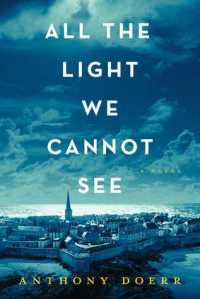
All the Light We Cannot See by Anthony Doerr has won many (richly deserved) awards including the Pulitzer. I read this book soon after it came out and actually grabbed people’s wrists as I implored them to read it. The main characters are a blind French girl and an orphaned German boy growing up as war irrevocably alters their destinies. Their stories swoop through the lives of many characters, even the minor ones so clearly rendered that they’re real as the person sitting next to you. There are few novels by any author as perfectly executed as this one.
The Signature of All Thingsby Elizabeth Gilbert is one of those rare books which manages to combine science and history into a captivating story. In it, a brilliant young woman defies her era’s conventions to pursue science, eventually leaving behind her quiet life to explore the larger world. The book manages to be cerebral and carnal, large in scope yet about the miniature cosmos of moss. Although there were a few pages that jangled off-key, it is an amazing book. I gave it as a gift to one friend along with terrarium I’d planted with mosses. (A trip to Tahiti would be just as relevant, but moss is a bit more affordable.)
Peace Like a River by Leif Enger is, I daresay, is as timeless a masterpiece as To Kill A Mockingbird. The plot seems ordinary enough: a family from rural Minnesota goes on a quest to save the eldest son who has escaped from jail during his trial for murder. The telling, however, illuminates the ordinary to gleaming transcendence. The fully drawn characters of Peace Like a River are people you want to invite to dinner so you can thank them for offering such sustenance. Enger makes every line worth savoring in this story of justice, faith, and enduring loyalty.
Euphoria by Lily King is very loosely based on episodes in the life of anthropologist Margaret Mead. I’ve been quietly obsessed with (and often appalled by) anthropology since discovering it was a thing back in high school. Euphoria has that and much more: revelation, rivalry, lust, despair, and a recognition that what we see says more about us than who we’re observing. Reading it, I was so immersed that I was surprised to look up and find I wasn’t climbing a ladder to a treehouse in the wilds of New Guinea.
The History of Love by Nicole Kraus is artful, complex, and beautifully written. There are books within this book, including a book written about a Polish girl named Alma and decades later, another Alma, named after a character in a Chilean book that her mother is translating. Kraus pulls together disparate strings including Holocaust survival, plagiarism, and a ten-year-old lamed vovnik — knotting them into a hauntingly lovely story about overcoming the greatest cruelty of all, loneliness.
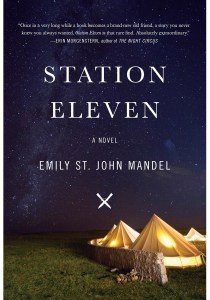
Station Eleven by Emily St. John Mandel is a stark look at a world we take for granted — where small rectangles hold the power to connect us with people around the world, where metal cylinders transport passengers across the sky, where something magical called the Internet answers every question — although that world is gone in Station Eleven. After nearly all of humanity has been wiped out by a plague the future is a dangerous place, but we see it come alive through a troupe of artists who travel from settlement to settlement playing Beethoven and performing Shakespeare. Their motto is lifted from Star Trek: “Survival is insufficient.” This book brings that motto come alive.
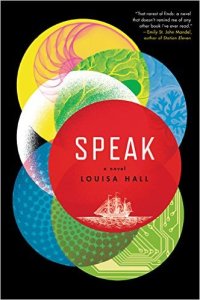
Speak by Louisa Hall offers us five very different voices, each emerging from different times and places. They include Alan Turing, a Puritan girl, and a doomed babybot. These characters act within ever-tightening strictures that, together, make up a larger pattern. Hall asks us to consider what it means to understand each other in this thought-provoking and entirely original novel.
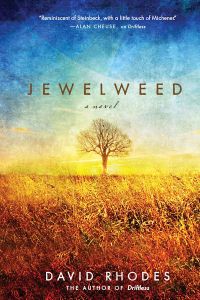
Jewelweed by David Rhodes is a book of quiet insight told from many viewpoints—an ex-con, chronically ill child, wary young mother, minister, long-distance trucker, and others. Although it takes place in rural Wisconsin, the humble epiphanies Rhodes shares are relevant in any setting. At 464 pages this is a long novel, but you may find yourself wishing for a sequel. I do.
The Kin of Ata Are Waiting for You by Dorothy Bryant was written in 1971, yet it’s ever more necessary in our time. The novel centers on a successful yet desperate man who finds himself transported to an unknown place, one that seems primitive to him. He finds he’s landed in a kind of Eden where the inhabitants uphold and maintain the “real” world through their dreams. I was reminded of Daniel Quinn’s Ishmael as I read Bryant’s book, but Quinn’s book left me in despair while this one imparted a sense of delight and wonder.
Bel Canto (P.S.) by Ann Patchett. Yes, another Patchett book! Music forms the spine of this unlikely story. Wealthy international businessmen, a world-famous singer, and desperate terrorists move the storyline along with pacing that speeds up and slows down like the plot of an opera, coming to a sudden ending with nary a curtain call. Even if opera isn’t your thing, you may find yourself searching out pieces integral to the narrative. I suspect this novel, all on its own, created many new opera lovers.
Sum: Forty Tales from the Afterlivesby David Eagleman. I’ve never encountered a book quite as imaginatively intelligent. Written by a neuroscientist, this intriguing volume offers wildly divergent speculative tales. Each is only a few pages, but Eagleman packs them with such fresh ideas that it’s best to read only one at a time in order to fully savor them. This book makes a great gift. I’ve given it to a teen, to one of those people who have everything, and to someone who insisted he wasn’t much of a reader. They all adored it.
Okay, if my motive still isn’t apparent, I want you to tell me what fiction YOU are fawning over!


 by Ann Patchett takes us into the Amazon jungle where the competing aims of pharmaceutical researchers and indigenous people unfold in prose so vivid you can feel the humidity and hear the insects. This is a tale of lies, poison arrows, reluctant heroes, and strange miracles. The last few chapters offer an entirely satisfying conclusion without a trace of the cloying sentiment so common in lesser books.
 All the Light We Cannot See
 The Signature of All Things
 by Elizabeth Gilbert is one of those rare books which manages to combine science and history into a captivating story. In it, a brilliant young woman defies her era’s conventions to pursue science, eventually leaving behind her quiet life to explore the larger world. The book manages to be cerebral and carnal, large in scope yet about the miniature cosmos of moss. Although there were a few pages that jangled off-key, it is an amazing book. I gave it as a gift to one friend along with terrarium I’d planted with mosses. (A trip to Tahiti would be just as relevant, but moss is a bit more affordable.)
 Peace Like a River
 Euphoria
 by Lily King is very loosely based on episodes in the life of anthropologist Margaret Mead. I’ve been quietly obsessed with (and often appalled by) anthropology since discovering it was a thing back in high school. Euphoria has that and much more: revelation, rivalry, lust, despair, and a recognition that what we see says more about us than who we’re observing. Reading it, I was so immersed that I was surprised to look up and find I wasn’t climbing a ladder to a treehouse in the wilds of New Guinea.
 The History of Love
 Station Eleven
 Speak
Speak by Louisa Hall offers us five very different voices, each emerging from different times and places. They include Alan Turing, a Puritan girl, and a doomed babybot. These characters act within ever-tightening strictures that, together, make up a larger pattern. Hall asks us to consider what it means to understand each other in this thought-provoking and entirely original novel.
 Jewelweed
 by David Rhodes is a book of quiet insight told from many viewpoints—an ex-con, chronically ill child, wary young mother, minister, long-distance trucker, and others. Although it takes place in rural Wisconsin, the humble epiphanies Rhodes shares are relevant in any setting. At 464 pages this is a long novel, but you may find yourself wishing for a sequel. I do.
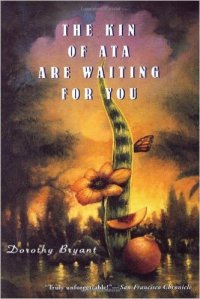 The Kin of Ata Are Waiting for You
 but Quinn’s book left me in despair while this one imparted a sense of delight and wonder.
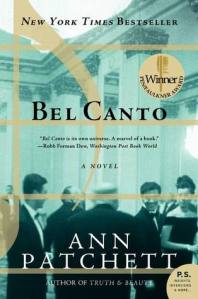 Bel Canto (P.S.)
 by Ann Patchett. Yes, another Patchett book! Music forms the spine of this unlikely story. Wealthy international businessmen, a world-famous singer, and desperate terrorists move the storyline along with pacing that speeds up and slows down like the plot of an opera, coming to a sudden ending with nary a curtain call. Even if opera isn’t your thing, you may find yourself searching out pieces integral to the narrative. I suspect this novel, all on its own, created many new opera lovers.
 Sum: Forty Tales from the Afterlives
 Laura Grace Weldon