On Living Happily with Less

living on less, the shift, RFK, gross national product,

My husband is the bee inspector for two counties. He meets interesting people every time he goes out to another apiary. If he lingers after the heavy work of opening hives, the conversation invariably heads in the direction of self-reliance. People tend to talk about making home and equipment repairs, canning and freezing a garden’s bounty, earth-respecting ways of farming, living on less. It seems everywhere around us people are doing what they can to save. They’re also working harder to connect with others who have experience and talents to offer.

After two years of searching for full-time work my husband is well acquainted with these topics, but also because we’ve spent decades trying (sometimes with slapstick results) to live well on less. We make do, repurpose, and enjoy frugality without making a fuss about it. It’s a work in progress, as we’re still trying to gain reasonable proficiency in skills our great grandparents took for granted.

The times we live in are tossing millions of people in this direction whether they go willingly or scream all the way. It isn’t easy. It probably isn’t fair either. Our current economic downturn came after a long slide of wealth slipping from middle class hands into the tight grip of the wealthy. Nearly 8 million jobs are gone, many possibly for good. Yet the richest among us have actually increased their holdings.

Some of us have lost the illusion of security. Some of us have lost much more—jobs, health care, pension funds, and homes. All of us have been forced to grow a little. That’s part of a larger shift. Insecurity pushes us to pay closer attention to our core values. We’re recognizing that purchases don’t really buy happiness and as a result, saving more than we have in decades. We’re doing more for ourselves and still reaching out to help others.  We’re as ingenious, adaptable and happy as we choose to be.

The shift is even more noticeable when we see certain long-established structures around us breaking apart, with more cracks appearing every day. Just look at what’s happening to prescribe-and-placate medical models, inflexible financial institutions, condemning religious frameworks, and rigid corporations.

But these current conditions of breakup, economic chaos, and environmental decline are exactly those which are (slowly) leading to beneficial change. Collectively we’re waking up to the weakness of limited thinking and short-term fixes. Hopefully we’re also waking up to the reality that we’re in this together—rich and poor, developed and developing nations, young and old, left and right.

We see in our own lives that what’s important can’t be measured by dollars alone. Things like good health, supportive relationships, a vital ecosystem as well as economic security. Even the word “wealth” is derived from the Old English term “weal” which means “well-being.”

Less than two months before he was assassinated, RFK said in a speech,

“…America is deep in a malaise of spirit:  discouraging initiative, paralyzing will and action, and dividing Americans from one another, by their age, their views and by the color of their skin and I don’t think we have to accept that here in the United States of America.”

He went on to say,

“For too long, we seemed to have surrendered personal excellence and community values in the mere accumulation of material things…  The Gross National Product counts air pollution and cigarette advertising, and ambulances to clear our highways of carnage.  It counts special locks for our doors and the jails for the people who break them.  It counts the destruction of the redwood and the loss of our natural wonder in chaotic sprawl.  It counts napalm and counts nuclear warheads and armored cars for the police to fight the riots in our cities.  It counts Whitman’s rifle and Speck’s knife, and the television programs which glorify violence in order to sell toys to our children.”

“Yet the gross national product does not allow for the health of our children, the quality of their education or the joy of their play.  It does not include the beauty of our poetry or the strength of our marriages, the intelligence of our public debate or the integrity of our public officials.  It measures neither our wit nor our courage, neither our wisdom nor our learning, neither our compassion nor our devotion to our country, it measures everything in short, except that which makes life worthwhile.”

redefine the GDP, frugal living,

Time to clarify what we mean by well-being—for ourselves, our economy and our future.

*

*


*


Patchwork Living Bee post*

One with the Universe courtesy of Suvetar

Together courtesy of Morfa9977
What To Expect From A Load of Crap

optimism, bad day, negativity,

I’ve had one of those days. A steaming pile of crap sort of day. You know how it is.

We all have them. When the morning starts out with headache, an angry tailgater or the continuation of some tough circumstances the bad mood usually isn’t far behind. This has a ripple effect. We complain to others, tipping conversational topics toward what grinds and grates. And somehow that negative outlook sets our personal radar to scan for more difficulty on the horizon. Those days rarely improve.

Some of us hold out a little longer. We work hard at emphasizing the positive, which is handy because moods are downright contagious. Studies show an individual’s emotions can influence entire groups (families, playgrounds, workplaces). Positive contagion leads to more cooperation and less conflict. Negative contagion, well, you know how fun that can be. Apparently moods stick like that pink goo from The Cat in the Hat Comes Back.

No one is upbeat all the time. Besides, constantly perky people inspire loathing. But I keep learning the necessity of choosing the way we experience life’s ups and downs. You know how easy it is to focus on five minutes of difficulty rather than the smooth progress of the day. We do it all the time. A child’s angry outburst overshadows hours of sunny cooperation. A colleague’s late return from lunch somehow reflects badly on a week’s worth of work. Or a whole slew of minor problems start to look like a steaming pile.

I’ve discovered while reading Buddha’s Brain: The Practical Neuroscience of Happiness, Love, and Wisdom that we’re fighting a hard-wired tendency. Our brains pay more attention to the negative than the positive. That was probably helpful when saber-toothed tigers threatened our early ancestors. Not so helpful these days.

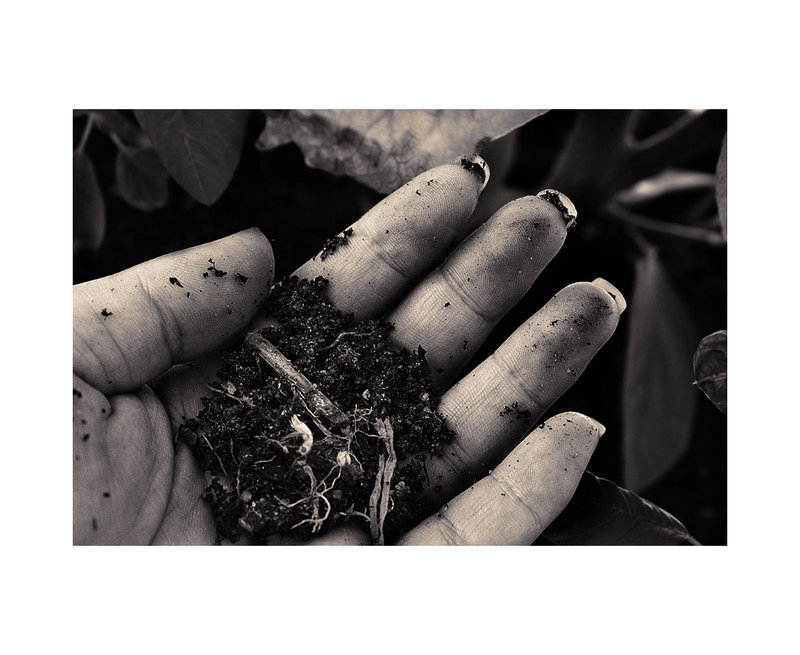
Fortunately I live on a small farm where the cows produce loads of actual crap. So I know what to expect from it. Whether mixed in to the garden beds or left in a heap, eventually it bursts into flower.

The same potential lies dormant in our worst days. No matter what, we’re still in charge of our own attitudes. Because “sh*t happens” is only one way to look at it. “Compost happens” too.

*

*

*

Dirt in hand photo courtesy of Tea Cupie

Flower in hand photo courtesy of Prismes

The Beauty of Ordinary People

“Not everything that can be counted counts, and not everything that counts can be counted.”

Einstein

*

*

*

*

The world is full of ordinary, wonderful people.

Ever since I learned about Randy Stang in Regina Brett’s Plain Dealer column his example of casual grace has helped me see greatness in a new way. Those who bring out the best in themselves have a way of doing that.

Most people who get media attention are nothing like us. They’re obnoxiously wealthy, phenomenally talented or otherwise good at accumulating fame.

A great deal of publicity is also devoted to those who bring out the worst in themselves. They commit crimes or wreak havoc more acceptably, perhaps as scornful political pundits.

Occasionally attention shines on people who devote themselves to a cause in ways we can’t imagine doing or who risk their lives to save a stranger. True heroes. We may marvel at their efforts but end up feeling worse about our own choices. Who can imagine sacrificing as these selfless people do?

But Randy Stang was not the sort of man who attracted attention. He lived with his family right by Bradley Park in Bay Village, Ohio. Tall lights lit up his yard till late at night. Enthusiastic yelling from nearby soccer, basketball and baseball games made for a noisy home. When Randy Stang heard about a proposed biking and skateboard park he decided to attend the public hearing. So did many of his neighbors.

He waited for his chance to talk holding three pages of notes. A middle school teacher spoke about the six years of resistance the skate park had already faced, saying Bradley Park was likely the last hope for local bikers and skateboarders. Residents also spoke, saying the noise and inconvenience of a skate park was unacceptable. They liked the idea of teens gathering somewhere but preferred that place be far from their backyards.

Finally it was Randy Stang’s turn to talk. He explained what it was like to live near the park. He mentioned the noise and lights. He noted that his garage had been broken into just two days before the public hearing.  Then he gave his opinion.

“I’m in favor of a skate and bike park in Bay Village in Bradley Park. I am wondering if the citizens against the park have no grandchildren, no children, or are not a child themselves.”

He finished, saying, “You want to put it just to the north of that baseball diamond there, probably about 50 feet from my yard.”

Then Randy Stang collapsed. A nurse and doctor performed CPR to no avail. But his efforts were not in vain. It looks like Bay Village will be building The Stang Memorial Skate and Bike Park.

People who are acclaimed every day in the media don’t exemplify us. It’s the uncelebrated lives of ordinary, wonderful people who form the bedrock of human existence. These people are next to you and across the world. Chances are they won’t gain notice unless they perish dramatically while simply being themselves.

Unselfish acts performed a million times a minute weave us together as a caring species. We tend to the helpless, comfort the sorrowful, share knowledge and create happiness. It happens most often in small, unnoticed ways. This is why I know humanity has every hope of skating ahead toward the very best possibilities.

*

*

Creative Commons photo collage