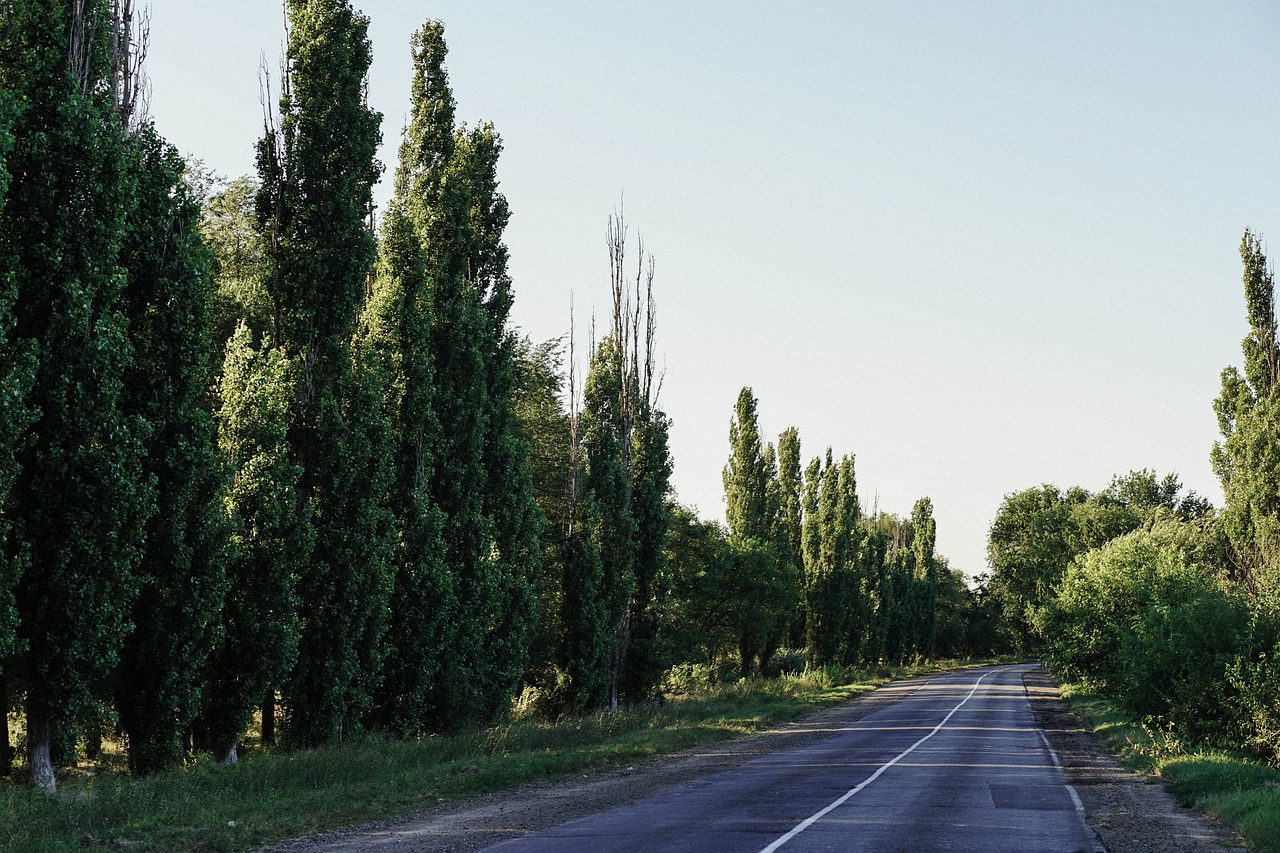
I was on my way home after a medical appointment, wrapped the quiet sort of reverie that comes from driving a long-familiar route. The car ahead of me applied its brakes and went around a slow-moving obstacle just over a rise in the road. I expected a farm tractor, bicyclist, or carcass of an unfortunate deer but couldn’t confirm till I made it over that hill. When I did, I saw what I could only describe as a contraption. It looked like the square hood of an Amish buggy (common sight around here) stretched over a small metal frame. Attached to the back was a hand-lettered sign with words nearly too faded to read.
Blinkers on, I passed carefully on the 55-mph road, trying to decipher the sign. It said something like “Walking To California.” And there, pulling the cart, was a man. I didn’t get a good glimpse, but enough to see he looked dusty and road-weary. He had at least another 45 minutes of walking before he’d get to a place where he might buy food or drink. If he stayed on this route he’d have many days of walking a two lane road passing little more than farms, struggling businesses, and homes built on former farmland.
“Pull over,” my heart told me.
There wasn’t any place to pull over. I drove on slowly, waiting for a turnoff where I might wait for him to catch up. But then what? I wanted to ask if he’d like a homecooked meal and a shower. Surely his cart could fit in my trunk. My husband was home, so I didn’t pause to worry about the lone woman and strange man thing, instead I thought about what I had in the refrigerator.
As I looked for a place to stop, half of me argued with the other half. My heart told me it takes rare courage to do what this man is trying to do. I wondered what fueled his quest. Maybe a pilgrimage of sorts, or an outgrowth of loss, or a creative venture, or a personal challenge. Maybe a quest to answer for himself what Einstein called the most important question facing humanity, “Is the universe a friendly place?”
“Pull over!” my heart kept saying.
But my mind’s voice reminded me this traveler might also be carrying Covid-19.
My husband and I have medical conditions that make us more vulnerable to the virus. We continue to be careful during a pandemic that has not gone away. Although media and government sources assure us it’s safe to get back to normal, stats show the last seven days there were nearly three thousand Covid deaths in the U.S., a 911-level loss of life per week. As of September 18th, there are now 464 deaths per day, which will move the weekly toll even higher. These numbers can’t possibly hint at the suffering and grief on a planet that has lost 6.53 million souls to this disease since early 2020.
In the last two and a half years, my husband and I have lost irreplaceable time with family members. We have not hosted our beloved house concerts here, or eaten once inside a restaurant together, or gone into any building without a mask. That is, until last week. All this time I’ve been completing editing jobs at home and teaching writing classes via Zoom. But my newest series of classes are, per the regulations of the institution offering them, in person. I walked in the first day wearing my KN95 mask. I set up the room and greeted the first few students. But about ten minutes before class started, two older students told me they couldn’t hear me with my mask on. I dithered for a moment (dithering is one of my most practiced abilities), then took off my mask. I reasoned I could leave the doors open for ventilation and the classroom, posted as large enough to hold 100 people while we were only 20, was roomy enough to confer extra protection. I’d also gotten the most recent bivalent booster. We’ll all be safe, I told myself. I’m still not sure about that.
Now I was considering this additional risk.
I thought of pulling over to offer this man help that didn’t involve an invitation to our home. I could offer him whatever I had in my wallet, although a quick assessment showed I had only two dollars. Okay, I could ask him if he’d share his story and a cell number so I could offer to call local media to help him get coverage. And contact area churches to see if they might want to alert congregations along the way who might host him. Heck, I could simply say hello, welcome him to this part of Ohio, and listen to what he had to say. By this time I was nearly home. I decided to brainstorm solutions with my husband, then drive back along the same route until I spotted the man.
I was convinced at this point that I had a soul-deep need to respond to this traveler. This urge, as I understand it, is deeply embedded in who we are as a species. I mean, come on, it’s there in belief systems around the world.
“Do not neglect to show hospitality to strangers, for thereby some have entertained angels unawares.” Christianity. Hebrews 13.1
“The husband and wife of the house should not turn away any who comes at eating time and asks for food. If food is not available, a place to rest, water for refreshing one’s self, a reed mat to lay one’s self on, and pleasing words entertaining the guest–these at least never fail in the houses of the good.” Hinduism. Apastamba Dharma Sutra 8.2
“One should give even from a scanty store to him who asks.” Buddhism. Dhammapada 224
“You shall not wrong a stranger or oppress them, for you were strangers in the land of Egypt” Judaism, Exodus 22:20
“Serve Allah, and join not any partners with Him; and do good – to parents, kinsfolk, orphans, those in need, neighbors who are near, neighbors who are strangers, the companion by your side, the wayfarer (ye meet) and what your right hands possess: For Allah loveth not the arrogant, the vainglorious.” Islam. Quran 4:36
“Charity—to be moved at the sight of the thirsty, the hungry, and the miserable and to offer relief to them out of pity—is the spring of virtue.” Jainsim/Kundakunda, Pancastikaya 137
“The heavenly food is needed successively; be thou a server of the food and direct thou the people of the world to present themselves at that table and guide them to partake thereof.” Baha’I (Abdu’l-Baha)
“A traveler through a country would stop at a village and he didn’t have to ask for food or for water. Once he stops, the people give him food, entertain him.” Nelson Mandela, discussing the southern Africa tradition of Ubuntu.
But, despite my strong conviction, my husband informed me I was nuts. He made rather pointed arguments to support his contention that one does not stop to talk to strangers on the side of the road, let alone bring them home, pandemic or no pandemic. I briefly wondered if I’d married the wrong man, although our differences make our lasting partnership work. Maybe he was right. Maybe it was foolhardy hubris for me to think I should do anything other than let a stranger live his life while I live mine. I didn’t get in the car and head back to greet the traveler.
I believe there are essential friendships never made and significant soul promptings never answered because we don’t make time, or don’t feel ready, or harbor fear, or simply let life’s everydayness block us from what might be. We never find out how these unexplored connections might answer one another’s deepest questions. I still regret not listening to my heart.

 Laura Grace Weldon