Seeing Each Other As Loves

If there’s a deep end, I just jumped in.

I have long used endearments when addressing humans I love but also dogs, cats, cows, goats, birds, insects, and yes, the beings most consider inanimate objects. I’ve probably been in above my head for a long time because I can’t help myself from addressing participants in my writing classes as “dear people” and “beloved writers” and worse.

But today I was checking out at the local market. I always put my fabric bags on the belt before loading my items. The cute young checkout person was preoccupied talking to the cute young bagging person, and I was preoccupied with ineptly “tapping” my card, so none of us noticed right away that the bagger was loading my things into plastic despite the sturdy cloth bags in front of her. “Oh, sorry love,” I said “but I brought cloth bags.” She looked up, startled. Then she said, “I’ve never been corrected so sweetly.” She went back to talking to the cute checkout guy.

I recognize calling a stranger “love” is likely a step too far. I know some people actively detest being called “honey” or “dear” or other overly familiar words. That’s their right and I want to respect that. Actually, I rarely use endearments when speaking to strangers. But some people have a gleam so noticeable to me, even if they seem shut down (maybe especially if they seem shut down) that I can’t help myself.

Brief conversations with strangers filled with dry wit, shared insight, and surprising alignment seem to happen more often for me now. That’s a side benefit of getting older. Those of us who are dismissed as irrelevant are, in a way, freer. Who expects to have a moment where they are seen, really seen, by someone who comfortably goes about unseen?  

I used to call only the people I love “loves.” Maybe I’ve watched too many UK series or read too many old British novels, but that word is stuck now. It’s the way I hope to see others — as loves. As beautiful people. As complex and strange and conflicted as we all are.

Seeing others as whole people is particularly difficult when we’re pitted against one another by systemic forces that place seemingly insurmountable barriers between us. <gestures broadly at world>

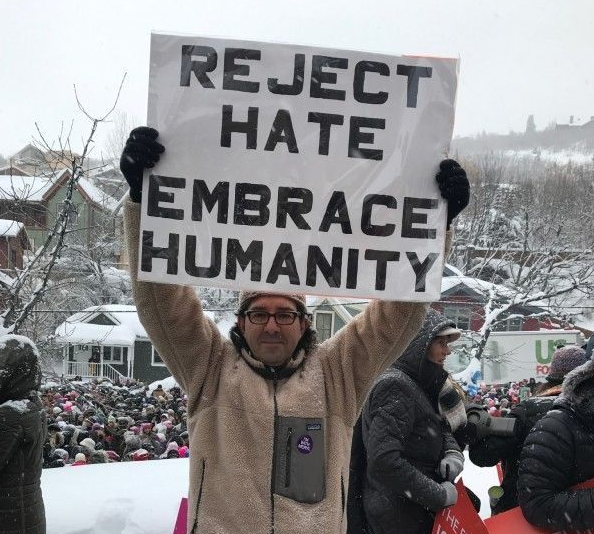
And yet, some people step beautifully beyond these divisions. Last week I read about an LA man who approached a phalanx of federal agents working for ICE, all of them heavily armed and masked up to their eyeballs. Much as I like to think I am a pacifist, I see them as poorly paid* enemies of justice and compassion and democracy itself. The man who approached them was carrying little white slips of paper that turned out to be copies of his most recent two-week pay stub. He walked along the line attempting to pass out these slips, saying some version of, “I know everyone needs a paycheck, but you don’t have to do this.  Come work with us. This is what a union carpenter makes.” 

This man saw these armed agents as fellow human who need to work, just as he does. Seeing others in their full humanity is the heart of nonviolent action. Fact-filled or expletive-filled rants against someone is useless in changing their minds, and is likely to more firmly entrench their views. As Stephen Jay Gould noted, “leave an escape hatch for your opponent so that he can gracefully swing over to your side without an embarrassing loss of face.”

Open dialogue with the very people she condemned is what inspired Megan Phelps-Roper to renounce her membership in the extremist Westboro Baptist Church. It’s what led neo-Nazi skinhead Christian Picciolini to stop spreading hate and work to lead others away from such ideologies. It’s how Daryl Davis, a Black man, befriends Ku Klux Klan members in hopes they will have a change of heart.

Oh, I did another quick errand at another locally owned store. My cashier was a beautiful young man with the fluffiest of Afros. We commiserated over the bankruptcy of a longstanding area business. Somehow, in the magical way conversations happen, he told me he was a “survivor” of hideous corporate policies from his last job and we agreed rapacious capitalism was destroying our country and I told him about our food co-op. As I left, he blew me a kiss.  

*These federal agents are no longer poorly paid. Thanks to the horrific tax overhaul bill recently signed, the budget for ICE enforcement is larger than Russia’s total military budget. ICE is now the highest-funded federal law enforcement agency in history, with more money than the budgets of the DEA, ATF, FBI, US Marshals, and Bureau of Prisons combined. Starting this week, these masked warrantless federal agents will be offered a signing bonus of 42K and a six-figure salary.

A Glorious Shade of Purple

I was stuck in the miseries this morning due to small funked up health problems and huge funked up world problems. I try, as a practice, to have a silent but earnest conversation with my insides when the miseries have a grip on me. I say to pain or fear or despair I see you, I acknowledge you, help me learn from you and beyond you. (Okay, sometimes my inner conversation isn’t all that polite.)

And I try, as a practice, to look around me with gratitude even if, like this morning, it felt like I was spreading a thin layer of appreciation over a turbulent inner mess. As I drove to meet someone I love for our weekly walk, I did what I could to savor the air’s spring freshness. I did what I could to notice light flickering through the trees, flower baskets hanging from storefronts, and the kindness of a driver waving another car ahead.

My mind drifted right back to the morass.

I don’t know how any of us go on with our ordinary lives lately. I am among those privileged enough to have my days largely unchanged, so far, despite—among other tragedies—a climate pushed past the tipping point, despite the ongoing genocide of the Palestinian people, despite all three branches of government stomping directly into authoritarianism. I’m aware my puny efforts to protest, write letters, support good causes, even drive around with a handmade protest sign on my car aren’t enough. I simply hope it’s a teensy contribution toward the transformative 3.5 percent rule invoked by Erica Chenoweth, author of Why Civil Resistance Works. After researching hundreds of social/political change movements over the last century, Dr. Chenoweth found that nonviolent campaigns are twice as likely to achieve their goals as violent campaigns. And although the exact dynamics depend on many factors, her data shows it takes around 3.5% of the population actively participating in the protests to ensure serious political change. But what are the chances it can happen here, I grumbled to myself.

And then I drove past a dumpster. A beautiful dumpster.

It was a deep purple, a purple most often seen in delphiniums, pansies, hydrangeas, and irises. The sort of purple that would look good as a velvet dress or painted across a domed ceiling scattered with gleaming constellations. My mind gladly rested on that color purple for the rest of the drive.

On my way home after the walk and an appointment, I went the long way just so I could take that dumpster’s picture. It was right outside a small locally owned flooring shop. As I got out of the car I realized the dumpster had recently been painted. I could almost see the former lettering under its shiny new color. Someone, maybe the shop owner, had chosen that color. Chosen to grace this useful, much-maligned object with beauty. For all I know, it’s the only dumpster that color for thousands of miles.

I’m plotting to drag my spouse to that shop to see if we can afford to do something about our kitchen’s falling apart linoleum. Whether we can or can’t, I’m going to tell the shop owner how much that glorious purple dumpster lifted my sagging spirits. As Alice Walker wrote in her magnificent The Color Purple, “I think it pisses God off if you walk by the color purple in a field somewhere and don’t notice it.”

Maybe that applies to the color purple anywhere we find it.

Necessary Equipment

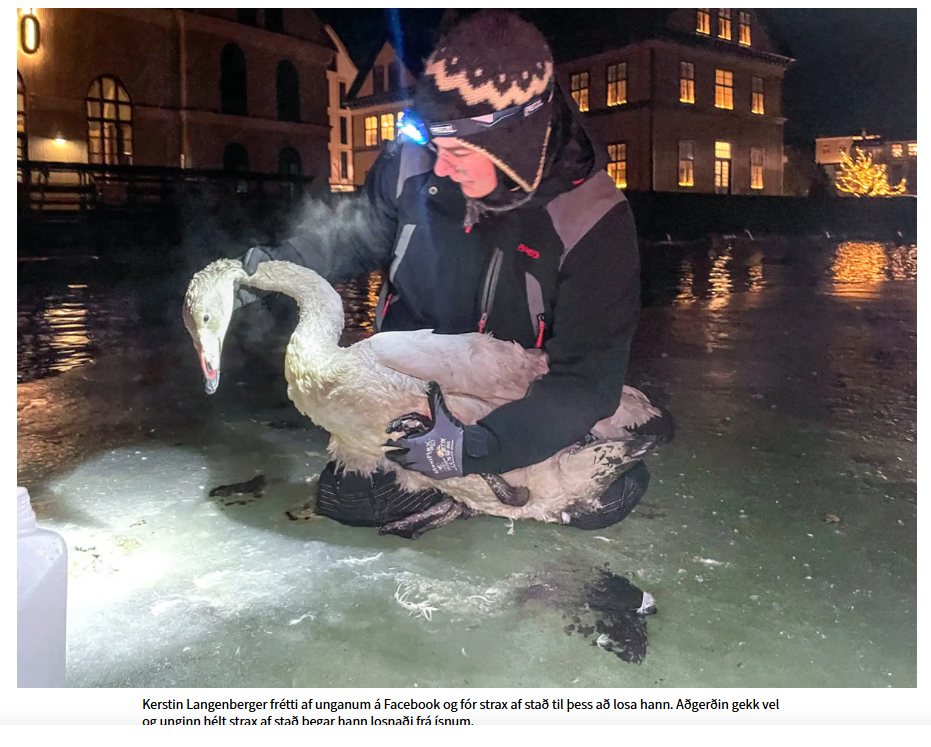
Yesterday a social media post reported that a swan chick was trapped in the ice-covered Tjörnin, a lake in Iceland’s capital city of Reykjavík. Conservationist Kerstin Langenberger saw the post and replied, “I am on my way with the necessary equipment.”

She immediately set off on a rescue mission bringing thermoses of warm water and a surfboard (in case the ice was unstable). She gently poured warm water on the cygnet’s frozen feathers, rubbing away the ice to release him. Although he could easily have died, he was saved by concerned bystanders and a person with the necessary equipment. He flew off without any apparent injury.

We are living in a time of increasing horrors. Just as the stark danger of climate change is apparent in ever-increasing weather extremes and ocean warming —promises to cut down fossil fuel production and subsidies are broken. Just as we learn about the lifelong harm imposed by PFAS, microplastics, and particulate pollution — an incoming administration vows to eliminate regulations necessary to reduce these dangers. The list goes on — intentional harm to our civil liberties, to a sustainable environment, to freedoms considered essential all over the world.  

Everyone I talk to feels overwhelmed by all that’s going on and all that’s coming. I think it will help if we focus rather than react to every outrage. If women’s issues or immigration or climate change or the genocide being perpetrated in Palestine are your top concern, hone down to read about and act on that one issue as a priority.

When I look around, I see all sorts of necessary equipment in use. A Dad Hugs shirt worn to Pride parades. Smiles brought by volunteer reading tutors. Handouts used in citizen testimony to stop Ohio’s mandated fracking leases at all state parks. Tea shared between groups from different religions. Paint and brushes brought to create a community mural. Household goods given away through local No Buy groups. Videos taken to document and report abuses. Chainsaws brought to clear trees downed by storms. Typewriters set up in public spaces for free poems written by request. Neighbors out walking to help find a lost dog. Shareable groups formed to create a walking school bus, a regular stranger dinner, and much more

There are infinite ways we humans reach out to care for the world around us. Our experiences and abilities are exactly the tools needed. Rest up, breathe deeply, keep your pockets full of hope.

“I pin my hopes to quiet processes and small circles, in which vital and transforming events take place.”
~ Rufus Jones