Thanksgiving: A Holiday To Prevent War

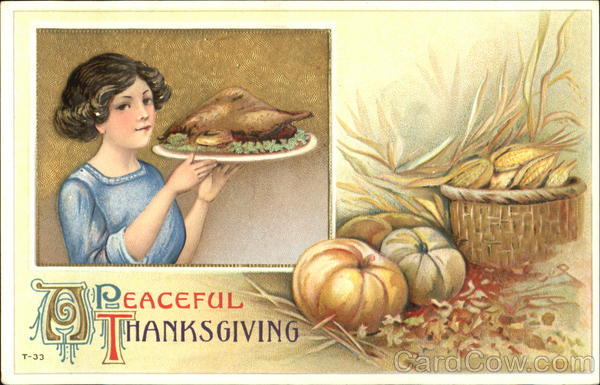
A Peaceful Thanksgiving cardcow.com

Kids draw bright crayoned versions pictures of the “first” Thanksgiving, although chances are they don’t depict the original celebrants eating venison and eel, or engaging in shooting demonstrations. It’s certainly not an event the Wampanoag would have recognized. The Thanksgiving holidays we celebrate today center around family and togetherness. That’s due to one woman, Sarah Josepha Hale (who incidentally was the author of the poem “Mary Had A Little Lamb,” later put to music).

Before Hale’s campaign to create a national holiday, Thanksgiving was held at different times in different jurisdictions on any date between October and January. Or not at all. And in the South the holiday was largely unknown.

Thanksgiving origins, Thanksgiving peace,

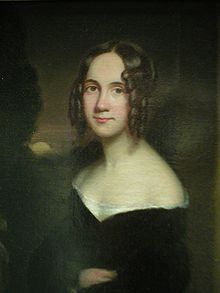
Sarah Josepha Hale, 1831, by James Reid Lambdin

But Hale was editor of the most widely circulated magazine of the time, Godey’s Lady’s Book. This publication, largely aimed at women, published influential poetry, art, and fiction, and under Hale, advocated for women’s educational attainment. Beginning in 1846, Hale used this platform to push for a national day of gratitude. She hoped such a holiday would help to unify the North and South, even prevent a Civil War. Violating the magazine’s policy against politics, she wrote editorials year after year asking the nation’s leaders to declare the last Thursday in November a national holiday–Thanksgiving Day.

In an editorial published November 1857 she wrote:

Consecrate the day to benevolence of action, by sending good gifts to the poor, and doing those deeds of charity that will, for one day, make every American home the place of plenty and rejoicing. These seasons of refreshing are of inestimable advantage to the popular heart; and, if rightly managed, will greatly aid and strengthen public harmony of feeling. Let the people of all the States and Territories set down together to the “feast of fat things” and drink, in the sweet draught of joy and gratitude to the Divine giver of all our blessings, the pledge of renewed love to the Union, and to each other; and of peace and good-will to all the world. Then the last Thursday in November will soon become the day of AMERICAN THANKSGIVING throughout the world.

She also steered public sentiment by promoting Thanksgiving recipes (including roast turkey and pumpkin pie), poems, stories, and drawings of families gathered at the Thanksgiving table. She wrote hundreds of letters to governors, presidents, and secretaries of state as part of her campaign.

Seventeen years later, in the midst of the Civil War, Abraham Lincoln issued a presidential proclamation that Thanksgiving Day be celebrated as a national holiday. This day, which many of this country’s original inhabitants consider a national day of mourning, is also a day established to promote peace and goodwill. Never underestimate the power of an idea, pushed by a pen and persuasive pumpkin pie recipes.

Who We Are In A Crisis

how people act in disaster, survivor, true survivor behavior,

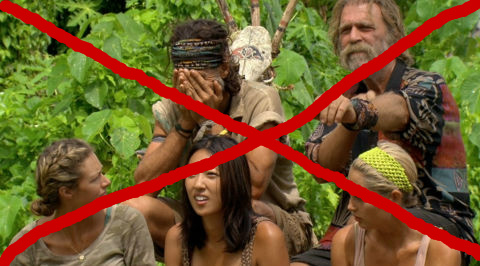
Versions of Survivor are watched all over the world. Forty-five countries have pitted contestants against the odds and shows are still filmed in Denmark, Croatia, Italy, Norway, Serbia, France, India, Israel, Spain, Sweden, Turkey, and the U.S. These series drop people in inhospitable places with minimal resources and ask them to cope successfully with unexpected challenges. It’s called “reality” television, although people in the real world face harder challenges every day.

Survivor shows have to be carefully structured with authoritarian rules and imposed competition. Otherwise contestants might resort to a very natural state. Not Lord of the Flies levels of cruelty and exclusion. No, something far worse for ratings. Cooperation.

In our non-reality TV lives we don’t live as separate entities battling for limited resources like wanna-be stars on an island bristling with cameras. We humans are wired to live in interdependent networks of people based on mutual support and compassion. Ninety-nine percent of humanity’s time on earth took place while we lived as nomadic hunter-gatherers, a time when we did not make war against each other. Anthropologists tell us that our species never would have survived without structuring our lives around sharing food and resources. This responsive caring is basic to who we are.

But somehow, after years of schooling where collaboration is redefined as cheating and recreation where play is turned into supervised competition, we adopt the idea that people are essentially selfish. Popular culture feeds this concept by elevating what’s superficial and materialistic, the better to shape us into perpetual consumers. Worse, we seem to think that selfishness can easily erupt into brutally dangerous behavior when disaster strikes. According to a remarkable book, A Paradise Built in Hell: The Extraordinary Communities That Arise in Disaster, the opposite is true.

Author Rebecca Solnit takes a close look at disasters including earthquakes, floods, and explosions. She finds tragedy and grief, but something else too, something rarely noticed. During and after these horrific crises there shines from the wreckage something extraordinary. People rise up as if liberated, regardless of their differences, to act out of deep regard for one another. They improvise, coordinate, create new social ties, and pour themselves into work that has no personal gain other than a sense of meaning. Such people express strangely transcendent feelings of joy, envisioning a greater and more altruistic community in the making. Even those suffering the most horrific misfortune often turn around to aid others and later remember it as the defining moment of their lives. This is a testament to the human spirit, as if disaster cracks us open to our better selves. As Solnit says, “The possibility of paradise is already within us as a default setting.”

Disaster is often compounded by those who believe that human nature is selfish and cruel. In many cases this is the drumbeat sounded by the media and acted on by authorities. An analysis of disasters shows that official efforts to deal with disaster tend to focus on this aspect, suppressing the efforts of ordinary people to help one another while increasing militaristic control. This deprives people of helping one another and compounds the crisis.

Solnit says that the enlivening purpose that truly comes to the fore as a result of disasters tells us something about ourselves. “Each of us enlarges the world by idealistic passion and engagement. Meaning must be sought out; it is not built into most people’s lives. The tasks that arise in disaster often restore this meaning.”

No one wants their blessedly ordinary lives wiped away by something unimaginably horrible. But it’s good to know, as Solnit says, who we are in a crisis gives us a “glimpse of who else we ourselves may be and what else our society could become.”

who we are in a crisis, humanity at its best in crisis,

This article first published in Wired

26 Ways To Make History Relevant


put your child in history, family history activities, make history fun,

History is always relevant.

It’s the quiet reminder found in old buildings, tall trees and important decisions. It is present in the way we do things, although we rarely stop to realize that we do things a certain way because it was done that way in the past. When children ask “why” we often realize we don’t know. Figuring out the answer invariably leads us back to history.

Each of us is the product of history. Our lives today are evidence that our ancestors survived unbelievable odds stretching back to prehistory. The ground we stand on and the flesh we are composed of is not new, each atom has history.

Taking a fresh look at the past is a great way to provide meaning for our lives today. Here are some ways to make history come alive for you and your family.

history of natural places, seeing hidden history, making history come alive,  

Imagine history. Take a walk in a natural area while thinking about how earlier peoples used resources they encountered. What could be utilized to hold water, provide shelter and heat, to cut or pound foods, to heal, to defend? How would natural conditions affect the stories, celebrations and religion of the region? What evidence might be left behind by the earliest inhabitants?

Take a walk in the city and ask children to imagine it as it was long ago. Notice buildings that were standing more than 100 years ago, talk about what sounds may have been heard then, ask what sort of businesses and transportation they would have seen.

Investigate the past in your backyard. See what you find in the ground before putting in a new garden or extending the patio. Learn about the people who lived in the area long before you by researching the settlement of the town, early explorers, and original inhabitants. Discover what you can about the history of your home and previous owners. Check out Discovering the History of Your House: And Your Neighborhood by Betsy J. Green.

Develop a book of family lore. Compile family recipes and any anecdotes that go with these foods. Add family sayings, funny stories, traditions, timelines, anything you’d like to record for coming generations.

Enjoy history brought to life. Check out Living History offerings to witness life as it was in the past. Enter terms such as “open air museum,” “folk museum,” “living history” and “living farm museum” into a search engine to find listings for your area. Such places provide immersion experiences, hands-on workshops, and history theater.

Don’t forget historical reenactments. Reenactment organizations use meticulous care to replay pivotal events. And there are the ever popular Renaissance fairs filled with entertainment, jousting tournaments, art and foods.

Emphasize the importance of primary documents. Rather than relying on the interpretations of others, discover what history has to say through letters, photos, deeds and more. Consider Eyewitness to History and American Memory Project. For information on using primary documents go to The National Archives.

Use the past today. When facing an ordinary quandary, think back to how the same sort of problem was handled in the past. This is particularly effective on a personal level.  History helps us learn from the actions of others. We can see the long term effects of mistakes and faulty reasoning. We can also see the results of highly ethical choices. A consideration of history helps develop good judgment.

explore your ethnic roots,

Explore your heritage. It’s likely your family tree branches out into several regions or countries. Find out about the stories, customs, foods, inventions, struggles, and successes that make up your cultural background.

Dig into archeology. This field connects history, anthropology, art, geography and more. History is underground awaiting discovery, just as our era will someday be a mystery to future archeologists. Children may be inspired to set up a backyard dig. They may want to wire bleached chicken bones back into a skeleton or excavate a garbage can for lifestyle “clues.”

Dig offers links, art and a state guide to educational events. For younger children, try  Archaeologists Dig for Clues by Kate Duke. For preteens, look into Archaeology for Kids: Uncovering the Mysteries of Our Past by Richard Panchyk.

Maintain a special trunk, box or storage container as a personal history cache for each child. Keep copies of photos, artwork, letters, special ticket stubs and programs, mementos such as a forgotten toddler toy, notes about the child’s humorous sayings, a lock of hair, even a few baby teeth saved from the Tooth Fairy.

See history as a mystery. The clues in letters, photographs and everyday items tell the story of people who can no longer speak for themselves. Books that children will enjoy are   The Mary Celeste: An Unsolved Mystery from History and Roanoke: Roanoke: The Lost Colony–An Unsolved Mystery from History both by authors Jane Yolen and Heidi Elisabet Y Stemple. For older youth, enjoy Unsolved Mysteries of American History
by Robert Stewart.

Indulge in biographies and autobiographies. This is a great way to learn how the conditions of the time impacted individual lives. It also gives insight into character formation. It’s helpful to let your child choose who he or she would like to read about. Even if your child tends to prefer specific biographies, say only sports bios, he’ll be learning how different eras shape a person’s life.

Gain perspective by playing historical games. Playing long-forgotten games helps us recognize that people in earlier eras were also youngsters who longed to have fun. For example, nineteenth century immigrant children in crowded U.S. cities played games that fit on stoops, sidewalks or a section of the street. Classic pastimes like stickball, scully (bottle caps), marbles, and hopscotch were inexpensive amusements for children even in the poorest families. Enjoy games from other cultures. Check out or the book Kids Around the World Play!: The Best Fun and Games from Many Lands by Arlette N. Braman

Value stories from your own family history. Tell your children stories of your childhood and what current events were going on at the time. Solicit stories from older members of the family. Encourage your children to ask their elders questions such as, “What made your family come to this country?” and “What was your first job?” and “What was it like when you were my age?” Display photos of ancestors and mention what you knew of their history. This provides children with a sense of continuity. It also helps them recognize that those who came before them contributed to who they are now.

Record oral history. Family members are a good way to start, but consider those in the community as well. Everyone has stories to tell, it’s a matter of finding out what topics are the catalyst. Be prepared with questions but remember to avoid interrupting. Start out with comfortable topics and work toward any that may be more intense. Let the interviewee talk and the conversation go in unexpected directions.

You may want to collect oral histories of a specific era, relevant to your ancestry or on a topic of interest. Augment this oral history with photographs, music and artwork.

history activities for families, history for kids,

Springboard into history using interests.  If your daughter is an adventurer at heart, she can learn how explorers, inventors, navigators, and wanderers changed the course of history with the same intrepid desire to “find out” that she has. If your son likes cartoons, he can discover similar drawings made for political commentary, social satire, and storytelling that show such artists as unafraid to advance ideas through deceptively simple sketches. Those earlier cartoonists made the medium what it is today.

There’s a historical angle to any interest. Whether your child has a passion for airplanes, stand-up comedy, glassblowing, or skiing there’s a back story to be discovered that makes history relevant to who your child is right now.

Act it out. Learning about Napoléon? As a child the future emperor was bullied by older students, that is until he led younger boys to rout their elders in a successful snowball battle (hinting at his nascent leadership skills).  It might look something like this.  Dramatic moments in history are perfect to reenact in the back yard or park.

Learn about time capsules. Documents and artifacts are vital historical evidence. Sometimes such evidence is discovered hidden away in an attic, trunk or archeological dig, creating a kind of unintentional time capsule. Many people leave time capsules, either to be opened themselves a few decades later or to leave for future generations. Make a time capsule together, filling it with personally and historically relevant items.

Learn about Golden Record included in both Voyager spacecraft launched in the late 1970s. Find out what it included and why. This message was sent along: “This is a present from a small, distant world, a token of our sounds, our science, our images, our music, our thoughts and our feelings. We are attempting to survive our time so we may live into yours.”

Put yourself in history with fiction. Good books help young people imagine themselves in another place or era. Try an activity mentioned in the book such as darning a sock, shooting a slingshot, or foretelling the future through dreams. A Book in Time offers a chronological list of children’s books, plus crafts and other project ideas.


history enrichment ideas, making history fun, history for kids,

Time travel. Ask yourself “what if” questions to stimulate thinking about different outcomes. “What if the Black Plague never occurred?” or “What if the Allies had lost World War I?” Ask what event or decision in history you would most like to see altered, and why. Ask what person from the past you would most like to meet, and what you would ask him or her.

Let periodicals bring history to your door. A freshly delivered magazine is enticing. There are wonderful historical and cultural magazines for children including Calliope: World History for Kids, Cobblestone: American History for Kids and Faces: People, Places and Cultures.

Make a gift of family history. Give the tiny leather case with great grandma’s reading glasses to your daughter, along with your memory of this lady who loved to write. This might mean a great deal to a teenager who harbors ambitions of becoming a novelist. The pocketknife from a great uncle who left to seek his fortune as a merchant marine, and who sent letters from ports all over the world may be a meaningful gift for your son who talks of setting off on his own travels.

cook historically, history activities, family history fun,

Cook historically. Try some of the characteristic foods and preparation techniques from the past. Cook stew over a fire, taste plantain, make hasty pudding, grind buckwheat. Ever wonder when people began eating certain foods or developing distinct recipes? The Food Timeline offers a look back, with each foodstuff clickable to an historical article.

Hold a fair. Some homeschool and enrichment groups have a yearly fair oriented toward history or social studies. Consider a biography fair, genealogy fair, history fair, or international fair. For example, at an international fair each young person sets up a display for the country or region they’ve chosen. They might have posters, projects, foods to sample, crafts and interactive activities. Each participant comes prepared to lead a game from the country they studied, making the fair a lively event. Some groups might also require each participant to provide a hand-out so that everyone leaves with information about all countries featured at the fair.

explore graveyards with kids,

Visit graveyards. Cemeteries have stories to tell. Children can learn about family size, immigration and wartime. They can look for the most unusual names, notice the frequency of childhood death in different eras, write down interesting epitaphs. Discuss in advance the necessity for showing respect for gravesites and acting with decorum.

Oakland Chinatown StreetFest

Explore the impact of culture. Immerse yourself in a culture’s art, music and stories. Learn about legends and beliefs. How do these aspects affect the way those people organized their societies and lived their lives? Who would you be in that society? How would your worldview change if that were your culture? Notice similarities and differences in current times.

Look at your life as an historian or anthropologist might. What’s called “folklife” is simply the everyday creativity surrounding us right now. Jump rope chants, ghost stories, jokes, the way your parents or grandparents warn you to behave, celebrations and daily rituals—these are folklife. The memories you are building right now are history in the making.

These ideas are excerpted from Free Range Learning: How Homeschooling Changes Everything.  

Additional Resources

Online

Odyssey provides interactive learning about the Near East, Egypt, Greece, Rome, Africa, and ancient Americas.

BBC History offers a wealth of information from ancient to recent history through in-depth articles, animations, games and videos.

History Matters emphasizes the use of primary sources in text, image and audio.

HyperHistory Online presents world history through interactive timelines, maps, images and text files.

World Digital Library offers multilingual primary materials to promote current and historical understanding.


Books

Around The World Crafts: Great Activities For Kids Who Like History, Math, Art, Science And More! by Kathy Ceceri

A Street Through Time by Anne Millard

A City Through Time by Philip Steele

Constitution Translated for Kids  by Cathy Travis

Turn of the Century by Ellen Jackson

We Were There, Too!: Young People in U.S. History by Phillip Hoose

We Are One Being

We are one being, linked in profound and essential ways even though we rarely pause to consider them.

The surface of Earth is seventy percent water just as we are made up of seventy percent water. This is the same water that has been on Earth for four and a half billion years. It flows in and out of each one of us. In cycles too infinite to imagine this water has been drawn up in plant cells, swirled in oceans, circulated in bloodstreams, sweated, excreted, wept out tearfully, drunk up thirstily, formed into new life, risen into vapor, and locked into ice. The saliva in your mouth is made of water molecules intimately shared with beings that lived long ago and will be shared with all who come after us.

We breathe about 600 million breaths in a lifetime. The air we rely on is a balance of nitrogen, oxygen, argon, carbon dioxide, and a dozen or so other gases perfect suited to our existence. It circulates through endless forms and uses, moved by the wind of our planet and by each exhale of living beings—-trees, crows, humpback whales, and newborn babies. It recycles just as the calcium in your jawbone may well have been quicklime poured on a criminal’s grave, a garnet on a nobleman’s finger, cheese carried by a nomadic herder, and a coral reef in a tropical ocean.

Nothing about our bodies is separate from what’s around us. We are nourished by what has grown from the sun’s energy and we remake ourselves constantly, replacing millions of cells every second using only the materials that have been on this planet for millennia.

Quantum physics tells us the principle of entanglement explains how particles, once linked, can remain connected even when physically separated by vast distances, possibly even by time. Entanglement occurs between living beings as well, both human and animal, indicating a greater connection same call a morphic field and others call a holographic universe.

On this planet we are linked to every particle and every life form so intimately that science is beginning to echo what poets and sages have been saying for thousands of years. We. Are. One.

Each person is truly your kin. Our human connection begins with common ancestors. Genealogist Gary Boyd Roberts estimates that everyone on the planet is at least a 40th cousin. That’s because the family tree expands as each generation traces back. You have eight great-grandparents. Their parents had 16 parents. Go back 40 generations and you’d find a trillion grandparents at a time when there were fewer than 15 million people on the planet. That means we share 40th great-grandparents. In that way you are connected to eighty percent of the people on this planet. That includes the guy driving the delivery truck right outside your window and the woman thousands of miles away struggling to find water in a drought.

The smallest children seem to recognize that existence is an “alive poem.” They find kinship with rocks, animals, as well as people. Our human family, built on kindness and cooperation, helps one another heroically. We are waking to the ways our Earth sustains us, working harder than ever to restore justice and ecological balance. We are reaching out to share, laugh, explain, and find kinship with one another.

We are entangled in a universe so holographic that we can’t help but sense the oneness that has been there all along.

What the French Revolution Can Teach Us About Parenting

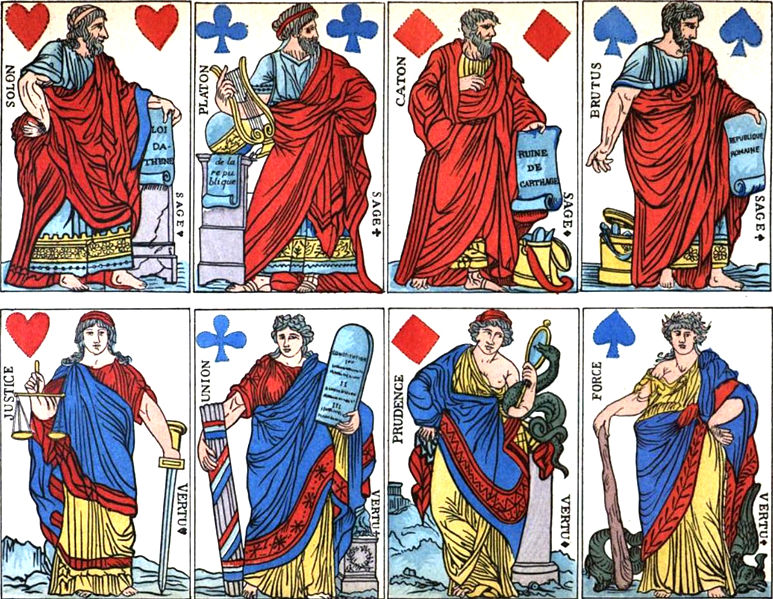
A Deck of Cards Dating Back to the French Revolution Where Kings Have Been Replaced With Wise Men (Solo, Plato, Cato, & Brutus), and Queens With Virtues (Justice, Union, Prudence, & Force) La Bibliofilia

The parent I would become was changed by history. Or at least by revelations history can offer.

At 18, I signed up for a college history course simply to fulfill a requirement.  Although I’ve forgotten the professor’s name, I’ll never forget the man. He was oddly proportioned with a short round body that didn’t match his oversized head. His florid face, full lips, and bulging eyes gave the impression that he was continually strangled by an unseen hand. Stadium seating in our introductory history class of nearly 100 students made him look even more foreshortened as he stood below us at the front of the room. He used no visual aids, no videos, only an occasional map that he drew himself on the board. He spoke without notes about a subject that impassioned him. As he lectured his voice started to quaver, his hands trembled in front of him, and he leaned forward looking at us with red-rimmed eyes. He was overwhelmed with the task. His lessons had to sink in.

That lesson was the same no matter what era we studied. He taught us to look at all of history using one pivotal question.

What happens when people are deprived of (or otherwise separated from) the consequences of their words and actions?

We studied the elite in various societies throughout history who were insulated from the consequences of their actions, even if the working poor around them suffered more and more from decisions made by the elite. We analyzed the larger impact this had on the culture over time. Then we narrowed it down. We looked at rulers who were typically brought up with all the advantages of privilege. Those who rarely experienced the consequences of their actions from childhood on tended to make decisions that resulted in tragedy, sometimes immediately, sometimes in ways that resounded for generations.

Any time we stumble on truth we see how it interconnects with larger truths. That was the case with my history professor’s question. I saw that theme, consequences, everywhere I looked—- in literature, in politics, and in the news being reported each day. I saw it in relationships around me. And on weekends, while volunteering with a project that offered services to teen addicts, I saw it there too.

So I vowed to use what I’d gained from my history professor when I became a parent. When my toddlers made a mess, even spilling a drink, I offered them a rag and some assistance cleaning it up but I didn’t do it for them. That work was their own. As they got older I expected them to give me three reasons when they wanted to do something outside our normal rules. They learned impeccable logic in the service of their own interests. And when they were teens I didn’t keep them from taking reasonable risks, knowing that they had developed a fine awareness of their own abilities.  I certainly suffer at times from parenting this way.  My kids expect ME to deal with the consequences of my own words and actions.  I can’t rant about an idiot driver on the road without one of my kids telling me it’s an opportunity to practice inner peace. That’s what happens when my words come back to bite me.

Too many kids are deprived of the consequences on a small scale. When parents help a child on and off playground equipment for fear of falls, the child is taught she can’t trust her own body. If a parent takes over building a model when the child becomes frustrated, the child is taught he is incompetent. If a parent refuses to let a child take the blame after hurting another child, she is being taught to avoid responsibility (and empathy). These aren’t the messages parents intend to convey. They’re hoping to make things safer, easier, and happier for their children. But frustration, embarrassment, even a few bruises are important parts of the maturing process. Attempts to make childhood frictionless are misguided. Worse, the consequences of words and actions on a larger scale may be much harder for these children to understand. At least that’s what history tells us.

Maria Theresa of Savoy, comtesse d’Artois