“Some words are more than letters on a page, don’t you think? They have shape and texture. They are like bullets, full of energy, and when you give one breath you can feel its sharp edge against your lip.” ~Pip Williams
The Dictionary of Lost Words, by Pip Williams, is an engaging novel written in a gentle style that evokes an era of teapots, shawls, and regular correspondence. (Okay, still my era….) I appreciate it for its love of words and books as well as for topics including class division, suffrage, and the British home front during WWI.
The main character’s galvanizing focus is on why some words were deemed worthy of becoming dictionary entries while others were not. Her lifelong work became saving words overlooked because they were too common, not in print, or insufficiently upper-class male to deserve dictionary space.
I grew up in a word-loving family and my own kids have taken that much farther than I might have imagined. When very young they developed an unnamed game of verbal jousting I call, in this post, Game of Slurs, although the post doesn’t go into just how amusingly over-the-top they could get with inventive word pairings. They also played, with only minor nudges from me, all sorts of dictionary-based games including my favorite, Blackbird. And all of us have unconsciously incorporated words into our everyday conversations that, apparently, seem strange to those around us. When they were younger, some of my kids consciously modified what words they used when, but these days they not only use whatever obscure words they like, they also, well, “experiment” on others to see if they can get them to start using such words too.
I’m grateful it’s now commonplace for everyday vernacular to show up in print and online dictionaries, although dictionaries will never be fast enough keep up with linguistic improvisations in music, film, literature, and everyday conversation. (There are several sites where you can look up words first found in print in your birth year. Merriam-Webster’s version of this includes sixty words for 1992 including buzzkill, civil union, exoplanet, hacktivism, meh, skeezy, smack talk, and woo-woo.)
In many ways, the language(s) we speak shape the way we think. We will never know what ways of thinking about, seeing, and interacting with the world are lost to us when we speak only one language. This is even more troubling in relation to entire languages going extinct. The Linguistic Society of America reports there are more than 6,500 languages used worldwide. Eighty percent, by some estimates, may vanish within the next century.
My problem, as a writer, takes place in a much smaller arena — my head. Much as I love words, it often seems impossible to fit meaning more than partway into language. I might manage to get a pinch of the inexpressible in, but that’s it, and only if I’m lucky. It’s like trying to stuff a galaxy into a suitcase and still zip it closed.
I hope we all do what we can, in these troubling times, to use language clearly, kindly, and well. Even more, that we make every effort to listen.
Somehow I hadn’t read Kaye Gibbons’ 2005 novel, Charms for the Easy Life, until recently. It’s a delight to open a book and, within a few pages, realize it’s going to be a good read. The novel follows the life of a girlchild raised within a circle of intensely vibrant women. Each character is so memorable that the plot almost seems secondary.
I often turn to the inside of a book’s back cover to look at the author’s photo. That’s what I did several times recently while reading Tiffany McDaniel’s gorgeously written Summer That Melted Everythingand again while reading Brian Broome’s powerfully unique memoir Punch Me Up To The Gods. Somehow it helps to see the author is an actual person inhabiting a mortal body. For me it increases the magic of words they simmer into meaning.
My library copy didn’t show Kaye Gibbon’s photo, so I casually clicked over to the interwebs. There I saw an array of images that moved from a charmingly innocent author photo to a devastating booking photo. I was gutted to learn that Ms. Gibbon suffered a traumatic childhood as well as mental health difficulties, with concomitant substance issues. The chapters I read afterwards were imbued with more meaning in light of her struggles.
It brought to mind the challenges many of my writer, artist, and musician friends have endured. And some of my challenges as well.
What is it about creative pursuits and suffering?
A few years ago I wrote an article about how creative gifts in young people are often labeled as defiance, dyslexia, and other “disorders.” I quoted Lynne Azpeitia and Mary Rocamora’s piece, “Misdiagnosis of the Gifted,” in which they explain gifted, talented, and creative people “… exhibit greater intensity and increased levels of emotional, imaginational, intellectual, sensual and psychomotor excitability and that this is a normal pattern of development.” These attributes, however, are often misunderstood by teachers, parents, and therapists as mental health disorders. Young people may be subjected to all sorts of interventions in hopes of normalizing what are essentially symptoms of an exceptional individual.
Is there a link between creative professions and conditions like anxiety, depression, and compulsions? Some research seems to indicate that’s the case.
One study followed participants in the prestigious Iowa Writer’s Workshop. For ten years researchers tracked 30 participants from the program along with 30 people matched in age and IQ who didn’t work in creative fields. Close to 30 percent of the control group reported some form of mental illness. In contrast, 80 percent of the writers suffered from some form of mental illness. This is intriguing, but such a small study can’t be seen as definitive.
A large-scale Swedish study followed 1.2 million people and their relatives. The research was so extensive that it incorporated much of the Swedish population. It concluded that a higher prevalence of people with bipolar disorder were working in creative fields. Again, there were limitations to the study. In large part that had to do with how the data was collected. Researchers compared medical records to occupations, deciding, for example that people working as accountants and auditors worked in “uncreative” fields while a broad range of people were assumed to be creative if they worked as university instructors, visual artists, photographers, designers, performing artists, composers, musicians, or authors. Using expanded criteria, the study found one creative field most closely associated with mental health issues — authors. The study’s abstract notes, “being an author was specifically associated with increased likelihood of schizophrenia, bipolar disorder, unipolar depression, anxiety disorders, substance abuse, and suicide.”
Then there’s James C. Kaufman’s analysis, “The Sylvia Plath Effect: Mental Illness in Eminent Creative Writers” published in The Journal of Creative Behavior. He discussed a study of 1,629 writers which found female poets were significantly more likely to experience mental illness than female fiction writers or male writers of any genre. Another study he included looked at 520 eminent women. They were poets, fiction as well as nonfiction writers, visual artists, actresses, and politicians. (Politicians?) It was found that poets were most likely to experience mental illness.
But Keith Sawyer’s book, Explaining Creativity, disputes many of these findings. Dr. Sawyer asserts that there is no link between creativity and mental illness. As he notes in a blog post,
If you’re a creative person, the good news is that there is lots of research showing that creativity is connected to normal mental functioning and elevated mental health. Much of creativity involves working with existing conventions and languages; you can’t make up your own separate universe. Creative success requires networking and interacting with support networks, and this requires social skill and political savvy. And creativity is mostly conscious hard work, not a sudden moment of insight; getting the work done takes a highly effective person. Many psychologists have demonstrated that when people engage in creative work, they attain a state of peak experience, sometimes called “flow,” that represents the pinnacle of effective human performance. Creativity is related to higher-than-average mental health–just the opposite of our belief in a connection between creativity and mental illness.
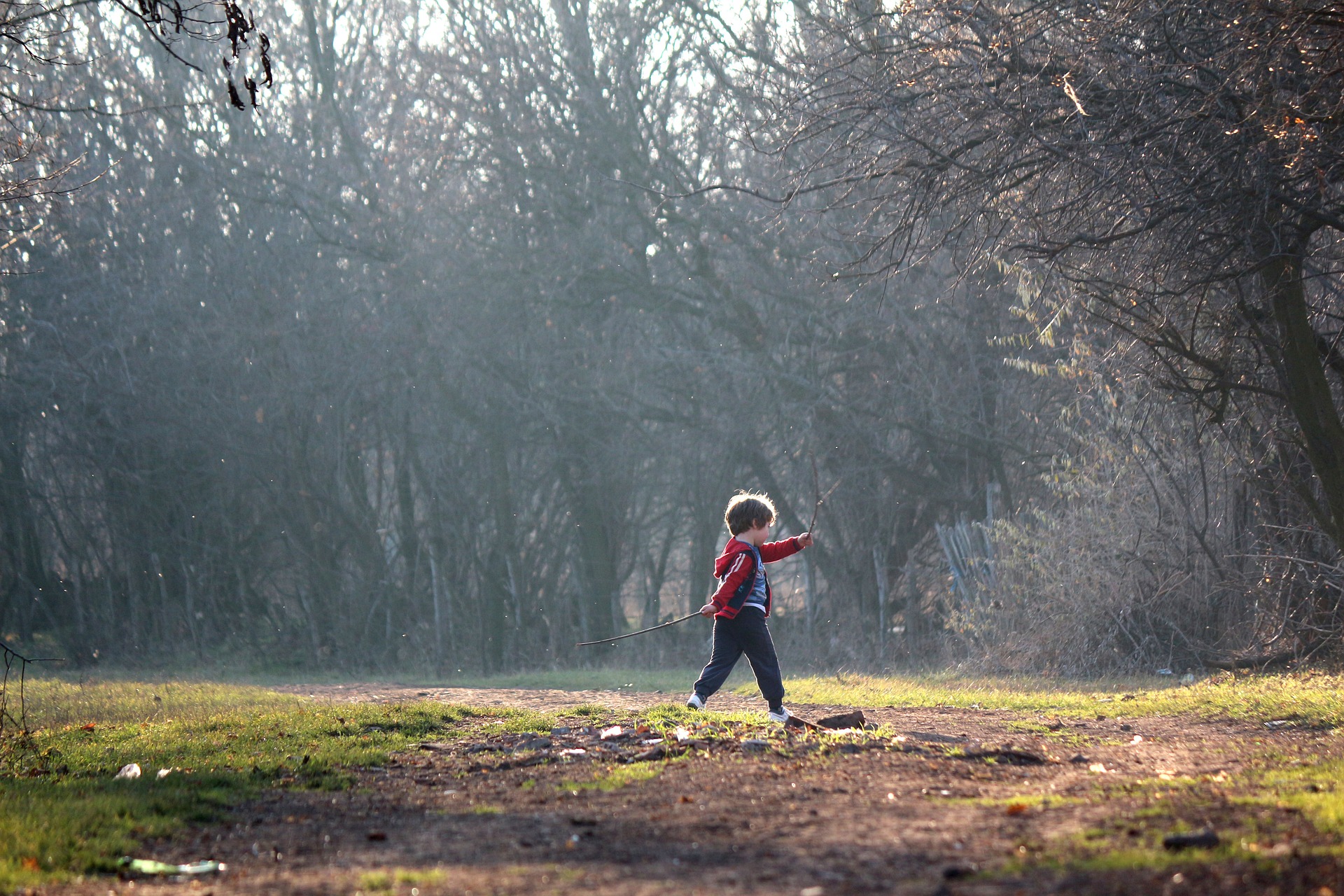
I’m convinced we have to look at the myriad ways creativity is suppressed in our culture, starting in early childhood. Time spent in free play has declined precipitously, replaced by structured, supervised activities which supplant a child’s natural curiosity-driven, inventive, and ever-fluid play. Young people have less time and freedom to play with loose parts — the sticks, dirt, water, pinecones, leaves, logs, flowers, and rocks that have inspired children’s imaginations for eons. Even in toddlerhood, intrinsic motivation can be diminished by external motivators like rewards and praise. Despite the best efforts of caring educators, schools have been severely hampered by structural racism, by assignments that emphasize narrow thinking, and by test-laden curricula. Even the education of gifted children is seriously compromised. We seem to forget that differences and eccentricities are often how our species flourishes.
Creativity is typically seen as the nearly exclusive province of the artistic few, yet we demonstrate creativity all the time as we riff on recipes, interact playfully, solve problems, collaborate on projects, tell our stories, forge new relationships, and grow from past mistakes. Creativity is not a rare gift, but a characteristic human trait. It’s so characteristic that most young children are, according to some scientists, creative geniuses.
Back in the late sixties, NASA was looking for a way to select for the most creative scientists and engineers. George Land and Beth Jarman created a creativity test to identify those who were best able to come up with new and innovative ways to solve problems. It worked remarkably well. Land and Jarman, as they explain in Breakpoint and Beyond: Mastering the Future Today, used the same basic test on 1,600 three-to-five year old children enrolled in Head Start. They were shocked to discover a full 98 percent of children age five and under tested at genius level. They managed to get funding to test these children over time. Dishearteningly, only 30 percent of 10-year-olds scored at the creative genius level. That number dropped to 12 percent at 15 years of age. They expanded the scope of their research, giving the test to 280,000 adults with an average age of 31. Only two percent were, according to the results, creative geniuses.
George Land attributes the slide in creativity to schooling. When it comes to creativity, we use two forms of mental processes. Convergent thinking is necessary for judging and critiquing ideas, in order to refine and improve them. This is a fully conscious process. Divergent thinking is more freeform and imaginative, resulting in innovative ideas that may need refining. This process is more like daydreaming. Land suggests many school assignments require children to use both processes at once, which is nearly impossible, resulting in predominantly convergent thinking. We are taught, unintentionally, to turn off our creativity. Now that is painful. In my view, creativity is the essence of who we are. If anything, it isn’t connected to pain, but to healing.
I’m glad to turn to poets for their perspectives on writing, creativity, and pain.
“Poems have to make our lives clear. Poems have to make our lives real on the page. And nobody’s living an easy life. Nobody’s living a life that is anything other than complex. And there are things about our lives that TV’s not going to give us, that movies, even, are not going to give us. And poems are where I go for that. That’s where I go for the complexity, the thing in us that we don’t really understand.” ~Jericho Brown (from On Being interview)
“There’s a reason poets often say, ‘Poetry saved my life,’ for often the blank page is the only one listening to the soul’s suffering, the only one registering the story completely, the only one receiving all softly and without condemnation.” ~Clarissa Pinkola Estes
“When I began to listen to poetry, it’s when I began to listen to the stones, and I began to listen to what the clouds had to say, and I began to listen to other. And I think, most importantly for all of us, then you begin to learn to listen to the soul, the soul of yourself in here, which is also the soul of everyone else.” ~Joy Harjo
I was a little kid the day Earthlings landed on the moon. I stood in a campground’s crowded rec room, stopover on one of our lengthy summer trips. Each summer our parents drove us place-to-place in a small car hauling a 15-foot Scotty travel trailer for the most frugal, yet educational, travel possible. That’s why we were here, looking up at a TV mounted near the ceiling. I could barely see due to all the people around me and still remember the press of strangers’ sweaty skin on mine.
My family had entered the room with celebratory excitement about this history-making event. But the prevailing mood here was far different. People seemed to anticipate disaster with unsettling eagerness. I’d never heard grown-ups talk around kids as these people did. There was rampant speculation that astronauts would “blow up in their suits,” or be stranded on the moon to die, or return carrying undetectable germs likely to infect our whole planet. A loud man in front of me said, “You won’t know aliens snuck back with them till it’s too late!” My calm and reasonable parents were somewhere in the crowd, along with my two siblings, but I didn’t risk taking my eyes off the screen to look for them.
The static-filled TV images I managed to see were hard to decipher. It was even harder to understand what the astronauts were saying. But I could easily hear Houston’s Mission Control. The very idea that people on the ground were speaking to people on the moon, a moon small as a sugar cookie in the night sky, gave me a sense we were all connected. Perhaps improbably, it reminded me of a scene I loved from the 101 Dalmatians movie, where people gave up looking for stolen puppies, but intrepid dogs never gave up. At twilight they barked and barked, their voices moving from attic window to alley to hilltop across improbable distances in a mutual effort to save those puppies.
We’d recently learned about space in elementary school. I was troubled by the concept of endless galaxies because it made me think of the tiny place everyone I loved occupied in the vastness of space and time. But this mission to the moon felt like an antidote to smallness. These astronauts were also tiny in the context of space and time, yet they went ahead anyway. They packed up their smarts and their faith in science to head off for an improbable adventure that, we were told, would benefit all mankind.
There are always people who are afraid (I know plenty about fear) but the engine of hope can’t help but lift us. I was wildly proud of Science, Humanity, and the USA back when those blurry figures bounced like tiny cartoon characters on the moon. I’m still hopeful. It’s amazing what we can do when we have resolve and act on it, together.
We are blessed to live at a time when we are largely free to embrace what we find meaningful, connecting our choices to what we truly value. That reconnection is profoundly restorative for us, but also resonates well beyond our own lives. Why? Because it’s a step toward healing much greater divides in ourselves and the world around us.
We’ve grown accustomed to division. Early on we learn to value our physical selves by little more than appearance and ability, turning to professionals to manage the symptoms our misunderstood bodies develop. We ignore inner promptings guiding us toward more authentic lives, then expect the resulting misery can be resolved by assigning blame, seeking distraction, or ingesting comfort. We cede our true authority to experts until we no longer recognize it in ourselves.
Our lifestyles tend to separate us from nature as well. Food is processed, garbage hauled away, the passages of birth and death largely hidden. We go about our daily activities without taking part in processes intrinsic to the natural world so we don’t think about how completely everything is connected.
We’re led to believe that personal values and beliefs are separate from the dictates of work, education, and commerce. This leads to one set of ethics at home, with another set of more expedient guidelines for the world at large. We may treat our children tenderly yet buy products made by other children in sweatshops. We may insist on eating organic food yet carry out polluting corporate policies at work. We may identify as a person of faith, but not apply the principles of compassion and forgiveness to our political views.
Separation between our beliefs and actions creates a schism that is profoundly unhealthy for the world around us, just as it is for our bodies and spirits. It takes significant inner work to act with integrity. But when we do, we begin to usher in a mighty personal peace.
Our world struggles with religious intolerance, a vast wealth gap, ecological devastation, and injustice. We’re torn further apart when political leaders foster fear, religious leaders preach condemnation, and CEO’s mandate greed as a business policy. Such separation does not solve our most challenging issues. It accelerates them.
Strangely, struggle often brings meaning and purpose, even transcendence at times. That’s because struggle can wake us up. Struggle can cause us to react with judgement, fear, even vengefulness. This reaction creates new problems, new lessons, until we gradually awaken to greater understanding. Oftentimes it takes significant difficulty before people break through limitations, identify with higher ethical standards, and act in alignment with these core values.
The headlong pursuit of what is newer and more profitable has led many of us to ignore the separations that brought us to this point. Especially what is separate within us. But denying the fullness of who we are doesn’t allow us to be complete. When we acknowledge that each of us has the capacity for good and evil, for greed as well as generosity, for lies as well as truth—we finally build bridges of understanding. We can see beyond divisions within us as well as divisions between us. There’s less need to fall back on blame or fear. We can begin to fully awaken the boundless energy found in the real choice to tell the truth, to act with compassion, to do what is best for all concerned. That provides an endless wellspring of hope.
Surely today’s challenges will be transformative. We’ve shown increasing willingness to reach out to one another, to share ideas, to find meaning and value in common pursuits. We’ve risen up in hundreds of thousands of movements to create positive change. That’s enormously powerful. As Albert Einstein said, “We can’t solve problems by using the same kind of thinking we used when we created them.” Our words, actions and even our thoughts are creating the world anew.
These are some of the final paragraphs from my 2010 book, Free Range Learning. They seem ever more relevant…
I’m back to joyfully jaunting around in my 17-year-old rust-pocked but trusty Honda to meetings, classes, and social gatherings. (The same Honda once starred in the Goose & Honda Love Story. Click HERE to read that weirdness.) Because I’m short and the driver’s seat is somewhat slumped, I position myself as far right on the seat as possible so the shoulder harness doesn’t catch me across the throat. And because my phone is often busy spitting out GPS directions, I listen to audiobooks on CD.
Each recorded book borrowed from the library comes in a plastic case harder to open than a pickle jar, at least while driving, so I situate the next disc on a soft fabric shopping bag on the passenger seat, careful to cover it with the another bag lest some convergence of sunlight and disc angle spark a conflagration. It’s entirely worth it since audiobooks combine the kindergarten-like pleasure of being read to with the magic of good literature.
That is, till hot weather returns. My CD player does not get along with my AC. I get about 20 to 30 minutes of audio play before the disc freezes up. Literally chills until it’s unplayable. I take it out, warm the disc against my chest, then slide it back in and stab buttons until the narration returns to where I left off. Sometimes I’m merging or looking for a turn-off and the disc plays on through weirdly repeated phrases and jittery vowel stutters. It is like innovative slam poetry or experimental theater coming at me right from the car speakers. I can’t help but listen for meaning.
It adds an entirely new layer to The Water Dancer by Ta-Nehsi Coates when the phrase “how much you see” repeats in a loop. It gives me more to consider about The Night Watchman by Louise Erdrich when the single word “again” is stretched, over and over, to a whistle-sharp refrain. And when the narrator’s voice gets stuck on a single sound in J. Drew Lanham’s The Home Place, it becomes both less and more than a word, like visiting a foreign country where someone keeps saying the same thing as if repetition might aid comprehension.
I’m not annoyed, I’m entranced. It’s strangely fascinating to have these audio glitches pop up in the midst of an already-fascinating book. I am grateful to my elderly car and old technology for teaching me a whole new appreciation for words.
Our next door neighbors are preparing to move after living on this street for decades. Their daughter is here to help her parents sort through and pack up their things. Her sons, ages 4 and 8, are here too. They play on our swings, visit our chickens, sometimes borrow a riding toy from our garage. I am utterly charmed by these gentlemen. (Okay, I am charmed by nearly every child I meet.)
The other day they were out with squirt guns and after a particularly fierce battle clambered up to my porch. My kids and I used to enjoy making up stories together, so I gave it a go. “If each of your squirt guns could have a magical power,” I asked, “what would you like it to be?” One of them said, “To make things bigger or smaller!” The other said, “To make things real!” So we launched into a collaborative story about the crayon drawing of a giraffe that, when squirted, lifted off the page to become a real giraffe. We went back and forth making up adventures for this giraffe and his boy companions, until it was suggested the police were out to arrest the animal for chomping on neighborhood trees and pooping in the park. The fictional boys and their giraffe friend raced home to avoid getting in trouble, but the giraffe couldn’t fit through the door. Out came the other magical squirt gun to shrink it. The boys debated whether it should be reduced to the size of a dog or a rabbit or a hamster, then decided it should be even smaller so it could live with them without grown-ups noticing.
After that first story, the boys have been back nearly every day for a new story. We’ve made up stories about space travel, weird babysitters, and troublesome siblings. I’d been helping them start stories by saying, “There once were two young gentlemen who ____.” But one afternoon the four-year-old started a story with, “There once was a gentleman named Laura” and I told him if we used the word “gentleperson” that it worked for all of us. They insisted on starting all stories that way afterwards.
I’m grateful they are given the freedom to amuse themselves outdoors. Primary experiences outdoors, in whatever scrap of nature kids can find, is pivotal for creative mind and body-stretching play. It’s also vital to help children develop a lifelong kinship with nature.
Their freedom is increasingly rare. The range children are allowed to travel on their own is what psychologist Roger Hart has termed the “geography of children.” This range, for an eight-year-old, has shrunk from six or so city blocks a few decades ago to barely beyond the front door today. In the 1970’s, Dr. Hart spent two years conducting informal walking interviews with every child between the ages of four and 12 in one Vermont town to discover where and how they played. Kids particularly enjoyed the type of play that manipulated the physical world, making forts or using sticks and dirt to create (as one child did) a miniature airport. Dr. Hart observed that four and five-year-old children were allowed to play in the neighborhood without direct supervision, and children had the run of the town by the age of 10.
He went back to that town three decades later to see how childhood might have changed. No surprise, parents were much more involved in the moment-to-moment details of their children’s lives, resulting in much less freedom for children (and adults, presumably). As he did in interviews back in the 1970’s, he asked children to talk about secret places they liked to play. One child called out to his mother to ask if he had such a place. Dr. Hart wrote, “That would have been inconceivable 30 years ago. Then, most children I interviewed had places they went to that their parents had never been to.” Thirty years later, Dr. Hart found no children who played with sticks. This impeded freedom to play away from adult gaze has only gotten worse since. (See also The Geography of Children.)
My husband tends to be a curmudgeon about these boys hanging around. “They shouldn’t be in the garage asking me questions if they’re barefoot,” he says. “Someone could get hurt.” And he recently came across the younger boy just standing, looking over some tractor implements sitting out back. “This isn’t safe,” he said. He may have a point about safety, but his own childhood was rich with neighborhood mentors. From the time he was very small he watched and offered to help as neighbors fixed cars, repaired homes, ran small businesses. These older men let him hang around, and their influence helped him grow up to be the man he is today. (I can only remember one neighbor who let me hang around, once, yet I still see her influence in my life today.)
We now know how important these adult role models can be for children. The benefits don’t just flow one way, adult to child. Children are brimming with gifts — curiosity, enthusiasm, wit, fresh perspective, kindness, and the blessings of playfulness. If we’re open, we can re-learn from them how to bring these qualities back into our lives. They can also teach us to get past our presumptions, as these boys teach me.
Yesterday the oldest came over to chat when he saw me outside. Immediately our puppy started jumping and barking. “Why are you holding him,” he asked.
“He doesn’t understand the boundary between our yard and your grandparents’ yard, and it’s best I don’t let him follow you over.”
“It would be okay,” he said.
“It probably would,” I told him, “but when new people move in he’d have to learn anyway.”
He kicked a few stones in the driveway and I added, “Silly, really, that humans have all these imaginary boundaries — this is mine and this is yours — animals don’t recognize property lines.” This sort of observation would wash with most adults. Quite often it would lead to a conversation about something pat, like how much we can learn from animals. But it didn’t wash with him.
He came back with, “Lots of animals have territories.”
“Oh, good point,” I said, feeling an extra surge of affection for this dear young man. He is so like my own kids, well-informed and completely himself.
“I learned from a science podcast that warthogs like it when a mongoose picks it clean of insects,” he said. “Mongooses like to go back to the same warthog, sometimes they pee on their warthog to warn others away.” Of course this observation led to a fine conversation about territory marking in many species.
Thanks to this gentleperson, I ended up far more knowledgeable and hopefully less likely to make blanket statements I couldn’t defend. I also ended up wishing I had a pocket-sized giraffe living in a Lego house, just like in our story.
I can barely lead this morning’s writing class. A sudden migraine hit only a few minutes before students began to show up on Zoom. It’s a bad one — pain and nausea plus vivid wavy lines distorting my vision. I take some restorative slow breaths, drink a glass of water, then welcome everyone to the class.
I love teaching. I’m particularly mesmerized by the way community writing classes effortlessly build connections between strangers. Over weeks of reading and discussing their writing, people can’t help but get to know one another. Ordinary conversations, even between close friends, tend to fritter time away on surface topics. But in writing class we skip weather and family updates, going directly to deeper topics. It’s entirely natural to bond after sharing universal experiences like fear, regret, grief, embarrassment, triumph, and joy. I suspect we carry one another’s poems and stories with us long after the class is over. I certainly do. Many friendships built in writing class persist and several former classes of mine continue to meet independently as writing groups. Writing together has a magic all its own.
But this morning I am in trouble. I can’t easily focus on the screen and can barely see my notes. Worst of all, I have trouble explaining concepts due to migraine-imposed brain fog, In this session I introduce persona poems. I explain, falteringly, how persona poems free us to write from the perspective of a soup bowl, a tree, an astronomer, a virus. I point out persona poems can help to stretch us. After all, if we’re writing in the voice of a dolphin or the voice of Donald Trump, we are writing our way toward understanding those lives more completely. I note that some people insist all poems are persona poems because the “I” in the poem is still a persona the poet choose to present. I’m not sure how much I get across because I feel like a balloon floating over the class.
We go on to the first writing exercise after reading and discussing Lisa Bellamy’s sharply humorous poem “Black-Eyed Susan.” As Bellamy did, I ask the class to write from a non-human perspective and to include at least one example of being misunderstood. I close my eyes while participants write until they are ready to read freshly written poems told from viewpoints such as a cat, coffee mug, and sunrise.
Then we read and discuss another example of persona poetry before going on to the next exercise, one I learned from Rosemerry Whatola Trommer. In it, participants are asked to create an alter ego. Whatever they personally want to do but don’t let themselves do, the alter ego does. Whatever they’re afraid of, the alter ego loves. The alter ego relishes what they can’t imagine facing. This is such a freeing exercise that everyone is brimming with ideas. We notice, as they read their work aloud, how each other’s alter egos are witty, tender, and wildly hopeful. Some alter egos get revenge, others take lovers, and one woman’s alter ego finishes writing her novel for her. The warmth and laughter shared across Zoom screens lifts more of my migraine’s misery. By the time I explain their homework, I am able to see and read clearly. I tell the class I’m grateful.
My migraines rarely improve so quickly. I can only think it has to do with the transformative power of creative connection. I don’t advise teaching while unwell, but if you must, don’t be surprised that writing’s healing magic still exists on Zoom. Now I’m off to take a walk. Maybe I’ll let my alter ego come along too.
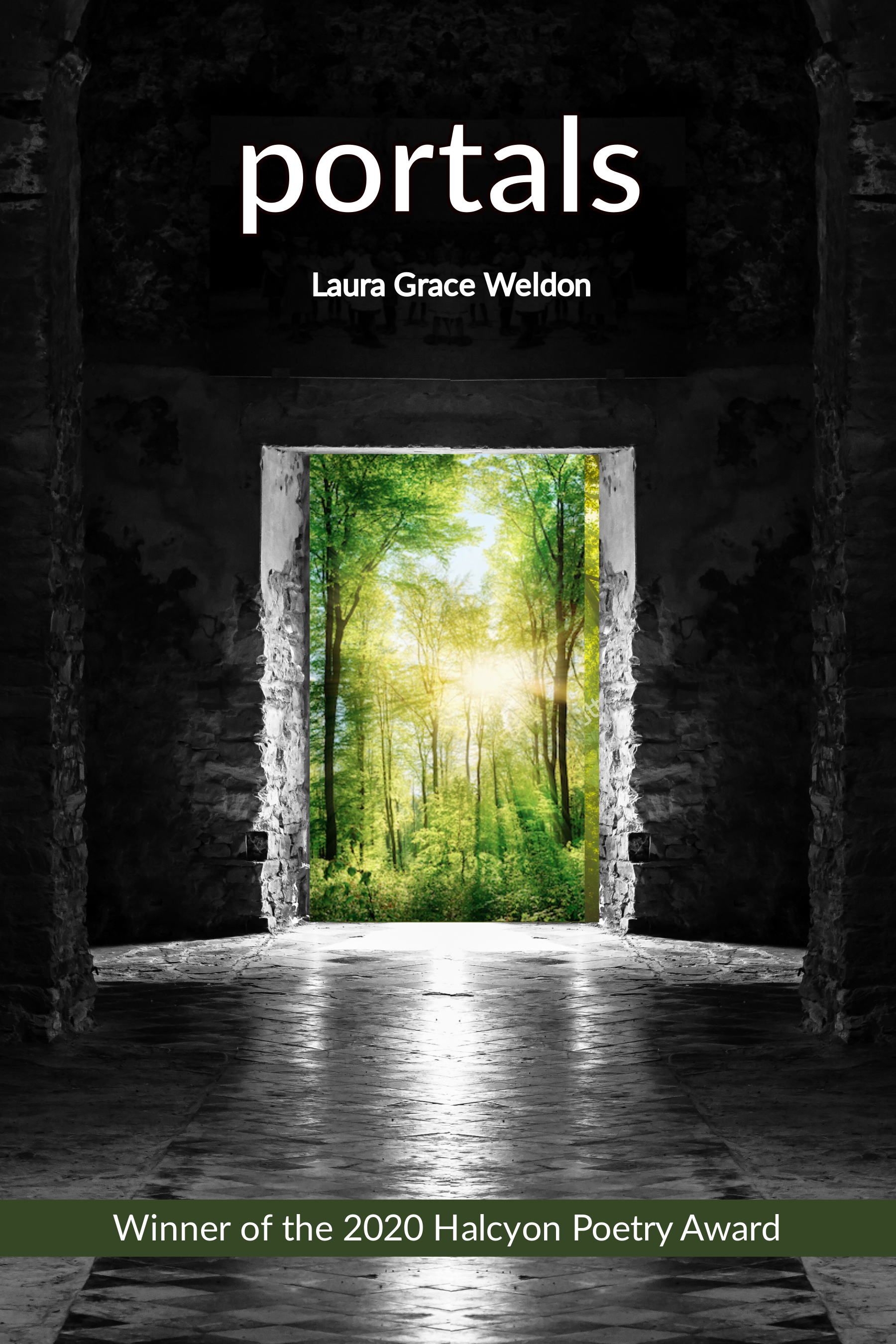
Last fall I sent a pile of newer poems to Middle Creek Press, hoping I might salvage something out of what little I wrote during our ongoing pandemic misery. Turns out that collection, titled Portals, won the 2020 Halcyon Poetry Prize. Wild, right?
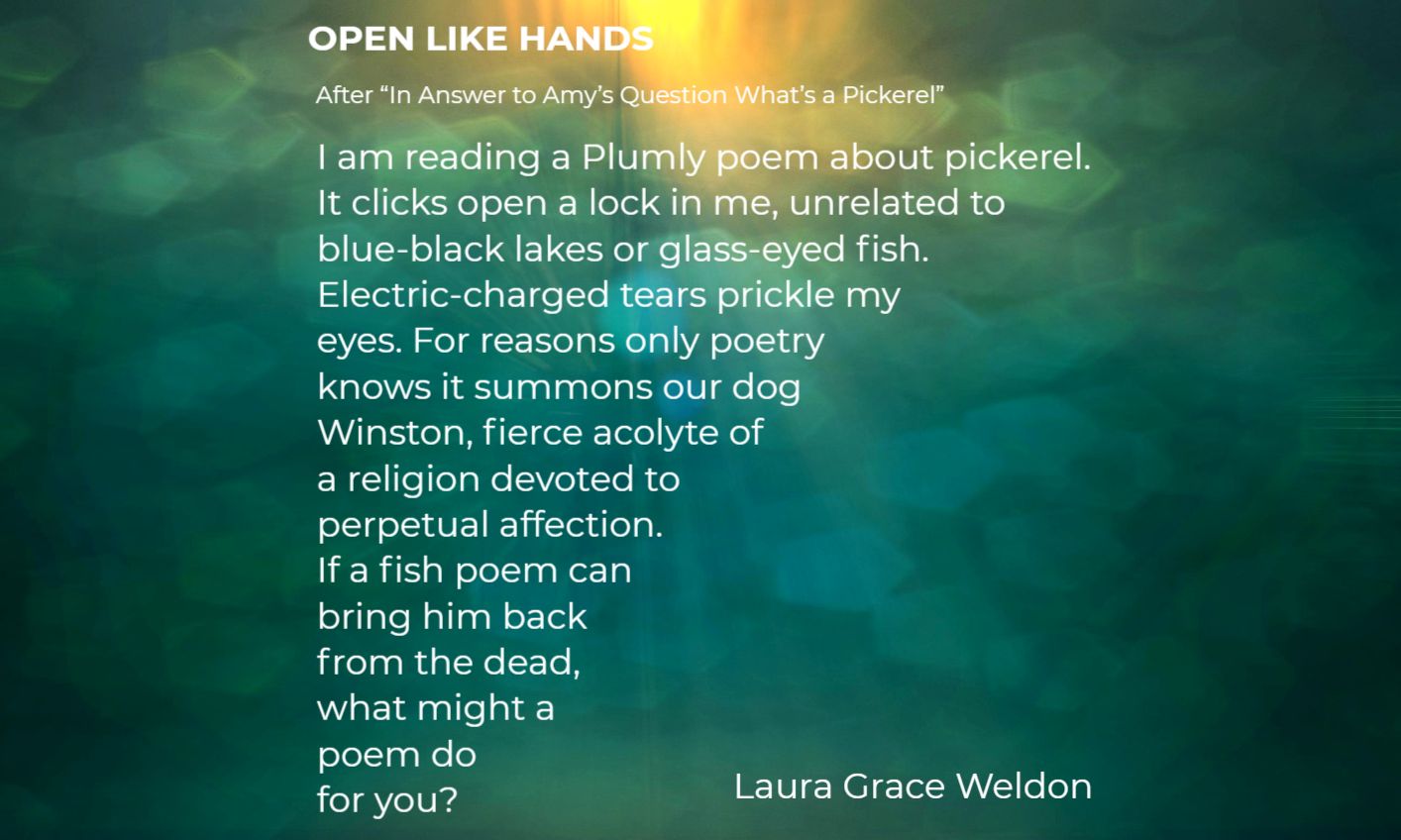
What an honor to have Middle Creek publisher David Anthony Martin select my manuscript. This collection is packed with poems about sycamore leaves, gut bacteria, quicksand, protests, yeast, talking peonies, insects, inflation, and consequential strangers. Here’s a sample:
People seem to think a writer writes in isolation, pulled only by some invisible drive to assemble words into form. For years I felt that isolation acutely. Heck, I didn’t even admit I was writing and publishing poems until my first collection, Tending, was accepted by a small poetry press. All that time the work of other poets pulled me onward. Their poems nourished me and helped me recognize poetry is in us all.
When the publisher of my first collection told me to solicit blurbs by reaching out to poets I admired, the task seemed unimaginable. Approach a busy stranger, someone I’d deeply respected from a distance, then ask for a favor? A distinctly time-consuming favor? I was appalled. Maybe my book could be published with a blank back cover. Maybe I could pretend the blankness was some kind of artistic choice. Turns out that wasn’t necessary. Every poet I contacted was gracious, even the poets who turned me down. Their kindness introduced me to the kindness of the writing community. (There are unkind pockets too, but I’m too small potatoes to be affected.)
My next collection, Blackbird,continued to teach me just how beautiful the writing community can be. Writers go out of their way to amplify the work of other writers. They mentor, they share, they podcast, they teach. Many dedicate their time to make literary journals, literary organizations, and literary events possible.
I am the recipient of these kindnesses and more. I am endlessly grateful for Rosemerry Wahtola Trommer’s bountiful forward and for generous blurbs by James Crews, Donna Hilbert, and Phyllis Cole-Dai. Many thanks to Middle Creek publisher David Anthony Martin; it is a delight to work with a press dedicated to growing a “mycelial network of artists and readers.” Thank you to the poetry editors who published many of these poems in print and online journals. Much appreciation to the poets from our 811s poetry critique group who helped reshape these poems: Laurie Kincer, Diane Kendig, Roberta Jupin, Geoff Polk, and Richard Ferris. Appreciation to my longstanding writers’ group: Connie Gunn, Sarah Vradenburg, and Margaret Swift. Endless thanks to poetry readers who share my work – you truly light the way for every poet. Most of all, thank you to my family who have held it all together during these surreal and humbling times.
Portals is now available from the publisher. You can also request it at your local library, favorite indie bookstore, or indie-bookstore based Bookshop.org. And you can also get it via Amazon.
“If we think of a library as a city and a book as an individual house in that city, each sentence becomes one tiny component of that house. Some are mostly functional – the load-bearing wall, the grout between the bathroom tiles – while others are the details we remember and take away, perhaps recalling their texture and colour when we assemble our own verbal dwelling-place.” –Jenny Davidson
Who I am is constructed, in part, out of books I’ve read. When I read, especially if I love what I’m reading, I feel as if the book has entered my very bone marrow. But I read, on average, four or five books a week. Often more. Where has my mind put decades of books?
Julie Beck’s article in The Atlantic offers an answer. It’s titled, “Why We Forget Most of the Books We Read.” She writes, “people often shove more into their brains than they can possibly hold.” She cites a study from 2009 showing the average American encounters 100,000 words a day. Our memories simply cannot keep all this information readily available. I say pish posh, the memories we take in from what we read has to do with its relevance. We hang on to the information that most impacts us, intrigues us, or that we put to use.
Beck also points out we’re better able to recall the context in which we read a book, so we remember reading a green-jacketed novel based in Sierra Leone while on vacation, but are less likely to recall the book’s contents. To me that’s one of memory’s gifts. I’ll never forget reading The Color Purple while nursing my firstborn or reading The World According To Garp while on the couch recovering from knee surgery or becoming so immersed in by Kathleen Grissom’s The Kitchen House while at an airport departure gate that I missed my flight.
Okay, maybe I feel threatened by the idea that I’ve wasted literal years of my life reading books that simply float beyond memory into a void. But there’s plenty of evidence that books change us, whether we remember them well or not at all.
~A study at Emory University found reading can have long-term effects on our biology. Study participants read only part of a novel, yet still showed significant increases in connectivity between the left and right brain regions. This effect lasted for several days. Imagine the effect of reading regularly!
~Stanford’s Natalie Phillips found an overall increase in blood flow during close reading. She writes in Stanford News, “paying attention to literary texts requires the coordination of multiple complex cognitive functions.” Blood flow also increases during pleasure reading, but in different brain areas. Phillips suggested that each style of reading can create distinct patterns in the brain that are “far more complex than just work and play.”
~Regular readers, according to various studies, are much more likely to volunteer, donate to charity, and vote than non-readers.
~Research demonstrates that people who find themselves most transported by fiction and who express the most empathy for the book’s characters are more likely to express empathy in real life.
~Fiction readers score higher on theory of mind, which is the ability to understand other people’s thoughts, emotions, and perspectives. It’s likely to stem from the way we engage with stories. As researcher Keith Oatley writes, “These effects are due partly to the process of engagement in stories, which includes making inferences and becoming emotionally involved, and partly to the contents of fiction, which include complex characters and circumstances that we might not encounter in daily life. Fiction can be thought of as a form of consciousness of selves and others that can be passed from an author to a reader or spectator.”
Yes, we “forget” books we’ve read in the sense that we can’t easily recall them, or maybe recall but can’t remember much of the plot. In school-like terms, we can’t pass the test. I can’t help thinking, however, that this goes much deeper than surface recall.
Tiny babies take in language all around them. They learn, on their own timetables, more and more words. (Which adults around them can’t help but “test” with “What does an owl say?” and react in delight when the child hoots.)
They also learn what reactions words elicit (Making the sounds for “Want milk” turns, magically, into actual milk.) And they learn much more – how words convey and transform emotion, how words affect people differently, how words on a flat page can hold a world-stretching story, how words can soothe and harm and instigate and become vehicles for imagination.
Thankfully babies acquire language without testing them on where they first learned a word or what picture book taught them about the sounds made by owls.
I believe we take books in much the same way. They sink in deep and stay there whether we can dredge them back up to the surface of recall or not. I can remember some books reasonably well without Google’s help, but those are a fraction of the books that expanded my perspective, deepened my spiritual outlook, and gave me glimpses of lives well beyond my own. I may not remember the titles I’ve loved but at the same time I know they changed me. Still, I’ll let Billy Collins have the last word.
FORGETFULNESS by Billy Collins
The name of the author is the first to go followed obediently by the title, the plot, the heartbreaking conclusion, the entire novel which suddenly becomes one you have never read, never even heard of,
as if, one by one, the memories you used to harbor decided to retire to the southern hemisphere of the brain, to a little fishing village where there are no phones.
Long ago you kissed the names of the nine muses goodbye and watched the quadratic equation pack its bag, and even now as you memorize the order of the planets,
something else is slipping away, a state flower perhaps, the address of an uncle, the capital of Paraguay.
Whatever it is you are struggling to remember, it is not poised on the tip of your tongue or even lurking in some obscure corner of your spleen.
It has floated away down a dark mythological river whose name begins with an L as far as you can recall
well on your own way to oblivion where you will join those who have even forgotten how to swim and how to ride a bicycle.
No wonder you rise in the middle of the night to look up the date of a famous battle in a book on war. No wonder the moon in the window seems to have drifted out of a love poem that you used to know by heart.
I’m standing in line for my second dose of Pfizer vaccine in a bustling CVS. Everyone waiting joins in a jovial camaraderie. The man wearing a United Steelworkers t-shirt says he can’t wait to get the shot. “I’m retired,” he says. “I spend my time traveling to see my five grandchildren, that’s what I do. Until Covid. I haven’t seen them in a year. That includes a three-month-old granddaughter I haven’t held.” He shakes his head. “You can’t have a relationship with a baby on a screen.”
A woman with a soft accent takes off her coat and folds it over her arm. “I am so happy to get my second shot,” she says. “I feel so lucky.”
A man with a ponytail in his curly gray hair says, “I don’t know who I’m going to be seeing of my family, what with everyone divided over politics. I’ll keep quiet if that’s what it takes to sit down at the same table.” He doesn’t say what “side” he’s on. It doesn’t matter. We’re in this together.
I think about a report I recently read. It’s based on a national survey taken in late January of this year. Its focus is what Americans prioritize and what they think others prioritize for this country’s long-term future. The survey included Trump voters and Biden voters. Instead of asking only direct question about support or opposition to various positions, they also asked choice-based questions to get beyond what respondents believe they should say or think most people would say.
The results? Americans share long-term goals to a remarkable degree. Here’s a summary of their findings.
Across race, gender, income, education, generational cohorts, and 2020 presidential vote, there is stunning agreement on the long-term national values and priorities that Americans believe should characterize the country moving forward. Chief among them: high quality healthcare as a necessity, not a privilege; an overwhelming commitment to individual rights; and upholding equal treatment for all, but not necessarily equal outcomes.
Where significant differences in aspirations do emerge, they are almost entirely political in nature. The evidence suggests Americans mistake intensity of partisan disagreement on a small number of issues (e.g., immigration) for breadth of partisan disagreement across a far-ranging number of issues.
Collective illusions — significant gaps between personal and perceived societal aspirations for the nation — as an obstacle to progress. For example, there is a surprising level of support for action on climate change and conservation. However, Americans don’t recognize it. Climate action privately ranks as the third highest personally-held national aspiration out of 55 possibilities; yet, Americans believe that ‘most others’ would rank climate action as a much lower priority (#33).
Biden voters and Trump voters share a sense of urgency around 5 policy objectives. Voters from both political camps want improvement in the near-term on healthcare, keeping communities safe, helping the middle class, modernizing infrastructure, and criminal justice reform.
It’s the retired steelworker’s turn. Before sitting in the chair for his shot, he turns to us. “I’m leaving two weeks from today,” he says with a grin, “driving across Ohio to hold the baby girl I’ve been missing.”
The dark-haired woman is next. She says “I hope I don’t cry. This has me all emotional.”
Then it’s my turn. I find it hard to contain my exuberance. “I expected trumpet fanfares with each shot!” I say to the pharmacist. What does she do? She bursts into song.