Thanks To Mom, We Tried Turkey Farming

I offered to host Thanksgiving year after year. My mother turned me down each time. She liked hosting the family get-together even though her kids and grandkids lived close enough to visit weekly. She preferred her wedding china and linens to my mismatched dishes and homespun tablecloth. Mostly she wanted to ensure that the meal featured homemade white crescent rolls and a large Butterball turkey filled with her own stuffing recipe. She was afraid that her annoyingly whole foods vegetarian daughter might prepare something horribly non-traditional, like nutloaf with chestnut wild rice dressing instead of turkey. Valid point.

But her health kept declining. I took to coming over early on Thanksgiving Day to stuff the turkey with her and hoist it in the oven. We all came back a few hours later with side dishes. I always brought homemade crescent rolls that looked suspiciously brown and healthy. Our meals continued to be lively events and we worked hard to make sure my mother didn’t notice how much we all helped out.

I knew she’d reached a new low in her energy level when she offered to let me host Thanksgiving a few years ago. She said I had to agree to one condition. I had to make a real turkey (not a Tofurky, she hastened to add) and stuff it with her stuffing recipe. I had to promise. I wanted to cry, knowing that she was much sicker than she let on. I promised.

But there was no way I was going to cook a typical grocery store turkey. I know these birds spend their short lives in tightly confined spaces, eating foods that aren’t natural to them. We raise pastured livestock on our little farm, so we drove nearly an hour to buy a similarly pastured turkey directly from the farmer. I felt particularly solemn as I prepared that first Thanksgiving meal at our house, knowing it was difficult enough for my mother to get from the car to the house so she could spend the day with us. At least the turkey was a hit. According to the meat-eaters in the bunch, it was the best they’d ever had. It was also so juicy that it overflowed the pan. That’s something grocery store birds don’t do, even though they’re injected with a “7% solution containing water, salt, modified food starch, sodium phosphate and natural flavors.”

But that pastured turkey was astonishingly expensive. We thought we might be able to raise a flock of our own more cheaply. We were wrong. But I’m getting ahead of myself.

Nearby farmers gently told us that we were foolhardy. They warned us to keep turkeys “on wire,” indoors, and away from what they said were the disease-carrying dangers of grass. They said our plan to avoid feed pumped up with medications and synthetic vitamins would leave us with a dying flock. Online articles repeated these woeful predictions.

Still, the next spring we bought turkey chicks. They were raised in the warmth of an Amish kitchen until they were old enough to live outdoors.

On our place they lived in what’s called a “tractor.” This is a moveable coop, allowing the birds access to fresh areas to forage. My husband and oldest son built it with roosts and feeders. We soon learned turkeys toss food from feeders and don’t like to roost. Out came both of those modifications. Then to forestall problems with predators we added a moveable electric fence.

How much our rapidly growing chicks ate surprised us. In addition to the roots, grasses, leaves, and bugs they scratched up on their own we provided them with a locally grown and ground mix of seeds and grain. And we gave them fresh organic produce from the garden each day. They had strong preferences. One day they might eagerly eat cucumbers and squash, the next day they refused to eat those veggies but enjoyed tomatoes. They turned up their beaks at plenty of other treats, like broccoli and rutabagas.

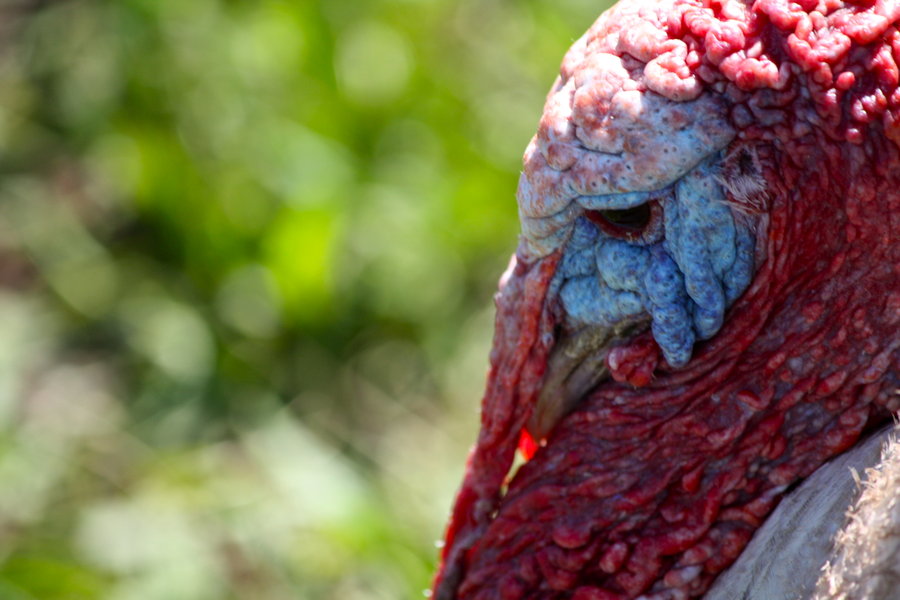
We found turkeys quite interesting. When they’re young they peep and squawk. Then the gobble develops, something we found relentlessly amusing. Hens don’t gobble. They chirp and cluck in their own quiet manner while the toms are prone to showy displays of exaggerated feather fluffing. The toms gobbled at any noisy airborne attraction including Canada geese, crows, and helicopters. When annoyed, their heads turned iridescent blue and sometimes they engaged in snood-grabbing jousts. Our dogs were fascinated by the turkeys, but the turkeys showed little interest in creatures beyond their own genus.

All day, every day the flock had a visitor. A little brown hen moseyed up from the back of our property to visit her fowl friends. She stayed close. She pecked at grass and bugs, sometimes a few feet away and sometimes a few inches away. When we gave the turkeys a treat from the garden like a monster zucchini she’d cluck at me, waiting for her own piece. Quite often the turkeys, in their zucchini-enhanced exuberance, tossed flecks of what they were eating almost as if to share. Their friend the hen was right there waiting for those offerings. I never saw the turkeys peck at her.

What we learned about turkeys wasn’t entirely charming. Full grown turkeys are huge. Some of ours were over 80 pounds. Their poo, I’m sorry to say, was also huge. I never realized just how foul it was until I slipped and fell in it. And despite the overall health and vitality of our flock, once we factored in all the expenses there wasn’t any profit at all. Plus, after feeding and chatting with them for six months, it felt like a horrible betrayal to take them to the butcher.

This year we let the turkey farming venture go. We’re gratefully buying a pastured turkey, knowing that it’s worth the cost. It’ll be cooked with my mother’s stuffing recipe. I’ll also be using my mother’s china and linens. We’ll sit here at a table filled with friends and family, fully aware that our blessings include those made of memory.

I’ll smile this Thanksgiving at all who are here with me. I’ll leave the sob in my throat, choosing instead to share fond and funny stories of my parents who I miss every day. I realize now why every generation goes on celebrating even after the elders who made the traditions meaningful have gone. Holidays are a sort of bridge between past and future, a way of steadying ourselves with the idea that some things stay the same. When the time comes for me to pass along the honor of hosting Thanksgiving dinner, I’ll try passing along my mother’s stuffing recipe too.

honoring memories at Thanksgiving, how to raise pastured turkeys, small farm turkey story, missing mom at Thanksgiving,

Image: Karuntribs


Ancestors Live On in Our Lives

ancestry, emotional resonance, quantum physics, consciousness, celebration,

We all grow up with the weight of history on us. Our ancestors dwell in the attics of our brains as they do in the spiraling chains of knowledge hidden in every cell of our bodies.

~Shirley Abbott


When my east coast cousin visited she asked for updates on our extended family. I told her about surgery an uncle had on a drooping eyelid.  She was intrigued because her doctor recommended she have surgery for the same thing. He told her the problem came from stretching tender skin around her eyes as she put in contacts.  How could she have known the tendency ran in the family?  Later, as we looked through old photographs we saw the same prematurely sagging eyelids in a few of our ancestors.  Orphaned children, stoic immigrants who left loved ones behind, farmers who’d lost their land shared this feature—-they looked as if they’d stopped fully opening their eyes.  She and I considered the emotional resonance.  When she left she was still mulling over what it might mean in her own life.

There are many traits passed down in families.  We’re familiar with inheritance of physical features but it seems that other tendencies run through the generations as well.  In my family we’re prone to heart palpitations, stomach problems, anxiety.  We error on the side of caution.  We tend to make a living as teachers, clergy, academics, scientists.  This is true of the living and those long gone.  Such facts can be easily traced.

Some things are less easily traced but just as pronounced. When I was a new parent, the legacy from my ancestors rarely occurred to me. I saw my newborns as wondrously made beings with talents and personalities that would unfold in time. But as I held, nursed and rocked my babies I found in myself certain ingrained beliefs that surely had passed to me through bloodlines or through ways of thinking that were tight as hidden stitching.

My parents were warm and loving with their children, but they also fought against a palpable sense of worthlessness that pervaded their daily lives. As a child I sensed this in my mother’s suppressed anger and in my father’s hidden sorrow. My father whistled as he worked on chores and hugged us each night before bed, but his posture often showed sorrow. My mother read to us, played games with us and wore bright red lipstick but she was on guard against a hard world. When my children were babies my own feelings of worthlessness came out in me full force. By what means had these feelings become mine?

Then I remembered how fully I identified with my parents. My father’s frugality was learned during a difficult childhood and was passed on to help his own children learn economy. But his despair had an exaggerated effect on me, in fact I felt unworthy when given praise or gifts. I’d absorbed my father’s childhood pain.

My mother emphasized her sacrifices on behalf of others, hoping for enough appreciation to fill hungry gaps in her life. I learned to sacrifice as quietly as possible so that I would gather no perfunctory gratitude, absorbing her childhood misery without the redemption she sought.

These were not healthy adaptations, yet I’ve come to believe children take on the angst of those who are close to them as if by osmosis. My parents overcame the painful realities of their early years through hard work, faith and loving attention to people around them. But they also took on the stories of their own parents and grandparents. Of course we are strengthened by adversity, but when we repress the hidden impact of generational suffering it’s more difficult to heal and grow.  That I was raised in a happy home yet felt this pain makes this obvious.

It is one of the tasks of humanity to steer one’s tribe toward the light of greater understanding. The legacy of sorrow and suffering we take on can be overcome, and in some way the overcoming is not only a victory for ourselves but also a triumph for our ancestors. Each generation can heal not only itself but ancestral pain as well. Changing the energy around who we are affects who our loved ones have been. The more I learn about quantum physics the more I understand this to be possible.

It’s not all about overcoming difficulty. It’s also about living out the gifts passed on by those who have gone before us. Those abilities and interests we call our own, so often are legacies from those long gone. As my children get older I find something ‘clicks’ when I notice attributes in them that were present in their relatives. I see these traits all the time. My research-minded, highly technical grandfather would recognize these traits manifested abundantly in my sons. A grandmother and great-great uncle who taught Latin and the classics would find kinship with my daughter. I see myself in relatives who wrote, searched for spiritual meaning and had highly idealistic views of the future. Even in day-to-day preferences I see commonality. My own mother loved mysteries, scorned shoes in favor of sandals and adored rich desserts much like my daughter. My husband’s grandfather was always tinkering with equipment much like my sons.

When I come across things these relatives left behind I give them to my children. A ring, a book, a pair of binoculars once owned by long-gone relatives carry meaning, especially because I tell my children what they have in common with the people who used them. I also try to keep alive the stories of their relatives’ lives as best I can. In this way we retain the living memory of those who have gone before us. We learn from the pain, celebrate the gifts and hold their light aloft for future generations.

To be aware of this is to consciously carry forward what we choose from our rebellious, curious, compassionate, inventive, wild, spirited, loving, angry and freedom-seeking ancestors. That we exist at all is a testament to their endurance. Who we are is a choice, made in the context of many who lived so very fully before us.

*

*

*

In memory of my gentle father, who left us 7-26-2010. Too soon.

How Big Are Your Moments?

hurry, multi-tasking, paying attention, living each moment, conscious living, cherishing loved ones, “Every moment is enormous, and it’s all we have.”   Natalie Goldberg

When my daughter was a baby she napped in the stroller. One time. This may stand out in my memory because it was so unusual. Or because I savored that wonderfully long nap in a babyhood troubled by chronic illness. But I think it’s because I consciously chose to hold on to the memory.

That day I pulled the stroller gently into the backyard. Tiny spring wildflowers sprouted everywhere in the expanse of weeds we called a lawn. The honey locust trees were in bloom, making the air smell particularly sweet. As I sat there watching my oldest child play and my daughter sleep, an ice cream truck passed a few streets away, adding a magical tune to the afternoon.  The springtime smells, the sun shining on my little boy, the soft untroubled look on my baby’s face, the complete peace of sitting on the back step are still with me.

Our lives are stitched together by what we notice and remember. Look back at any particular phase of your life. What you recall is constructed from what you paid attention to. Each moment there are sights, sounds, tastes, thoughts and feelings unique to your experience. The way you pay attention to those elements forms your memories. The shocking part? Looking back and realizing how few rich and full memories we really form.

That’s because we only really latch on to memories when we pay attention. When we’re engaged in the moment. Recall the last really memorable meal you had. It probably wasn’t one you ate in the car or standing at the kitchen counter. It was one you savored with full awareness of flavor, texture, scent. Most likely there were other important elements as well. Perhaps it was a meal shared with a new friend or made from a challenging cookbook. Perhaps it was a last meal you had before a loved one passed away, a meal you now try reconstruct in detail.

It’s easier than ever to miss our own lives. I’m guilty. Large chunks of mine have drifted by unheeded. Sure I was there. But I was distracted. I was multitasking. I was rummaging around in the past or fussing over the future rather than paying attention to the moment.

I won’t delude myself into believing that I have the capacity to stay in the moment. But I can try. And because my daughter has just come into the room I’ll be turning from the computer now to hear about her day.

*

*

*

*

Maybe Next Time courtesy of PORG

You’re Gonna Fall, So Laugh

statue falling

I’m a terribly flawed human being.

I don’t steal. I’m not greedy. But falling strikes me funny. Friends tell me their falling stories to see me snort with the sort of uncontrollable laughter that continues to erupt well after the conversation has moved on. They also send me video clips of strangers tripping and stumbling. Surely that’s not to feed into an unhealthy preoccupation, but only because they care about my happiness.

I don’t enjoy the falls of children, the elderly or anything looks remotely painful. But ordinary falls, those that tend to be accompanied by awkwardness and shock, show me the vulnerability that unites us as a species. You may be a glamorous celebrity, a rich girl on your wedding day, a confident dare devil, a casual visitor to a muddy llama farm, whatever. But when you fall, this is what we share. A moment of instability. A look of disbelief spreading across your face that expresses, “I’m a bi-pedal Homo sapiens well acquainted with upright posture and this can’t be happening.” Gravity continues to exert its influence as your feet and arms flail in an effort to push time backward. This sequence from stable to unstable is my favorite part, actually. The body slamming I could do without. I’ve had a few serious falls myself; two in my twenties required an ambulance ride with the World’s Best People, paramedics. I’ve learned it’s better to find the humor in our own falls, even when they hurt our dignity and our limbs.

Falling is on my mind after a phone call from a loved one. He tripped recently and can’t seem to stop going over the incident. To him it’s embarrassing, an ugly reminder of his own incompetence. That no one else saw him doesn’t even matter.

Here’s what does matter. What we tell ourselves has tremendous power over the way we store and retrieve memory. Each time we call up a memory we color the details with our current emotions. If you fell down on your way into a job interview, then later while depressed you cite that incident as evidence of your own worthlessness, that memory will be more closely associated with a negative state. If, on the other hand, you relate that incident as a wonderfully funny story to a group of friends who howl with laughter, that fall will be associated with more positive emotions. I probably laugh about awkward falls because I am a person entirely lacking in gracefulness. My own history of dropping over at inopportune moments is only tolerable because I recall it as funny.

So tomorrow I’ll call my loved one back. I plan to tell him one of my many falling down stories. Perhaps the one about what did and did not happen between myself and a boy who looked like Jesus, back in North Olmsted Junior High. Maybe he’ll feel some empathy for my plight, hear my laughter and know that laughing about falling is just another way of seeing that we fragile beings are in this together.

Here’s the story, in case you need a laugh.

Falling for a Guy

Back in hip hugger days, guys and girls flirted slowly. At least in junior high (a term that came before “middle school.”)  Romance started with glances. After a few days or even weeks of glances came long soulful looks. Then the first “hi.”

Our school was hugely overcrowded with grades 7 through 9, so packed that administrators had traffic lines complete with no passing zones painted on the hallway floors. I was in 8th grade. I wore hip huggers and tiny little tops I bought with my babysitting money at the forbidden head shop on Lorain Road. I listened to WMMS, the cool station that played entire albums. I wasn’t interested 8th grade boys. No, I liked a boy whose long wavy brown hair made him look like Jesus, and whose name, Joe Gagliardo, sounded warm and exotic. Being a grade ahead of me made him out of my reach. But, miracle of miracles, he started the “eye thing” and before long he was looking at me and smiling. I knew he’d be saying “hi” soon. I could barely sleep at night.

My friends advised playing hard to get. I bought a pair of the newest fashion, cuffed high-waisted jeans. With these on I could get away wearing a midriff top, a little skin showing as I walked down the hall between classes. Joe’s locker was up ahead and there he stood with a group of his friends. Suddenly those 9th grade boys looked huge and scary, but I mustered up my confidence. Joe was looking my way. He smiled. Then he said, “Hi Laura.” He knew my name!

Exultation took over, limiting what little coordination I possessed. I hurried so that I could pass by while tossing a brief, hard-to-get-girl hello. At the moment I was closest to Joe, my right foot stepped directly into the left cuff of my new jeans. There it stayed trapped. My mouth hung open in shock. I looked straight into the eyes of the boy I was trying to impress as I teetered forward. My knees buckled. I dropped down in a fall that seemed to take centuries. My head landed directly into Joe’s open locker, my butt hung out facing Joe and his friends.

Although I willed myself invisible or better yet, dead, nothing happened aside from some kind of static that replaced my ability to hear. I backed up like a crab, hurriedly stood and skittered away without looking at any one. I never ever exchanged another glance with Joe. It was easy in that crowded school to avoid him after that. But I used that story to amuse my girlfriends, although most of them couldn’t believe I would laugh about it. A few months later I met the taller, smarter and even older boy who later became the man I married.

Still, thinking of the girl who tried so hard to be cute yet hurled herself headfirst into a locker can make me smirk. Especially when I think of the expressions that must have been on the faces of those guys watching a girl playing hard to get.

photo of statue shared by benleto,  Creative Commons