
The other day I was sitting in a medical facility waiting room while my husband was undergoing tests. I was trying to ignore various worries common to such tests while also attempting to ignore the wall-mounted television’s prattle. I normally bring a book but had forgotten this time. So I scrolled around to see what friends recently posted. I watched a few art process Insta posts that reliably soothe my fluster. I read several of the longform essays I enjoy on Emergence,Aeon, and Nautilus.
Still waiting.
I did another look around. There was the slumped teenager with headphones on, carefully avoiding eye contact. There was the expensive overcoat guy on his phone sounding bossy. And there was a gentle-faced man in a wheelchair. Whoever brought him (daughter? caretaker?) sat looking at the TV while he gazed around him with a look of quiet wonder. Maybe he was what some might call developmentally disabled or maybe he had dementia or maybe he was a saint, because few adults allow themselves such open and endearing expressions of interest in everything. I wanted to go over to sit by him. Heck, I wanted to kneel by his side and ask him for a blessing. When I caught his eye we indulged in a long smile at each other. His name was called soon after: Moses.
When I went back to scrolling. I came across this:

What a beautiful place to take one’s mind.
I started with the easiest person for me, my mother. I loved most her hugs (oh, for another hug), her genuine interest in everyone she met, her endless committment to stay in touch, her detective-like pursuit of what she wanted to know, her storyform memories, her intuition (that woman could with great accuracy tell who was calling well before caller ID and invariably got in touch with people saying “you’ve been on my mind” only to find out there was a good reason for that).
Then my dad. I loved most his ability to offer undivided attention, the way he put children first, his more-spiritual-than-religious views (which he hid well in a lifetime of regular church attendance), his quiet presence, his wry sense of humor, the way he whistled when he was happy.
Then my friend Leia. I loved her soft laugh and bawdy humor, her light-up-the-room smile, her interest in exploring our mutual meaning of life questions, her insistence that everything was “perfect” despite the multiple sclerosis that put her in a wheelchair in her 30’s and nursing home in her 50s. Our meaning of life conversations got far more serious after her beloved daughter was shot and killed by muggers.
All of these listed qualities are far fewer than the many things I most love about these people. “Love,” I realize, remains a present tense verb because death doesn’t subtract love.
On nights when I can’t sleep, I try to remind myself to engage in this practice of listing qualities I adore most in the (too many) people who are now gone. And, yes, in animals I adore too. I don’t know if I can “be” these things. But recalling some of their finest traits helps me love those I miss in a way that goes beyond grief. It reminds me I still love them and will always love them. This is the way I suspect any of us would like to be remembered.
If you’d like, please share some traits of a person who has died that you’d like to emulate.
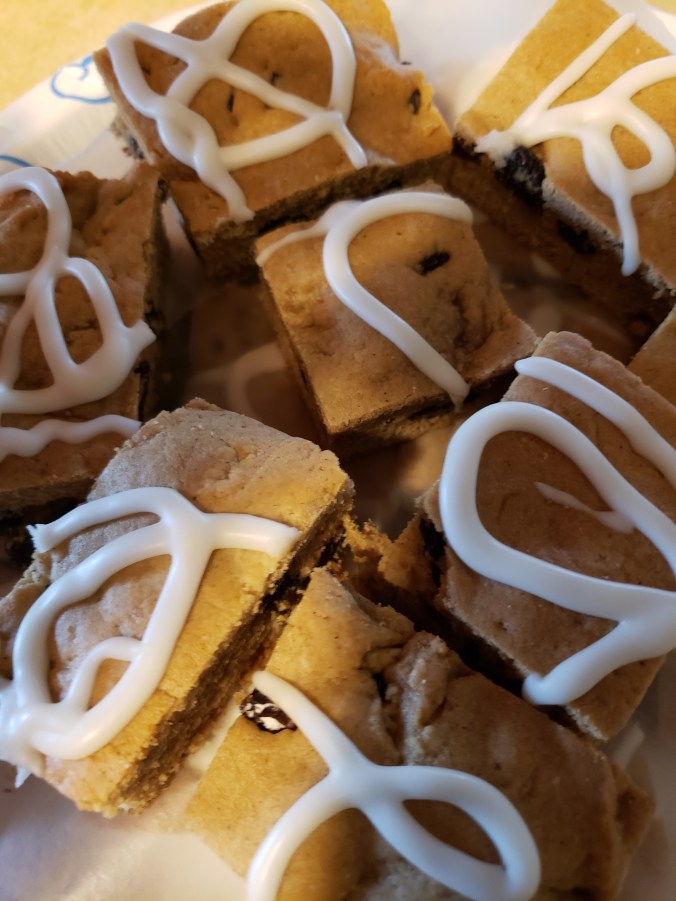 Butter and sugar combine quickly in the vintage Kitchen Aid mixer that once belonged to my mother. I drizzle in molasses, drop in cinnamon and allspice, add eggs one at a time. I’m making four batches, 140 cookies in total, for this week’s porch drop-off. I’ve never made Hermit Bars before and admit to choosing the recipe solely for its name. I am intrigued to learn it may have originated 150 years ago in New England, even more intrigued to find it may instead hark back to
  Although we’ve lived in this township for nearly 23 years, we simply haven’t gotten to know many people. Perhaps it’s because the houses are farther apart than in our previous neighborhoods. Perhaps because we homeschooled. Perhaps because of other encounters in our first few months here that made us wary,
  I’ve also gotten some perspective on despair after talking with my friend Maureen. She told me she’s been inert and ineffectual, retreating into herself. She also said she was feeling on a deeper level all the loss she’s been through in the past few years while at the same time feeling guilty about her grief because so many people are going through far worse.
 Laura Grace Weldon