Natural Antidote To Bullying

antidote to bullying, free play prevents bullying, bullies made by restrictions, nature prevents bullies,

Wikimedia Commons

Children are drawn to challenge themselves. They need to take risks of all kinds—physical, social, emotional, intellectual—in order to grow into mature self-reliance.

Where do such challenges most naturally occur? Outdoors. As detailed in Last Child in the Woods, when children spend time in natural areas their play is more creative and they self-manage risk more appropriately. They’re more likely to incorporate each other’s ideas into expressive make-believe scenarios using their dynamic surroundings—tall grasses become a savannah, tree roots become elf houses, boulders become a fort. Their games are more likely to incorporate peers of differing ages and abilities. Regular outdoor experiences not only boost emotional health, memory, and problem solving, they also help children learn how to get along with each other in ever-changing circumstances. Free outdoor play with others, especially when it’s not hampered by adult interference, teaches kids to interact with others while also maintaining self-control. Otherwise, no one wants to play with them. It’s the best sort of learning because it’s fun. Sounds like the perfect way to raise bully-proof kids doesn’t it?

But the opportunity for free play and risk is funneled into very narrow options for today’s children. They are shuttled from one adult-run activity to another. Time between these obligations is often spent indoors. And children’s outdoor play is restricted by excessive rules designed to keep them safe from dangers out of proportion to any real safety issue.

So kids don’t get natural challenges like climbing trees, exploring fields, building forts. They are deprived of the rich lessons of cooperation and self-control found in free play. And they don’t develop biophilia, that essential sense of connection with nature. Then we expect them to get along and recognize real risk. Any wonder that bullying is a growing problem?

Here are examples of playground designs that, in institutions like schools and daycare programs, foster free play using natural materials. Sensory play, places for solitude, and opportunities for physical risk are built in and, no surprise, children get along better.

It’s a step in the right direction. A few steps farther and we’ll let kids back in nature herself, playing in woods and fields and beaches. Too bad all the money thrown at anti-bullying programs aren’t used to fling open the doors to the natural world. “Go out and play,” may very well be the best anti-bullying advice yet.

Give Em The Finger

working with instead of against resistance, leading children, foster learning, non-compliant children, resistant children, non-coercion,

geograph.org.uk

“Self-trust is the first secret of success.”  Ralph Waldo Emerson

No one wants to be cajoled, forced, or coerced. Some of us resist mightily. Such resisters are called all sorts of names: underachieving, non-compliant, difficult, withdrawn, eccentric, or worse.

Human beings naturally resist when our autonomy is threatened. And autonomy is most threatened in childhood because many adults (particularly in the western world) believe children require moment-to-moment instruction, advice, and entertainment. Unlike most of previous human history, children’s lives today are heavily monitored and controlled. Adults keep kids in pre-planned activities,  insist that education proceed in a linear fashion, intervene to minimize difficulties, and provide distractions to prevent even momentary boredom. They do so assuming these efforts will advance learning and boost success.

Yet this puts character development at risk, because children are attracted to dilemmas that help them learn. Learning from mistakes, taking on challenges,  and developing a growth mindset are pivotal for success. So is preservation of a trait found in people at the top of their fields in science, the arts, and entrepreneurship—curiosity. And curiosity arises in unique and unpredictable ways, often appearing after a child has traveled from boredom to inspiration on his or her own.

Coercion also puts the child in an uncomfortable position, because all this control comes from adults with the best intentions. Usually adults who love them. So children, who don’t like overt control any more than you do, typically react somewhere on the spectrum between compliance and resistance. Extreme compliance and they’re less likely to think for themselves, developing an external rather than internal locus of control.  Extreme resistance and they’re likely to face ever more punitive efforts to get them to comply. Neither reaction is what adults want or expect.

Which leads me to a story about Transcendentalist writer, Ralph Waldo Emerson. He and his son Edward were trying to get a calf through a barn door. Emerson pushed from behind while his son pulled on the calf’s ear. The heifer wouldn’t move an inch despite a great deal of effort exerted by the two men. Emerson thought back over his scientific and literary readings in hopes of figuring out some way of getting the reluctant animal to move but didn’t come up with any solutions. They continued trying, to the amusement of a servant woman who was passing by. She offered a finger to the calf. Easily led by its desire to suckle, the calf followed her at once.

The wisdom of capitalizing on natural tendencies is the key to good animal husbandry. It’s probably a key to decent human relationships as well. I’m not for a moment suggesting that children are calves. (In fact, I’d rather see calves left with their mothers to suckle than led into a barn by capitalizing on that unmet need.) Children need rules, responsibilities, and the expectation that they’ll treat others with compassion. They need to be nurtured by adults who understand that pushing and pulling aren’t useful ways to help children mature. And they need the freedom to learn in ways that are best for them. At any age, those of us who aren’t oppressed by coercive relationships or controlling institutions gladly seek out advice as we need it, find role models who inspire us, and advance in the direction of our greatest gifts.

“No human right, except the right to life itself, is more fundamental than this. A person’s freedom of learning is part of his freedom of thought, even more basic than his freedom of speech. If we take from someone his right to decide what he will be curious about, we destroy his freedom of thought. We say, in effect, you must think not about what interests and concerns you, but about what interests and concerns us.” John Holt

Learning Disabilities Linked To Environmental Toxins

toxic waste causes learning disabilities, prenatal exposure to pollution, my child affected by pollution,

fema.gov

Parents of children who struggle with learning disabilities or health problems are familiar with questions that keep us awake at night. Is it genetic, congenital, dietary? Is it my parenting? It is fate? While helping our kids every day to gain new strengths we still search for the cause, hoping we’ll find lasting solutions.

Of course, learning problems have been observed in children for generations, but evidence is mounting that toxins in our highly industrial world are a contributing factor. Today, one out of every six children has a developmental disability. Many of these conditions affect the nervous system: developmental delays, learning disorders, sensory deficits, autism, and cerebral palsy.

Most of us are familiar with studies linking lead (largely from old paint dust and chips) and mercury (from coal-fired power plants, certain fish) to cognitive and behavioral problems.

We’re also aware that BPA found in plastics like food containers, toys, lining of metal cans, and beverage bottles can impair brain function in mammals, via hormone signaling in areas of the brain related to forming memories and retaining information. Choosing only eco-friendly versions of these products doesn’t remove the danger entirely. Even goods marked “BPA-free” can contain damaging chemicals.  And this exposure isn’t just linked to plastics. It’s also found on store receipts!  While debate continues over the effect of these chemicals on our health, it’s interesting to note that studies conducted by independent scientists show adverse effect while those financed by BPA-using industries tend to show the risk is negligible.

Some of the newest research points to cadmium as another potential culprit. This heavy metal naturally occurs in the earth’s crust, but cadmium is released through smelting, burning fossil fuel, incinerating waste, and using phosphate fertilizer—where it’s taken up by food crops such as root vegetables and grains. Cadmium exposure also comes through tobacco smoke, even some toys and jewelry. Children with high levels of cadmium in their urine were found to have more learning disabilities and special education needs. These neurocognitive problems were reported by parents in a study of  2,200 children ages 6 to 15, and more studies with data directly from schools and physicians are needed. Although we can modify our habits to limit exposure to most toxins, the presence of cadmium is largely out of individual control.

We’re also discovering that exposure to all sorts of modern-day chemicals before birth and during the formative years may be related to later learning problems. These chemicals are ubiquitous. An article in the medical journal The Lancet, titled “Developmental Neurotoxicity of Industrial Chemicals –A Silent Pandemic,” reports that half of 201 chemicals identified as neurotoxic are produced in high volume (more than 1 million pounds each year) and over 20 are often found in chemical waste.

follow-up report by Harvard School of Public Health identifies 278 additional neurotoxic chemicals. A multi-national effort is underway to test for developmental toxicity. Experts estimate that up to a quarter of the 80,000 to 100,000 chemicals in use around the world may show neurotoxic properties.

For those of us who know the hope and hard work required to raise children who have additional burdens, such test results are only the beginning. We want action to protect the brains and bodies of every child.

Take Action

Follow EPA advice and information about protecting kids from toxins in the home

Check out specifics about toxins in skin care products your children use.

Get involved in the Environmental Working Group‘s Kid-Safe Chemical Campaign

Support the Clean Air Council‘s push to reduce the emission of mercury, arsenic, and dioxin from coal-fired plants

Contact your legislators to support the Safe Chemicals Act

Use the Open Secrets database to find out how your elected officials are funded by lobbying groups.

Raising Elijah: Protecting Our Children in an Age of Environmental Crisis

Plastic-Free: How I Kicked the Plastic Habit and How You Can Too

Smart Mama’s Green Guide: Simple Steps to Reduce Your Child’s Toxic Chemical Exposure

Super Natural Home: Improve Your Health, Home, and Planet–One Room at a Time

The Newman’s Own Organics Guide to a Good Life: Simple Measures That Benefit You and the Place You Live

Slow Death by Rubber Duck: The Secret Danger of Everyday Things

Ecological Intelligence: The Hidden Impacts of What We Buy

Unacceptable Levels

1,000 Ways To Play With A Cardboard Box

imaginative play, cardboard box playthings, build your own toys, cardboard village,

CC 2.0 Flickr photostream mollypop

A large appliance box waiting at the curb has always been a call to action. We’ve done whatever is necessary to get it home, mostly dragging it behind our bikes or lashing it to the car roof. That because every refrigerator or washing machine box (as well as every smaller box) has another life waiting for it. One dreamed up by children.

When I was a little girl, we played for months with a tall furniture box. My mother fashioned a door and windows that opened like shutters. It stood in our basement ready to serve as a palace, fort, or playhouse. This box was large enough to fit my sister and me and a few of our friends. It lasted through the winter before sagging into uselessness. (Check out a wonderful gallery of cardboard creations on MyMakeDo.)

build a cardboard city, play with cardboard boxes, host a box party, Bring Your Own Box party, let kids build with cardboard,

CC 2.0 edenpictures Flickr photostream

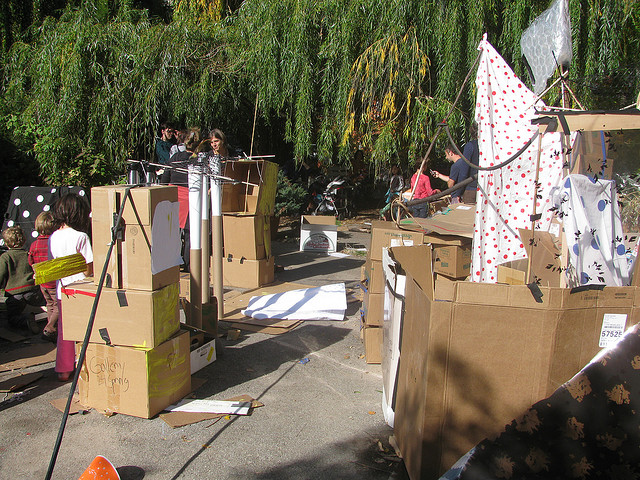
One of my favorite events to throw for the kids of friends and neighbors is a BYOB gathering. As in Bring Your Own Box. Guests are invited to show up with cardboard boxes of all sizes. We supply masking tape, duct tape, markers, paint, and plenty of room on our property. The adults wield mat knifes, cutting where the kids direct. Sometimes more than a dozen huge boxes are transformed into cardboard rooms featuring turrets and rope-opening drawbridges. Sometimes they are a connected series of tunnels leading to a fort under a tree. Once the kids made a child-sized passageway they invited to adults to enter, giggling as we stooped and crawled and squeezed our way through. The biggest thrill for kids seems to be in the planning, arguing for one vision or another, then working together to make the project a reality. Of course, playing in it afterwards is fun too. The benefit of hosting it here? Plenty of days to play in the box creation after the event is over.

A cardboard box-related program we ran at enrichment classes was a hit. We called it Junk Science. We saved cardboard boxes and cardboard tubes of all sizes, along with string, rubber bands, lids, paper clips, yogurt cups, and other creativity-inspiring loose parts. Each child or team was given equal amounts of this “junk” and on free days allowed to build whatever he or she choose. On other days they were given a specific challenge, similar to the old TV series Junkyard Wars.  The kids built sorters that sent pennies down one chute and dimes down another, bridges that held weight, catapults that tossed ping pong balls, and much more. They preferred the specific challenges to free days, perhaps enjoying the way their ideas took off while solving a problem.

I know a boy who used to make vehicles and trains out of cardboard boxes. He hitched them together with ropes and dragged them around. This made cleaning up toys more fun, and conveying groceries from the front door to the cupboards became his favorite job. And I know a girl who used to make mazes out of boxes for her pet rats to scurry through, kissing them on their pink noses when they emerged to find a treat at the end.

I also know a child who made a world out of a refrigerator box, a world that continutes to absorb his interest for hours on end day after day.

You may have thought I’d list 955 other ways to play with cardboard boxes but any child can do that. Who wants to limit creativity to a list anyway? Start saving those free toys called boxes.


Staring Down Worry

mystical experience of fear, metaphysical encounter with darkness, overcoming evil, facing worry, staring at Satan, prince of darkness in my room,

Image courtesy of pitrisek.deviantart.com

Something happened the night Worry appeared to me.

Some of us are chronic worriers. There’s probably an adaptive reason for this, since humans who envisioned potential dangers would be more likely to survive and pass on their genes. But saber-toothed tigers aren’t lurking by our front doors these days. I know for a fact that worry generates misery while producing absolutely no benefit. Giving it up, however, isn’t an easy matter. Worry runs in our heads like movies of disaster to come, unbidden yet powerful, making some of us wary of the smallest choices.

I worried from the earliest time I can remember. It may have an adaptive start in my life too. As a tiny child I spent many nights struggling to breathe through asthma attacks. When I was five years old I got a bit of food lodged in my esophagus. When my worried mother called the doctor he said it couldn’t possibly still be stuck hours later, I was just overreacting. I stayed awake all night spitting my saliva into a bowl, since even a moment’s inattention caused it to run down my windpipe and sent me into fits of choking. The next morning my parents took me to the ER where a surgeon removed a very stuck bit of food. The year I turned nine my grandparents all died, catapulting me into years of obsessive worry that everyone else I loved would die too. I was assaulted by an adult when I was 13, telling no one until years later. The focus of my worry widened as I spent years searching for the causes of evil and suffering. Worry continued to be my companion when I hit my 20’s. Each of my babies were born with medical problems. The unknown dangers threatening even the most innocent lives suddenly resided in my house. Chances are my chronic insomnia has roots in all this worry.

One night as I lay awake worrying, I had an experience that profoundly changed me. That night I had plenty of things to worry about: serious concerns about my children’s health, our finances, and other problems. Normally I fought off worry with gratitude—focusing on the comfort of my family sleeping safely nearby and the many blessings in my life. But worry was there haunting my mind and hollowing my body.

Sudden as a car crash, something happened.

I know it sounds bizarre but it was as real as the lamp on my desk is now. I became aware of a huge black column next to my bed. It was comprised of the most immense energy I’d ever experienced. It was dark and powerful with a presence that seemed alive and completely aware of my thoughts.

I had the sense that it was of such infinite size and strength that it went through the floor and out the roof, stretching far in both directions. I should have been more frightened, but the moment this column appeared I realized, as if the message hit all my cells at once, that I had summoned this darkness.

It was born of my own intense worry. It was a profound lesson that went through me the way wisdom does, filling not just our brains but also our bodies and souls. Lying there, I resolved to bring forth every ounce of light I could muster.

The instant I thought to do this, whatever that column was disappeared.

I woke my husband to tell him. He kindly assured me that I was nuts. Until this post I’ve only told one other friend. But in today’s atmosphere of worry, I wanted to share this image—of fear so huge that it manifests next to you. It taught me that worry is a kind of unintentional evil. It presupposes things will go wrong. It’s the opposite of faith.

I’m not entirely cured of worrying nor would I ever change those earlier years of worry. They’ve made me stronger, more open to the beauty found just beyond despair, and left me with a positive quest. But ever since that moment, years ago, I have made a conscious effort to reorient myself.

Ironically, my family has been through times more difficult than I could have imagined back when this happened—crime, financial hardship, loss, and grief. But I know the antidote—to shine forth with all the light I can. Some days I’m practically optimism’s parasite.

But really, if all my moments of hope coalesce into some kind of vision, I can’t wait to see it.

metaphysical experience of evil, starting at evil, facing Satan, summoning fear, transcending worry, transcending fear, overcoming worry, renewing optimism,

Image courtesy of m0thyyku.deviantart.com

Newcomers To God’s Country

move to country bad idea, angry rural neighbors, rural life hilarity, rural living problems, religion as a weapon, angry Christians, We left behind gangs and sexual predators when we moved to the country. After city living, settling our family on a small farm seemed like coming to the Promised Land. Even the weather was welcoming as we made more and more repairs to the house we could barely afford. No matter. We hiked through the woods and crouched by the pond, watching frogs, fish, and goggle-eyed insects with a sense of gratitude that felt as solid as a good decision.

Then we got to know our neighbors.

Though we’d moved less than an hour away it seemed we’d crossed an unmarked border. Lovely pastoral stillness was regularly broken by target shooting, 4-wheelers careening around pastures, and barking from what sounded like a dog breeding operation. Some neighbors chose to burn garbage rather than pay the requisite fee for trash pickup, which explained the toxic stench of burnt plastic that sometimes hung in the air. And we quickly learned that some neighbors didn’t talk to other neighbors due to longstanding feuds. Allegedly these conflicts had escalated to bodily harm, lawsuits, and the biggest threat — eternal damnation.

This was the most overtly foreign to us, religion right out front as a beacon or bludgeon. Religious paraphernalia was evident everywhere; on bumper stickers, yard signs, and lapel pins. “Where do you go to church?” was the question people typically asked upon meeting us, right after “Where are you from?”

Realizing the only correct answer would be the exact denomination of the questioner, I gave vague relies. If pressed I said truthfully that we headed back north each Sunday to go to our old church before spending the afternoon visiting relatives. Then I quickly changed the subject. This conversational maneuver seemed to leave my new neighbors unsure of whether to save my soul or shun me. Left in the dreaded middle ground, many of them parted with helpful advice about sins I should take care to avoid.

“Don’t vote for the library levy, because you know the library is an agent of Satan. It has that Internet thing.”

“Don’t celebrate Halloween. That pleases the devil’s minions.”

But we couldn’t remain anonymous for long. Our children ventured down the street to scout out playmates. They returned quickly. Apparently the neighborhood children posed a single-question quiz before agreeing to make friends with newcomers. When our children didn’t know the answer to “Are you born again?” they weren’t allowed to stay.

Soon after we arrived, I was invited by a neighbor to her home. I brought muffins. She nodded as I handed them to her, saying, “God told me not to bake.” While ranging around her kitchen swatting flies and yelling at her children, this woman crisply explained why those who didn’t ascribe to her exact version of Christianity were destined for hell. With joyous fervor she started listing houses on the street by the sins of the occupants, from her next door neighbor (“She’s a Catholic, you know, one of those so-called Christians.”) to the woman who lived at the end of the street (“Don’t talk to her, she uses a hyphenated name. Probably a feminist.”) 

I demurred, saying something about seeing the light in each person. She swiveled her full attention in my direction, fly swatter in hand, and asked me where I went to church. No middle ground left, I told her that I attended a Unitarian Universalist fellowship.

She was shocked.

“Oh, you people believe anything goes,” she gasped.

“Not intolerance,” I said.

She kicked me out of her house.

It seemed that my admission branded me, and not in the correct tattoo-for-Christ way. Word spread quickly. A man who lived a few doors down called soon after. When I answered the phone he asked to speak to my husband.

“Let your wife know she shouldn’t be hiking in the woods,” he said before adding gruffly, “I target shoot there and I don’t look first.”

I hoped school presented better possibilities.

Our children were assigned to two different rural elementary schools, miles apart. I picked our kindergartner up every day at lunchtime. Other parents also waited in the school hallway. It was immediately apparent that two factions leaned against opposite walls. This presented a difficult choice. If I spoke to the woman with frosted lipstick and tight shirt who stood on the less populated side, the woman with the heavy necklace and shag haircut on the other side would glare at me. And vice versa.

Frosted Lipstick talked to me more often. She told me about her well-muscled prayer partner and how she felt called to meet with him alone even though this made her husband jealous. She told me that Jesus gave her too many challenges. She told me I would be cuter if I wore lipstick.

Shag Haircut was more interesting, or maybe I just enjoyed her sardonic commentary. One day Shag Haircut told me what was behind the hallway glaring. A group of mothers were trying to remove Frosted Lipstick from membership in the school’s parent/teacher organization over a dispute concerning craft supplies. Ribbon and scissors worth something like $36 had not been returned. Shag Haircut and her cohorts considered Frosted Lipstick a thief.

I made what I hoped were reasonable suggestions to solve the problem. No luck.

I’ve taught conflict resolution for years but apparently peace wasn’t nearly as enticing as the entertainment value of scandal. A few weeks later the superintendent acted. Weary of the dispute, he threatened to eliminate the entire parent/teacher organization. Both sides of the hallway were deliciously shocked.

Frantically, Frosted Lipstick asked me to babysit after kindergarten so she could meet with him and solve the problem. I was relieved that she seemed to be taking my advice about talking the issue over, finding common ground, and healing the breach. I agreed to babysit, but explained that I needed to pick up my third-grader at the other school by three-thirty for a dentist appointment.

I assumed that she would drop off her kindergartner to play with my child. I was wrong. She appeared at my door with three additional boys. When she saw my surprise she said, “Everyone knows I operate a home daycare business.”

Everyone but the newcomer.

She went back to her minivan and returned with a woman she called Grandma. This woman was not her relative. Frosted Lipstick was branching out in the daycare business and had taken in an elderly confused person who needed supervision. Frosted Lipstick left quickly after I reminded her I needed to leave at three sharp. I made additional places at the table and invited these guests to lunch.

It became apparent that the boys were not accustomed to eating while sitting or eating without throwing food. They also used God’s name in vain frequently, surely a habit they didn’t indulge in while in the care of a woman who talked so much about her prayer life. I gave up the silly idea of showing them how to make sandwich shapes with cookies cutters and simply tried to impose order. It wasn’t working well.

Grandma wouldn’t sit. She smelled as if she might have damp undergarments but her waistband was fastened with some kind of dementia-proof catch. I couldn’t figure the thing out.

The afternoon deteriorated rapidly. My five-year-old normally enjoyed eating while I read to him, then he played Legos after lunch, but these boys were only amused by diversions such as hitting each other and slamming themselves into furniture. Grandma sidled along the walls with her hands up touching everything as if she read a form of Braille expressed in window frames and light switches. At one point she nearly escaped through the locked front door. Like hostages, my son and I exchanged repeated sympathy glances at each other as the home invasion dragged on.

Despite the chaos around me I was cheered by the knowledge that a greater good was being served — the conflict was being talked out at the superintendent’s office. In fact I was beginning to feel a sense of peace about the whole ordeal. Three o’clock was approaching. Frosted Lipstick would ring the doorbell and then I’d be free to retrieve my third grader. By now my son had retreated completely from the boys, who were bouncing around in a frenzy like ping pong balls. I couldn’t imagine the inner clamor their behavior was expressing. I also felt a generous amount of sorrow for Grandma, left here with strangers when she’d already lost so much.

Three o’clock got closer and closer. Frosted Lipstick still didn’t arrive. My smug sense of peace was evaporating. A few minutes after three, she called. Her tone was casual. She said she couldn’t get to my house but had made other arrangements. I was to drop off the kids and Grandma at the school’s aftercare program, she knew everyone there.

I had no time to express my indignation. I loaded the boys and Grandma in the van, checked seat belts, and turned onto the road. In moments the boys had taken off their seat belts and were beginning to crawl over the seats. That did it. I pulled over, trucks hurtling past, and told the boys to get their seat belts on using the slow dispassionate voice that my own children know indicates true rage. As I merged back into traffic I realized my vindictive thoughts were an indicator of how far I had to go before calling myself a pacifist.

In moments I was hurrying across the school parking lot holding many hands at once. We crammed into the tiny school office. I stood at the counter assuring the secretary that arrangements had been made for the boys to stay in the aftercare program. She seemed entirely unaware of such arrangements. Then I uttered Frosted Lipstick’s name. The school secretary’s face slackened into disgust. I leaned over the counter, trying to hear her response but the boys were arguing and shoving the hard-backed chairs back and forth on the linoleum. Grandma was running her hands along the corporate-sponsored posters on the walls. Clearly none of us wanted to be in this office but my own child was waiting miles away and I needed to assert some control over the situation. A chair tipped over, one boy slapped another.

I turned to the boys, hissing furiously over the din, “Stop it right now or I’ll tie you to those chairs!” Unfortunately just at that moment the principal came through the door with what appeared to be a new family. Upon seeing her, the boys stopped their noise immediately. Sudden silence turned my threat into a broadcast. Grandma strolled right into the principal, her upraised hands roaming across the guests’ bodies, along the door hinge, and onto the next wall. I’d been in the township less than two months and now was heard threatening to use restraints on a confused woman and three disorderly little boys.

The secretary said there was no protocol for leaving the boys without parental consent slips, and of course the elderly woman whose name I didn’t know could not stay. Trying to keep from hyperventilating, I asked the secretary to call the other school about my child, now surely left in the office. She tried. She told me no one was answering, Her tone assured everyone in the room that I was indeed a bad mother.

I did what I had to do. I subdued my hysteria, gathered my charges, and walked down the hall to the aftercare program. Both women working there said they knew the boys and the Grandma, as most people in the township seem to know everyone else. I informed them that Frosted Lipstick had told me to leave them for just a few minutes till she got back.

“Even the old lady?” asked one of the aides.

I nodded, wishing I had never stopped in the school office.

“Okay,” said the other aide. The first woman looked skeptical, but the moment the word “okay” left the mouth of a human being able to watch these four I took my son’s hand and ran from the building—past a janitor, several parents, and a blur of faces in the school office. I wondered if I abandonment charges were possible.

We pulled out of the parking lot and almost immediately found ourselves behind a line of traffic on the way to the other school. Cars, vans, trucks, and at the front, a school bus. It takes a single school bus to clog a rural road for miles. Worse, directly in front of us was a tractor pulling a manure spreader. Dark clumps fell onto the road and the heavy odor drifted in through our closed windows.

That drawn-out stinky scene wasn’t the final act of our little drama. Nor was it the sight of my third grader waiting for me in front of his school building, his face confident but his backpack sagging. No, it was the phone call from Frosted Lipstick later that evening. At the sound of her voice I was confident I would hear that the day’s calamities had been for a good cause.

“So did you resolve your differences?” I asked her.

“I went there to serve them with papers,” she said. “I’m suing the superintendent, the school, and the officers of the parent/teacher organization. God told me to seek vengeance.”
The Boy With No Toys

why toys are bad for kids, overstimulated kids,

Before he was born, his mother decided her son would have no toys. Abandoned by the father, she was already a single parent. She made a living cleaning for other people. Most days she took the bus to affluent streets where children never seemed to play outside. As she vacuumed and scrubbed beautiful homes overfilled with possessions she paid close attention to what children did all day. Often they were gone at lessons, after school programs, or playdates. When they were home they usually sat staring at screens. Toys in their carefully decorated rooms appeared to be tossed around as if the small owners had no idea how to play, only how to root restlessly for entertainment.

She thought about it, talked to the oldest people she knew, and read everything she could. Then she informed anyone who cared to listen that her child would not have toys. Not a single purchased plaything.

Will (name changed) and his mother live in a small mobile home park. By most standards they are poor. Their income is well below the poverty line. They don’t have a TV or computer (although Will uses the computer at the library and watches the occasional TV program at babysitters’ homes). But their lives are rich in what matters. Together Will and his mom grow food on several shares of a community garden, bartering when they have extra produce. They make all their meals from scratch. These routines activate a whole array of learning opportunities for Will, quite naturally.

They are close to most of their neighbors in proximity as well as in friendliness. While his mother is working Will is cared for by several different seniors in their trailer park. He not only likes to help his mother garden, cook, and take care of their small home but he also likes to take part in helping his neighbors with small tasks. He carries groceries for certain ladies, helps an older gentleman with a birdhouse building hobby, and sometimes gets to assist another neighbor in automotive repairs.  He gets a lot out of these meaningful tasks.  Children long to take on real responsibility and make useful contributions. Giving them these opportunities promotes their development in important ways.

Sounds nice. But what about play?

natural play best for kids, free play, no toys,

When Will was a baby his mother made all sorts of toys. Most took no time at all. Food containers became stacking toys, a small water bottle with beans inside became a rattle, a sock stuffed with drier fuzz and tied in knots became a soft animal.

Will is now six years old. He plays as any child naturally does. He makes up games and turns all sorts of objects into toys. His mother saves money by not owning a car, so Will has commandeered a large portion of the shed that would normally be used as a garage. Mostly he uses it to stockpile his own resources. He has scrap wood, a few tools, and cans of nails. He likes to straighten bent nails for future projects, working carefully now that he recently discovered what smacking his fingers with a hammer feels like. Recently he found a discarded lawn mower tire, so he’s looking for three more tires to make a go-cart. In the evenings he likes to draw elaborate pictures of this upcoming project. He particularly enjoys playing in the soft dirt along the side of the shed where “robot men” he makes out of kitchen utensils use their potato peeler and wisk limbs to churn through the soil, leaving tracks as they clink. When he visits friends he happily plays with their toys, although he doesn’t always “get” that certain TV or movie-themed toys are limited to the plot-related storylines. So far he seems to have no urge to possess the same toys.

What about birthdays and holidays? Will’s mother does give him gifts. But she limits her gifts to useful items—crayons, clothes, tools, a compass. Each weekend her folk band practices at their mobile home. Will quickly mastered the harmonica and begged for time on the fiddle, so her big gift to him this year was a used child-sized fiddle. She urges the other adults in his life to gift him with experiences—a trip to the beach, a day of horseback riding, a visit to a museum. Out-of-town relatives now renew a children’s magazine subscription and send him regular snail mail letters, both of which are helping him learn to read with very little prompting.

natural child development,

Will’s childhood has a lot in common with the way children have learned and grown throughout history. As historian Howard Chudacoff notes in Children at Play: An American History, play is vital to development. It’s has everything to do with autonomy, exploration, imagination, and fun. It has very little to do with purchased playthings. In fact, structured programs and commercial toys actually tend to co-opt play.

Studies with rodents show those raised in enriched environments (toys and changing items in cage) have enhanced brain development compared to rats raised in a standard environment (plain cage, unchanging). We’ve misinterpreted these results. Rats don’t naturally live in boring, unchanging cages. They live in nature, which is by definition a challenging often constantly changing environment. In nature rats have far more complex lives than they ever might in a cage. Such an interesting life IS an enriched environment. It’s the same for children.

Sure there are devices that will “read” to a child. These are not more enriching than being read to by a responsive adult. And there are all sorts of adult-designed games. They’re not more fun or enticing than games kids make up on their own or with friends.

In fact, the overstimulation of blinking, beeping, passive entertainment isn’t beneficial for children. Joseph Chilton Pearce wrote in Evolution’s End: Claiming the Potential of Our Intelligence that the overload of television, electronics, and too many toys limits a child’s sensory awareness. Their brains and nervous systems accommodate intense bursts of sound, light, and color during their earliest years. Rather than developing the subtle awareness fostered by time spent in nature, in conversation, and in play they instead are wired to expect overstimulation. Without it, says Peace, they’re bored.

And yet, so many people are amused when tiny children are clearly pushed to the limits by a toy too overwhelming for them. (Every search for a video to illustrate this seems to think “baby scared by toy” is funny.)

The children Will’s mother cleans for, who are kept busy in adult-run programs and have access to electronic distractions, don’t have Will’s advantages. As he plays and innovates he’s actually promoting the kind of learning that translates to a lifetime of passionate interests. Studies show that children who are free to explore their interests without adult pressure and interference  are more autonomous, eagerly pursuing excellence through healthy engagement rather than heavy-handed adult pressure.

Ask the oldest person you know to share some memories about play from his or her childhood. Chances are you’ll hear about pick-up games, handmade toys, and free time that spun long summer days into marvels of imagination. That’s what Will’s mother wants for her child.

play develops intelligence, benefits of free play, deprive your kids of toys, handmade toys,

First published in Natural Life Magazine

Are Your Past Loves Hidden?

telling all in a relationship, total truth in relationship, sexual honesty,

Flickr photostream of qthomasbower

I was a teenaged bride (really). I began dating a tall, open-hearted 16-year-old guy when I was 14. I had a few middle school boyfriends before him, as well as a crush on a Jesus lookalike named Joe (which ended before it began when I fell headfirst into his locker while trying to coolly walk by) but never a true “past love.” We married when I was 18 and he was 20. Depending on how you look at it, either we missed out on all the fun of falling in love with other people or we were spared the emotional damage of falling in love with other people.

Everyone else I know has been in relationships that ended, often badly. Many of them in marriages that ended, also badly. When they talk about these former partners they tend to emphasize the negative. Surely this is a necessary part of the healing process, helping them to recognize where they were wounded as well as where they may have done some wounding. But sometimes, from my very limited experience in this area, I wonder why pain and anger seem to weigh down the rest of their memories— the funny ones, tender ones, and ordinary ones—memories that are an integral part of their earlier years. In truth, every fully lived moment goes into making a person who she or he is today.

Until I talked to Kate Harper and Leon Marasco, authors of If Only I Could Tell You..: Where Past Loves and Current Intimacy Meet, I hadn’t given much thought to past loves. They told me when they fell in love they learned to share the stories of their hearts’ travels as well as the feelings those stories still evoked. Doing so brought their relationship to profoundly deeper levels of intimacy and acceptance. They didn’t have to close off or reframe any part of their emotional lives. For example, Kate only heard a certain song the time her former partner Ted tenderly sang it to her. One day while she and Leon were sitting in a café, that song came on. Her eyes filled with tears, tears she didn’t have to pretend weren’t there. Leon already knew about Ted and how much that song meant to her. He reached across the table to hold her hand and they sat together sharing those feelings safely within their own cherished relationship.

They acknowledge that there are reasons to avoid talking about memories, but find even more reasons for speaking openly. As they write,

We are forever changed through what we have felt and experienced within an intimate relationship. That in itself is worth knowing. In the light remaining from each previous love, we can better see our inner world, see who we are. No matter how the romance ended, it began in hopes and dreams and that mysterious spark, not all of it physical, that brings lovers together. All of this is true whether we find a new love or remain alone.

And why does it matter if we recognize this? It matters in that we are creatures who thrive on the natural flow of what sustains us, nourishes us, strengthens us. Past loves—the special and profound energy fields they still engender—are one source of our lifeblood.

Their book includes interviews with 28 men and women, each talking frankly about how memories of former loves echo in their current lives. They also write about what is important to consider before sharing, as well as ways to think about when, how, and why that sharing might take place.

I have no memories of past loves to share, beyond those first self-doubting and all too often klutzy moments shared with middle school boyfriends equally new to romance. So I ask you to help me out of this ignorance. Do you hide the tender, funny, ordinary memories shared with your past loves?

Book Zombie

zone out while reading, reading addict, can't stop reading, staying up late to read, tune out the world when reading,

L.G. Weldon, book zombie

book [book]  noun
1. a work of fiction or nonfiction bound within covers or digital version
zom·bie  [zom-bee] noun
1. a person whose behavior or responses are wooden, inanimate, remote
 2. an eccentric or peculiar person.


I stayed up past two a.m. last night happily churning through a book. Reading seems timeless to me, a book-related fugue state that got me in trouble in elementary school.  Many days the class moved on from reading time to math while I remained completely absorbed in a book. I’d look up to find I’d been called on to answer an equation. My brain would scramble to move from The Wolves of Willoughby Chase’s18th century manor house to third grade long division, the plight of children dealing with villians more real than dreary numbers chalked on the board.

This still causes me trouble. I have no idea how many minutes or hours have elapsed when I finally lift my eyes from the page. That’s not helpful. At night I tuck into an enticing stack of books, often enjoying non-fiction for a few hours and then finishing up with a long indulgent dessert of fiction. The evening me doesn’t care about the morning me, she unpages chapter after chapter oblivious of the clock’s reality. But no matter how late she stays up reading there’s still an early start. When the morning me looks at the stack of books she isn’t bitter. She may sigh, but she also looks forward to reading some more.

When my kids were tiny I only let myself read when they were asleep or nursing. Okay, I also read while they were safely strapped in the stroller, pushing it with a book propped against the handle. I hoped this would keep them safe from their mother’s zombie reading state. It didn’t. Now they’re zombies when they read. Or maybe they pretend to be, the better to filter out reminding parental voices.

I can’t recall a fraction of all the marvelous books, essays, poems, and articles I’ve read over the years. But I’m convinced that they’re in there, ready to provide a bit of insight or wisdom I might call on when the need arises. They are a part of who I am as surely as the experiences that make up my life.

Yes, today I feel pretty zombified with only a few hours of sleep due to the magical novel, The Night Circus. But if my schedule allowed I wouldn’t wait until this evening to finish it.

Perhaps because I’m tired, it occurs to me that books lure us into this zombification. Think about it. Close scrutiny of readers reveals that we willingly zone out, only our eyes moving in oddly repetitive back and forth motions. While reading we are out of our own minds, happily roaming through the imaginings of someone else’s. Perhaps our beloved books build brains to feed on them. If that were true I’d say, “Nosh away my dear books. Make a buffet of my mind. I am your happy zombie.”

Are you a fellow book zombie? If so, what are you reading lately? And if not, does something else cause you to zombie-out?

Better Test Scores Don’t Lead To Success

national test score rankings meaningful ,US students compared internationally meaningless data, global test score comparisons overlook data, standardized tests meaningless, rebel against standardized tests, opt-out of proficiency tests, opt out of school tests,

Wikimedia public domain

We shake our heads at the way standardized testing chews the heart out of real learning.   We know about the zombifying effect on schools, teachers, and kids.

Even in the best districts, the effort to attain those all-important numbers eliminates deeper, richer education. Less stellar districts see their schools under a test-heavy siege, charged with getting results or being taken over. This drive also shapes the kind of material students see, relentlessly preparing them to reach higher for the Almighty Score while giving them little time to build essential traits such as critical thinking, creativity, initiative, and persistence.

Parents and educators alike decry this approach, but it’s seen as a necessary pill to swallow (or actually, to make students swallow) in order to achieve some longer term goal. The goal, policy-makers tell us, is greater success for individual students and greater success in global competitiveness.

Do they have proof that boosting individual as well as overall test scores lead to success on either count?

No.

*

National test scores

We’re told that national test score rankings are vitally important indicators of a country’s future. To improve those rankings, core standards are imposed with more frequent assessments to determine student achievement (meaning more testing, more oversight, more teaching to the test).

But do higher test scores actually make a difference to a nation’s future?

study by Christopher H. Tienken compared results from international mathematics and science tests from a fifty-year period to future economic competitiveness by those countries. Surely it showed that those countries with kids performing best on tests become high performing counties. Actually, no. Across all indicators there was minimal evidence that students’ high test scores produce value for their countries. Tienken concluded that higher student test scores were unrelated to any factors consistently predictive of a developed country’s growth and competitiveness.

In another such analysis, Keith Baker, a former researcher for the U.S. Department of Education, examined achievement studies across the world to see if they reflected the success of participating nations. Using numerous comparisons including national wealth, degree of democracy, economic growth, even happiness, Baker found no association between test scores and the success of advanced countries. Merely average test scores were correlated with successful nations while top test scores were not.

Baker explains, “In short, the higher a nation’s test score 40 years ago, the worse its economic performance…” He goes on to speculate whether testing [or forms of education emphasizing testing] itself may be damaging to a nation’s future.

*

Individual test scores

What about individual success?

Educational reformer Alfie Kohn explains, “Research has repeatedly classified kids on the basis of whether they tend to be deep or shallow thinkers, and, for elementary, middle, and high school students, a positive correlation has been found between shallow thinking and how well kids do on standardized tests. So an individual student’s high test scores are not usually a good sign.”

Why do we push standardized tests it has been demonstrated that the results are counterproductive? We’ve been told this is the price children must pay in order to achieve success. This is profound evidence of societal shallow thinking because the evidence doesn’t stack up.

Studies show that high test scores in school don’t correlate with adult accomplishments  (but do line up with interpersonal immaturity). We’ve known this for a long time. Back in 1985, the research seeking to link academic success with later success was examined. It was appropriated titled, “Do grades and tests predict adult accomplishment?”

The conclusion?

Not really.

The criteria for academic success isn’t a direct line to lifetime success. Studies show that grades and test scores do not necessarily correlate to later accomplishment in such areas as social leadership, the arts, or sciences. Grades and tests only do a good job of forecasting how well youth will perform in future grades and tests. They are not good predictors of success in real life problems, relationships, or career advancement.

What can concerned parents do?

Let’s work toward a future where our children have more time to play, to dream, and to love learning.

school tests don't lead to success, proficiency tests useless, good test scores no related to adult success, ban standardized tests now, ban No Child Left Behind now,

CC Flickr photostream of comedy_nose