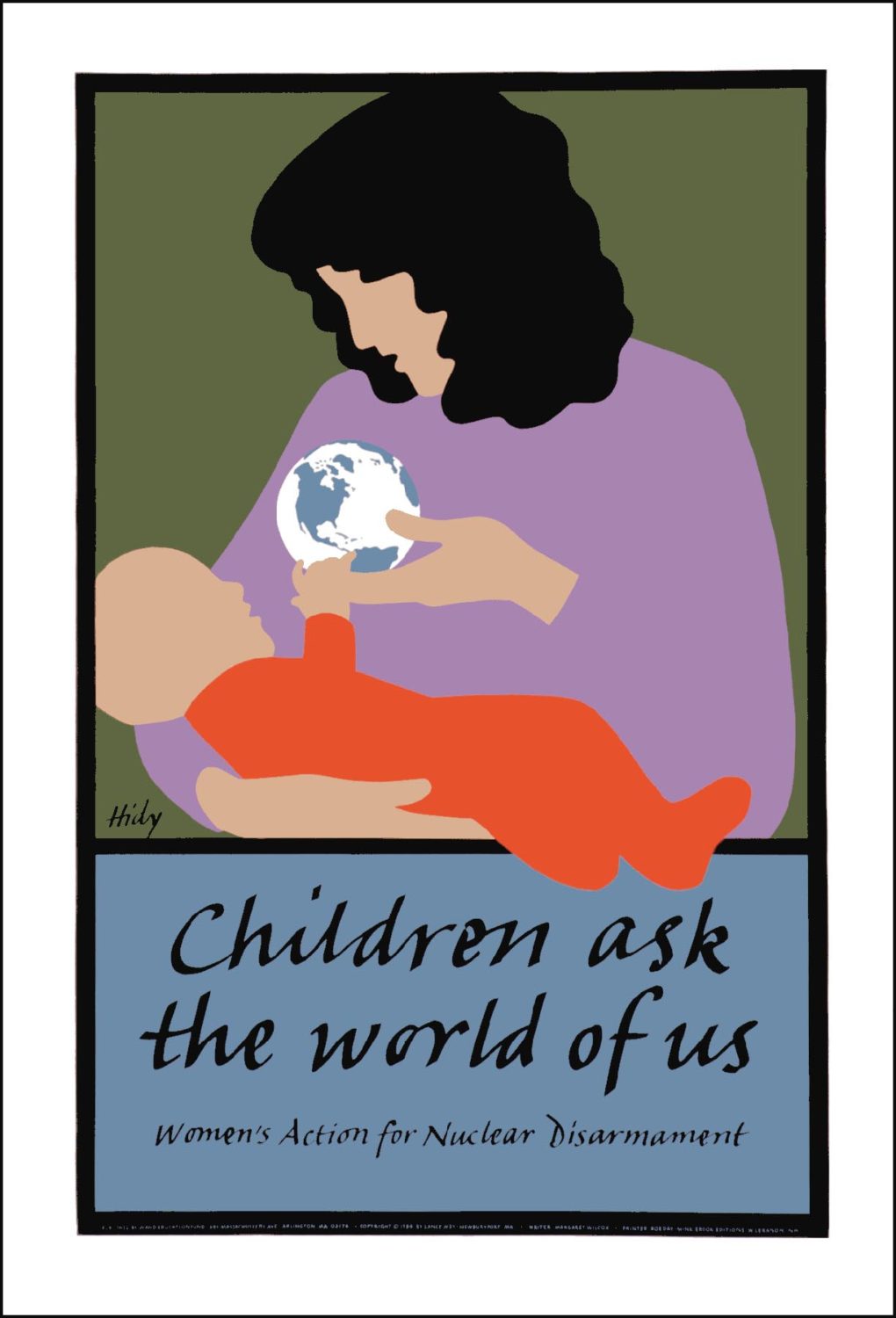
A month or so after my daughter was born, I took friends upstairs to see her nursery. She didn’t sleep there yet, instead she slept in my arms or in the bassinet next to our bed, but this space was hers. It was painted pale yellow and the rocking chair was softened by a handmade quilt hung over the back. On the wall was the Lance Hidy poster “Children Ask The World Of Us.” The room had, to my new mom heart, the feel of a sanctuary.
The wife was my oldest friend, her husband was a man who kept us laughing with his stories, and they were expecting their first baby soon. He snorted when he spotted the poster, then brought up a conflict that US politicians were blustering about (and covertly messing with) at the time in the Middle East. He said, “We should just nuke them.”
I wanted him and his poisonous opinions out of my baby’s bedroom. I would have been horrified by any human advocating the use of nuclear weapons under any circumstances, but I was even more resoundingly appalled because this man was the son of Middle Eastern immigrants and had recently qualified as a doctor sworn to heal, yet here he was sanctioning the most unspeakable harm. Even while I was sputtering an angry response, I realized he may well have been mocking my pacifism. I hadn’t been quiet about my views or my activism. I even painted onesies with cheery peace slogans under smiling suns which, in retrospect, may have been a bit too earnest as baby gifts for my non-peacenik friends.
My baby girl is grown now but that moment comes back to me in these calamitous times. The memory also brought up a remarkable antidote to nuclear war that was proposed in all seriousness back in 1981 by a man named Roger Fisher.
Fisher had served in WWII, argued cases before the US Supreme Court, worked as a Harvard law professor specializing in negotiation, and co-authored a popular book Getting To Yes. Throughout his career he was deeply committed to peacemaking. For example, he was involved in the Camp David summit that led to an Israeli–Egyptian peace treaty in 1979, helped negotiate the release of US hostages held in Iran in 1981, and later worked directly to end of South Africa’s apartheid rule. Fisher devised negotiation tactics that ensured all parties were fully represented, including a cooperative interest-based negotiation process now commonly used around the world. The man was no slouch in the hard work of creating a more peaceful world.
Then he took on the utter idiocy of nuclear weapons. Writing March’s 1981 issue of The Bulletin of the Atomic Scientists (the entire article is a worthy read) Fisher pointed out that there are no military solutions to the world’s largest problems. “The only means we have available,” Fisher wrote, “is to try to change someone’s mind.” Like any good negotiator, he explains why negotiation must include each side’s interests with full participation in joint problem-solving. And, further, to understand and to care about one another as the only way to lasting peace. His essay includes specific recommendations but my favorite and the most controversial is the following.
There is a person who is required to accompany the president with an attaché case containing the codes needed to authorize firing nuclear weapons. Fisher imagines this person as a young man, perhaps a naval officer named George, who is around the president every day. That person-to-person familiarity is the heart of Fisher’s nuclear deterrence. Because in his proposal, the nuclear codes are not in the case. Here’s how Fisher explains it.
My suggestion was quite simple: Put that needed code number in a little capsule, and then implant that capsule right next to the heart of a volunteer. The volunteer would carry with him a big, heavy butcher knife as he accompanied the President. If ever the President wanted to fire nuclear weapons, the only way he could do so would be for him first, with his own hands, to kill one human being. The President says, ‘George, I’m sorry but tens of millions must die.’ He has to look at someone and realize what death is — what an innocent death is. Blood on the White House carpet. It’s reality brought home.
When I suggested this to friends in the Pentagon they said, “My God, that’s terrible. Having to kill someone would distort the President’s judgment. He might never push the button.”
Exactly.
We have enough nuclear weapons to destroy the world many times over with at least nine countries possessing nuclear weapons. The overall stockpile is lower than it was in the Cold War era but, as the Union of Concerned Scientists note, “the warheads on just one US nuclear-armed submarine have seven times the destructive power of all the bombs dropped during World War II, including the two atomic bombs dropped on Japan.” And global spending on nuclear weapons increased by thirteen percent in 2023. The strategy of mutual assured destruction means a nuclear attack by one superpower will be met with an overwhelming nuclear counterattack by the target country — leading to complete destruction of both countries and, presumably, the rest of the world. Most of the deployed nuclear-armed weapons held by the US are maintained on prompt-launch status.
And now the unspeakable is being spoken.
Israel’s Heritage Minister Amihai Eliyahu said in a radio interview from last November that a nuclear option would be “one way” to deal with Gaza. He was suspended from his position, but his remarks may indicate what the far-right ruling coalition considers an option. Mr. Eliyahu repeated his call for striking the Gaza Strip with nuclear weapons again in January. More recently, Senator Lindsey Graham spoke on Meet The Press where he repeatedly brought up the US’s use of nuclear weapons against civilian populations in Japan during WWII.
Graham said. “That was the right decision.”
He added, “Give Israel the bombs they need to end the war. They can’t afford to lose.”
Later in the interview he doubled down. “Why is it OK for America to drop two nuclear bombs on Hiroshima and Nagasaki to end their existential threat war? Why was it OK for us to do that? I thought it was OK.”
“So, Israel, do whatever you have to do to survive as a Jewish state. Whatever you have to do.”
Representative Tim Walberg of Michigan offered similar remarks during a town hall held in March. Israel’s strategy in Gaza, he said, “should be like Nagasaki and Hiroshima. Get it over quick,” And now NC representative Greg Murphy suggests Israel would be justified in using nuclear weapons against Palestinians.
This sort of “fix a far-off problem with annihilation” is beyond genocidal speech. It’s ecocide speech. We are all inhabitants of the same nursery, Earth. Let it be a sanctuary.

 Laura Grace Weldon